New Semester
Started
Get
50% OFF
Study Help!
--h --m --s
Claim Now
Question Answers
Textbooks
Find textbooks, questions and answers
Oops, something went wrong!
Change your search query and then try again
S
Books
FREE
Study Help
Expert Questions
Accounting
General Management
Mathematics
Finance
Organizational Behaviour
Law
Physics
Operating System
Management Leadership
Sociology
Programming
Marketing
Database
Computer Network
Economics
Textbooks Solutions
Accounting
Managerial Accounting
Management Leadership
Cost Accounting
Statistics
Business Law
Corporate Finance
Finance
Economics
Auditing
Tutors
Online Tutors
Find a Tutor
Hire a Tutor
Become a Tutor
AI Tutor
AI Study Planner
NEW
Sell Books
Search
Search
Sign In
Register
study help
sciences
introductory chemistry concepts
Introductory Chemistry Concepts And Critical Thinking 7th Edition Charles Corwin - Solutions
Write the chemical formula for the following binary compounds given their constituent ions.(a) Lithium chloride, Li+ and Cl–(b) Silver oxide, Ag+ and O2–(c) Chromium(III) iodide, Cr3+ and I–(d) Tin(II) nitride, Sn2+ and N3–.
Which of the following acids is named nonmetal stem + @ic acid: HCl(aq), HClO3(aq), HClO2(aq)?
Provide the formula for each of the following binary ionic compounds.(a) Stannic nitrite (b) Ferrous acetate.
According to the anion suffix, which of the following is a ternary ionic compound: potassium nitride, potassium nitrate, or potassium nitrite?
Write the chemical formula for the following ternary compounds given their constituent ions.(a) Potassium nitrate, K+ and NO3–(b) Ammonium dichromate, NH4+ and Cr2O72–(c) Copper (I) carbonate, Cu+ and CO32–(d) Manganese(II) sulfite, Mn2+ and SO32–.
Supply a systematic name for the following ternary ionic compounds.(a) Cu(NO3)2 (b) Co(MnO4)2.
Which of the following acids is named nonmetal stem + @ous acid: HCl(aq), HClO3(aq), HClO2(aq)?
Give the IUPAC systematic name for each of the following binary molecular compounds:(a) Cl2O5 (b) P4S10.
Which of the following is named using Greek prefixes to specify the number of atoms of each element: Fe2O3 or P2O3?
Write the chemical formula for the following ternary compounds given their constituent ions.(a) sodium acetate, Na+ and C2H3O2–(b) aluminum sulfite, Al3+ and SO32–(c) mercury(II) cyanide, Hg2+ and CN–(d) chromium(III) hypochlorite, Cr3+ and ClO–.
Give the IUPAC systematic name for each of the following binary molecular compounds:(a) IF6 (b) Br3O8.
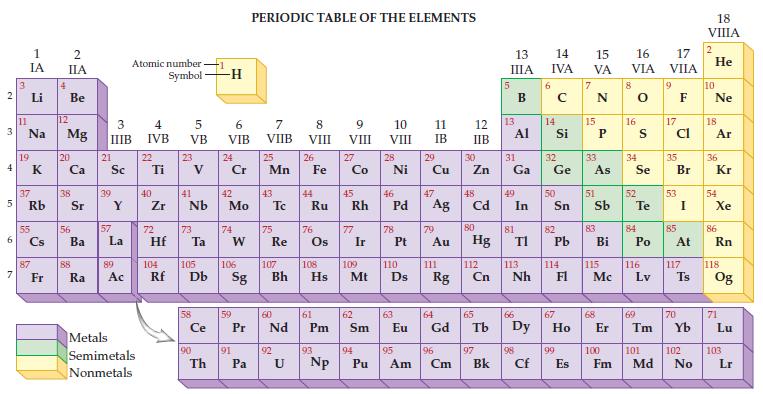
Examine the periodic table and propose an explanation why copper ions can have a charge of either 1+ or 2+.
Provide the formula for each of the following binary molecular compounds:(a) Diphosphorus tetraiodide (b) Sulfur hexafluoride.
Which of the following is a binary molecular compound: magnesium oxide or nitrogen oxide?
Write the chemical formula for the following ternary compounds given their constituent ions.(a) Strontium nitrite, Sr2+ and NO2–(b) Zinc permanganate, Zn2+ and MnO4–(c) Calcium chromate, Ca2+ and CrO42–(d) Nickel(II) perchlorate, Ni2+ and ClO4–.
Provide the formula for each of the following binary molecular compounds:(a) Diphosphorus pentasulfide (b) Tetraiodine nonaoxide.
Examine the periodic table and propose an explanation why iron ions can have a charge of either 2+ or 3+.
Give the IUPAC systematic name for H2S(aq).
Which of the following acids is named using a hydro– prefix: HBr(aq), HBrO2(aq), HBrO3(aq)?
Write the chemical formula for the following ternary compounds given their constituent ions.(a) Lead(IV) sulfate, Pb4+ and SO42–(b) Tin(II) chlorite, Sn2+ and ClO2–(c) Cobalt(II) hydroxide, Co2+ and OH–(d) Mercury(I) phosphate, Hg22+ and PO43–.
Give the IUPAC systematic name for HF(aq), a binary acid.
Chalk and marble are both examples of limestone, CaCO3. Why is chalk a soft substance, while marble is a hard mineral?
Give the IUPAC systematic name for H3PO(aq), a ternary oxyacid.
Which of the following acids is named nonmetal stem plus –ic acid: HBr(aq), HBrO2(aq), HBrO3(aq)?
Supply a systematic name for each of the following binary ionic compounds.(a) MgO (b) ZnO (c) CdO(d) BaO.
Give the IUPAC systematic name for H3PO4(aq), a ternary oxyacid.
Supply a systematic name for each of the following binary ionic compounds.(a) LiBr (b) SrI2 (c) Na3N (d) AlF3.
Supply a Stock system name for each of the following binary ionic compounds.(a) CoO (b) FeO (c) HgO (d) SnO.
Supply a Stock system name for each of the following binary ionic compounds.(a) MnCl2 (b) NiF2 (c) SnBr2 (d) CrP.
Provide the formula for each of the following binary ionic compounds.(a) Copper(I) oxide (b) Iron(II) nitride (c) Mercury(II) chloride (d) Lead(IV) sulfide.
Provide the formula for each of the following binary ionic compounds.(a) Copper(II) sulfide (b) Iron(III) phosphide (c) Mercury(I) iodide (d) Lead(II) oxide.
Predict the chemical formula for each of the following binary ionic compounds given the formula of sodium chloride, NaCl.(a) Rubidium chloride (b) Sodium bromide.
Predict the chemical formula for each of the following binary ionic compounds given the formula of calcium oxide, CaO.(a) Beryllium oxide (b) Calcium selenide.
Predict the chemical formula for each of the following binary ionic compounds given the formula of aluminum nitride, AlN.(a) Gallium nitride (b) Aluminum arsenide.
Predict the chemical formula for each of the following binary ionic compounds given the formula of titanium oxide, TiO2.(a) Zirconium oxide (b) Titanium sulfide.
Supply a systematic name for each of the following ternary ionic compounds.(a) LiMnO4 (b) Sr(ClO2)2 (c) BaCO3 (d) (NH4)2Cr2O7.
Supply a systematic name for each of the following ternary ionic compounds.(a) KClO3 (b) Mg(NO3)2 (c) Ag2SO4 (d) Al2(CrO4)3.
Supply a Stock system name for each of the following ternary ionic compounds.(a) CuSO4 (b) FeCrO4 (c) Hg(NO2)2 (d) Pb(C2H3O2)2.
Supply a Stock system name for each of the following ternary ionic compounds.(a) Cu2SO4 (b) Fe2(CrO4)3 (c) Hg2(NO2)2 (d) Pb(C2H3O2)4.
Provide the formula for each of the following ternary ionic compounds.(a) Manganese(II) acetate (b) Lead(IV) chlorite (c) Tin(II) phosphate (d) Iron(III) hypochlorite.
Provide the formula for each of the following ternary ionic compounds.(a) Chromium(III) chlorate (b) Lead(II) sulfite (c) Tin(IV) carbonate (d) Iron(II) chromate.
Provide the formula for each of the following binary ionic compounds:(a) Lithium fluoride (b) Lead(II) sulfide.
What is the systematic name for aqueous H2SO4?(a) Hydrogen sulfide (b) Hydrosulfuric acid(c) Sulfurous acid (d) Sulfuric acid(e) None of the above.
Provide the formula for the following binary ionic compounds:(a) Copper(II) iodide (b) Mercury(II) oxide.
Predict the formula for potassium iodide, given the formula of sodium fluoride, NaF.
Supply a systematic name for each of the following oxyanions.(a) NO3– (b) NO2–(c) ClO3– (d) ClO2–.
Predict the chemical formula for each of the following binary compounds given the formula of aluminum oxide, Al2O3:(a) Gallium oxide (b) Aluminum sulfide.
Predict the chemical formula for each of the following binary compounds given the formula of magnesium chloride, MgCl2:(a) Radium chloride (b) Magnesium fluoride.
What is the ionic charge on a metal (M), given the formula of the carbonate, MCO3?
Supply a systematic name for each of the following oxyanions.(a) CO32–(b) HCO3–(c) SO42–(d) HSO4–.
Determine the ionic charge for iron in Fe3(PO4)2.
Supply a systematic name for the following binary ionic compounds.(a) SnF2 (b) FeCl3.
State whether the following describes a physical or a chemical change: changing chemical formula, but not physical state.
Can atoms of different elements have the same atomic number?
Which of the following of Dalton’s proposals is still valid?(a) An element is composed of tiny particles called atoms.(b) Atoms of different elements combine to form compounds.(c) Compounds contain atoms in small whole number ratios.(d) All of the above (e) None of the above.
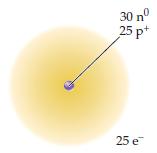
Given the following diagram, indicate the nucleus using atomic notation. 30 n 25 pt 25 e™
Given the atomic notation for the following atoms, draw a diagram showing the arrangement of protons, neutrons, and electrons.(a) 199F (b) 10947Ag.
Can atoms of different elements have the same mass number?
Which Greek philosopher argued that matter is continuous in 350 B.C.?
What do the raisins represent in the plum pudding model of the atom? (a) Electrons (b) Neutrons(c) Protons (d) Nuclei(e) None of the above.
State the number of protons and the number of neutrons in an atom of each of the following isotopes.(a) 3717Cl (b) Mercury-202.
State the number of protons and the number of neutrons in an atom of each of the following isotopes.(a) 12050Sn (b) Uranium-238.
A bag of marbles has 75 large marbles with a mass of 2.00 g each, and 25 small marbles with a mass of 1.00 g each. Calculate (a) The simple average mass,(b) The weighted average mass of the marble collection.
State three scientists whose work Dalton used to support the atomic theory.
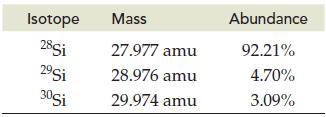
Silicon is the second most abundant element in Earth’s crust. Calculate the atomic mass of silicon given the following data for its three natural isotopes: Isotope 28Si 29Si 30Si Mass 27.977 amu 28.976 amu 29.974 amu Abundance 92.21% 4.70% 3.09%
Which subatomic particle has a relative charge of +1 and a mass of 1 amu?(a) Alpha (b) Electron(c) Neutron (d) Proton(e) None of the above.
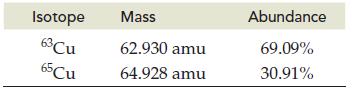
Calculate the atomic mass of copper given the following data: Isotope 63 Cu 65Cu Mass 62.930 amu 64.928 amu Abundance 69.09% 30.91%
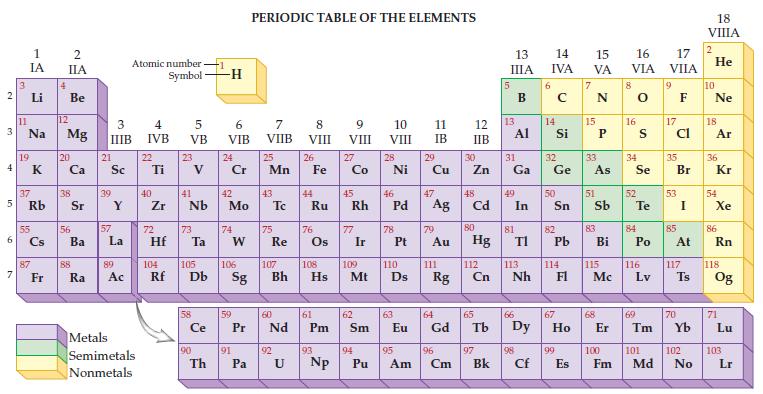
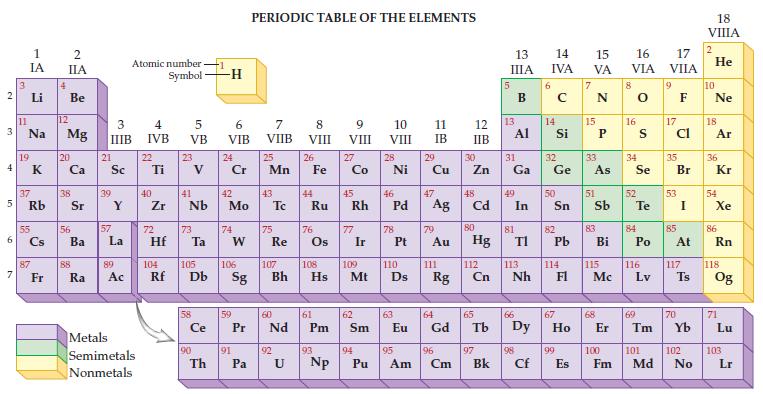
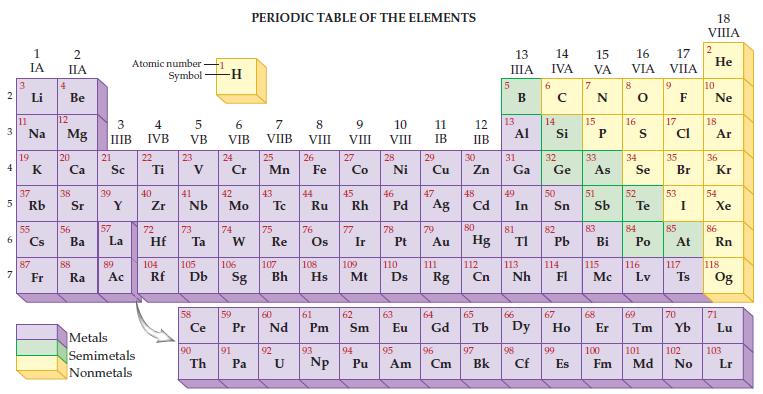
Refer to the periodic table on the inside cover of this text and determine the atomic number and atomic mass for iron. 2 3 4 5 6 7 3 11 1 IA Li Na 19 37 Rb 55 87 Fr 4 2 IIA Be 12 Mg 20 38 56 Ba 88 Ra 3 IIIB 21 Sc 39 57 Y La 89 Ac Atomic
Refer to the periodic table and determine the atomic number and atomic mass for sulfur. 2 3 4 5 6 7 3 11 1 IA Li Na 19 37 Rb 55 87 Fr 4 2 IIA Be 12 Mg 20 38 56 Ba 88 Ra 3 IIIB 21 Sc 39 57 Y La 89 Ac Atomic number Symbol Metals Semimetals Nonmetals 4 IVB 22 Ti 40 Zr 5 VB 72 23 41 Nb 73 Hf
Sodium has only one stable isotope. What is the mass of the Na-23 stable isotope?
State two experimental laws Dalton used to support the atomic theory.
How many neutrons are in the nucleus of an atom of cobalt-60? (a) 27 (b) 33(c) 60 (d) 87(e) None of the above.
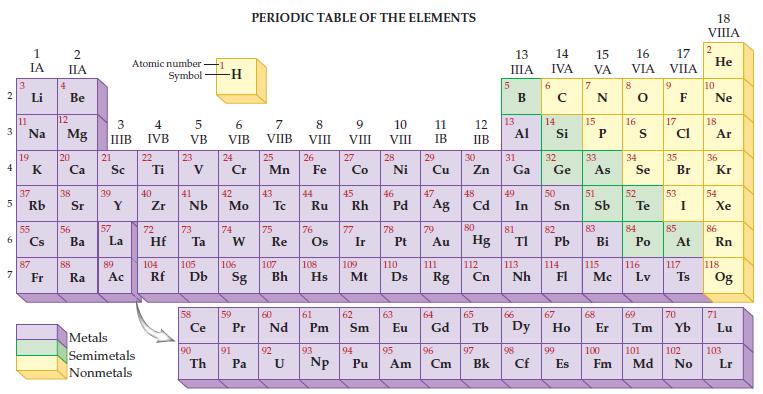
Refer to the periodic table on the inside cover of this text and determine the atomic number and mass number for element 92, uranium. 2 3 4 5 6 7 3 11 1 IA Li Na 19 37 Rb 55 87 Fr 4 2 IIA Be 12 Mg 20 38 56 Ba 88 Ra 3 IIIB 21 Sc 39 57 Y La 89 Ac Atomic
Refer to the periodic table and determine the atomic number and mass number listed for element 61, promethium. 2 3 4 5 6 7 3 11 1 IA Li Na 19 37 Rb 55 87 Fr 4 2 IIA Be 12 Mg 20 38 56 Ba 88 Ra 3 IIIB 21 Sc 39 57 Y La 89 Ac Atomic
Which of the following is never a whole number value: atomic number, atomic mass, or mass number?
Which of the following of Dalton’s proposals proved to be invalid?(a) Atoms of different elements combine to form compounds.(b) Atoms can combine in small whole number ratios.(c) Atoms are indivisible.
Element X has two natural isotopes: X-63 (62.940 amu) and X-65 (64.928 amu). Calculate the atomic mass of element X given the abundance of X-63 is 69.17%.(a) 63.55 amu (b) 64.00 amu(c) 64.32 amu (d) 107.85 amu(e) 108.46 amu.
The energy of light (increases/decreases) as the wavelength increases. The energy of light (increases/decreases) as the frequency increases.
Which of the following of Dalton’s proposals proved to be invalid?(a) Atoms are indestructible.(b) Atoms of the same element are identical.(c) Atoms can combine in more than one whole number ratio.
Which of the following colors of light has the highest energy?(a) Blue (b) Green(c) Red (d) Violet(e) Yellow.
Considering blue light and yellow light, which has the (a) Longer wavelength? (b) Higher frequency?(c) Higher energy?
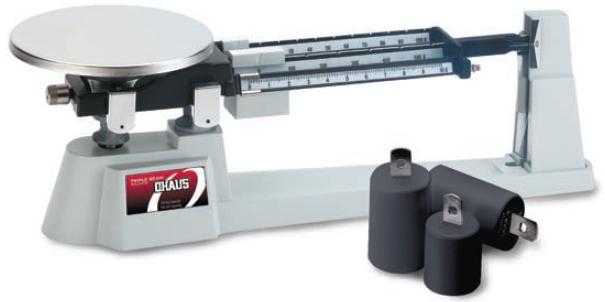
Which of the following measurements corresponds to the graduated cylinder shown in Figure PSS.3 having an uncertainty of ±0.5 mL?(a) 25 mL (b) 25.0 mL (c) 25.5 mL (d) 25.50 mL.Figure PSS.3(a)(b)(c) CHAUS
Which of the following is a positive reason for learning chemistry?(a) Chemistry is relevant to daily life (b) Chemistry offers career opportunities (c) Chemistry studies interesting topics (d) Chemistry benefits society (e) All of the above.
Which of the following measurements corresponds to the buret shown in Figure PSS.3 having an uncertainty of ±0.05 mL?(a) 32.0 mL (b) 32.00 mL (c) 32.05 mL (d) 32.58 mL.Figure PSS.3(a)(b)(c) CHAUS
What is the maximum number of electrons that can occupy the 3d energy sublevel?(a) 2 (b) 6(c) 8 (d) 14(e) None of the above.
What is the maximum number of electrons that can occupy the fourth energy level?
The energy difference between sublevels (increases/decreases) moving away from the nucleus.
What is the simplest positive particle in an atom?
Refer to the periodic table and state whether Cr or Mn has more electrons in the outermost d sublevel. 2 3 4 5 6 7 3 11 1 IA Li Na 19 37 Rb 55 87 Fr 4 2 IIA Be 12 Mg 20 38 56 Ba 88 Ra 3 IIIB 21 Sc 39 57 Y La 89 Ac Atomic
According to increasing energy, what is the next energy sublevel after each of the following sublevels?(a) 3p (b) 4d.
What is the electron configuration for an atom of manganese?(a) 1s2 2s2 2p6 3s2 3p6 3d5 (b) 1s2 2s2 2p6 3s2 3p6 4s2 3d5 (c) 1s2 2s2 2p6 3s2 3p6 4s2 4p5 (d) 1s2 2s2 2p6 3s2 3p6 4s2 4d5 (e) None of the above.
Which sublevel gains electrons after each of the following sublevels is filled?(a) 2s (b) 5p.
What is the relative charge on an electron?
Write the predicted electron configuration for each of the following elements:(a) F (b) Sr.
Which of the following is true for both an orbit and an orbital?(a) An orbit and an orbital always contain two electrons.(b) An orbit and an orbital can be described as elliptical.(c) An orbit and an orbital represent an electron boundary.(d) An orbit and an orbital represent a fixed energy
Write the predicted electron configuration for each of the following elements:(a) Argon (b) Cadmium.
Which of the following statements are true according to the quantum mechanical model of the atom?(a) Orbitals represent quantum energy levels for electrons.(b) Orbitals represent probability boundaries for electrons.(c) Orbitals can have different shapes.
What is the relative charge on a proton?
Considering infrared light and ultraviolet light, which has the (a) Longer wavelength? (b) Higher frequency?(c) Higher energy?
Complete the following quantum analogy: a water wave is to a drop of water, as a light wave is to a ______.
Showing 2000 - 2100
of 2636
First
13
14
15
16
17
18
19
20
21
22
23
24
25
26
27
Step by Step Answers

 Get 50% OFF
Claim Now
Get 50% OFF
Claim Now