New Semester
Started
Get
50% OFF
Study Help!
--h --m --s
Claim Now
Question Answers
Textbooks
Find textbooks, questions and answers
Oops, something went wrong!
Change your search query and then try again
S
Books
FREE
Study Help
Expert Questions
Accounting
General Management
Mathematics
Finance
Organizational Behaviour
Law
Physics
Operating System
Management Leadership
Sociology
Programming
Marketing
Database
Computer Network
Economics
Textbooks Solutions
Accounting
Managerial Accounting
Management Leadership
Cost Accounting
Statistics
Business Law
Corporate Finance
Finance
Economics
Auditing
Tutors
Online Tutors
Find a Tutor
Hire a Tutor
Become a Tutor
AI Tutor
AI Study Planner
NEW
Sell Books
Search
Search
Sign In
Register
study help
business
marketing
Advertising Promotion And Other Aspects Of Integrated Marketing Communications 9th Edition Terence Shimp, Craig Andrews - Solutions
With the following data, fill in the empty blanks.Total ’000A ’000B% AcrossC% DownDIndexAll Adults18–2425–34218,28928,09839,48535,1446,28510,50916.1100.0100
Based exclusively on the data in question 13, if you were an advertiser deciding whether to advertise your brand just to people aged 18 to 24, just to the 25-to-34 age group, or to both age groups, what would be your decision? Provide a detailed rationale for your decision.
Discuss how multitasking among TV viewing (e.g., smartphones, social media) has affected how people watch program content. How can this best be measured?
Assume you are brand manager for a product line of book bags designed for college students. These bags come in each university’s school colors and are imprinted with the school’s mascot. Assume you have $5 million to invest in a two-month magazine advertising campaign (July and August). What
Assume you are a manufacturer of various jewelry items. Graduation rings for high school students are among the most important items in your product line. You are in the process of developing a media strategy aimed specifically at high school students. With an annual budget of $10 million, what
Examine a copy of the most recent Spot Radio Rates and Data available in your library and compare the advertising rates for three or four of the radio stations in your hometown or university community.
Pick your favorite clothing store in your university community (or hometown), and justify the choice of one radio station that the clothing store should select for its radio advertising. Do not feel constrained by what the clothing store may be doing already; focus instead on what you think is most
Magazine A is read by 11,000,000 people and costs $52,000 for a full-page, four-color advertisement. Magazine B reaches 15,000,000 readers and costs $68,000 for a full-page, four-color advertisement. Holding all other factors constant, in which magazine would you choose to advertise?
Radio is the only major medium that is nonvisual. Is this a major disadvantage? Thoroughly justify your response.
In your opinion, will portable digital-audio players (e.g., Apple’s iPod) eventually replace radio?
As noted in the text, some observers have gone so far as to claim that traditional advertising is on its deathbed and will eventually be supplanted by online advertising. What are your views on this?
Behavioral targeting was characterized as search engine advertising on steroids. Explain what the practitioner who used this clever expression had in mind.
From the perspective of an advertiser for a low-involvement packaged goods product such as cereal, compare and contrast the strengths and weaknesses of the two forms of search engine advertising: keyword-matching versus content-targeted advertising.
As noted in the text, some observers have gone so far as to claim that traditional advertising is on its deathbed and will eventually be supplanted by online advertising. What are your views on this? Discuss.
The text described the Internet user as being in a “leaning forward” mind-set compared with, say, the TV viewer who is “leaning back.” Explain what this means and why the distinction is advantageous or problematic for online advertisers.
Can banner ads be effective if less than 0.3 percent of all people click through them?
Do you believe that online companies’ use of cookies invades your privacy? Would you favor legislation that prevents the use of this technology? If such a law were passed, what would be the downside from the consumer’s perspective?
The following set of questions was mentioned in the chapter in reference to the Nike logo on Kobe Bryant’s basketball shoes or the University of Oregon football uniforms: Does it make you more likely to buy some of the company’s products? If so, would you admit it in a survey? Would you admit
How would you go about advertising on Facebook? Twitter? Other social media? Compare how this differs from other traditional media (e.g., television, radio, magazines, newspapers).
Explain the differences among direct marketing, direct-response advertising, direct mail, and direct selling.
Assume you are a direct marketer of a line of merchandise imprinted with the logos of major universities. These items are targeted to the fans and supporters of university athletic programs. Detail how you would compile an appropriate mailing list, one that would reach people who are most likely to
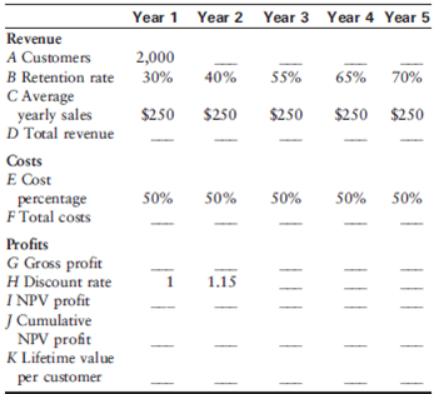
Following is a lifetime-value analysis framework similar to that presented in the chapter. Perform the calculations necessary to complete row K:
Assume that, 10 years after graduating from your university or college, you are appointed to your school’s Athletics Oversight Committee. The chair of the committee suggests that it would be useful to know the lifetime value of the average season-ticket holder. Describe how you might go about
What are your views on advergaming? Respond by commenting about this advertising practice both from the perspective of advertisers and from the viewpoint of game players.
Virtually any space is a potential medium for a marketer’s advertisement. Identify several novel forms of advertising media that go beyond the “other” media described in this chapter. Describe the target for each of these novel media, and offer an explanation as to why, in your opinion, each
Why is target audience selection the critical first step in formulating a media strategy?
A TV program has a rating of 17.6. With approximately 114.7 million television households in the United States as of 2012, what is that program’s CPM if a 30-second commercial costs $600,000? Now assume that an advertiser’s target audience consists only of people aged 25 to 54, which constitute
Which is more important for an advertiser: maximizing reach or maximizing frequency? Explain in detail.
Following are the ratings and number of ad insertions on five cable TV programs designated as C1 through C5: C1 (rating = 7; insertions = 6); C2 (rating = 4; insertions = 12); C3 (rating = 3; insertions = 20); C4 (rating = 5; insertions = 10); C5 (rating = 6; insertions = 15). How many GRPs would
Assume that in Canada there are 14 million TV households. A popular TV program, Hockey Night in Canada, aired at 6 p.m. and had a rating of 5.7 and a 10 share. At the 6 p.m. airtime, how many TV sets were tuned into this or another program? (Hint: Ratings are based on total households, whereas
Compare and contrast TRPs and GRPs as media selection criteria.
Contrast the term reach with its related terms net coverage and unduplicated audience.
A television advertising schedule produced the following vehicle frequency distribution:fPercentage fPercentage f +031.5100.019.368.527.159.236.052.145.246.154.640.964.136.373.732.283.428.593.125.110+22.022.0a. What is the reach for this advertising schedule?b. What is the effective
Assume that the TV advertising schedule in Question 4 cost $2 million and generated 240 million gross impressions. What are the CPM and CPP?
With reference to the three-exposure hypothesis, explain the difference between three exposures to an advertising message versus three exposures to an advertising vehicle.
When an advertiser uses the latter, what implicit assumption is that advertiser making?
Describe in your own words the fundamental logic underlying the principle of recency (or what also is referred to as the shelf-space model of advertising). Is this model always the best model to apply in setting media allocations over time?
It is desirable that the measurement of advertising effectiveness focuses on sales response rather than on some precursor to sales, yet measuring sales response to advertising is typically difficult. What complicates the measurement of sales response to advertising? To answer this question, please
Television commercials are tested in various stages of completion, including storyboards, animatics, photomatics, ripamatics, liveamatics, and finished commercials (see IMC Focus). What reservations might you have concerning the ability to project results from testing pre-finished commercials to
What are your thoughts about the value (or lack of value) of using measures of physiological responses, such as the galvanometer?
Compare and contrast the Ipsos ASI Next*TV® measure with comScore ARS’s Share of Choice method.
In the context of the discussion of single-source data, explain the difference between weight tests and copy tests. Illustrate your understanding of the difference between these two types of tests by designing a hypothetical weight test and then a copy test for the same brand.
With reference to Frito-Lay’s copy tests in Table 17.3, the results reveal that of the 23 commercials tested, only 57 percent of the tests generated significant differences in sales between the split panels tested. Assume that Frito-Lay’s results are applicable to television advertising in
Offer an explanation as to why, in general, increasing advertising weight is an insufficient means of increasing brand sales.
Explain your understanding of why in the case of mature products with familiar brands greater advertising weight is effective in increasing sales only when affective cues are used in advertising the brand.
In your opinion, why do commercials for familiar brands with strong equities wear out less rapidly than is the case for unfamiliar brands?
PACT principle 2 states that a good copytesting system should establish how results will be used in advance of each copy test. Explain the specific meaning and importance of this copytesting principle. Construct illustrations of an anticipated result lacking a sufficient action standard and one
What’s the distinction between pre- and posttesting forms of advertising research? Which in your opinion is more important? Be sure to justify your response.
The Bruzzone test is based on a measure of recognition in comparison to day-after-recall testing, which, of course, is based on a recall measure. Present an argument as to why Bruzzone recognition measurement might be more appropriate than recall measurement in attempting to determine the
If you were an account executive in an advertising agency, what would you tell clients to convince them to use (or not to use) the GfK MRI Starch Ad Readership Studies?
A test of television advertising effectiveness performed by BehaviorScan will cost you, as brand manager of a new brand of cereal, over $250,000. Why might this be a prudent investment in comparison to spending $50,000 to perform an awareness study?
Assume that several years from now, after you have graduated college and begun a career, you open your mail one day and find a letter from SymphonyIRI Group requesting you to become a BehaviorScan panel member. Would you have any reservations about agreeing to do this? Assume that the letter is
The term promotional inducement has been suggested as an alternative to sales promotion. Explain why this term is more descriptive than the established one.
Assume you are the marketing manager of a company that manufacturers a line of paper products (tissues, napkins, etc.). Your current market share is 7 percent, and you are considering offering retailers an attractive bill-back allowance for giving your brand special display spaces. Comment on this
In your own words, explain the practices and problems of forward buying and diverting. Also, describe the advantages and disadvantages of bill-and-hold programs.
Assume you are a buyer for a large supermarket chain and that you have been asked to speak to a group of marketing students at a nearby university. During the question-and-answer session following your comments, a student makes the following statement: “My father works for a grocery product
Explain why selling private brands often enables large retail chains to pocket trade deals instead of passing their reduced costs along to consumers in the form of lower product prices.
In your own words, explain why EDLP(M) pricing diminishes forward buying and diverting. Can EDLP(M) be challenging to implement?
From your perspective, discuss how pay-for-performance programs, or scan-downs, would, if widely implemented, virtually eliminate forward buying and diverting.
Describe the factors that have accounted for sales promotion’s rapid growth. Do you expect a continual increase in the use of sales promotion throughout the following decade?
Why, in your opinion, is the Internet a good medium for offering sales promotions to consumers? How has social media helped to provide sales promotions to consumers?
Explain in your own words the meaning of push- versus pull-oriented promotional strategies. Using an illustration of a well-known supermarket brand of your choice, explain which elements of this brand’s marcom mix embody push and which embody pull.
Assume you are the chief marketing officer for a large, well-known CPG company (e.g., P&G, Unilever, or Johnson & Johnson). What steps might you take to restore a balance of power favoring your company in its relations with retailers?
Are promotions able to reverse a brand’s temporary sales decline and/or a permanent sales decline? Be specific.
How can a manufacturer’s use of trade- and consumer-oriented promotions generate enthusiasm and stimulate improved performance from the sales force?
Generalization 5 in the chapter claimed that higher-market-share brands are less deal elastic. Construct a realistic example to illustrate your understanding of this empirical generalization.
Generalization 8 asserted that promotions in one product category affect sales of brands in complementary and competitive categories. Tostitos tortilla chips were used as an example of this generalization. Provide examples of two additional brands and the complementary and competitive product
Why are immediate (versus delayed) rewards more effective in inducing the consumer behaviors desired by a brand marketer? Use a specific, concrete illustration from your own experience to support your answer.
Assume you are the brand manager of Mountain State Bottled Water. This new brand competes in a product category with several well-known brands. Your marketing communications objective is to generate trial purchases among predominantly younger and better-educated consumers. Propose a promotion that
A concluding section of this chapter indicated that promotion agencies have become an increasingly important resource for brand managers in planning and executing promotional programs. One could argue that the fees brand managers pay for the services of promotion agencies might better be spent
One of the major trends in product sampling is selective sampling of targeted groups. Assume you work for a company that has just developed a new candy bar substitute that tastes almost as good as a regular candy bar but has far fewer calories. Marketing research has identified the target market as
Compare and contrast sampling and media-delivered coupons in terms of objectives, consumer impact, and overall roles in marketing communications strategies.
A packaged goods company plans to introduce a new bath soap that differs from competitive soaps by virtue of a distinct new fragrance. Should sampling be used to introduce the product?
A packaged goods company plans to introduce a new bath soap that differs from competitive soaps by virtue of a distinct new fragrance. Should sampling be used to introduce the product? Discuss.
Rather than offering discounts in the form of coupons, why don’t brand managers simply reduce the prices of their brands?
Using Table 19.3 as a rough guide, calculate the full cost per redeemed coupon given the following facts: (1) face value = 75 cents; (2) 20 million coupons distributed at $7 per thousand; (3) redemption rate = 3 percent; (4) handling cost = 8 cents; and (5) misredemption rate = 5 percent.
Go through a Sunday newspaper and select three FSIs. Analyze each in terms of what you think are the marketer’s objectives in using this particular promotion. Do not restrict your chosen FSIs to just those offering coupons.
Present a position on the following statement (voiced by a student who read a previous edition of this textbook): “I can’t understand why in Table 20.1 mail-in premiums are positioned as accomplishing just a trial-impact function. It would seem that this form of promotion also accomplishes
Visit a local grocery store and identify five instances of sales promotions. Describe each promotion and comment on the objectives that promotion was intended to accomplish for the sponsoring brand or for the retailer.
Your company sells hot dogs, bologna, and other processed meats. You wish to offer a self-liquidating premium that would cost consumers approximately $25, would require five proofs of purchase, and would be appropriately themed to your product category during the summer months. Your primary market
What is the purpose of the Federal Trade Commission’s price-off regulations based on the Fair Packaging and Labeling Act?
Compare bonus packs and price-off deals in terms of consumer impact.
How can sales promotion reinforce a brand’s image? Is this a major objective of sales promotion?
Compare sweepstakes, contests, and games in terms of how they function and their relative effectiveness.
Your company sells antifreeze. Sales to consumers take place in a very short period, primarily September through December. You want to tie in a promotion between your product and the product of another company that would bring more visibility to your brand and encourage retailers to provide more
Have you participated in online promotions (e.g., on Facebook), and if so, what has been your experience? Considering just a single online promotion that you participated in and considering yourself representative of the brand’s target market, do you think the promotion accomplished its objective?
What are your thoughts regarding the future of online promotions?
Assume you are the owner of a restaurant in your college or university community. A false rumor about your business has circulated claiming that your head chef has a very contagious disease. Your business is falling off. Explain precisely how you would combat this rumor.
With reference to the discussion of explosive self-generating demand, describe a current movie that would lend itself to buzz-creation and viral marketing efforts and another that would not. What is the difference between these movies that makes only one amenable to such efforts?
Is ambushing unethical or just smart, hard-nosed marketing?
As mentioned in the chapter, event sponsorship expenditures in the United States far exceed investments in cause-oriented sponsorships—basically more than a tenfold differential ($21 billion versus $1.7 billion). Why, in your opinion, is the difference so large? In other words, why do you think
The National Football League (NFL) does not permit players to wear logos of sponsoring brands. For discussion sake, let us assume that the NFL suspends its prohibition of players displaying brand logos on their uniforms. Now suppose that you are the event manager for a brand of your choice and you
What are the advantages of publicity compared with advertising?
Some marketing practitioners consider publicity to be too difficult to control and measure. Evaluate these criticisms.
Some marketing people claim that any news about a brand, negative or positive, is good as longs as it enables the brand to get noticed and encourages people to talk about the brand. Do you agree that negative publicity is always good? Under what conditions might it not be good?
Faced with the rumor about Corona beer being contaminated with urine (see discussion earlier in the chapter), what course of action would you have taken if the Heineken distributor in Reno had not been identified as starting the rumor? In other words, if the source of the rumor were unknown, and it
Suppose you are the manager of a new board shop (e.g., long boards, skateboards, kite boards, snowboards) located in your college or university community that caters primarily to the campus population. Your fledgling store cannot yet afford media advertising, so the promotional burden rests upon
With thoughts of the GM Volt in mind, if you were the brand manager, what would you do to generate explosive self-generating demand?
Select a packaged goods product category and apply the VIEW model to three competitive brands within that category. Define all four components of the model, and explain how each applies to your selected product. Then use the following procedures to weigh each component in the model in terms of your
During past decades, cigarette advertisements were responsible for a very large percentage of all billboard advertising in the United States. The same is true for alcohol. What explanations can you offer for why these products dominated the billboard medium? What is it about consumer behavior
Showing 4000 - 4100
of 13098
First
34
35
36
37
38
39
40
41
42
43
44
45
46
47
48
Last
Step by Step Answers

 Get 50% OFF
Claim Now
Get 50% OFF
Claim Now