New Semester
Started
Get
50% OFF
Study Help!
--h --m --s
Claim Now
Question Answers
Textbooks
Find textbooks, questions and answers
Oops, something went wrong!
Change your search query and then try again
S
Books
FREE
Study Help
Expert Questions
Accounting
General Management
Mathematics
Finance
Organizational Behaviour
Law
Physics
Operating System
Management Leadership
Sociology
Programming
Marketing
Database
Computer Network
Economics
Textbooks Solutions
Accounting
Managerial Accounting
Management Leadership
Cost Accounting
Statistics
Business Law
Corporate Finance
Finance
Economics
Auditing
Tutors
Online Tutors
Find a Tutor
Hire a Tutor
Become a Tutor
AI Tutor
AI Study Planner
NEW
Sell Books
Search
Search
Sign In
Register
study help
engineering
telecommunication engineering
Digital Signal Processing 3rd Edition Jonh G. Proakis, Dimitris G.Manolakis - Solutions
Compute the zero-state response of the system described by the difference equation y(n) + ? y(n - 1) = x(n) + 2x (n - 2) to the input By solving the difference equation recursively
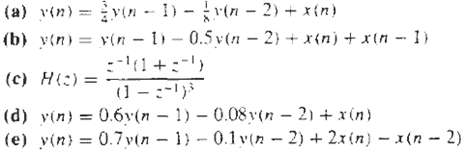
Determine the direct form II realization for each of the following LTI system.
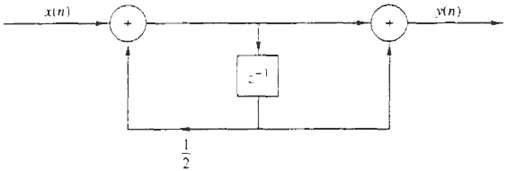
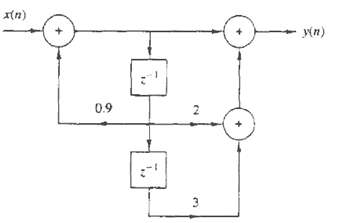
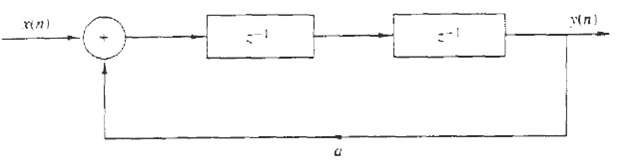
Consider the discrete-time system shown in figure (a) Compute the 10 first samples of its impulse response. (b) Find the input-output relation. (c) Apply the input x(n) = {1, 1, 1, ..} and compute the first 10 samples of the output. (d) Compute the first 10 samples of the output for the input given
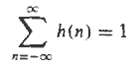
Consider the system describe by the difference equationy(n) = ay(n - 1) + bx(n)(a) Determine b in terms of a so that(b) Compute the zero-state step response s(n) of the system and choose b so that s(?)= 1.(c) Compare the values of b obtained in parts (a) and (b). What did you notice?
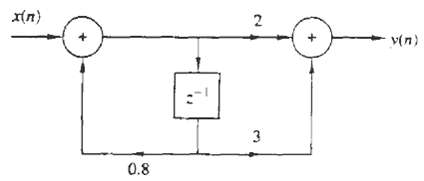
A discrete-time system is realized by the structure shown in figure(a) Determine the impulse response.(b) Determine a realization for its inverse system, that is, the system which produces x(n) as output when y(n) is used as aninput.
Consider the discrete-time system shown in figure (a) Compute the first six values of the impulse response of the system. (b) Compute the first six values of the zero-state step response of the system. (c) Determine an analysis expression for the impulse response of the system
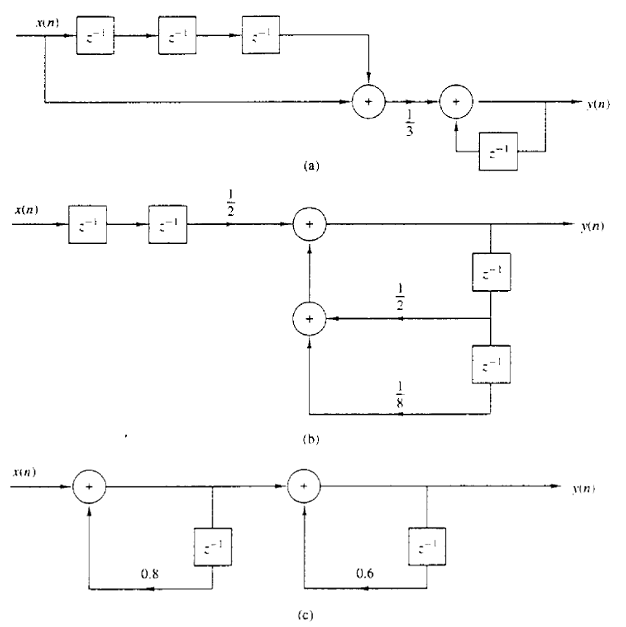
Determine and sketch the impulse response of the following systems for n = 0, 1, . . . , 9.(a) Figure (a)(b) Figure (b)(c) Figure (c)(d) Classify the systems above as FIR or IIR(e) Find an explicit expression for the impulse response of the system in part (c)
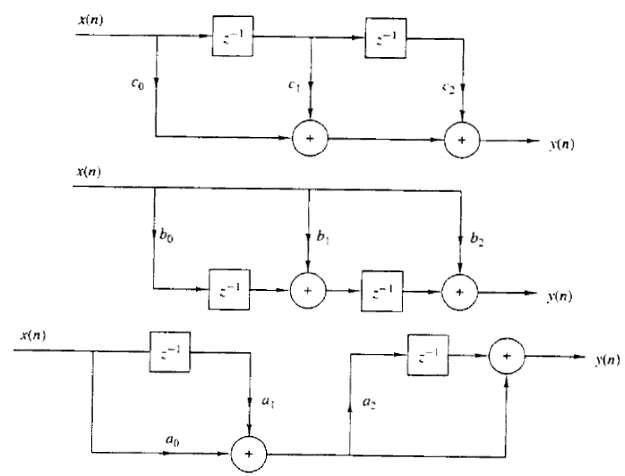
Consider the systems shown in figure(a) Determine and sketch their impulse responses h1(n). h2 (n), and h3(n).(b) Is it possible to choose the coefficients of these systems in such away thath1(n) = h2 (n) =h3(n)
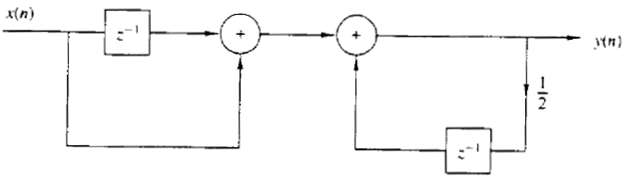
Consider the system shown in figure(a) Determine its impulse response h(n).(b) Shown that h(n) is equal to the convolution of the following signals.h1(n) = ?(n) + ?(n - 1)h2(n) = (1/2)n u (n)
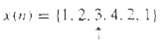
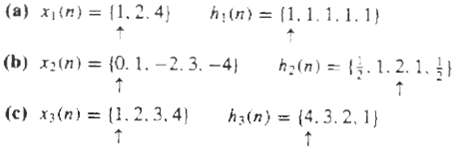
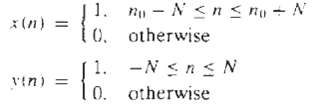
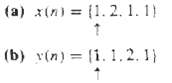
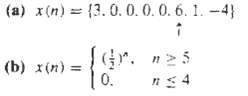
Consider the sketch the convolution yi(n) and correlation ri(n) sequences for the following pairs of signals and comments on the resultobtained.
The zero-state response of a causal LTI system to the input x(n) = {1, 3, 3, 1} is y(n)={1,4,6,4,1}. Determine its impulse response.
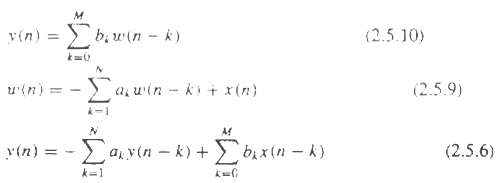
Prove by direct substitution the equivalence of equation (2.5.9) and (2.5.10), which describe the direct form II structure to the relation (2.5.6), which describes the direct form Istructure.
Determine the response y(n), n ≥ 0 of the system described by the second-order difference equation y(n) – 4y(n - 1) + 4y(n - 2) = x(n) – x(n - 1) when the input is x(n) = (–1)nu(n) and the initial conditions are y(–1) = y(–2) = 0.
Determine the impulse response h(n) for the system describe by the second-order difference equationy(n) – 4y(n - 1) + 4y(n - 2) = x(n) – x(n - 1)
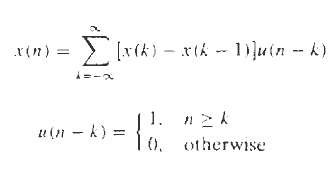
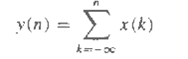
Show that any discrete-time signal x(n) can be expressed as where u(n - k) is a unit step delayed by k units in time, thatis,
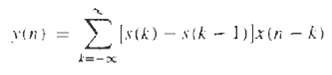
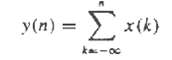
Show that the output of an LTI system can be expressed in terms of its unit step response s(n)asfollows.
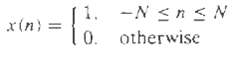
Compute the correlation sequences rxx (l) and rxy (l) for the following signal sequences.
Determine the auto-correlation sequences of the following signals. What is your conclusion?
What is the normalized autocorrelation sequence of the signal x (n) givenby
An audio signal s(t) generated by a loudspeaker is reflected at two different walls with reflection coefficients r1 and r2. The signal x(t) recorded by a microphone close to the loudspeaker, after sampling, isx(n) = s(n) + r1s(n – k1) + r2s(n – k2)where k1 and k2 are the delays of the
Implementation of LTI systems consider the recursive discrete-time system described by the difference equation y(n) = a1y(n - 1) – a2y(n - 2) + b0x(n) where a1 = -0.8, a2 = 0.64 and b0 = 0.866.(a) Write a program to compute and plot the impulse response h(n) of the system for 0 ≤
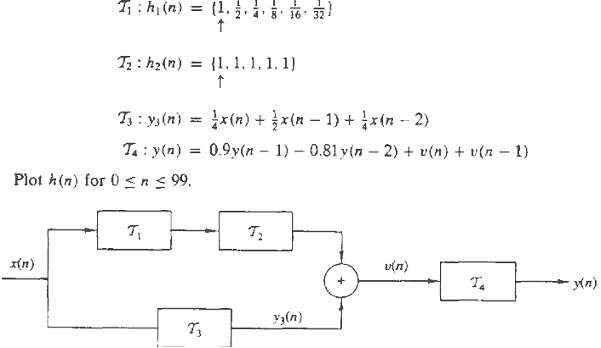
Write a computer program that computes the overall impulse response h(n) of the system shown in figure for 0 ? n ? 99. The system T1, T2, T3 and T4 = specified by
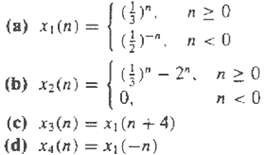
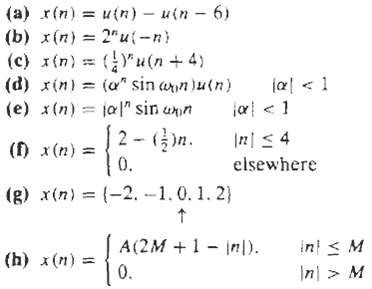
Determine the z-transform of the followingsignals.
Determine the z-transforms of the following signals and sketch the corresponding pole-zero patterns.(a) x(n) = (l + n) u (n)(b) x(n) = (an + a –n) u(n), a real(c) x(n) = (-1)a2-nu(n)(d) x(n) = (nanωsinω0n)u(n)(e) x(n) = (nanωcosω0n)u(n)(f) x(n) = Arncos(ω0n + Ф)u(n). 0 < r < 1(g) x(n)
Determine the z-transforms and sketch the ROC of the followingsignals. 0 n
Determine the z-transform of the following signals.(a) x(n) = n(-1)n u(n)(b) x(n) = n2u (n)(c) x(n) = -nanu(-n - 1)(d) x(n) = (-1)n (cosn/3n) u(n)(e) x(n) = (-1)nu(n)
Determine the regions of convergence of right-sided, left-sided, and finite-duration two-sided sequences.
Express the z-transform of in terms of X(z).
Compute the convolution of the following signals by means of thez-transform.
Use the convolution property to: (a) Express the z-transform of in terms of X (z). (b) Determine the z-transform of x(n) = (n + 1)u(n).
The z-transform X (z) of a real signal x(n) includes a pair of complex-conjugate zeros and a pair of complex-conjugate poles. What happens to these pairs if we multiply x(n) by ejωοn ?
Using long division, determine the inverse z-transform of, if (a) x(n) is causal and (b) x(n) is anti causal. if (a) x(n) is causal and (b) isanticausal.
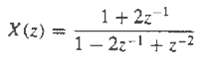
Determine the causal signal x(n) having thez-transform
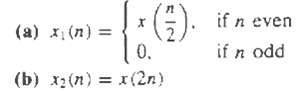
Let x(n) be a sequence with z-transform X(z). Determine, in terms if X(z), the z-transforms of the followingsignals.
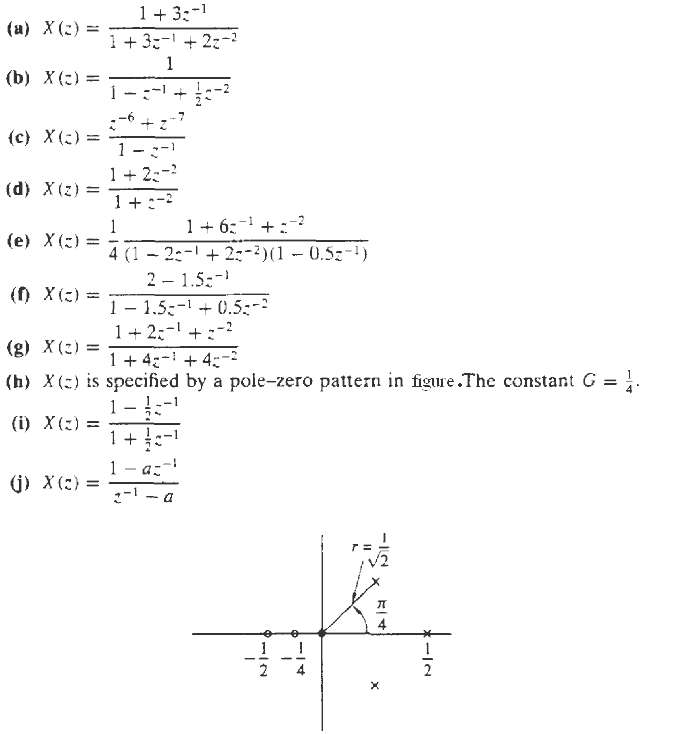
Determine the causal signal x(n) if its z-transform X(z) is givenby:
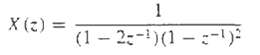
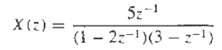
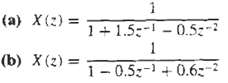
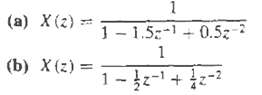
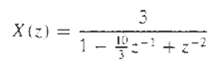
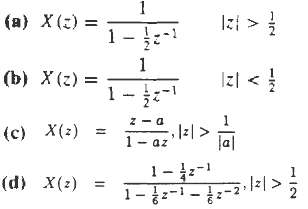
Determine the all possible signals x(n) associated with thez-transform
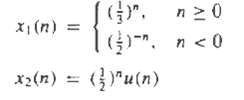
Determine the convolution of the following pairs of signals by means of the z- transform. (a) x1(n) = (1/4)nu(n - 1), x2(n) = [1 + (1/2)n]u(n) (b) x1(n) = u(n), x2 (n) = δ(n) + (1/2)n u(n) (c) x1(n) = (1/2)n u(n), x2(n) = cos πnu(n) (d) x1(n) = nu (n), x2 (n) =2nu(n - 1)
Prove the final value theorem for the one-sided z-transform.
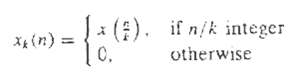
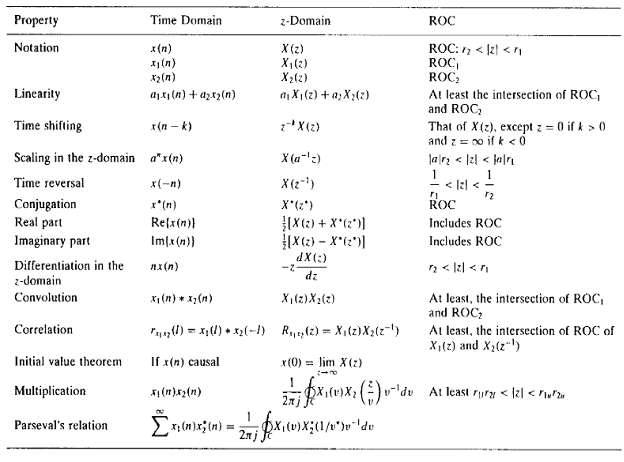
If X(z) is the z-transform of x(n), show that:(a) Z{x*(n)} = Z*(z*)(b) Z{Re[x (n)]} = 1/2[X (z) + X*(z*)](c) Z{Im [x(n)]} = ? [X (z) ?? X*(z*) ](d) IfThenxk(z) = X(zk)(e) Z{ej?0nx (n)} = X(ze-j?0)
By the first differentiating X(z) and then using appropriate properties of the z-transform, determine x(n) for the following transforms.(a) X(z) = log(1 – 2z), |z| < ½ (b) X(z) = log(1 – z-1), |z| > ½
(a) Draw the pole-zero pattern for the signal x1(n) = (rn sin ω0n) u (n) 0 < r < 1 (b) Compute the z-transform X2(z), which corresponds to the pole-zero patterns in part (a). (c) Compare X1(z) with X2(z). Are they indentical? If not, indicate a method to derive X1(z) from the pole-zero
Show that the roots of a polynomial with real coefficients are real of form complex-conjugate pairs. The inverse is not true, in general.
Prove the convolution and correlation properties of the z- transform using only its definition.
Determine the signal x(n) with z-transform X(z) = ez + e1/z |z| ≠ 0
Determine, in closed form, the causal signal x(n) whose z-transforms are given by:Partially check your results by computing x(0), x(1), x(2) and x(?) by an alternative method.
Determine all possible signals that can have the followingz-transforms.
Determine the signal x(n) with z-transform if X(z) converges on the unitcircle.
Prove the complex convolution relation given by(3.2.22).
Prove the conjugation properties and Parseval?s relation for the z-transform given in
In example 3.4.1 we solved for x(n), n < 0, by performing contour integration for each value of n. In general, this procedure proves to be tedious. It can be avoided by making a transforming in the contour integral from z-plane to the w = 1/z plane. Thus a circle of radius R in the z-plane is
Let x(n), 0 ≤ n ≤ N – 1 be a finite-duration sequence, which is also real-valued and even. Show that the zeros of the polynomial X(z) occur in mirror-image pairs about the unit circle. That is, if z = rejө is a zero of X(z), then z = (1/r) ejө is also z zero.
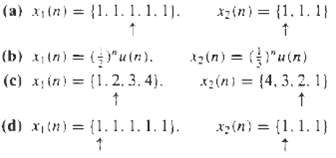
Compute the convolution of the following pair of signals in the time domain and by using the one-sided z-transform Did you obtain the same results by both methods? Explain.
Determine the one-sided z-transform of the constant signal x(n) = 1, -∞ < n < ∞.
Prove that the Fibonacci sequence can be though of as the impulse response of the system described by the difference equation:y(n) = y(n - 1) + y(n - 2) + y(n - 2) + x(n) Then determine h(n) using z-transform techniques.
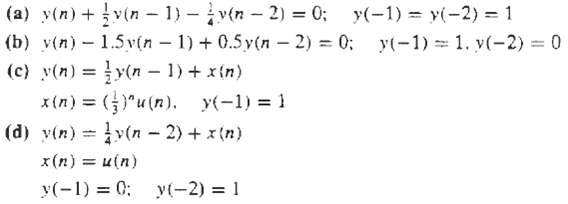
Use the one-sided z-transform to determine y(n), n ? 0 in the following cases.
Show that the following systems are equivalent.(a) y(n) = 0.2y(n – 1) + x(n) -0.3x(n – 1) + 0.02x(n – 2)(b) y(n) = x(n) – 0.1x(n – 1)
Consider the sequence x(n) = anu(n), -1 < a < 1. Determine at least two sequences that are not equal to x(n) but have the same autocorrelation.
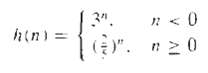
Compute the unit step response of the system with impulse response
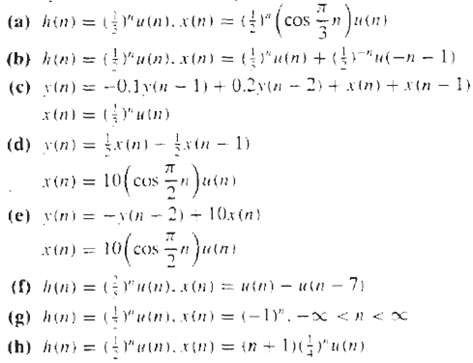
Compute the zero-state response for the following pairs of systems and inputsignals.
Consider the system Determine the impulse response of the system.
Compute the response of the system y(n) = 0.7y (n – 1) -0.12y(n – 2) + x(n – 1) + x(n – 2)to the input x(n) = nu(n). Is the system stable?
Determine the impulse response and the step response of the following causal systems. Plot the pole-zero patterns and determine which of the system arestable.
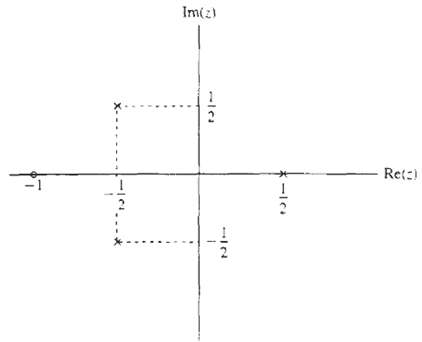
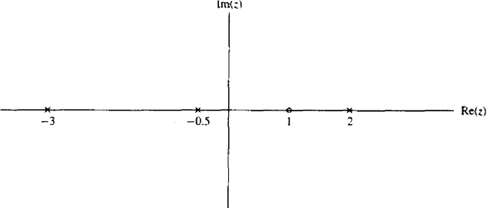
Let x(n) be a causal sequence with z-transform X(z) whose pole-zero plot is shown is figure. Sketch the plots and the ROC of the following sequences:(a) x1(n) = x(-n + 2)(b) x2(n) = ej|?lin x(n)
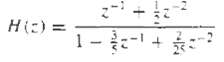
We want to design a causal discrete-time LTI system with the property that if the input is x(n) = (1/2)nu(n) – ¼(1/2) n – 1 u(n – 1) then the output isy(n) = (1/3)nu(n)(a) Determine the impulse response h(n) and the system function H(z) of a system that satisfies the foregoing conditions.(b)
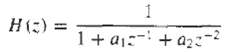
Determine the stability region for the causal system by computing its poles and restricting them to be inside the unitcircle.
Consider the systemDetermine:(a) The impulse response(b) The zero-state step response(c) The step response if y(-1) = 1 and y(-2) =2
Determine the system function, impulse response, and zero-state step response of the system as shown infigure
Consider the causal system y(n) = -a1y(n – 1) + b0x(n) + b1x(n – 1 ) Determine: (a) The impulse response (b) The zero-state step response (c) The step response if y(-1) = A ≠ 0 (d) The response to the input x(n) = cos ω0n 0≤ n < ∞
Determine the zero-state response of the system y(n) = ½y(n – 1) + 4x(n) + 3x(n – 1) to the input x(n) = e j∞0nun. What is the steady-state response of the system?
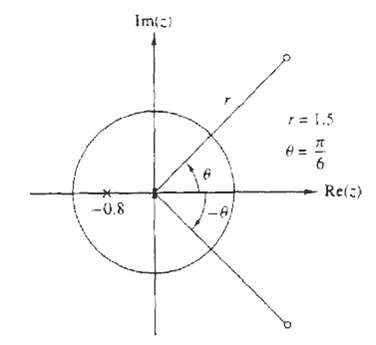
Consider the causal system defined by the pole-zero patterns shown in figure (a) Determine the system function and the impulse response of the system given that H(z)|z=1 = 1. (b) Is the system stable? (c) Sketch a possible implementation of the system and determine the corresponding
An FIR LTI system has an impulse response h(n), which is real valued, even, and has finite duration of 2NI + 1. Show that if z1 = rejω0 is a zero of the system, then z1 = (1/r)ejω0 is also a zero.
Consider an LTI discrete-time system whose pole-zero patterns is shown in figure (a) Determine the ROC of the system function H(z) if the system is known to be stable. (b) it is possible for given pole-zero plot to correspond to a causal and stable system? If so, what is the appropriate ROC? (c)
Let x(n) be a causal sequence.(a) What conclusion can you draw about the value of its z-transform X (z) at z = ??(b) Use the result in part (a) to check which of the following transforms cannot be associated with a causal sequence.
A causal pole-zero system is BIBO stable if its poles are inside the unit circle. Consider now a pole-zero system that is BIBO stable and has its poles inside the unit circle. Is the system always causal? Consider the system h1(n) = anu(n) and h2(n) = anu(n + 3), |a| < 1.
Let x(n) be an anti causal signal [i.e., x(n) = 0 for n > 0]. Formulate and prove an initial value theorem value theorem for anti causal signals.
The step response of an LTI system iss(n) = (1/3) n-2 u(n + 2)(a) find the system function H(z) and sketch the pole-zero plot.(b) Determine the impulse response h(n) (c) Check if the system is causal and stable.
Use contour integration to determine the sequence x(n) whose z-transform is given by
Let x(n) be a sequence with z-transform with 0 x(n) by using contour integration.
The z-transform of a sequence x(n) is given by Furthermore it is know that X(z) converges for |z| = 1 (a) Determine the ROC of X(z). (b) Determine x(n) at n =-18.
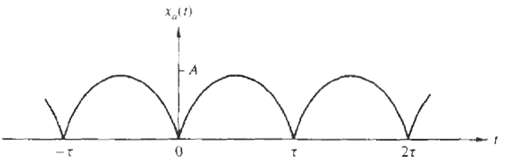
Consider the full-wave rectified sinusoid in figure (a) Determine its spectrum Xa(F). (b) Compute the power of signal. (c) Plot the powder spectral density. (d) Check the validity of Parseval?s relation for this signal
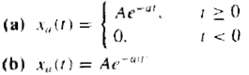
Compute and sketch the magnitude and phase spectra for the following signals (a >0).
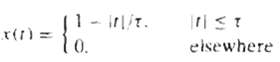
Consider the signal (a) Determine and sketch its magnitude and phase spectra. |Xa (F)| and (b) Create a periodic signal xp (t) with fundamental period Tp ? 2r, so that x (t) = xp (t) for |t| (c) Using the results in parts (a) and (b) Show that ck = (1/Tp) Xa (k/Tp).
Consider the following periodic signal: SHAPE * MERGEFORMAT (a) Sketch the signal x(n) and its magnitude and phase spectra. (b) Using the result in part (a). Verify Parseval's relation by computing the power in the time and frequency domains.
Consider the signal(a) Determine and sketch its power density spectrum.(b) Evaluate the power of thesignal.
Determine ad sketch the magnitude and phase spectra of the following periodic signals.
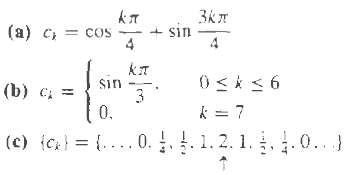
Determine the periodic signals x(n). With fundamental period N = 8. If their Fourier coefficients are givenby:
Determine the periodic signals x(n). With fundamental period N = 8. If their Fourier coefficients are givenby:
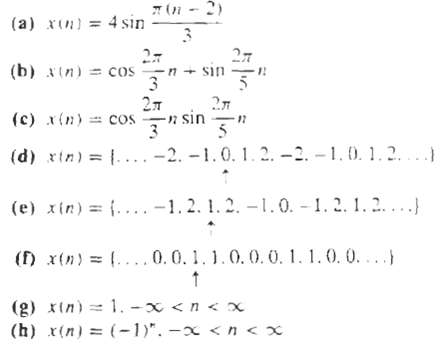
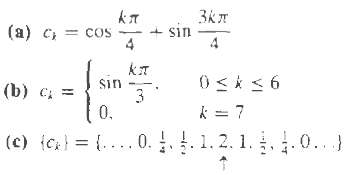
Compute the Fourier transform of the following signals. Sketch the magnitude and phase spectra for parts (a), (f), and(g).
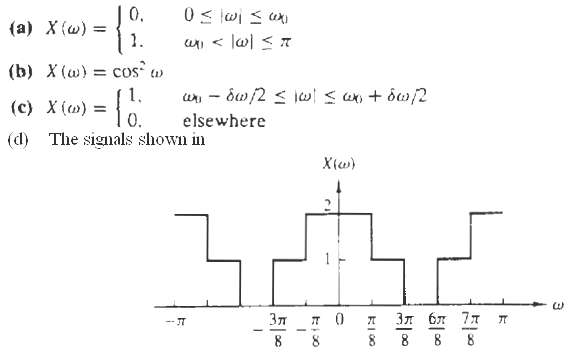
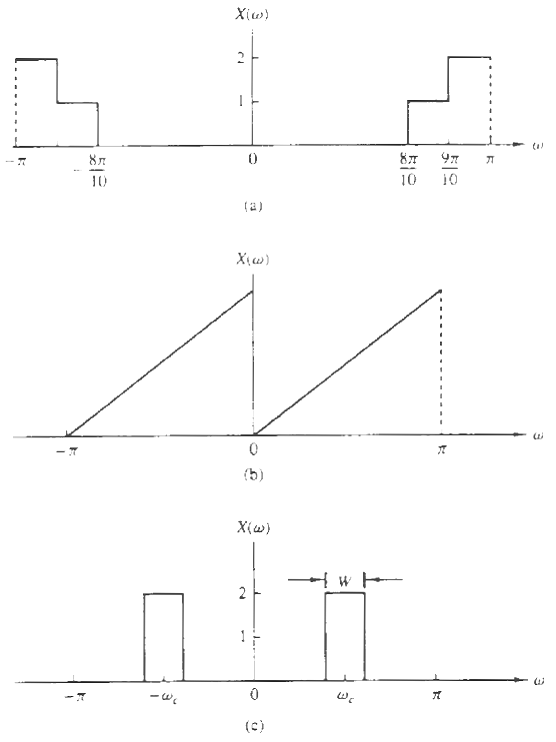
Determine the signals having the following Fouriertransforms.
Consider the signalwith Fourier transform X(ω) = XR(ω) + j(X1(ω)). Determine and sketch the signal y(n) with Fourier transform Y(ω) = X1(ω) + X1(ω)ej2ω
Determine the signal x(n) if its Fourier transform is as given in figure.
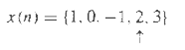
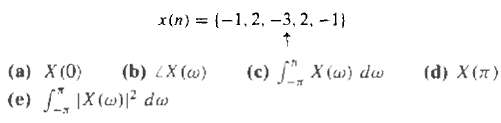
Consider the signal with Fourier transform X(?). Compute the following quantities, without explicitly computing X(?):
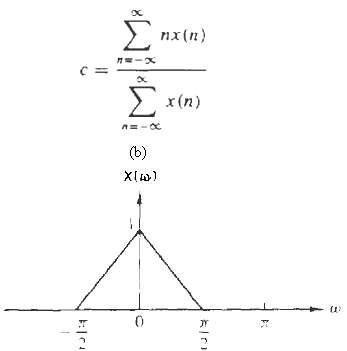
The center of gravity of a signal x(n) is defined as and provides a measure of the ?time delay? of the signal. (a) Express 0 in terms of X(?). (b) Compute 0 for the signal x(n) whose Fourier transform is shown in figure.
Consider the Fourier transform pairUse the differentiation in frequency theorem and induction to showthat
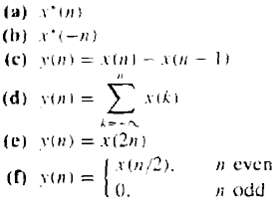
Let x(n) be an arbitrary signal, not necessarily real-valued. With Fourier transform X(?). Express the Fourier transforms of the following signals in terms of X(?).
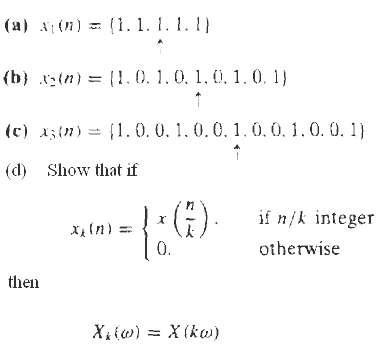
Determine and sketch the Fourier transforms X1(?), X2(?), and X3(?) of the following signals. (e) Is there any relation between X1(?), X2(?), and X3(?)? What is its physical meaning?
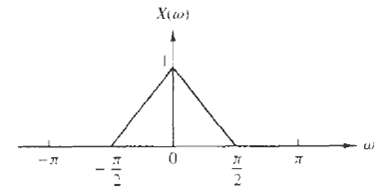
Le x(n) be a signal with Fourier transforms as shown in figure. Determine and sketch the Fourier Transforms of the following signals.(a) x1(n) = x(n) cos(?n/4)(b) x2(n) = x(n) sin(?n/2)(c) x3(n) = x(n) cos(?n/2)(d) x4(n) = x(n) cos?nNote that these signal sequences are obtained by amplitude
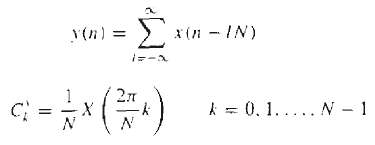
Consider an aperiodic signal x(n) with Fourier transform X(?). Show that the Fourier series coefficients C?v of the periodic signal are given by
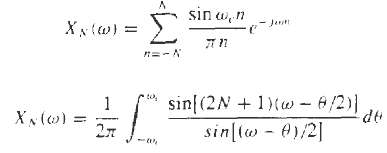
Prove that, may beexpressed.
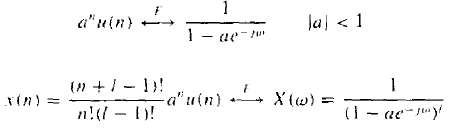
A single x (n) has the following Fourier transform: X (ω) = 1/1 – ae – jω. Determine the Fourier transforms of the following signals: (a) x (2n + 1) (b) eπn/2 x (i + 2) (c) x(-2n) (d) x (n) cos (0.3πn) (e) x (n) * x (n – 1) (f) x(n) * x (-n)
Showing 900 - 1000
of 1744
First
3
4
5
6
7
8
9
10
11
12
13
14
15
16
17
Last
Step by Step Answers

 Get 50% OFF
Claim Now
Get 50% OFF
Claim Now