New Semester
Started
Get
50% OFF
Study Help!
--h --m --s
Claim Now
Question Answers
Textbooks
Find textbooks, questions and answers
Oops, something went wrong!
Change your search query and then try again
S
Books
FREE
Study Help
Expert Questions
Accounting
General Management
Mathematics
Finance
Organizational Behaviour
Law
Physics
Operating System
Management Leadership
Sociology
Programming
Marketing
Database
Computer Network
Economics
Textbooks Solutions
Accounting
Managerial Accounting
Management Leadership
Cost Accounting
Statistics
Business Law
Corporate Finance
Finance
Economics
Auditing
Tutors
Online Tutors
Find a Tutor
Hire a Tutor
Become a Tutor
AI Tutor
AI Study Planner
NEW
Sell Books
Search
Search
Sign In
Register
study help
engineering
telecommunication engineering
Communication Systems 4th Edition Simon Haykin - Solutions
In receiver using coherent detection, the sinusoidal wave generated by the local oscillator suffers from a phase error θ (t) with respect to the carrier wave cos (2πƒct). Assuming that θ (t) is a ample function of a zero-mean Guassian process of variance σ2o, and that most of the time the
Following a procedure similar to that described in Section 2.11 for the DSB-SC receiver, extend this noise analysis to a SSB receiver. Specifically, evaluate the followings:(a) The output signal-to-noise ratio.(b) The channel signal-to-noise ratio.Hence, show that the failure of merit for the SSB
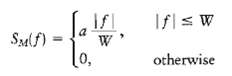
Let a message signal m (t) be transmitted using single-sideband modulation. The power spectral density of m (t) is, where a and W are constant. White Gaussian noise of zero mean and power spectral density N0/2 is added to the SSB modulated wave at the receiver input. Find an expression for the
Consider the output of an envelope detector defined by Equation (2.92), which is reproduced here for convenience y (t) = {[Ac + Ac ka m (t) + n l (t)] 2 + n2Q (t)} 1/2 (a) Assume that the probability of the event | nQ (t) | > ε Ac | 1 + ka m (t) | is equal to or less than δ1, where ε
An unmodulated carrier of amplitude Ac and frequency ƒc and band-limited white noise are summed and then passed through an ideal envelope detector. Assume the noise spectral density to be of height N0/2 and bandwidth 2W, centered about the carrier frequency ƒc. Determine the output
Let R denote the random variable obtained by observing the output of an envelope detector at some fixed time. Intuitively, the envelope detector is expected to be operating well into the threshold region if the probability that the random variable R exceeds the carrier amplitude Ac is 0.5. On the
Consider a phase modulation (PM) system, with the modulated wave defined by s (t) = Ac cos [2πƒct + k p m (t)], where k p is a constant and m (t) is the message signal. The additive noise n (t) at the phase detector input is n (t) = n1 (t) cos (2πƒct) – nQ (t) sin (2πƒct). Assuming that the
An FDM system uses single-sideband modulation to combine 12 independent voice signals and then uses frequency modulation to transmit the composite band 0.3 to 3.4 kHz; the system allocates it a bandwidth of 4 kHz. For each voice signal, only the lower sideband is transmitted. The subcarrier waves
In the discussion on FM threshold effect presented in Section 2.13, we describe the condition for the positive-going and negative-going clicks in terms of the envelope r (t) and phase ψ (t) of the narrow band noise n (t). Reformulate these conditions in term of the in phase components n1 (t) and
By using the pre-emphasis filter shown in Figure a and with a voice signal as the modulating wave, and FM transmitter produces a signal that is essentially frequency modulated by the lower audio frequencies and phase-modulated by the higher audio frequencies. Explain the reasons for this phenomenon.
In this experiment we study the behavior of the envelope detector shown in Figure for the following specifications: Source resistance, Rs = 75Ω. Load resistance, Rl = 10Ω. Capacitance, C = 0.01μF. The diode has resistance of 25Ω when it is forward-biased and infinite resistance when
Consider a binary input Q-ary output discrete memory less channel. The channel is said to be symmetric if rite channel transition probability p(j|i) satisfies the condition: p(j|0) = p(Q– 1 –j|1), j = 0,1,...,Q – 1 suppose that the channel input symbols 0 and 1 are equally likely. Show that
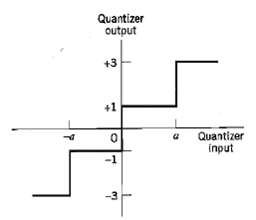
Consider the quantized demodulator for binary PSK signals shown in Figure. The quantizer is a four-Level quantizer, normalized as in Figure. Evaluate the transition probabilities of the binary input-quarternary output discrete memory less channel so characterized. Hence, show that it is a symmetric
Consider a binary input AWGN channel, in which the binary symbols 1 and 0 are equally likely. The binary symbols are transmitted over the channel by means of phase-shift keying. The code symbol energy is E, and the AWGN has zero mean and power spectral density N0/2. Show that the channel transition
In a single-parity-check code, a single parity bit is appended to a block of k message bits (m1, m2,,.., mk,). The single parity bit b1 is chosen so that the code word satisfies the even parity ride:m1 + m2 + . . . + mk + b1 = 0, mod 2 for k = 3, set up the 2k possible code words in
Compare the parity-check matrix of the (7, 4) Hamming code considered in Example 10.2 with that of a (4, 1) repetition code.
Consider the (7, 4) Hamming code of Example 10.2. The generator matrix G and the parity-check matrix H of the code are described in that example. Show that these two matrices satisfy the condition HGT = 0
(a) For the (7, 4) Hamming code described in Example 10.2, construct the eight code words in the dual code.(b) Find the minimum distance of the dual code determined in part (a).
Consider the (5, 1) repetition code of Example 10.1. Evaluate the syndrome s for the following error patterns:(a) All five possible single-error patterns(b) All 10 possible double-error patterns
For aim application that requires error detection only, we may use a nonsystematic code. In this problem, we explore the generation of such a cyclic code. Let g(X) denote the generator polynomial, and rn(X) denote the message polynomial. We define the code polynomial c(X) simply as c(X) = m(X) g
The polynomial 1 + X7 has 1 + X + X3 and 1 + X2 + X3 as primitive factors. In Example 10.3, we used 1 + X + X3 as the generator polynomial for a (7,4)1-lamming code. In this problem, we consider the adoption of 1 + X2 + X3 as the generator polynomial. This should lead to a (7, 4) Hamming code that
Consider the (7, 4) Hamming code defined by the generator polynomial g(X) = 1 + X + X3 the code word 0111001 is sent over a noisy channel, producing the received word 0101001 that has a single error. Determine the syndrome polynomial s(X) for this received word, and show that it is identical to the
The generator polynomial of a (15, 11 Hamming code is defined by g(X) = 1 + X + X4 develop the encoder and syndrome calculator for this code, using a systematic form for the code.
Consider the (15, 4) maximal-length code that is the dual of the (15, 11) Hamming code of problem. Do the following:(a) Find the feedback connections of the encoder, and compare your results with those of Table 7.1 on maximal-length codes presented.(b) Find the generator polynomial g(X); hence,
Consider the (31, 15) Reed-Solomon code.(a) How many bits are there in a symbol of the code?(b) What is the block length in bits?(c) What is the minimum distance of the code?(d) How many symbols in error can the code correct?
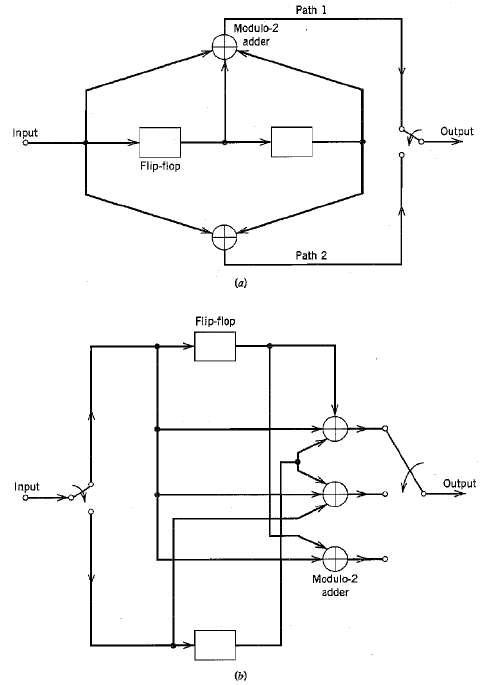
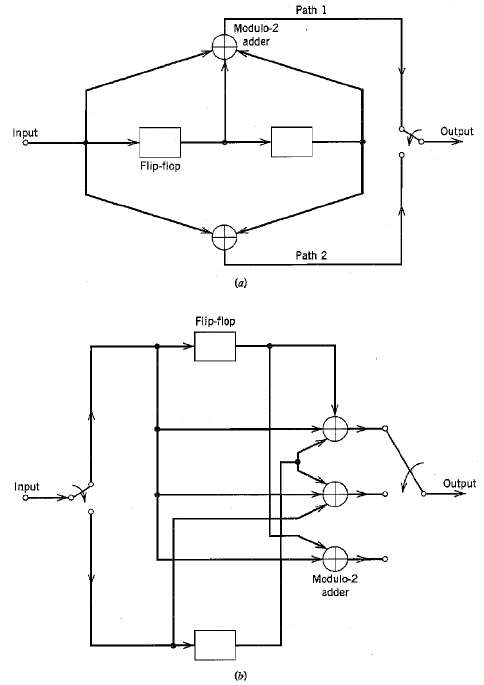
A convolutional encoder has a single-shift register with two stages, (i.e., constraint length K = 3), three modulo-2 adders, and an output multiplexer. The generator sequences of the encoder are as follows:g(1) = (1, 0, 1)g(2) = (1, 1, 0)g(3) = (1, 1, 1)Draw the block diagram of the encoder.
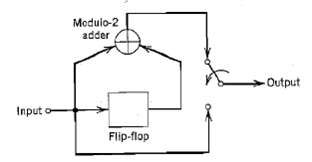
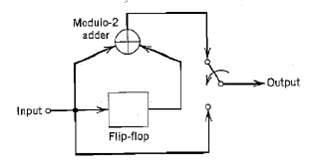
Consider the rate r = 1/2, constraint length K = 2 convolutional encoder of figure the code is systematic. Find the encoder output produced by the message sequence 10111....
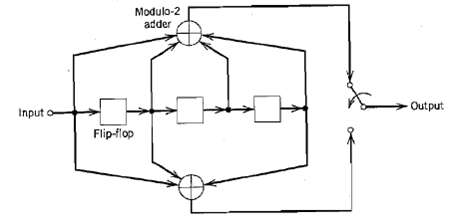
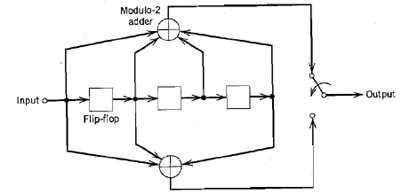
Figure shows the encoder for a rate r = 1/2, constraint length K = 4 convolutional code. Determine the encoder output produced by the message sequence 10111....
Consider the encoder of Figure b for a rate r = 2/3, constraint length K = 2 convolutional code. Determine the code sequence produced by the message sequence 10111....
Construct the code tree for the convolutional encoder of Figure. Trace the path through the tree that corresponds to the message sequence 10111 . . . , and compare the encoder output with that determined in problem.
Construct the code tree for the encoder of figure. Trace the path through the tree that corresponds to the message sequence 10111.... Compare the resulting encoder output with that found inproblem.
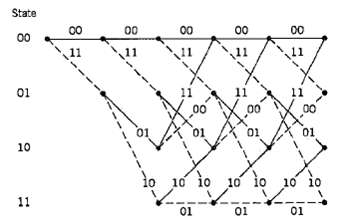
Construct the trellis diagram for the encoder of Figure, assuming a message sequence of length 5. Trace the path through the trellis corresponding to the message sequence 10111. . . . Compare the resulting encoder output with that found inproblem.
Construct the state diagram for the encoder of figure. Starting with the all-zero state, trace the path that corresponds to the message sequence 10111.. . , and compare the resulting code sequence with that determined in problem.
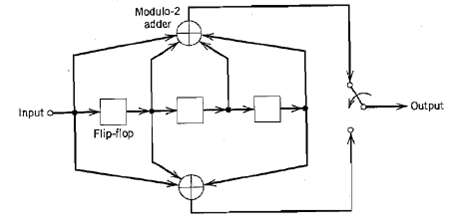
Consider the encoder of Figure. (a) Construct the state diagram for this encoder. (b) Starting from the all-zero stare, trace the path that corresponds to the message sequence 10111. .. . Compare the resulting sequence with that determined inproblem.
By viewing the minimum shift keying (MSK) scheme as a finite-state machine, construct the trellis diagram for MSK. (A description of MSK is presented in Chapter.)
The trellis diagram of a rate-1/2, constraint length-3 convolutional code is shown in figure. The all-zero sequence is transmitted, and the received sequence is 100010000... . Using the Viterbi algorithm, compute the decodedsequence.
Consider a rate-1/2, constraint length-7 convolutional code with free distance d free = 10. Calculate the asymptotic coding gain for the following two channels(a) Binary symmetric channel(b) Binary input AWGN channel
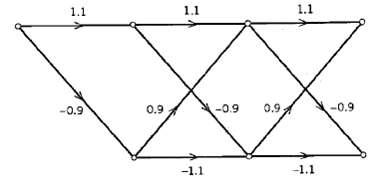
In Section 10.6 we described the Viterbi algorithm for maximum likelihood decoding of a convolutional code. Another application of the Viterbi algorithm is for maximum likelihood demodulation of a received sequence corrupted by inters symbol interference due to a dispersive channel. Figure P10.27
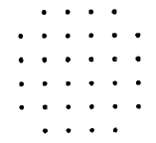
Figure depicts 32-QAM cross constellation. Partition this constellation into eight subsets. Ar each stage of the partitioning, indicate the within-subset (shortest) Euclideandistance.
As explained in the Introduction to this chapter, channel coding can be used to reduce the Eb/N0 required for a prescribed error performance or reduce the size of the receiving antenna for a prescribed Eb/N0. In this problem we explore these two practical benefits of coding by revisiting Example
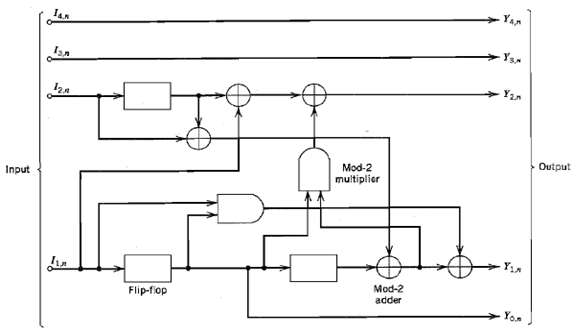
Unlike the convolutional codes considered in this chapter, we recall from Chapter 6 that the convolutional code used in the voice band modem V.32 modem is nonlinear. Figure shows the circuit diagram of the convolutional encoder used in this modem; it uses modulo-2 multiplication and gates in
Let rc(1) = p/q1 and rc(2) = p/q2 be the code rates of RSC encoders 1 and 2 in the turbo encoder of Figure. Find the code rate of the turbo code.
The feedback nature of the constituent codes in the turbo encoder of Figure has the following implication: A single bit error corresponds to an infinite sequence of channel errors. Illustrate this phenomenon by using a message sequence consisting of symbol 1 followed by an infinite number of
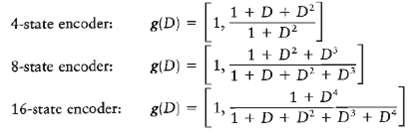
Consider the following generator matrices for rate 1/2 turbo codes: (a) Construct the block diagram for each one of these RSC encoders. (b) Setup the parity-check equation associated with eachencoder.
The turbo encoder of Figure involves the use of two RSC encoders.(a) Generalize this encoder to encompass a total of M inter-leavers.(b) Construct the block diagram of the turbo decoder that exploits the M sets of parity check bits generated by such a generalization.
Turbo decoding relies on the feedback of extrinsic information. The fundamental principle adhered to in the turbo decoder is to avoid feeding a decoding stage information that stems from the stage itself. Explain the justification for this principle in conceptual terms.
Suppose a communication receiver consists of two components, a demodulator and a decoder. The demodulator is based on a Markov model of the combined modulator and channel, and the decoder is based on a Markov model of a forward error correction code. Discuss how the turbo principle may be applied
A narrowband signal has a bandwidth of 10 kHz centered on a carrier frequency of 100 kHz. It is proposed to represent this signal in discrete-tune form by sampling it’s in- phase and quadrature components individually. What is the minimum sampling rate that can be used for this representation?
In natural sampling, an analog signal g (t) is multiplied by a periodic train of rectangular pulses c (t). Given that the pulse repetition frequency of this periodic train is ƒb and the duration of each rectangular pulse is T (with ƒb T << 1), do the following:(a) Find the spectrum of the
Specify the Nyquist rate and the Nyquist interval for each of the following signals:(a) g (t) = sinc (200t)(b) g (t) sinc2 (200t)(c) g (t) = sinc (200t) + sinc2 (200t)
(a) Plot the spectrum of a PAM wave produced by the modulating signal m (t) Am cos (2iπƒmt) assuming a modulation frequency ƒm = 0.25 Hz, sampling period Ts = 1 s, and pulse duration T = 0.45 s.(b) Using an ideal reconstruction filter, plot the spectrum of the filter output. Compare this result
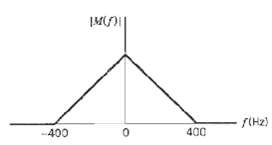
Figure shows the idealized spectrum of a message signal m (t). The signal is sampled at a rate equal to 1 kHz using flat-top pulses, with each pulse being of unit amplitude and duration 0.1 ms. Determine and sketch the spectrum of the resulting PAM signal
In this problem, we evaluate the equalization needed for the aperture effect in a PAM system. The operating frequency ƒ = ƒs/2, which corresponds to the highest frequency component of the message signal for a sampling rate equal to the Nyquist rate. Plot 1/sinc (0.5T/T,) versus T/Ts, and hence
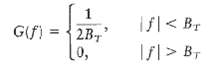
Consider a PAM wave transmitted through a channel with white Gaussian noise and minimum bandwidth BT = 1/2Ts, where Ts is the sampling period. The noise is of zero mean and power spectral density N0/2. The PAM signal uses a standard pulse g (t) with its Fourier transform defined by below. By
Twenty-four voice signals are sampled uniformly and then rime-division multiplexed. The sampling operation uses flat-top samples with 1 μ duration. The multiplexing operation includes provision for synchronization by adding an extra pulse of sufficient amplitude and also 1 μ duration. The highest
Twelve different message signals, each with a bandwidth of 10 kHz, are to be multiplexed and transmitted. Determine the minimum bandwidth required for each method if the multiplexing/modulation method used is(a) FDM, SSB.(b) TDM, PAM.
A PAM telemetry system involves the multiplexing of four input signals: si (t), i = 1, 2 3, 4. Two of the signals s1 (t) and s2 (t) have bandwidths of 80 Hz each, whereas the remaining two signals s3 (t) and s4 (t) have bandwidths of 1 kHz each. The signals s3 (t) and s4 (1) are each sampled at the
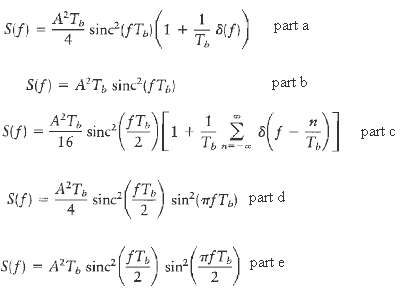
In this problem we derive the formulas used to compute the power spectra of Figure for the five Line codes described in Section 3.7. In the case of each line code, the bit duration is Tb and the pulse amplitude A is conditioned to normalize the average power of the line code o unity as indicated in
Suppose a random binary data stream (with equiprobable symbols) is differentially encoded and then transmitted using one of the five line codes described in Problem 3.11. How is the power spectral density of the transmitted data affected by the use of differential encoding? Justify your answer.
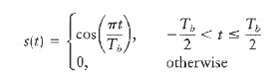
A randomly generated data stream consists of equiprobable binary symbols 0 and 1. It is encoded into a polar nonreturn-to-zero waveform with each binary symbol being defined as follows: (a) Sketch the waveform so generated, assuming that the data stream is 00101110. (b) Derive an expression for the
A speech signal has a total duration of 10 s. It is sampled at the rate of 8 kHz and then encoded. The signal-to-(quantization) noise ratio is required to be 40 dB. Calculate minimum storage capacity needed to accommodate this digitized speech signal.
Consider a uniform quantizer characterized by the input—output relation illustrated Figure a. Assume that a Gaussian-distributed random variable with zero mean and unit variance is applied to this quantizer input.(a) What is the probability that the amplitude of the input lies outside the range
A PCM system uses a uniform quantizer followed by a 7-bit binary encoder. The hit rate of the system is equal to 50 x 106b/s(a) What is the maximum message bandwidth for which the system operates satisfactorily?(b) Determine the output signal-to-(quantization) noise ratio when a full-load
Show that, with a non-uniform quantizer, the mean-square value of the quantization error is approximately equal to (1/12) Σi ∆2i pi, where ∆i is the ith step size and pi is the probability that the input signal amplitude lies within the ith interval. Assume that the step size ∆i is small
(a) A sinusoidal signal, with amplitude of 3.25 volts, is applied to a uniform quantizer of the mid-tread type whose output takes on the values 0, ±1, ±2, ±3 volts. Sketch the waveform of the resulting quantizer output for one complete cycle of the input.(b) Repeat this evaluation for the case
The signal m (t) = 6 sin (2πt) volts is transmitted using a 4-bit binary PCM system. The quantizer is of the midrise type, with a step size of 1 volt. Sketch the resulting PCM wave for one complete cycle of the input. Assume a sampling rate of four samples per second, with samples taken at t =
Figure shows a PCM signal in which the amplitude levels of +1 volt and ?1 are used to represent binary symbols 1 and 0, respectively. The code word used consists of three bits. Find the sampled version of an analog signal from which this PCM signal is derived.
Consider a chain of (n — 1) regenerative repeaters, with a total of n sequential decisions made on a binary PCM wave, including the final decision made at the receiver. Assume that any binary symbol transmitted through the system has an independent probability p1 of being inverted by any
Discuss the basic issues involved in the design of a regenerative repeater for pulse-code modulation.
Consider a test signal m (t) defined by a hyperbolic tangent function: m (t) = A tanh (βt), where A and β are constants. Determine the minimum step size ∆ for delta modulation of this signal, which is required to avoid slope overload.
Consider a sine wave of frequency ƒm and amplitude Am which is applied to a delta modulator of step sue A. Show that slope-overload distortion will occur if Am > ∆/2π ƒm Ts where Ts is the sampling period. What is the maximum power that may be transmitted without
A linear delta modulator is designed to operate on speech signals limited to 3.4 kHz; the specifications of the modulator are as follows:Sampling rate = l0 ƒNyquist, where ƒNyquist is the Nyquist rate of the speech signal.Step size ∆ = 100 mV.The modulator is tested with a 1-KHz sinusoidal
In this problem, we derive an empirical formula for the average signal-to-(quantization) noise ratio of a DM system with a sinusoidal signal of amplitude A and frequency fm as the test signal. Assume that the power spectral density of the granular noise generated by the system is governed by the
Consider a DM system designed to accommodate analog message signals limited to band-width W = 5 kHz. A sinusoidal test signal of amplitude A = 1 volt and frequency ƒm = 1 kHz is applied to the system. The sampling rate of the system is 50 kHz.(a) Calculate the step size ∆ required to minimize
Consider a low-pass signal with a bandwidth of 3 kHz. A linear delta modulation system, with step size ∆ = 0.1V, is used to process this signal at a sampling rate ten times the Nyquist rate. (a) Evaluate the maximum amplitude of a test sinusoidal signal of frequency 1 kHz which can be processed
A one-step linear predictor operates on the sampled version of a sinusoidal signal. The sampling rate is equal to 10 ƒ0 where ƒ0 is the frequency of the sinusoid. The predictor has a single coefficient denoted by w1.(a) Determine the optimum value of w1 required to minimize the prediction error
A stationary process X (t) has the following values for its autocorrelation function RX (0) = 1, RX (1) = 0.8, RX (2) = 0.6, RX (3) = 0.4(a) Calculate the coefficients of an optimum linear predictor involving the use of three unit-delays.(b) Calculate the variance of the resulting prediction error.
Repeat the calculations of Problem 3.32, but this time use a linear predictor with two unit-delays. Compare the performance of this second optimum linear predictor with that considered in Problem 3.32.
A DPCM system uses a linear predictor with a single tap. The normalized autocorrelation function of the input signal for a lag of one sampling interval is 0.75. The predictor is designed to minimize the prediction error variance. Determine the processing gain attained by the use of this predictor.
Calculate the improvement in processing gain of a DPCM system using the optimized three-rap linear predictor of Problem 3.32 over that of the optimized two-tap linear predictor of Problem 3.33. For this calculation, use the autocorrelation function values of the input signal specified in Problem
In this problem, we compare the performance of a DPCM system with that of an ordinary PCM system using companding. For a sufficiently large number of representation levels, the signal-to-(quantization) noise ratio of PCM systems, in general, is defined by 10 1og10 (SNR) O = α + 6n dB where 2n
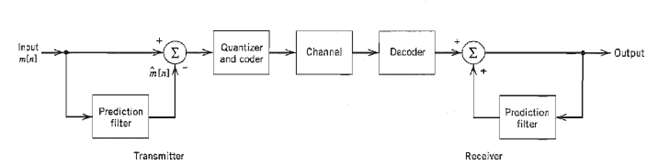
In the DPCM system depicted in Figure, show that in the absence of channel noise, the transmitting and receiving prediction filters operate on slightly different input signals.
A sinusoidal signal of frequency ƒ0 = 104/2π Hz is sampled at the rate of 8 kHz and then applied to a sample-and-hold circuit to produce a flat-topped PAM signal s (t) with pulse duration T = 500μs(a) Compute the waveform of the PAM signal s (t).(b) Compute | S (ƒ) |, denoting the magnitude
In this problem, we use computer simulation to compare the performance of a companded PCM system using the law against that of the corresponding system using a uniform quantizer. The simulation is to be performed for a sinusoidal input signal of varying amplitude.(a) Using the μ-law described in
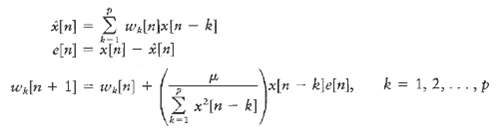
In this experiment we study the linear adaptive prediction of a signal x [n] governed the following recursion: x [n] = 0.8x [n ? 1] ? 0.1x [n ? 2] + 0.1v [n], where v [n] is drawn from a discrete?time white noise process of zero mean and unit variance. (A process generated in this manner is
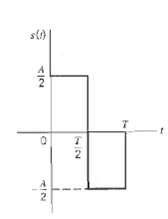
Consider the signal s (t) shown in Figure. (a) Determine the impulse response of a filter matched to this signal and sketch it as a function of rime. (b) Plot the matched filter output as a function of time. (c) What is the peak value of the output?
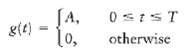
Consider a rectangular pulse defined by, it is proposed to approximate the marched filter for g (t) by an ideal low-pass filter of bandwidth B; maximization of the peak pulse signal-to-noise ratio is the primary objective. (a) Determine the optimum value of B for which the ideal low-pass filter
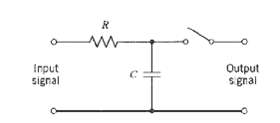
In this problem we explore another method fur the approximate realization of a matched filter, this time using the simple resistance-capacitance (RC) low-pass filter shown in Figure. The frequency response of this filter is H (?) = 1/1 + j?/?0,?where ?0 = 1/2?RC. The input signal g (t) is a
The formula for the optimum threshold in the receiver of Figure is, in general, given by Equation (4.37). Discuss, in graphical terms, how this optimum choice affects the contributions of the two terms in Equation (4.35) for the average probability of error P by considering the following two
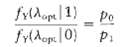
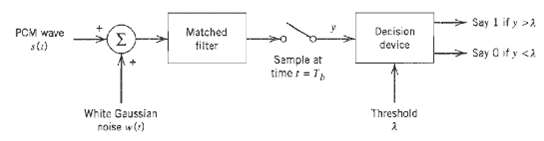
In a binary PCM system, symbols 0 and 1 have a priori probabilities p0 and p1, respectively. The conditional probability density function of the random variable Y (with sample value y) obtained by sampling the matched filter output in the receiver of Figure at end of a signaling interval, given
A binary PCM system using polar NRZ signaling operates just above the error threshold with an average probability of error equal to 10-6. Suppose that the signaling rate doubled. Find the new value of the average probability of error. You may use Table to evaluate the complementary error function.
A continuous-time signal is sampled and then transmitted as a PCM signal. The random variable at the input of the decision device in the receiver has a variance of 0.01 volts2(a) Assuming the use of polar NRZ signaling, determine the pulse amplitude that must be transmitted for the average error
A binary PCM wave uses unipolar NRZ signaling to transmit symbols 1 and 0; symbol 1 is represented by a rectangular pulse of amplitude A and duration Tb. The channel noise is modeled as additive, white and Gaussian, with zero means and power spectral density N0/2. Assuming that symbols 1 and 0
Repeat Problem 4.9 for the case of unipolar return-to-zero signaling, in which case symbol 1 is represented by a pulse of amplitude A and duration Tb/2 and symbol 0 is represent by transmitting no pulse. Hence show that this unipolar type of signaling requires twice the average power of unipolar
In this problem, we revisit the PCM receiver of Figure, but this rime we consider the use of bipolar nonreturn-to-zero signaling, in which case the transmitted signal s (t) is defined by Binary symbol 1: s (t) ?A for 0
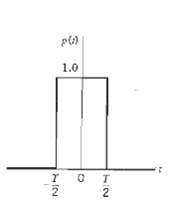
The nonreturn-to-zero pulse of Figure may be viewed as a very crude form of a Nyquist pulse. Compare the spectral characteristics of these two pulses.
Determine the inverse Fourier transform of the frequency function P (ƒ) defined in Equation (4.60).
An analog signal is sampled, quantized, and encoded into a binary PCM wave. The specifications of the PCM system include the following: Sampling rate = 8 kHz, Number of representation levels 64. The PCM wave is transmitted over a baseband channel using discrete pulse-amplitude modulation. Determine
Consider a baseband binary PAM system that is designed to have a raised-cosine spectrum P (ƒ). The resulting pulse p (t) is defined in Equation (4.62). How would this pulse be modified if the system was designed to have a linear phase response?
Repeat Problem 4.16, given that each set of three successive binary digits in the computer output are coded into one of eight possible amplitude levels, and the resulting signal is transmitted using an eight-level PAM system designed to have a raised-cosine spectrum.
Showing 200 - 300
of 1744
1
2
3
4
5
6
7
8
9
10
11
12
13
14
15
Last
Step by Step Answers

 Get 50% OFF
Claim Now
Get 50% OFF
Claim Now