New Semester
Started
Get
50% OFF
Study Help!
--h --m --s
Claim Now
Question Answers
Textbooks
Find textbooks, questions and answers
Oops, something went wrong!
Change your search query and then try again
S
Books
FREE
Study Help
Expert Questions
Accounting
General Management
Mathematics
Finance
Organizational Behaviour
Law
Physics
Operating System
Management Leadership
Sociology
Programming
Marketing
Database
Computer Network
Economics
Textbooks Solutions
Accounting
Managerial Accounting
Management Leadership
Cost Accounting
Statistics
Business Law
Corporate Finance
Finance
Economics
Auditing
Tutors
Online Tutors
Find a Tutor
Hire a Tutor
Become a Tutor
AI Tutor
AI Study Planner
NEW
Sell Books
Search
Search
Sign In
Register
study help
engineering
telecommunication engineering
Discrete Time Signal Processing 2nd Edition Alan V. Oppenheim, Rolan W. Schafer - Solutions
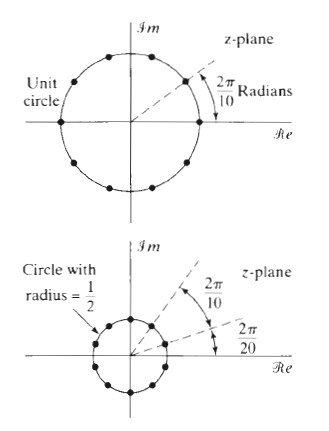
The DFT of a finite-duration sequence corresponds to samples of its z-transform on the unit circle. For example, the DFT of a 10-point sequence x[n] corresponds to samples of X(z) at the 10 equally spaced points indicated in Figure. We wish to find the equally spaced samples of X(z) on the contour
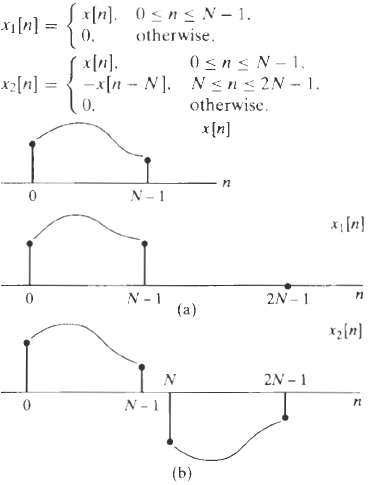
Consider a finite-length sequence x[n] of length N as indicated in Figure. (The solid line is used to suggest the envelope of the sequence values between 0 and N ? 1.) Two finite-length sequence x1[n] and x2[n] of length 2N are constructed from x[n] as indicated in Figure, with x1[n] and x2[n]
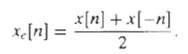
The even part of a real sequence x[n] is defined by Suppose that x[n] is a real finite-length sequence defined such that x[n] = 0 for n (a) Is Re{x[k]} the DFT of xe[n]? (b) What is the inverse DFT of Re{X [k]} in terms of x[n]?
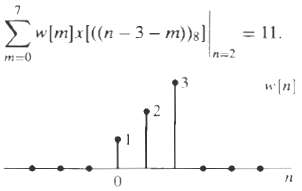
Determine a sequence x[n] that satisfies all of the following three conditions: Condition 1: The Fourier transform of x[n] has the form X(ej?) = 1 + A1 cos ? + A2 cos 2?, Where A1 and A2 are some unknown constants.? Condition 2: The sequence x[n]*?[n ? 3] evaluated at n = 2 is 5. Condition 3: For
Consider the finite-length sequencex[n] = 2δ[n] + δ[n – 1] + [n – 3]. We perform the following operation on this sequence:(i) We compute the five-point DFT X[k].(ii) We compute a five-point inverse DFT of Y[k] = X[k]2 to obtain a sequence y[n].(a) Determine the sequence y[n] for n = 0,
x[n] is a real-valued finite-length sequence of length 10 and is nonzero in the interval from 0 to 9, i.e., x[n] = 0, n < 0, n ≥ 10,x[n] ≠ 0, 0 ≤ n ≤ 9.X(ejω) denotes the Fourier transform of x[n], and
Two finite-length sequences x1[n] and x2[n], which are zero outside the interval 0 ? n ? 99, are circularly convolved to form a new sequence y[n]; i.e., ? If, in fact, x1[n] is nonzero only for 10 ? n ? 39, determine the set of values of n for which y[n] is guaranteed to be identical to the linear
Consider two finite-length sequences x[n] and h[n] for which x[n] = 0 outside the interval 0 ≤ n ≤ 49 and h[n] = 0 outside the interval 0 ≤ n ≤ 9.(a) What is the maximum possible number of nonzero values in the linear convolution of x[n] and h[n]?(b) The 50-point circular convolution of
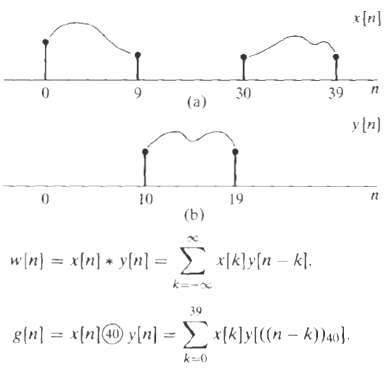
Consider two finite-duration sequences x[n] and y[n]. x[n] is zero for n 19, as indicated in Figure Let w[n] denote the linear convolution of x[n] and y[n], Let g[n] denote the 40-point circular convolution of x[n] and y[n]:? (a) Determine the values of n for which w[n] can be nonzero. (b)
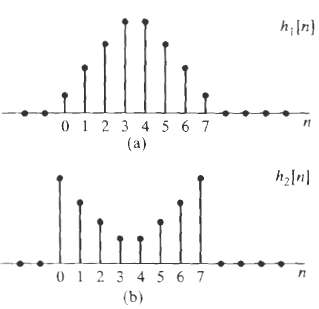
Two finite-duration sequences h1[n] and h2[n] of length 8 are sketched in Figure. The two sequences are related by a circular shift, i.e., h1[n] = h2[((n ? m)) 8]. (a) Specify whether the magnitudes of the eight-point DFTs are equal. (b) We wish to implement a lowpass Fir filter and must use
We want to implement the linear convolution of a 10,000-point sequence with an FIR impulse response that is 100 points long. The convolution is to be implemented by using DFT s and inverse DFT s of length 256.(a) If the overlap-add method is used, what is the minimum number of 256-poinst DFTs and
Let x1[n] be a sequence obtained by expanding the sequence x[n] = (1/4)n u[n] by a factor of 4; i.e., Find and sketch a six-point sequence q[n] whose six-point DFT Q[k] satisfies the two constraints. ?Q[0] = X1(1), Q[3] = X1(? 1), ?where X1(z) represents the z-transform of X1[n].
Let x2[n] be a real-valued five-point sequence whose seven-point DFT is denoted by X2[k]. If Real{X2[k]} is the seven-point DFT of g[n], show that g[0] = x2[0], and determine the relationship between g[1] and x2[1]. Justify your answer.
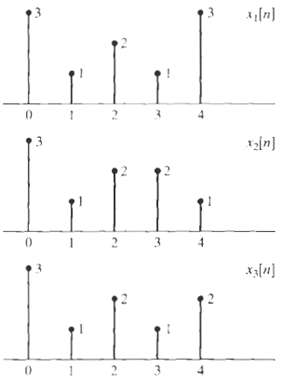
Shown in Figure are three finite-length sequences of length 5. Xi(ej?) denotes the DTFT of xi[n], and Xi[k] denotes the five-point DFT of xi[n]. For each of the following properties, indicate which sequence and satisfy the property and which do not. Clearly justify your answers for each sequence
Letx[n] = 0, n < 0, n > 7, be a real eight-point sequence, and let X[k] be its eight-point DFT.(a) Evaluate in terms of x[n].(b) Let u[n] = 0, n < 0, n > 7,be an eight-point sequence, and let V[k] be its eight-point DFT, If V[k] = X(z) at z = 2exp(j(2πk + π)/8) for
(a) Suppose x[n] = 0, n < 0, n > (N – 1), is an N-point sequence having at least one nonzero sample. Is it possible for such a sequence to have a DTFT X(ej2πk/M) = 0, k = 0, 1….. M −
Suppose x1[n] is an infinite-length, stable (i.e., absolutely summable) sequence with z-transform given byx1(z) = 1/ 1−1/3z−1.Suppose x2[n] is a finite-length sequence of length N, and the N-point DFT of x2[n] is X2[k] = X1(z) | z=ej2πk/N’
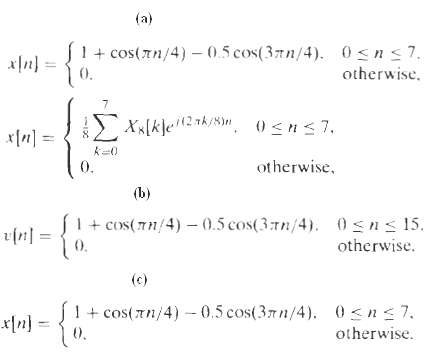
Read each part of this problem carefully to note the differences among parts. (a) Consider the signal which can be represented by the IDFT equation as where X8[k] is the eight-point DFT of x[n]. Plot X8[k] for 0 ? k ? 7. (b) Determine V16[k], the sixteen-point DFT of the sixteen-point sequence plot
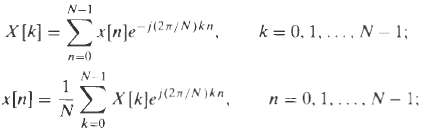
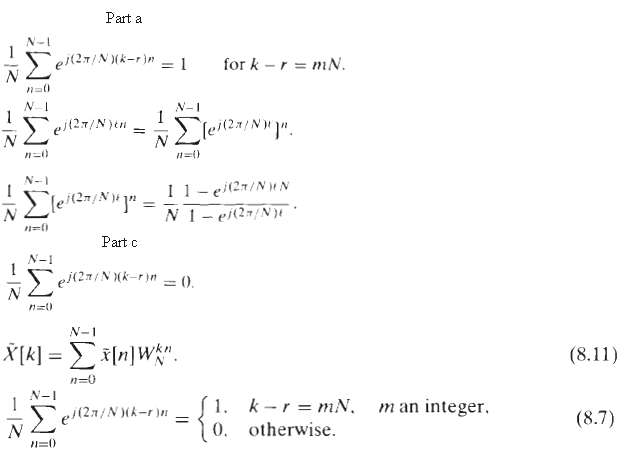
In deriving the DFS analysis equation (8.11), we used the identity of Eq. (8.7). To verify this identity, we will consider the two conditions k ? r = m N and k ? r ? m N separately. (a) For k ? r = m N, show that e j (2?/N) (k ? r) n = 1 and, from this, that since k and r are both integers in Eq.
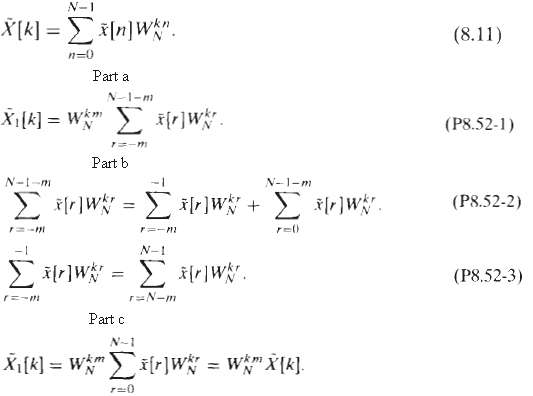
In section 8.2, we stated the property that if? x1[n] = x[n ? m], ?then? X1[k] = WkmN X[k]. Where X[k] and X1[k] are the DFS coefficients of x[n] and x1[n], respectively. In this problem, we consider the proof of that property. ?? (a) Using Eq (8.11) together with an appropriate substitution of
(a) Table 8.1 lists a number of symmetry properties of the discrete Fourier series for periodic sequences, several of which we repeat here. Prove that each of these properties is true. In carrying out your proofs, you may use the definition of the discrete Fourier series and any previous property
We stated in Section 8.4 that a direct relationship between X(ejω) and X[k] can be derived, where X[k] is the DFS coefficients of a periodic sequence and X(ejω) is the “Fourier transform of one period. Since X[k] corresponds to samples of X(ejω), the relationship then corresponds to an
Let X[k] denote the N-point DFT of the N-point sequence x[n].(a) Show that ifx[n] = − x[N – 1 – n],then X[0] = 0. Consider separately the cases of N even and N odd.(b) Show that if N is even and ifx[n] = x[N – 1 – n], then X[N/2] = 0.
In Section 2.8, the conjugate-symmetric and conjugate-antisymmetric components of a sequence x[n] were defined, respectively, asxe[n] = ½ (x[n] + x*[– n]).X0[n] = ½ (x[n] – x*[– n]).In Section 8.6.4, we found it convenient to respectively define the periodic conjugate symmetric and periodic
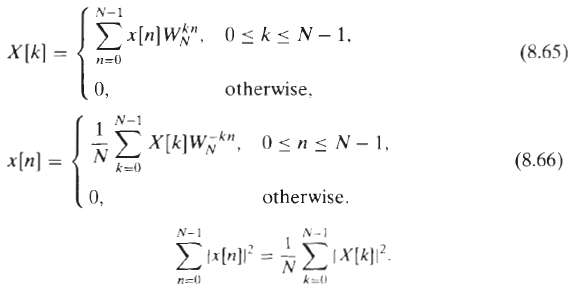
Show from Eqs. (8.65) and (8.66) that with x[n] as an N-point sequence and X[k] as its N-point DFT, This equation is commonly referred to as Parseval?s relation for the DFT.
x[n] is a real-valued, nonnegative, finite-length sequence of length N; i.e., x[n] is real and nonnegative for 0 ≤ n ≤ N – 1 and is zero otherwise. The N-point DFT of x[n] is X[k], and the Fourier transform of x[n] is X(ejω). Determine whether each of the following statements is true or
X[n] and y[n] are two real-valued, positive, finite-length sequences of length 256; i.e.,? x[n] > 0, 0 ? n ? 225, y[n] > 0, 0 ? n ? 255, x[n] = y[n] = 0, otherwise r[n] denotes the linear convolution of x[n] and y[n]. R(ej?) denotes the Fourier transform of r[n]. Rs[k] denotes 128 equally
Y[n] is the output of a stable LTI system with system function H(z) = 1/(z – bz –1), where b is a known constant. We would like to recover the input signal x[n] by operating on y[n]. The following procedure is proposed for recovering part of x[n] from the data y[n]:1. Using y[n], 0 ≤ n ≤ N
A modified discrete Fourier transform (MDFT) was proposed (Vernet, 1971) that computes samples of the z-transform on the unit circle offset from those computed by the DFT. In particular, with XM[k] denoting the MDFT of x (n), Assume that N is even.(a) The N-point MDFT of a sequence x[n]
In some applications in coding theory, it is necessary to compute a 63-point circular convolution of two 63-point sequences x[n] and h[n]. Suppose that the only computational devices a available are multipliers, adders, and processors that compute N-point DFT s, with N restricted to be a power of
We want to filter a very long string of data with an FIR filter whose impulse response is 50 samples long. We wish to implement this filter with a DFT using the overlap-save technique. The procedure is as follows:1. The input sections must be overlapped by V samples.2. From the output of each
A problem that often arises in practice is one in which a distorted signal y[n] is the output that results when a desired signal x[n] has been filtered by an LTI system. We wish to recover the original signal x[n] by processing y[n]. In theory, x[n] can be recovered from y[n] by passing y[n]
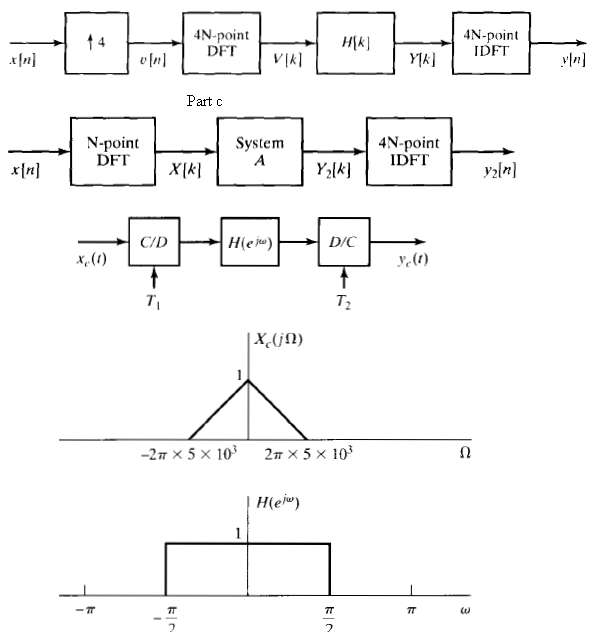
In this problem, you will examine the use of the DFT to implement the filtering necessary for the discrete-time interpolation, or up sampling, of a signal. Assume that the discrete-time signal x[n] was obtained by sampling a continuous-time signal xc(1) with a sampling period T. Moreover, the
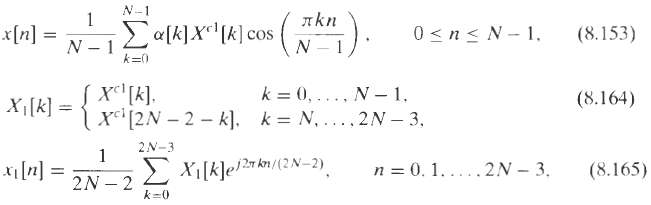
Derive Eq. using Eqs, (8.153) using Eqs, (8.164) and(8.165).
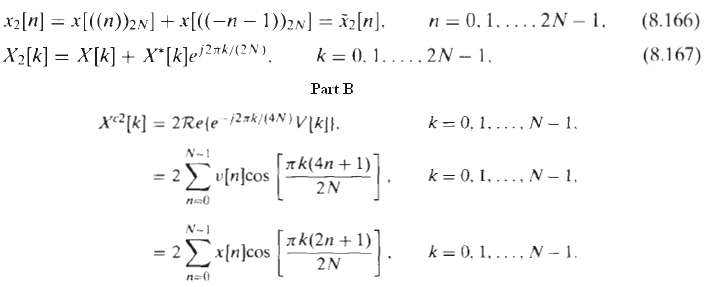
Consider the following procedure? (a) Form the sequence v[n] = x2[2n] where x2[n] is given by Eq. (8.166). This yields? v[n] = x[2n]? ? ? ? ? ? ? ? ? n = 0, 1 ?. N/2 ? 1 v[N ? 1 ? n] = x[2n + 1],? ? ? ? ? ? ? ? ? ? ? n =0, 1?. N/2 ? 1. (b) Compute V[k], the N-point DFT of v[n].? Demonstrate that
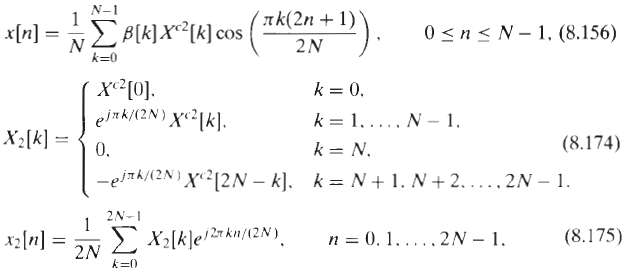
Derive Eq. (8.156) using Eqs (8.174) and(8.175).
(a) Use Parseval’s theorem for the DFT to derive a relationship between ∑ | Xc1[k] |2 and ∑ |x[n]|2.(b) Use Parseval’s theorem for the DFT to derive a relationship between ∑ |Xc2[k] ∑|2 and ∑ |x[k]|2.
Suppose that a computer program is available for computing the DFT i.e., the input to the program is the sequence x[n] and the output is the DFT X[k]. Show how the input and/or output sequences may be rearranged such that the program can also be used to compute the inverse DFT? i.e., the input to
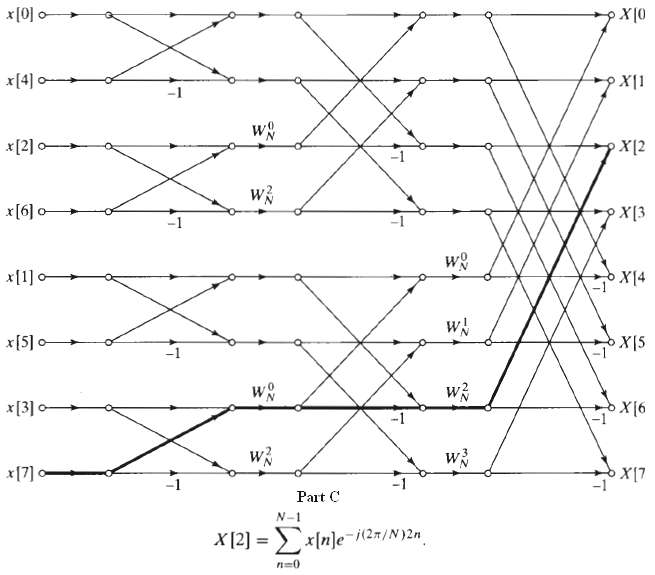
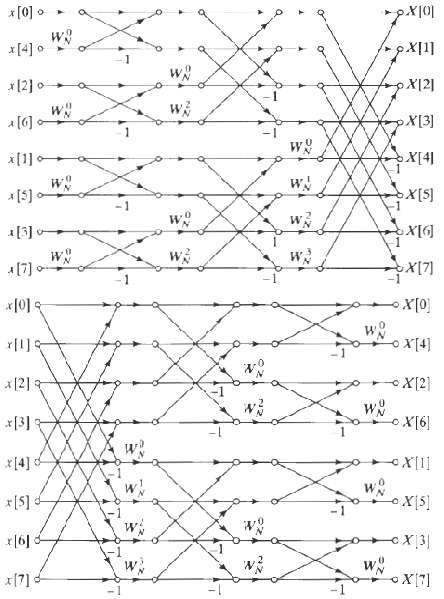
Figure shows the graph representation of a decimation-in-time FFT algorithm for N = 8. The heavy line shows a path from sample x[n] to DFT sample X [2]. (a) What is the ?fain? along the path that is emphasized in Figure? (b) How many other paths in the flow graph begin at x[7] and end at X[2]? Is
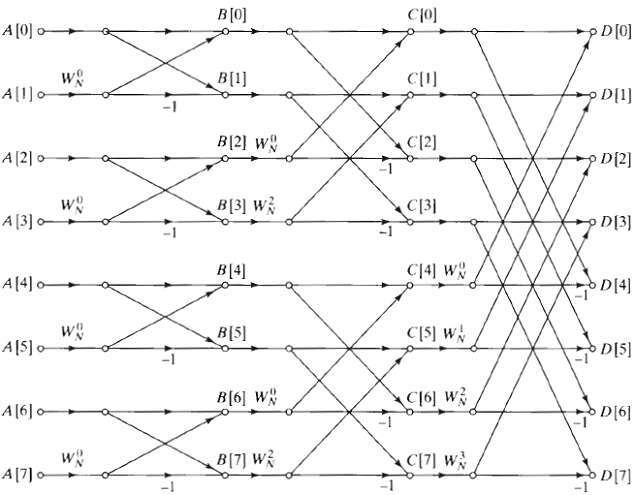
Figure shows the flow graph for an 8-point decimation-in?time FFT algorithm, Let x[n] be the sequence whose DFT is X[k]. In the flow graph, A[?], B[?], C[?], and D[?] represent separate arrays that are indexed consecutively in the same order as the indicated nodes. (a) Specify how the elements of
In implementing an FFT algorithm, it is sometimes useful to generate the powers of WN with a recursive difference equation, or oscillator. In this problem we consider a radix-2 decimation-in-time algorithm for N = 2v. Figure depicts this type of algorithm for N = 8. To generate the coefficients
Computing the DFT generally requires complex multiplications. Consider the product X + JY = (A + JB) (C + JD) = (AC – BD) + J (BC + AD). In this form, a complex multiplication requires four real multiplications and two real additions. Verify that a complex multiplication can be performed with
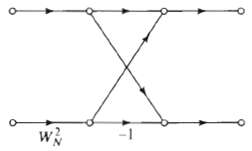
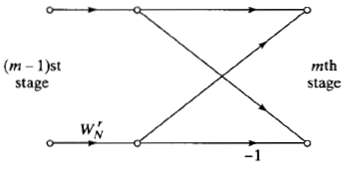
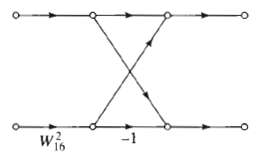
Consider the butterfly in figure. This butterfly was extracted from a signal flow graph implementing an FFT algorithm. Choose the most accurate statement from the following list: 1. The butterfly was extracted from a decimation-in-time FFT algorithm. 2. The butterfly was extracted from a
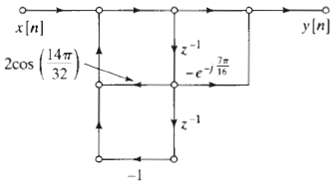
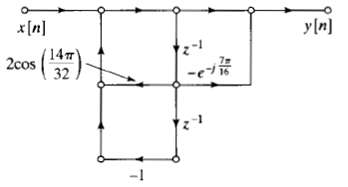
Consider the system shown in figure. If the input to the system, x[n], is a 32-point sequence in the interval 0 ? n ? 31, the output y[n] at n = 32 is equal to X(e?j?) evaluated at a specific frequency ?k. What is ?k for the coefficients shown in Figure?
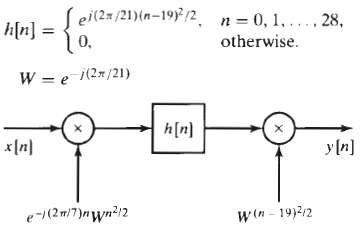
A finite-length signal x[n] is nonzero in the interval 0 ? n ? 19. This signal is the input to the system shown in figure, where the output of the system, y[n], for the interval n = 19 ?.. 28 can be expressed in terms of the DTFT X(e j?) for appropriate values of ?. Write an expression for y[n] in
The butterfly flow graph in figure can be used to compute the DFT of a sequence of length N = 2v ?in-place,? i.e., using a single array of complex-valued registers. Assume this array of registers A[?] is indexed on 0 ? I ? N ? 1. The input sequence is initially stored in A[?] in bit-reversed order.
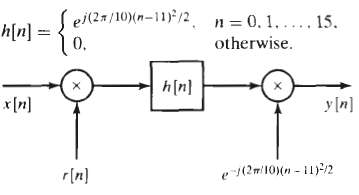
Consider the system shown in Figure, with, it is desired that the output of the system, y[n + 11] = X(e j?n), where ?n = (2?/19) + n(2?/10) for n = 0,?,4, Give the correct value for the sequence r[n] in Figure. Such that the output y [n] provides the desired samples of the discrete-time Fourier
Assume that you wish to sort a sequence x[n] of length N = 16 into bit-reversed order for input to an FFT algorithm. Give the new sample order for the bit-reversed sequence.
The butterfly in Figure was taken from a decimation-in-time FFT with N = 16. Assume that the four stages of the signal flow graph are indexed by m = 1,?., 4. What are the possible values of r for each of the four stages?
Suppose you have two programs for computing the DFT of a sequence x[n] that has N = 2v nonzero samples. Program A computes the DFT by directly implementing the definition of the DFT sum from Eq. and takes N2 seconds to run. Program B implements the decimation-in-time FFT algorithm and takes 10N
The butterfly in figure was taken from a decimation-in-time FFT with N = 16. Assume that the four stages of the signal flow graph are indexed by m = 1,?, 4. Which of the four stages have butterflies of this form?
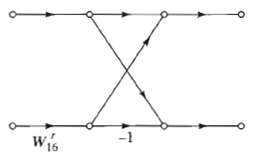
Suppose you are told that an N = 32 FFT algorithm has a “twiddle” factor W232 for one of the butterflies in its fifth (last) stage. Is the FFT a decimation-in-time or decimation-in-frequency algorithm?
Suppose you have a signal x[n] with 1021 nonzero samples whose discrete-time Fourier transform you wish to estimate by computing the DFT. You find that it takes your computer 100 seconds to compute the 1021-point DFT of x[n]. You then add three zero-valued samples at the end of the sequence to form
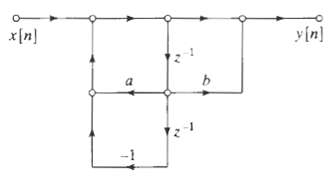
Consider the signal flow graph in figure. Suppose that the input to the system x[n] is an 8-point sequence. Choose the values of a and b such that y[8] = X(ej6?/8).
Suppose that you time-reverse and delay a real-valued 32-point sequence x [n] to obtain x1[n] = x[32 ? n]. If x1[n] is used as the input for the system in figure, find an expression for y[32] in terms of X(e j?), the discrete-time Fourier transform of the original sequence x[n]. ?
In Section 9.2, we used the fact that W-kNN = 1 to derive a recurrence algorithm for computing a specific DFT value X [k] for a finite-length sequence x[n], = 0, 1, ,?, N ? 1. (a) Using the fact that WkNN = WNnN = 1, show that X[N ? k] can be obtained as the output after N iterations of the
Construct a flow graph for a 16-point radix-2 decimation-in-time FFT algorithm. Label all multipliers in terms of powers of W16, and also label any branch transmittances that are equal to – 1. Label the input and output nodes with the appropriate values of the input and DFT sequences,
This problem deals with the efficient computation of samples of the z-transform of a finite-length sequence. Using the chirp transform algorithm, develop a procedure for computing valued of X (z) at 25 points spaced uniformly on an arc of a circle of radius 0.5, beginning at an angle of – π/6
The N-point DFT of the N-point sequence x[n] = e–j (π/N) n2, for N even, is X[k] = √Ne– jπ/4 ej(π/N) k2.Determine the 2N-point DFT of the 2N-point sequence y[n] = e– j(π/N) n2, assuming that N is even.
We are given a finite-length sequence x[n] of length 627 (i.e., x [n] = 0 for n 626), and we have available an FFT program that will compute the DFT of a sequence of any length N = 2v. For the given sequence, we want to compute samples of the discrete-time Fourier transform at
A finite-length signal of length L = 500 (x[n] = 0 for n < 0 and n > L – 1) is obtained by sampling a continuous-time signal with sampling rate 10,000 samples per second. We wish to compute samples of the z-transform of x[n] at the N equally spaced points zk = (0.8) e j2πk/N, for 0 ≤ k
Suppose that a finite-length sequence x[n] has the N-point DFT X [k], and suppose that the sequence satisfies the symmetry condition x[n] = − x[((n + N/2)) N], 0 ≤ n ≤ N – 1, where N is even and x [n] is complex.(a) Show that X [k] = 0 for k = 0, 2,…, N – 2.(b) Show how to compute the
Consider an N-point sequence x[n] with DFT X[k], k = 0, 1, ?, N ? 1. The following algorithm computes the even-indexed DFT values X[k], k0, 2, ?. , N ? 2, for N even, using only a single N/2 ?point DFT: 1. Form the sequence y [n] by time aliasing, i.e., 2. Compute Y [r], r = 0, 1, ?., (N/2) ? 1,
Let x [n] and h [n] be two real finite-length sequences such that x[n] = 0 for n outside the interval 0 ? n ? L ? 1, h[n] = 0 for n outside the interval 0 ? n ? p ? 1. We wish to compute the sequence y[n] = x[n] * h[n], where * denotes ordinary convolution. (a) What is the length of the sequence y
X[n] is a 1024-point sequence that is nonzero only for 0 ? n ? 1023. Let X[k] be the 1024-point DFT of x[n]. Given X[k], we want to compute x[n] in the ranges 0 ? n ? 3 and 1020 ? 1023 using the system in Figure. Note that the input to the system is the sequence of DFT coefficients. By selecting
In many applications (such as evaluating frequency responses and interpolation), it is of interest to compute the DFT of a short sequence that is ?zero-padded.? In such cases, a specialized ?pruned? FFT algorithm can be used to increase the efficiency of computation (Markel, 1971). In this problem,
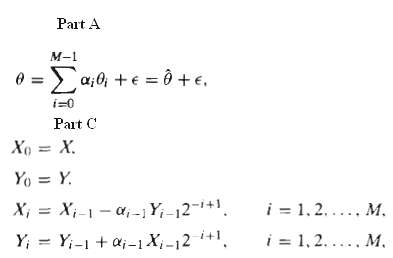
In computing the DFT, it is necessary to multiply a complex number by another complex number whose magnitude is unity, i.e., (X + jY) e j?. Clearly, such a complex multiplication changes only the angle of the complex number, leaving the magnitude unchanged. For this reason, multiplications by a
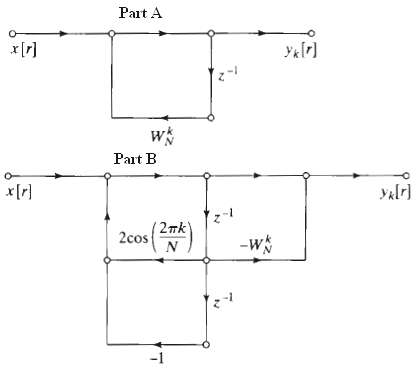
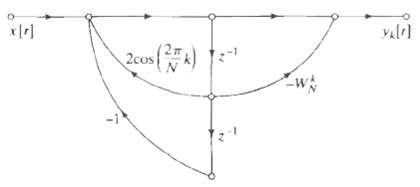
In the Goertzel algorithm for computation of the discrete Fourier transform, X[k] is computed as X[k] = Yk[n], where yk[n] is the output of the network shown in Figure. Consider the implementation of the Goertzel algorithm using fixed-point arithmetic with rounding. Assume that the register length
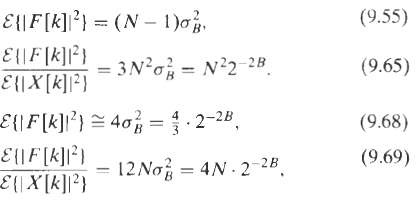
Consider direct computation of the DFT using fixed-point arithmetic with rounding. Assume that the register length is B bits plus the sign (i.e., a total of B + 1 bits) and that the round-off noise introduced by any real multiplication is independent of that produced by any other real
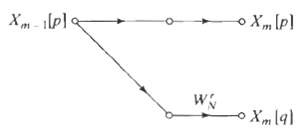
In implementing a decimation-in-time FFT algorithm, the basic butterfly computation is Xm[p] = Xm-1[p] + /WrN Xm-1[q], Xm[q] = Xm-1[p] – WrN Xm-1[q]. In using fixed-point arithmetic to implement the computations, it is commonly assumed that all numbers are scaled to be less than unity. Therefore,
In deriving formulas tor the noise-to-signal ratio for the fixed-point radix-2 decimation-in-time FFT algorithm, we assumed that each output node was connected to (N ? 1) butterfly computations, each of which contributed an amount ?2B = 1/3. 2?2B to the output noise variance However, when WrN = ? 1
In Section 9.7 we considered a noise analysis of the decimation-in-time FFT algorithm of figure. Carry out a similar analysis for the decimation-in-frequency algorithm of figure, obtaining equations for the output noise variance and noise-to-signal ratio for scaling at the input and also for
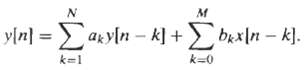
The input and output of a linear time-invariant system satisfy a difference equation of the form, Assume that an FFT program is available for computing the DFT of any finite-length sequence of length N = 2v. Describe a procedure that utilizes the available FFT program to compute H(ej(2?/512) k) for
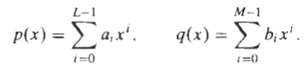
Suppose that we wish to multiply two very large numbers (possibly thousands of bits long) on a 16-bit computer. In this problem, we will investigate a technique for doing these using FFTs. (a) Let p(x) and q(x) be the two polynomials, show that the coefficients of the polynomial r(x) = p(x) q(x)
The discrete Hartley transform (DHT) of a sequence x[n] of length N is defined as, where HN[a] = CN[a] + SN[a], with CN[a] = cos (2?a/N), SN[a] = sin(2?a/N). Problem explores the properties of the discrete Hartley transform in detail, particularly its circular convolution property. (a) Verify that
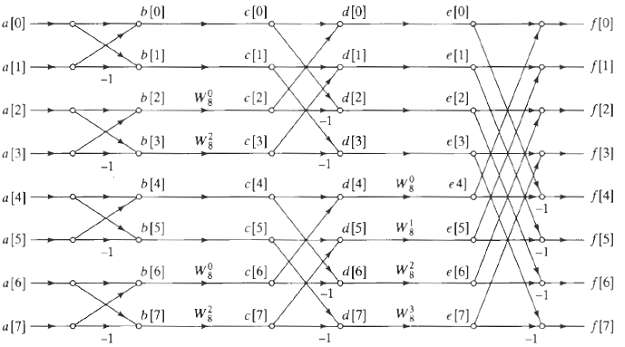
In this problem, we will write the FFT as a sequence of matrix operations. Consider the 8-point decimation-in-time FFT algorithm shown in figure. Let a and f denote the input and output vectors, respectively. Assume that the input is in bit-reversed order and that the output is in normal order
In real continuous-time signal xc(t) is bandlimited to frequencies below 5 kHz; i.e., Xc(jΩ) = 0 for |Ω| ≥ 2π(5000). The signal xc(t) is sampled with a sampling rate of 10,000 samples per second (10kHz) to produce a sequence x[n] = xc(nT) with T = 10−4.Let X[k] be the 1000-point DFT of
A continuous-time signal xc(t) is bandlimited to 5 kHz; i.e., Xc(jΩ) = 0 for |Ω| ≥ 2π (5000). xc(t) is sampled with period T, producing the sequence x[n] = xc(nT). To examine the spectral properties of the signal, we compute the N-point DFT of a segment of N samples of x[n] using a computer
A speech signal is sampled with a sampling rate of 16,000 samples/s (16 kHz). A window of 20-ms duration is used in time-dependent Fourier analyses of the signal, as described in section 10.3, with the window being advanced by 40 samples between computations of the DFT. Assume that the length of
A real-valued continuous-time segment of a signal xc(t) is sampled at a rate of 20,000 samples/sec, yielding a 1000-point finite-length discrete-time sequence x[n] that is nonzero in the interval 0 ≤ n ≤ 999. It is known that xc(t) is also bandlimited such that Xc(jΩ) = 0 for |Ω| ≥ 2π
A continuous-time signal xc(t) = cos(Ω0t) is sampled with period T to produce the sequence x[n] = xc(nT). An N-point rectangular window is applied to x[n] for 0, 1, … N−1, and X[k], for k = 0, 1,…. N – 1, is the N-point DFT of the resulting sequence. (a) Assuming that Ω0, N, and k0
Let xc(t) be a real-valued, bandlimited signal whose Fourier transform xc(jΩ) is zero for |Ω| ≥ 2π (5000). The sequence x[n] is obtained by sampling xc(t) at 10 kHz. Assume that the sequence x[n] is zero for n < 0 and n > 999.Let X[k] denote the 1000-point DFT of x[n]. It is known that
Consider estimating the spectrum of a discrete-time signal x[n] using the DFT with a Hamming window for w[n]. A conservative rule of thumb for the frequency resolution of windowed DFT analysis is that the frequency resolution is equal to the width of the main lobe of W(ejω). You wish to be able to
Let x[n] be a discrete-time signal whose spectrum you wish to estimate using a windowed DFT. You are required to obtain a frequency resolution of at least π/25 and are also required to use a window length N = 256. A safe estimate of the frequency resolution of a spectral estimate is the main-lobe
The following are three different signals xi[n] that are the sum of two sinusoids:x1[n] = cos (πn/4) + cos (17πn/64),x2[n] = cos (πn/4) + 0.8 cos (21πn/64),x3[n] = cos (πn/4) + 0.001 cos (21πn/64).We wish to estimate the spectrum of each of these signals using a 64-point DFT with a 64-point
Let x[n] be a discrete-time signal obtained by sampling a continuous-time signal xc(t) with some sampling period T so that x[n] = xc(nT). Assume xc(t) is bandlimited to 100 Hz, i.e, Xc(jΩ) = 0 for |Ω| ≥ 2π(100). We wish to estimate the continuous-time spectrum Xc(jΩ) by computing a
Let x[n] be a 5000-point sequence obtained by sampling a continuous-time signal xc(t) at T = 50 μs. Suppose X[k] is the 8192-point DFT of x[n]. What is the equivalent frequency spacing in continuous time of adjacent DFT samples?
Assume that x[n] is a 1000-point sequence obtained by sampling a continuous-time signal xc(t) at 8 kHz and that Xc(jΩ) is sufficiently bandlimited to avoid aliasing. What is the minimum DFT length N such that adjacent samples of X[k] correspond to a frequency spacing of 5 Hz or less in the
Let Xr[k] be the time-dependent Fourier transform (TDFT) defined in Eq. (10.36). For this problem, consider the TDFT when both the DFT length N = 36 and the sampling interval R = 36. Let the window w[n] be a rectangular window. Compute the TDFT Xr[k] for −∞ < r < ∞ and 0 ≤ k ≤ N –
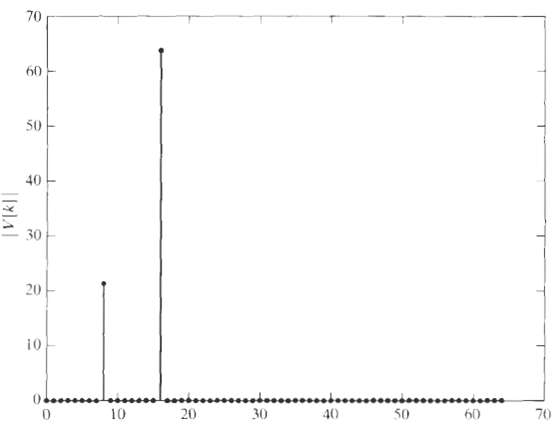
Figure shows the magnitude |V[k]| of the 128-point DFT V[k] for a signal v[n]. The signal v[n] was obtained by multiplying x[n] by a 128-point rectangular window w[n]; i.e., v[n] = x[n]w[n]. Note that Figure shows |V[k]| only for the interval 0 ? k ? 64. Which of the following signals could be
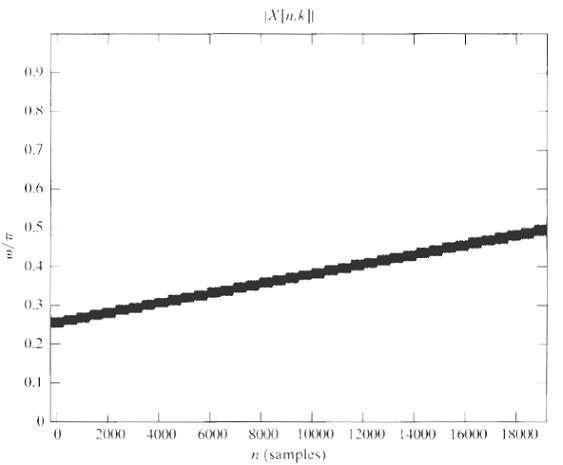
Figure shows the spectrogram of a chirp signal of the form? x[n] = sin (?0n + 1/2?n2). Note that the spectrogram is a representation of the magnitude of X[n, k], as defined in Eq. (??), where the dark regions indicate large values of |X[n, k]|. Based on the figure, estimate ?0 and ?.
A continuous-time signal is sampled at a sampling rate of 10 kHz, and the DFT of 1024 samples is computed. Determine the continuous-time frequency spacing between spectral samples. Justify your answer.
A signal x[n] is analyzed using the time-dependent Fourier transform Xr[k], as defined in Eq. (10.36). Initially, the analysis is performed with an N = 128 DFT using an L = 128-point Hamming window w[n]. The time-domain sampling of adjacent blocks is R= 128; i.e., the windowed segments are offset
Let x[n] be a signal with a single sinusoidal component. The signal x[n] is windowed with an L-point Hamming window w[n] to obtain v1[n] before computing V1(ejω). The signal is then windowed with an L-point rectangular window to obtain v2[n], which is used compute V2(ejω). Will the peaks in
Assume that you wish to estimate the spectrum of x[n] by applying a Kaiser window to the signal before computing the DTFT. You require that the side lobe of the window be 30 dB below the main lobe and that the frequency resolution be π/40. The width of the main lobe of the window is a safe
It is desired to estimate the spectrum of x[n] by applying a 512-point Kaiser window to the signal before computing X(ejω).(a) The requirements for the frequency resolution of the system specify that the largest allowable main lobe for the Kaiser window is π/100. What is the best side lobe
Let x[n] = cos(2πn/5) and v[n] be the sequence obtained by applying a 32-point rectangular window to x[n] before computing V(ejω). Sketch |V(ejω) for –π ≤ ω ≤ π, labeling the frequencies of all peaks and the first nulls on either side of the peak. In addition, label the amplitudes of
Sketch the spectrogram obtained by using a 256-point rectangular window and 256-point DFTs with no overlap (R = 256) on the signalx[n] cos [πn/4 + 1000sin (πn/8000)]for the interval 0 ≤ n ≤ 16,000.
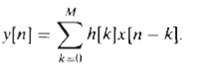
Suppose that y[n] is the output of linear time-invariant FIR system with input x[n]; i.e., (a) Obtain a relationship between the time-dependent Fourier transform Y[n, ?) of the output of the linear system and the time-dependent Fourier transform X[n, ?) of the input. (b) Show that if the window is
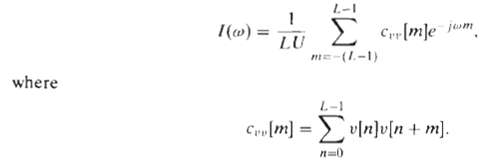
The periodogram I(?) if a discrete-time random signal x[n] was defined in Eq. (10.52) as? I(?) = 1/LU |V(ej?)|2, where V(ej?) is the discrete-time Fourier transform of the finite-length sequence v[n] = w[n]x[n], with w[n] a finite-length window sequence of?length L, and U is a normalizing
Showing 700 - 800
of 1744
1
2
3
4
5
6
7
8
9
10
11
12
13
14
15
Last
Step by Step Answers

 Get 50% OFF
Claim Now
Get 50% OFF
Claim Now




![Part A X|k]e(2a/8)kn t%39 Part D S 2X(k]. k = 0, 2, 4. 6. k = 1. 3, 5, 7. 0. Y(k]](https://dsd5zvtm8ll6.cloudfront.net/si.question.images/images/question_images/1550/2/0/5/7975c664365949251550205797337.jpg)
![Periodic Sequence (Period N) DFS Cocfficients (Period N) *(k] 10. *|-n) X.k] = }(X(k] + **(-k) X,k] = }(X[k] – X*l-k](https://dsd5zvtm8ll6.cloudfront.net/si.question.images/images/question_images/1550/2/0/6/9505c6647e6a5d111550206949557.jpg)
![š[n]. 0<n< N – 1, otherwise. 0, x[n] = (8.57) N-1 E x[m] E WN E x(m]p[n – m]. ř[n] = (8.54) k=0 m=-00 m=-0 sin[(wN](https://dsd5zvtm8ll6.cloudfront.net/si.question.images/images/question_images/1550/2/0/7/0815c6648693a2ee1550207080966.jpg)
![V[k] = (W – bW)Y[R]. N.](https://dsd5zvtm8ll6.cloudfront.net/si.question.images/images/question_images/1550/2/0/7/6945c664ace550151550207693062.jpg)
![X 4[k] = X(z)| k = 0, 1. 2. .... N – 1. z=e{?+k;Ni+;N](https://dsd5zvtm8ll6.cloudfront.net/si.question.images/images/question_images/1550/2/0/7/7745c664b1ecda861550207774578.jpg)