New Semester
Started
Get
50% OFF
Study Help!
--h --m --s
Claim Now
Question Answers
Textbooks
Find textbooks, questions and answers
Oops, something went wrong!
Change your search query and then try again
S
Books
FREE
Study Help
Expert Questions
Accounting
General Management
Mathematics
Finance
Organizational Behaviour
Law
Physics
Operating System
Management Leadership
Sociology
Programming
Marketing
Database
Computer Network
Economics
Textbooks Solutions
Accounting
Managerial Accounting
Management Leadership
Cost Accounting
Statistics
Business Law
Corporate Finance
Finance
Economics
Auditing
Tutors
Online Tutors
Find a Tutor
Hire a Tutor
Become a Tutor
AI Tutor
AI Study Planner
NEW
Sell Books
Search
Search
Sign In
Register
study help
physics
electricity and magnetism
Fundamentals of Ethics for Scientists and Engineers 1st Edition Edmund G. Seebauer, Robert L. Barry - Solutions
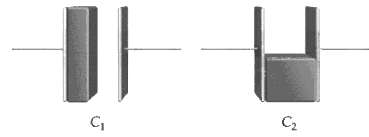
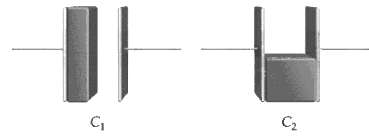
The plate areas and plate separations of the two parallel-plate capacitors shown in Figure are identical. Half the region between the plates of capacitor C1 is filled with a dielectric of dielectric constant ?. What fraction of the volume of capacitor C2 should be filled with the same dielectric
Repeat Problem 80 if the region filled with dielectric of capacitor (a) is two-thirds of the volume between the plates.
Two conducting spheres of radius R are separated by a distance large compared to their size. One initially has charge Q and the other is uncharged. A thin wire is then connected between them. What fraction of the initial energy is dissipated?
A parallel-plate capacitor of area A and separation d is charged to a potential difference V and then disconnected from the charging source. The plates are then pulled apart until the separation is 2d. Find expressions in terms of A, d, and V for(a) The new capacitance,(b) The new potential
A parallel-plate capacitor has capacitance C0 with no dielectric. It is then filled with dielectric of constant κ. When a second capacitor of capacitance C' is connected in series with the first one, the capacitance of the series combination is C0. Find C'.
A Leyden jar, the earliest type of capacitor, is a glass jar coated inside and out with metal foil. Suppose that a Leyden jar is a cylinder 40 cm high with 2.0-mm-thick walls and an inner diameter of 8 cm. Ignore any field fringing.(a) Find the capacitance of this Leyden jar if the dielectric
A parallel-plate capacitor is constructed from a layer of silicon dioxide of thickness 5 × 10⁻⁶ m between two conducting films. The dielectric constant of silicon dioxide is 3.8 and its dielectric strength is 8 × 10⁶ V/m.(a) What voltage can be applied across this capacitor without dielectric
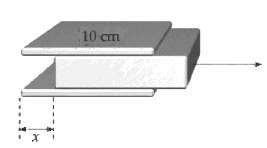
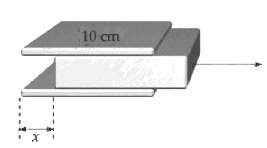
A parallel-plate capacitor has rectangular plates of length L = 10 cm and width W = 4 cm (Figure). The region between the plates is filled with a dielectric slab of dielectric constant ? = 4 which can slide along the length of the capacitor. Initially, the slab completely fills the rectangular
Suppose the capacitor of Problem 88 is connected to a constant voltage source of 20 V. How far should the dielectric slab be pulled so that the stored energy is reduced to half its initialvalue?
A parallel combination of two identical 2-μF parallel-plate capacitors is connected to a 100-V battery. The battery is then removed and the separation between the plates of one of the capacitors is doubled. Find the charge on each of the capacitors.
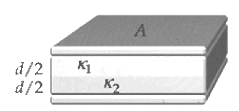
A parallel-plate capacitor has a capacitance C0 and a plate separation d. Two dielectric slabs of constants ?1 and ?2, each of thickness ½ d and having the same area as the plates, are inserted between the plates as shown in Figure. When the charge on the plates is Q, find (a) The electric field
A parallel-plate capacitor has a plate area A and a separation d. A metal slab of thickness t and area A is inserted between the plates.(a) Show that the capacitance is given by C = є0A/(d - t), regardless of where the metal slab is placed.(b) Show that this arrangement can be considered to be a
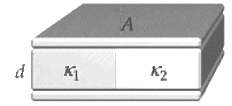
A parallel-plate capacitor is filled with two dielectrics of equal size as shown in Figure. (a) Show that this system can be considered to be two capacitors of area ??A?connected in parallel. (b) Show that the capacitance is increased by the factor (?1 + ?2)/2.
A parallel-plate capacitor of plate area A and separation x is given a charge Q and is then removed from the charging source.(a) Find the stored electrostatic energy as a function of x.(b) Find the increase in energy dU due to an increase in plate separation dx from dU = (dU/dx) dx.(c) If F is the
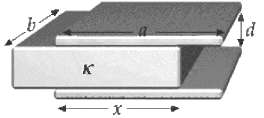
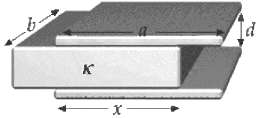
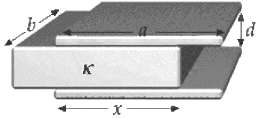
A rectangular parallel-plate capacitor of length a and width b has a dielectric of width b partially inserted a distance x between the plates, as shown in Figure. (a) Find the capacitance as a function of x. Neglect edge effects. (b) Show that your answer gives the expected results for x = 0 and x
Two identical, 4-μF parallel-plate capacitors are connected in series across a 24-V battery.(a) What is the charge on each capacitor?(b) What is the total stored energy of the capacitors? A dielectric having a dielectric constant of 4.2 is inserted between the plates of one of the capacitors while
A parallel-plate capacitor has a plate area of 1.0 m2 and a plate separation distance of 0.5 cm. Completely filling the space between the conducting plates is a glass plate having a dielectric constant of 5.0. The capacitor is charged to a potential difference of 12.0 V and is then removed from its
The capacitor shown in Figure carries charges of +Q and ???Q on its plates. (a) Find the stored energy as a function x. (b) Use the result of (a) to determine the force that acts on the dielectric slab.
The capacitor shown in Figure is connected to a constant voltage source V. (a) Find the stored energy as a function of x. (b) Use the result of (a) to determine the force that acts on the dielectricslab.
A capacitor carries a charge of 15 μC when the potential between its plates is V. When the charge on the capacitor is increased to 18 μC, the potential between the plates increases by 6 V. Find the capacitance of the capacitor and the initial and final voltages.
You are asked to construct a parallel-plate, air-gap capacitor that will store 100 kJ of energy.(a) What minimum volume is required between the plates of the capacitor?(b) Suppose you have developed a dielectric that can withstand 3 × 10⁸ V/m and has a dielectric constant of 5. What volume of this
Consider two parallel-plate capacitors, C1 and C2, that are connected in parallel. The capacitors are identical except that C2 has a dielectric inserted between its plates. A voltage source of 200 V is connected across the capacitors to charge them and is then disconnected.(a) What is the charge on
A capacitor is constructed of two concentric cylinders of radii a and b (b > a) having a length L >> b. A charge of +Q is on the inner cylinder and a charge of –Q is on the outer cylinder. The region between the two cylinders is filled with a dielectric having a dielectric constant k.(a)
Two parallel-plate capacitors have the same separation and plate area. The capacitance of each is initially 10 μF. When a dielectric is inserted such that it completely fills the space between the plates of one of the capacitors, the capacitance of that capacitor increases to 35 μF. The 35- and
A spherical weather balloon made of aluminized Mylar and filled with helium at atmospheric pressure can lift a payload of 0.2 kg. Determine the capacitance of the balloon. (Neglect the mass of the Mylar.)
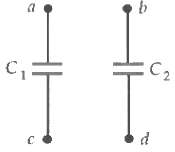
The two capacitors shown in Figure have capacitances C1 = 0.4 ?F and C2 = 1.2 ?F. The voltages across the two capacitors are V1 and V2, respectively, and the total stored energy in the two capacitors is 1.14 mJ. If terminals b?and c?are connected together, the voltage Va?? Vd?= 80 V; if terminal
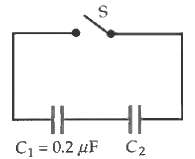
Before switch S in Figure is closed, the voltage across the terminals of the switch is 120 V and the voltage across the 0.2 ?F capacitor is 40 V. The total energy stored in the two capacitors is 1440 ?J. After closing the switch, the voltage across each capacitor is 80 V, and the energy stored by
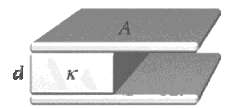
A parallel-plate capacitor of area A and separation d is charged to a potential difference V and is then removed from the charging source. A dielectric slab of constant k = 2, thickness d, and area ½A is inserted as shown in Figure. Let ?1 be the free charge density at the conductor???dielectric
Two identical, 10-μF parallel-plate capacitors are given equal charges of 100 μC each and are then removed from the charging source. The charged capacitors are connected by a wire between their positive plates and another wire between their negative plates.(a) What is the stored energy of the
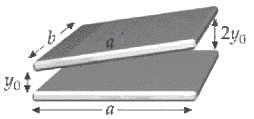
A capacitor has rectangular plates of length a and width b. The top plate is inclined at a small angle as shown in Figure. The plate separation varies from d = y0 at the left to d = 2y0 at the right, where y0 is much less than a or b. Calculate the capacitance using strips of width dx and length b
Not all dielectrics that separate the plates of a capacitor are rigid. For example, the membrane of a nerve axon is a bilipid layer that has a finite compressibility. Consider a parallel-plate capacitor whose plate separation is maintained by a dielectric of dielectric constant k = 3.0 and
A conducting sphere of radius R1 is given a free charge Q. The sphere is surrounded by an uncharged concentric spherical dielectric shell having an inner radius R1, an outer radius R2, and a dielectric constant κ. The system is far removed from other objects.(a) Find the electric field everywhere
A variable air capacitor like the one shown in the photograph on page 759 has a capacitance that changes between 0.02 and 0.12 μF as the shaft is rotated through an angle of 180o. A voltage of 100 V is maintained between the capacitor plates. Initially the capacitor is in its minimum capacitance
Repeat Problem 113 with a voltage of 100 V applied and then disconnected when the capacitor is fully charged.
(Multiple choice)(1)If the voltage across a parallel-plate capacitor is doubled, its capacitance (a) Doubles. (b) Drops by half. (c) Remains the same.(2)If the charge on an isolated spherical conductor is doubled, its capacitance (a) Doubles. (b) Drops by half. (c)
(Multiple choice)(1) True or false: (a) The equivalent capacitance of two capacitors in parallel equals the sum of the individual capacitances. (b) The equivalent capacitance of two capacitors in series is less than the capacitance of either capacitor alone.(2)Two initially uncharged
A physics professor has assembled his class at the baggage-claim carousel of the local airport to demonstrate an analog of electrical current. “Think of each suitcase on the conveyor belt as a package of electrons carrying one coulomb of charge,” he says. Counting and timing the suitcases
A 10–gauge copper wire carries a current of 20 A. Assuming one free electron per copper atom, calculate the drift velocity of the electrons.
In a fluorescent tube of diameter 3.0 cm, 2.0 × 10¹⁸ electrons and 0.5 × 10¹⁸ positive ions (with a charge of +e) flow through a cross-sectional area each second. What is the current in the tube?
In a certain electron beam, there are 5.0 × 10⁶ electrons per cubic centimeter. Suppose the kinetic energy of each electron is 10.0 keV, and the beam is cylindrical, with a diameter of 1.00 mm.(a) What is the velocity of an electron in the beam?(b) Find the beam current.
A charge +q moves in a circle of radius r with speed v.(a) Express the frequency f with which the charge passes a particular point in terms of r and v.(b) Show that the average current is qf and express it in terms of v and r.
A ring of radius a with a linear charge density λ rotates about its axis with angular velocity ω. Find an expression for the current.
A 10-gauge copper wire and a 14-gauge copper wire are welded together end to end. The wires carry a current of 15 A. If there is one free electron per copper atom in each wire, find the drift velocity of the electrons in each wire.
In a certain particle accelerator, a proton beam with a diameter of 2.0 mm constitutes a current of 1.0 mA. The kinetic energy of each proton is 20 MeV. The beam strikes a metal target and is absorbed by it.(a) What is the number n of protons per unit volume in the beam?(b) How many protons strike
The current in a wire varies with time according to the relation I = 20 + 3t2, where I is in amperes and t is in seconds.(a) How many coulombs are transported by the wire between t = 0 and t = 10 s?(b) What constant current would transport the same charge in the same time interval?
In a proton supercollider, the protons in a 5-mA beam move with nearly the speed of light.(a) How many protons are there per meter of the beam?(b) If the cross-sectional area of the beam is 10–6 m2, what is the number density of protons?
Name several common sources of emf. What sort of energy is converted into electrical energy in each?
A 10-m-long wire of resistance 0.2 Ω carries a current of 5 A.(a) What is the potential difference across the wire?(b) What is the magnitude of the electric field in the wire?
A potential difference of 100 V produces a current of 3 A in a certain resistor.(a) What is the resistance of the resistor?(b) What is the current when the potential difference is 25 V?
A block of carbon is 3.0 cm long and has a square cross-sectional area with sides of 0.5 cm. A potential difference of 8.4 V is maintained across its length.(a) What is the resistance of the block?(b) What is the current in this resistor?
A carbon rod with a radius of 0.1 mm is used to make a resistor. The resistivity of this material is 3.5 × 10⁻⁵ Ω • m. What length of the carbon rod will make a 10- Ω resistor?
The third (current-carrying) rail of a subway track is made of steel and has a cross-sectional area of about 55 cm2. What is the resistance of 10 km of this track?
What is the potential difference across one wire of a 30-m extension cord made of 16-gauge copper wire carrying a current of 5.0 A?
How long is a 14-gauge copper wire that has a resistance of 2 Ω?
A cylinder of glass 1 cm long has a resistivity of 1012 Ω • m. How long would a copper wire of the same cross-sectional area need to be to have the same resistance as the glass cylinder?
An 80.0-m copper wire 1.0 mm in diameter is joined end to end with a 49.0-m iron wire of the same diameter. The current in each is 2.0 A.(a) Find the electric field in each wire.(b) Find the potential drop across each wire.
A copper wire and an iron wire with the same length and diameter carry the same current I.(a) Find the ratio of the potential drops across these wires.(b) In which wire is the electric field greater?
A variable resistance R is connected across a potential difference V that remains constant. When R = R1, the current is 6.0 A. When R is increased to R2 = R1 + 10.0 Ω, the current drops to 2.0 A. Find(a) R1 and(b) V.
A rubber tube 1 m long with an inside diameter of 4 mm is filled with a salt solution that has a resistivity of 10–3 Ω • m. Metal plugs form electrodes at the ends of the tube.(a) What is the resistance of the filled tube?(b) What is the resistance of the filled tube if it is uniformly
Currents up to 30 A can be carried by 10-gauge copper wire.(a) What is the resistance of 100 m of 10- gauge copper wire?(b) What is the electric field in the wire when the current is 30 A?(c) How long does it take for an electron to travel 100 m in the wire when the current is 30 A?
A cube of copper has sides of 2.0 cm. If it is drawn out to form a 14-gauge wire, what will its resistance be?
A semiconducting diode is a nonlinear device whose current I is related to the voltage V across the diode by I = I0(eeV/kT – 1), where k is Boltzmann’s constant, e is the magnitude of the charge on an electron, and T is the absolute temperature. If I0 = 10–9 A and T = 293 K,(a) What is the
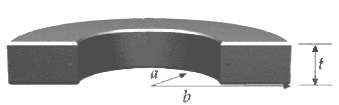
Find the resistance between the ends of the half ring shown in Figure. The resistivity of the material of the ring is ?.
The radius of a wire of length L increases linearly along its length according to r = a + [(b – a)/L]x, where x is the distance from the small end of radius a. What is the resistance of this wire in terms of its resistivity ρ, length L, radius a, and radius b?
The space between two concentric spherical-shell conductors is filled with a material that has a resistivity of 109 Ω • m. If the inner shell has a radius of 1.5 cm and the outer shell has a radius of 5 cm, what is the resistance between the conductors?
The space between two metallic coaxial cylinders of length L and radii a and b is completely filled with a material having a resistivity ρ.(a) What is the resistance between the two cylinders?(b) Find the current between the two cylinders if ρ = 30 Ω • m, a = 1.5 cm, b = 2.5 cm, L = 50 cm, and
A tungsten rod is 50 cm long and has a square cross-sectional area with sides of 1.0 mm.(a) What is its resistance at 20oC?(b) What is its resistance at 40oC?
A toaster with a Nichrome heating element has a resistance of 80 Ω at 20oC and an initial current of 1.5 A. When the heating element reaches its final temperature, the current is 1.3 A. What is the final temperature of the heating element?
An electric space heater has a Nichrome heating element with a resistance of 8 Ω at 20oC. When 120 V are applied, the electric current heats the Nichrome wire to 1000oC.(a) What is the initial current drawn by the cold heating element?(b) What is the resistance of the heating element at 1000oC?(c)
A 10-Ω Nichrome resistor is wired into an electronic circuit using copper leads (wires) of diameter 0.6 mm with a total length of 50 cm.(a) What additional resistance is due to the copper leads?(b) What percentage error in the total added resistance is produced by neglecting the resistance of the
The filament of a certain lamp has a resistance that increases linearly with temperature. When a constant voltage is switched on, the initial current decreases until the filament reaches its steady-state temperature. The temperature coefficient of resistivity of the filament is 4 × 10⁻³ K–1.
A wire of cross-sectional area A, length L1, resistivity ρ1, and temperature coefficient α1 is connected end to end to a second wire of the same cross-sectional area, length L2, resistivity ρ2, and temperature coefficient α2, so that the wires carry the same current.(a) Show that if ρ1L1α1 +
A 10,000-Ω carbon resistor used in electronic circuits is rated at 0.25 W.(a) What maximum current can this resistor carry?(b) What maximum voltage can be placed across this resistor?
A 1-kW heater is designed to operate at 240 V.(a) What is its resistance, and what current does it draw?(b) What is the power dissipated in this resistor if it operates at 120 V? Assume that its resistance is constant.
A battery has an emf of 12.0 V. How much work does it do in 5 s if it delivers a current of 3 A?
(a) How much power is delivered by the emf of the battery in Problem 53 when it delivers a current of 20 A?(b) How much of this power is delivered to the starter?(c) By how much does the chemical energy of the battery decrease when it delivers a current of 20 A to the starter for 3 min?(d) How much
A physics student runs a 1200-W electric heater constantly in her basement bedroom during the winter time. If electric energy costs 9 cents per kilowatt-hour, how much does this electric heating cost per 30-day month?
A battery with an emf of 6 V and an internal resistance of 0.3 Ω is connected to a variable resistance R. Find the current and power delivered by the battery when R is(a) 0,(b) 5 Ω,(c) 10 Ω, and(d) Infinite.
Staying up late to study, and having no stove to heat water, you use a 200-W heater from the lab to make coffee throughout the night. If 90% of the energy produced by the heater goes toward heating the water in your cup,(a) How long does it take to heat 0.25 kg of water from 15 to 100oC?(b) If you
Suppose the bulb in a two-cell flashlight draws 4 W of power. The batteries go dead in 45 min and cost $7.99.(a) How many kilowatt-hours of energy can be supplied by the two batteries?(b) What is the cost per kilowatt-hour of energy if the batteries cannot be recharged?(c) If the batteries can be
A 12-V automobile battery with negligible internal resistance can deliver a total charge of 160 A · h.(a) What is the total stored energy in the battery?(b) How long could this battery provide 150 W to a pair of headlights?
A space heater in an old home draws a 12.5-A current. A pair of 12-gauge copper wires carries the current from the fuse box to the wall outlet, a distance of 30 m. The voltage at the fuse box is exactly 120 V.(a) What is the voltage delivered to the space heater?(b) If the fuse will blow at a
A lightweight electric car is powered by ten 12-V batteries. At a speed of 80 km/h, the average frictional force is 1200 N.(a) What must be the power of the electric motor if the car is to travel at a speed of 80 km/h?(b) If each battery can deliver a total charge of 160 A · h before recharging,
A 100-W heater is designed to operate with an emf of 120 V.(a) What is its resistance, and what current does it draw?(b) Show that if the potential difference across the heater changes by a small amount ΔV, the power changes by a small amount ΔP, where ΔP/P ≈ 2 ΔV/V.(c) Find the approximate
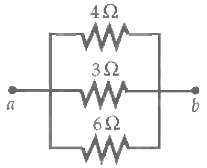
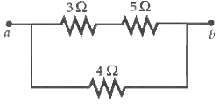
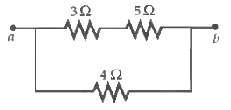
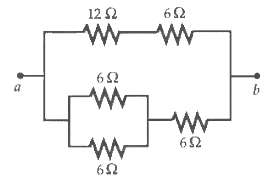
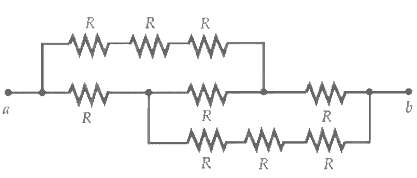
(a) Find the equivalent resistance between points a and b in Figure. (b) If the potential drop between a and b is 12 V, find the current in eachresistor.
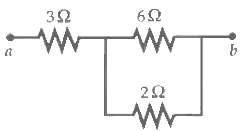
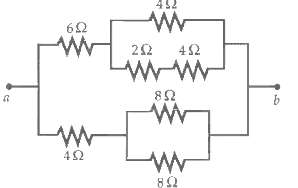
Repeat Problem 66 for the resistor network shown in Figure.
Repeat Problem 66 for the resistor network shown in Figure.
In Figure, the current in the 4-? resistor is 4 A. (a) What is the potential drop between a and b? (b) What is the current in the 3-? resistor?
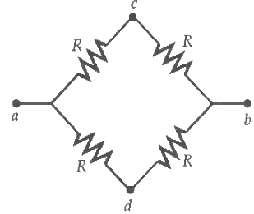
(a) Show that the equivalent resistance between points a and b in Figure is R. (b) What would be the effect of adding a resistance R between points c andd?
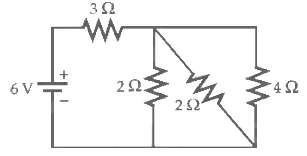
The battery in Figure has negligible internal resistance. Find (a) The current in each resistor and (b) The power delivered by the battery.
A battery has an emf E and an internal resistance r. When a 5.0-Ω resistor is connected across the terminals, the current is 0.5 A. When this resistor is replaced by an 11.0-Ω resistor, the current is 0.25 A. Find(a) The emf E and(b) The internal resistance r.
Consider the equivalent resistance of two resistors R1 and R2 connected in parallel as a function of the ratio x = R2/R1.(a) Show that Req = R1x/(1 + x).(b) Sketch a plot of Req as a function of x.
Repeat Problem 66 for the resistor network shown in Figure.
Repeat Problem 66 for the resistor network shown in figure
A length of wire has a resistance of 120 Ω. The wire is cut into N identical pieces which are then connected in parallel. The resistance of the parallel arrangement is 1.875 Ω. Find N.
A parallel combination of an 8-Ω resistor and an unknown resistor R is connected in series with a 16-Ω resistor and a battery. This circuit is then disassembled and the three resistors are then connected in series with each other and the same battery. In both arrangements, the current through the
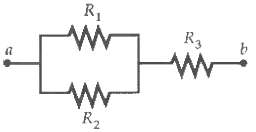
For the resistance network shown in Figure, find (a) R3 such that Rab = R1 (b) R2 such that Rab = R3 and (c) R1 such that Rab =R1.
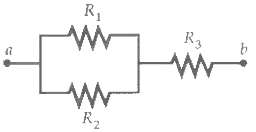
Check your results for Problem 78 using (a) R1 = 4 ?, R2 = 6 ? (b) R1 = 4 ?, R3 = 3 ?; and (c) R2 = 6 ?, R3 = 3 ?.
Nine 10-? resistors are connected as shown in Figure, and a potential difference of 20 V is applied between points a and b. (a) What is the equivalent resistance of this network? (b) Find the current in each of the nine resistors.
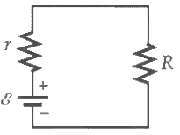
In Figure, the emf is 6 V and R = 0.5 ?. The rate of Joule heating in R is 8 W. (a) What is the current in the circuit? (b) What is the potential difference across R? (c) What is r?
Showing 4500 - 4600
of 8940
First
39
40
41
42
43
44
45
46
47
48
49
50
51
52
53
Last
Step by Step Answers

 Get 50% OFF
Claim Now
Get 50% OFF
Claim Now