New Semester
Started
Get
50% OFF
Study Help!
--h --m --s
Claim Now
Question Answers
Textbooks
Find textbooks, questions and answers
Oops, something went wrong!
Change your search query and then try again
S
Books
FREE
Study Help
Expert Questions
Accounting
General Management
Mathematics
Finance
Organizational Behaviour
Law
Physics
Operating System
Management Leadership
Sociology
Programming
Marketing
Database
Computer Network
Economics
Textbooks Solutions
Accounting
Managerial Accounting
Management Leadership
Cost Accounting
Statistics
Business Law
Corporate Finance
Finance
Economics
Auditing
Tutors
Online Tutors
Find a Tutor
Hire a Tutor
Become a Tutor
AI Tutor
AI Study Planner
NEW
Sell Books
Search
Search
Sign In
Register
study help
physics
mechanics
An Introduction to Geotechnical Engineering 2nd edition Robert D. Holtz, William D. Kovacs, Thomas C. Sheahan - Solutions
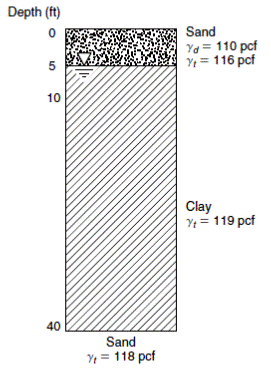
Refer to the soil profile shown in Fig. P6.29 (a) For the conditions shown, compute the ?v, ?v' and u values at the ground surface, water table, and at all soil layer interfaces. (b) During the spring, the water rises to 4 ft above the ground surface. Determine the ?v, ?v' and u at 25 ft.?
Calculate the theoretical height of capillary rise and the capillary tension of the three soils whose grain size distribution is shown in Fig. 2.6.?
For the soil profile of Example 6.8 plot the total, neutral, and effective stresses with depth if the groundwater table is lowered 4 m below the ground surface.
Soil borings made at a site near Chicago indicate that the top 6 m is a loose sand and miscellaneous fill, with the groundwater table at 3 m below the ground surface. Below this is a fairly soft blue-gray silty clay with an average water content of 30%. The boring was terminated at 16 m below the
Plot the soil profile of Problem 6.31 and the total, neutral, and effective stresses with depth.
A soil profile consists of 5 m of compacted sandy clay followed by 5 m of medium dense sand. Below the sand is a layer of compressible silty clay 20 m thick. The initial groundwater table is located at the bottom of the first layer (at 5 m below the ground surface). The densities are 2.05 Mg/m3
For the soil profile of Problem 6.31, calculate the horizontal, total, and effective stresses at depths of 3, 7, 12, and 16 m, assuming (a) Ko is 0.45 (b) Ko is 1.6.?
The value of Ko for the compressible silty clay layer of Problem 6.33 is 0.68. What are the total and effective horizontal stresses at mid-depth of the layer?
A tube, similar to that shown in Fig. 6.12, has a 0.0025-mm inside diameter and is open at both ends. The tube is held vertically and water is added to the top end. What is the maximum height h of the column of water that will be supported? [Hint: A meniscus will form at the top and at the bottom
Figure P6.6 shows an angled, glass capillary tube with diameter 110 m. Other dimensions are shown.(a) Where will the top of the capillary rise be?(b) What is the water pressure in the horizontal section of the tube, in kPa?(c) What air pressure should be applied to the top opening in the tube to
A glass tube with inside diameter 150 μm is placed in a water bath.(a) How high will the water rise inside the tube? Give your answer in cm.(b) What will the water pressure be halfway between the free water surface and the water level in the tube (i.e., at hc/2)? Give your answer in kN/m2.(c) If
Figure P6.8 shows a tube with two sections, each with a different diameter, d1 and d2. The tube is placed in the water bath as shown.(a) How high above the phreatic surface will the water rise in the tube due to capillarity? What is the pore pressure at the surface of the capillary rise?(b) If the
Figure P6.9 shows a long, thin tube which was filled with a clay and placed in a water bath. The D10 for the clay is shown.(a) How high, hc, will the water rise in the tube?(b) What is the capillary pressure at hc, in kN/m2?
A clean sand having a permeability of 4.5 x 10⁻³ cm/s and a void ratio of 0.45 is placed in a horizontal permeability apparatus, as shown in Fig. 7.2. Compute the discharge velocity and the seepage velocity as the head Δh goes from 0 to 80 cm. The cross-sectional area of the horizontal pipe is 95
A constant head permeability test is performed on a soil that is 2 cm x 2 cm square and 2.5 cm long. The head difference applied during the test is 18 cm, and 5 cm3 is collected over a time of 100 sec. (a) Compute the permeability based on these test conditions and results. (b) A falling head
The coefficient of permeability of a clean sand was 389 x 10-4 cm/s at a void ratio of 0.38. Estimate the permeability of this soil when the void ratio is 0.61.?
Permeability tests on a soil supplied the following data:e1 = 0.70, Temp1 = 25 C, k1 = (0.32)-4 cm/se2 = 1.10, Temp2 = 40 C, k1 = (1.80)-4 cm/sEstimate the coefficient of permeability at 20°C and a void ratio of 0.85. (After Taylor, 1948)?
For the initial case in Problem 6.33, compute the head of water required at the top of the silty clay layer to cause a quick condition.?
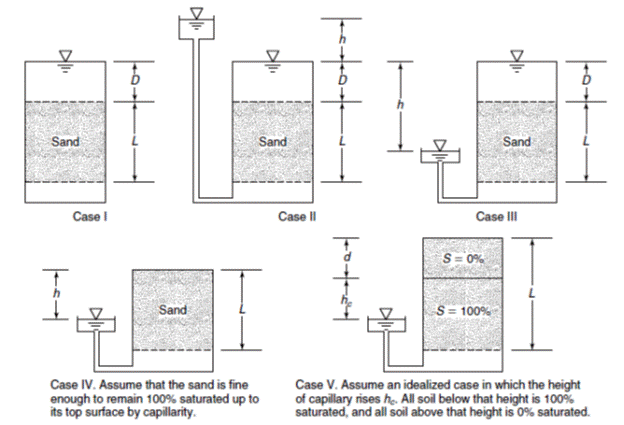
Sand is supported on a porous disc and screen in vertical cylinder, as shown in Fig. P7.14. These are equilibrium conditions. (a) For each of the five cases, plot the total, neutral, and effective stresses versus height. These plots should be approximately to scale. (b) Derive formulas for those
Given the soil cylinder and test setup of Example 7.4, with actual dimensions as follows: AB = 5 cm, BC = 10 cm, CD = 10 cm, and DE = 5 cm. Calculate the pressure, elevation, and total heads at points A through E in cm of water, and plot these values versus elevation.?
For each of the cases I, II, and III of Fig P7.16, determine the pressure, elevation, and total head at the entering end, exit end, and point A of the sample. (After Taylor, 1948)?
For each of the cases shown in Fig P7.16, determine the discharge velocity, the seepage velocity, and the seepage force per unit volume for(a) a permeability of 0.14 cm/s and a porosity of 46%(b) a permeability of 0.0013 cm/s and a void ratio of 0.71. (After Taylor, 1948)?
An inclined permeameter tube is filled with three layers of soil of different permeabilities as in Fig. P7.18. Express the head at points A, B, C, and D (with respect to the datum indicated) in terms of the different dimensions and permeabilities. (After A. Casagrande)
Assume the soil of Fig. 7.10 has a saturated density of 1.89 Mg/m3. If the head of water h above elevation B is 2.45 m, compute the effective stress at elevation A at the bottom of the soil sample during flow. What is the effective stress under these conditions at mid height in the soil column
A sample of medium quartz sand is tested in a constant head permeameter. The sample's diameter is 60 mm and its length is 130 mm. Under an applied head of 60 cm, 119 cm3 flows through the sample in 5 min. The Ms of the sample is 410 g. Calculate(a) The Darcy coefficient of permeability(b) The
The foundation soil at the toe of a masonry dam has a porosity of 38% and a ρ s of 2.73 Mg/m3. To assure safety against piping, the specifications state that the upward gradient must not exceed 30% of the gradient at which a quick condition occurs. What is the maximum permissible upward gradient?
A contractor plans to dig an excavation as show in Fig. P7.23. If the river is at level A, what is the factor of safety against quick conditions? Neglect any vertical shear. To what elevation can the water rise before a quick condition will develop? (After D. N. Humphrey)?
Given the excavation as shown in Example 7.13, with h = 18 m and ρ = 1915 kg/m3. Calculate the minimum allowable Hs.?
A sheet pile wall has been installed partially through a silty sand layer, similar to the one shown in Fig. 7.13(b). Assume a sheet pile 12 m long penetrates 6 m (halfway) into the silty sand layer of thickness 12 m. For this condition: (a) Draw a flow net using three (or four at most) flow
Using the data of Fig. 7.16, compute the total head, piezometric head, pressure head, and elevation head for points C and C'. Assume any convenient datum.?
Assuming that you have completed the flow net of Problem 7.24, compute the total head, piezometric head, pressure head, and elevation head for a point halfway up the sheet pile from its base, on either side of the sheet pile. Assume the datum is at the bottom of the silty sand layer. Plot gradient
A permeability test was run on a compacted sample of dirty sandy gravel. The sample was 175 mm long and the diameter of the mold 175 mm. In 90 s the discharge under a constant head of 38 cm was 405 cm3. The sample had a dry mass of 4950 g and its ρ s was 2710 kg/m3. Calculate(a) the coefficient of
For the completed flow net of Fig. P7.30, compute the flow under the dam per meter of dam if the coefficient of permeability is 4.2 x 10⁻⁴ cm/s.?
Given the data of Problem 7.25 Using the method of fragments, determine:(a) The amount of water flowing under the sheet pile per meter of wall.(b) The exit gradient.?
For the dam of Fig. 7.15, solve for q using the method of fragments.
A protective three-layer filter is proposed between the foundation and rock drain located near the toe of a compacted earth-fill dam. Is this filter acceptable?
In an attempt to reduce minor surface instability and maintenance problems on the backslopes of a rural highway, interceptor trench drains are to be installed at the top of the slope of to intercept surface and infiltrating groundwater from the hillsides above the road. The drains are 1 to 1.5 m
During a falling-head permeability test, the head fell from 49 to 28 cm in 4.7 min. The specimen was 8 cm in diameter and had a length of 85 mm. The area of the standpipe was 0.45 cm2. Compute the coefficient of permeability of the soil in cm/s, m/s. and ft/d. What was the probable classification
A falling-head permeability test is performed on a soil whose permeability is estimated to be 2.8 x 10⁻⁶ m/s. What diameter standpipe for head to drop from 31.2 cm to 19.4 cm in about 5 min? The cross section is 12 cm2 and its length is 7.4 cm. (Taylor, 1948)?
In Example 7.1, the void ratio is specified as 0.43. If the void ratio of the same soil were 0.35, evaluate its coefficient of permeability. First estimate in which direction k would go, higher or lower; then proceed.?
A falling-head permeability test on a specimen of fine sand 12.5 cm2 in area and 10 cm long gave a k of 6.2 x 10⁻⁴ cm/s. The dry mass of the sand specimen was 195 g and ρs was 2.71 Mg/m3. The test temperature was 23°C. Compute the coefficient of permeability of the sand for a void ratio of 0.67
The compression curve for a certain clay is a straight line on the semilogarithmic plot, and it passes through the point e = 1.15, σ' v = 65 kPa and e = 0.76, σ' v = 825 kPa. Determine an equation for this relationship. (After Taylor, 1948)
The following consolidation test data were obtained from undisturbed San Francisco Bay Mud. For this clay, LL = 88, PL = 43, ρs = 2.70 Mg/m3 and w = 105.7%. Initially, the specimen height was 2.54 cm and its volume was 75.14 cm3. Plot the data as percent consolidation versus log pressure. Evaluate
Plot the data of Problem 8.12, on a void ratio versus log pressure graph. Evaluate the pre-consolidation pressure and the virgin compression index. Do these values agree with what you found in Problem 8.12??
The initial water content of the sample in Problem 8.12 is 105.7%, and the density of the solids ρs = 2.70 Mg/m3. Compute the wet and dry density and degree of saturation of the consolidation test sample if the dry weight of the sample is 52.8 g. If the final water content is 59.6%, compute the
A 7.8 m thick layer of soft San Francisco Bay Mud is to be loaded with a granular fill 3.2 m thick, on the average. The total density of the fill is about 1.8 Mg/m3. Assume that the test data in Problem 8.12 is typical of the clay layer, and that the layer is normally consolidated. What
Assume the laboratory test results in Problem 8.12 are typical of another San Francisco Bay Mud site, but where the clay is slightly over-consolidated. The present vertical effective overburden stress is calculated to be about 15 kPa, and the thickness of the clay is 3.9 m. At this location, the
What settlement would you expect at the over consolidated site in Problem 8.16 if the fill to be constructed were 4 m thick?
Plot the following data and determine the preconsolidation pressure and the modified compression index. Specimen height is 25.4 mm, wn = 32.5%, ρd = 1.45 Mg/m3. Sample is from a depth of -11.5 m.% Strain.....................................Pressure
At the site where the sample of Problem 8.18 was taken, the soil profile consists of about 6.5 m of sand and rubble fill and then 9.1 m of clay. The water table is about 1.8 m below the ground surface. Average densities of the sand and rubble fill are 1.45 Mg/m3 above the water table and 1.70 Mg/m3
Plot the following void ratio versus pressure data, and evaluate the compression index and the recompression index. Determine the pre-consolidation stress.Void Ratio____________ Pressure (kPa)1.025 ...................................... 01.006 .................................... 100.997
Use the consolidation data from Problem 8.20 to compute the settlement of a structure that adds 175 kPa to the already existing overburden pressure of 130 kPa at the middle of a 6 m thick layer.
What would be the settlement of the same structure in Problem 8.21 if the over-consolidation ratio of the clay were 1.0 and σ'vo + Δσv = 305 kPa at the mid-depth of the clay layer? Show your work and assumptions on the e versus log s curve of Problem 8.20.
The consolidation curve of Fig Ex. 8.9 is typical of a compressible layer 5 m thick. If the existing overburden pressure is 50 kPa, compute the settlement due to an additional stress of 150 kPa added by a structure?
For the test data of Problem 8.12, construct the field virgin compression curve using the Schmertmann procedure for an OCR of unity?
Do Problem 8.24 for an OCR = 2.5??
At the midpoint of a 7.5 m thick soil layer, the void ratio is 1.9. Find this point on the field virgin compression curve determined in Problem 8.24. What is the corresponding pressure? If this pressure is doubled over the entire site, compute the consolidation settlement of the layer.?
Determine the over consolidation ratio (OCR) for the five fine-grained soils of Figure 8.9a
Figure P8.31 shows a proposed foundation site, with 10 ft of sand overlying 15 ft of clay with consolidation properties shown. The clay is normally consolidated. Assume 1-D conditions.(a) Compute the initial σ'v at the middle of the clay layer prior to excavation and construction.(b) After
As part of a construction project, a 7.5 m thick layer of clay is to be loaded with a temporary 3 m thick sand layer (refer to Fig. P8.32). The figure shows the water-table location, soil unit weights, and the compression curve properties for the clay. Assume the sand layer remains dry.(a)
Refer to Fig. 8.5a. Determine:(a) Using log interpolation between 100 and 1000, determine the σv value at a vertical strain, εv = 20%.(b) If the initial void ratio, eo = 2.6, determine Cr and Cc for this soil. For Cc use the portion of the curve between σv = 100 and 500
A large embankment is to be built on the surface of a 15-ft clay layer. Before the embankment is built, the initial σ'v at the middle of the clay layer is 480 psf. The results from a 1-D consolidation test on the clay from the middle of the layer are as follows: σ'p = 1800 psf C rε = 0.0352 C
Figure P8.35 shows a proposed site where an excavation will be made. The 10 ft layer of sand will be removed, so that the top of the 24 ft normally consolidated clay layer will be exposed. Assume full capillarity in the clay only.(a) Assume that the water-table location remains the same during
Figure P8.36 shows the soil profile at a site where you plan to lower the water table. You have results from two consolidation tests, one from the upper 12 ft thick over-consolidated crust, and another from the lower 32 ft thick normally consolidated zone. You plan to lower the water table from its
When a consolidation test is performed on some soils, the virgin compression region is not linear, but bilinear. Figure P8.37 shows such a compression curve from a 15 ft thick layer.Required:(a) What vertical strain, occurs when the soil is loaded from an initial σ'v1 = 560 psf to σ'v2 =
Refer to the compression curve marked Soil 13 in Fig. 8.9a. Disregard the small unloading cycle in the middle of the curve. The initial void ratio for this soil is 1.17, and the pre-consolidation pressure is 290 kPa. The right-hand vertical boundary of this graph is at σ'vc = 2000 kPa.Required:(a)
What is the OCR of the clay till in Fig. 8.9c?
Estimate the pre-consolidation stress for: (a) The undisturbed Leda clay in Fig. 8.9d (b) Undisturbed Mexico City clay in Fig. 8.9e (c) Undisturbed Chicago clay in Fig. 8.9f (d) The swelling clays from Texas in Fig. 8.9g.?
Determine the compression indices for the four soils of Problem 8.6.?
The pressure versus void ratio data determined from a consolidation test on an undisturbed clay specimen is as follows:(a) Plot the pressure versus void ratio curve on both arithmetic and semi-logarithmic graphs.(b) Determine the equations for the virgin compression curve and for the rebound curve
A building is to be constructed on a stratum of the clay 7 m thick for which consolidation data are given in Problem 8.8. The average existing effective overburden pressure on this clay stratum is 126 kPa. The average applied pressure on the clay after construction of the building is 285 kPa. (a)
The time factor for a clay layer undergoing consolidation is 0.15. What is the degree of consolidation (consolidation ratio) at the center and at the quarter points (that is, z/H = 0.25 and 0.75)? What is the average degree of consolidation for the layer?
A doubly drained specimen, 2.54 cm in height, is consolidated in the lab under an applied stress. The time for 50% overall (or average) consolidation is 12 min. (a) Compute the cv value for the lab specimen. (b) How long will it take for the specimen to consolidate to an average consolidation of
The settlement analysis for a proposed structure indicates that the underlying clay layer will settle 7.5 cm in 3 years, and that ultimately the total settlement will be about 32 cm. However, this analysis is based on the clay layer being doubly drained. It is suspected that there may be no
The time rate of settlement data shown below is for the increment from 20 to 40 kPa from the test in Fig. 8.5. The initial sample height is 2.54 cm, and there are porous stones on the top and at the bottom of the sample. Determine cv by: (a) The log time-fitting procedure (b) The square root of
A consolidation test (Taylor, 1948) was conducted on a sample of soft Chicago silty clay. The specimen had a dry weight of 343.57 g and a density of solids of 2.65 Mg/m3. The area of the ring was 93.31 cm2. A displacement transducer was used, which has a precision of one ten thousandth of an inch
A consolidation test is performed on the specimen with these characteristics:Height of specimen = 37.60 mmArea of specimen = 90.1 cm2Wet weight of specimen = 645.3 gDry weight of specimen = 491.2 gDensity of solids = 2.72 Mg/m3The consolidation data (after A. Casagrande) are summarized in Table
A certain compressible layer has a thickness of 3.8 m. After 1.5 yr, when the clay is 50% consolidated, 7.3 cm of settlement has occurred. For a similar clay and loading conditions, how much settlement would occur at the end of 1.5 yr and 5 yr if the thickness of this new layer were 38 m?
In a laboratory consolidation test on a representative sample of cohesive soil, the original height of a doubly-drained sample was 25.4 mm. Based on the log time versus dial reading data, the time for 50% consolidation was 8.5 min. The laboratory sample was taken from a soil layer which is 14 m
A layer of normally consolidated clay 4.2 m thick has an average void ratio of 1.1. Its compression index is 0.52 and its coefficient of consolidation is 0.8 m2/yr. When the existing vertical pressure on the clay layer is doubled, what change in thickness of the clay layer will result?
The settlement analysis for a proposed structure indicates that 6.5 cm of settlement will occur in 3.4 yr and that the ultimate total settlement will be about 25 cm. The analysis is based on the assumption that the compressible clay layer is drained at both its top and bottom surfaces. However, it
If the final consolidation settlement for the clay layer of Problem 9.1 is expected to be 1.5 m, how much settlement has occurred when the time factor is(a) 0.3(b) 0.8?
The structure of Problem 9.19 was constructed and performed essentially as expected during the first 3.4 yr (that is, the settlement of the building was about 6.5 cm). The owner decides to build a duplicate of the first structure nearby. During foundation investigations, it is discovered that the
A certain doubly drained clay layer has an expected ultimate settlement sc 18 cm. The clay layer, which is 15 m thick, has a coefficient of consolidation of 4.7 x 10⁻³ cm2/s. Plot the sc-time relationship to: (a) an arithmetic time scale (b) a semilog time scale.
Given soil data from Prob. 9.21 After 2.5 yr, an identical load is placed, causing an additional 12 cm of consolidation settlement. Plot the time rate of settlement under these conditions, assuming that the load causing consolidation settlement is placed instantaneously
A specimen of clay in a special consolidation device (with drainage at the top only) has a height of 2.065 cm when fully consolidated under a pressure of 65 kPa. A pressure transducer is located at the base of the sample to measure the pore water pressure. (a) When another stress increment of 65
The total consolidation settlement for a compressible layer 8.3 m thick is estimated to be about 35 cm. After about 8 mo (240 d) a point 2 m below the top of the singly drained layer has a degree of consolidation of 70%. (a) Compute the coefficient of consolidation of the material in m2/day. (b)
A 22 m thick normally consolidated clay layer has a load of 150 kPa applied to it over a large areal extent. The clay layer is located below a granular fill (ρ = 1.8 Mg/m3) 3.5 m thick. A dense sandy gravel is found below the clay. The groundwater table is located at the top of the clay layer, and
Given the same data as for Problem 9.24 for t = 4 yr. At what is the average degree of consolidation for the clay layer?
Again, given the same data as for Problem 9.26 If the clay layer were singly drained from the top only, compute the effective stress at a depth of 16 m below the ground surface and 3.5 yr after placement of the external load.
A doubly drained soil specimen is 3 cm thick. It is loaded from σ'v = 150 kPa to 300 kPa, leading to a change in void ratio from 1.30 to 1.18. Its original void ratio at the start of the test, eo = 1.42.(a) If the time required for 50% consolidation is 20 min, what is the coefficient of
If the clay layer of Example 9.1 were singly drained, would there be any difference in the calculated values? If so, how much difference?
Figure P9.30 shows a 20 m thick layer of normally consolidated clay ( γt = 18.6 kN/m3) that is one-dimensionally loaded by Δσv = 60 kPa. The clay layer is below a 3 m thick layer of granular fill ( γt = 19.6 kN/m3), and a dense, compacted glacial till underlies the clay. The water table
Figure P9.31 shows a soil profile at a certain site, including an 8.5 m thick stratum of saturated, normally consolidated clay overlying an impermeable rock formation. The groundwater location is not known; however, a pore pressure measurement device (piezometer) has been installed in the middle of
Figure P9.32 shows a 20 m thick layer of normally consolidated clay (γt = 18.6 kN/m3) that is one-dimensionally loaded by Δσv = 50 kPa. The clay layer is below a 3 m thick layer of granular fill (γt = 19.6 kN/m3), and a dense, compacted glacial till underlies the clay. The water table is
Determine the average coefficient of permeability, corrected to 20°C, of a clay specimen for the following consolidation increment:σ1 = 200 kPa, e1 = 1.24, σ2 = 400 kPa, e2 = 1.09Height of specimen = 25.4 mm, Drainage at both top and bottom facesTime required for 50% consolidation = 18 min, Test
The following data were obtained from a consolidation test on an undisturbed clay sample: The average value of the coefficient of permeability of the clay in this pressure increment range is 9.2 x 10⁻⁸ cm/s. Compute and plot the decrease in thickness with time for a 12 m layer of this clay which is
Given the data of Problem 9.13 Evaluate(a) The secondary compression index(b) The modified secondary compression index if: eo = 2.45, Ho = 2.54 cm, ρs = 2.69 Mg/m3At t = 0, e = 1.67, H = 1.872 cm. At t = 1485 min, e = 1.387, H = 1.646 cm
Plot a graph of excess pore pressure versus depth, similar to Fig. Ex. 9.2, for the soil and loading conditions given in Example 9.2, but for the case of single drainage. Assume that under the clay there is impervious shale instead of a dense sand.
A consolidation test was performed on a specimen of inorganic clay 2.3 cm thick (doubly drained) and gave the following results: C rε = 0.043, C cε = 0.265, and σ'p = 75 kPa. The typical t100 in the recompression range was 8.4 min, and in the virgin compression range it was 32.5 min. (a) If each
Showing 21600 - 21700
of 21795
First
204
205
206
207
208
209
210
211
212
213
214
215
216
217
218
Step by Step Answers

 Get 50% OFF
Claim Now
Get 50% OFF
Claim Now


.png)
.png)
.png)
.png)
.png)
.png)
.png)
.png)
.png)
.png)
.png)
.png)
.png)
.png)
.png)
.png)
.png)
.png)
.png)
.png)
.png)
.png)


