New Semester
Started
Get
50% OFF
Study Help!
--h --m --s
Claim Now
Question Answers
Textbooks
Find textbooks, questions and answers
Oops, something went wrong!
Change your search query and then try again
S
Books
FREE
Study Help
Expert Questions
Accounting
General Management
Mathematics
Finance
Organizational Behaviour
Law
Physics
Operating System
Management Leadership
Sociology
Programming
Marketing
Database
Computer Network
Economics
Textbooks Solutions
Accounting
Managerial Accounting
Management Leadership
Cost Accounting
Statistics
Business Law
Corporate Finance
Finance
Economics
Auditing
Tutors
Online Tutors
Find a Tutor
Hire a Tutor
Become a Tutor
AI Tutor
AI Study Planner
NEW
Sell Books
Search
Search
Sign In
Register
study help
physics
modern physics
Materials Science and Engineering An Introduction 9th edition William D. Callister Jr., David G. Rethwisch - Solutions
The atomic weight, density, and atomic radius for three hypothetical alloys are listed in the following table. For each, determine whether its crystal structure is FCC, BCC, or simple cubic and then justify your determination?
The unit cell for uranium (U) has orthorhombic symmetry, with a, b, and c lattice parameters of 0.286, 0.587, and 0.495 nm, respectively. If its density, atomic weight, and atomic radius are 19.05 g/cm3, 238.03 g/mol, and 0.1385 nm, respectively, compute the atomic packing factor?
Indium (In) has a tetragonal unit cell for which the a and c lattice parameters are 0.459 and 0.495 nm, respectively.(a) If the atomic packing factor and atomic radius are 0.693 and 0.1625 nm, respectively, determine the number of atoms in each unit cell.(b) The atomic weight of indium is 114.82
Beryllium (Be) has an HCP unit cell for which the ratio of the lattice parameters c/a is 1.568. If the radius of the Be atom is 0.1143 nm,(a) Determine the unit cell volume, and(b) Calculate the theoretical density of Be and compare it with the literature value?
If the atomic radius of lead is 0.175 nm, calculate the volume of its unit cell in cubic meters?
Magnesium (Mg) has an HCP crystal structure, a c/a ratio of 1.624, and a density of 1.74 g/cm3. Compute the atomic radius for Mg?
Cobalt (Co) has an HCP crystal structure, an atomic radius of 0.1253 nm, and a c/a ratio of 1.623. Compute the volume of the unit cell for Co?
Iron (Fe) undergoes an allotropic transformation at 912oC: upon heating from a BCC (α phase) to an FCC (( phase). Accompanying this transformation is a change in the atomic radius of Fe-from RBCC = 0.12584 nm to R= = 0.12894 nm-and, in addition a change in density (and volume). Compute the percent
The accompanying figure shows a unit cell for a hypothetical metal.(a) To which crystal system does this unit cell belong?(b) What would this crystal structure be called?(c) Calculate the density of the material, given that its atomic weight is 141 g/mol.
List the point coordinates of both the zinc (Zn) and sulfur (S) atoms for a unit cell of the zinc blende (ZnS) crystal structure (Figure 12.4)?
(a) What are the direction indices for a vector that passes from pointto pointin a cubic unit cell?(b) Repeat part (a) for a monoclinic unit cell?
(a) What are the direction indices for a vector that passes from pointto pointin a tetragonal unit cell?(b) Repeat part (a) for a rhombohedral unit cell.
For tetragonal crystals, cite the indices of directions that are equivalent to each of the following directions:(a) [011](b) [100]
The accompanying figure shows three different crystallographic planes for a unit cell of a hypothetical metal. The circles represent atoms:(a) To what crystal system does the unit cell belong?(b) What would this crystal structure be called?
The accompanying figure shows three different crystallographic planes for a unit cell of some hypothetical metal. The circles represent atoms:(a) To what crystal system does the unit cell belong?(b) What would this crystal structure be called?(c) If the density of this metal is 18.91 g/cm3,
The interplanar spacing dhkl for planes in a unit cell having orthorhombic geometry is given bywhere a, b, and c are the lattice parameters.(a) To what equation does this expression reduce for crystals having cubic symmetry?(b) For crystals having tetragonal symmetry?
Molybdenum (Mo) has a BCC crystal structure, an atomic radius of 0.1363 nm, and an atomic weight of 95.94 g/mol. Compute and compare its theoretical density with the experimental value found inside the front cover of the book?
For which set of crystallographic planes will a first-order diffraction peak occur at a diffraction angle of 136.15° for BCC tantalum (Ta) when monochromatic radiation having a wavelength of 0.1937 nm is used?
Figure 3.26 shows the first five peaks of the x-ray diffraction pattern for tungsten (W), which has a BCC crystal structure; monochromatic x-radiation having a wavelength of 0.1542 nm was used.(a) Index (i.e., give h, k, and l indices) for each of these peaks.(b) Determine the interplanar spacing
The following table lists diffraction angles for the first four peaks (first-order) of the x-ray diffraction pattern for platinum (Pt), which has an FCC crystal structure; monochromatic x-radiation having a wavelength of 0.0711 nm was used.Plane Indices _____________ Diffraction Angle (2()(111)
The following table lists diffraction angles for the first three peaks (first-order) of the x-ray diffraction pattern for some metal. Monochromatic x-radiation having a wavelength of 0.1397 nm was used.(a) Determine whether this metal's crystal structure is FCC, BCC or neither FCC or BCC, and
The following table lists diffraction angles for the first three peaks (first-order) of the x-ray diffraction pattern for some metal. Monochromatic x-radiation having a wavelength of 0.0711 nm was used.(a) Determine whether this metal's crystal structure is FCC, BCC or neither FCC or BCC and
Strontium (Sr) has an FCC crystal structure, an atomic radius of 0.215 nm and an atomic weight of 87.62 g/mol. Calculate the theoretical density for Sr?
Calculate the radius of a palladium (Pd) atom, given that Pd has an FCC crystal structure, a density of 12.0 g/cm3, and an atomic weight of 106.4 g/mol?
A hypothetical metal has the BCC crystal structure, a density of 7.24 g/cm3, and an atomic weight of 48.9 g/mol. The atomic radius of this metal is:(A) 0.122 nm(B) 1.22 nm(C) 0.0997 nm(D) 0.154 nm
In the following unit cell, which vector represents the [121] direction?
What are the Miller indices for the plane shown in the following cubic unit cell?(A) (201)(B) (1 ( 1 / 2)(C) (10 1/2)(D) (102)
The equilibrium fraction of lattice sites that are vacant in silver (Ag) at 700oC is 2 × 10⁻⁶. Calculate the number of vacancies (per meter cubed) at 700oC. Assume a density of 10.35 g/cm3 for Ag?
(a) Using the result of Problem 4.8(a), compute the radius of an octahedral interstitial site in FCC iron. (b) On the basis of this result and the answer to Problem 4.9, explain why a higher concentration of carbon will dissolve in FCC iron than in iron that has a BCC crystal structure?
(a) For BCC iron, compute the radius of a tetrahedral interstitial site. (See the result of Problem 4.9.) (b) Lattice strains are imposed on iron atoms surrounding this site when carbon atoms occupy it. Compute the approximate magnitude of this strain by taking the difference between the carbon
What is the composition, in atom percent, of an alloy that consists of 92.5 wt% Ag and 7.5 wt% Cu?
What is the composition, in atom percent, of an alloy that consists of 5.5 wt% Pb and 94.5 wt% Sn?
What is the composition, in weight percent, of an alloy that consists of 5 at% Cu and 95 at% Pt?
Calculate the composition, in weight percent, of an alloy that contains 105 kg of iron, 0.2 kg of carbon, and 1.0 kg of chromium?
What is the composition, in atom percent, of an alloy that contains 33 g of copper and 47 g of zinc?
What is the composition, in atom percent, of an alloy that contains 44.5 lbm of Ag, 83.7 lbm of Au, and 5.3 lbm of Cu?
For some hypothetical metal, the equilibrium number of vacancies at 900(C is 2.3 ( 1025 m(3. If the density and atomic weight of this metal are 7.40 g/cm3 and 85.5 g/mol, respectively, calculate the fraction of vacancies for this metal at 900(C?
Calculate the number of atoms per cubic meter in Pb?
Calculate the number of atoms per cubic meter in Cr?
The concentration of Si in an Fe-Si alloy is 0.25 wt%. What is the concentration in kilograms of Si per cubic meter of alloy?
The concentration of phosphorus in silicon is 1.0 × 10⁻⁷ at%. What is the concentration in kilograms of phosphorus per cubic meter?
Determine the approximate density of a Ti-6Al-4V titanium (Ti) alloy that has a composition of 90 wt% Ti, 6 wt% Al, and 4 wt% V?
Calculate the unit cell edge length for an 80 wt% Ag-20 wt% Pd alloy. All of the palladium is in solid solution, the crystal structure for this alloy is FCC, and the room-temperature density of Pd is 12.02 g/cm3?
Some hypothetical alloy is composed of 25 wt% of metal A and 75 wt% of metal B. If the densities of metals A and B are 6.17 and 8.00 g/cm3, respectively, and their respective atomic weights are 171.3 and 162.0 g/mol, determine whether the crystal structure for this alloy is simple cubic,
Molybdenum (Mo) forms a substitutional solid solution with tungsten (W). Compute the number of molybdenum atoms per cubic centimeter for a molybdenum-tungsten alloy that contains 16.4 wt% Mo and 83.6 wt% W. The densities of pure molybdenum and tungsten are 10.22 and 19.30 g/cm3, respectively?
Niobium forms a substitutional solid solution with vanadium. Compute the number of niobium atoms per cubic centimeter for a niobium-vanadium alloy that contains 24 wt% Nb and 76 wt% V. The densities of pure niobium and vanadium are 8.57 and 6.10 g/cm3, respectively?
(a) Calculate the fraction of atom sites that are vacant for copper (Cu) at its melting temperature of 1084°C (1357 K). Assume an energy for vacancy formation of 0.90 eV/atom.(b) Repeat this calculation at room temperature (298 K).(c) What is ratio of Nv /N(1357 K) and Nv /N(298 K)?
Consider an iron-carbon alloy that contains 0.2 wt% C, in which all the carbon atoms reside in tetrahedral interstitial sites. Compute the fraction of these sites that are occupied by carbon atoms?
For a BCC iron-carbon alloy that contains 0.1 wt% C, calculate the fraction of unit cells that contain carbon atoms?
For Si to which has had added 1.0 × 10⁻⁵ at% of aluminum (Al), calculate the number of Al atoms per cubic meter?
Gold (Au) forms a substitutional solid solution with silver (Ag). Compute the weight percent of gold that must be added to silver to yield an alloy that contains 5.5 × 10²¹ Au atoms per cubic centimeter. The densities of pure Au and Ag are 19.32 and 10.49 g/cm3, respectively?
Germanium (Ge) forms a substitutional solid solution with silicon (Si). Compute the weight percent of germanium that must be added to silicon to yield an alloy that contains 2.43 × 10²¹Ge atoms per cubic centimeter. The densities of pure Ge and Si are 5.32 and 2.33 g/cm3, respectively?
Electronic devices found in integrated circuits are composed of very high purity silicon to which has been added small and very controlled concentrations of elements found in Groups IIIA and VA of the periodic table. For Si to which has had added 6.5 × 10²¹ atoms per cubic meter of phosphorus,
Calculate the number of vacancies per cubic meter in gold (Au) at 900°C. The energy for vacancy formation is 0.98 eV/atom. Furthermore, the density and atomic weight for Au are 18.63 g/cm3 (at 900°C) and 196.9 g/mol, respectively?
For a single crystal of some hypothetical metal that has the simple cubic crystal structure (Figure 3.3), would you expect the surface energy for a (100) plane to be greater, equal to, or less than a (110) plane. Why?
For an ASTM grain size of 6, approximately how many grains would there be per square inch under each of the following conditions?(a) At a magnification of 100 ×(b) Without any magnification?
Determine the ASTM grain size number if 30 grains per square inch are measured at a magnification of 250 ×?
Calculate the energy for vacancy formation in nickel (Ni), given that the equilibrium number of vacancies at 850°C (1123 K) is 4.7 × 10²² m-3. The atomic weight and density (at 850°C) for Ni are, respectively, 58.69 g/mol and 8.80 g/cm3?
Atomic radius, crystal structure, electro negativity, and the most common valence are given in the following table for several elements; for those that are nonmetals, only atomic radii are indicated.Which of these elements would you expect to form the following with nickel:(a) A substitutional
Which of the following systems (i.e., pair of metals) would you expect to exhibit complete solid solubility? Explain your answers.(a) Cr-V(b) Mg-Zn(c) Al-Zr(d) Ag-Au(e) Pb-Pt
(a) Compute the radius r of an impurity atom that will just fit into an FCC octahedral site in terms of the atomic radius R of the host atom (without introducing lattice strains).(b) Repeat part (a) for the FCC tetrahedral site.(You may want to consult Figure 4.3a.)
Compute the radius r of an impurity atom that will just fit into a BCC tetrahedral site in terms of the atomic radius R of the host atom (without introducing lattice strains).(You may want to consult Figure 4.3b.)
Copper (Cu) and platinum (Pt) both have the FCC crystal structure, and Cu forms a substitutional solid solution for concentrations up to approximately 6 wt% Cu at room temperature. Determine the concentration in weight percent of Cu that must be added to Pt to yield a unit cell edge length of 0.390
Calculate the number of vacancies per cubic meter at 1000°C for a metal that has an energy for vacancy formation of 1.22 eV/atom, a density of 6.25 g/cm3, and an atomic weight of 37.4 g/mol.(A) 1.49 × 10¹⁸ m-3(B) 7.18 × 10²² m-3(C) 1.49 × 1024 m-3(D) 2.57 × 1024 m-3
What is the composition, in atom percent, of an alloy that consists of 4.5 wt% Pb and 95.5 wt% Sn? The atomic weights for Pb and Sn are 207.19 g/mol and 118.71 g/mol, respectively.(A) 2.6 at% Pb and 97.4 at% Sn(B) 7.6 at% Pb and 92.4 at% Sn(C) 97.4 at% Pb and 2.6 at% Sn(D) 92.4 at% Pb and 7.6 at% Sn
What is the composition, in weight percent, of an alloy that consists of 94.1 at% Ag and 5.9 at% Cu? The atomic weights for Ag and Cu are 107.87 g/mol and 63.55 g/mol, respectively.(A) 9.6 wt% Ag and 90.4 wt% Cu(B) 3.6 wt% Ag and 96.4 wt% Cu(C) 90.4 wt% Ag and 9.6 wt% Cu(D) 96.4 wt% Ag and 3.6 wt%
A sheet of BCC iron 2-mm thick was exposed to a carburizing gas atmosphere on one side and a decarburizing atmosphere on the other side at 675°C.After reaching steady state, the iron was quickly cooled to room temperature. The carbon concentrations at the two surfaces of the sheet were determined
When α-iron is subjected to an atmosphere of nitrogen gas, the concentration of nitrogen in the iron, CN (in weight percent), is a function of hydrogen pressure, pN2 (in MPa), and absolute temperature (T) according to(5.14)Furthermore, the values of D0 and Qd for this diffusion system are 5.0
Determine the carburizing time necessary to achieve a carbon concentration of 0.30 wt% at a position 4 mm into an iron-carbon alloy that initially contains 0.10 wt% C. The surface concentration is to be maintained at 0.90 wt% C, and the treatment is to be conducted at 1100°C. Use the diffusion
An FCC iron-carbon alloy initially containing 0.55 wt% C is exposed to an oxygen-rich and virtually carbon-free atmosphere at 1325 K (1052°C). Under these circumstances the carbon diffuses from the alloy and reacts at the surface with the oxygen in the atmosphere-that is, the carbon concentration
Nitrogen from a gaseous phase is to be diffused into pure iron at 675°C. If the surface concentration is maintained at 0.2 wt% N, what will be the concentration 2 mm from the surface after 25 h? The diffusion coefficient for nitrogen in iron at 675°C is 2.8 × 10⁻¹¹ m2/s?
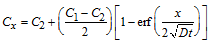
Consider a diffusion couple composed of two semi-infinite solids of the same metal and that each side of the diffusion couple has a different concentration of the same elemental impurity; furthermore, assume each impurity level is constant throughout its side of the diffusion couple. For this
Consider a diffusion couple composed of two cobalt-iron alloys; one has a composition of 75 wt% Co-25 wt% Fe; the other alloy composition is 50 wt% Co-50 wt% Fe. If this couple is heated to a temperature of 800°C (1073 K) for 20,000 s, determine how far from the original interface into the 50 wt%
Consider a diffusion couple between silver and a gold alloy that contains 10 wt% silver. This couple is heat treated at an elevated temperature and it was found that after 850 s the concentration of silver had increased to 12 wt% at 10 μm from the interface into the Ag-Au alloy. Assuming
For a steel alloy it has been determined that a carburizing heat treatment of 15 h duration will raise the carbon concentration to 0.35 wt% at a point 2.0 mm from the surface. Estimate the time necessary to achieve the same concentration at a 6.0-mm position for an identical steel and at the same
Cite the values of the diffusion coefficients for the inter diffusion of carbon in both α-iron (BCC) and γ-iron (FCC) at 900°C. Which is larger? Explain why this is the case.
Using the data in Table 5.2, compute the value of D for the diffusion of magnesium in aluminum at 400°C?
Using the data in Table 5.2 compute the value of D for the diffusion of nitrogen in FCC iron at 950oC?
At what temperature will the diffusion coefficient for the diffusion of zinc in copper have a value of 2.6 × 10⁻¹⁶ m2 / s? Use the diffusion data in Table 5.2.
At what temperature will the diffusion coefficient for the diffusion of nickel in copper have a value of 4.0 ( 10-17 m2/s? Use the diffusion data in Table 5.2.
The preexponential and activation energy for the diffusion of chromium in nickel are 1.1 × 10⁻⁴ m2/s and 272,000 J/mol, respectively. At what temperature will the diffusion coefficient have a value of 1.2 × 10⁻¹⁴ m2/s?
The activation energy for the diffusion of copper in silver is 193,000 J/mol. Calculate the diffusion coefficient at 1200 K (927°C), given that D at 1000 K (727°C) is 1.0 × 10⁻¹⁴ m2/s?
The diffusion coefficients for nickel in iron are given at two temperatures, as follows:T (K) ____________ D (m2/s)1473 ................. 2.2 × 10-151673 ................. 4.8 × 10⁻¹⁴(a) Determine the values of D0 and the activation energy Qd.(b) What is the magnitude of D at 1300°C (1573 K)?
The diffusion coefficients for carbon in nickel are given at two temperatures are as follows:T (°C) _________ D (m2 / s)600 ............ 5.5 × 10-14700............. 3.9 × 10⁻¹³(a) Determine the values of D0 and Qd/(b) What is the magnitude of D at 850°C?
The accompanying figure shows a plot of the logarithm (to the base 10) of the diffusion coefficient versus reciprocal of the absolute temperature for the diffusion of gold in silver. Determine values for the activation energy and pre-exponential?
The accompanying figure shows a plot of the logarithm (to the base 10) of the diffusion coefficient versus reciprocal of the absolute temperature for the diffusion of vanadium in molybdenum. Determine values for the activation energy and pre-exponential.
From Figure 5.12 calculate activation energy for the diffusion of(a) Copper in silicon, and(b) Aluminum in silicon(c) How do these values compare?
Carbon is allowed to diffuse through a steel plate 10 mm thick. The concentrations of carbon at the two faces are 0.85 and 0.40 kg C/cm3 Fe, which are maintained constant. If the pre-exponential and activation energy are 5.0 × 10⁻⁷ m2/s and 77,000 J/mol, respectively, compute the temperature at
The steady-state diffusion flux through a metal plate is 7.8 × 10⁻⁸ kg/m2.s at a temperature of 1200°C (1473 K) and when the concentration gradient is -500 kg/m4. Calculate the diffusion flux at 1000°C (1273 K) for the same concentration gradient and assuming an activation energy for diffusion
At approximately what temperature would a specimen of γ-iron have to be carburized for 4 h to produce the same diffusion result as carburization at 1000°C for 12 h?
(a) Calculate the diffusion coefficient for magnesium in aluminum at 450°C.(b) What time will be required at 550°C to produce the same diffusion result (in terms of concentration at a specific point) as for 15 h at 450°C?
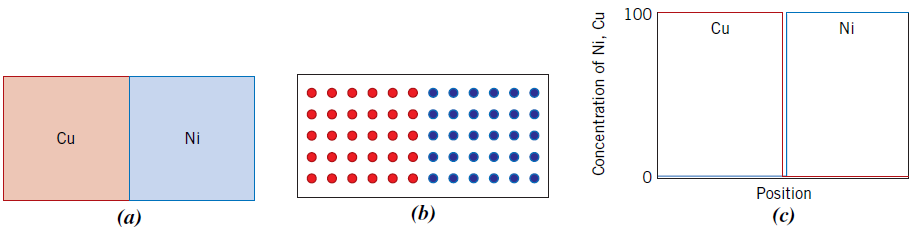
A copper-nickel diffusion couple similar to that shown in Figure 5.1a is fashioned. After a 500-h heat treatment at 1000°C (1273 K) the concentration of Ni is 3.0 wt% at the 1.0-mm position within the copper. At what temperature should the diffusion couple be heated to produce this same
A diffusion couple similar to that shown in Figure 5.1a is prepared using two hypothetical metals A and B. After a 20-h heat treatment at 800°C (and subsequently cooling to room temperature) the concentration of B in A is 2.5 wt% at the 5.0-mm position within metal A. If another heat treatment is
Consider the diffusion of some hypothetical metal Y into another hypothetical metal Z at 950(C; after 10 h the concentration at the 0.5 mm position (in metal Z) is 2.0 wt% Y. At what position will the concentration also be 2.0 wt% Y after a 17.5 h heat treatment again at 950(C? Assume
A diffusion couple similar to that shown in Figure 5.1a is prepared using two hypothetical metals R and S. After a 2.5-h heat treatment at 750(C the concentration of R is 4 at% at the 4-mm position within S. Another heat treatment is conducted on an identical diffusion couple at 900(C and the time
Carbon diffuses in iron via an interstitial mechanism-for FCC iron from one octahedral site to an adjacent one. In Section 4.3 (Figure 4.3a), we note that two general sets of point coordinates for this site areandSpecify the family of crystallographic directions in which this diffusion of carbon in
The outer surface of a steel gear is to be hardened by increasing its carbon content; the carbon is to be supplied from an external carbon-rich atmosphere maintained at an elevated temperature. A diffusion heat treatment at 600°C (873 K) for 100 min increases the carbon concentration to 0.75 wt%
An FCC iron-carbon alloy initially containing 0.10 wt% C is carburized at an elevated temperature and in an atmosphere in which the surface carbon concentration is maintained at 1.10 wt%. If after 48 h the concentration of carbon is 0.30 wt% at a position 3.5 mm below the surface, determine the
For the pre-deposition heat treatment of a semiconducting device, gallium atoms are to be diffused into silicon at a temperature of 1150(C for 2.5 h. If the required concentration of Ga at a position 2 (m below the surface is 8 ( 1023 atoms/m3, compute the required surface concentration of Ga.
Antimony atoms are to be diffused into a silicon wafer using both pre-deposition and drive-in heat treatments; the background concentration of Sb in this silicon material is known to be 2 ( 1020 atoms/m3. The pre-deposition treatment is to be conducted at 900(C for 1 h; the surface concentration of
Showing 7700 - 7800
of 8241
First
69
70
71
72
73
74
75
76
77
78
79
80
81
82
83
Step by Step Answers

 Get 50% OFF
Claim Now
Get 50% OFF
Claim Now


.png)
.png)
-1.png)
-2.png)
-1.png)
-2.png)
.png)
.png)
.png)
.png)
.png)
.png)
.png)

.png)
.png)
-1.png)
-2.png)


