New Semester
Started
Get
50% OFF
Study Help!
--h --m --s
Claim Now
Question Answers
Textbooks
Find textbooks, questions and answers
Oops, something went wrong!
Change your search query and then try again
S
Books
FREE
Study Help
Expert Questions
Accounting
General Management
Mathematics
Finance
Organizational Behaviour
Law
Physics
Operating System
Management Leadership
Sociology
Programming
Marketing
Database
Computer Network
Economics
Textbooks Solutions
Accounting
Managerial Accounting
Management Leadership
Cost Accounting
Statistics
Business Law
Corporate Finance
Finance
Economics
Auditing
Tutors
Online Tutors
Find a Tutor
Hire a Tutor
Become a Tutor
AI Tutor
AI Study Planner
NEW
Sell Books
Search
Search
Sign In
Register
study help
physics
modern physics
Materials Science and Engineering An Introduction 9th edition William D. Callister Jr., David G. Rethwisch - Solutions
Indium atoms are to be diffused into a silicon wafer using both pre-deposition and drive-in heat treatments; the background concentration of In in this silicon material is known to be 2 ( 1020 atoms/m3. The drive-in diffusion treatment is to be carried out at 1175(C for a period of 2.0 h, which
Carbon diffuses in iron via an interstitial mechanism-for BCC iron from one tetrahedral site to an adjacent one. In Section 4.3 (Figure 4.3b) we note that a general set of point coordinates for this site are. Specify the family of crystallographic directions in which this diffusion of carbon in BCC
A sheet of steel 2.5-mm thick has nitrogen atmospheres on both sides at 900°C and is permitted to achieve a steady-state diffusion condition. The diffusion coefficient for nitrogen in steel at this temperature is 1.85 × 10⁻¹⁰ m2/s, and the diffusion flux is found to be 1.0 × 10⁻⁷ kg/m2.s. Also,
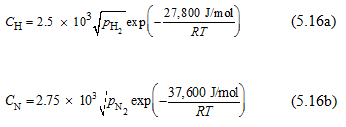
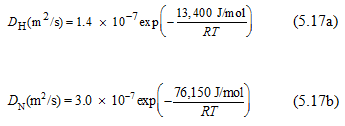
It is desired to enrich the partial pressure of hydrogen in a hydrogen-nitrogen gas mixture for which the partial pressures of both gases are 0.1013 MPa (1 atm). It has been proposed to accomplish this by passing both gases through a thin sheet of some metal at an elevated temperature; inasmuch as
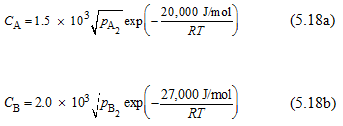
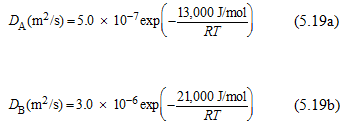
A gas mixture is found to contain two diatomic A and B species (A2 and B2), the partial pressures of both of which are 0.1013 MPa (1 atm). This mixture is to be enriched in the partial pressure of the A species by passing both gases through a thin sheet of some metal at an elevated temperature. The
The wear resistance of a steel shaft is to be improved by hardening its surface by increasing the nitrogen content within an outer surface layer as a result of nitrogen diffusion into the steel; the nitrogen is to be supplied from an external nitrogen-rich gas at an elevated and constant
The wear resistance of a steel gear is to be improved by hardening its surface, as described in Design Example 5.1. However, in this case the initial carbon content of the steel is 0.15 wt%, and a carbon content of 0.75 wt% is to be established at a position 0.65 mm below the surface. Furthermore,
One integrated circuit design calls for the diffusion of aluminum into silicon wafers; the background concentration of Al in Si is 1.75 ( 1019 atoms/m3. The pre-deposition heat treatment is to be conducted at 975(C for 1.25 h, with a constant surface concentration of 4 ( 1026 Al atoms/m3. At a
Atoms of which of the following elements will diffuse most rapidly in iron? (A) Mo (B) C (D) W (C) Cr
Calculate the diffusion coefficient for copper in aluminum at 600(C. Pre-exponential and activation energy values for this system are 6.5 ( 10-5 m2/s and 136,000 J/mol, respectively.(A) 5.7 ( 10(2 m2/s(B) 9.4 ( 10(17 m2/s(C) 4.7 ( 10(13 m2/s(D) 3.9 ( 10(2 m2/s
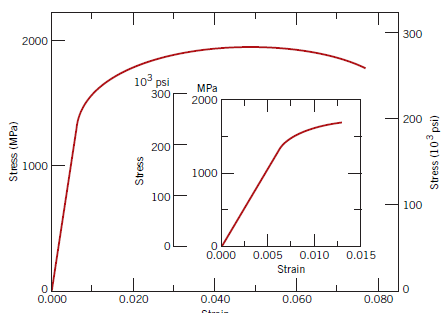
Consider a cylindrical specimen of a steel alloy (Figure 6.22) 8.5 mm (0.33 in.) in diameter and 80 mm (3.15 in.) long that is pulled in tension. Determine its elongation when a load of 65,250 N (14,500 lbf) is applied?Figure 6.22
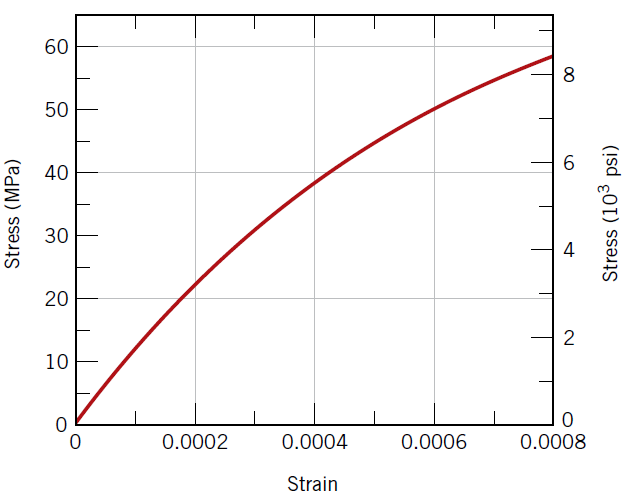
Figure 6.23 shows the tensile engineering stress-strain curve in the elastic region for a gray cast iron. Determine(a) The tangent modulus at 25 MPa (3625 psi) and(b) The secant modulus taken to 35 MPa (5000 psi)?Figure 6.23
Using the solution to Problem 6.13, rank the magnitudes of the moduli of elasticity for the following hypothetical X, Y, and Z materials from the greatest to the least. The appropriate A, B, and n parameters (Equation 6.31) for these three materials are tabulated below; they yield EN in units of
A cylindrical specimen of steel having a diameter of 15.2 mm (0.60 in.) and length of 250 mm (10.0 in.) is deformed elastically in tension with a force of 48,900 N (11,000 lbf). Using the data contained in Table 6.1, determine the following:(a) The amount by which this specimen will elongate in the
A cylindrical bar of aluminum 19 mm (0.75 in.) in diameter is to be deformed elastically by application of a force along the bar axis. Using the data in Table 6.1, determine the force that produces an elastic reduction of 2.5 × 10⁻³ mm (1.0 × 10⁻⁴ in.) in the diameter?
A cylindrical specimen of a metal alloy 10 mm (0.4 in.) in diameter is stressed elastically in tension. A force of 15,000 N (3,370 lbf) produces a reduction in specimen diameter of 7 × 10⁻³ mm (2.8 × 10⁻⁴ in.). Compute Poisson's ratio for this material if its elastic modulus is 100 GPa (14.5 ×
A cylindrical specimen of a hypothetical metal alloy is stressed in compression. If its original and final diameters are 30.00 and 30.04 mm, respectively, and its final length is 105.20 mm, compute its original length if the deformation is totally elastic. The elastic and shear moduli for this
Consider a cylindrical specimen of some hypothetical metal alloy that has a diameter of 10.0 mm (0.39 in.). A tensile force of 1500 N (340 lbf) produces an elastic reduction in diameter of 6.7 × 10⁻⁴ mm (2.64 × 10⁻⁵ in.). Compute the elastic modulus of this alloy, given that Poisson's ratio is
A brass alloy is known to have a yield strength of 240 MPa (35,000 psi), a tensile strength of 310 MPa (45,000 psi), and an elastic modulus of 110 GPa (16.0 × 10⁶ psi). A cylindrical specimen of this alloy 15.2 mm (0.60 in.) in diameter and 380 mm (15.0 in.) long is stressed in tension and found
A cylindrical metal specimen 15.0 mm (0.59 in.) in diameter and 150 mm (5.9 in.) long is to be subjected to a tensile stress of 50 MPa (7250 psi); at this stress level, the resulting deformation will be totally elastic.(a) If the elongation must be less than 0.072 mm (2.83 × 10⁻³ in.), which of
A cylindrical metal specimen 10.7000 mm in diameter and 95.000 mm long is to be subjected to a tensile force of 6300 N; at this force level, the resulting deformation will be totally elastic.(a) If the final length must be less than 95.040 mm, which of the metals in Table 6.1 are suitable
Consider the brass alloy for which the stress-strain behavior is shown in Figure 6.12. A cylindrical specimen of this material 10.0 mm (0.39 in.) in diameter and 101.6 mm (4.0 in.) long is pulled in tension with a force of 10,000 N (2250 lbf). If it is known that this alloy has a value for
A cylindrical rod 120 mm long and having a diameter of 15.0 mm is to be deformed using a tensile load of 35,000 N. It must not experience either plastic deformation or a diameter reduction of more than 1.2 × 10⁻² mm. Of the following materials listed, which are possible candidates? Justify your
A cylindrical rod 500 mm (20.0 in.) long and having a diameter of 12.7 mm (0.50 in.) is to be subjected to a tensile load. If the rod is to experience neither plastic deformation nor an elongation of more than 1.3 mm (0.05 in.) when the applied load is 29,000 N (6500 lb f), which of the four metals
A cylindrical specimen of a brass alloy having a length of 100 mm (4 in.) must elongate only 5 mm (0.2 in.) when a tensile load of 100,000 N (22,500 lbf) is applied. Under these circumstances, what must be the radius of the specimen? Consider this brass alloy to have the stress-strain behavior
A load of 140,000 N (31,500 lbf) is applied to a cylindrical specimen of a steel alloy (displaying the stress-strain behavior shown in Figure 6.22) that has a cross-sectional diameter of 10 mm (0.40 in.).(a) Will the specimen experience elastic and/or plastic deformation? Why?(b) If the original
A bar of a steel alloy that exhibits the stress-strain behavior shown in Figure 6.22 is subjected to a tensile load; the specimen is 375 mm (14.8 in.) long and has a square cross section 5.5 mm (0.22 in.) on a side.(a) Compute the magnitude of the load necessary to produce an elongation of 2.25 mm
A specimen of copper having a rectangular cross section 15.2 mm × 19.1 mm (0.60 in. × 0.75 in.) is pulled in tension with 44,500 N (10,000 lbf) force, producing only elastic deformation. Calculate the resulting strain?
A cylindrical specimen of stainless steel having a diameter of 12.8 mm (0.505 in.) and a gauge length of 50.800 mm (2.000 in.) is pulled in tension. Use the load-elongation characteristics shown in the following table to complete parts (a) through (f)?(a) Plot the data as engineering stress versus
(a) Plot the data as engineering stress versus engineering strain.(b) Compute the modulus of elasticity.(c) Determine the yield strength at a strain offset of 0.002.(d) Determine the tensile strength of this alloy.(e) Compute the modulus of resilience.(f) What is the ductility, in percent
A cylindrical metal specimen 15.00 mm in diameter and 120 mm long is to be subjected to a tensile force of 15,000 N.(a) If this metal must not experience any plastic deformation, which of aluminum, copper, brass, nickel, steel, and titanium (Table 6.2) are suitable candidates? Why?(b) If, in
A cylindrical metal specimen having an original diameter of 12.8 mm (0.505 in.) and gauge length of 50.80 mm (2.000 in.) is pulled in tension until fracture occurs. The diameter at the point of fracture is 8.13 mm (0.320 in.), and the fractured gauge length is 74.17 mm (2.920 in.). Calculate the
Determine the modulus of resilience for each of the following alloys:Use the modulus of elasticity values in Table 6.1?
A cylindrical specimen of a nickel alloy having an elastic modulus of 207 GPa (30 × 106 psi) and an original diameter of 10.2 mm (0.40 in.) experiences only elastic deformation when a tensile load of 8900 N (2000 lbf) is applied. Compute the maximum length of the specimen before deformation if the
A steel alloy to be used for a spring application must have a modulus of resilience of at least 2.07 MPa (300 psi). What must be its minimum yield strength?
Using data found in Appendix B, estimate the modulus of resilience (in MPa) of cold-rolled 17-7PH stainless steel?
Using the data in Problem 6.30 and Equations 6.15, 6.16, and 6.18a, generate a true stress-true strain plot for stainless steel. Equation 6.18a becomes invalid past the point at which necking begins; therefore, measured diameters are given in the following table for the last three data points,
A tensile test is performed on a metal specimen, and it is found that a true plastic strain of 0.16 is produced when a true stress of 500 MPa (72,500 psi) is applied; for the same metal, the value of K in Equation 6.19 is 825 MPa (120,000 psi). Calculate the true strain that results from the
For some metal alloy, a true stress of 345 MPa (50,000 psi) produces a plastic true strain of 0.02. How much does a specimen of this material elongate when a true stress of 415 MPa (60,000 psi) is applied if the original length is 500 mm (20 in.)? Assume a value of 0.22 for the strain-hardening
The following true stresses produce the corresponding true plastic strains for a brass alloy:True Stress (psi) _______ True Strain60,000 ............................ 0.1570,000 ............................ 0.25What true stress is necessary to produce a true plastic strain of 0.21?
For a brass alloy, the following engineering stresses produce the corresponding plastic engineering strains prior to necking:Engineering Stress (MPa) _______________ Engineering Strain315 .......................................................... 0.105340
Find the toughness (or energy to cause fracture) for a metal that experiences both elastic and plastic deformation. Assume Equation 6.5 for elastic deformation, that the modulus of elasticity is 103 GPa (15 × 106 psi), and that elastic deformation terminates at a strain of 0.007. For plastic
An aluminum bar 125 mm (5.0 in.) long and having a square cross section 16.5 mm (0.65 in.) on an edge is pulled in tension with a load of 66,700 N (15,000 lbf) and experiences an elongation of 0.43 mm (1.7 × 10⁻² in.). Assuming that the deformation is entirely elastic, calculate the modulus of
A cylindrical specimen of a brass alloy 10.0 mm (0.39 in.) in diameter and 120.0 mm (4.72 in.) long is pulled in tension with a force of 11,750 N (2640 lbf); the force is subsequently released.(a) Compute the final length of the specimen at this time. The tensile stress-strain behavior for this
(a) Determine the elastic and plastic strain values.(b) If its original length is 610 mm (24.0 in.), what will be its final length after the load in part (a) is applied and then released?
(a) A 10-mm-diameter Brinell hardness indenter produced an indentation 2.50 mm in diameter in a steel alloy when a load of 1000 kg was used. Compute the HB of this material.(b) What will be the diameter of an indentation to yield a hardness of 300 HB when a 500-kg load is used?
(a) Calculate the Knoop hardness when a 500-g load yields an indentation diagonal length of 100 m.(b) The measured HK of some material is 200. Compute the applied load if the indentation diagonal length is 0.25 mm?
(a) What is the indentation diagonal length when a load of 0.60 kg produces a Vickers HV of 400?(b) Calculate the Vickers hardness when a 700-g load yields an indentation diagonal length of 0.050 mm?
Consider a cylindrical nickel wire 2.0 mm (0.08 in.) in diameter and 3 × 104 mm (1200 in.) long. Calculate its elongation when a load of 300 N (67 lbf) is applied. Assume that the deformation is totally elastic?
The following table gives a number of Rockwell G hardness values that were measured on a single steel specimen. Compute average and standard deviation hardness values.
The following table gives a number of yield strength values (in MPa) that were measured on the same aluminum alloy. Compute average and standard deviation yield strength values? 274.3 ................... 277.1 ................... 263.8 267.5 ................... 258.6 ................... 271.2 255.4
For a brass alloy, the stress at which plastic deformation begins is 345 MPa (50,000 psi), and the modulus of elasticity is 103 GPa (15.0 × 10⁶ psi).(a) What is the maximum load that can be applied to a specimen with a cross-sectional area of 130 mm2 (0.2 in.2) without plastic deformation?(b) If
A cylindrical rod of steel (E =207 GPa, 30 × 106 psi) having a yield strength of 310 MPa (45,000 psi) is to be subjected to a load of 11,100 N (2500 lbf). If the length of the rod is 500 mm (20.0 in.), what must be the diameter to allow an elongation of 0.38 mm (0.015 in.)?
A large tower is to be supported by a series of steel wires; it is estimated that the load on each wire will be 13,300 N (3000 lbf). Determine the minimum required wire diameter, assuming a factor of safety of 2.0 and a yield strength of 860 MPa (125,000 psi) for the steel?
(a) Consider a thin-walled cylindrical tube having a radius of 65 mm is to be used to transport pressurized gas. If inside and outside tube pressures are 100 and 2.0 atm (10.13 and 0.2026MPa), respectively, compute the minimum required thickness for each of the following metal alloys. Assume a
(a) Gaseous hydrogen at a constant pressure of 0.658 MPa (5 atm) is to flow within the inside of a thin-walled cylindrical tube of nickel that has a radius of 0.125 m. The temperature of the tube is to be 350°C and the pressure of hydrogen outside of the tube will be maintained at 0.0127 MPa
Consider the steady-state diffusion of hydrogen through the walls of a cylindrical nickel tube as described in Problem 6.D3. One design calls for a diffusion flux of 2.5 × 10⁻⁸mol/m2.s, a tube radius of 0.100 m, and inside and outside pressures of 1.015 MPa (10 atm) and 0.01015 MPa (0.1 atm),
A steel rod is pulled in tension with a stress that is less than the yield strength. The modulus of elasticity may be calculated as (A) Axial stress divided by axial strain (B) Axial stress divided by change in length (C) Axial stress times axial strain (D) Axial load divided by change in length
A cylindrical specimen of brass that has a diameter of 20 mm, a tensile modulus of 110 GPa, and a Poisson's ratio of 0.35 is pulled in tension with force of 40,000 N. If the deformation is totally elastic, what is the strain experienced by the specimen?(A) 0.00116(B) 0.00029(C) 0.00463(D) 0.01350
The following figure shows the tensile stress-strain curve for a plain-carbon steel.(1) What is this alloy's tensile strength?(A) 650 MPa(B) 300 MPa(C) 570 MPa(D) 3,000 MPa(2) What is its modulus of elasticity?(A) 320 GPa(B) 400 GPa(C) 500 GPa(D) 215 GPa(3) What is the yield strength?(A) 550 MPa(B)
A specimen of steel has a rectangular cross section 20 mm wide and 40 mm thick, an elastic modulus of 207 GPa, and a Poisson's ratio of 0.30. If this specimen is pulled in tension with a force of 60,000 N, what is the change in width if deformation is totally elastic?(A) Increase in width of 3.62
A cylindrical specimen of under formed brass that has a radius of 300 mm is elastically deformed to a tensile strain of 0.001. If Poisson's ratio for this brass is 0.35, what is the change in specimen diameter?(A) Increase by 0.028 mm(B) Decrease by 1.05 (10(4 m(C) Decrease by 3.00 (10(4 m(D)
Consider a metal single crystal oriented such that the normal to the slip plane and the slip direction are at angles of 60° and 35°, respectively, with the tensile axis. If the critical resolved shear stress is 6.2 MPa (900 psi), will an applied stress of 12 MPa (1750 psi) cause the single
A single crystal of zinc is oriented for a tensile test such that its slip plane normal makes an angle of 65° with the tensile axis. Three possible slip directions make angles of 30°, 48°, and 78° with the same tensile axis.(a) Which of these three slip directions is most favored?(b) If plastic
Consider a single crystal of nickel oriented such that a tensile stress is applied along a [001] direction. If slip occurs on a (111) plane and in a [101] direction and is initiated at an applied tensile stress of 13.9 MPa (2020 psi), compute the critical resolved shear stress?
A single crystal of a metal that has the FCC crystal structure is oriented such that a tensile stress is applied parallel to the [100] direction. If the critical resolved shear stress for this material is 0.5 MPa, calculate the magnitude(s) of applied stress(es) necessary to cause slip to occur on
(a) A single crystal of a metal that has the BCC crystal structure is oriented such that a tensile stress is applied in the [100] direction. If the magnitude of this stress is 4.0 MPa, compute the resolved shear stress in the direction on each of the (110), (011), and planes.(b) On the basis of
Consider a single crystal of some hypothetical metal that has the BCC crystal structure and is oriented such that a tensile stress is applied along a [121] direction. If slip occurs on a (101) plane and in a [111] direction, compute the stress at which the crystal yields if its critical resolved
Consider a single crystal of some hypothetical metal that has the FCC crystal structure and is oriented such that a tensile stress is applied along a [112] direction. If slip occurs on a (111) plane and in a [011] direction, and the crystal yields at a stress of 5.12 MPa compute the critical
The critical resolved shear stress for copper (Cu) is 0.48 MPa (70 psi). Determine the maximum possible yield strength for a single crystal of Cu pulled in tension?
Briefly explain why HCP metals are typically more brittle than FCC and BCC metals?
Describe in your own words the three strengthening mechanisms discussed in this chapter (i.e., grain size reduction, solid-solution strengthening, and strain hardening). Explain how dislocations are involved in each of the strengthening techniques?
(a) From the plot of yield strength versus (grain diameter)-1/2 for a 70 Cu-30 Zn cartridge brass in Figure 7.15, determine values for the constants σ0 and ky in Equation 7.7.(b) Now predict the yield strength of this alloy when the average grain diameter is 2.0 × 10⁻³ mm.
The lower yield point for an iron that has an average grain diameter of 1 × 10⁻² mm is 230 MPa (33,000 psi). At a grain diameter of 6 × 10⁻³ mm, the yield point increases to 275 MPa (40,000 psi). At what grain diameter will the lower yield point be 310 MPa (45,000 psi)?
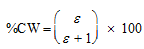
(a) Show, for a tensile test, thatIf there is no change in specimen volume during the deformation process (i.e., A0l0 = Adld).(b) Using the result of part (a), compute the percent cold work experienced by naval brass (for which the stress-strain behavior is shown in Figure 6.12) when a stress of
Two previously under formed specimens of the same metal are to be plastically deformed by reducing their cross-sectional areas. One has a circular cross section, and the other is rectangular; during deformation the circular cross section is to remain circular, and the rectangular is to remain as
A cylindrical specimen of cold-worked copper has a ductility (%EL) of 15%. If its cold-worked radius is 6.4 mm (0.25 in.), what was its radius before deformation?
(a) What is the approximate ductility (%EL) of a brass that has a yield strength of 345 MPa (50,000 psi)? (b) What is the approximate Brinell hardness of a 1040 steel having a yield strength of 620 MPa (90,000 psi)?
(a) From Figure 7.25, compute the length of time required for the average grain diameter to increase from 0.03 to 0.3 mm at 600°C for this brass material. (b) Repeat the calculation, this time using 700° C?
Consider a hypothetical material that has a grain diameter of 2.1 ( 10-2 mm. After a heat treatment at 600(C for 3 h, the grain diameter has increased to 7.2 ( 10-2 mm. Compute the grain diameter when a specimen of this same original material (i.e., d0 = 2.1 ( 10-2 mm) is heated for 1.7 h at 600(C.
A hypothetical metal alloy has a grain diameter of 1.7 ( 10-2 mm. After a heat treatment at 450(C for 250 min the grain diameter has increased to 4.5 ( 10-2 mm. Compute the time required for a specimen of this same material (i.e., d0 = 1.7 ( 10-2 mm) to achieve a grain diameter of 8.7 (10-2 mm
The average grain diameter for a brass material was measured as a function of time at 650°C, which is shown in the following table at two different times:Time (min)______________ Grain Diameter (mm)40 ......................................... 5.6 × 10-2100 .......................................
An undeformed specimen of some alloy has an average grain diameter of 0.050 mm. You are asked to reduce its average grain diameter to 0.020 mm. Is this possible? If so, explain the procedures you would use and name the processes involved. If it is not possible, explain why?
A non-cold-worked brass specimen of average grain size 0.01 mm has a yield strength of 150 MPa (21,750 psi). Estimate the yield strength of this alloy after it has been heated to 500°C for 1000 s, if it is known that the value of σ0 is 25 MPa (3625 psi)?
The following yield strength, grain diameter, and heat treatment time (for grain growth) data were gathered for an iron specimen that was heat treated at 800(C. Using these data compute the yield strength of a specimen that was heated at 800(C for 3 h. Assume a value of 2 for n, the grain diameter
Determine whether it is possible to cold work steel so as to give a minimum Brinell hardness of 240 and at the same time have a ductility of at least 15%EL. Justify your answer.
Determine whether it is possible to cold work brass so as to give a minimum Brinell hardness of 150 and at the same time have a ductility of at least 20%EL? Justify your answer.
A cylindrical specimen of cold-worked steel has a Brinell hardness of 240. (a) Estimate its ductility in percent elongation. (b) If the specimen remained cylindrical during deformation and its original radius was 10 mm (0.40 in.), determine its radius after deformation?
It is necessary to select a metal alloy for an application that requires a yield strength of at least 310 MPa (45,000 psi) while maintaining a minimum ductility (%EL) of 27%. If the metal may be cold worked, decide which of the following are candidates: copper, brass, or a 1040 steel. Why?
A cylindrical rod of 1040 steel originally 11.4 mm (0.45 in.) in diameter is to be cold worked by drawing; the circular cross section will be maintained during deformation. A cold-worked tensile strength in excess of 825 MPa (120,000 psi) and a ductility of at least 12%EL are desired. Furthermore,
A cylindrical rod of brass originally 10.2 mm (0.40 in.) in diameter is to be cold worked by drawing; the circular cross section will be maintained during deformation. A cold-worked yield strength in excess of 380 MPa (55,000 psi) and a ductility of at least 15%EL are desired. Furthermore, the
A cylindrical brass rod having a minimum tensile strength of 450 MPa (65,000 psi), a ductility of at least 13%EL, and a final diameter of 12.7 mm (0.50 in.) is desired. Some brass stock of diameter 19.0 mm (0.75 in.) that has been cold worked 35% is available. Describe the procedure you would
Consider the brass alloy discussed in Problem 7.41. Given the following yield strengths for the two specimens, compute the heat treatment time required at 650oC to give a yield strength of 90 MPa. Assume a value of 2 for n, the grain diameter exponent?Time (min) __________ Yield Strength (MPa)40
Plastically deforming a metal specimen near room temperature generally leads to which of the following property changes? (A) An increased tensile strength and a decreased ductility (B) A decreased tensile strength and an increased ductility (C) An increased tensile strength and an increased
A dislocation formed by adding an extra half-plane of atoms to a crystal is referred to as a (an) (A) Screw dislocation (B) Vacancy dislocation (C) Interstitial dislocation (D) Edge dislocation
The atoms surrounding a screw dislocation experience which kinds of strains? (A) Tensile strains (B) Shear strains (C) Compressive strains (D) Both B and C
What is the magnitude of the maximum stress that exists at the tip of an internal crack having a radius of curvature of 1.9 × 10⁻⁴ mm (7.5 × 10⁻⁶ in.) and a crack length of 3.8 × 10⁻² mm (1.5 × 10⁻³ in.) when a tensile stress of 140 MPa (20,000 psi) is applied?
Calculate the maximum internal crack length allowable for a Ti-6Al-4V titanium alloy (Table 8.1) component that is loaded to a stress one-half its yield strength. Assume that the value of Y is 1.50?
A structural component in the form of a wide plate is to be fabricated from a steel alloy that has a plane-strain fracture toughness of 98.9 MPa(m (90 ksi(in) and a yield strength of 860 MPa (125,000 psi). The flaw size resolution limit of the flaw detection apparatus is 3.0 mm (0.12 in.). If the
The following tabulated data were gathered from a series of Charpy impact tests on a tempered 4340 steel alloy.Temperature (°C) _______________ Impact Energy (J)0 .................................................... 105-25 ..................................................104-50
Showing 7800 - 7900
of 8241
First
69
70
71
72
73
74
75
76
77
78
79
80
81
82
83
Step by Step Answers

 Get 50% OFF
Claim Now
Get 50% OFF
Claim Now


.png)
.png)
.png)
.png)
.png)
.png)
.png)
.png)
-1.png)
-2.png)
-3.png)
.png)
.png)
.png)


