New Semester
Started
Get
50% OFF
Study Help!
--h --m --s
Claim Now
Question Answers
Textbooks
Find textbooks, questions and answers
Oops, something went wrong!
Change your search query and then try again
S
Books
FREE
Study Help
Expert Questions
Accounting
General Management
Mathematics
Finance
Organizational Behaviour
Law
Physics
Operating System
Management Leadership
Sociology
Programming
Marketing
Database
Computer Network
Economics
Textbooks Solutions
Accounting
Managerial Accounting
Management Leadership
Cost Accounting
Statistics
Business Law
Corporate Finance
Finance
Economics
Auditing
Tutors
Online Tutors
Find a Tutor
Hire a Tutor
Become a Tutor
AI Tutor
AI Study Planner
NEW
Sell Books
Search
Search
Sign In
Register
study help
physics
modern physics
Materials Science and Engineering An Introduction 9th edition William D. Callister Jr., David G. Rethwisch - Solutions
An alternating copolymer is known to have a number-average molecular weight of 100,000 g/mol and a degree of polymerization of 2210. If one of the repeat units is ethylene, which of styrene, propylene, tetrafluoroethylene, and vinyl chloride is the other repeat unit? Why?
(a) Determine the ratio of butadiene to acrylonitrile repeat units in a copolymer having a number-average molecular weight of 250,000 g/mol and a degree of polymerization of 4640.(b) Which type(s) of copolymer(s) will this copolymer be, considering the following possibilities: random, alternating,
Cross-linked copolymers consisting of 35 wt% ethylene and 65 wt% propylene may have elastic properties similar to those for natural rubber. For a copolymer of this composition, determine the fraction of both repeat unit types?
A random poly (styrene-butadiene) copolymer has a number-average molecular weight of 350,000 g/mol and a degree of polymerization of 5000. Compute the fraction of styrene and butadiene repeat units in this copolymer?
The density of totally crystalline nylon 6,6 at room temperature is 1.213 g/cm3. Also, at room temperature the unit cell for this material is triclinic with the following lattice parameters:a = 0.497 nm ..................... α = 48.4(b = 0.547 nm ..................... β = 76.6(c = 1.729 nm
The density and associated percent crystallinity for two poly(ethylene terephthalate) materials are as follows:ρ (g/cm3) ____________ crystallinity (%)1.408 .............................. 74.31.343 .............................. 31.2(a) Compute the densities of totally crystalline and totally
The density and associated percent crystallinity for two polypropylene materials are as follows:ρ(g/cm3) ..................... crystallinity (%)0.904 ....................................... 62.80.895 ....................................... 54.4(a) Compute the densities of totally crystalline and
Consider the diffusion of oxygen through a low-density polyethylene (LDPE) sheet 15 mm thick. The pressures of oxygen at the two faces are 2000 kPa and 150 kPa, which are maintained constant. Assuming conditions of steady state, what is the diffusion flux [in [(cm3STP)/cm2-s] at 298 K?
Carbon dioxide diffuses through a high-density polyethylene (HDPE) sheet 50 mm thick at a rate of 2.2 × 10⁻⁸(cm3STP)/cm2-s at 325 K. The pressures of carbon dioxide at the two faces are 4000 kPa and 2500 kPa, which are maintained constant. Assuming conditions of steady state, what is the
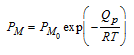
The permeability coefficient of a type of small gas molecule in a polymer is dependent on absolute temperature according to the following equation:Whereand Qp are constants for a given gas-polymer pair. Consider the diffusion of water through a polystyrene sheet 30 mm thick. The water vapor
The number-average molecular weight of a polystyrene is 500,000 g/mol. Compute the degree of polymerization?
The following table lists molecular weight data for a polytetrafluoroethylene material. Compute the following:(a) The number-average molecular weight(b) The weight-average molecular weight(c) The degree of polymerization.
Molecular weight data for some polymer are tabulated here. Compute the following:(a) The number-average molecular weight(b) The weight-average molecular weight.(c) If it is known that this material's degree of polymerization is 477, which one of the polymers listed in Table 14.3 is this polymer?
Is it possible to have a poly (vinyl chloride) homo-polymer with the following molecular weight data, and a degree of polymerization of 1120? Why or why not?
High-density polyethylene may be chlorinated by inducing the random substitution of chlorine atoms for hydrogen.(a) Determine the concentration of Cl (in wt%) that must be added if this substitution occurs for 8% of all the original hydrogen atoms.(b) In what ways does this chlorinated polyethylene
What type(s) of bonds is (are) found between atoms within hydrocarbon molecules? (A) Ionic bonds (B) Covalent bonds (C) van der Waals bonds (D) Metallic bonds
How do the densities compare for crystalline and amorphous polymers of the same material that have identical molecular weights? (A) Density of crystalline polymer ( density of amorphous polymer (B) Density of crystalline polymer ( density of amorphous polymer (C) Density of crystalline polymer (
What is the name of the polymer represented by the following repeat unit?(A) Poly (methyl methacrylate)(B) Polyethylene(C) Polypropylene(D) Polystyrene
Normal butane and isobutane have boiling temperatures of -0.5°C and-12.3°C (31.1°F and 9.9°F), respectively. Briefly explain this behavior on the basis of their molecular structures, as presented in Section 14.2?
The tensile strength and number-average molecular weight for two poly (methyl methacrylate) materials are as follows:Tensile Strength (MPa) ____________ Number-Average Molecular Weight (g/mol)50 ................................................................... 30,000150
The tensile strength and number-average molecular weight for two polyethylene materials are as follows:Tensile Strength (MPa) __________ Number-Average Molecular Weight (g/mol)90 ......................................................................... 20,000180
For each of the following pairs of polymers, plot and label schematic stress-strain curves on the same graph [i.e., make separate plots for parts (a) to (c)]. (a) Polyisoprene having a number-average molecular weight of 100,000 g/mol and 10% of available sites cross-linked; polyisoprene having a
Which of the following would you expect to be elastomers and which thermosetting polymers at room temperature? Justify each choice.(a) Linear and highly crystalline polyethylene(b) Phenol-formaldehyde(c) Heavily cross-linked polyisoprene having a glass transition temperature of 50°C (122°F)(d)
Fifteen kilograms of polychloroprene is vulcanized with 5.2 kg of sulfur. What fraction of the possible crosslink sites is bonded to sulfur cross-links, assuming that, on the average, 5.5 sulfur atoms participate in each crosslink?
The vulcanization of polyisoprene is accomplished with sulfur atoms according to Equation 15.4. If 45.3 wt% sulfur is combined with polyisoprene, how many cross-links will be associated with each isoprene repeat unit if it is assumed that, on the average, five sulfur atoms participate in each
For the vulcanization of polyisoprene, compute the weight percent of sulfur that must be added to ensure that 10% of possible sites will be cross-linked; assume that, on the average, 3.5 sulfur atoms are associated with each crosslink?
For each of the following pairs of polymers, plot and label schematic specific volume-versus-temperature curves on the same graph [i.e., make separate plots for parts (a) to (c)]. (a) Linear polyethylene with a weight-average molecular weight of 75,000 g/mol; branched polyethylene with a
For each of the following pairs of polymers, (1) state whether it is possible to determine whether one polymer has a higher melting temperature than the other; (2) if it is possible, note which has the higher melting temperature and then cite reason(s) for your choice; and (3) if it is not possible
(a) How much ethylene glycol must be added to 20.0 kg of dimethyl terephthalate to produce a linear chain structure of poly(ethylene terephthalate) according to Equations 15.9?(b) What is the mass of the resulting polymer?
On the basis of the curves in Figure 15.5, sketch schematic strain-time plots for the following polystyrene materials at the specified temperatures:(a) Crystalline at 70°C(b) Amorphous at 180°C(c) Cross-linked at 180°C(d) Amorphous at 100°C
Amorphous thermoplastics are formed above their (A) Glass transition temperatures (B) Softening points (C) Melting temperatures (D) None of the above
The mechanical properties of cobalt may be improved by incorporating fine particles of tungsten carbide (WC). Given that the moduli of elasticity of these materials are, respectively, 200 GPa (30 × 106 psi) and 700 GPa (102 × 106 psi), plot the modulus of elasticity versus the volume percent of
For a continuous and oriented fiber-reinforced composite, the moduli of elasticity in the longitudinal and transverse directions are 33.1 and 3.66 GPa (4.8 × 10⁶ and 5.3 × 10⁵ psi), respectively. If the volume fraction of fibers is 0.30, determine the moduli of elasticity of fiber and matrix
In an aligned and continuous carbon fiber-reinforced nylon 6,6 composite, the fibers are to carry 97% of a load applied in the longitudinal direction.(a) Using the data provided, determine the volume fraction of fibers that will be required.(b) What will be the tensile strength of this composite?
Assume that the composite described in Problem 16.8 has a cross-sectional area of 480 mm2 (0.75 in.2) and is subjected to a longitudinal load of 53,400 N (12,000 lbf).(a) Calculate the fiber-matrix load ratio.(b) Calculate the actual loads carried by both fiber and matrix phases.(c) Compute the
A continuous and aligned fibrous reinforced composite having a cross-sectional area of 970 mm2 (1.5 in.2) is subjected to an external tensile load. If the stresses sustained by the fiber and matrix phases are 215 MPa (31,300 psi) and 5.38 MPa (780 psi), respectively, the force sustained by the
Compute the longitudinal strength of an aligned carbon fiber-epoxy matrix composite having a 0.20 volume fraction of fibers, assuming the following: (1) an average fiber diameter of 6 × 10⁻³ mm (2.4 × 10⁻⁴ in.), (2) an average fiber length of 8.0 mm (0.31 in.), (3) a fiber fracture strength of
It is desired to produce an aligned carbon fiber-epoxy matrix composite having a longitudinal tensile strength of 500 MPa (72,500 psi). Calculate the volume fraction of fibers necessary if (1) the average fiber diameter and length are 0.01 mm (3.9 × 10⁻⁴ in.) and 0.5 mm (2 × 10⁻² in.),
Compute the longitudinal tensile strength of an aligned glass fiber-epoxy matrix composite in which the average fiber diameter and length are 0.015 mm (5.9 × 10⁻⁴ in.) and 2.0 mm (0.08 in.), respectively, and the volume fraction of fibers is 0.25. Assume that (1) the fiber-matrix bond strength is
Estimate the maximum and minimum thermal conductivity values for a cermet that contains 90 vol% titanium carbide (TiC) particles in a nickel matrix. Assume thermal conductivities of 27 and 67 W/m.K for TiC and Ni, respectively?
(a) Calculate the specific longitudinal strengths of the glass-fiber, carbon-fiber, and aramid-fiber reinforced epoxy composites in Table 16.5 and compare them with those of the following alloys: cold-rolled 17-7PH stainless steel, normalized 1040 plain-carbon steel, 7075-T6 aluminum alloy,
(a) Write an expression for the modulus of elasticity for a hybrid composite in which all fibers of both types are oriented in the same direction.(b) Using this expression, compute the longitudinal modulus of elasticity of a hybrid composite consisting of aramid and glass fibers in volume fractions
A large-particle composite consisting of tungsten particles within a copper matrix is to be prepared. If the volume fractions of tungsten and copper are 0.70 and 0.30, respectively, estimate the upper limit for the specific stiffness of this composite, given the data that follow.
(a) For a fiber-reinforced composite, the efficiency of reinforcement η depends on fiber length l according toWhere x represents the length of the fiber at each end that does not contribute to the load transfer. Make a plot of η versus l to l =50 mm (2.0 in.), assuming
A continuous and aligned fiber-reinforced composite is to be produced consisting of 45 vol% aramid fibers and 55 vol% polycarbonate matrix; the mechanical characteristics of these two materials are as follows:The stress on the polycarbonate matrix when the aramid fibers fail is 35 MPa (5075
Is it possible to produce a continuous and oriented aramid fiber-epoxy matrix composite having longitudinal and transverse moduli of elasticity of 35 GPa (5 × 10⁶ psi) and 5.17 GPa (7.5 × 10⁵ psi), respectively? Why or why not? Assume that the elastic modulus of the epoxy is 3.4 GPa (4.93 × 10⁵
It is desired to produce an aligned and continuous fiber-reinforced epoxy composite having a maximum of 40 vol% fibers. In addition, a minimum longitudinal modulus of elasticity of 55 GPa (8 × 10⁶ psi) is required, as is a minimum tensile strength of 1200 MPa (175,000 psi). Of E-glass, carbon (PAN
It is desired to produce a continuous and oriented carbon fiber-reinforced epoxy having a modulus of elasticity of at least 69 GPa (10 × 106psi) in the direction of fiber alignment. The maximum permissible specific gravity is 1.40. Given the data in the following table, is such a composite
It is desired to fabricate a continuous and aligned glass fiber-reinforced polyester having a tensile strength of at least 1250 MPa (180,000 psi) in the longitudinal direction. The maximum possible specific gravity is 1.80. Using the following data, determine whether such a composite is possible.
It is necessary to fabricate an aligned and discontinuous glass fiber-epoxy matrix composite having a longitudinal tensile strength of 1200 MPa (175,000 psi) using a 0.35 volume fraction of fibers. Compute the required fiber fracture strength, assuming that the average fiber diameter and length are
A tubular shaft similar to that shown in Figure 16.11 is to be designed that has an outside diameter of 100 mm (4 in.) and a length of 1.25 m (4.1 ft). The mechanical characteristic of prime importance is bending stiffness in terms of the longitudinal modulus of elasticity. Stiffness is to be
The mechanical properties of some metals may be improved by incorporating fine particles of their oxides. If the moduli of elasticity of the metal and oxide are, respectively, 55 GPa and 430 GPa, what is the upper-bound modulus of elasticity value for a composite that has a composition of 31 vol%
How are continuous fibers typically oriented in fibrous composites? (A) Aligned (B) Partially oriented (C) Randomly oriented (D) All of the above
Compared to other ceramic materials, ceramic-matrix composites have better/higher: (A) Oxidation resistance (B) Stability at elevated temperatures (C) Fracture toughnesses (D) all of the above
A continuous and aligned hybrid composite consists of aramid and glass fibers embedded within a polymer resin matrix. Compute the longitudinal modulus of elasticity of this material if the respective volume fractions are 0.24 and 0.28, given the following data: Material ____________ Modulus of
A piece of corroded metal alloy plate was found in a submerged ocean vessel. It was estimated that the original area of the plate was 800 cm2 and that approximately 7.6 kg had corroded away during the submersion. Assuming a corrosion penetration rate of 4 mm/yr for this alloy in seawater, estimate
A thick steel sheet of area 100 in.2 is exposed to air near the ocean. After a one-year period it was found to experience a weight loss of 485 g due to corrosion. To what rate of corrosion, in both mpy and mm/yr, does this correspond?
Using the results of Problem 17.13, compute the corrosion penetration rate, in mpy, for the corrosion of iron in HCl (to form Fe2+ ions) if the corrosion current density is 8 × 10⁻⁵ A/cm2.
For each form of corrosion other than uniform, do the following:(a) Describe why, where, and the conditions under which the corrosion occurs.(b) Cite three measures that may be taken to prevent or control it.
For each of the metals listed in the following table, compute the Pilling-Bedworth ratio. Also, on the basis of this value, specify whether you would expect the oxide scale that forms on the surface to be protective, and then justify your decision. Density data for both the metal and its oxide are
The following table gives weight gain-time data for the oxidation of nickel at an elevated temperature.W (mg/cm2)Time (min)0.527...............................100.857...............................301.526..............................100(a) Determine whether the oxidation kinetics obey a linear,
The following table gives weight gain-time data for the oxidation of some metal at an elevated temperature.W (mg/cm2)Time (min)6.16................................1008.59................................25012.72.............................1000(a) Determine whether the oxidation kinetics obey a
The following table gives weight gain-time data for the oxidation of some metal at an elevated temperature.W (mg/cm2)Time (min)1.54.................................1023.24..............................15095.37..............................620(a) Determine whether the oxidation kinetics obey a
(a) Compute the voltage at 25°C of an electrochemical cell consisting of pure lead immersed in a 5 × 10⁻² M solution of Pb2+ ions and pure tin in a 0.25 M solution of Sn2+ ions.(b) Write the spontaneous electrochemical reaction.
An Fe/Fe2+ concentration cell is constructed in which both electrodes are pure iron. The Fe2+ concentration for one cell half is 0.5 M and for the other cell half is 2 × 10⁻² M. Is a voltage generated between the two cell halves? If so, what is its magnitude and which electrode will be oxidized?
An electrochemical cell is composed of pure copper and pure cadmium electrodes immersed in solutions of their respective divalent ions. For a 6.5 × 10⁻² M concentration of Cd2+, the cadmium electrode is oxidized, yielding a cell potential of 0.775 V. Calculate the concentration of Cu2+ ions if the
An electrochemical cell is constructed such that on one side a pure Zn electrode is in contact with a solution containing Zn2+ ions at a concentration of 10-2 M. The other cell half consists of a pure Pb electrode immersed in a solution of Pb2+ ions that has a concentration of 10-4 M. At what
Which of the following is (are) reduction reaction(s)?(A) Fe2+( Fe3++ e-(B) Al3+ + 3e-( Al(C) H2( 2H+ + 2e-(D) Both A and C
An electrochemical cell is composed of pure nickel and pure iron electrodes immersed in solutions of their divalent ions. If the concentrations of Ni2+ and Fe2+ ions are 0.002 M and 0.40 M, respectively, what voltage is generated at 25(C? (The respective standard reduction potentials for Ni and Fe
Which of the following describes crevice corrosion? (A) Corrosion that occurs preferentially along grain boundaries (B) Corrosion that results from the combined action of an applied tensile stress and a corrosive environment (C) Localized corrosion that may be initiated at a surface defect (D)
Polymer deterioration by swelling may be reduced by which of the following? (A) Increasing degree of cross-linking, increasing molecular weight, and increasing degree of crystallinity (B) Decreasing degree of cross-linking, decreasing molecular weight, and decreasing degree of crystallinity (C)
(a) Compute the electrical conductivity of a cylindrical silicon specimen 7.0 mm (0.28 in.) diameter and 57 mm (2.25 in.) in length in which a current of 0.25 A passes in an axial direction. A voltage of 24 V is measured across two probes that are separated by 45 mm (1.75 in.).(b)Compute the
(a) Calculate the drift velocity of electrons in silicon at room temperature and when the magnitude of the electric field is 500 V/m.(b) Under these circumstances, how long does it take an electron to traverse a 25-mm (1-in.) length of crystal?
At room temperature the electrical conductivity and the electron mobility for aluminum are 3.8 × 10⁷ (Ω.m)-1 and 0.0012 m2/V.s, respectively. (a) Compute the number of free electrons per cubic meter for aluminum at room temperature. (b) What is the number of free electrons per aluminum atom?
(a) Calculate the number of free electrons per cubic meter for silver, assuming that there are 1.3 free electrons per silver atom. The electrical conductivity and density for Ag are 6.8 × 10⁷(Ω.m)-1 and 10.5 g/cm3, respectively.(b) Now compute the electron mobility for Ag.
(a)Using the data in Figure 18.8, determine the values of ρ0 and a from Equation 18.10 for pure copper. Take the temperature T to be in degrees Celsius.(b) Determine the value of A in Equation 18.11 for nickel as an impurity in copper, using the data in Figure 18.8.(c) Using the results of parts
Determine the electrical conductivity of a Cu-Ni alloy that has a tensile strength of 275 MPa (40,000 psi). See Figure 7.16.
A cylindrical metal wire 3 mm (0.12 in.) in diameter is required to carry a current of 12 A with a minimum of 0.01 V drop per foot (300 mm) of wire. Which of the metals and alloys listed in Table 18.1 are possible candidates?
An aluminum wire 10 m long must experience a voltage drop of less than 1.0 V when a current of 5 A passes through it. Using the data in Table 18.1, compute the minimum diameter of the wire.
At room temperature the electrical conductivity of PbS is 25 (Ω.m)-1, whereas the electron and hole mobilities are 0.06 and 0.02 m2/V.s, respectively. Compute the intrinsic carrier concentration for PbS at room temperature.
An n-type semiconductor is known to have an electron concentration of 5 × 10¹⁷ m-3. If the electron drift velocity is 350 m/s in an electric field of 1000 V/m, calculate the conductivity of this material.
a) In your own words, explain how donor impurities in semiconductors give rise to free electrons in numbers in excess of those generated by valence band-conduction band excitations.(b) Also explain how acceptor impurities give rise to holes in numbers in excess of those generated by valence
Predict whether each of the following elements will act as a donor or an acceptor when added to the indicated semiconducting material. Assume that the impurity elements are substitutional.
a) The room-temperature electrical conductivity of a silicon specimen is 500 (Ω.m)-1. The hole concentration is known to be 2.0 × 10²² m-3. Using the electron and hole mobilities for silicon in Table 18.3, compute the electron concentration.(b) On the basis of the result in part (a), is the
A plain carbon steel wire 3 mm in diameter is to offer a resistance of no more than 20 Ω. Using the data in Table 18.1, compute the maximum wire length.
The following electrical characteristics have been determined for both intrinsic and p-type extrinsic gallium antimonide (GaSb) at room temperature:Calculate electron and hole mobilities.
Calculate the conductivity of intrinsic silicon at 80°C.
Using Equation 18.36 and the results of Problem 18.33, determine the temperature at which the electrical conductivity of intrinsic germanium is 40 (Ω.m)-1.
Estimate the temperature at which GaAs has an electrical conductivity of 1.6 × 10⁻³ (Ω.m)-1, assuming the temperature dependence for σ of Equation 18.36. The data shown in Table 18.3 may prove helpful.
(a) Using the data in Table 18.1, compute the resistance of an aluminum wire 5 mm (0.20 in.) in diameter and 5 m (200 in.) in length.(b) What would be the current flow if the potential drop across the ends of the wire is 0.04 V?(c) What is the current density?(d) What is the magnitude of the
Railroad tracks made of 1025 steel are to be laid during the time of year when the temperature averages 4°C (40°F). If a joint space of 5.4 mm (0.210 in.) is allowed between standard rails of length 11.9 m (39 ft), what is the highest possible temperature that can be tolerated without the
Estimate the energy required to raise the temperature of 5 kg (11.0 lbm) of the following materials from 20°C to 150°C (68°F to 300°F): aluminum, brass, aluminum oxide (alumina), and polypropylene.
Compute the density for iron at 700°C, given that its room-temperature density is 7.870 g/cm3. Assume that the volume coefficient of thermal expansion, αv, is equal to 3αl.
When a metal is heated its density decreases. There are two sources that give rise to this decrease of ρ: (1) the thermal expansion of the solid and (2) the formation of vacancies (Section 4.2). Consider a specimen of gold at room temperature (20°C) that has a density of 19.320 g/cm3.(a)Determine
To what temperature must a cylindrical rod of tungsten 15.025 mm in diameter and a plate of 1025 steel having a circular hole 15.000 mm in diameter have to be heated for the rod to just fit into the hole? Assume that the initial temperature is 25°C.
a) Calculate the heat flux through a sheet of brass 7.5 mm (0.30 in.) thick if the temperatures at the two faces are 150°C and 50°C (302°F and 122°F); assume steady-state heat flow.(b) What is the heat loss per hour if the area of the sheet is 0.5 m2 (5.4 ft2)?(c) What will be the heat loss per
The ends of a cylindrical rod 6.4 mm (0.25 in.) in diameter and 250 mm (10 in.) long are mounted between rigid supports. The rod is stress free at room temperature [20°C (68°F)]; upon cooling to -60°C (- 76°F), a maximum thermally induced tensile stress of 138 MPa (20,000 psi) is possible. Of
To what temperature would 10 lbm of a brass specimen at 25°C (77 °F) be raised if 65 Btu of heat is supplied?
For each of the following pairs of materials, decide which has the larger thermal conductivity. Justify your choices. (a)Pure silver; sterling silver (92.5 wt% Ag-7.5 wt% Cu) (b) Fused silica; polycrystalline silica (c) Linear and syndiotactic poly (vinyl chloride) (DP = 1000); linear and
(a) If a rod of brass 0.35 m (13.8 in.) long is heated from 15°C to 85°C (60°F to 185°F) while its ends are maintained rigid, determine the type and magnitude of stress that develops. Assume that at 15°C the rod is stress-free.(b) What will be the stress magnitude if a rod 1 m (39.4 in.) long
Showing 8100 - 8200
of 8241
First
69
70
71
72
73
74
75
76
77
78
79
80
81
82
83
Step by Step Answers

 Get 50% OFF
Claim Now
Get 50% OFF
Claim Now



.png)
.png)
.png)
.png)
![Modulus of Elasticity [GPa (psi)] Tensile Strength [MPa (psi)] Carbon fiber 260 (37 x 106) 4000 (580,000) Nylon 6,6 2.8 (4.0 × 10⁵) 76 (11,000)](https://dsd5zvtm8ll6.cloudfront.net/si.question.images/image/images16/1403-P-M-P-A-S(2164).png)
.png)
.png)
![Modulus of Elasticity Tensile Strength [GPa (psi)] [MPa (psi)] Aramid fiber 131 (19 x 106) 3600 (520,000) Polycarbonate 2.4 (3.5 x 10⁵) 65 (9425)](https://dsd5zvtm8ll6.cloudfront.net/si.question.images/image/images16/1403-P-M-P-A-S(2175).png)
![Specific Gravity Modulus of Elasticity [GPa (psi)] Carbon fiber 1.80 260 (37 × 100) Ероху 1.25 2.4 (3.5 × 105)](https://dsd5zvtm8ll6.cloudfront.net/si.question.images/image/images16/1403-P-M-P-A-S(2178).png)
![Specific Gravity Tensile Strength [MPa (psi)] Glass fiber 2.50 3500 (5 x 10⁵) Polyester 50 (7.25 x 10³) 1.35](https://dsd5zvtm8ll6.cloudfront.net/si.question.images/image/images16/1403-P-M-P-A-S(2179).png)
.png)
.png)
.png)


