New Semester
Started
Get
50% OFF
Study Help!
--h --m --s
Claim Now
Question Answers
Textbooks
Find textbooks, questions and answers
Oops, something went wrong!
Change your search query and then try again
S
Books
FREE
Study Help
Expert Questions
Accounting
General Management
Mathematics
Finance
Organizational Behaviour
Law
Physics
Operating System
Management Leadership
Sociology
Programming
Marketing
Database
Computer Network
Economics
Textbooks Solutions
Accounting
Managerial Accounting
Management Leadership
Cost Accounting
Statistics
Business Law
Corporate Finance
Finance
Economics
Auditing
Tutors
Online Tutors
Find a Tutor
Hire a Tutor
Become a Tutor
AI Tutor
AI Study Planner
NEW
Sell Books
Search
Search
Sign In
Register
study help
business
construction project management
Project Management For Engineering Business And Technology 4th Edition John M. Nicholas, Herman Steyn - Solutions
What are the unique issues in defi ning the scope and SOW for an international project?
How can the project manager learn about the host country and about potential risks related to culture and environment in the project?
What are ways to build good relations with local stakeholders? With local vendors and offi cials? Why are these relations so important?
What are ways to build teamwork and encourage cooperation between members of the project team from the home and host countries?
What is the role of the PMO in an international project?
What is the role of the project steering committee (or governance committee or review board), and who is on the committee? What is the difference between the global and local steering committees?
What are the responsibilities and qualifi cations of the local representative?
In an international project, who should be trained in the cultures, traditions, and regulations of the home or host country—the managers and staff who will be going to the host country to work on the project, or the local managers and subcontractors in the host country who will be working on the
Can it be assumed that a technology or process that proved successful in a project in one country or culture will automatically be successful in an identical project in another country or culture?
In global projects that include subprojects at multiple sites, who is responsible for day-to-day oversight of each subproject at each site?
A project involves team members in New York and Rome. Discuss how you would accommodate the 6-hour time difference between the countries to encourage maximal communication and coordination between the teams.
Name some forms of export/import restrictions. In what ways can export/import restrictions impact an international project?
What is an “offset”? Compare indirect and direct offsets.
Describe some ways that the contractor can protect against rising costs or falling prices as a result of fl uctuating exchange rates.
Describe the role of informal gatherings and social events in building trust in international projects.
What are the potential benefi ts of hiring local contractors in an international project? What are the potential drawbacks and diffi culties?
How can the project manager know in advance of impending political or labor/union problems in the host country?
What diffi culties are associated with contracts in international projects? What steps should be taken to avoid legal problems, and to deal with them should they arise?
What are “Incoterms”?
For an overseas project, whose laws prevail—those of the host country or those of the home country?
Why might worker layoffs following the project cause legal problems for the contractor or employer?
Consider two countries you are familiar with. Compare and contrast them in terms of the following: language, formality, gift giving, attitudes about age and about time, social behavior, food and drink, holidays and time off, and customary labor time.
In the above list, which unknowns are implicit and which are explicit? Why are implicit unknowns potentially more problematic for the project manager?
What are the four main categories of “unknowns” in an international project?
Consider the analogy of an international project to a play. In international projects, who are the actors, what are the scripts, what are the sets, and what are the props?
If the organization has a PMO, discuss the PMO’s role in portfolio management and the gating process.
If the organization has both portfolio management and gating processes, discuss the relationship between the two and the manner in which they are integrated.
If the organization has a gating process, describe the gates, the assessment criteria at each, and who participates. In your opinion, is the process effective?
How are projects compared and rank-ordered? Are techniques described in this chapter used? Who makes approval and funding decisions?
Describe the organization’s project analysis and selection process. What kind of analysis and selection models and methods are used?
Does the organization have a project review board (governance board, project steering committee, etc.)? Describe the board, its role, membership, meetings, etc.
Does the organization have a portfolio management process? If so, describe the key steps in the process, and the managers and others who participate in the process. In your opinion, is the process effective? What are its strengths and weaknesses?
Describe the differences between the gating process and the portfolio management process. What are the diffi culties in integrating the two processes? How might the diffi culties be overcome so that portfolio projects can also be gated projects?
Once a project has been approved and admitted to the project portfolio, how is it monitored thereafter? Under what circumstances might it be cancelled?
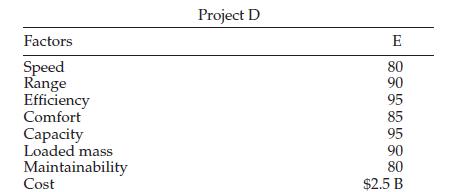
Suppose project D is added to the projects in Table 17.4 and has been rated for effectiveness as follows:Compute the total weighted effectiveness using the weights in Table 17.4. How does Project D compare to the others in Figure 17.7? Factors Speed Range Efficiency Comfort Capacity Loaded mass
Top management has decided to reallocate funds among the fi ve categories of projects listed in Table 17.3 as follows: $13M, $8M, $7.5M, $10M, and $7.8M, respectively. What are the cut-off projects in each of the fi ve categories?
Draw a bubble chart for Risk versus Reward similar to Figure 17.4 for the projects in Table 17.2. Assume ECV < 3 is “Low” and ECV > 6 is “High.” For risk, 1 is “Low” and 4 is “High.” Use the Public Image ratings (not rankings) from Problem 23 to “size” the projects on the chart:
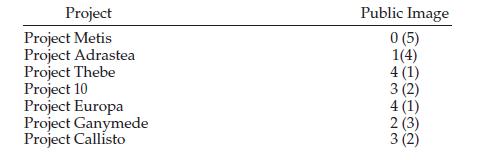
Repeat the example in Table 17.2, but besides Fit, Reward, and Risk include a fourth criterion: Public Image of Project (4 = high, 0 = none). Assume the projects are rated as follows on Public Image (numbers in parentheses are ranking on list):Include this ranking with the rankings for Strategic
What is the drawback of ranking projects using single-criterion methods?
What are the three main approaches to comparing and selecting projects?
What are the drawbacks of (a) fi nancial models; (b) scoring models?
What advantage do scoring models have over fi nancial models in terms of assessing the value or utility of projects?
Project A and Project B both have the same overall cost of $4M. Project A’s likelihood of success is 95 percent, B’s chances are 50 percent. Project A is expected to generate $11M but will incur $5M maintenance in costs. Project B is expected to generate revenue of $8M and also to provide
In Problem 15, suppose the likelihood of project success is 0.5 × 0.8 × 0.7 = 0.28.• What is the B/C ratio for the project?• Which measure makes the project look more attractive, ECV or B/C? In your opinion, does the project merit approval?
In the previous example, what else must be considered if the stream of earning were in euros instead of dollars?
A project has three phases, concept, development, and launch, that are expected to cost $5M, $15M, and $4M, respectively. The likelihoods of success for the three phases are 0.5, 0.8, and 0.7, respectively. If the estimated NPV of future earnings is $90M, what is the ECV for the project?[Answer:
What is the expected commercial value (ECV) of a project involving the launch of a new product with an estimated development cost of $15M, launch cost of$0.8M and an NPV for the future stream of earnings of $45M if the probabilities for success are 70 percent in development and 50 percent in the
Compare the ECV and B/C methods for evaluating projects.
For the above four projects, assign scores of high = 3, medium = 2, and low = 1.Assume the criteria are weighted: Potential Return on Investment = 0.3, Lack of Technological Risk = 0.3, Environmental “Friendliness” = 0.3, and Service to Community = 0.1. Now which projects come out best and
Projects W, X, Y, and Z are each being screened according to four criteria:Potential Return on Investment, Lack of Technological Risk, Environmental“Friendliness,” and Service to Community:• Project W: Return, high; Risk, medium; Environment, medium; Service, low• Project X: Return, medium;
What is the purpose of prescreening in the project selection process? How does it differ from project screening?
Do “obligatory projects” (see previous question) necessarily have high priority?
“Some projects you simply have to do. You have no choice.” Give examples of different types of cases where you have no choice.
What is the responsibility of the project review board? Who typically are members of the PRB?
Compare the following; for each state the focus and how it relates to projects:• Strategic management• Portfolio management• Gating methodology.
Is it poor practice to do the easiest projects fi rst (“pick the low hanging fruit”)?
What is project portfolio? How do project portfolios differ from programs?
What are the three or four main features of project portfolio management?
Does the organization have a PMO? If so, what are its functions? How was the role of the PMO visible in this project? In your opinion, did the PMO help or hinder the project manager? Explain.
Of the many knowledge management methods described in this chapter, which were practiced in this project? Which of the methods does the project organization practice? How is knowledge shared in the organization?
Was anything done to capture knowledge in this project? Were any measures taken to retain this knowledge for application and transfer to other projects?
What is your opinion about the project management maturity of this organization? Would you say the organization is mature or somewhat immature?
If no formal methodology existed, did the project manager have her own, informal methodology? If so, what was it? Was it effective?
Did the project follow an established, formal methodology? If so, describe the methodology. In your opinion, did it help or hinder the project? What is the opinion of the project manager and project staff as to the effectiveness of the methodology? Where did the methodology originate, and how was
How does a typical PMO get started and grow? Describe the role of project managers in initiating and managing the PMO.
What is the role of the PMO with respect to each of the following:a. Project management methodologyb. Project management policy, procedures, and standardsc. Project resource managementd. Project software and communications technologye. Mentoring, consulting, and knowledge managementf. Project
What is the overall purpose of the project management offi ce (PMO)?
What responsibility does the project manager have for project knowledge management?
How is peer consultation used in knowledge sharing?
What is an after-action review? How does it differ from a post-completion review?
What kind of knowledge cannot be retained in a database? Where is that knowledge to be found?
What kind of knowledge can be retained in a database?
Name some diffi culties associated with retaining and sharing (transferring) tacit knowledge.
What is the difference between tacit knowledge and explicit knowledge?
Describe some ways of capturing project knowledge.
In a sentence, what is the purpose of knowledge management in project management?
What aspects critical to effective project management do the maturity models ignore?
Name the benefi ts of an organization being highly rated on a project management maturity model.
List fi ve levels of project management maturity.
What do project management maturity process models measure or assess?
Discuss the meaning of the term “project management maturity.”
Why might an organization have more than one methodology? What is a potential problem with having more than one?
What is the purpose of project gates? Describe how the gating process fi ts in with the project management methodology.
Where does the methodology originate? Who creates and promotes it?
What does the project management methodology specify? Describe the key features and topics addressed by the methodology. Discuss the kinds of tasks and deliverables covered in the methodology.
What are the benefi ts of a project management methodology? What are the disadvantages of an organization not having one?
Does the project manager try to help team members deal with job stress?Explain.
Is this a high-stress or low-stress project? Explain. If high stress, is it taken for granted that that is the way it must be or do people feel steps could be taken to reduce the stress?
Emotional stress is a personal issue, and most people are hesitant to speak about it other than on a general level. Still, you might ask the project manager or other team members about stresses they personally feel or perceive in the project.
Are any formal procedures used, such as RCT or IGPS, to resolve confl icts?
How does the project manager resolve confl ict? Is confrontation used?
How prevalent is confl ict, and what effect does it have on individual and project performance?
At the end of this (or other projects), what does the organization do to disband a team? Are there any procedures for giving recognition or dealing with members’feelings about disbanding?
Ask the project manager if he or she knows about formal team-building and intergroup problem-solving procedures like those described in this book.
How would you characterize the level of teamwork in this project?
What steps are taken to resolve problems involving multiple groups?
What kinds of formal and informal activities are used to increase the cohesiveness of the project team? Can any of these be termed team-building?
What mechanisms are used to link these teams—for example, coordinators, frequent meetings, or close proximity of workers?
Describe the different groups (management teams, project offi ce, functional groups) that comprise the project team in this project.
What do you think are the primary work motivators for people in this project?Discuss the relative importance of salary, career potential, incentives, and participation in decision-making.
Showing 4300 - 4400
of 6659
First
37
38
39
40
41
42
43
44
45
46
47
48
49
50
51
Last
Step by Step Answers

 Get 50% OFF
Claim Now
Get 50% OFF
Claim Now