New Semester
Started
Get
50% OFF
Study Help!
--h --m --s
Claim Now
Question Answers
Textbooks
Find textbooks, questions and answers
Oops, something went wrong!
Change your search query and then try again
S
Books
FREE
Study Help
Expert Questions
Accounting
General Management
Mathematics
Finance
Organizational Behaviour
Law
Physics
Operating System
Management Leadership
Sociology
Programming
Marketing
Database
Computer Network
Economics
Textbooks Solutions
Accounting
Managerial Accounting
Management Leadership
Cost Accounting
Statistics
Business Law
Corporate Finance
Finance
Economics
Auditing
Tutors
Online Tutors
Find a Tutor
Hire a Tutor
Become a Tutor
AI Tutor
AI Study Planner
NEW
Sell Books
Search
Search
Sign In
Register
study help
business
construction project management
Project Management For Engineering Business And Technology 4th Edition John M. Nicholas, Herman Steyn - Solutions
A procurement offi cer fi nds that the delivery time for a specifi c item is never less than 5 days. The worst case scenario is that it takes 30 days for the item to arrive. A delivery lead time of 10 days is more frequent than any other.a. Calculate the expected delivery time.b. What estimate
Has variability in a time estimate ever caused you to be late for an appointment?Describe.
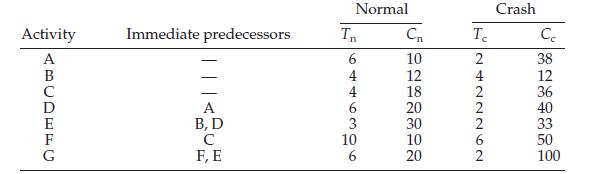
The following table gives information on a project (T in days, C in $1000s).a. Draw the network diagram. Under normal conditions, what is the earliest the project can be completed? What is the direct cost? What is the critical path?b. What is the cost of the project if it is completed 1 day
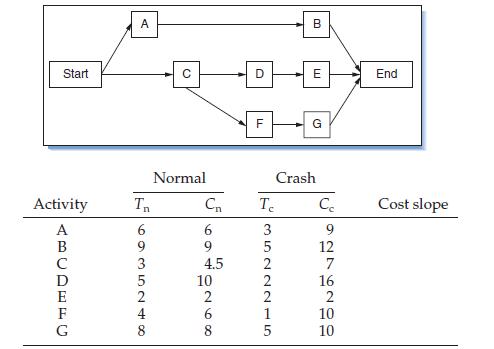
The project network and associated costs (T in days, C in $1,000s) are shown below.a. What is the earliest the project can be completed under normal conditions?What is the direct cost?b. What is the least costly way to reduce the project duration by 2 days? What is the project cost?c. What is the
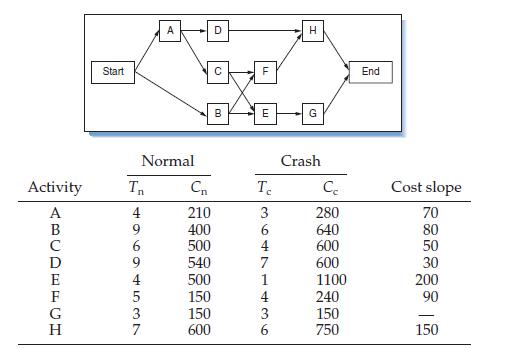
The project network and associated costs (T in days, C in $1,000s) are shown below.a. Verify that the normal duration is 22 days and that the direct cost is $3,050.b. What is the least costly way to reduce the project duration to 21 days? What is the project cost?c. What is the least costly way to
What are the criticisms of CPM? How and where is CPM limited in its application?
Time–cost trade-off analysis deals only with direct costs. What distinguishes these costs from indirect costs? Give examples of both direct and indirect costs.
The cost slope always has a negative value. What does this indicate?
What does the cost slope represent?
How do CPM and PERT differ? How are they the same?
Defi ne crash effort and normal effort in terms of the cost and time they represent.When would a project be crashed?
Were there any complaints about unrealistic workloads?
Was resource leveling done?
Did the functional manger(s) take responsibility for workload on resources?
If the project was done within a matrix structure, how did communication between the functional and project managers take place?
Was the workload on resources made visible?
How was the schedule reserve determined and included into the schedule?
Was all detail planning done upfront or was a phased approach followed?
At what point in the project were networks created? When were they updated?
Were networks used for scheduling? If so, describe the networks. Show examples. What kind of computer software system was used to create and maintain them? Who was responsible for system inputs and system operations?Describe the capabilities of the software system.
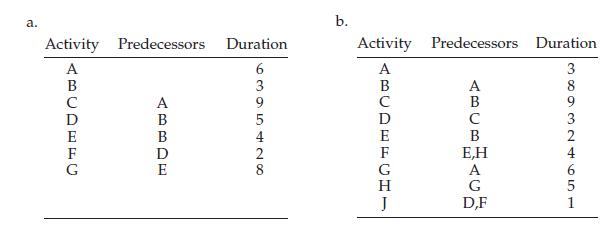
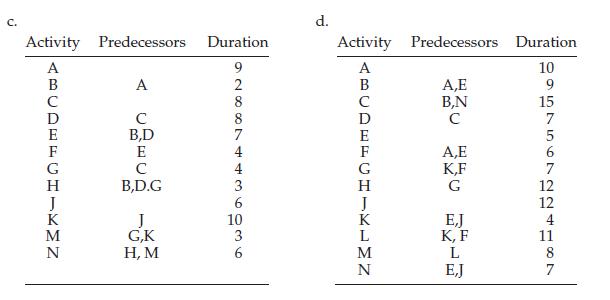
For each of the following predecessor tables:• Draw a corresponding AON network.• Compute ES and EF for each activity.• Compute LS and LF for each activity. Find the critical path.• Determine the total slack and free slack. a. b. Activity Predecessors Duration 369324651 A 8 E,H G BUBMACH
Redraw Figure 6.6 using the AOA method.
Suppose in Figure 6.20 everything is the same except Activity Y can start 4 days after Activity V starts, but cannot be fi nished until 6 days after Activity V is fi nished. Show how this changes the values for ES, EF, LS, and LF.
Show that the schedule in Figure 6.23 (which produced an erratic loading for workers) yields a more balanced loading for equipment than the one shown in Figure 6.27.
Discuss the implications of resource allocation for organizations involved in multiple projects.
Level the resources for a project with the workload diagram below. In the timephased diagram at the top of the diagram, dotted lines indicate slack.8 Discuss pros and cons of the alternatives available.
The requirements for systems analysts and programmers for the GUMBY project are as follows:a. Compute ESs, LSs, and total slack times.b. Then show the separate resource loadings for systems analysts and programmers, assuming early start times.c. Suppose the maximum weekly availability is eight
Describe how resource leveling of a resource-constrained project differs from resource leveling in a time-constrained project.
Why is leveling of resources preferred to large fl uctuation of workload? What negative result could resource leveling cause?
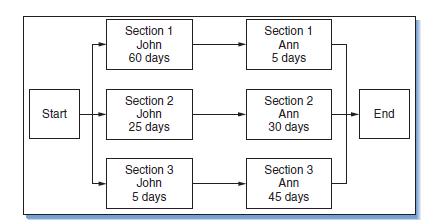
To produce a manual, John has to write the text, after which Ann has to draw sketches and typeset the document. John can start with any section of the book(i.e., he does not have to start with Section 1). The work has to be done within 95 days. The network diagram below shows the precedence
For the PDM network in Figure 6.20, calculate ES, EF, LS, and LF for all activities.
Give examples of applications of non-FS PDM. Take a project you are familiar with (or invent one) and create a PDM network.
What limitations of simple AON networks does non-FS PDM overcome? What limitations does it not overcome?
In the development of a new (fi rst of its kind) complex system, the design of a certain subsystem has large slack. Suffi cient resources are available for either an early start or a late start. Discuss the pros and cons of early and late starts. Consider the risk of delaying the project, the risk
Explain how it is possible that there can be slack on the critical path. What is the implication of negative slack on the critical path?
Some projects have a fi xed due date while others have to be fi nished as early as possible, and the project manager only makes commitments on the completion date once she and her project management team have scheduled the project. Explain how the backward pass differs for these two project types.
Use Figures 6.5 (a &b) to draw Gantt charts for the ROSEBUD project.
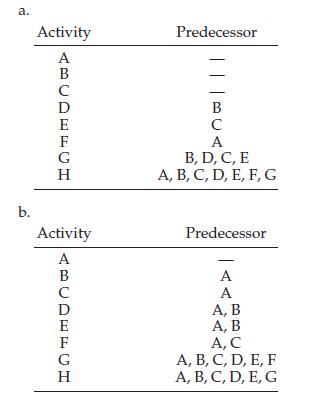
Eliminate redundant predecessors from the following lists so only immediate predecessors remain. a. Activity Predecessor ABCDEECH G b. Activity B C A B, D, C, E A, B, C, D, E, F, G Predecessor ABCDEFCH G A A A, B A, B A, C A, B, C, D, E, F A, B, C, D, E, G
Refer to Figure 6.1 in the text.a. If the person wants to get more sleep by waking up later, which of the following steps would be useful?i. Put socks on faster ii. Put tie in pocket to put on later iii. Put shoes on faster iv. Buy a hair dryer that works faster.b. Calculate the total fl oat and
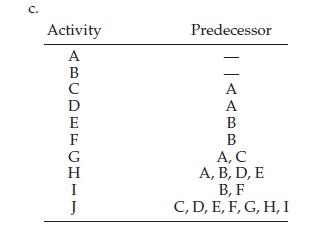
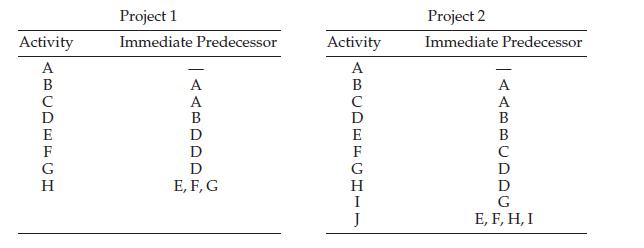
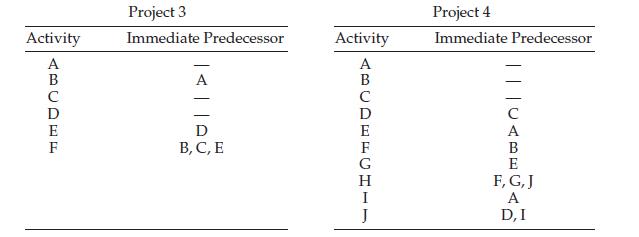
Draw the AON network diagrams for the following four projects: Activity Project 1 Immediate Predecessor Activity Project 2 Immediate Predecessor AABBCDDGE ABCDEFGHI AARDDDE ABCDEFGH E, F, G E, F, H, I J
Draw the network diagram (using the AON scheme).
Show the immediate predecessors for each activity.
List the activities or work packages.
Using your experience or imagination, create a WBS.
Consider each of the following projects:a. Composing and mailing a letter to an old friendb. Preparing a fi ve-course meal (you specify the course and dishes served)c. Planning a wedding for 500 peopled. Building a sundeck for your homee. Planning, promoting, and conducting a rock concertf. Moving
Explain the difference between ES, EF, LS, and LF.
Explain the difference between total and free slack.
Why is it vital to know the critical path? Explain the different ways the critical path is used in network analysis and project planning.
Can a Gantt chart be created from a network? Can a network be created from a Gantt chart? Which is the preferred way? Explain.
How is a WBS used to create a network and what role does a scope statement play?
Draw a network diagram of your college studies, starting with enrolment and fi nishing with graduation. Indicate the courses, projects, and exams, as well as precedence relationships where applicable.
What are the advantages of networks over Gantt charts?
What are the procured GWS in the project? Were these items managed differently than in-house aspects of the project? How were they fi rst identifi ed and then integrated into the project plan? Did procured items pose any diffi culties to the project?
Show examples of project-level and task-level schedules. Who prepared each?How were they checked and integrated?
How were activities in the WBS transferred to a schedule? How were times estimated?Who prepared the schedules?
Was a responsibility matrix used? Show an example.
How were individuals assigned to the project? Describe the process.
How were responsibilities in the WBS assigned to the project organization (i.e., how did the functional areas become involved in the project)?
How were ongoing activities such as management, supervision, inspection, and maintenance handled in the WBS? Was there a work package for each?
Was the work package concept used? If so, describe what a work package includes. How are work packages defi ned?
Where in the WBS is project management included?
How, when, and by whom was the work breakdown structure (WBS) prepared?Describe the process used in preparing the WBS.
Is there an SOW or project charter? Describe its purpose and contents.
Is there a project scope statement? Who prepared it? Do major areas of work and deliverables of the project correspond to the scope statement?
What is the relationship between the master plan and the project proposal? Was the plan derived from the proposal?
At what point in the project was the plan prepared?
Who prepared the plan?
Describe the project master plan for your project (the plan developed at the start of the project). What are the contents? Show a typical master plan.
Consider this statement: The management of procured items can pose greater diffi culties than managing internal items. Do you agree or disagree, and why?
What aspects of the project fall under “procurement management?” Why is managing procured items just as important to project success as managing internal items? What are the issues in scheduling procured items?
If a hierarchy of schedules is used in project planning, explain whether there should be a corresponding hierarchy of plans as well.
How do you decide when more than one level of schedule is necessary?
In a hierarchy of schedules, how does changing a schedule at one level affect schedules at other levels?
Is the Gantt chart adequate for planning and controlling small projects?
How would the Gantt chart you drew in question 24 have to be changed if you were told that C and D could not begin until B was completed, and that G could not begin until C was completed? What would happen to the project completion time?
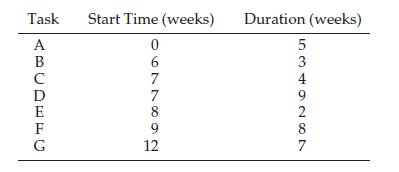
Construct a Gantt chart similar to the one in Figure 5.10, using the following data:When will task G be completed? Task Start Time (weeks) Duration (weeks) 5349287 9 17822 ABCDEFG 0 6 7
How are project-level and task-level schedules prepared? What is the relationship between them? Who prepares them?
Distinguish an interface event from a milestone event. Give some examples of each. When is an interface event also a milestone event?
Distinguish an event from an activity. What problems can arise if people on a project confuse these terms?
Can a responsibility matrix seem threatening to managers and others? Why?
What function does the responsibility matrix serve in project control?
In doing this, consider the project organization and the managerial/technical staff to be assigned and their duties.
Construct a responsibility matrix using the WBS you developed in question
Figure 5.8 shows some possible types of responsibilities that could be indicated on a responsibility matrix. What other kinds of responsibilities or duties could be indicated?
What is the relationship between the WBS and organization structure? In this relationship, what is the meaning of a “control account?”
What should a “well-defi ned” work package include?
What is the impact of altering the WBS after the project has started?
What is the role of functional managers in developing a WBS?
In what ways is the WBS important to project managers?
Could the WBS in Figure 5.5 have started with different Level-2 elements and still result in the same work packages? In general, can different WBS approaches give similar results?
How do you know in a WBS when you have reached a level where no further breakdown is necessary?
Think of a somewhat complicated endeavor you are familiar with and develop a WBS for it. (Examples: wedding, high school reunion, questionnaire survey, movie or stage play, etc.). Now repeat this for a complicated job you are not familiar with. At what point do you need assistance from
What are differences and similarities between the SOW and the project charter?
What is the statement of work? In what documents does the SOW appear?
What is the purpose of the project scope statement? What information is used to create the scope statement? How is the scope refl ected on the WBS?
A section addressing “Risk and Uncertainty” is often left out of the project master plan. What are the potential pitfalls of doing this?
Which aspects of the master plan might be eliminated for projects with small budgets? Which might be eliminated for short-duration projects (a few weeks or months) with relatively few tasks?
Can a project be undertaken without a master plan? What are the possible consequences?
What is the purpose of a project master plan? At what stage of the project should this plan be prepared?
What questions need to be answered every time when a new project is planned?What are the steps in the planning process that answer these questions?
Showing 4700 - 4800
of 6659
First
41
42
43
44
45
46
47
48
49
50
51
52
53
54
55
Last
Step by Step Answers

 Get 50% OFF
Claim Now
Get 50% OFF
Claim Now