New Semester
Started
Get
50% OFF
Study Help!
--h --m --s
Claim Now
Question Answers
Textbooks
Find textbooks, questions and answers
Oops, something went wrong!
Change your search query and then try again
S
Books
FREE
Study Help
Expert Questions
Accounting
General Management
Mathematics
Finance
Organizational Behaviour
Law
Physics
Operating System
Management Leadership
Sociology
Programming
Marketing
Database
Computer Network
Economics
Textbooks Solutions
Accounting
Managerial Accounting
Management Leadership
Cost Accounting
Statistics
Business Law
Corporate Finance
Finance
Economics
Auditing
Tutors
Online Tutors
Find a Tutor
Hire a Tutor
Become a Tutor
AI Tutor
AI Study Planner
NEW
Sell Books
Search
Search
Sign In
Register
study help
business
construction project management
Project Management For Engineering Business And Technology 4th Edition John M. Nicholas, Herman Steyn - Solutions
How often and what kinds of review meetings were held in the project? Why were they held? Who attended them?
Describe what happens during the operation phase. What is the role of the systems development organization (contractor) in this phase?
What are the differences between the post-completion project (or post mortem)review and the post-installation system review? Describe each of these.
What is a project extension, and how do project extensions originate? How is a project extension managed?
What is a punch list?
What kinds of negotiated adjustments are made to the contract, post-acceptance?Why would a user or contractor want to specify the terms of a contract after the project is completed?
What are side items? Give examples not used in this book. How can they delay project completion?
What is the role of the project manager and contract administrator in receiving customer acceptance of the work and fi nal payment?
What is involved in planning and scheduling the project termination?
What are the reasons for project termination? How can termination for reasons other than achievement of project goals be avoided?
Describe the different strategies for installing or converting over to the new system.
How is the project end-item tested and checked out for approval?
Discuss user training and why it is sometimes included in the implementation stage.
How is the system implemented? Describe the important considerations for turning the system over to the user.
Discuss the uses of the PMIS throughout the phases of the project life cycle.
Discuss the applications and benefi ts of Web-based project management.
What is the role of the PMIS in project management?
When and what kind of reports are sent to the customer? Why is reporting to customers so important?
What reports are sent to functional managers?
What reports should the project manager receive? How does the project manager use these reports?
What should be included in status reports to top management?
What is a formal critical review? When is a formal review held, and what does it look at? Why do outsiders conduct it? Why would a customer or project supporter want a formal review?
What is an action plan? What must it include?
What is the purpose of internal peer reviews? When are they held? Who participates?
What are the advantages and disadvantages of the following sources of information:(a) charts and tables, (b) oral and written reports, (c) fi rsthand evaluation?
Why is it better to rely on a variety of information sources for evaluation than just a few? Give some examples of how several sources are used in project evaluation.
Describe the difference between formative evaluation and summary evaluation in project management.
What changes to the product or project goal occurred during the project?Describe the change control process used. How were changes to the plan or system reviewed, authorized, and communicated? Show examples of change control documents.
When cost, schedule, or performance problems occurred, what action did the project manager take? Give examples of problems and what the project manager did.
Were variance limits established for project cost and performance? What were they? How were they applied?
Were the concepts of forecasting ETC and EAC used? If so, by whom? How often?
How were problems pinpointed and tracked?
How was project performance monitored? What performance and variance measures were used? Who did it? How often?
Was the concept of earned value (budgeted cost of work performed) used?
Describe the project control process:How was work authorized to begin? Give examples of work authorization orders.How were data collected to monitor work? Explain the methods and procedures(time cards, invoices, etc.).How were the data tallied and summarized?How were the data validated?
What kinds of internal controls were used? (For instance, work package control, cost account control, etc.) Describe.
What kinds of external controls, if any, were imposed by the client on the project?
For the following questions, refer to Figure 11.22.As of Week 5, for the project:a. What is the planned value (PV)? Fill in the PV column.b. What is the earned value of the work completed (EV)? Fill in the EV column.c. What is actual cost of the project (AC)?d. What is the value of work
What is the revised early completion date for the project?
Refer back to Problem 26 and Figure 11.20.a. For Network (a), suppose that after 7 weeks, activities A, B, and E have been completed, D is 50 percent completed, and C is 80 percent completed. What is the revised early completion date for the project?b. For Network (b), suppose after 25 weeks,
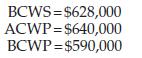
Assume the $590,000 indicated for Week 22 is the most likely EV. Given a BAC of $990,000, this represents 59.6 percent of the project completed. Suppose an expert assesses the LOGON project at that time, using various measures, and concludes that LOGON is between 50 percent and 65 percent
Refer back to Problem
The actual start dates for Tasks A and B are August 2 and August 1, respectively. At the end of August 4, Task A is assessed to be 20 percent completed and Task B 30 percent completed. What is the expected early start time for Task C?
After 4 days of work, the supervisor estimates that the task is 25 percent completed. If the work rate stays the same, what is the forecast date of completion?b. Task C has two immediate predecessors, Tasks A and B. Task A is planned to take 5 days to complete; Task B is planned to take 10 days.
Assume for the following problems that work continues during weekends.a. A task is planned to start on April 30 and takes 20 days to complete. The actual start date is May
Interpret the results.b. Compute ETC and EAC. Estimate the revised completion date, and sketch the lines for forecast AC and forecast EV.
Using the status chart in Figure 11.21:a. Estimate SV, CV, and TV, and compute SPI and CPI for Week
For a particular work package, the budgeted cost as of April 30 is $18,000. Suppose, as of April 30, the supervisor determines that only 80 percent of the scheduled work has been completed and the actual expense is $19,000. What is the BCWP? Compute SV, CV, SPI, and CPI for the work package.
In the LOGON project suppose the status of the project as of Week 22 is as follows(note usage of the longer acronyms; some project management software use these and not the shorter acronyms PV, AC, and EV).Answer the following questions:a. What is the earned value of the project as of Week 22?b.
Use the networks in Figure 11.20 to determine ES, LS, EF, and LF for all activities(number by activity is the duration in days). Apply the buffer concept to the critical path. For network (a), use a 3-week time buffer for the critical path, a 1-week time buffer for every path that connects to the
What are some diffi culties encountered when attempting project control?
What aspects of project control fall under contract administration?
What should a change control system guarantee? Describe procedures that minimize unnecessary changes.
Discuss reasons why the project manager frequently resists project changes.
Explain what is meant by ETC and how it is related to EAC.
Explain TPM, its purpose, and how it is conducted.
What does it signify if cost or schedule index fi gures are less than 1.00?
Explain PV, AC, and EV, and how they are used to determine the variances AV, SV, CV, and TV. Explain the meaning of these variances.
What are the principal causes of project schedule overruns? Discuss at least four practices that may be used to reduce schedule variability and keep projects on schedule.
Discuss quality control as applied to projects.
Why is scope change control an important part of the project control process?
Discuss different ways of measuring ongoing work progress.
Describe the process of collecting data about the cost, schedule, and work accomplished.
Describe the process of work authorization. What does a work order usually include?
If a cost or schedule variance is noticed at the project level, how is it traced to the source of the variance?
How are overhead expenses allocated in work packages?
Explain the differences between internal and external project controls.
What are the three phases of the project control process?
What is contract administration?
What is the distinction between the project end-item and project side-items?What role does the project manager have regarding each?
What happens during the production or building stage? How is work planned and coordinated? Who oversees the work?
What does the plan for production/build include?
What is the role of interaction design in product design and development?
What happens during the design stage? Who is involved? What do they do?What is the role of the project manager? How are design changes monitored and controlled?
What is the practice of “fast-tracking” or “design/build?” What are the associated potential benefi ts and dangers?
What risks materialized during the project, and how were they handled?
Discuss the use of contingency plans and budget and schedule reserves to cover risks.
How were risks dealt with (through risk transfer, acceptance, avoidance, reduction, etc.)?
How were risks identifi ed?
Was there a risk offi cer? Discuss her duties and role in the project.
Was a formal risk management plan created? Discuss the plan.
Was formal risk analysis performed? When was it done (in initiation, feasibility, etc.)?
In your own judgment, was this a risky project? Why or why not?
What did managers and stakeholders believe were the major risks in the project?
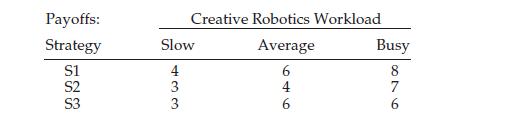
Frank Wesley, project manager for the LOGON project, is concerned about the development time for the robotic transporter. Although the subcontractor, Creative Robotics, has promised a delivery time of 6 weeks, Frank knows that the actual delivery time will be a function of the number of other
Iron Butterfl y Company submits proposals in response to RFPs and faces three possible outcomes: N1, Iron Butterfl y gets a full contract; N2, it gets a partial contract (job is shared with other contractors); N3, it gets no contract. The company is currently assessing three RFPs, coded P1, P2, and
Corecast Contractors has been requested by a municipality to submit a proposal bid for a parking garage contract. In the past, the cost of preparing bids has been about 2 percent of the cost of the job. Corecast project manager Bradford Pitts is considering three possible bids: cost plus 10
Softside Systems has a $100,000 fi xed price contract for installation of a new application system. The project is expected to take 5 weeks and cost $50,000.Experience with similar projects suggests a 0.30 likelihood that the project will encounter problems that could delay it by as much as 3 weeks
Because of its geographical location, the Largesse Hydro project is threatened with weather-associated delays and costs. The likelihood of bad weather is estimated at 0.30 with a potential impact of delaying work by 10 weeks and increasing the cost by $20,000.a. Ignoring the time and cost risks in
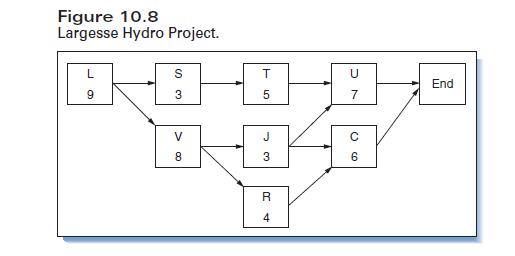
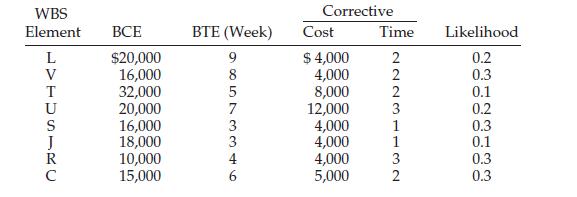
Figure 10.8 is the network for the Largesse Hydro Project:The table gives the baseline cost and time estimates (BCE and BTE), the cost and time estimates to correct for failure, and the likelihood of failure for each work package.a. Determine the risk time and risk cost for all the WBS elements of
Where would criteria such as maximax, maximin, and minimax regret be used during the project life cycle to manage project risk?
How and where are risk time and risk cost considerations used in project planning?
Can risk be eliminated from projects? Should management try to eliminate it?
Risk management includes being prepared for the unexpected. Explain.
How does risk planning serve to increase risk-taking behavior?
List and review the principles of risk management.
A 3 percent design margin is applied to the system and the subsystems.Note, because the power requirement is stated as minimum output, the target output will be 3 percent above the requirement.a. What is the target requirement output for the overall system?b. What are the target requirement outputs
One requirement of a power-generating system states that it must provide 500 kWh minimum output. The system has three power-generating subsystems, X, Y, and Z. Constraints on physical size indicate that the output capacity of overall system will be split among the three subsystems in the
What is a design margin? How does its application reduce risk?
Think of a project you are familiar with and problems it encountered. List some ways the problems could have been avoided, and explain each of them.
Showing 4500 - 4600
of 6659
First
39
40
41
42
43
44
45
46
47
48
49
50
51
52
53
Last
Step by Step Answers

 Get 50% OFF
Claim Now
Get 50% OFF
Claim Now