New Semester
Started
Get
50% OFF
Study Help!
--h --m --s
Claim Now
Question Answers
Textbooks
Find textbooks, questions and answers
Oops, something went wrong!
Change your search query and then try again
S
Books
FREE
Study Help
Expert Questions
Accounting
General Management
Mathematics
Finance
Organizational Behaviour
Law
Physics
Operating System
Management Leadership
Sociology
Programming
Marketing
Database
Computer Network
Economics
Textbooks Solutions
Accounting
Managerial Accounting
Management Leadership
Cost Accounting
Statistics
Business Law
Corporate Finance
Finance
Economics
Auditing
Tutors
Online Tutors
Find a Tutor
Hire a Tutor
Become a Tutor
AI Tutor
AI Study Planner
NEW
Sell Books
Search
Search
Sign In
Register
study help
business
probability and stochastic modeling
Brownian Motion A Guide To Random Processes And Stochastic Calculus De Gruyter Textbook 3rd Edition René L. Schilling, Björn Böttcher - Solutions
The linear growth of the coefficients is essential for Corollary 21.31.a) Consider the case where \(d=n=1, b(x)=-e^{x}\) and \(\sigma(x)=0\). Find the solution of this deterministic ODE and compare your findings for \(x \rightarrow+\infty\) with Corollary 21.31b) Assume that \(|b(x)|+|\sigma(x)|
Let \(\left(B_{t}\right)_{t \geqslant 0}\) be a \(\mathrm{BM}^{1}\) and \(b(x), \sigma(x)\) autonomous and globally Lipschitz continuous coefficients. We have seen in Corollary 21.24 that the solution of the stochastic differential equation \(d X_{t}=b\left(X_{t}\right) d t+\sigma\left(X_{t}\right)
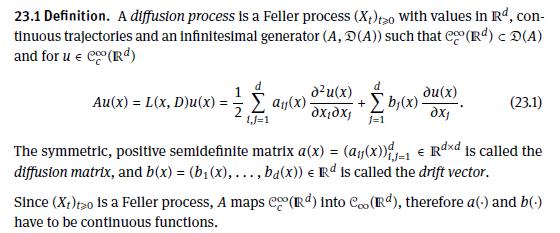
Let \((A, \mathfrak{D}(A))\) be the generator of a diffusion process in the sense of Definition 23.1 and denote by \(a, b\) the diffusion and drift coefficients. Show that \(a \in \mathcal{C}\left(\mathbb{R}^{d}, \mathbb{R}^{d \times d}\right)\) and \(b \in \mathcal{C}\left(\mathbb{R}^{d},
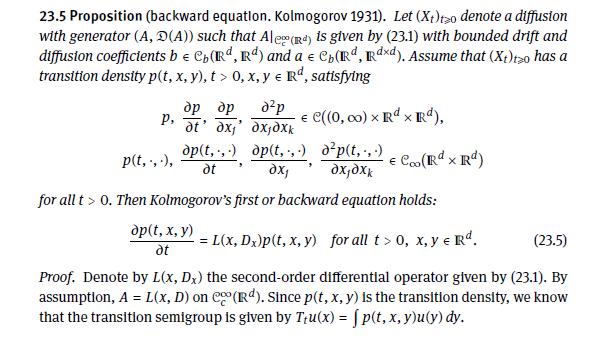
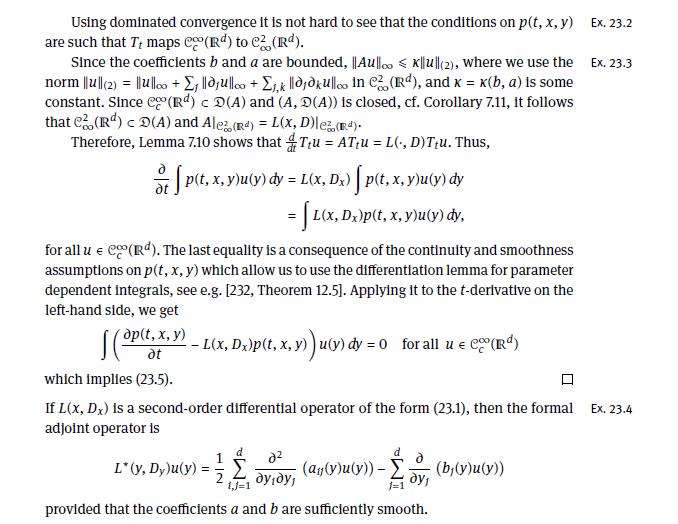
Show that under the assumptions of Proposition 23.5 we can interchange integration and differentiation: \(\frac{\partial^{2}}{\partial x_{j} \partial x_{k}} \int p(t, x, y) u(y) d y=\int \frac{\partial^{2}}{\partial x_{j} \partial x_{k}} p(t, x, y) u(y) d y\) and that the resulting function is in
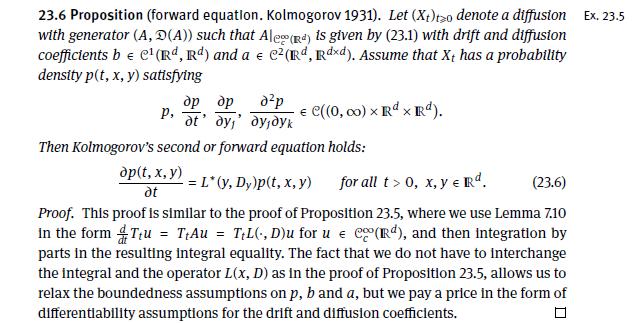
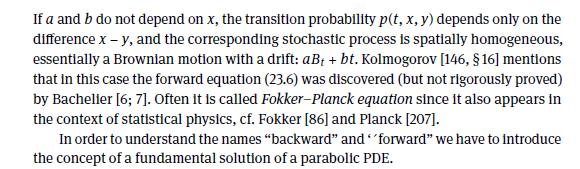
Complete the proof of Proposition 23.6 (Kolmogorov's forward equation).Data From 23.6 Proposition 23.6 Proposition (forward equation. Kolmogorov 1931). Let (X+) to denote a diffusion Ex. 23.5 with generator (A, D(A)) such that Alego (R) is given by (23.1) with drift and diffusion
Let \(\left(X_{t}\right)_{t \geqslant 0}\) be a diffusion process with the infinitesimal generator \(L=L(x, D)=\left.A\right|_{\mathcal{C}_{c}^{\infty}}\) as in (23.1). Write \(M_{t}^{u}=u\left(X_{t}\right)-u\left(X_{0}\right)-\int_{0}^{t} L u\left(X_{r}\right) d r\).a) Show that
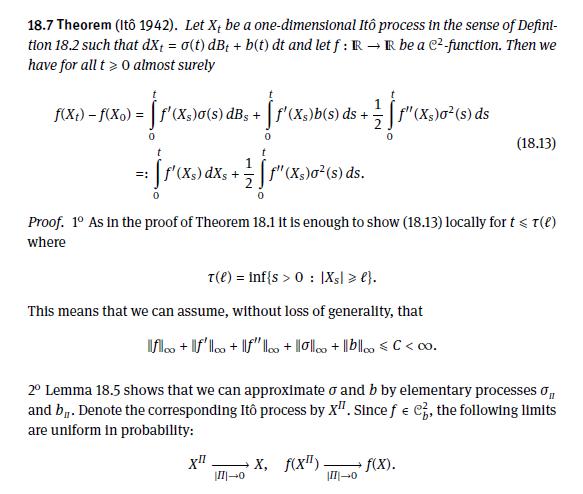
Let \(\left(N_{t}, \mathscr{F}_{t}\right)_{t \geqslant 0}\) be a continuous, real-valued local martingale and \(u \in \mathcal{C}^{2}(\mathbb{R})\). Show the following Itô formula \(d u\left(N_{t}\right)=u^{\prime}\left(N_{t}\right) d N_{t}+\frac{1}{2} u^{\prime \prime}\left(N_{t}\right) d\langle
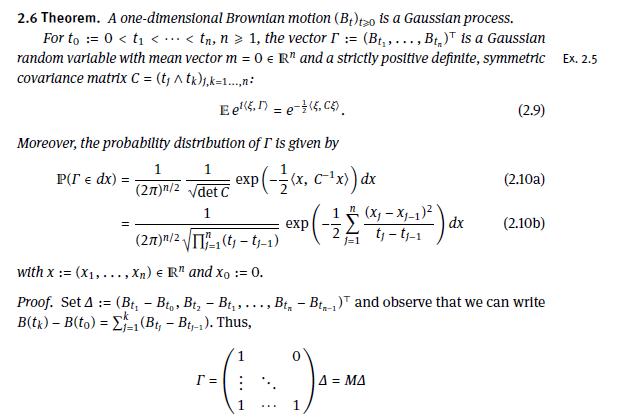
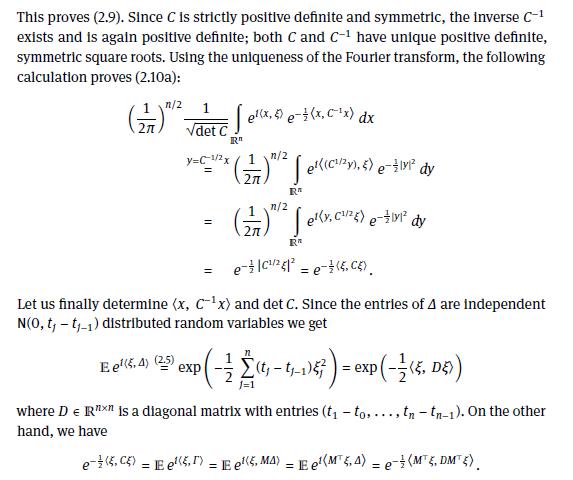
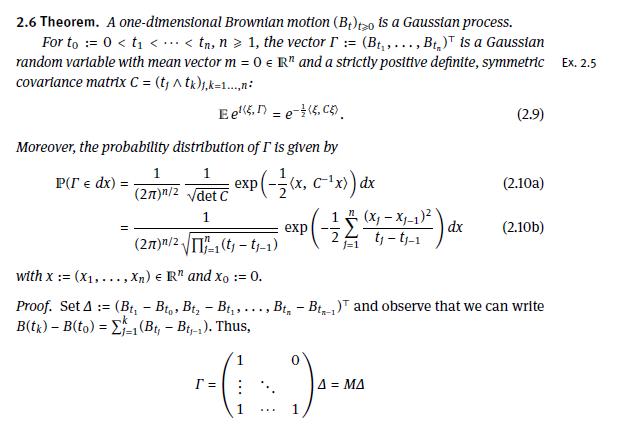
Show that the covariance matrix \(C=\left(t_{j} \wedge t_{k}\right)_{j, k=1, \ldots, n}\) appearing in Theorem 2.6 is positive definite.Data From Theorem 2.6 2.6 Theorem. A one-dimensional Brownian motion (B+)to is a Gaussian process. For to 0 1, the vector I := (Bt,,..., Bt.) is a Gaussian random
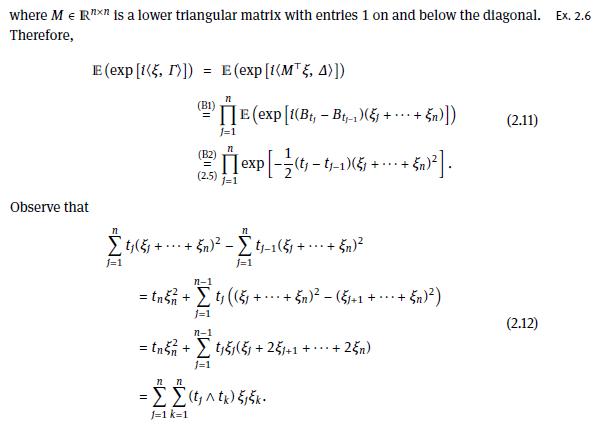
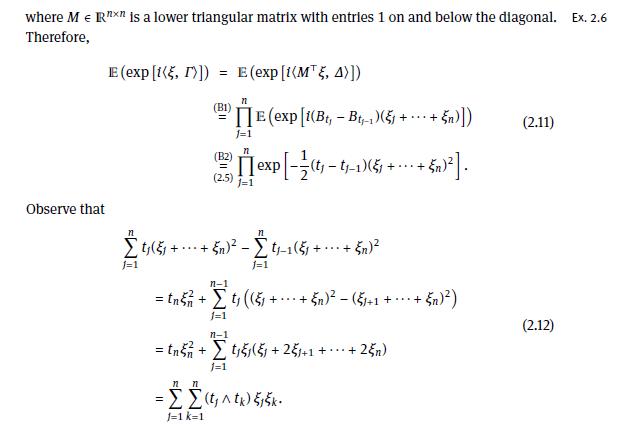
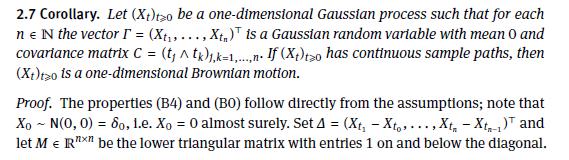
Verify that the matrix \(M\) in the proof of Theorem 2.6 and Corollary 2.7 is a lower triangular matrix with entries 1 on and below the diagonal. Show that the inverse matrix \(M^{-1}\) is a lower triangular matrix with entries 1 on the diagonal and -1 directly below the diagonal.Data From Theorem
Find out whether the processes \(X(t):=B\left(e^{t}\right)\) and \(X(t):=e^{-t / 2} B\left(e^{t}\right), t \geqslant 0\), have the no-memory property, i.e. o(X(t) ta) o(X(t + a) - X(a): t> 0) for a > 0.
Prove the time inversion property from Paragraph 2.15. W
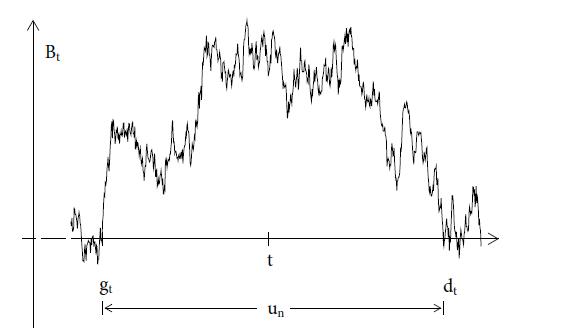
Let \(\left(B_{t}\right)_{t \geqslant 0}\) be a \(\mathrm{BM}^{1}\). Use Paragraph 2.17 to show that \(\lim _{t \rightarrow \infty} B_{t} / t=0\) a.s. and in mean square sense.Data From Paragraph 2.17 B gt K un d
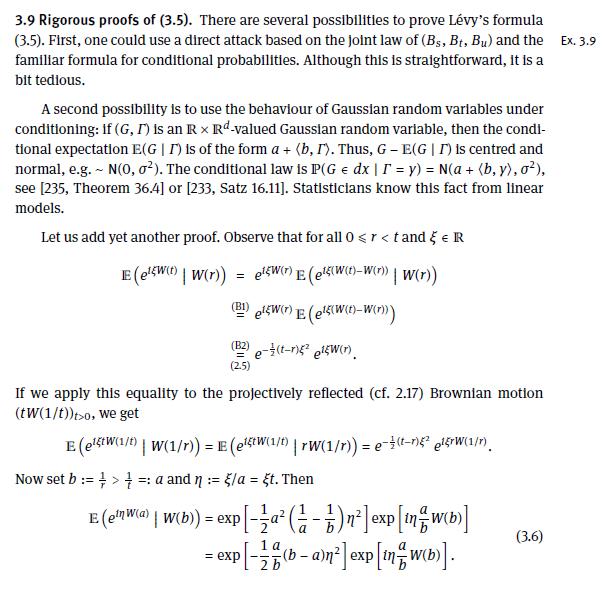
Give a direct proof of the formula (3.5) using the joint probability distribution \(\left(W\left(t_{0}\right), W(t), W\left(t_{1}\right)\right)\) of the Brownian motion \(W(t)\).Data From Formula 3.5 3.9 Rigorous proofs of (3.5). There are several possibilities to prove Lvy's formula (3.5). First,
Let for some \(T>0\). Show that for all (Bt)tzo be a BM, e c(R), (0) = 0 and f, g L
Let \(\left(B_{t}\right)_{t \geqslant 0}\) be a \(\mathrm{BM}^{1}, \Phi(y):=\mathbb{P}\left(B_{1} \leqslant y\right)\), and set \(X_{t}:=B_{t}+\alpha t\) for some \(\alpha \in \mathbb{R}\). Use Girsanov's theorem to show for all \(0 \leqslant x \leqslant y, t>0\)\[\mathbb{P}\left(X_{t} \leqslant x,
Let \(\left(B_{t}\right)_{t \geqslant 0}\) be a \(\mathrm{BM}^{d}\) and denote by \(\left(X_{t}^{x}\right)_{t \geqslant 0}\) the strong solution of the SDE\[d X_{t}=abla c\left(X_{t}\right) d t+d B_{t}, \quad X_{0}=x \in \mathbb{R}^{d},\]where \(c \in \mathcal{C}_{c}^{2}\left(\mathbb{R}^{d},
Let \(F: \mathbb{R} ightarrow[0,1]\) be a distribution function.a) Show that there exists a probability space \((\Omega, \mathscr{A}, \mathbb{P})\) and a random variable \(X\) such that \(F(x)=\mathbb{P}(X \leqslant x)\).b) Show that there exists a probability space \((\Omega, \mathscr{A},
Let \(\left(B_{t}ight)_{t \geqslant 0}\) be a \(\mathrm{BM}^{d}\) and assume that \(X\) is a \(d\)-dimensional random variable which is independent of \(\mathscr{F}_{\infty}^{B}\).a) Show that \(\widetilde{\mathscr{F}}_{t}:=\sigma\left(X, B_{s}: s \leqslant tight)\) defines an admissible filtration
Let \(\left(X_{t}, \mathscr{F}_{t}ight)_{t \geqslant 0}\) be a martingale and denote by \(\mathscr{F}_{t}^{*}\) be the completion of \(\mathscr{F}_{t}\) (completion means to add all subsets of \(\mathbb{P}\)-null sets).a) Show that \(\left(X_{t}, \mathscr{F}_{t}^{*}ight)_{t \geqslant 0}\) is a
Let \(\left(X_{t}, \mathscr{F}_{t}ight)_{t \geqslant 0}\) be a submartingale with continuous paths and \(\mathscr{F}_{t+}=\bigcap_{u>t} \mathscr{F}_{u}\). Show that \(\left(X_{t}, \mathscr{F}_{t+}ight)_{t \geqslant 0}\) is again a submartingale.
Let \(\left(B_{t}ight)_{t \geqslant 0}\) be a \(\mathrm{BM}^{1}\). Find a polynomial \(\pi(t, x)\) in \(x\) and \(t\), which is of order 4 in the variable \(x\), such that \(\pi\left(t, B_{t}ight)\) is a martingale.One possibility is to use the exponential Wald identity \(\mathbb{E} \exp \left(\xi
This exercise contains a recipe how to obtain "polynomial" martingales with leading term \(B_{t}^{n}\), where \(\left(B_{t}, \mathscr{F}_{t}ight)_{t \geqslant 0}\) is a \(\mathrm{BM}^{1}\).a) We know that \(M_{t}^{\xi}:=\exp \left(\xi B_{t}-\frac{1}{2} \xi^{2} tight), t \geqslant 0, \xi \in
Let \(\left(B_{t}ight)_{t \geqslant 0}\) be a \(\mathrm{BM}^{d}\). Find all \(c \in \mathbb{R}\) such that \(\mathbb{E} e^{c\left|B_{t}ight|}\) and \(\mathbb{E} e^{c\left|B_{t}ight|^{2}}\) are finite.
Let \(p(t, x)=(2 \pi t)^{-d / 2} \exp \left(-|x|^{2} /(2 t)ight), x \in \mathbb{R}^{d}, t>0\), be the transition density of a \(d\)-dimensional Brownian motion.a) Show that \(p(t, x)\) is a solution for the heat equation, i.e.\[\frac{\partial}{\partial t} p(t, x)=\frac{1}{2} \Delta_{x} p(t,
Let \(\left(B_{t}, \mathscr{F}_{t}ight)_{t \geqslant 0}\) be a \(\mathrm{BM}^{1}\). Show that \(X_{t}=\exp \left(a B_{t}+b tight), t \geqslant 0\), is a martingale if, and only if, \(a^{2} / 2+b=0\).
Let \(\left(B_{t}, \mathscr{F}_{t}ight)_{t \geqslant 0}\) be a one-dimensional Brownian motion. Which of the following processes are martingales?a) \(U_{t}=e^{c B_{t}}, c \in \mathbb{R}\);b) \(V_{t}=t B_{t}-\int_{0}^{t} B_{s} d s\);c) \(W_{t}=B_{t}^{3}-t B_{t}\);d) \(X_{t}=B_{t}^{3}-3 \int_{0}^{t}
Let \(\left(B_{t}, \mathscr{F}_{t}ight)_{t \geqslant 0}\) be a one-dimensional Brownian motion and \(f \in \mathcal{C}^{1}(\mathbb{R})\). Show that \(M_{t}:=f(t) B_{t}-\int_{0}^{t} f^{\prime}(s) B_{s} d s\) is a martingale.
Let \(\left(B_{t}, \mathscr{F}_{t}ight)_{t \geqslant 0}\) be a \(\mathrm{BM}^{d}\). Show that \(X_{t}=\frac{1}{d}\left|B_{t}ight|^{2}-t, t \geqslant 0\), is a martingale.
Let \(\left(X_{t}, \mathscr{F}_{t}ight)_{t \geqslant 0}\) be a \(d\)-dimensional stochastic process and \(A, A_{n}, C \in \mathscr{B}\left(\mathbb{R}^{d}ight), n \geqslant 1\). Thena) \(A \subset C\) implies \(\tau_{A}^{\circ} \geqslant \tau_{C}^{\circ}\) and \(\tau_{A} \geqslant \tau_{C}\);b)
Let \(U \subset \mathbb{R}^{d}\) be an open set and assume that \(\left(X_{t}ight)_{t \geqslant 0}\) is a stochastic process with continuous paths. Show that \(\tau_{U}=\tau_{U}^{\circ}\).
Show that the function \(d(x, A):=\inf _{y \in A}|x-y|, A \subset \mathbb{R}^{d}\), is continuous.
Let \(\tau\) be a stopping time. Check that \(\mathscr{F}_{\tau}\) and \(\mathscr{F}_{\tau+}\) are \(\sigma\)-algebras.
Let \(\tau\) be a stopping time for the filtration \(\left(\mathscr{F}_{t}ight)_{t \geqslant 0}\). Show thata) \(F \in \mathscr{F}_{\tau+} \Longleftrightarrow \forall t \geqslant 0: F \cap\{\tau
Let \(\left(B_{t}ight)_{t \geqslant 0}\) be a \(\mathrm{BM}^{d}\). Find \(\mathbb{E} \tau_{R}\) where \(\tau_{R}=\inf \left\{t \geqslant 0:\left|B_{t}ight|=Right\}\).
Let \(\left(B_{t}ight)_{t \geqslant 0}\) be a \(\mathrm{BM}^{1}\) and \(\sigma, \tau\) be two stopping times such that \(\mathbb{E} \tau, \mathbb{E} \sigma
Let \(B=\left(B_{t}ight)_{t \geqslant 0}\) be a canonical \(\operatorname{BM}^{1}\) on Wiener space \((\Omega, \mathscr{A}, \mathbb{P})=\left(\mathcal{C}_{(\mathrm{o})}, \mathscr{B}\left(\mathcal{C}_{(0)}ight), \muight)\) and \(\mathscr{F}_{t}:=\sigma\left(B_{s}, s \leqslant tight),
Let \(\left(B_{t}, \mathscr{F}_{t}ight)_{t \geqslant 0}\) be a \(\mathrm{BM}^{1}\).a) Show that \(X_{t}:=\left|B_{t}ight|, t \geqslant 0\), is also a Markov process for the filtration \(\left(\mathscr{F}_{t}ight)_{t \geqslant 0}\), i.e. for all \(s, t \geqslant 0\) and \(u \in
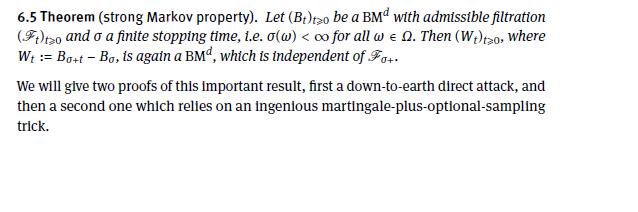
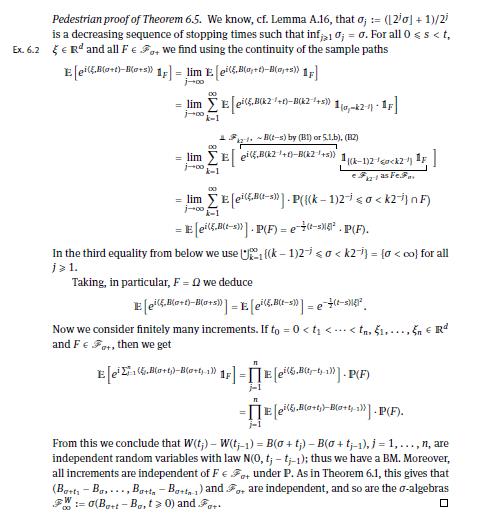
Compare the (last part of the) first ("pedestrian") proof of Theorem 6.5 with the characterization of a BM by Lemma 5.4. Can you think of a way to use this lemma instead of the direct calculation?Data From Theorem 6.5Data From Lemma 5.4 6.5 Theorem (strong Markov property). Let (Bt)to be a BMd with
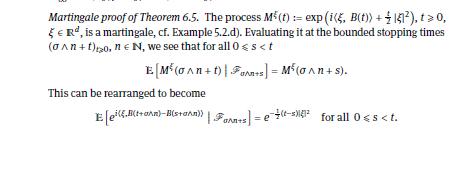
Assume that \(\left(X_{t}ight)_{t \geqslant 0}\) is a uniformly bounded stochastic process with exclusively continuous sample paths, \(\left(\mathscr{F}_{t}ight)_{t \geqslant 0}\) is some filtration, and \(\sigma\) is an everywhere finite stopping time.a) Show that \(\sigma \wedge n+t\) are again
Let \(\left(B_{t}ight)_{t \geqslant 0}\) be a Brownian motion on the space \(\left(\mathcal{C}, \mathscr{B}(\mathcal{C}), \mathbb{P}^{0}ight)\). The (canonical) shift operator is the map \(\theta_{h}: \mathcal{C} ightarrow \mathcal{C}, \theta_{h} w(\cdot)=\) \(w(\cdot+h)\), i.e. \(\left(\theta_{h}
Let \(\left(B_{t}, \mathscr{F}_{t}ight)_{t \geqslant 0}\) be a \(\mathrm{BM}^{1}\) and set \(M_{t}:=\sup _{s \leqslant t} B_{s}\) and \(I_{t}=\int_{0}^{t} B_{s} d s\).a) Show that the two-dimensional process \(\left(B_{t}, M_{t}ight)_{t \geqslant 0}\) is a Markov process for
Let \((B(t))_{t \geqslant 0}\) be a \(\mathrm{BM}^{d}\) and let \(Z\) be a bounded \(\mathscr{F}_{\infty}^{B}\) measurable random variable. Then \(x \mapsto \mathbb{E}^{x} Z\) is in \(\mathcal{B}_{b}\left(\mathbb{R}^{d}ight)\).\(\mathscr{F}_{\infty}^{B}\) is generated by sets of the form
Let \(\left(B_{t}ight)_{t \geqslant 0}\) be a \(\mathrm{BM}^{1}\). Show that \(\mathbb{P}\left(\sup _{s \leqslant t}\left|B_{s}ight| \geqslant xight) \leqslant 2 \mathbb{P}\left(\left|B_{t}ight| \geqslant xight), x, t \geqslant 0\).
Let \(\left(B_{t}ight)_{t \geqslant 0}\) be a \(\mathrm{BM}^{1}\) and denote by \(\tau_{b}=\inf \left\{s \geqslant 0: B_{s}=bight\}\) the first time when \(B_{t}\) reaches \(b \in \mathbb{R}\). Show thata) \(\tau_{b} \sim \tau_{-b}\);b) \(\tau_{c b} \sim c^{2} \tau_{b}, c \in \mathbb{R}\);c) if \(0
Let \(\tau=\tau_{(a, b)^{c}}^{\circ}\) be the first exit time of a Brownian motion from the interval \((a, b)\).a) Find \(\mathbb{E}^{x} e^{-\lambda \tau}\) for all \(x \in(a, b)\) and \(\lambda>0\).b) Find \(\mathbb{E}^{x}\left(e^{-\lambda \tau} \mathbb{1}_{\left\{B_{\tau}=aight\}}ight)\) for all
Let \(W=\left(W_{t}ight)_{t \geqslant 0}\) be a \(\mathrm{BM}^{2}\) such that \(W_{0}=(a, b)\) with \(a, b>0\). What is the probability that \(W_{t}\) hits first the positive part of the \(x\)-axis before it hits the negative part?
Let \(\left(B_{t}ight)_{t \geqslant 0}\) be a \(\mathrm{BM}^{1}\) and set \(M_{t}:=\sup _{s \leqslant t} B_{s}\). Find the distribution of \(\left(M_{t}, B_{t}ight)\).
Let \(\left(B_{t}ight)_{t \geqslant 0}\) be a \(\mathrm{BM}^{1}\) and let \(\tau_{0}\) be the first hitting time of 0 . Find the "density" of \(\mathbb{P}^{x}\left(B_{t} \in d z, \tau_{0}>tight)\), i.e. find the function \(f_{t, x}(z)\) such that\[\mathbb{P}^{X}\left(B_{t} \in A,
Let \(K \subset \mathbb{R}^{d}\) be a compact set. Show that there is a decreasing sequence of continuous functions \(\phi_{n}(x)\) such that \(\mathbb{1}_{K}=\inf _{n} \phi_{n}\).Let \(U \supset K\) be an open set and \(\phi(x):=d\left(x, U^{c}ight) /\left(d(x, K)+d\left(x, U^{c}ight)ight)\).
Let \(\left(B_{t}ight)_{t \geqslant 0}\) be a \(\mathrm{BM}^{1}\). Find the distribution of \(\widetilde{\xi}_{t}:=\inf \left\{s \geqslant t: B_{s}=0ight\}\).
Let \(\left(B_{t}ight)_{t \geqslant 0}\) be a \(\mathrm{BM}^{1}\) and set \(M_{t}=\sup _{s \leqslant t} B_{s}\). Denote by \(\xi_{t}\) the largest zero of \(B_{s}\) before time \(t\) and by \(\eta_{t}\) the largest zero of \(Y_{S}=M_{s}-B_{s}\) before time \(t\). Show that \(\xi_{t} \sim \eta_{t}\).
Let \(\left(B_{t}ight)_{t \geqslant 0}\) be a \(\mathrm{BM}^{1}\) and \(0
Show that \(\mathcal{C}_{\infty}:=\left\{u: \mathbb{R}^{d} ightarrow \mathbb{R}ight.\) : continuous and \(\left.\lim _{|x| ightarrow \infty} u(x)=0ight\}\) equipped with the uniform topology is a Banach space. Show that in this topology \(\mathcal{C}_{\infty}\) is the closure of
Let \(A, B \in \mathbb{R}^{d \times d}\) and set \(P_{t}:=\exp (t A):=\sum_{j=0}^{\infty}(t A)^{j} / j\) !.a) Show that \(P_{t}\) is a strongly continuous semigroup. Is it contractive?b) Show that \(\frac{d}{d t} e^{t A}\) exists and that \(\frac{d}{d t} e^{t A}=A e^{t A}=e^{t A} A\).c) Show that
Let \(\left(P_{t}ight)_{t \geqslant 0}\) and \(\left(T_{t}ight)_{t \geqslant 0}\) be two Feller semigroups with generators \((A, \mathfrak{D}(A))\), resp. \((B, \mathfrak{D}(B))\).a) If \(\mathfrak{D}(B) \subset \mathfrak{D}(A)\), then we have \(\frac{d}{d s} P_{t-s} T_{s}=-P_{t-s} A T_{s}+P_{t-s}
Let \(U_{\alpha}\) be the \(\alpha\)-potential operator of a \(\mathrm{BM}^{d}\). Give a probabilistic interpretation of \(U_{\alpha} \mathbb{1}_{C}\) and \(\lim _{\alpha ightarrow 0} U_{\alpha} \mathbb{1}_{C}\) if \(C \subset \mathbb{R}^{d}\) is a Borel set.
Let \(U_{0}\) be the potential operator of a \(\mathrm{BM}^{d}\) in dimension \(d=1\) or \(d=2\). Show that every \(u \in \mathfrak{D}\left(U_{0}ight)\) such that \(u \geqslant 0\) is trivial, i.e. \(u=0\).
Let \(\left(U_{\alpha}ight)_{\alpha>0}\) be the \(\alpha\)-potential operator of a \(\mathrm{BM}^{d}\). Use the resolvent equation to prove the following formulae for \(f \in \mathcal{B}_{b}\) and \(x \in \mathbb{R}^{d}\) :\[\frac{d^{n}}{d \alpha^{n}} U_{\alpha} f(x)=n !(-1)^{n} U_{\alpha}^{n+1}
Let \(\left(f_{n}ight)_{n \geqslant 1} \subset \mathcal{C}_{\infty}\left(\mathbb{R}^{d}ight)\) be a sequence of functions such that \(0 \leqslant f_{n} \leqslant f_{n+1}\) and \(f:=\sup _{n} f_{n} \in \mathcal{C}_{\infty}\left(\mathbb{R}^{d}ight)\). Show that \(\lim _{n ightarrow
Let \(t \mapsto X_{t}\) be a right continuous stochastic process. Show that for closed sets \(F\)\[\mathbb{P}\left(X_{t} \in F \quad \forall t \in \mathbb{R}^{+}ight)=\mathbb{P}\left(X_{q} \in F \quad \forall q \in \mathbb{Q}^{+}ight)\]
Let \(\left(B_{t}ight)_{t \geqslant 0}\) be a \(\mathrm{BM}^{d}, f: \mathbb{R}^{d} ightarrow \mathbb{R}\) be a continuous function such that \(\int_{0}^{t} f\left(B_{s}ight) d s=0\) for all \(t>0\). Show that \(f\left(B_{s}ight)=0\) for all \(s>0\), and conclude that \(f \equiv 0\).
Let Show that the random variable \(\beta\left(\sigma_{n}ight)\) has a probability density. (b, ) be a BM and = infit > 1/n b(t) = 0}
Let \(\left(\Pi_{n}ight)_{n \geqslant 1}\) be a sequence of refining (i.e. \(\left.\Pi_{n} \subset \Pi_{n+1}ight)\) partitions of \([0,1]\) such that \(\lim _{n ightarrow \infty}\left|\Pi_{n}ight|=0\). Show that for every function \(f \in \mathcal{C}[0,1]\) the limit\[\begin{aligned}\lim _{n
Let \(f=(g, h):[0, \infty) ightarrow \mathbb{R}^{2}\) and \(p>0\). Show that \(\operatorname{VAR}_{p}(f ;[0, t])
Let \(f \in \mathcal{C}[0,1]\). For every partition \(\Pi=\left\{t_{0}=0
Let \(f\) be continuous. Show that it does not affect the finiteness of \(\operatorname{VAR}_{p}(f ;[0, t])\) and the numerical value of \(\operatorname{var}_{p}(f ;[0, t])\) if we restrict ourselves to partitions not containing the endpoints 0 and \(t\) of the interval. (In this case we have to
(Quadratic variation) Let \((B(t))_{t \geqslant 0}\) be a one-dimensional Brownian motion. Consider the random variables \(Y_{n}:=\sum_{k=1}^{n}\left(B\left(\frac{k}{n}ight)-B\left(\frac{k-1}{n}ight)ight)^{2}\).a) Find \(\mathbb{E} Y_{n}\) and \(\mathbb{V} Y_{n}\).b) Determine the probability
Show that \(\mathrm{BM}^{1}\) is almost surely not \(1 / 2\)-Hölder continuous:a) For all \(Z \sim \mathrm{N}(0,1)\) and \(x>0\) we have\[\frac{1}{\sqrt{2 \pi}} \frac{x e^{-x^{2} / 2}}{x^{2}+1}x)c \sqrt{n 2^{-n}}ight\}\) and show that for each \(c
Let \(X \sim \mathrm{N}(0,1)\). Show that for every \(\lambda_{0} \in\left(0, \frac{1}{2}ight)\) there is a constant \(C=C\left(\lambda_{0}ight)\) such that \(\sup _{\lambda \leqslant \lambda_{0}} \mathbb{E}\left(\left(X^{2}-1ight)^{2} e^{|\lambda|\left(X^{2}-1ight)}ight) \leqslant C
Let \(X\) be a real-valued random variable on \((\Omega, \mathscr{A}, \mathbb{P})\) and \(\mathscr{F} \subset \mathscr{A}\) be \(\sigma\)-algebra. Show thatShow that \(\mathbb{E}\left(e^{i \xi X} e^{i \eta \mathbb{1}_{F}}ight)=\mathbb{E}\left(e^{i \xi X}ight) \mathbb{E}\left(e^{i \eta
Prove that in \(\mathbb{R}^{n}\) all \(\ell^{p}\)-norms \((1 \leqslant p \leqslant \infty)\) are equivalent:\[\max _{1 \leqslant j \leqslant n}\left|x_{j}ight| \leqslant\left(\sum_{j=1}^{n}\left|x_{j}ight|^{p}ight)^{1 / p} \leqslant n^{1 / p} \max _{1 \leqslant j \leqslant n}\left|x_{j}ight| \quad
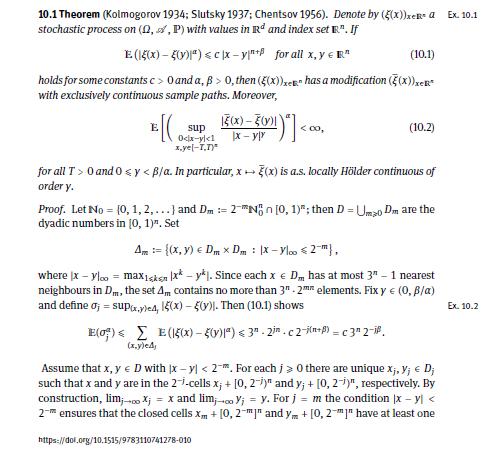
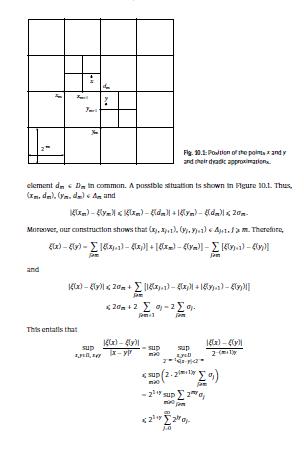
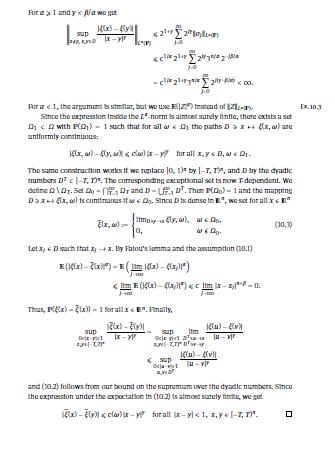
Show that for \(\alpha \in(0,1)\) the function \(Z \mapsto \mathbb{E}\left(|Z|^{\alpha}ight)\) is subadditive and complete the argument in the proof of Theorem 10.1 for this case.Data From Theorem 10.1 10.1 Theorem (Kolmogorov 1934; Slutsky 1937; Chentsov 1956). Denote by ((x))xen a stochastic
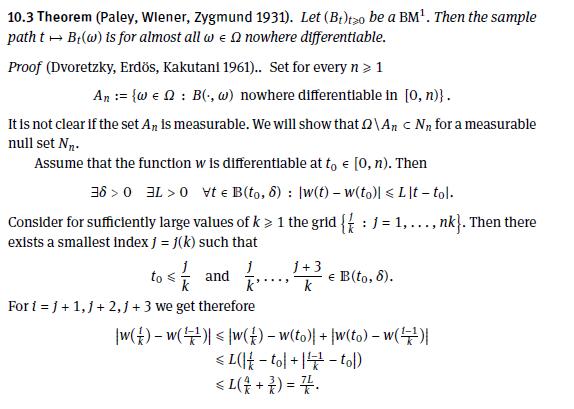
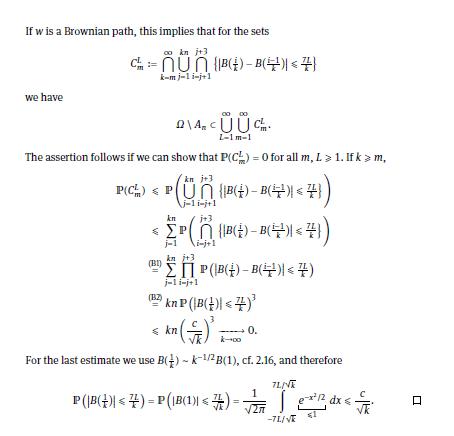
The proof of Theorem 10.3 actually shows, that almost all Brownian paths are nowhere Lipschitz continuous. Modify the argument of this proof to show that almost all Brownian paths are nowhere Hölder continuous for all \(\alpha>1 / 2\). Why does the argument break down for \(\alpha=1 / 2\) ?It
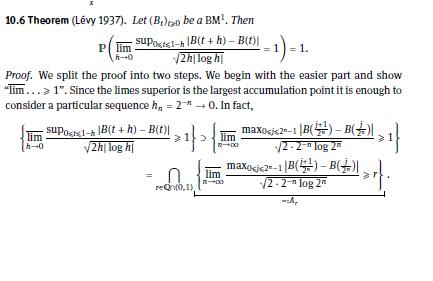
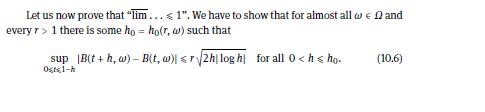
Use Theorem 10.6 to show that the strong \(p\)-variation \(\operatorname{VAR}_{p}(B ;[0,1])\) of \(\mathrm{BM}^{1}\) is for \(p>2\) finite.Data From Theorem 10.6 10.6 Theorem (Lvy 1937). Let (B)o be a BM. Then P suposts-h B(t + h) - B(t)| 2h|log h (0-1)=1. Proof. We split the proof into two
Verify that s-dimensional Hausdorff measure is an outer measure.
Show that the \(d\)-dimensional Hausdorff measure of a bounded open set \(U \subset \mathbb{R}^{d}\) is finite and positive: \(0
Let \(E \subset \mathbb{R}^{d}\). Show that Hausdorff dimension \(\operatorname{dim} E\) coincides with the numbers (E)-co}, sup [a30: sup {a 0 (E) > 0} inf (a 0:(E)
Let \(\left(E_{j}ight)_{j \geqslant 1}\) be subsets of \(\mathbb{R}^{d}\) and \(E:=\bigcup_{j \geqslant 1} E_{j}\). Show that \(\operatorname{dim} E=\sup _{j \geqslant 1} \operatorname{dim} E_{j}\).
Let \(E \subset \mathbb{R}^{d}\). Show that \(\operatorname{dim}\left(E \times \mathbb{R}^{n}ight)=\operatorname{dim} E+n\). Does a similar formula hold for \(E \times F\) where \(E \subset \mathbb{R}^{d}\) and \(F \subset \mathbb{R}^{n}\) ?
Let \(f: \mathbb{R}^{d} ightarrow \mathbb{R}^{n}\) be a bi-Lipschitz map, i.e. both \(f\) and \(f^{-1}\) are Lipschitz continuous. Show that \(\operatorname{dim} f(E)=\operatorname{dim} E\). Is this also true for a Hölder continuous map with index \(\gamma \in(0,1)\) ?
Let \(\left(B_{t}ight)_{t \geqslant 0}\) be a \(\mathrm{BM}^{d}\). Show that for \(\lambda
Let \(F \subset \mathbb{R}\) be a non-void perfect set, i.e. a closed set such that each point in \(F\) is an accumulation point of \(F\). Show that a perfect set is uncountable.
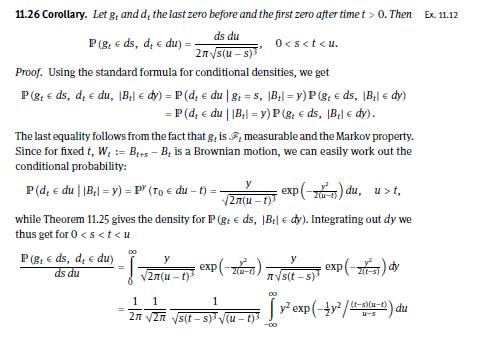
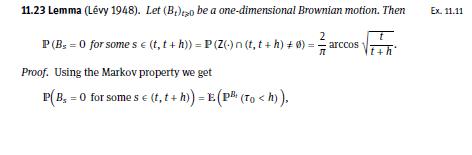
Show that Corollary 11.26 also follows from Lemma 11.23.Calculate \(\frac{\partial^{2}}{\partial u \partial s}\left(1-\frac{2}{\pi} \arccos \sqrt{\frac{s}{u}}ight)\).Data From Corollary 11.26Data From Lemma 11.23 11.26 Corollary. Let g, and d, the last zero before and the first zero after time t>0.
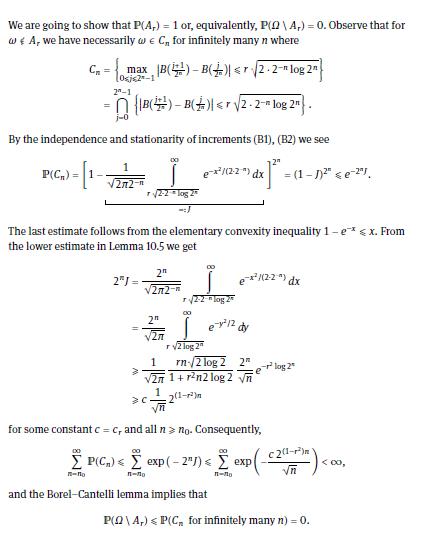
Let \(\left(B_{t}ight)_{t \geqslant 0}\) be a \(\mathrm{BM}^{1}\). Use the Borel-Cantelli lemma to show that the running maximum \(M_{n}\) := \(\sup _{0 \leqslant t \leqslant n} B_{t}\) cannot grow faster than \(C \sqrt{n \log n}\) for any \(C>2\). Use this to show that\[\varlimsup_{t ightarrow
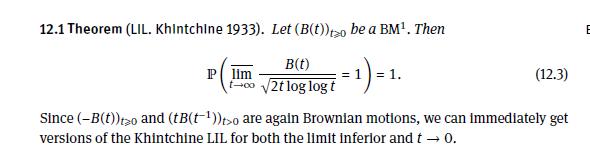
Show that the proof of Khinchine's LIL, Theorem 12.1, can be modified to give \[\varlimsup_{t ightarrow \infty} \frac{\sup _{s \leqslant t}|B(s)|}{\sqrt{2 t \log \log t}} \leqslant 1\]Use in Step \(1^{0}\) of the proof \(\mathbb{P}\left(\sup _{s \leqslant t}|B(s)| \geqslant xight) \leqslant 4
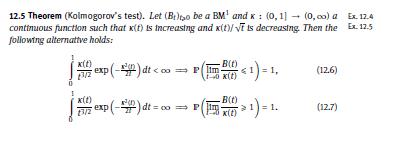
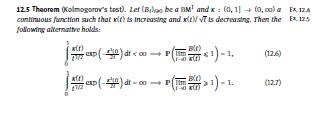
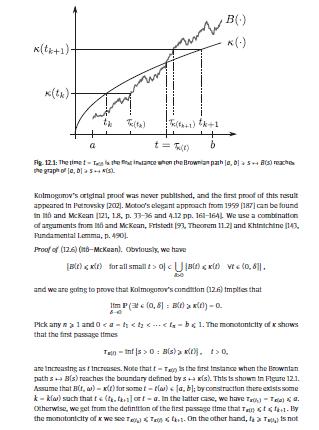
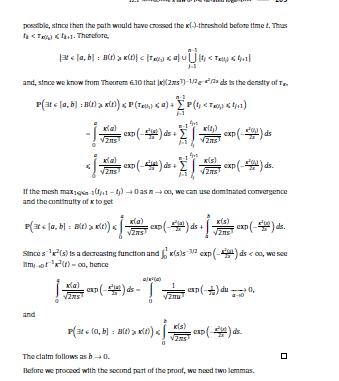
Let \(\left(B_{t}ight)_{t \geqslant 0}\) be a \(\mathrm{BM}^{1}\). Use Theorem 12.5 to show that \(\kappa(t)=(1+\epsilon) \sqrt{2 t \log |\log t|}\) is an upper function for \(t ightarrow 0\).Data From Theorem 12.5 12.5 Theorem (Kolmogorov's test). Let (Br)o be a BM and x: (0,1] (0,00) continuous
Let \(\left(B_{t}ight)_{t \geqslant 0}\) be a \(\mathrm{BM}^{1}\). Deduce from Theorem 12.5 the following test for upper functions in large time. Assume that \(\kappa \in \mathcal{C}[1, \infty)\) is a positive function such that \(\kappa(t) / t\) is decreasing and \(\kappa(t) / \sqrt{t}\) is
Let \(\left(B_{t}ight)_{t \geqslant 0}\) be a one-dimensional Brownian motion, \(a, b>0\) and \(\tau:=\inf \left\{t \geqslant 0:\left|B_{t}ight|=b \sqrt{a+t}ight\}\). Show thata) \(\mathbb{P}(\tau
Let \(w \in \mathcal{C}_{(\mathrm{o})}[0,1]\) and assume that for every fixed \(t \in[0,1]\) the number \(w(t)\) is a limit point of the family \(\left\{Z_{s}(t): s>eight\} \subset \mathbb{R}\). Show that this is not sufficient for \(w\) to be a limit point of \(\mathcal{C}_{(0)}[0,1]\).
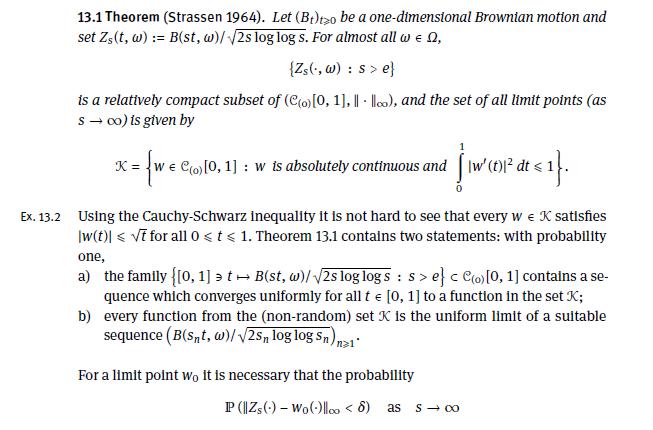
Let \(\mathcal{K}\) be the set from Theorem 13.1. Show that for \(w \in \mathcal{K}\) the estimate \(|w(t)| \leqslant \sqrt{t}\), \(t \in[0,1]\) holds.Data From Theorem 13.1 13.1 Theorem (Strassen 1964). Let (Bt)to be a one-dimensional Brownian motion and set Zs(t, w) := B(st, w)/2s log logs. For
Let \(u \in \mathcal{H}^{1}\) and denote by \(\Pi_{n}, n \geqslant 1\), a sequence of partitions of \([0,1]\) such that \(\lim _{n ightarrow \infty}\left|\Pi_{n}ight|=0\). Show that the functions\[f_{n}(t)=\sum_{t_{j}, t_{j-1} \in \Pi_{n}}\left[\frac{1}{t_{j}-t_{j-1}} \int_{t_{j-1}}^{t_{j}}
Let \(\phi \in \mathrm{BV}[0,1]\) and consider the following Riemann-Stieltjes integral\[G^{\phi}(w)=\phi(1) w(1)-\int_{0}^{1} w(s) d \phi(s), \quad w \in \mathcal{C}_{(0)}[0,1]\]Show that \(G^{\phi}\) is a linear functional on \(\left(\mathcal{C}_{(0)}[0,1],
Let \(w \in \mathcal{C}_{(0)}[0,1]\). Find the densities of the following bi-variate random variables:a) \(\left(\int_{1 / 2}^{t} s^{2} d w(s), w(1 / 2)ight)\) for \(1 / 2 \leqslant t \leqslant 1\);b) \(\left(\int_{1 / 2}^{t} s^{2} d w(s), w(u+1 / 2)ight)\) for \(0 \leqslant u \leqslant t / 2,1 / 2
Show that \(F:=\left\{w \in \mathcal{C}_{(0)}[0,1]: \sup _{q^{-1} \leqslant c \leqslant 1} \sup _{0 \leqslant r \leqslant 1}|w(c r)-w(r)| \geqslant 1ight\}\) is for every \(q>1\) a closed subset of \(\mathcal{C}_{(0)}[0,1]\).
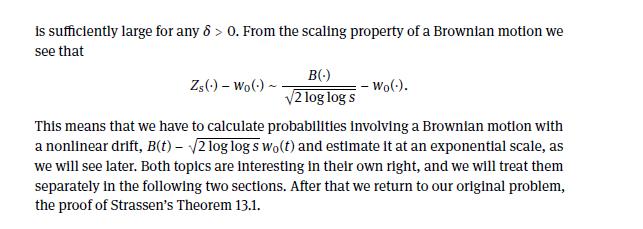
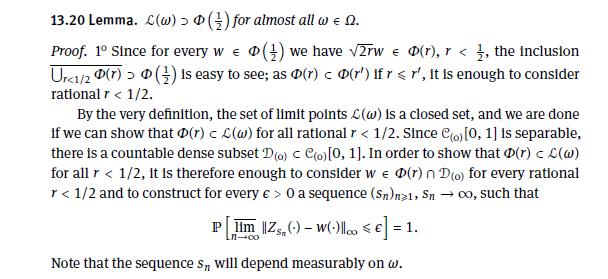
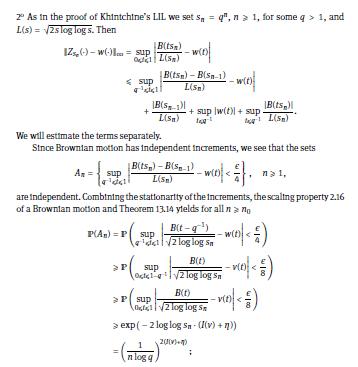
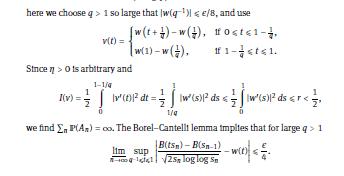
Check the (in)equalities from Step \(3^{\circ}\) in the proof of Lemma 13.20.Data From Leema 13.20 13.20 Lemma. (w)>() for almost all w = 0. Proof. 1 Since for every w = D() we have 2rw = (r), r 0 a sequence (Sn)n31, Sn co, such that Plim Zs. () - W()ll. ] = 1. Ln-co Note that the sequence s,, will
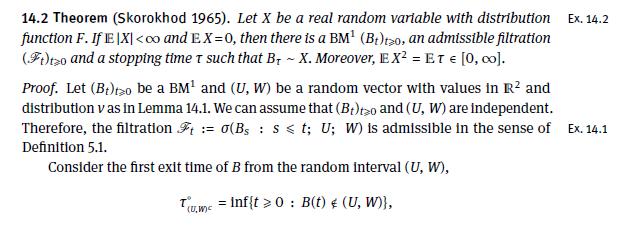
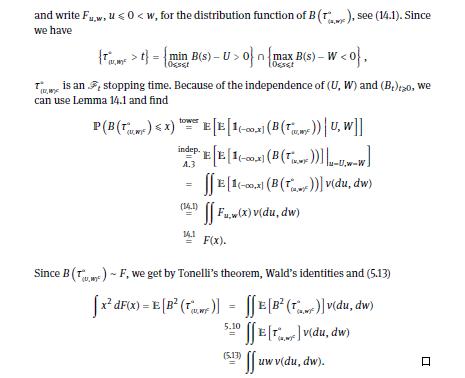
In the proof of Theorem 14.2 we assume that \(\left(B_{t}ight)_{t \geqslant 0}\) and \((U, W)\) are independent. Show that \(\mathscr{F}_{t}:=\sigma\left(B_{s}, s \leqslant t ; U, Wight)\) is an admissible filtration for a Brownian motion, cf. Definition 5.1.Data From Theorem 14.2 14.2 Theorem
Let \(\left(M_{n}, \mathscr{F}_{n}ight)_{n \geqslant 0}\) and \(\left(N_{n}, \mathscr{F}_{n}ight)_{n \geqslant 0}\) be \(L^{2}\) martingales; then \(\left(M_{n} N_{n}-\langle M, Nangle_{n}, \mathscr{F}_{n}ight)_{n \geqslant 0}\) is a martingale.
Let \(\left(M_{n}, \mathscr{F}_{n}ight)_{n \geqslant 0}\) and \(\left(N_{n}, \mathscr{F}_{n}ight)_{n \geqslant 0}\) be \(L^{2}\) martingales. Show that \(\left|\langle M, Nangle_{n}ight| \leqslant\) \(\sqrt{\langle Mangle_{n}} \sqrt{\langle Nangle_{n}}\).Try the classical proof of the
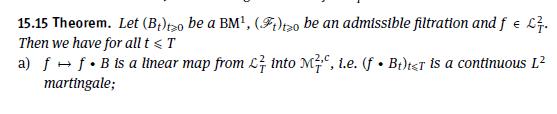
Show that \(\|M\|_{\mathcal{M}_{T}^{2}}:=\left(\mathbb{E}\left[\sup _{s \leqslant T}\left|M_{s}ight|^{2}ight]ight)^{\frac{1}{2}}\) is a norm in the family \(\mathcal{M}_{T}^{2}\) of equivalence classes of \(L^{2}\) martingales ( \(M\) and \(\widetilde{M}\) are said to be equivalent if, and only if,
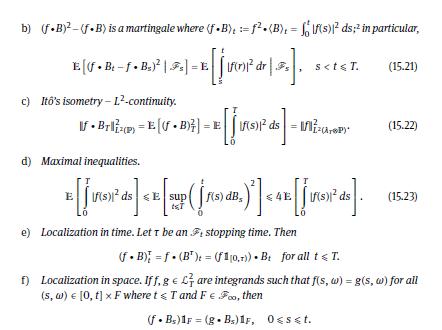
Let \(\left(B_{t}, \mathscr{F}_{t}ight)_{t \geqslant 0}\) be a \(\mathrm{BM}^{1}\) and \(\tau\) a stopping time. Find \(\left\langle B^{\tau}ightangle_{t}\).
Showing 6100 - 6200
of 6914
First
55
56
57
58
59
60
61
62
63
64
65
66
67
68
69
Last
Step by Step Answers

 Get 50% OFF
Claim Now
Get 50% OFF
Claim Now