New Semester
Started
Get
50% OFF
Study Help!
--h --m --s
Claim Now
Question Answers
Textbooks
Find textbooks, questions and answers
Oops, something went wrong!
Change your search query and then try again
S
Books
FREE
Study Help
Expert Questions
Accounting
General Management
Mathematics
Finance
Organizational Behaviour
Law
Physics
Operating System
Management Leadership
Sociology
Programming
Marketing
Database
Computer Network
Economics
Textbooks Solutions
Accounting
Managerial Accounting
Management Leadership
Cost Accounting
Statistics
Business Law
Corporate Finance
Finance
Economics
Auditing
Tutors
Online Tutors
Find a Tutor
Hire a Tutor
Become a Tutor
AI Tutor
AI Study Planner
NEW
Sell Books
Search
Search
Sign In
Register
study help
business
probability and stochastic modeling
Brownian Motion A Guide To Random Processes And Stochastic Calculus De Gruyter Textbook 3rd Edition René L. Schilling, Björn Böttcher - Solutions
Let \(\left(B_{t}ight)_{t \geqslant 0}\) be a \(\mathrm{BM}^{1}\) and \(f, g \in \mathcal{L}_{T}^{2}\). Show thata) \(\mathbb{E}\left(f \cdot B_{t} \cdot g \cdot B_{t} \mid \mathscr{F}_{s}ight)=\mathbb{E}\left[\int_{s}^{t} f(u, \cdot) g(u, \cdot) d u \mid \mathscr{F}_{s}ight]\) if \(f\), \(g\)
Let \(\left(B_{t}ight)_{t \geqslant 0}\) be \(\mathrm{BM}^{1}\) and \(\left(f_{n}ight)_{n \geqslant 1}\) a sequence in \(\mathcal{L}_{T}^{2}\) such that \(f_{n} ightarrow f\) in \(L^{2}\left(\lambda_{T} \otimes \mathbb{P}ight)\). Then \(f_{n} \bullet B ightarrow f \bullet B\) in
Let \(\left(B_{t}ight)_{t \geqslant 0}\) be a \(\mathrm{BM}^{1}\) and \(f \in L^{2}\left(\lambda_{T} \otimes \mathbb{P}ight.\) ) for some \(T>0\). Assume that the limit \(\lim _{\epsilon ightarrow 0} f(\epsilon)=f(0)\) exists in \(L^{2}(\mathbb{P})\). Show that \[\frac{1}{B_{\epsilon}}
Let \(\left(B_{t}ight)_{t \geqslant 0}\) be a \(\mathrm{BM}^{1},\left(Y_{t}ight)_{t \geqslant 0}\) and adapted process such that \(Y_{t} Y_{s}=Y_{t}\) for all \(s \leqslant t\) and \(\left(X_{t}ight)_{t \geqslant 0} \in \mathcal{L}_{T}^{2}\). Show that \[Y_{t} \int_{0}^{t} X_{S} d B_{s}=Y_{t}
Let \(\left(B_{t}ight)_{t \geqslant 0}\) be a \(\mathrm{BM}^{1}\). Show that \((0, \infty) i s \mapsto f(s, \omega):=\mathbb{1}_{(0, \infty)}\left(B_{s}ight)\) is continuous in \(L^{2}(\mathbb{P})\).
Let \(\left(X_{n}ight)_{n \geqslant 0}\) be a sequence of r. v. in \(L^{2}(\mathbb{P})\). Show that \(L^{2}-\lim _{n ightarrow \infty} X_{n}=X\) implies \(L^{1}-\lim _{n ightarrow \infty} X_{n}^{2}=X^{2}\).
Let \(\left(B_{t}ight)_{t \geqslant 0}\) be a \(\mathrm{BM}^{1}\). Show that \(\int_{0}^{T} B_{s}^{2} d B_{s}=\frac{1}{3} B_{T}^{3}-\int_{0}^{T} B_{s} d s, T>0\).
Let \(\left(B_{t}, \mathscr{F}_{t}ight)_{t \geqslant 0}\) be a one-dimensional Brownian motion, \(T
Show that \[\mathscr{P}=\left\{\Gamma: \Gamma \subset[0, T] \times \Omega, \Gamma \cap([0, t] \times \Omega) \in \mathscr{B}[0, t] \otimes \mathscr{F}_{t} \quad \text { for all } t \leqslant Tight\}\] is a \(\sigma\)-algebra.
Show that every right or left continuous adapted process is \(\mathscr{P}\) measurable.
Let \(T
Let \(\tau\) be a stopping time. Show that \(\mathbb{1}_{[0, \tau)}\) is \(\mathscr{P}\) measurable.
If \(\sigma_{n}\) is localizing for a local martingale, so is \(\tau_{n}:=\sigma_{n} \wedge n\).
The factor \(\mathbb{1}_{\left\{\sigma_{n}>0ight\}}\) is used in the definition of a local martingale, in order to avoid integrability requirements for \(M_{0}\). More precisely, if \(\left(\sigma_{n}ight)_{n \geqslant 1}\) is a localizing sequence, then we have\(M_{0} \in L^{1}(\mathbb{P})
Let \(\left(I_{t}, \mathscr{F}_{t}ight)_{t \geqslant 0}\) be a continuous adapted process with values in \([0, \infty)\) and a.s. increasing sample paths. Set for \(u \geqslant 0\)\[\sigma_{u}(\omega):=\inf \left\{t \geqslant 0: I_{t}(\omega)>uight\} \quad \text { and } \quad \tau_{u}(\omega):=\inf
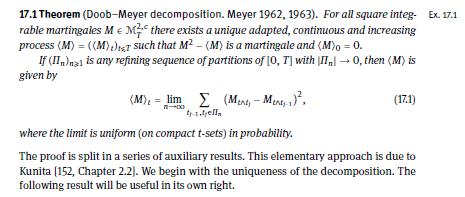
Extend Theorem 17.1 to local martingales with continuous paths.Data From Theorem 17.1 17.1 Theorem (Doob-Meyer decomposition. Meyer 1962, 1963). For all square integ. Ex. 17.1 rable martingales Me M there exists a unique adapted, continuous and increasing process (M)=((M))st such that M - (M) is a
For \(M, N \in \mathcal{M}_{T, \text { loc }}^{c}\) we define the covariation by \(\langle M, Nangle_{t}:=\frac{1}{4}\left(\langle M+Nangle_{t}-\langle M-Nangle_{t}ight)\). Show thata) \(t \mapsto\langle M, Nangle_{t}\) is well-defined, of bounded variation on compact \(t\)-intervals
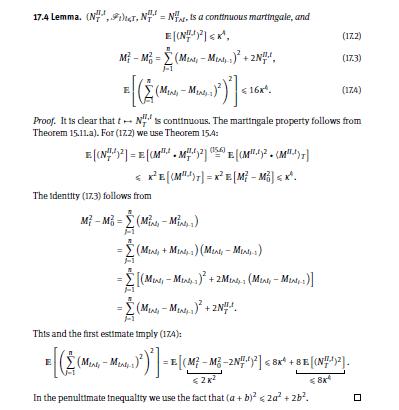
Use Lemma 17.14 to show the following assertions:a) \(\lim _{n} \mathbb{E}\left(\sup _{t \leqslant T}\left|X_{t}^{n}-X_{t}ight|^{2}ight)=0 \Longrightarrow X^{n} \xrightarrow[n ightarrow \infty]{\text { ucp }} X\).b) \(X^{n} \xrightarrow[n ightarrow \infty]{\text { ucp }} X, \quad Y^{n}
Let \(M \in \mathcal{M}_{T, \text { loc }}^{c}\). Show that the following maps are continuous, if we use ucpconvergence in both range and domain:a) \(\mathcal{L}_{T, \text { loc }}^{2}(M) i f \mapsto f^{2} \cdot\langle Mangle\).b) \(\mathcal{L}_{T, \text { loc }}^{2}(M) i f \mapsto f \bullet M \in
Let \(M \in \mathcal{M}_{T, \text { loc }}^{c}\) and \(f(t, \omega)\) be an adapted càdlàg (right continuous, finite left limits) process and \(t \in[0, T]\).a) Show that \(f \in \mathcal{L}_{T}^{0}(M)\), i.e. \(\int_{0}^{T} f(t, \omega) d\langle Mangle_{t}
Let \(M \in \mathcal{M}_{T, \text { loc }}^{c}\) and \(f_{n}\) be a sequence in \(\mathcal{L}_{T}^{0}(M)\). If \(f_{n} ightarrow f\) in ucp-sense, then \(f \in \mathcal{L}_{T}^{0}(M)\).
Let \(\left(B_{t}ight)_{t \geqslant 0}\) be \(B M^{1}\). Use Itô's formula to obtain representations of\[X_{t}=\int_{0}^{t} \exp \left(B_{s}ight) d B_{s} \quad \text { and } \quad Y_{t}=\int_{0}^{t} B_{s} \exp \left(B_{s}^{2}ight) d B_{s}\]which do not contain Itô integrals.
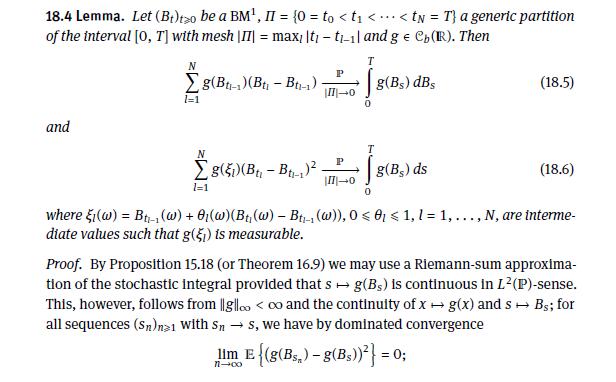
Let \(\Pi=\left\{0=t_{0}
Give a direct proof for the identity \[\begin{aligned}\mathbb{E} & {\left[\left(\sum_{l=1}^{N} g\left(B_{t_{l-1}}ight)\left[\left(B_{t_{l}}-B_{t_{l-1}}ight)^{2}-\left(t_{l}-t_{l-1}ight)ight]ight)^{2}ight] } \\&
Prove the following time-dependent version of Itô's formula: let \(\left(B_{t}ight)_{t \geqslant 0}\) be a \(\mathrm{BM}^{1}\) and \(f:[0, \infty) \times \mathbb{R} ightarrow \mathbb{R}\) be a function of class \(\mathcal{C}^{1,2}\). Then\[f\left(t, B_{t}ight)-f(0,0)=\int_{0}^{t} \frac{\partial
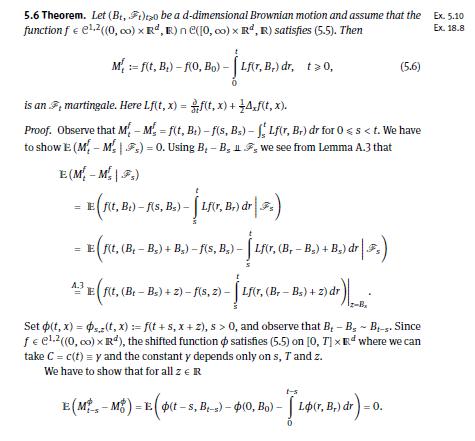
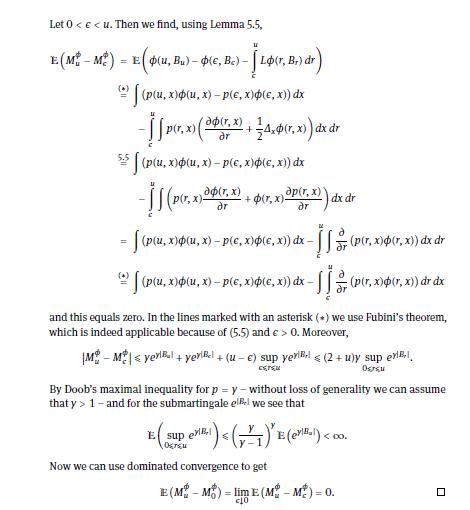
Prove Theorem 5.6 using Itô's formula.Data From Theorem 5.6 5.6 Theorem. Let (Bt, Ft)to be a d-dimensional Brownian motion and assume that the Ex. 5.10 function fee.2 ((0, co) x Rd, R) ne([0, o) x Rd, R) satisfies (5.5). Then - M{ := f(t, B,) f(0, Bo) | Lf(r, B,) dr, t0, is an F, martingale.
Let \(\left(B_{t}, \mathscr{F}_{t}ight)_{t \geqslant 0}\) be a \(\mathrm{BM}^{1}\). Use Itô's formula to verify that the following processes are martingales:\[X_{t}=e^{t / 2} \cos B_{t} \quad \text { and } \quad Y_{t}=\left(B_{t}+tight) \exp \left(-B_{t}-t / 2ight) \text {. }\]
Let \(B_{t}=\left(b_{t}, \beta_{t}ight), t \geqslant 0\) be a \(\mathrm{BM}^{2}\) and set \(r_{t}:=\left|B_{t}ight|=\sqrt{b_{t}^{2}+\beta_{t}^{2}}\).a) Show that the stochastic integrals \(\int_{0}^{t} b_{s} / r_{s} d b_{s}\) and \(\int_{0}^{t} \beta_{s} / r_{s} d \beta_{s}\) exist.b) Show that
Let \(B_{t}=\left(b_{t}, \beta_{t}ight), t \geqslant 0\) be a \(\mathrm{BM}^{2}\) and \(f(x+i y)=u(x, y)+i v(x, y), x, y \in \mathbb{R}\), an analytic function. If \(u_{x}^{2}+u_{y}^{2}=1\), then \(\left(u\left(b_{t}, \beta_{t}ight), v\left(b_{t}, \beta_{t}ight)ight), t \geqslant 0\), is a
Show that the \(d\)-dimensional Itô formula remains valid if we replace the real-valued function \(f: \mathbb{R}^{d} ightarrow \mathbb{R}\) by a complex function \(f=u+i v: \mathbb{R}^{d} ightarrow \mathbb{C}\).
Let \(\chi \in \mathcal{C}_{c}^{\infty}(-1,1)\) with \(0 \leqslant \chi \leqslant 1, \chi(0)=1\) and \(\int \chi(x) d x=1\). Set \(\chi_{n}(x):=n \chi(n x)\).a) Show that supp \(\chi_{n} \subset[-1 / n, 1 / n]\) and \(\int \chi_{n}(x) d x=1\).b) Let \(f \in \mathcal{C}(\mathbb{R})\) and \(f_{n}:=f
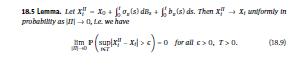
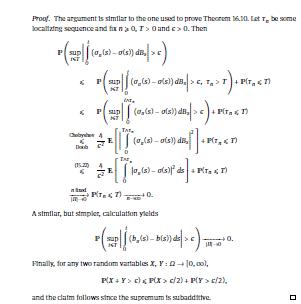
Let \(\sigma_{\Pi}, b_{\Pi} \in \mathcal{S}_{T}\) which approximate \(\sigma, b \in \mathcal{L}_{T}^{2}\) as \(|\Pi| ightarrow 0\), and consider the Itô processes \(X_{t}^{\Pi}=X_{0}+\int_{0}^{t} \sigma_{\Pi}(s) d B_{s}+\int_{0}^{t} b_{\Pi}(s) d s\) and \(X_{t}=X_{0}+\int_{0}^{t} \sigma(s) d
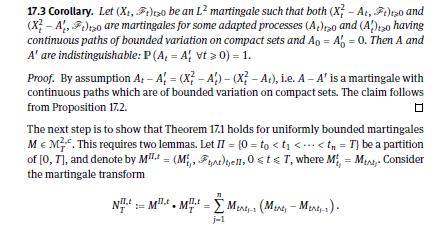
Let \(X_{t}=M_{t}+A_{t}\) and \(X_{t}=M_{t}^{\prime}+A_{t}^{\prime}\) where \(M, M^{\prime}\) are continuous local martingales and \(A, A^{\prime}\) are continuous processes which have locally a.s. bounded variation. Show that \(M-M^{\prime}\) and \(A-A^{\prime}\) are a.s. constant.Have a look at
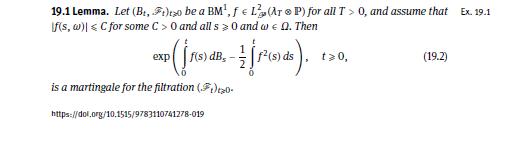
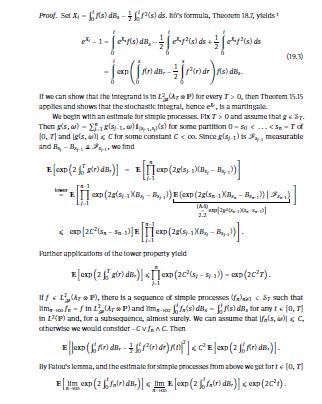
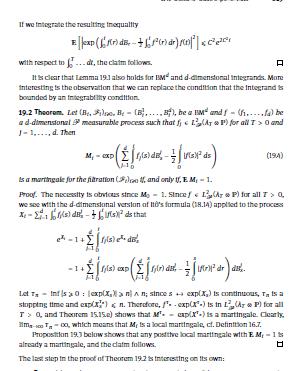
State and prove the \(d\)-dimensional version of Lemma 19.1.Data From Lemma 19.1 19.1 Lemma. Let (Bt, Ft)o be a BM, f L (ATP) for all T> 0, and assume that \f(s, w) < C for some C > 0 and all s > 0 and we Q. Then Ex. 19.1 exp P (JK f(s) dB,-- - {{P(s) as). t0, is a martingale for the filtration
Let \(B_{t}=\left(b_{t}, \beta_{t}ight), t \geqslant 0\), be a two-dimensional Brownian motion, i.e. \(\left(b_{t}ight)_{t \geqslant 0},\left(\beta_{t}ight)_{t \geqslant 0}\) are independent one-dimensional Brownian motions. Show that for all \(\sigma_{1},
Let \((B(t))_{t \geqslant 0}\) be a \(B M^{1}\) and \(T
Let \((\mathcal{L},\langle\cdot, \cdotangle)\) be a Hilbert space and \(\mathcal{H}\) some linear subspace. Show that \(\mathcal{H}\) is a dense subset of \(\mathcal{L}\) if, and only if, the following property holds: \(\forall x \in \mathcal{L}: x \perp \mathcal{H} \Longrightarrow x=0\).
Let \(\left(B_{t}ight)_{t \geqslant 0}\) be a \(\mathrm{BM}^{1}, n \geqslant 1,0 \leqslant t_{1}
Assume that \(\left(B_{t}, \mathscr{G}_{t}ight)_{t \geqslant 0}\) and \(\left(M_{t}, \mathscr{F}_{t}ight)_{t \geqslant 0}\) are independent martingales. Show that \(\left(M_{t}ight)_{t \leqslant T}\) and \(\left(B_{t}ight)_{t \leqslant T}\) are martingales for the enlarged filtration
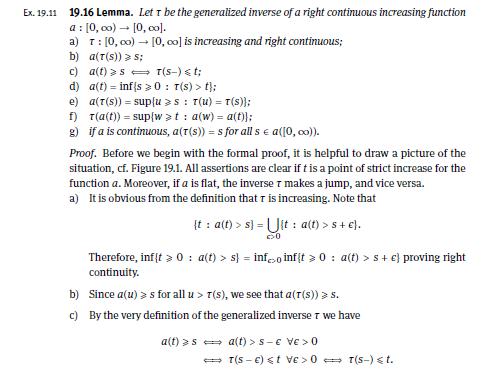
Show the following addition to Lemma 19.16:\[\tau(t-)=\inf \{s \geqslant 0: a(s) \geqslant t\} \quad \text { and } \quad a(t-)=\inf \{s \geqslant 0: \tau(s) \geqslant t\}\]and \(\tau(s) \geqslant t \Longleftrightarrow a(t-) \leqslant s\).Data From Lemma 19.16 Ex. 19.11 19.16 Lemma. Let T be the
Let \(f:[0, \infty) ightarrow \mathbb{R}\) be absolutely continuous. Show that \(\int f^{a-1} d f=f^{a} / a\) for all \(a>0\).
Use the strong Markov property to show the stationary and independent increments property in Lemma 19.32.c) directly, i.e. for all \(0=u_{0}Data From Lemma 19.32 19.32 Lemma. Let (Bt)to be a BM, Lo the local time at zero and Tu its generalized right continuous inverse. a) (Lt)to satisfies Lt+s =
Show that the Hermite Polynomials are linearly independent.
Let \((X, Y)\) be a mean zero Gaussian random variable. Show that \(\mathbb{E}\left(X^{2} Yight)=0\). Use this observation to show that \(I^{2}(f)-\|f\|_{L^{2}}^{2}\) is and \(\mathcal{K}_{1}:=\left\{I_{1}(g): g \in L^{2}\left(\mathbb{R}_{+}ight)ight\}\)are orthogonal.
Pick any orthonormal basis \(\left(e_{k}ight)_{k \geqslant 1}\) of \(H\). Let \(\alpha \in \mathbb{N}_{0}^{(\infty)}\), i.e. \(\alpha=\left(\alpha_{1}, \ldots, \alpha_{N}, 0,0, \ldotsight)\) where \(N \in \mathbb{N}\) and \(\alpha_{1}, \ldots, \alpha_{N} \in \mathbb{N}_{0}\), and define
Let \(F, G\) be smooth, bounded cylindrical functions. Show thata) \(D_{t}(F G)=G D_{t} F+F D_{t} G\).b) \(D_{t}^{m}(F G)=\sum_{k=0}^{m}\left(\begin{array}{c}m \\ k\end{array}ight) D_{t}^{k} F \cdot D_{t}^{m-k} G\).
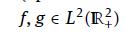
(Special case of Problem 9) Use Itô's formula to show that for any two symmetric f, g L (R)
Let \(F=\exp \left[I_{1}(g)-\frac{1}{2} \int_{0}^{\infty} g^{2}(s) d sight]\) for some \(g \in L^{2}\left(\mathbb{R}_{+}ight)\). Find all derivatives \(D^{k} F\) as well as the Wiener-Itô chaos representation.
Find the Wiener-Itô chaos decomposition for the following random variables ( \(T>0\) is fixed):a) \(\exp \left(B_{T}-T / 2ight)\),b) \(B_{T}^{5}\),c) \(\int_{0}^{1}\left(r^{3} B_{t}^{3}+2 t B_{t}^{2}ight) d B_{t}\),d) \(\int_{0}^{1} t e^{B_{t}} d B_{t}\).
Find the Wiener-Itô chaos decomposition for the following random variables ( \(T>0\) is fixed):a) \(\sinh \left(B_{T}ight)\)b) \(\cosh \left(B_{T}ight)\).
Let \(\mathcal{D} \subset L^{2}(\mu)\) and write \(\Sigma:=\operatorname{span}(\mathcal{D})\). Show that \(\Sigma\) is dense if, and only if \(\mathcal{D}\) is total, i.e. \[\bar{\Sigma}=L^{2}(\mu) \Longleftrightarrow\left[\forall \phi \in \mathcal{D}:\langle u, \phiangle_{L^{2}(\mu)}=0
Let \((B(t))_{t \in[0,1]}\) be a \({B M^{1}}^{1}\) and set \(t_{k}=k / 2^{n}\) for \(k=0,1, \ldots, 2^{n}\) and \(\Delta t=2^{-n}\). Consider the difference equation\[\Delta X_{n}\left(t_{k}ight)=-\frac{1}{2} X_{n}\left(t_{k}ight) \Delta t+\Delta B\left(t_{k}ight), \quad X_{n}(0)=A,\]where \(\Delta
Let \(\left(B_{t}ight)_{t \geqslant 0}\) be a \(\mathrm{BM}^{1}\). The solution of the \(\mathrm{SDE}\)\[d X_{t}=-\beta X_{t} d t+\sigma d B_{t}, \quad X_{0}=\xi\]with \(\beta>0\) and \(\sigma \in \mathbb{R}\) is an Ornstein-Uhlenbeck process.a) Find \(X_{t}\) explicitly.b) Determine the
Let \(\left(B_{t}ight)_{t \geqslant 0}\) be a \(\mathrm{BM}^{1}\). Find an SDE which has \(X_{t}=t B_{t}, t \geqslant 0\), as unique solution.
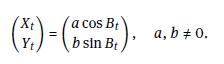
Let \(\left(B_{t}ight)_{t \geqslant 0}\) be a \(\mathrm{BM}^{1}\). Find for each of the following processes an SDE which is solved by it:(a) \(U_{t}=\frac{B_{t}}{1+t}\);(b) \(V_{t}=\sin B_{t}\);(c) (x) = ( a cos Bt b sin Bt, a, b = 0.
Let \(\left(B_{t}ight)_{t \geqslant 0}\) be a \(\mathrm{BM}^{1}\). Solve the following SDEsa) \(d X_{t}=b d t+\sigma X_{t} d B_{t}, X_{0}=x_{0}\) and \(b, \sigma \in \mathbb{R}\);b) \(d X_{t}=\left(m-X_{t}ight) d t+\sigma d B_{t}, X_{0}=x_{0}\) and \(m, \sigma>0\).
Show for all \(x, y \in \mathbb{R}^{n}\) the inequality\[|x-y|(1+|x|)^{-1}(1+|y|)^{-1} \leqslant\left.|| xight|^{-2} x-|y|^{-2} y \mid .\]Use a direct calculation after squaring both sides.
Letbe two globally Lipschitz continuous functions. If \(f\) is bounded, then \(h(x):=f(x) g(x)\) is locally Lipschitz continuous and at most linearly growing. fg: R-R
Let \(A: \mathcal{C}_{c}^{\infty}\left(\mathbb{R}^{d}ight) ightarrow \mathcal{C}_{\infty}\left(\mathbb{R}^{d}ight)\) be a closed operator such that \(\|A u\|_{\infty} \leqslant C\|u\|_{(2)}\); here \(\|u\|_{(2)}=\|u\|_{\infty}+\sum_{j}\left\|\partial_{j} uight\|_{\infty}+\sum_{j
Let \(L=L\left(x, D_{x}ight)=\sum_{i j} a_{i j}(x) \partial_{i} \partial_{j}+\sum_{j} b_{j}(x) \partial_{j}+c(x)\) be a second order differential operator. Determine its formal adjoint \(L^{*}\left(y, D_{y}ight)\), i.e. the linear operator satisfying \(\langle L u, \phiangle_{L^{2}}=\left\langle u,
Let \(\left(B_{t}ight)_{t \geqslant 0}\) be a \(\mathrm{BM}^{1}\). Show that \(X_{t}:=\left(B_{t}, \int_{0}^{t} B_{s} d sight)\) is a diffusion process and determine its generator.
Consider the \(\operatorname{ODE} \partial_{t} \xi(t, x)=x+b(\xi(t, x)), \xi(0, x)=x\), where \(b \in \mathcal{C}_{b}^{2}\left(\mathbb{R}^{d}, \mathbb{R}^{d}ight)\) such that \(\left|\partial_{x}^{\alpha} b(x)ight|,|\alpha|=2\), is Lipschitz continuous. Show that all \(\partial_{x}^{\alpha} \xi(t,
Let \(\left(M^{(1)}, \ldots, M^{(d)}ight)\) be a local martingale with \(M_{0}=0\) and denote its quadratic variation by \(\langle Mangle=\left(\left\langle M^{(j)}, M^{(k)}ightangleight)_{j, k}\). Show that \(\langle Mangle=0\) implies that \(M=0\).
Let \(\left(N_{t}, \mathscr{F}_{t}ight)_{t \geqslant 0}\) be a continuous local martingale. Show that \(\tau_{n}:=\left\{s \geqslant 0:\left|N_{t}ight| \geqslant night\}\) is a localizing sequence which makes \(N_{t \wedge \tau_{n}}\) bounded.
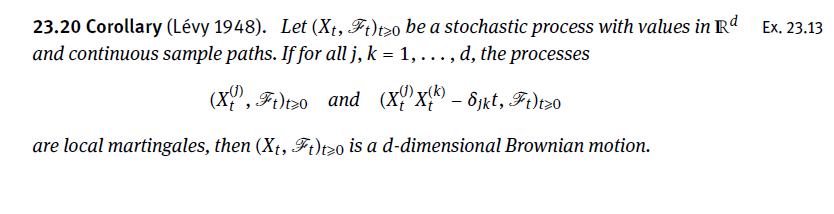
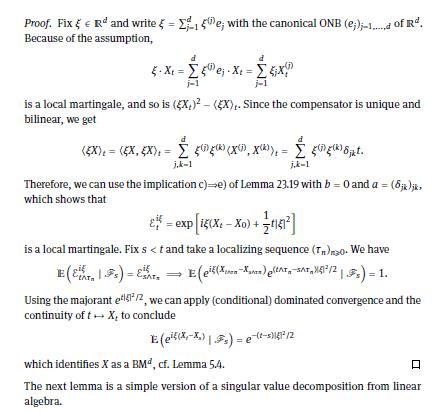
Prove the converse of Corollary 23.20.Data From Corollary 23.20 23.20 Corollary (Lvy 1948). Let (Xt, Ft)to be a stochastic process with values in Rd and continuous sample paths. If for all j, k = 1,..., d, the processes (X), Ft)tzo and (X)X() - 8jkt, Ft) 20 (X)X()-8jkt, are local martingales, then
Show that there exists a stochastic process \(\left(X_{t}ight)_{t \geqslant 0}\) such that the random variables \(X_{t}\) are independent \(\mathrm{N}(0, t)\) random variables. This process also satisfies \(\mathbb{P}\left(\lim _{s ightarrow t} X_{S}ight.\) exists \()=0\) for every \(t>0\).
Let \(S\) be any set and \(\mathscr{E}\) be a family of subsets of \(S\). Show that\[\sigma(\mathscr{E})=\bigcup\{\sigma(\mathscr{C}): \mathscr{C} \subset \mathscr{E}, \mathscr{C} \text { is countable }\}\]
Let \(\emptyset eq E \in \mathscr{B}\left(\mathbb{R}^{d}ight)\) contain at least two elements, and \(\emptyset eq I \subset[0, \infty)\) be any index set. We denote by \(E^{I}\) the product space \(E^{I}=\{f: f: I ightarrow E\}\) which we equip with its natural product topology (i.e. \(f_{n}
Let \(\mu\) be a probability measure on \(\left(\mathbb{R}^{d}, \mathscr{B}\left(\mathbb{R}^{d}ight)ight), v \in \mathbb{R}^{d}\) and consider the \(d\) dimensional stochastic process \(X_{t}(\omega):=\omega+t v, t \geqslant 0\), on the probability space \(\left(\mathbb{R}^{d},
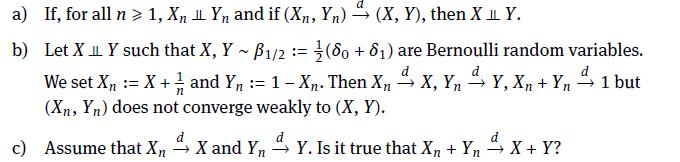
Let \(X, Y, X_{n}, Y_{n}: \Omega ightarrow \mathbb{R}, n \geqslant 1\), be random variables. a) If, for all n > 1, Xn Yn and if (Xn, Yn) (X, Y), then XIL Y. b) Let X Y such that X, Y ~ B1/2 = (80 +81) are Bernoulli random variables. We set X := X + and Y := 1 - X. Then X, X, Yn (Xn, Yn) does not
Let \(X_{n}, Y_{n}: \Omega ightarrow \mathbb{R}^{d}, n \geqslant 1\), be two sequences of random variables such that \(X_{n} \xrightarrow{d} X\) and \(X_{n}-Y_{n} \xrightarrow{\mathbb{P}} 0\). Then \(Y_{n} \xrightarrow{d} X\).
Let \(X_{n}, Y_{n}: \Omega ightarrow \mathbb{R}, n \geqslant 1\), be two sequences of random variables.a) If \(X_{n} \xrightarrow{d} X\) and \(Y_{n} \xrightarrow{\mathbb{P}} c\), then \(X_{n} Y_{n} \xrightarrow{d} c X\). Is this still true if \(Y_{n} \xrightarrow{d} c\) ?b) If \(X_{n}
Let Xn,X,Y:ΩightarrowR,n⩾1Xn,X,Y:ΩightarrowR,n⩾1, be random variables. Ifra \left or missing \ri lim E(f(x)g(Y)) = E(f(x)g(Y)) for all = C(R), g = B(R), n-co
Let \(\delta_{j}, j \geqslant 1\), be iid Bernoulli random variables with \(\mathbb{P}\left(\delta_{j}= \pm 1ight)=1 / 2\). We set\[S_{0}:=0, \quad S_{n}:=\delta_{1}+\cdots+\delta_{n} \quad \text { and } \quad X_{t}^{n}:=\frac{1}{\sqrt{n}} S_{\lfloor n tfloor}\]A one-dimensional random variable
Consider the condition for all \(s
Let \(G\) and \(G^{\prime}\) be two independent real N \((0,1)\)-random variables. Show that It: !! G+ G' ~N(0, 1) and . 2
Let \(\left(X_{t}ight)_{t \geqslant 0}\) be a stochastic process on the measure space \((\Omega, \mathscr{A}, \mathbb{P})\) satisfying (B1)(B3). Assume further that there is some measurable set \(\Omega_{0} \subset \Omega, \mathbb{P}\left(\Omega_{0}ight)=1\), such that for all \(\omega \in
Let \((\Omega, \mathscr{A}, \mathbb{P})\) be a probability space and let \(\mathbb{P}^{*}(Q):=\inf \{\mathbb{P}(A): A \supset Q, A \in \mathscr{A}\}\) be the outer measure. If \(\Omega_{0} \subset \Omega\) is such that \(\mathbb{P}^{*}\left(\Omega_{0}ight)=1\), then \(\left(\Omega_{0},
Let \((\Omega, \mathscr{A}, \mathbb{P})\) be a probability space. The completion \(\left(\Omega, \mathscr{A}^{\prime}, \mathbb{P}^{\prime}ight)\) is the smallest extension such that \(\mathscr{A}^{\prime}\) contains all subsets of \(\mathscr{A}\) measurable null sets. Show
Show that there exist a random vector \((U, V)\) such that \(U\) and \(V\) are one-dimensional Gaussian random variables but \((U, V)\) is not Gaussian.Try \(f(u, v)=g(u) g(v)(1-\sin u \sin v)\) where \(g(u)=(2 \pi)^{-1 / 2} e^{-u^{2} / 2}\).
Let \(G \sim \mathrm{N}(m, C)\) be a \(d\)-dimensional Gaussian random vector and \(A \in \mathbb{R}^{d \times d}\). Show that \(A G \sim \mathrm{N}\left(A m, A C A^{\top}ight)\).
Let \(X, \Gamma \sim \mathrm{N}(0, t)\). Show that - X + I and X ~ N(0, 2t).
Let \(G_{n} \sim \mathrm{N}\left(0, t_{n}ight), n \geqslant 1\), be sequence of Gaussian random variables. Show that \(G_{n} \xrightarrow{\mathrm{d}} G\) if, and only if, the sequence \(\left(t_{n}ight)_{n \geqslant 1}\) is convergent.
Let \(A, B \in \mathbb{R}^{n \times n}\) be symmetric matrices. If \(\langle A x, xangle=\langle B x, xangle\) for all \(x \in \mathbb{R}^{n}\), then \(A=B\).
Let \(\left(B_{t}ight)_{t \geqslant 0}\) be a \(\mathrm{BM}^{1}\). Decide which of the following processes are Brownian motions:a) \(X_{t}:=2 B_{t / 4}\);b) \(Y_{t}:=B_{2 t}-B_{t}\);c) \(Z_{t}:=\sqrt{t} B_{1}\)\((t \geqslant 0)\).
Let \((B(t))_{t \geqslant 0}\) be a \(B M^{1}\).a) Find the density of the random vector \((B(s), B(t))\) where \(0
Find the correlation function \(C(s, t):=\mathbb{E}\left(X_{S} X_{t}ight), s, t \geqslant 0\), of the stochastic process \(X_{t}:=B_{t}^{2}-t, t \geqslant 0\), where \(\left(B_{t}ight)_{t \geqslant 0}\) is a \(\mathrm{BM}^{1}\).
Let \(\left(B_{t}ight)_{t \geqslant 0}\) be a \(\mathrm{BM}^{1}, \alpha>0\) and consider the stochastic process \(X_{t}:=e^{-\alpha t / 2} B_{e^{\alpha t}}, t \geqslant 0\).a) Determine \(m(t)=\mathbb{E} X_{t}\) and \(C(s, t)=\mathbb{E}\left(X_{s} X_{t}ight), s, t \geqslant 0\).b) Find the
Let \(\left(B_{t}ight)_{t \geqslant 0}\) be a \(\mathrm{BM}^{1}\). Show that \(\mathscr{F}_{\infty}^{B}=\bigcup_{J \text { countable }}^{J \subset[0, \infty)} \sigma(B(t): t \in J)\).
Let \(X(t), Y(t)\) be any two stochastic processes. Show that (X(u1),..., X(up)) (Y(u),..., Y(up)) for all u 1 implies (X(S1),..., X(Sn)) (Y(t),..., Y(tm)) for all s < < Sm, t < ... < tn, m, n 1.
Let (Ft)t⩾0(Ft)t⩾0 and (Gt)t⩾0(Gt)t⩾0 be any two filtrations and define F∞=σ(⋃t⩾0Ft)F∞=σ(⋃t⩾0Ft) and G∞=σ(⋃t⩾0Gt)G∞=σ(⋃t⩾0Gt). Show that Ft Gt (Vt > 0) if, and only if, Foo Goo
Use Lemma 2.8 to show that (all finite dimensional distributions of) a \(\mathrm{BM}^{d}\) is invariant under rotations. 2.8 Lemma. Let (X+)to be a d-dimensional stochastic process. X satisfies (BO)-(B3) if, Ex. 2.15 and only if, for all n > 0, 0 to
Let \(B_{t}=\left(b_{t}, \beta_{t}ight), t \geqslant 0\), be a two-dimensional Brownian motion.a) Show that \(W_{t}:=\frac{1}{\sqrt{2}}\left(b_{t}+\beta_{t}ight)\) is a \(\mathrm{BM}^{1}\).b) Are \(X_{t}:=\left(W_{t}, \beta_{t}ight)\) and \(Y_{t}:=\frac{1}{\sqrt{2}}\left(b_{t}+\beta_{t},
Let \(B_{t}=\left(b_{t}, \beta_{t}ight), t \geqslant 0\), be a two-dimensional Brownian motion. For which values of \(\lambda, \mu \in \mathbb{R}\) is the process \(X_{t}:=\lambda b_{t}+\mu \beta_{t} \mathrm{aBM}^{1}\) ?
Let \(B_{t}=\left(b_{t}, \beta_{t}ight), t \geqslant 0\), be a two-dimensional Brownian motion. Decide whether for \(s>0\) the process \(X_{t}:=\left(b_{t}, \beta_{s-t}-\beta_{t}ight), 0 \leqslant t \leqslant s\) is a two-dimensional Brownian motion.
Let \(B_{t}=\left(b_{t}, \beta_{t}ight), t \geqslant 0\), be a two-dimensional Brownian motion and \(\alpha \in[0,2 \pi)\). Show that \(W_{t}=\left(b_{t} \cdot \cos \alpha+\beta_{t} \cdot \sin \alpha, \beta_{t} \cdot \cos \alpha-b_{t} \cdot \sin \alphaight)^{\top}\) is a two-dimensional Brownian
Let \(X\) be a \(Q\)-BM. Determine \(\operatorname{Cov}\left(X_{t}^{j}, X_{s}^{k}ight)\), the characteristic function of \(X(t)\) and the transition probability (density) of \(X(t)\).
Show that (B1) is equivalent to Bt-Bs for all 0 < s < t.
Let \(\left(B_{t}ight)_{t \geqslant 0}\) be a \(\mathrm{BM}^{1}\) and set \(\tau_{a}=\inf \left\{s \geqslant 0: B_{s}=aight\}\) where \(a \in \mathbb{R}\). Show that \(\tau_{a} \sim \tau_{-a}\) and \(\tau_{a} \sim a^{2} \tau_{1}\).
A \(\mathbb{R}\)-valued stochastic process \(\left(X_{t}ight)_{t \geqslant 0}\) such that \(\mathbb{E}\left(X_{t}^{2}ight)
Showing 6200 - 6300
of 6914
First
56
57
58
59
60
61
62
63
64
65
66
67
68
69
70
Step by Step Answers

 Get 50% OFF
Claim Now
Get 50% OFF
Claim Now