New Semester
Started
Get
50% OFF
Study Help!
--h --m --s
Claim Now
Question Answers
Textbooks
Find textbooks, questions and answers
Oops, something went wrong!
Change your search query and then try again
S
Books
FREE
Study Help
Expert Questions
Accounting
General Management
Mathematics
Finance
Organizational Behaviour
Law
Physics
Operating System
Management Leadership
Sociology
Programming
Marketing
Database
Computer Network
Economics
Textbooks Solutions
Accounting
Managerial Accounting
Management Leadership
Cost Accounting
Statistics
Business Law
Corporate Finance
Finance
Economics
Auditing
Tutors
Online Tutors
Find a Tutor
Hire a Tutor
Become a Tutor
AI Tutor
AI Study Planner
NEW
Sell Books
Search
Search
Sign In
Register
study help
engineering
chemical reaction engineering
Chemical Reaction Engineering 3rd Edition Octave Levenspiel - Solutions
An injected slug of tracer material flows with its carrier fluid down a long, straight pipe in dispersed plug flow. At point A in the pipe the spread of tracer is 16 m. At point B, 1 kilometer downstream from A, its spread is 32 m. What do you estimate its spread to be at a point C, which is 2
A refinery pumps products A and B successively to receiving stations up to 100 km away through a 10-cm ID pipeline. The average properties of A and B are ρ = 850 kg/m3. μ = 1.7 X 10⁻³ kglm-s, D = 10-9 m2/s, the fluid flows at μ = 20 cm/s, and there are no reservoirs, holding tanks or pipe
Last autumn our office received complaints of a large fish kill along the Ohio River, indicating that someone had discharged highly toxic material into the river. Our water monitoring stations at Cincinnati and Portsmouth, Ohio (119 miles apart) report that a large slug of phenol is moving down the
A 12-m length of pipe is packed with 1 m of 2-mm material, 9 m of 1-cm material, and 2 m of 4-mm material. Estimate the variance in the output C curve for a pulse input into this packed bed if the fluid takes 2 min to flow through the bed. Assume a constant bed voidage and a constant intensity of
The kinetics of a homogeneous liquid reaction are studied in a flow reactor, and to approximate plug flow the 48-cm long reactor is packed with 5- mm nonporous pellets. If the conversion is 99% for a mean residence time of 1 sec, calculate the rate constant for the first-order reaction(a) Assuming
Tubular reactors for thermal cracking are designed on the assumption of plug flow. On the suspicion that nonideal flow may be an important factor now being ignored, let us make a rough estimate of its role. For this assume isothermal operations in a 2.5 cm ID tubular reactor, using a Reynolds
Fit the tanks-in-series model to the following mixing cup output data to a pulse input. t C 0-2 2-4 4-6 6-8 8-10 2 10 8 4 2 10-12 0
Fluid flows at a steady rate through ten well-behaved tanks in series. A pulse of tracer is introduced into the first tank, and at the time this tracer leaves the systemmaximum concentration = 100 mmol tracer spread = 1 minIf ten more tanks are connected in series with the original ten
From the New York Times Magazine, December 25,1955, we read: "The United States Treasury reported that it costs eight-tenths of a cent to print dollar bills, and that of the billion and a quarter now in circulation, a billion have to be replaced annually." Assume that the bills are put into
Referring to the previous problem, suppose that during a working day a gang of counterfeiters put into circulation one million dollars in fake onedollar bills.Data from in previous problemFrom the New York Times Magazine, December 25,1955, we read: "The United States Treasury reported that it costs
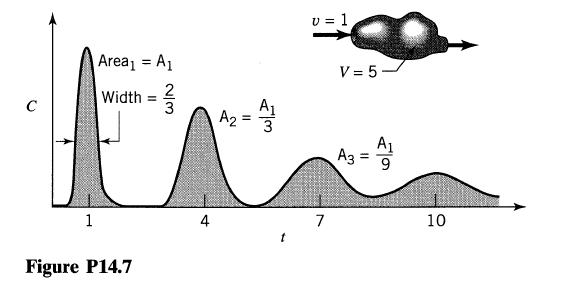
Fit the RTD of Fig. P14.7 with the tanks-in-series model. C 1 Area₁ = A1 Width = Figure P14.7 ~/3. 2 4 A₂ = حاس t v = 1 7 V = 5 A3 = A₁ 9 10
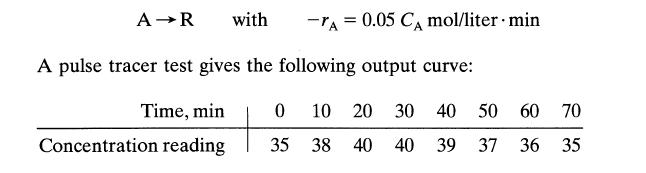
A reactor with a number of dividing baffles is to be used to run the reaction(a) Find the area under the C versus t curve.(b) Find the E versus t curve.(c) Calculate the variance of the E curve.(d) How many tanks in series is this vessel equivalent to?(e) Calculate XA assuming plug flow.(f)
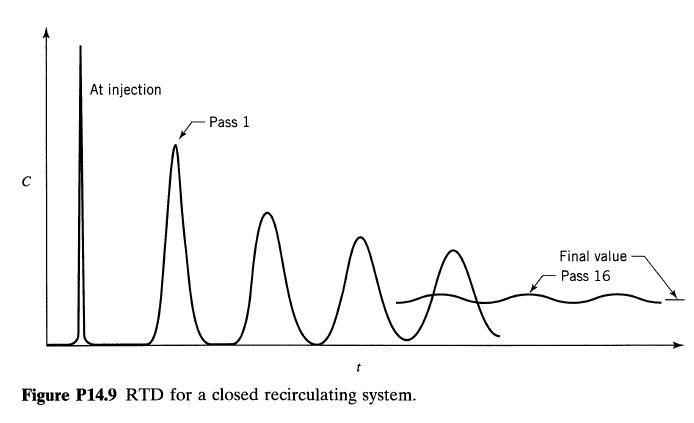
Strongly radioactive waste fluids are stored in "safe-tanks" which are simply long, small-diameter (e.g., 20 m by 10 cm) slightly sloping pipes. To avoid sedimentation and development of "hot spots," and also to insure uniformity before sampling the contents, fluid is recirculated in these
From a pulse input into a vessel we obtain the following output signalWe want to represent the flow through the vessel with the tanks-in-series model. Determine the number of tanks to use. Time, min Concentration. (arbitrary) 1 3 5 7 9 11 13 15 0 0 10 10 10 10 0 0
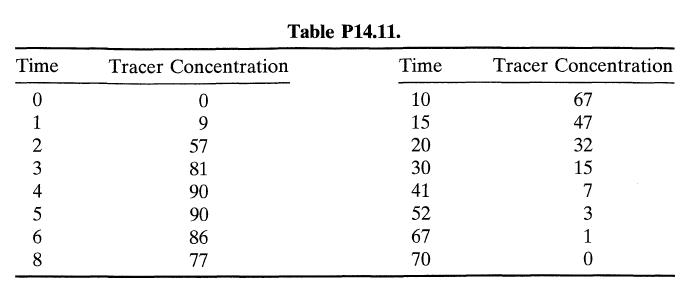
A reactor has flow characteristics given by the nonnormalized C curve in Table P14.11, and by the shape of this curve we feel that the dispersion or tanks-in-series models should satisfactorily represent flow in the reactor.(a) Find the conversion expected in this reactor, assuming that the
Aqueous A (CA0 = 1 mol/liter) with physical properties close to water (p = 1000 kg/m3, CB = m2/s) reacts by a first-order homogeneous reaction (A→R, k = 0.2 s-I) as it flows at 100 mm/s through a tubular reactor (dt = 50 mm, L = 5 m). Find the conversion of A in the fluid leaving this reactor.
A viscous liquid is to react while passing through a tubular reactor in which flow is expected to follow the convection model. What conversion can we expect in this reactor if plug flow in the reactor will give 80% conversion?Reaction is second order.
A viscous liquid is to react while passing through a tubular reactor in which flow is expected to follow the convection model. What conversion can we expect in this reactor if plug flow in the reactor will give 80% conversion?Reaction follows zero-order kinetics
Assuming plug flow we calculate that a tubular reactor 12 m long would give 96% conversion of A for the second-order reaction A --+ R. However, the fluid is very viscous, and flow will be strongly laminar, thus we expect the convection model, not the plug flow model, to closely represent the flow.
Aqueous A (CAO= 50 mol/m3) with physical properties close to water (p =1000 kg/m3, D-9 = m2/s) reacts by a second-order reaction (k = m3/mol · s) as it flows at 10 mm/s through a tubular reactor (dt = 10 mm, L = 20 m). Find the conversion of reactant A from this reactor.
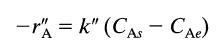
Gaseous reactant A diffuses through a gas film and reacts on the surface of a solid according to a reversible first-order rate,where CA, is the concentration of A in equilibrium with the solid surface. Develop an expression for the rate of reaction of A accounting for both the mass transfer and
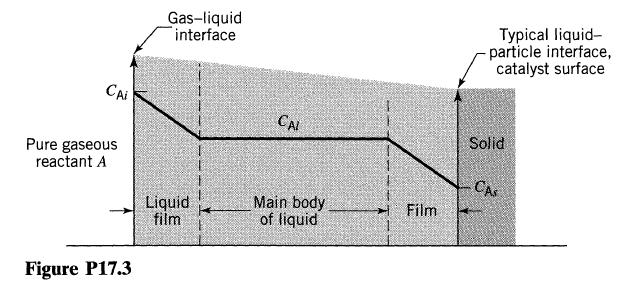
In slurry reactors, pure reactant gas is bubbled through liquid containing suspended catalyst particles. Let us view these kinetics in terms of the film theory, as shown in Fig. P17.3. Thus, to reach the surface of the solid, thereactant which enters the liquid must diffuse through the liquid film
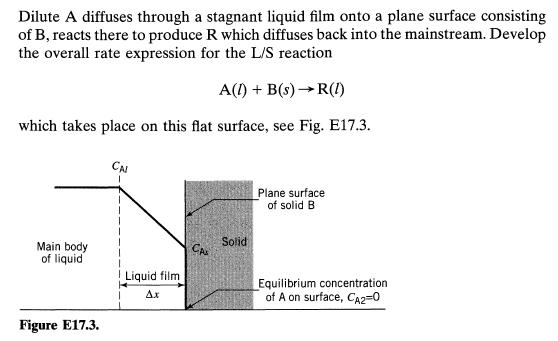
Example 17.4 gives the final rate expression for film mass transfer followed by a second-order rate expression for reaction on a plane surface. Please derive this expression and show that it is correct.Example 17.4 Dilute A diffuses through a stagnant liquid film onto a plane surface consisting of
We want to model the flow of fluid in a flow channel. For this we locate three measuring points A, B, and C, 100 m apart along the flow channel. We inject tracer upstream of point A, fluid flows past points A, B, and C with the following results:At A the tracer width is 2 mAt B the tracer width is
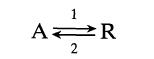
The reversible first-order gas reactionis to be carried out in a mixed flow reactor. For operations at 300 K the volume of reactor required is 100 liters for 60% conversion of A. What should be the volume of the reactor for the same feed rate and conversion but with operations at 400 K? 1 A R 2
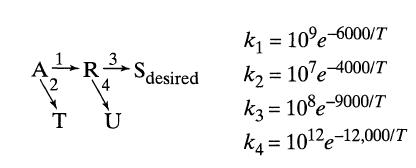
The first-order reactionsare to be run in two mixed flow reactors in series anywhere between 10 and 90°C. If the reactors may be kept at different temperatures, what should these temperatures be for maximum fractional yield of S? Find this fractional yield. 1. R t T U Sdesired k₁ =
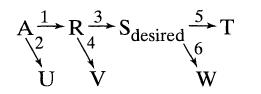
Qualitatively find the optimum temperature progression to maximize C, for the reaction scheme 1 R-²³² - Sa U V desired 5. T W
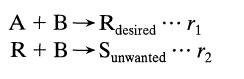
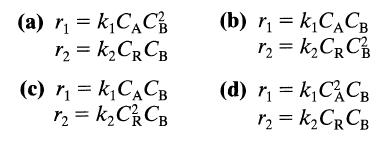
Starting with separate feeds of reactant A and B of given concentration (no dilution with inerts permitted), for the competitive-consecutive reactions with stoichiometry and rate as shownsketch the best contacting patterns for both continuous and noncontinuous operations: A + B Rdesired ***
Under appropriate conditions A decomposes as follows:R is to be produced from 1000 literlhr of feed in which CAo = 1 mollliter, cRo= cso= 0.(a) What size of plug flow reactor will maximize the concentration of R, and what is that concentration in the effluent stream from this reactor?(b) What size
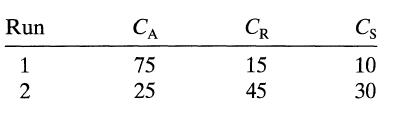
Pure A (CAo = 100) is fed to a mixed flow reactor, R and S are formed, and the following outlet concentrations are recorded. Find a kinetic scheme to fit this data. Run 12 CA 75 25 CR 15 45 Cs 10 30
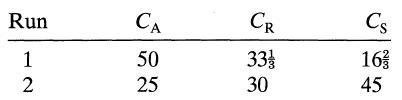
Pure A (CAo = 100) is fed to a mixed flow reactor, R and S are formed, and the following outlet concentrations are recorded. Find a kinetic scheme to fit this data. Run 1 2 CA 50 25 CR 333 30 Cs 163 45
Pure A (CAo = 100) is fed to a mixed flow reactor, R and S are formed, and the following outlet concentrations are recorded. Find a kinetic scheme to fit this data. Run 1 2 CA 50 20 CR 40 40 Cs 10 40 t, min 5 20
In grinding a continuous flow of pigments for paint, our company finds that too many too-small and too many too-large particles exit from our well-mixed grinder. A multistage grinder, approximating plug flow, could also have been used, but wasn't. Anyway, in either type of grinder the pigments are
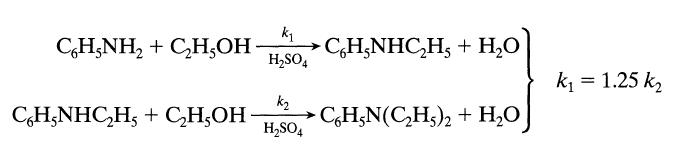
The liquid phase reaction of aniline with ethanol produces wanted monoethylaniline and unwanted diethylaniline(a) An equimolar feed is introduced into a batch reactor, and reaction is allowed to proceed to completion. Find the concentration of reactants and products at the end of the run.(b) Find
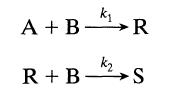
Consider the following elementary reactions:(a) One mole A and 3 moles B are rapidly mixed together. The reaction is very slow, allowing analysis of compositions at various times. When 2.2 moles B remain unreacted, 0.2 mole S is present in the mixture. What should be the composition of the mixture
Under the action of mixed enzymes reactant A is converted to products as follows:where the rate constants are dependent on the pH of the system.(a) What reactor set-up (plug flow, mixed flow, or staged mixed flow units) and what uniform pH level would you use?(b) If it were possible to change the
Under the action of mixed enzymes reactant A is converted to products as follows:where the rate constants are dependent on the pH of the system.(a) What reactor set-up (plug flow, mixed flow, or staged mixed flow units) and what uniform pH level would you use?(b) If it were possible to change the
Monoethylaniline can also be produced in the vapor phase in a fluidized bed using natural bauxite as the solid catalyst. The elementary reactions are shown in the previous problem. Using an equimolar feed of aniline and ethanol, the fluidized bed produces 3 parts monoethylaniline to 2 parts
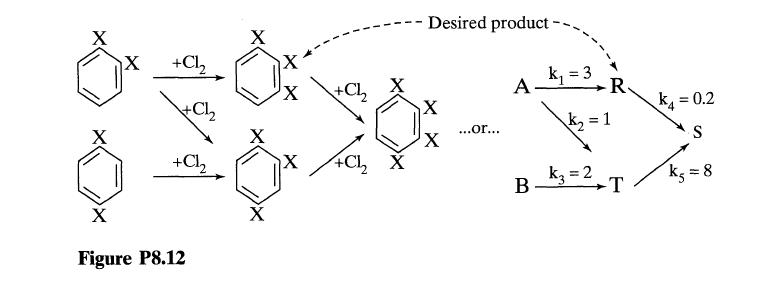
The progressive chlorination of o- and p-dichlorobenzene proceed with second-order rate, as shown in Fig. P8.12.For a single-feed stream having CAo = 2, CB0 = 1, and 1,2,3-trichlorobenzene as the desired product(a) Tell which kind of flow reactor is best.(b) In this reactor find CMAX.
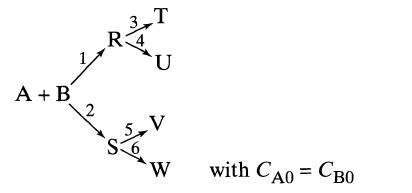
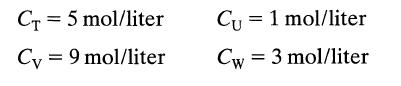
Chemicals A and B are thrown into a vat and react away according to the following elementary reactions:What can you say about these six rate constants if an analysis of the mixture shows thatat the time(a) When reaction is incomplete?(b) When reaction is complete? A + B 2 R 3 T U 5-V S6 W with
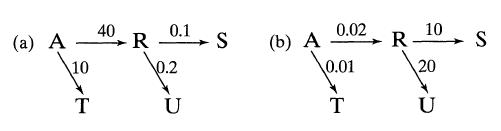
Consider the following first order decompositions with rate constants as shownIf a colleague reports that Cs = 0.2 CAo in the exit stream of a plug flow reactor, what can you say about the concentration of the other reactor components, A, R, T, and U in the exit stream? (a) A 10 T 40 0.1
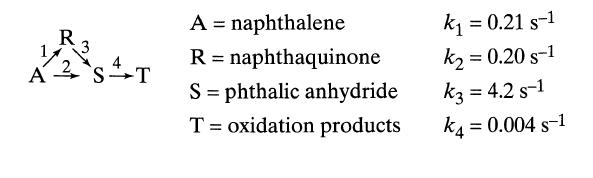
With a particular catalyst and at a given temperature, the oxidation of naphthalene to phthalic anhydride proceeds as follows:What reactor type gives the maximum yield of phthalic anhydride? Roughly estimate this yield and the fractional conversion of naphthalene which will give this yield. Note
Sandy's Rock and Gravel Company wants to shift a mountain of gravel, estimated at about 20,000 tons, from one side of their yard to the other. For this they intend to use a power shovel to fill a hopper, which in turn feeds a belt conveyor. The latter then transports the gravel to the new location.
A large fully automated municipal incinerator is being designed. A survey estimates the garbage load to be 1440 tons/day. This will be harvested by a fleet of compaction trucks which will disgorge their loads into an underground storage bin. A conveyor will then feed the garbage to the
Upper Slobbovians and Lower Slobbovians are always at it. . . , crushing skulls, slitting throats, and so on. . . . At any gathering the rate at which Upper Slobs are killed is directly proportional to the number of Lower Slobs around, and vice versa. And at the end of any meeting of these friendly
Chemical X, a powdered solid, is slowly and continuously fed for half an hour into a well stirred vat of water. The solid quickly dissolves and hydrolyses to Y, which then slowly decomposes to Z as followsThe volume of liquid in the vat stays close to 3 m3 throughout this operation, and if no
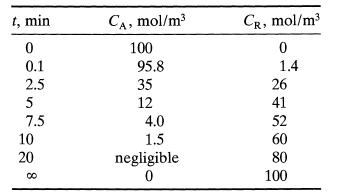
When oxygen is bubbled through a high temperature batch of A-containing liquid material, A oxidizes slowly to give a slowly decomposing intermediate X and final product R. Here are the results of an experimentWe have no way of analyzing for X; however, we are safe in assuming that at any time CA +
Chemical A reacts to form R (k1 = 6 hr-1) and R reacts away to form S (k1= 3 hr-l). In addition R slowly decomposes to form T (k2 = 1 hr-I). If a solution containing 1.0 mollliter of A is introduced into a batch reactor, how long would it take to reach CR,MAX and what would be CR,MAX?
Showing 700 - 800
of 748
1
2
3
4
5
6
7
8
Step by Step Answers

 Get 50% OFF
Claim Now
Get 50% OFF
Claim Now





![Data: k = 10 exp [-2416/T] ACp CPR CPA = 0 - AH, = -8000 cal/mol at 300 K K = 10 at 300 K Feed consists of](https://dsd5zvtm8ll6.cloudfront.net/si.question.images/images/question_images/1696/4/0/0/524651d048cabd501696400524239.jpg)