New Semester
Started
Get
50% OFF
Study Help!
--h --m --s
Claim Now
Question Answers
Textbooks
Find textbooks, questions and answers
Oops, something went wrong!
Change your search query and then try again
S
Books
FREE
Study Help
Expert Questions
Accounting
General Management
Mathematics
Finance
Organizational Behaviour
Law
Physics
Operating System
Management Leadership
Sociology
Programming
Marketing
Database
Computer Network
Economics
Textbooks Solutions
Accounting
Managerial Accounting
Management Leadership
Cost Accounting
Statistics
Business Law
Corporate Finance
Finance
Economics
Auditing
Tutors
Online Tutors
Find a Tutor
Hire a Tutor
Become a Tutor
AI Tutor
AI Study Planner
NEW
Sell Books
Search
Search
Sign In
Register
study help
engineering
chemical reaction engineering
Chemical Reaction Engineering 3rd Edition Octave Levenspiel - Solutions
The elementary, irreversible gas-phase reaction A → B + C is carried out adiabatically in a PFR packed with a catalyst. Pure A enters the reactor at a volumetric flow rate of 20 dm3/s, at a pressure of 10 atm, and a temperature of 450 K.Additional information:All heats of formation are referenced
A pulse of radioactive Ba-140 was injected into a 10-in. pipeline (25.5 cm ID) 293 km long used for pumping petroleum products (u = 81.7 cm/s, Re = 2400) from Rangely, Colorado to Salt Lake City, Utah. Estimate the time of passage of fluid having more than 1/2 Cmax from Rangely, Colorado to Salt
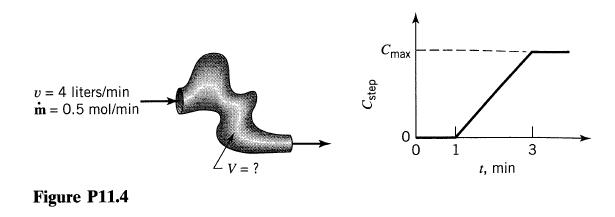
A step experiment is made on a reactor. The results are shown in Fig. P11.4.(a) Is the material balance consistent with the tracer curve?(b) If so, determine the vessel volume V, t, the F curve, and the E curve. v = 4 liters/min m = 0.5 mol/min Figure P11.4 Cmax ait Lv=? 1 t, min 3
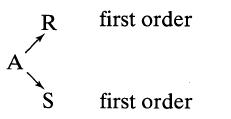
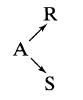
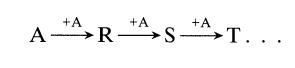
Substance A in a liquid reacts to produce R and S as follows:A feed (CA0 = 1, CR0 = 0, CS0= 0) enters two mixed flow reactors in series, (τ1 = 2.5 min, τ2 = 5 min). Knowing the composition in the first reactor (CA1 = 0.4, CR1 = 0.4, CS1 = 0.2), find the composition leaving the second reactor.
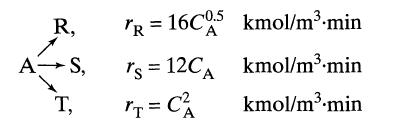
Under ultraviolet radiation, reactant A of CA0 = 10 kmol/m3 in a process stream (v = 1m3/min) decomposes as follows.We wish to design a reactor setup for a specific duty. Sketch the scheme selected, and calculate the fraction of feed transformed into desired product as well as the volume of reactor
Under ultraviolet radiation, reactant A of CA0 = 10 kmol/m3 in a process stream (v = 1m3/min) decomposes as follows.We wish to design a reactor setup for a specific duty. Sketch the scheme selected, and calculate the fraction of feed transformed into desired product as well as the volume of reactor
Under ultraviolet radiation, reactant A of CA0 = 10 kmol/m3 in a process stream (v = 1m3/min) decomposes as follows.We wish to design a reactor setup for a specific duty. Sketch the scheme selected, and calculate the fraction of feed transformed into desired product as well as the volume of reactor
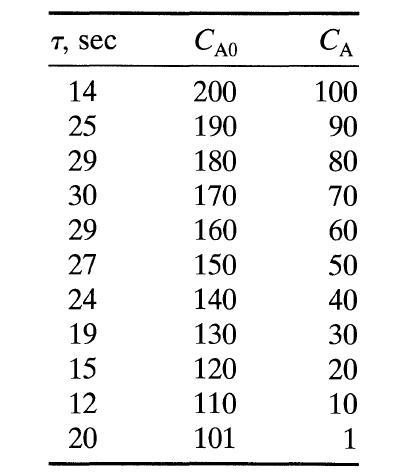
The stoichiometry of a liquid-phase decomposition is known to beIn a series of steady-state flow experiments (CA0 = 100, CRO = CSO = 0) in a laboratory mixed flow reactor the following results are obtained: Further experiments indicate that the level of C, and Cs have no effect on the progress of
The stoichiometry of a liquid-phase decomposition is known to beIn a series of steady-state flow experiments (CA0 = 100, CRO = CSO = 0) in a laboratory mixed flow reactor the following results are obtained: Further experiments indicate that the level of C, and Cs have no effect on the progress of
Water containing a short-lived radioactive species flows continuously through a well-mixed holdup tank. This gives time for the radioactive material to decay into harmless waste. As it now operates, the activity of the exit stream is 117 of the feed stream. This is not bad, but we'd like to lower
A liquid reactant stream (1 mol/liter) passes through two mixed flow reactors in a series. The concentration of A in the exit of the first reactor is 0.5 mol/liter. Find the concentration in the exit stream of the second reactor. The reaction is second-order with respect to A and V2/V1 = 2.
An aqueous reactant stream (4 mol A/liter) passes through a mixed flow reactor followed by a plug flow reactor. Find the concentration at the exit of the plug flow reactor if in the mixed flow reactor CA = 1 mol/liter. The reaction is second-order with respect to A, and the volume of the plug flow
Reactant A (A→R, CA0 = 26 mol/m3) passes in steady flow through four equal-size mixed flow reactors in series (τtotal = 2 min). When steady state is achieved the concentration of A is found to be 11, 5, 2, 1 mol/m3 in the four units. For this reaction, what must be πplug so as to reduce CA from
Originally we had planned to lower the activity of a gas stream containing radioactive Xe-138 (half-life = 14 min) by having it pass through two holdup tanks in series, both well mixed and of such size that the mean residence time of gas is 2 weeks in each tank. It has been suggested that we
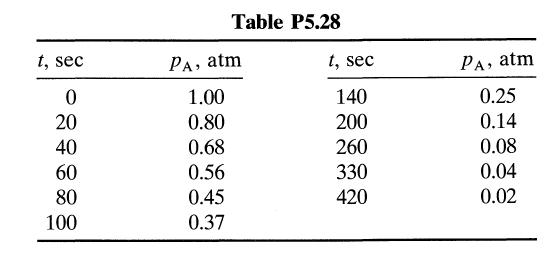
At 100°C pure gaseous A reacts away with stoichiometry 2A → R + S in a constant volume batch reactor as follows:What size of plug flow reactor operating at 100°C and 1 atm can treat 100 moles A/hr in a feed consisting of 20% inerts to obtain 95% conversion of A? t, sec PA, atm 0 20 1.00
We wish to treat 10 liters/min of liquid feed containing 1 mol A/liter to 99% conversion. The stoichiometry and kinetics of the reaction are given bySuggest a good arrangement for doing this using two mixed flow reactors, and find the size of the two units needed. Sketch the final design chosen. A
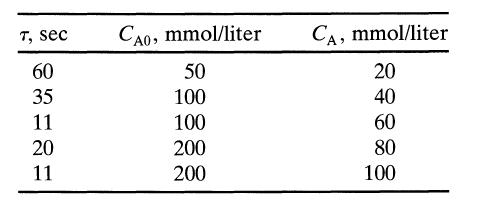
From steady-state kinetics runs in a mixed flow reactor, we obtain the following data on the reaction A→R.Find the space time needed to treat a feed of CA0 = 100 mmollliter to 80% conversion(a) In a plug flow reactor.(b) In a mixed flow reactor. T, sec 60 35 11 20 11 CAO,
Aqueous feed containing reactant A (CA0 = 2 mol/liter) enters a plug flow reactor (10 liter) which has a provision for recycling a portion of the flowing stream. The reaction kinetics and stoichiometry areand we wish to get 96% conversion. Should we use the recycle stream? If so, at what value
At present we have 90% conversion of a liquid feed (n = 1, CA0 = 10 mol/liter) to our plug flow reactor with recycle of product (R = 2). If we shut off the recycle stream, by how much will this lower the processing rate of our feed to the same 90% conversion?
Consider the autocatalytic reaction A → R, with - rA= 0.001 CACR mol/liter · s. We wish to process 1.5 liters/s of a CAo = 10 mol/liter feed to the highest conversion possible in the reactor system consisting of four 100-liter mixed flow reactors connected as you wish and any feed arrangement.
A first-order liquid-phase reaction, 92% conversion, is taking place in a mixed flow reactor. It has been suggested that a fraction of the product stream, with no additional treatment, be recycled. If the feed rate remains unchanged, in what way would this affect conversion?
100 liters/hr of radioactive fluid having a half-life of 20 hr is to be treated by passing it through two ideal stirred tanks in series, V = 40 000 liters each. In passing through this system, how much will the activity decay?
At present the elementary liquid-phase reaction A + B → R + S takes place in a plug flow reactor using equimolar quantities of A and B. Conversion is 96%, CA0 = CB0 = 1 mol/liter. If a mixed flow reactor ten times as large as the plug flow reactor were hooked up in series with the existing unit,
The kinetics of the aqueous-phase decomposition of A is investigated in two mixed flow reactors in series, the second having twice the volume of the first reactor. At steady state with a feed concentration of 1 mol A/liter and mean residence time of 96 sec in the first reactor, the concentration in
Using a color indicator which shows when the concentration of A falls below 0.1 mol/liter, the following scheme is devised to explore the kinetics of the decomposition of A. A feed of 0.6 mol A/liter is introduced into the first of the two mixed flow reactors in series, each having a volume of 400
The elementary irreversible aqueous-phase reaction A + B → R + S is carried out isothermally as follows. Equal volumetric flow rates of two liquid streams are introduced into a 4-liter mixing tank. One stream contains 0.020 mol A/liter, the other 1.400 mol B/liter. The mixed stream is then passed
At room temperature the second-order irreversible liquid-phase reaction proceeds as follows:A batch reactor takes 18 min to fill and empty. What percent conversion and reaction time should we use so as to maximize the daily output of product R? 2A → products, A = [0.005 liter/(mol)(min)]C², CAO
For an irreversible first-order liquid-phase reaction (CA0 = 10 mol/liter) conversion is 90% in a plug flow reactor. If two-thirds of the stream leaving the reactor is recycled to the reactor entrance, and if the throughput to the whole reactor-recycle system is kept unchanged, what does this do
Reactant A decomposes with stoichiometry A→R and with rate dependent only on CA. The following data on this aqueous decomposition are obtained in a mixed flow reactor:Determine which setup, plug flow, mixed flow, or any two- combination gives minimum τ for 90% conversion of a feed consisting of
At present conversion is 2/3 for our elementary second-order liquid reaction 2A→2R when operating in an isothermal plug flow reactor with a recycle ratio of unity. What will be the conversion if the recycle stream is shut off?
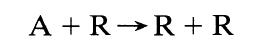
We wish to explore various reactor setups for the transformation of A into R. The feed contains 99% A, 1% R; the desired product is to consist of 10% A, 90% R. The transformation takes place by means of the elementary reactionwith rate constant k = 1 liter/mol · min. The concentration of active
Consider a gas-phase reaction 2A→R + 2s with unknown kinetics. If a space velocity of 1/min is needed for 90% conversion of A in a plug flow reactor, find the corresponding space-time and mean residence time or holding time of fluid in the plug flow reactor.
In an isothermal batch reactor 70% of a liquid reactant is converted in 13 min. What space-time and space-velocity are needed to effect this conversion in a plug flow reactor and in a mixed flow reactor?
A stream of aqueous monomer A (1 mol/liter, 4 liter/min) enters a 2-liter mixed flow reactor, is radiated therein, and polymerizes as followsIn the exit stream CA = 0.01 mol/liter, and for a particular reaction product W, CW = 0.0002 mol/liter. Find the rate of reaction of A and the rate of
We plan to replace our present mixed flow reactor with one having double the volume. For the same aqueous feed (10 mol A/liter) and the same feed rate find the new conversion. The reaction kinetics are represented byand present conversion is 70%. A →R, -TA = KCL.
An aqueous feed of A and B (400 liter/min, 100 mmol A/liter, 200 mmol B/liter) is to be converted to product in a plug flow reactor. The kinetics of the reaction is represented byFind the volume of reactor needed for 99.9% conversion of A to product. A + B →R, -A= 200 CACB mol liter min
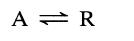
A plug flow reactor (2 m3) processes an aqueous feed (100 liter/min) containing reactant A (CA0 = 100 mmol/liter). This reaction is reversible and represented byFirst find the equilibrium conversion and then find the actual conversion of A in the reactor. A = R, -A= (0.04 min-¹)CA - (0.01 min-¹)CR
The off gas from a boiling water nuclear power reactor contains a whole variety of radioactive trash, one of the most troublesome being Xe-133 (half life = 5.2 days). This off gas flows continuously through a large holdup tank in which its mean residence time is 30 days, and where we can assume
A mixed flow reactor (2 m3) processes an aqueous feed (100 liter/min) containing reactant A (CA0 = 100 mmol/liter). The reaction is reversible and represented byWhat is the equilibrium conversion and the actual conversion in the reactor? A = R, -TA 0.04 CA - 0.01 CR mol liter min
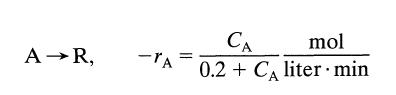
A specific enzyme acts as catalyst in the fermentation of reactant A. At a given enzyme concentration in the aqueous feed stream (25 liter/min) find the volume of plug flow reactor needed for 95% conversion of reactant A (CA0 = 2 mol/liter). The kinetics of the fermentation at this enzyme
A gaseous feed of pure A (2 mol/liter, 100 mol/min) decomposes to give a variety of products in a plug flow reactor. The kinetics of the conversion is represented byFind the expected conversion in a 22-liter reactor. A 2.5 (products), -TA (10 min-¹) CA =
An aqueous feed of A and B (400 liter/min, 100 mmol A/liter, 200 mmol B/liter) is to be converted to product in a mixed flow reactor. The kineticsof the reaction are represented byFind the volume of reactor needed for 99.9% conversion of A to product. A + B →R, -A = 200 CACB mol liter min
Enzyme E catalyses the fermentation of substrate A (the reactant) to product R. Find the size of mixed flow reactor needed for 95% conversion of reactant in a feed stream (25 liter/min) of reactant (2 mol/liter) and enzyme. The kinetics of the fermentation at this enzyme concentration are given by
At 650°C phosphine vapor decomposes as follows:What size of plug flow reactor operating at 649°C and 11.4 atm is needed for 75% conversion of 10 mol/hr of phosphine in a 2/3 phosphine-1/3 inert feed? 4PH3 P4(g) + 6H₂, -phos (10 hr-¹) phos =
A stream of pure gaseous reactant A (CA0 = 660 mmol/liter) enters a plug flow reactor at a flow rate of FA, = 540 mmol/min and polymerizes there as followsHow large a reactor is needed to lower the concentration of A in the exit stream to CAf = 330 mmol/liter? 3A → R, -"A = 54 mmol liter min
A gaseous feed of pure A (1 mol/liter) enters a mixed flow reactor (2 liters) and reacts as follows:Find what feed rate (liter/min) will give an outlet concentration CA = 0.5 mol/liter. 2A → R, -A = 0.05 C² mol liter sec
Gaseous reactant A decomposes as follows:Find the conversion of A in a 50% A-50% inert feed (v0 = 180 liter/min, CA0 = 300 mmol/liter) to a 1 m3 mixed flow reactor. A 3R, -A= (0.6 min-¹) CA
1 literls of a 20% ozone-80% air mixture at 1.5 atm and 93°C passes through a plug flow reactor. Under these conditions ozone decomposes by homogeneous reactionWhat size reactor is needed for 50% decomposition of ozone? This problem is a modification of a problem given by Corcoran and Lacey
A mixed flow reactor is being used to determine the kinetics of a reaction whose stoichiometry is A → R. For this purpose various flow rates of an aqueous solution of 100 mmol A/liter are fed to a 1-liter reactor, and for each run the outlet concentration of A is measured. Find a rate equation to
Pure gaseous A at about 3 atm and 30°C (120 mmollliter) is fed into a 1-liter mixed flow reactor at various flow rates. There it decomposes, and the exit concentration of A is measured for each flow rate. From the following data find a rate equation to represent the kinetics of the decomposition
An aqueous feed containing A (1 mol/liter) enters a 2-liter plug flow reactor and reacts away.Find the outlet concentration of A for a feed rate of 0.5 liter/min. (2AR, -A= 0.05 C mol/liter s)-
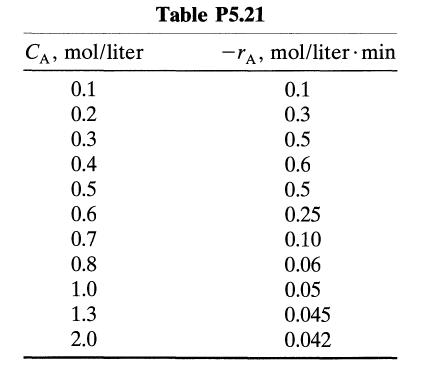
For the reaction of Problem 5.21, what size of plug flow reactor would be needed for 80% conversion of a feed stream of 1000 mol A/hr at CA0 = 1.5 mol/liter?Problem 9.21We are planning to operate a batch reactor to convert A into R. This is a liquid reaction, the stoichiometry is A → R, and the
We are planning to operate a batch reactor to convert A into R. This is a liquid reaction, the stoichiometry is A → R, and the rate of reaction is given in Table P5.21. How long must we react each batch for the concentration to drop from CA0 = 1.3 mol/liter to CAf = 0.3 mol/liter? CA,
(a) For the reaction of Problem 5.21, what size of mixed flow reactor is needed for 75% conversion of a feed stream of 1000 mol A/hr at CA0 = 1.2 mol/liter?(b) Repeat part (a) with the modification that the feed rate is doubled, thus 2000 mol A/hr at CAo = 1.2 mol/liter are to be treated.(c) Repeat
A high molecular weight hydrocarbon gas A is fed continuously to a heated high temperature mixed flow reactor where it thermally cracks (homogeneous gas reaction) into lower molecular weight materials, collectively called R, by a stoichiometry approximated by A →5R. By changing the feed rate
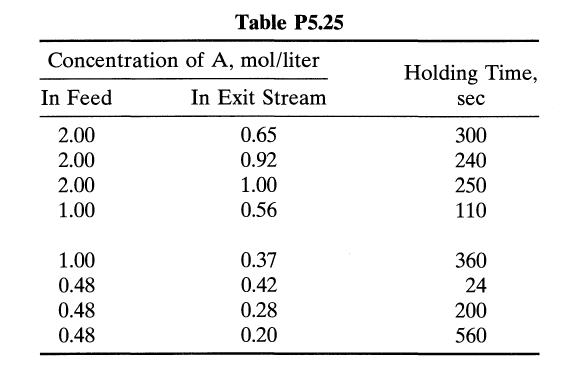
The aqueous decomposition of A is studied in an experimental mixed flow reactor. The results in Table P5.25 are obtained in steady-state runs. To obtain 75% conversion of reactant in a feed, CA0 = 0.8 mol/liter, what holding time is needed in a plug flow reactor? Concentration In
Repeat the previous problem but for a mixed flow reactor.Previous ProblemThe aqueous decomposition of A is studied in an experimental mixed flow reactor. The results in Table P5.25 are obtained in steady-state runs. To obtain 75% conversion of reactant in a feed, CA0 = 0.8 mol/liter, what holding
The data in Table P5.28 have been obtained on the decomposition of gaseous reactant A in a constant volume batch reactor at 100°C. The stoichiometry of the reaction is 2A → R + S. What size plug flow reactor (in liters) operating at 100°C and 1 atm can treat 100 mol A/hr in a feed consisting
Repeat the previous problem for a mixed flow reactor.The data in Table P5.28 have been obtained on the decomposition of gaseous reactant A in a constant volume batch reactor at 100°C. The stoichiometry of the reaction is 2A → R + S. What size plug flow reactor (in liters) operating at 100°C
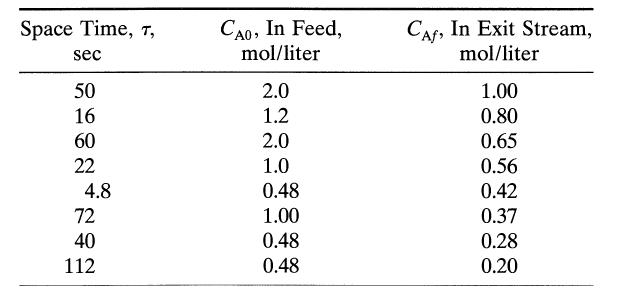
The aqueous decomposition of A produces R as follows:The following results are obtained in a series of steady state runs, all having no R in the feed stream.From this kinetic information, find the size of reactor needed to achieve 75% conversion of a feed stream of v = 1 liter/sec and CA0 = 0.8
The following four problems consider an isothermal single-phase flow reactor operating at steady-state and constant pressure.Given a gaseous feed, CA0 = 100, CB0 = 200, A + B→R + S, XA = 0.8. Find XB, CA, CB.
The following four problems consider an isothermal single-phase flow reactor operating at steady-state and constant pressure.Given a dilute aqueous feed, CA0, = CB0 = 100, A + 2B →R + S, CA = 20. Find XA, XB, CB.
The following four problems consider an isothermal single phase flow reactor operating at steady-state and constant pressure.Given a gaseous feed, CA0 = 200, CB0 = 100, A + B→R, CA = 50. Find XA, XB, CB.
The following four problems consider an isothermal single-phase flow reactor operating at steady-state and constant pressure.Given a gaseous feed, CA0 = CB0 = 100, A + 2B → R , CB = 20. Find XA, XB, CA.
In the following two problems a continuous stream of fluid enters a vessel at temperature T0 and pressure no, reacts there, and leaves at T and π. Given a gaseous feed, To A + B 2R, T = 300 K, π - 400 K, To = 4 atm, Cao 100, Cao = = 3 atm, CA = 20. Find XA, XB, CB. = 200,
In the following two problems a continuous stream of fluid enters a vessel at temperature T0 and pressure no, reacts there, and leaves at T and π. Given a gaseous feed, To 5R, T = 400 K, A + B = 1000 Κ, πο = = 4 atm, CA 5 atm, Cao 100, Cao = - 20. Find XA, XB, Св. = = 200,
A Commercial Popcorn Popping Popcorn Popper. We are constructing a 1-liter popcorn popper to be operated in steady flow. First tests in this unit show that 1 liter/min of raw corn feed stream produces 28 liter/min of mixed exit stream. Independent tests show that when raw corn pops its volume goes
If - rA = -(dCA/dt) = 0.2 mol/liter · sec when CA = 1 mol/liter, what is the rate of reaction when CA = 10 mol/liter?
After 8 minutes in a batch reactor, reactant (CA0 = 1 mol/liter) is 80% converted; after 18 minutes, conversion is 90%. Find a rate equation to represent this reaction.
In a homogeneous isothermal liquid polymerization, 20% of the monomer disappears in 34 minutes for initial monomer concentration of 0.04 and also for 0.8 mollliter. What rate equation represents the disappearance of the monomer?
A 10-minute experimental run shows that 75% of liquid reactant is converted to product by a 1/2-order rate. What would be the fraction converted in a half-hour run?
Repeat the previous problem for second-order kinetics.Data from previous problem Liquid A decomposes by first-order kinetics, and in a batch reactor 50% of A is converted in a 5-minute run. How much longer would it take to reach 75% conversion?
Liquid A decomposes by first-order kinetics, and in a batch reactor 50% of A is converted in a 5-minute run. How much longer would it take to reach 75% conversion?
Snake-Eyes Magoo is a man of habit. For instance, his Friday evenings are all alike-into the joint with his week's salary of $180, steady gambling at "2-up" for two hours, then home to his family leaving $45 behind. Snake Eyes's betting pattern is predictable. He always bets in amounts proportional
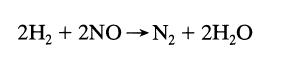
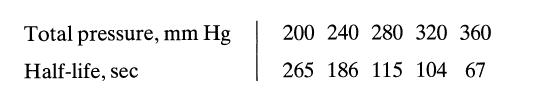
Find the overall order of the irreversible reactionfrom the following constant-volume data using equimolar amounts of hydrogen and nitric oxide: 2H₂ + 2NO N₂ + 2H₂O
Aqueous A reacts to form R (A → R) and in the first minute in a batch reactor its concentration drops from CA0 = 2.03 mol/liter to CAf = 1.97 mol/liter. Find the rate equation for the reaction if the kinetics are second order with respect to A.
The first-order reversible liquid reactiontakes place in a batch reactor. After 8 minutes, conversion of A is 33.3% while equilibrium conversion is 66.7%. Find the rate equation for this reaction. AR, CAO = 0.5 mol/liter, CRO = 0
Aqueous A at a concentration CA0 = 1 mol/liter is introduced into a batch reactor where it reacts away to form product R according to stoichiometry A → R. The concentration of A in the reactor is monitored at various times, as shown below:For CA0 = 500 mol/m3 find the conversion of reactant after
Find the rate for the reaction of Problem 11.Data from Problem 11Aqueous A at a concentration CA0 = 1 mol/liter is introduced into a batch reactor where it reacts away to form product R according to stoichiometry A → R. The concentration of A in the reactor is monitored at various times, as shown
Betahundert Bashby likes to play the gaming tables for relaxation. He does not expect to win, and he doesn't, so he picks games in which losses are a given small fraction of the money bet. He plays steadily without a break, and the sizes of his bets are proportional to the money he has. If at
For the elementary reactions in series find the maximum concentration of R and when it is reached. Ak₁ RK²S, K₁=k₂, att=0 Ca = CAO, CRO = CSO Cso = 0
Repeat the above problem, except this time solve by the differential method.Data from above problemAt room temperature sucrose is hydrolyzed by the catalytic action of the enzyme sucrase as follows:Starting with a sucrose concentration CA0 = 1.0 millimol/liter and an enzyme concentration CEO = 0.01
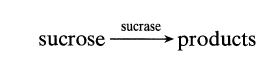
At room temperature sucrose is hydrolyzed by the catalytic action of the enzyme sucrase as follows:Starting with a sucrose concentration CA0 = 1.0 millimol/liter and an enzyme concentration CEO = 0.01 millimol/liter, the following kinetic data are obtained in a batch reactor (concentrations
An ampoule of radioactive Kr-89 (half life = 76 minutes) is set aside for a day. What does this do to the activity of the ampoule? Note that radioactive decay is a first-order process.
Enzyme E catalyzes the transformation of reactant A to product R as follows:If we introduce enzyme (CE0 = 0.001 mol/liter) and reactant (CA0 = 10 mol/liter) into a batch reactor and let the reaction proceed, find the time needed for the concentration of reactant to drop to 0.025 mol/liter. Note
Find the conversion after 1 hour in a batch reactor for A R, -A= 3C05 mol liter.hr' CA0 = 1 mol/liter
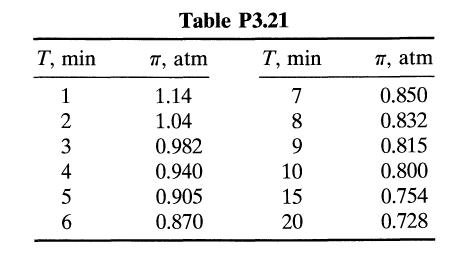
A small reaction bomb fitted with a sensitive pressure-measuring device is flushed out and then filled with pure reactant A at 1-atm pressure. The operation is carried out at 25OC, a temperature low enough that the reaction does not proceed to any appreciable extent. The temperature is then raised
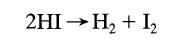
The thermal decomposition of hydrogen iodideis reported by M. Bodenstein [Z. phys. chem., 29, 295 (1899)l as follows:Find the complete rate equation for this reaction. units of joules, moles, cm3 and seconds. 2HI→H₂ + 1₂
Find the first-order rate constant for the disappearance of A in the gas reaction A → 1.6R if the volume of the reaction mixture, starting with pure A increases by 50% in 4 min. The total pressure within the system stays constant at 1.2 atm, and the temperature is 25°C.
Find the first-order rate constant for the disappearance of A in the gas reaction 2A → R if, on holding the pressure constant, the volume of them reaction mixture, starting with 80% A, decreases by 20% in 3 min.
The presence of substance C seems to increase the rate of reaction of A and B, A + B → AB. We suspect that C acts catalytically by combining with one of the reactants to form an intermediate, which then reacts further. From the rate data in Table P3.28 suggest a mechanism and rate equation for
When a concentrated urea solution is stored it slowly condenses to biuret by the following elementary reaction:To study the rate of condensation a sample of urea (C = 20 mollliter) is stored at 100°C and after 7 hr 40 min we find that 1 mol% has turned into biuret. Find the rate equation for this
The following data are obtained at 0°C in a constant-volume batch reactor using pure gaseous A:The stoichiometry of the decomposition is A → 2.5R. Find a rate equation which satisfactorily represents this decomposition. Time, min Partial pressure of A, mm 0 760 2 600 4 6 475 390 8 320 275 10 12
In the presence of a homogeneous catalyst of given concentration, aqueous reactant A is converted to product at the following rates, and C, alone determines this rate:We plan to run this reaction in a batch reactor at the same catalyst concentration as used in getting the above data. Find the time
For the decomposition A → R, CA0 = 1 mol/liter, in a batch reactor conversion is 75% after 1 hour, and is just complete after 2 hours. Find a rate equation to represent these kinetics.
For the reaction A → R, second-order kinetics and CA0 = 1 mol/liter, we get 50% conversion after 1 hour in a batch reactor. What will be the conversion and concentration of A after 1 hour if CA0 = 10 mol/liter?
For the enzyme-substrate reaction , the rate of disappearance of substrate is given byWhat are the units of the two constants? -TA 1760[A][E] 6+ CA mol/m³.s
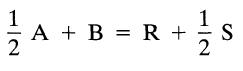
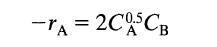
A reaction with stoichiometric equationhas the following rate expressionWhat is the rate expression for this reaction if the stoichiometric equation is written as A + 2B = 2R + S? A+B A + B = R + S 1 2
In the mid-nineteenth century the entomologist Henri Fabre noted that French ants (garden variety) busily bustled about their business on hot days but were rather sluggish on cool days. Checking his results with Oregon ants, I find What activation energy represents this change in bustliness?
On typical summer days, field crickets nibble, jump, and chirp now and then. But at a night when great numbers congregate, chirping seems to become a serious business and tends to be in unison. In 1897, A. E. Dolbear (Am. Naturalist, 31,970) reported that this social chirping rate was dependent on
Showing 500 - 600
of 748
1
2
3
4
5
6
7
8
Step by Step Answers

 Get 50% OFF
Claim Now
Get 50% OFF
Claim Now



![kx = 0.133x exp[ER(1450-1T)]dm3kg-cat six with Ex= 31.4x kJ/mol](https://s3.amazonaws.com/si.question.images/images/question_images/1697/5/2/0/735652e1c5f48dc31697520734178.jpg)



![2A products, A = [0.005 liter/(mol)(min)]C, CAO = 1 mol/liter](https://dsd5zvtm8ll6.cloudfront.net/si.question.images/images/question_images/1696/2/4/6/829651aac2dd00881696246826506.jpg)




























![[A] 1 3 4 2 2 1 Table P3.28 [B] 3 1 4 2 4 2 [C] 0.02 0.02 0.04 0.01 0.03 0.05 TAB 9 and 5 32 6 20 12](https://dsd5zvtm8ll6.cloudfront.net/si.question.images/images/question_images/1696/0/7/0/1336517f9f53f82f1696070129316.jpg)



![-TA 1760[A][E] 6+ CA mol/m.s](https://dsd5zvtm8ll6.cloudfront.net/si.question.images/images/question_images/1695/9/0/8/86765158403c37911695908865727.jpg)