New Semester
Started
Get
50% OFF
Study Help!
--h --m --s
Claim Now
Question Answers
Textbooks
Find textbooks, questions and answers
Oops, something went wrong!
Change your search query and then try again
S
Books
FREE
Study Help
Expert Questions
Accounting
General Management
Mathematics
Finance
Organizational Behaviour
Law
Physics
Operating System
Management Leadership
Sociology
Programming
Marketing
Database
Computer Network
Economics
Textbooks Solutions
Accounting
Managerial Accounting
Management Leadership
Cost Accounting
Statistics
Business Law
Corporate Finance
Finance
Economics
Auditing
Tutors
Online Tutors
Find a Tutor
Hire a Tutor
Become a Tutor
AI Tutor
AI Study Planner
NEW
Sell Books
Search
Search
Sign In
Register
study help
engineering
engineering fluid mechanics
Engineering Fluid Mechanics 11th Edition Donald F. Elger, Barbara A. LeBret, Clayton T. Crowe, John A. Robertson - Solutions
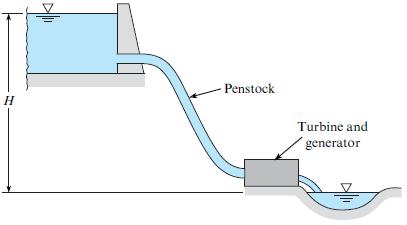
An engineer is making an estimate for a home owner. This owner has a small stream (Q = 1.4 cfs, T = 40°F) that is located at an elevation H = 34 ft above the owner’s residence. The owner is proposing to dam the stream, diverting the flow through a pipe (penstock). This flow will spin a hydraulic
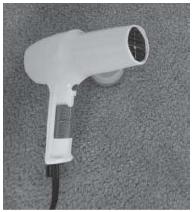
A fan produces a pressure rise of 6 mm of water to move air through a hair dryer. The mean velocity of the air at the exit is 10 m/s, and the exit diameter is 44 mm. Estimate the electrical power in watts that needs to be supplied to operate the fan. Assume that the fan/motor combination has an
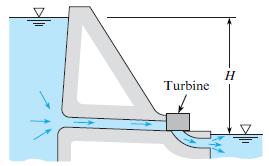
A small-scale hydraulic power system is shown. The elevation difference between the reservoir water surface and the pond water surface downstream of the reservoir, H, is 24 m. The velocity of the water exhausting into the pond is 7 m/s, and the discharge through the system is 4 m3/s. The head loss
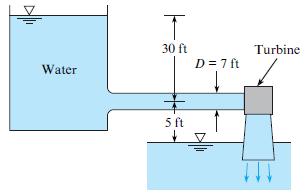
If the discharge is 480 cfs, what power output may be expected from the turbine? Assume that the turbine efficiency is 85% and that the overall head loss is 1.3 V2/ 2g, where V is the velocity in the 7 ft penstock Assume α = 1.0 at all locations. 30 ft D = 7 ft Turbine Water 5 ft
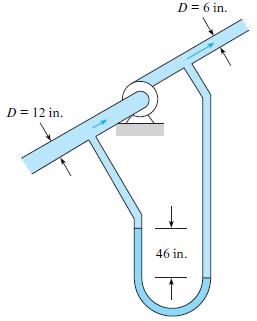
In the pump test shown, the rate of flow is 6 cfs of oil (SG = 0.88). Calculate the horsepower that the pump supplies to the oil if there is a differential reading of 46 in. of mercury in the U-tube manometer. Assume α = 1.0 at all locations. D = 6 in. D = 12 in. 46 in.
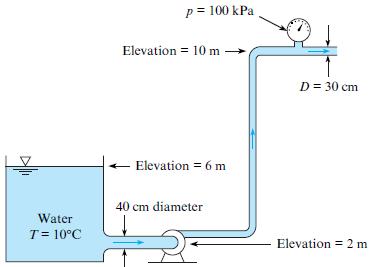
Water (10°C) is flowing at a rate of 0.35 m3/s, and it is assumed that hL = 2V2/2g from the reservoir to the gage, where V is the velocity in the 30 cm pipe. What power must the pump supply? Assume α = 1.0 at all locations. p = 100 kPa Elevation = 10 m - D= 30 cm - Elevation = 6 m 40 cm diameter
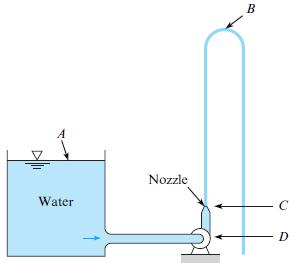
Neglecting head losses, determine what power the pump must deliver to produce the flow as shown. Here, the elevations at points A, B, C, and D are 40 m, 64 m, 35 m, and 30 m, respectively. The nozzle area is 11 cm2. B A Nozzle Water C D
Neglecting head losses, determine what horsepower the pump must deliver to produce the flow as shown. Here, the elevations at points A, B, C, and D are 124 ft, 161 ft, 110 ft, and 90 ft, respectively. The nozzle area is 0.10 ft2.
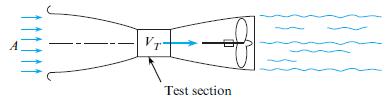
An engineer is designing a subsonic wind tunnel. The test section is to have a cross-sectional area of 4 m2 and an airspeed of 60 m/s. Th e air density is 1.2 kg/m3. The area of the tunnel exit is 10 m2. The head loss through the tunnel is given by hL = (0.025)(V2T /2g), where VT is the airspeed in
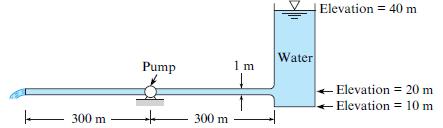
A water discharge of 8 m3/s is to flow through this horizontal pipe, which is 1 m in diameter. If the head loss is given as 7 V 2/2g (V is velocity in the pipe), how much power will have to be supplied to the flow by the pump to produce this discharge? Assume α = 1.0 at all locations. Elevation =
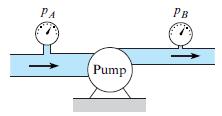
The pump shown in the figure supplies energy to the flow such that the upstream pressure (12 in. pipe) is 5 psi and the downstream pressure (6 in. pipe) is 59 psi when the flow of water is 7 cfs. What horsepower is delivered by the pump to the flow? Assume α = 1.0 at all locations. PB PA Pump
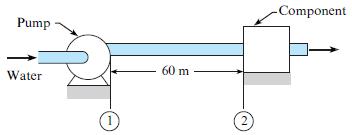
As shown, water at 15°C is flowing in a 15 cm diameter by 60 m long run of pipe that is situated horizontally. The mean velocity is 2 m/s, and the head loss is 2 m. Determine the pressure drop and the required pumping power to overcome head loss in the pipe. Component Pump 60 m Water 1 2
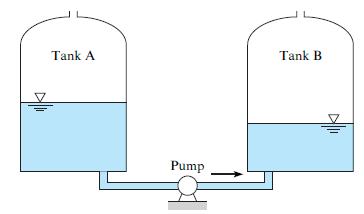
A pump is used to transfer SAE-30 oil from tank A to tank B as shown. The tanks have a diameter of 12 m. The initial depth of the oil in tank A is 20 m, and in tank B the depth is 1 m. The pump delivers a constant head of 60 m. The connecting pipe has a diameter of 20 cm, and the head loss due to
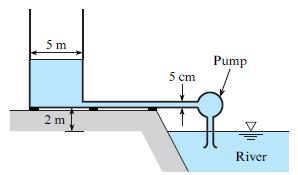
A pump is used to fill a tank 5 m in diameter from a river as shown. The water surface in the river is 2 m below the bottom of the tank. The pipe diameter is 5 cm, and the head loss in the pipe is given by hL = 10 V 2/2g, where V is the mean velocity in the pipe. The flow in the pipe is
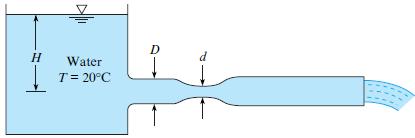
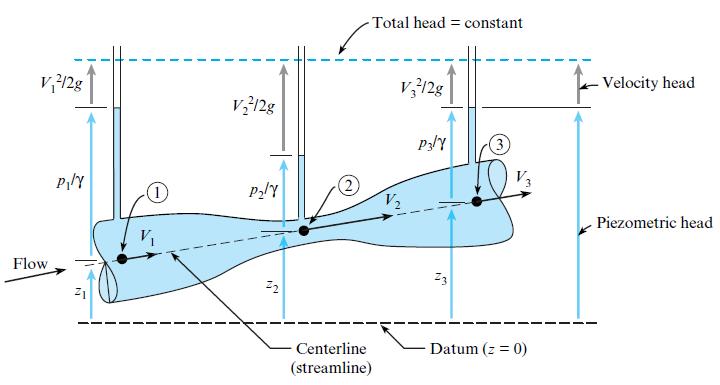
In this system, d = 15 cm, D = 35 cm, and the head loss from the venturi meter to the end of the pipe is given by hL = 1.5 V 2/2g, where V is the velocity in the pipe. Neglecting all other head losses, determine what head H will first initiate cavitation if the atmospheric pressure is 100 kPa
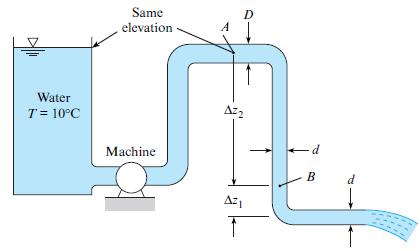
In this system, d = 6 in., D = 12 in., Δz1 = 6 ft , and Δz2 = 12 ft . The discharge of water in the system is 10 cfs. Is the machine a pump or a turbine? What are the pressures at points A and B? Neglect head losses. Assume α = 1.0 at all locations.D Same D elevation Water T= 10°C Az2 Machine d
For this system, point B is 10 m above the bottom of the upper reservoir. The head loss from A to B is 1.1V 2/2g, and the pipe area is 8 × 10⁻⁴ m2. Assume a constant discharge of 8 × 10⁻⁴ m3/s. For these conditions, what will be the depth of water in the upper reservoir for which cavitation
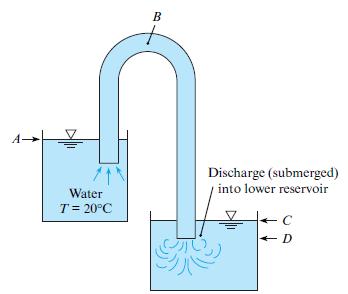
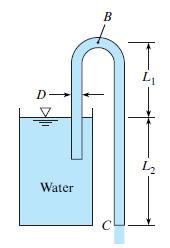
For this siphon the elevations at A, B, C, and D are 30 m, 32 m, 27 m, and 26 m, respectively. The head loss between the inlet and point B is three-quarters of the velocity head, and the head loss in the pipe itself between point B and the end of the pipe is one-quarter of the velocity head. For
The discharge in the siphon is 2.5 cfs, D = 7 in., L1 = 4 ft , and L2 = 5 ft. Determine the head loss between the reservoir surface and point C. Determine the pressure at point B if three quarters of the head loss (as found above) occurs between the reservoir surface and point B. Assume α = 1.0 at
The application of the Reynolds transport theorem to the first law of thermodynamics (select all that are correct)a. Refers to the increase of energy stored in a closed systemb. Extends the applicability of the first law from a closed system to an open system (control volume)c. Refers only to heat
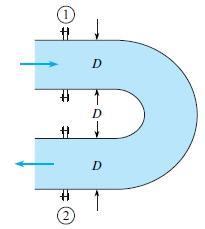
Solve Prob. 6.56, and answer the following questions:a. Do the two pressure forces from the inlet and exit act in the same direction, or in opposite directions?b. For the data given, which term has the larger magnitude (in N), the net pressure force term, or the net momentum flux term? D D D (2)
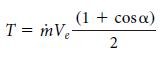
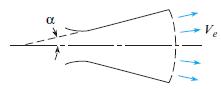
Th e expansion section of a rocket nozzle is often conical in shape, and because the flow diverges, the thrust derived from the nozzle is less than it would be if the exit velocity were everywhere parallel to the nozzle axis. By considering the flow through the spherical section suspended by the
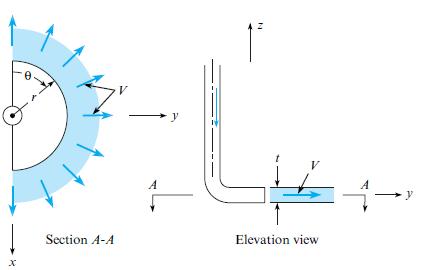
The semicircular nozzle sprays a sheet of liquid through 180° of arc as shown. The velocity is V at the efflux section where the sheet thickness is t. Derive a formula for the external force F (in the y-direction) required to hold the nozzle system in place. This force should be a function of ρ,
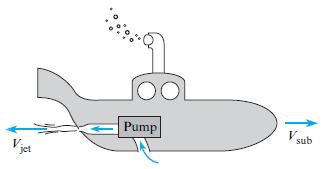
A design contest features a submarine that will travel at a steady speed of Vsub = 1 m/s in 15°C water. Th e sub is powered by a water jet. Th is jet is created by drawing water from an inlet of diameter 25 mm, passing this water through a pump and then accelerating the water through a nozzle of
For Example 6.2 in §6.4, the situation diagram shows concrete being “shot” at an angle into a cart that is tethered by a cable, and sitting on a scale. Determine whether the following two statements are true or false.a. Mass is being accumulated in the cart.b. Momentum is being accumulated in
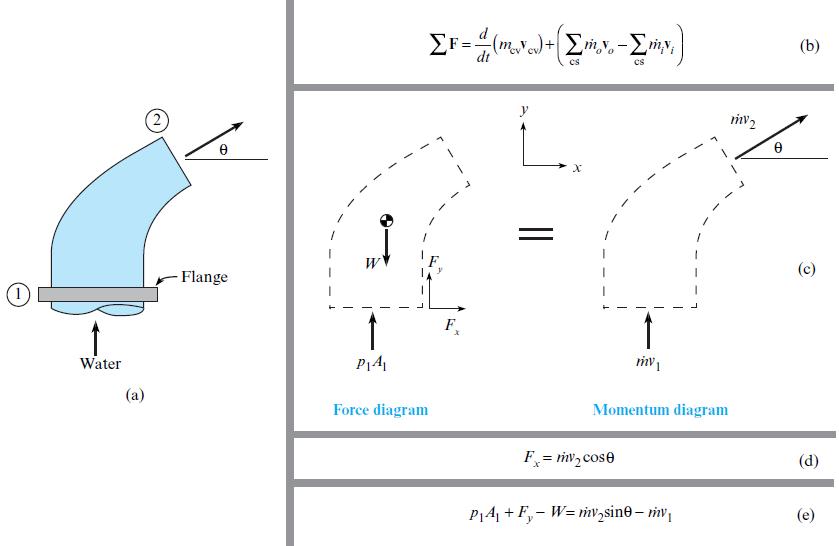
When making a force diagram (FD) and its partner momentum diagram (MD) to set up the equations for a momentum equation problem (see Fig. 6.10), which of the following elements should be in the FD and which should be in the MD? (Classify each of the following as either “FD” or “MD”.)a. Each
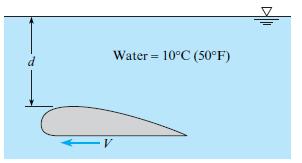
When the hydrofoil shown was tested, the minimum pressure on the surface of the foil was found to be 2.7 psi vacuum when the foil was submerged 3.1 ft. and towed at a speed of 20 ft /s. At the same depth, at what speed will cavitation first occur? Assume irrotational flow and T = 50°F. d Water =
Oxygen leaks slowly through a small orifice in an oxygen bottle. The volume of the bottle is 0.1 m3, and the diameter of the orifice is 0.12 mm. Th e temperature in the tank remains constant at 18°C, and the mass-flow rate is given by m· = 0.68 pA/√RT. How long will it take the absolute
A compressor supplies gas to a 8 m3 tank. The inlet mass flow rate is given by m· = 0.5 ρ0/ρ (kg/s), where ρ is the density in the tank and ρ0 is the initial density. Find the time it would take to increase the density in the tank by a factor of 2 if the initial density is 1.8 kg/m3. Assume
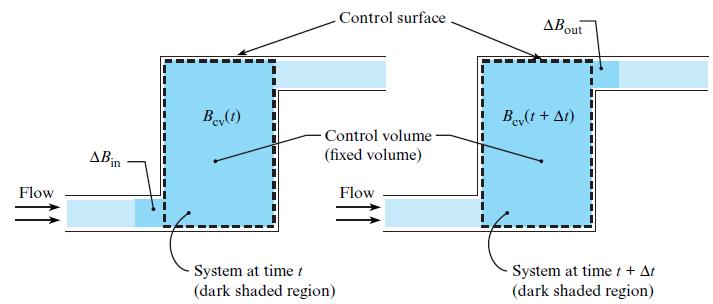
In Fig. 5.11, isa. The CV passing through the system?b. The system passing through the CV? Control surface ABout B1) B(t + At) -Control volume- ABin (fixed volume) Flow Flow System at time t (dark shaded region) System at time t + At (dark shaded region)
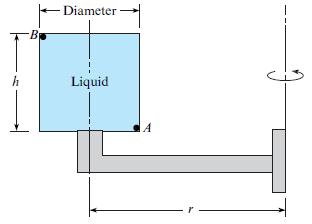
A tank of liquid (SG = 0.80) that is 1 ft in diameter and 1.0 ft high (h = 1.0 ft) is rigidly fixed (as shown) to a rotating arm having a 2 ft radius. The arm rotates such that the speed at point A is 20 ft/s. If the pressure at A is 25 psf, what is the pressure at B? Diameter B Liquid A
A fluid is flowing around a cylinder as shown in Fig. 4.37. A favorable pressure gradient can be found.Fig. 4.37.a. Upstream of the stagnation pointb. At the stagnation pointc. Between the stagnation point and separation point
When the Bernoulli Equation applies to a venture, such as in Fig. 4.27, which of the following are true? (Select all that apply.)a. If the velocity head and elevation head increase, then the pressure head must decrease.b. Pressure always decreases in the direction of flow along a streamline.c. The
Which of these assumptions and/or limitations must be known when using Eq. (3.33) for a submerged surface or panel to calculate the distance between the centroid of the panel and the center of pressure of the hydrostatic force (select all that apply):a. The equation only applies to a single fluid
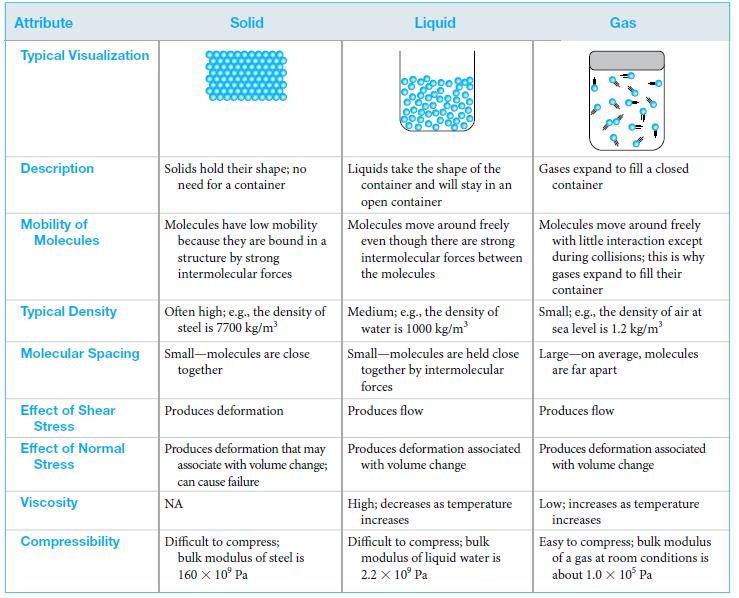
Propose three new rows for Table 1.1, and fill them in. Attribute Solid Liquid Gas Typical Visualization Solids hold their shape; no need for a container Liquids take the shape of the container and will stay in an Gases expand to fill a closed Description container open container Molecules have low
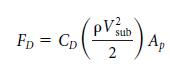
Using the first two sections in this chapter and using other resources, answer the questions that follow. Strive for depth, clarity, and accuracy. Also, strive for effective use of sketches, words, and equations. a. What are the four most important factors that influence the drag force?b. How
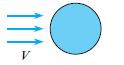
A sphere is immersed in a flowing fluid. The velocity V is doubled. Also, the sphere diameter D is doubled. Figure out how much the drag force increases. Only V and D are changed; all other relevant variables remain constant. The sphere is stationary. Choose the closest answer: (a)
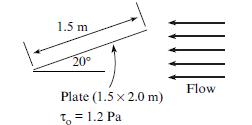
Flow over a rectangular plate produces an average wall shear stress of 1.2 pascals. Calculate the friction drag in units of N. The plate dimensions are 1.5 m by 2.0 m. The plate is inclined at 20 degrees with respect to the free stream. Choose the closest answer (N): (a) 3.4, (b)
Use information in §11.2 and 11.3 to find the coefficient of drag for each case described.a. A sphere is falling through water, and ReD = 10,000.b. Air is blowing normal to a very long circular cylinder, and ReD = 7,000.c. Wind is blowing normal to a billboard that is 20 ft wide by 10 ft high.
Determine whether the following statement is true or false:When an automobile moves through still air, the power to overcome fluid dynamic drag varies as the speed of the automobile cubed.
Water is flowing over a sphere. The Reynolds number based on sphere diameter is 20. The flow is steady. Calculate the coefficient of drag. Choose the closest answer: (a) 0.4 or less, (b) 0.6, (c) 0.8, (d) 1.0, or (e) 2 or greater.
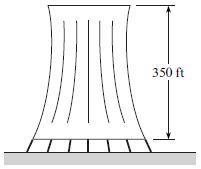
A cooling tower, used for cooling recirculating water in a modern steam power plant, is 350 ft high and 200 ft average diameter. Estimate the drag on the cooling tower in a 150 mph wind (T = 60°F). 350 ft
What is the moment at the bottom of a flagpole 20 m high and 20 cm in diameter in a 15 m/s wind? The atmospheric pressure is 100 kPa, and the temperature is 20°C.
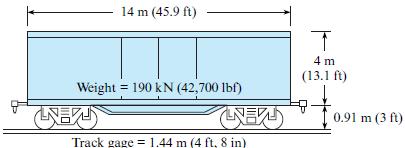
Windstorms sometimes blow empty boxcars off their tracks. The dimensions of one type of boxcar are shown. What minimum wind velocity normal to the side of the car would be required to blow the car over? Assume CD = 1.20. 14 m (45.9 ft) 4 m (13.1 ft) Weight = 190 kN (42,700 lbf) %3! で) 0.91 m (3
Estimate the wind force on a billboard 12 ft high and 36 ft wide when a 60 mph wind (T = 60°F) is blowing normal to it.
If Stokes’s law is considered valid below a Reynolds number of 0.5, what is the largest raindrop that will fall in accordance with Stokes’s law?
What drag is produced when a disk 0.75 m in diameter is submerged in water at 10°C and towed behind a boat at a speed of 4 m/s? Assume orientation of the disk so that maximum drag is produced.
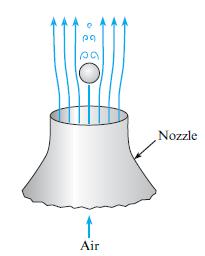
A Ping-Pong ball of mass 2.6 g and diameter 38 mm is supported by an air jet. The air is at a temperature of 18°C and a pressure of 27 in.-Hg. What is the minimum speed of the air jet? Nozzle Air
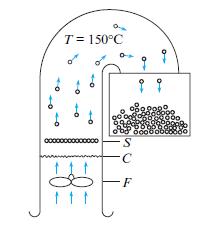
A semiautomatic popcorn popper is shown. After the unpopped corn is placed in screen S, the fan F blows air past the heating coils C and then past the popcorn. When the corn pops, its projected area increases; thus it is blown up and into a container. Unpopped corn has a mass of about 0.15 g per
How much power is required to move a spherical-shaped submarine of diameter 1.5 m through seawater at a speed of 10 knots? Assume the submarine is fully submerged.
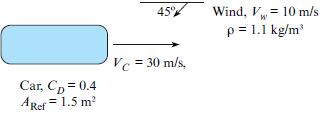
A car is driving into a headwind. Calculate the power (in kW) that is required to overcome drag. A car is traveling due east at a steady speed of 30 m/s. The coefficient of drag for the car is 0.4 and the reference area is 1.5 m2. The wind is coming from the northeast at a steady speed of 10 m/s.
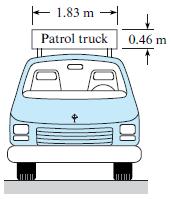
Estimate the additional power (in hp) required for the truck when it is carrying the rectangular sign at a speed of 30 m/s over that required when it is traveling at the same speed but is not carrying the sign. E 1.83 m Patrol truck 0.46 m
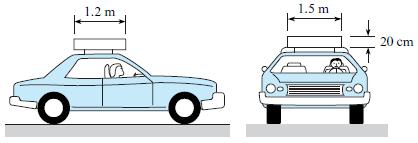
Estimate the added power (in hp) required for the car when the cartop carrier is used and the car is driven at 100 km/h in a 25 km/h headwind over that required when the carrier is not used in the same conditions. 1.5 m 1.2 m 20 cm
The resistance to motion of an automobile consists of rolling resistance and aerodynamic drag. The weight of an automobile is 3000 lbf, and it has a frontal area of 20 ft2. The drag coefficient is 0.30, and the coefficient of rolling friction is 0.02. Determine the percentage savings in gas mileage
A car coasts down a very long hill. The weight of the car is 2000 lbf, and the slope of the grade is 6%. The rolling friction coefficient is 0.01. The frontal area of the car is 18 ft2, and the drag coefficient is 0.29. The density of the air is 0.002 slugs/ft 3. Find the maximum coasting
An automobile with a mass of 1000 kg is driven up a hill where the slope is 3° (5.2% grade). The automobile is moving at 30 m/s. The coefficient of rolling friction is 0.02, the drag coefficient is 0.4, and the cross-sectional area is 4 m2. Find the power (in kW) needed for this condition. The air
A bicyclist is coasting down a hill with a slope of 4° into a headwind (measured with respect to the ground) of 7 m/s. The mass of the cyclist and bicycle is 80 kg, and the coefficient of rolling friction is 0.02. The drag coefficient is 0.5, and the projected area is 0.5 m2. The air density is
A bicyclist is capable of delivering 275 W of power to the wheels. How fast can the bicyclist travel in a 3 m/s headwind if his or her projected area is 0.5 m2, the drag coefficient is 0.3, and the air density is 1.2 kg/m3? Assume the rolling resistance is negligible.
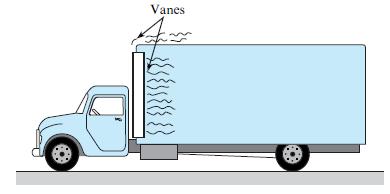
One way to reduce the drag of a blunt object is to install vanes to suppress the amount of separation. Such a procedure was used on model trucks in a wind tunnel study. For tests on a van-type truck without vanes the CD was 0.78. However, when vanes were installed around the top and side leading
Suppose you are designing an object to fall through seawater with a terminal velocity of exactly 1 m/s. What variables will have the most influence on the terminal velocity? List these variables and justify your decisions.
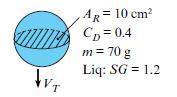
A sphere is falling in a liquid. Calculate the terminal velocity in units of m/s. The projected area (i.e., reference area) is 10 cm2. The coefficient of drag is 0.4. The mass of the sphere is 70 grams. The specific gravity of the liquid is 1.2. Choose the closest answer (m/s): (a)
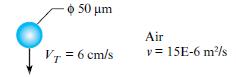
A grain of pollen is falling at terminal velocity. The fluid is air. Calculate the coefficient of drag. Idealize the pollen grain as a smooth sphere with a diameter of 50 microns. The terminal velocity is 6.0 cm/s. The air has a kinematic viscosity of 15.0 × 10⁶ m2/s. Choose the closest
Determine the terminal velocity in water (T = 10°C) of an 8-cm ball that weighs 15 N in air.
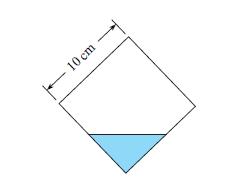
This cube is weighted so that it will fall with one edge down as shown. The cube weighs 22.2 N in air. What will be its terminal velocity in water? 10 cm
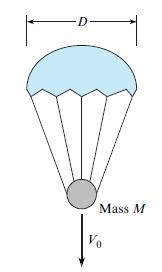
As shown, a 35 cm diameter emergency medicine parachute supporting a mass of 20 g is falling through air (20°C). Assume a coefficient of drag of CD = 2.2, and estimate the terminal velocity V0. Use a projected area of (πD2)/4. Mass M 0.
Consider a small air bubble (approximately 4 mm diameter) rising in a very tall column of liquid. Will the bubble accelerate or decelerate as it moves upward in the liquid? Will the drag of the bubble be largely skin friction or form drag? Explain.
A spherical rock weighs 30 N in air and 5 N in water. Estimate its terminal velocity as it falls in water (20°C).
A sphere 2 cm in diameter rises in oil at a velocity of 1.5 cm/s. What is the specific weight of the sphere if the oil density is 900 kg/m3 and the dynamic viscosity is 0.096 N∙s/m2?
Estimate the terminal velocity of a 1.5 mm plastic sphere in oil. The oil has a specific gravity of 0.95 and a kinematic viscosity of 10–4 m2/s. The plastic has a specific gravity of 1.07. The volume of a sphere is given by πD3/6.
What is the terminal velocity of a 0.5 cm hailstone in air that has an atmospheric pressure of 96 kPa absolute and a temperature of 0°C? Assume that the hailstone has a specific weight of 6 kN/m3.
A drag chute is used to decelerate an airplane after touchdown. The chute has a diameter of 12ft and is deployed when the aircraft is moving at 200 ft/s. The mass of the aircraft is 20,000 lbm, and the density of the air is 0.075 lbm/ft3. Find the initial deceleration of the aircraft due to the
If a balloon weighs 0.10 N (empty) and is inflated with helium to a diameter of 60 cm, what will be its terminal velocity in air (standard atmospheric conditions)? The helium is at a pressure of 1 atm and a temperature of 20°C.
A 2 cm plastic ball with a specific gravity of 1.2 is released from rest in water at 20°C. Find the time and distance needed to achieve 99% of the terminal velocity. Write out the equation of motion by equating the mass times acceleration to the buoyant force, weight, and drag force and solve by
Using §11.8 and other resources, answer the following questions. Strive for depth, clarity, and accuracy. Also, use effective sketches, words, and equations.a. What is circulation? Why is it important?b. What is lift force?c. What variables influence the magnitude of the lift force?
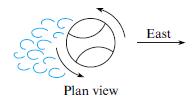
The baseball is thrown from west to east with a spin about its vertical axis as shown. Under these conditions it will “break” toward the (a) North,(b) South, or (c) Neither. East Plan view
A sphere of diameter 100 mm, rotating at a rate of 286 rpm, is situated in a stream of water (15°C) that has a velocity of 1.5 m/s. Determine the lift force (in newtons) on the rotating sphere.
A boat of the hydrofoil type has a lifting vane with an aspect ratio of 4 that has the characteristics shown in Fig. 11.24. If the angle of attack is 4° and the weight of the boat is 5 tons, what foil dimensions are needed to support the boat at a velocity of 60 fps?
One wing (wing A) is identical (same cross section) to another wing (wing B) except that wing B is twice as long as wing A. Then for a given wind speed past both wings and with the same angle of attack, one would expect the total lift of wing B to be (a) The same as that of wing A, (b)
What happens to the value of the induced drag coefficient for an aircraft that increases speed in level flight? (a) It increases,(b) It decreases, (c) It does not change.
The total drag coefficient for an airplane wing is CD = CD0 + C2L/πΛ, where CD0 is the form drag coefficient, CL is the lift coefficient and Λ is the aspect ratio of the wing. The power is given by P = FDV = 1/2 CDρV3S. For level flight the lift is equal to the weight, so W/S = 1/2ρCLV2, where
The landing speed of an airplane is 7 m/s faster than its stalling speed. The lift coefficient at landing speed is 1.2, and the maximum lift coefficient (stall condition) is 1.4. Calculate both the landing speed and the stalling speed.
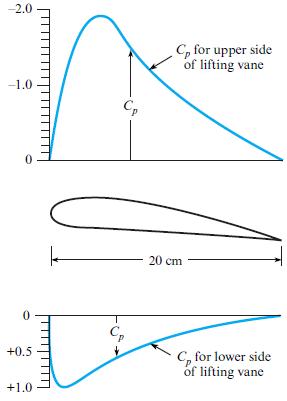
The figure shows the pressure distribution for a Göttingen 387-FB lifting vane (19) when the angle of attack is 8°. If such a vane with a 20 cm chord were used as a hydrofoil at a depth of 70 cm, at what speed in 10°C freshwater would cavitation begin? Also, estimate the lift per unit of length
A glider at 800 m altitude has a mass of 180 kg and a wing area of 20 m2. The glide angle is 1.7°, and the air density is 1.2 kg/m3. If the lift coefficient of the glider is 0.83, how many minutes will it take to reach sea level on a calm day?
The speed of sound in an ideal gas _______. Select all that are correct:a. Depends on √T where T is absolute temperatureb. Depends on √T where T is temperature in °Cc. Depends on √k, where k = cp/cv, a ratio of specific heats for a given gas
Make these calculations about the speed of sound in air. a. The speed of sound in air is 340 m/s. What is this speed in miles per hour?b. If it takes 4 seconds between seeing lightning and hearing the thunder, how far away (miles) is the storm (T = 50°F)?
The Mach number _______. (Select all that are correct).a. Is the ratio V/c, where c = specific heatb. Is the ratio V/c, where c = the speed of soundc. Depends on the velocity, V, of the fluid relative to the moving body.d. Has a magnitude of M < 1 for subsonic flowe. Has a magnitude of M > 1
How fast (in meters per second) will a sound wave travel in methane at −5°C?
Calculate the speed of sound in helium at 45°C.
Calculate the speed of sound in hydrogen at 38°F.
How much faster will a sound wave propagate in helium than in nitrogen if the temperature of both gases is 20°C?
A supersonic aircraft is flying at Mach 1.6 through air at 30°C. What temperature could be expected on exposed aircraft surfaces?
What is the temperature on the nose of a supersonic fighter flying at Mach 3 through air at −20°C?
A high-performance aircraft is flying at a Mach number of 1.8 at an altitude of 10,000 m, where the temperature is −44°C and the pressure is 30.5 kPa.a. How fast is the aircraft traveling in kilometers per hour?b. The total temperature is an estimate of surface temperature on the aircraft . What
An airplane travels at 850 km/h at sea level where the temperature is 10°C. How fast would the airplane be flying at the same Mach number at an altitude where the temperature was −50°C?
An airplane flies at a Mach number of 0.95 at a 10,000 m altitude, where the static temperature is −44°C and the pressure is 30 kPa absolute. The lift coefficient of the wing is 0.05. Determine the wing loading (lift force/wing area).
An airflow at M = 0.85 passes through a conduit with a cross-sectional area of 60 cm2. The total absolute pressure is 360 kPa, and the total temperature is 10°C. Calculate the mass flow rate through the conduit.
Oxygen flows from a reservoir in which the temperature is 200°C and the pressure is 300 kPa absolute. Assuming isentropic flow, calculate the velocity, pressure, and temperature when the Mach number is 0.9.
Hydrogen flows from a reservoir where the temperature is 20°C and the pressure is 500 kPa absolute to a duct 2 cm in diameter where the velocity is 250 m/s. Assuming isentropic flow, calculate the temperature, pressure, Mach number, and mass flow rate at the 2 cm section.
The total pressure in a Mach-2.5 wind tunnel operating with air is 547 kPa absolute. A sphere 3 cm in diameter, positioned in the wind tunnel, has a drag coefficient of 0.95. Calculate the drag of the sphere.
Which of the following statements are true?a. Shock waves only occur in supersonic flows.b. The static pressure increases across a normal shock wave.c. The Mach number downstream of a normal shock wave can be supersonic.
Showing 1600 - 1700
of 2369
First
10
11
12
13
14
15
16
17
18
19
20
21
22
23
24
Step by Step Answers

 Get 50% OFF
Claim Now
Get 50% OFF
Claim Now