New Semester
Started
Get
50% OFF
Study Help!
--h --m --s
Claim Now
Question Answers
Textbooks
Find textbooks, questions and answers
Oops, something went wrong!
Change your search query and then try again
S
Books
FREE
Study Help
Expert Questions
Accounting
General Management
Mathematics
Finance
Organizational Behaviour
Law
Physics
Operating System
Management Leadership
Sociology
Programming
Marketing
Database
Computer Network
Economics
Textbooks Solutions
Accounting
Managerial Accounting
Management Leadership
Cost Accounting
Statistics
Business Law
Corporate Finance
Finance
Economics
Auditing
Tutors
Online Tutors
Find a Tutor
Hire a Tutor
Become a Tutor
AI Tutor
AI Study Planner
NEW
Sell Books
Search
Search
Sign In
Register
study help
engineering
engineering fluid mechanics
Munson Young And Okiishi's Fundamentals Of Fluid Mechanics 8th Edition Philip M. Gerhart, Andrew L. Gerhart, John I. Hochstein - Solutions
Someone siphoned \(15 \mathrm{gal}\) of gasoline from a gas tank in the middle of the night. The gas tank measures 12 in. wide \(\times 24\) in. long \(\times 18\) in. high and was full when the thief started. If the siphoning tube has an inside diameter of \(\frac{1}{2}\) in., find the minimum
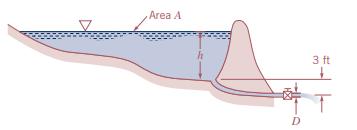
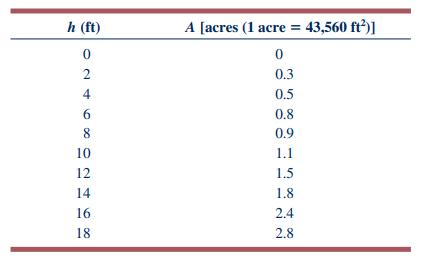
The surface area, \(A\), of the pond shown in Fig. P3. 108 varies with the water depth, \(h\), as shown in the table. At time \(t=0\) a valve is opened and the pond is allowed to drain through a pipe of diameter \(D\). If viscous effects are negligible and quasisteady conditions are assumed, plot
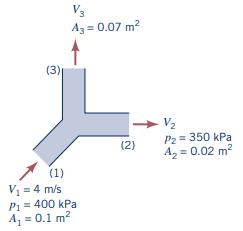
Water flows through a horizontal branching pipe as shown in Fig. P3.109. Determine the pressure at section (3).Figure P3.109 (3) V3 A = 0.07 m (1) V = 4 m/s P = 400 kPa A = 0.1 m (2) V2 P2=350 kPa A = 0.02 m
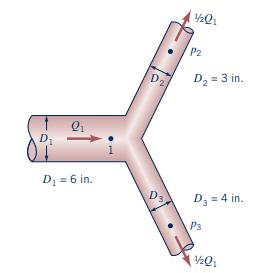
The "wye" fitting shown in Fig. P.3.110 lies in a horizontal plane. The fitting splits the inlet flow into two equal parts. At section 1 , the water velocity is \(12 \mathrm{ft} / \mathrm{sec}\) and the pressure is \(20 \mathrm{psig}\). Calculate the water pressure at sections 2 and 3 . Assume
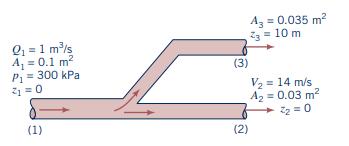
Water flows through the branching pipe shown in Fig. P3.111. If viscous effects are negligible, determine the pressure at section (2) and the pressure at section (3).Figure P3.111 Q = 1 m/s A = 0.1 m P = 300 kPa 3 =0 (1) (3) A3 = 0.035 m 3=10 m V = 14 m/s A = 0.03 m 2=0 (2)
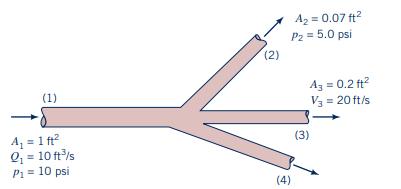
Water flows through the horizontal branching pipe shown in Fig. P3.112 at a rate of \(10 \mathrm{ft}^{3} / \mathrm{s}\). If viscous effects are negligible, determine the water speed at section (2), the pressure at section (3), and the flowrate at section (4).Figure P3.112 (1) (2) A = 0.07 ft P =
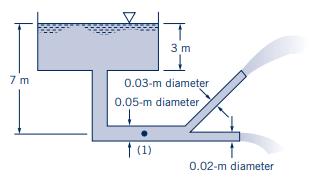
Water flows from a large tank through a large pipe that splits into two smaller pipes as shown in Fig. P3.113. If viscous effects are negligible, determine the flowrate from the tank and the pressure at point (1).Figure P3.113 7 m 3 m 0.03-m diameter 0.05-m diameter (1) 0.02-m diameter
A gutter running along the side of a house is 6 in. wide and \(40 \mathrm{ft}\) long. During a hard downpour, water is \(1 \mathrm{in}\). deep in the gutter. The gutter has only one downspout, and it is 3 in. in diameter. What is the velocity of the water entering the downspout? The pressure at the
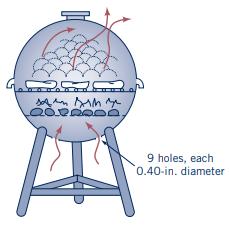
Air, assumed incompressible and inviscid, flows into the outdoor cooking grill through nine holes of 0.40-in. diameter as shown in Fig. P3.115. If a flowrate of \(40 \mathrm{in.}{ }^{3} / \mathrm{s}\) into the grill is required to maintain the correct cooking conditions, determine the pressure
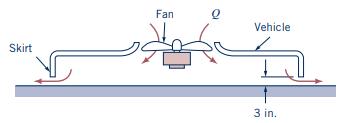
An air cushion vehicle is supported by forcing air into the chamber created by a skirt around the periphery of the vehicle as shown in Fig. P3.116. The air escapes through the 3-in. clearance between the lower end of the skirt and the ground (or water). Assume the vehicle weighs \(10,000
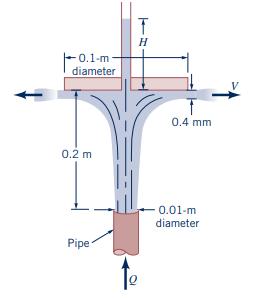
Water flows from the pipe shown in Fig. P3.117 as a free jet and strikes a circular flat plate. The flow geometry shown is axisymmetrical. Determine the flowrate and the manometer reading, \(H\).Figure P3.117 -0.1-m diameter T H 0.2 m Pipe 0.4 mm 0.01-m diameter
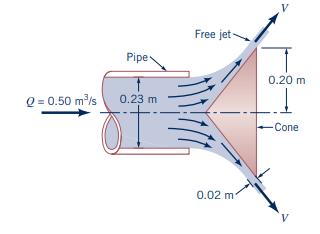
A conical plug is used to regulate the airflow from the pipe shown in Fig. P3.118. The air leaves the edge of the cone with a uniform thickness of \(0.02 \mathrm{~m}\). If viscous effects are negligible and the flowrate is \(0.50 \mathrm{~m}^{3} / \mathrm{s}\), determine the pressure within the
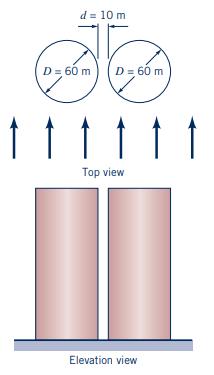
Figure P3.119 shows two tall towers. Air at \(10{ }^{\circ} \mathrm{C}\) is blowing toward the two towers at \(V_{0}=30 \mathrm{~km} / \mathrm{hr}\). If the two towers are \(10 \mathrm{~m}\) apart and half the air flow approaching the two towers passes between them, find the minimum air pressure
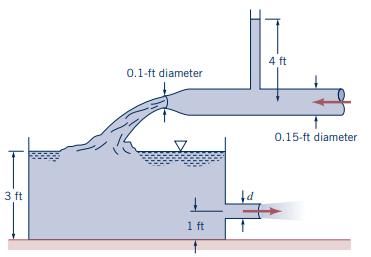
Water flows steadily from a nozzle into a large tank as shown in Fig. P3.120. The water then flows from the tank as a jet of diameter \(d\). Determine the value of \(d\) if the water level in the tank remains constant. Viscous effects are negligible.Figure P3.120 4 ft 0.1-ft diameter 3 ft 1 ft t
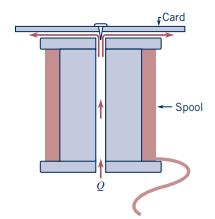
A small card is placed on top of a spool as shown in Fig. P3.121. It is not possible to blow the card off the spool by blowing air through the hole in the center of the spool. The harder one blows, the harder the card "sticks" to the spool. In fact by blowing hard enough it is possible to keep the
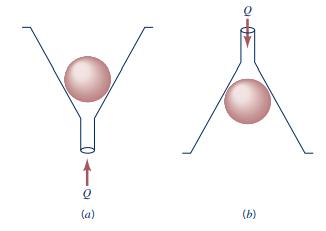
Observations show that it is not possible to blow the table tennis ball from the funnel shown in Fig. P3.122a. In fact, the ball can be kept in an inverted funnel, Fig. P3.122b, by blowing through it. The harder one blows through the funnel, the harder the ball is held within the funnel. Try this
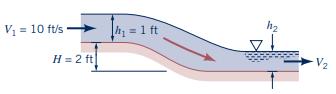
Water flows down the sloping ramp shown in Fig. P3.123 with negligible viscous effects. The flow is uniform at sections (1) and (2). For the conditions given show that three solutions for the downstream depth, \(h_{2}\), are obtained by use of the Bernoulli and continuity equations. However, show
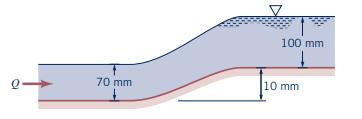
Water flows in a rectangular channel that is \(2.0 \mathrm{~m}\) wide as shown in Fig. P3.124. The upstream depth is \(70 \mathrm{~mm}\). The water surface rises \(40 \mathrm{~mm}\) as it passes over a portion where the channel bottom rises \(10 \mathrm{~mm}\). If viscous effects are negligible,
A Venturi meter with a minimum diameter of 3 in. is to be used to measure the flowrate of water through a 4 -in.-diameter pipe. Determine the pressure difference indicated by the pressure gage attached to the flowmeter if the flowrate is \(0.5 \mathrm{ft}^{3} / \mathrm{s}\) and viscous effects are
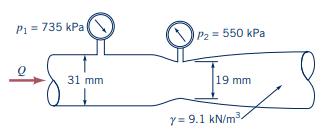
Determine the flowrate through the Venturi meter shown in Fig. P3.127 if ideal conditions exist.Figure P3.127 P = 735 kPa Q + 735 APU 31 mm P = 550 kPa 19 mm y=9.1 kN/m
For what flowrate through the Venturi meter of Problem 3.127 will cavitation begin if \(p_{1}=275 \mathrm{kPa}\) gage, atmospheric pressure is \(101 \mathrm{kPa}\) (abs), and the vapor pressure is \(3.6 \mathrm{kPa}\) (abs)?Problem 3.127Determine the flowrate through the Venturi meter shown in Fig.
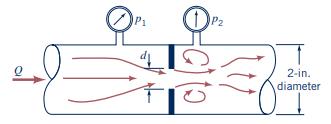
What diameter orifice hole, \(d\), is needed if under ideal conditions the flowrate through the orifice meter of Fig. P3.129 is to be \(30 \mathrm{gal} / \mathrm{min}\) of seawater with \(p_{1}-p_{2}=2.37 \mathrm{lb} / \mathrm{in}\). \(^{2}\) ? The contraction coefficient is assumed to be
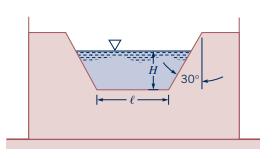
A weir of trapezoidal cross section is used to measure the flowrate in a channel as shown in Fig. P3.130. If the flowrate is \(Q_{0}\) when \(H=\ell / 2\), what flowrate is expected when \(H=\ell\) ?Figure P3.130 T H 30
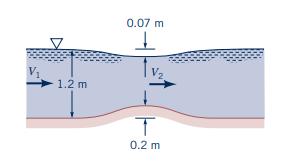
The flowrate in a water channel is sometimes determined by use of a device called a Venturi flume. As shown in Fig. P3.131, this device consists simply of a bump on the bottom of the channel. If the water surface dips a distance of \(0.07 \mathrm{~m}\) for the conditions shown, what is the flowrate
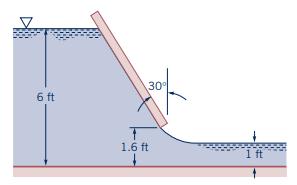
Water flows under the inclined sluice gate shown in Fig. P3.132. Determine the flowrate if the gate is \(8 \mathrm{ft}\) wide.Figure P3.132 6 ft 30 1.6 ft 1 ft
Water flows in a vertical pipe of \(0.15-\mathrm{m}\) diameter at a rate of \(0.2 \mathrm{~m}^{3} / \mathrm{s}\) and a pressure of \(200 \mathrm{kPa}\) at an elevation of \(25 \mathrm{~m}\). Determine the velocity head and pressure head at elevations of 20 and \(55 \mathrm{~m}\).
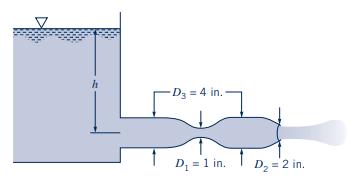
Draw the energy line and the hydraulic grade line for the flow of Problem 3.90.Problem 3.90Water flows from a large tank as shown in Fig. P3.90. Atmospheric pressure is \(14.5 \mathrm{psia}\), and the vapor pressure is 1.60 psia. If viscous effects are neglected, at what height, \(h\), will
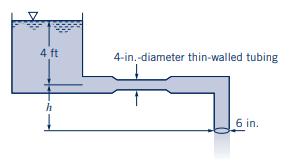
Draw the energy line and hydraulic grade line for the flow shown in Problem 3.77.Problem 3.77Water flows steadily with negligible viscous effects through the pipe shown in Fig. P3.77. It is known that the 4-in.-diameter section of thin-walled tubing will collapse if the pressure within it becomes
Obtain a photograph/image of a flow in which it would not be appropriate to use the Bernoulli equation. Print this photo and write a brief paragraph that describes the situation involved. Bernoulli equation p+pv + z = constant along streamline
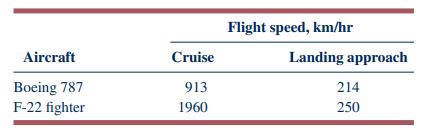
The following table lists typical flight speeds for two aircraft. For which of these conditions would it be reasonable to use the incompressible Bernoulli equation to study the aerodynamics associated with their flight? Explain. Aircraft Cruise Boeing 787 F-22 fighter 913 1960 Flight speed, km/hr
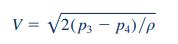
A meteorologist uses a Pitot-static tube to measure the wind speed in a tornado. Based on the damage caused by the storm, the tornado is rated as EF5 on the Enhanced Fujita Scale. This means that the wind speed is estimated to be in the range of 261 to 318 \(\mathrm{mph}\). Is it reasonable to use
Natural gas (methane) flows from a 3-in.-diameter gas main, through a 1-in.-diameter pipe, and into the burner of a furnace at a rate of \(100 \mathrm{ft}^{3} /\) hour. Determine the pressure in the gas main if the pressure in the 1-in. pipe is to be \(6 \mathrm{in}\). of water greater than
Calculate the Reynolds numbers for the flow of water and for air through a 4-mm-diameter tube, if the mean velocity is \(3 \mathrm{~m} / \mathrm{s}\) and the temperature is \(30^{\circ} \mathrm{C}\) in both cases (see Example 1.4). Assume the air is at standard atmospheric pressure.Example 1.4A
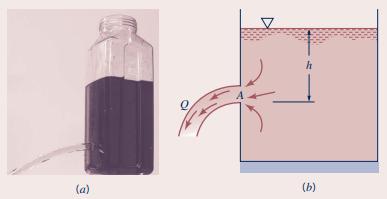
SAE 30 oil at \(60^{\circ} \mathrm{F}\) flows through a 2-in.-diameter pipe with a mean velocity of \(5 \mathrm{ft} / \mathrm{s}\). Determine the value of the Reynolds number (see Example 1.4).Example 1.4A liquid flows through an orifice located in the side of a tank as shown in Fig. E1.1. A
There are many fluids that exhibit non-Newtonian behavior. For a given fluid the distinction between Newtonian and non-Newtonian behavior is usually based on measurements of shear stress and rate of shearing strain. Assume that the viscosity of blood is to be determined by measurements of shear
Obtain a photograph/image of a situation in which the fact that in a static fluid the pressure increases with depth is important. Print this photo and write a brief paragraph that describes the situation involved.
The deepest known spot in the oceans is the Challenger Deep in the Mariana Trench of the Pacific Ocean and is approximately \(11,000 \mathrm{~m}\) below the surface. Assume that the salt water density is constant at \(1025 \mathrm{~kg} / \mathrm{m}^{3}\) and determine the pressure at this depth.
A closed tank is partially filled with glycerin. If the air pressure in the tank is \(6 \mathrm{lb} / \mathrm{in} .^{2}\) and the depth of glycerin is \(10 \mathrm{ft}\), what is the pressure in \(\mathrm{lb} / \mathrm{ft}^{2}\) at the bottom of the tank?
A 3-m-diameter vertical cylindrical tank is filled with water to a depth of \(11 \mathrm{~m}\). The rest of the tank is filled with air at atmospheric pressure. What is the absolute pressure at the bottom of the tank?
Blood pressure is usually given as a ratio of the maximum pressure (systolic pressure) to the minimum pressure (diastolic pressure). As shown in Video V2.3, such pressures are commonly measured with a mercury manometer. A typical value for this ratio for a human would be 120/70, where the pressures
An unknown immiscible liquid seeps into the bottom of an open oil tank. Some measurements indicate that the depth of the unknown liquid is \(1.5 \mathrm{~m}\) and the depth of the oil (specific weight \(=8.5 \mathrm{kN} / \mathrm{m}^{3}\) ) floating on top is \(5.0 \mathrm{~m}\). A pressure gage
A 30-ft-high downspout of a house is clogged at the bottom. Find the pressure at the bottom if the downspout is filled with \(60^{\circ} \mathrm{F}\) rainwater.
How high a column of SAE 30 oil would be required to give the same pressure as \(700 \mathrm{~mm} \mathrm{Hg}\) ?
Bathyscaphes are capable of submerging to great depths in the ocean. What is the pressure at a depth of \(5 \mathrm{~km}\), assuming that seawater has a constant specific weight of \(10.1 \mathrm{kN} / \mathrm{m}^{3}\) ? Express your answer in pascals and psi.
The deepest known spot in the oceans is the Challenger Deep in the Mariana Trench of the Pacific Ocean and is approximately \(11,000 \mathrm{~m}\) below the surface. For a surface density of \(1030 \mathrm{~kg} / \mathrm{m}^{3}\), a constant water temperature, and an isothermal bulk modulus of
A submarine submerges by admitting seawater \((S=1.03)\) into its ballast tanks. The amount of water admitted is controlled by air pressure, because seawater will cease to flow into the tank when the internal pressure (at the hull penetration) is equal to the hydrostatic pressure at the depth of
Determine the pressure at the bottom of an open 5-m-deep tank in which a chemical process is taking place that causes the density of the liquid in the tank to vary as\[ ho=ho_{\text {surf }} \sqrt{1+\sin ^{2}\left(\frac{h}{h_{\mathrm{bot}}} \frac{\pi}{2}\right)} \]where \(h\) is the distance from
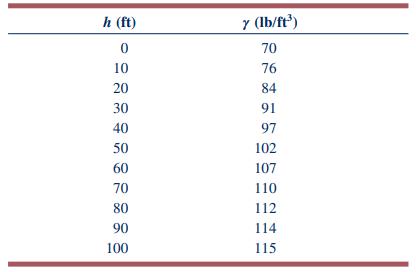
In a certain liquid at rest, measurements of the specific weight at various depths show the following variation:The depth \(h=0\) corresponds to a free surface at atmospheric pressure. Determine, through numerical integration of Eq. 2.4, the corresponding variation in pressure and show the results
Because of elevation differences, the water pressure in the second floor of your house is lower than it is in the first floor. For tall buildings this pressure difference can become unacceptable. Discuss possible ways to design the water distribution system in very tall buildings so that the
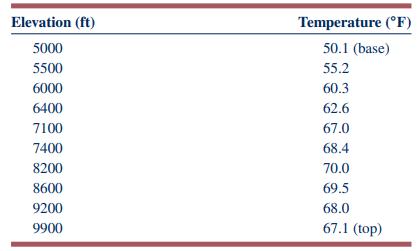
Under normal conditions the temperature of the atmosphere decreases with increasing elevation. In some situations, however, a temperature inversion may exist so that the air temperature increases with elevation. A series of temperature probes on a mountain give the elevation-temperature data shown
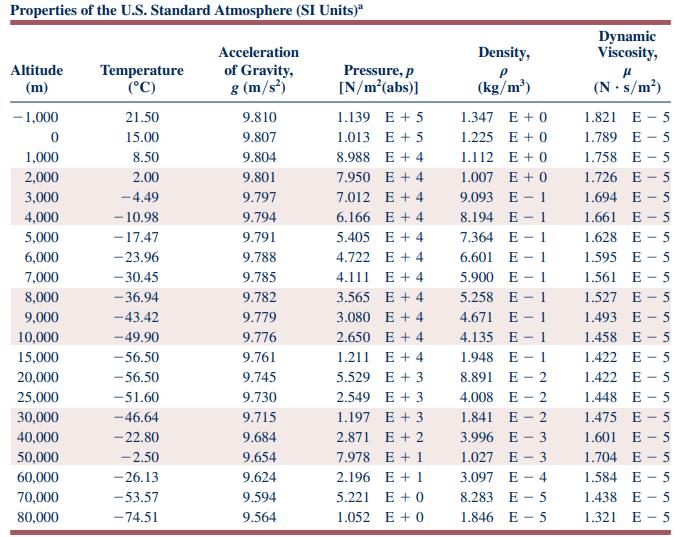
Equation 2.12 provides the relationship between pressure and elevation in the atmosphere for those regions in which the temperature varies linearly with elevation. Derive this equation and verify the value of the pressure given in Table C. 2 in Appendix C for an elevation of \(5
Often young children drink milk \(\left(ho=1030 \mathrm{~kg} / \mathrm{m}^{3}\right)\) through a straw. Determine the maximum length of a vertical straw that a child can use to empty a milk container, assuming that the child can develop \(75 \mathrm{~mm} \mathrm{Hg}\) of suction, and use this
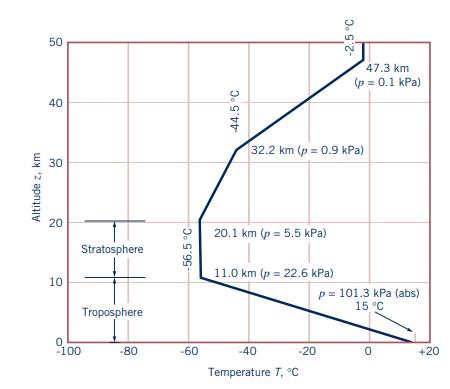
As shown in Fig. 2.6 for the U.S. standard atmosphere, the troposphere extends to an altitude of \(11 \mathrm{~km}\) where the pressure is \(22.6 \mathrm{kPa}\) (abs). In the next layer, called the stratosphere, the temperature remains constant at \(-56.5^{\circ} \mathrm{C}\). Determine the
Pikes Peak near Denver, Colorado, has an elevation of \(14,110 \mathrm{ft}\).(a) Determine the pressure at this elevation, based on Eq. 2.12.(b) If the air is assumed to have a constant specific weight of \(0.07647 \mathrm{lb} / \mathrm{ft}^{3}\), what would the pressure be at this altitude?(c) If
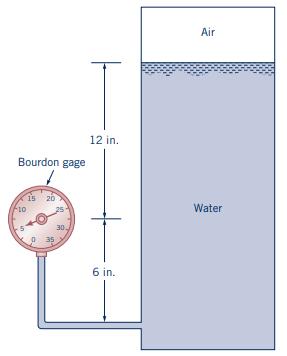
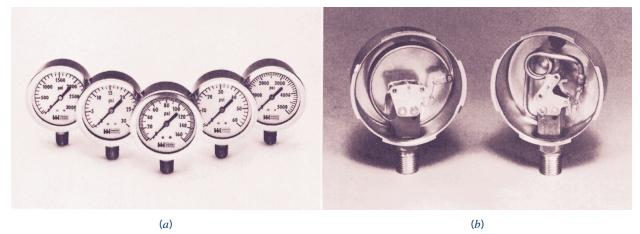
Bourdon gages see Fig. 2.13 are commonly used to measure pressure. When such a gage is attached to the closed water tank of Fig. P2.27 the gage reads 5 psi. What is the absolute air pressure in the tank? Assume standard atmospheric pressure of \(14.7 \mathrm{psi}\).Figure P2.27Fig. 2.13 Bourdon
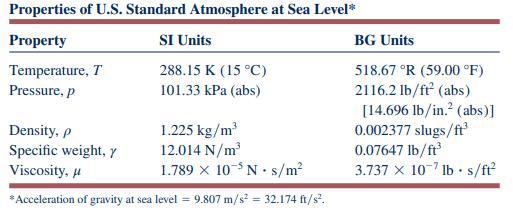
Denver, Colorado, is called the "mile-high city" because its state capitol stands on land \(1 \mathrm{mi}\) above sea level. Assuming that the Standard Atmosphere exists, what is the pressure and temperature of the air in Denver? The temperature follows the lapse rate ( \(T=\) \(T_{0}-B z\) ).
Assume that a person skiing high in the mountains at an altitude of \(15,000 \mathrm{ft}\) takes in the same volume of air with each breath as she does while walking at sea level. Determine the ratio of the mass of oxygen inhaled for each breath at this high altitude compared to that at sea level.
On a given day, a barometer at the base of the Washington Monument reads 29.97 in. of mercury. What would the barometer reading be when you carry it up to the observation deck \(500 \mathrm{ft}\) above the base of the monument?
A Bourdon pressure gage attached to the outside of a tank containing air reads \(77.0 \mathrm{psi}\) when the local atmospheric pressure is \(760 \mathrm{~mm} \mathrm{Hg}\). What will be the gage reading if the atmospheric pressure increases to \(773 \mathrm{~mm} \mathrm{Hg}\) ?
Aneroid barometers can be used to measure changes in altitude. If a barometer reads \(30.1 \mathrm{in}\). \(\mathrm{Hg}\) at one elevation, what has been the change in altitude in meters when the barometer reading is 28.3 in. \(\mathrm{Hg}\) ? Assume a standard atmosphere and that Eq. 2.12 is
A U-tube manometer is used to check the pressure of natural gas entering a furnace. One side of the manometer is connected to the gas inlet line, and the water level in the other side open to atmospheric pressure rises \(3 \mathrm{in}\). What is the gage pressure of the natural gas in the inlet
The Wide World of Fluids article titled "Weather, barometers, and bars,". The record low sea-level barometric pressure ever recorded is 25.8 in. of mercury. At what altitude in the standard atmosphere is the pressure equal to this value?
On the suction side of a pump, a Bourdon pressure gage reads \(40 \mathrm{kPa}\) vacuum. What is the corresponding absolute pressure if the local atmospheric pressure is \(100 \mathrm{kPa}\) (abs)?
Obtain a photograph/image of a situation in which the use of a manometer is important. Print this photo and write a brief paragraph that describes the situation involved.
For an atmospheric pressure of \(101 \mathrm{kPa}\) (abs) determine the heights of the fluid columns in barometers containing one of the following liquids:(a) mercury,(b) water, (c) ethyl alcohol. Calculate the heights including the effect of vapor pressure and compare the results with those
A barometric pressure of \(29.4 \mathrm{in}\). \(\mathrm{Hg}\) corresponds to what value of atmospheric pressure in psia, and in pascals?
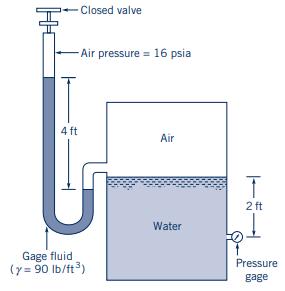
A U-tube manometer is connected to a closed tank containing air and water as shown in Fig. P2.37. At the closed end of the manometer the air pressure is 16 psia. Determine the reading on the pressure gage for a differential reading of \(4 \mathrm{ft}\) on the manometer. Express your answer in psi
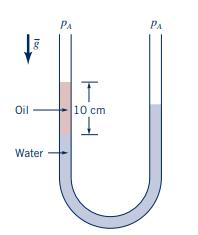
The U-tube manometer shown in Fig. P2.36 has two fluids, water and oil \((S=0.80)\). Find the height difference between the free water surface and the free oil surface with no applied pressure difference.Fig. P2.36 100 PA PA Oil- Water T 10 cm I
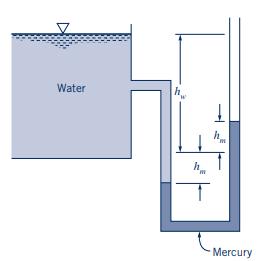
A mercury manometer is connected to a large reservoir of water as shown in Fig. P2.35. Determine the ratio, \(h_{w} / h_{m}\), of the distances \(h_{w}\) and \(h_{m}\) indicated in the figure.Figure P2. 35 Water h h h Mercury
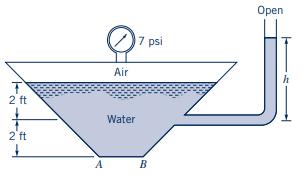
The closed tank of Fig. P. 2.34 is filled with water and is \(5 \mathrm{ft}\) long. The pressure gage on the tank reads 7 psi. Determine:(a) the height, \(h\), in the open water column,(b) the gage pressure acting on the bottom tank surface \(A B\), and(c) the absolute pressure of the air in the
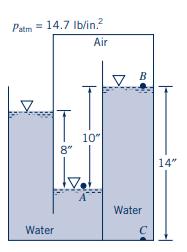
The container shown in Fig. P2.38 holds \(60^{\circ} \mathrm{F}\) water and \(60^{\circ} \mathrm{F}\) air as shown. Find the absolute pressures at locations \(A, B\), and \(C\).Figure P2.38 Patm = 14.7 lb/in Air Water 8" 10" Water C 14"
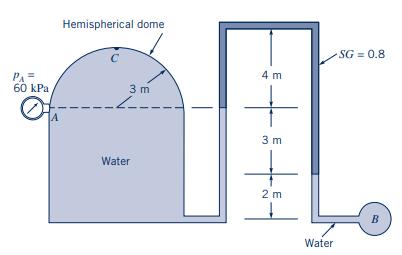
A closed cylindrical tank filled with water has a hemispherical dome and is connected to an inverted piping system as shown in Fig. P2.39. The liquid in the top part of the piping system has a specific gravity of 0.8, and the remaining parts of the system are filled with water. If the pressure gage
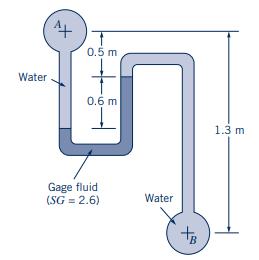
Two pipes are connected by a manometer as shown in Fig. P2.40. Determine the pressure difference, \(p_{\mathrm{A}}-p_{\mathrm{B}}\), between the pipes.Figure P2.40 Water A+ 0.5 m 0.6 m Gage fluid (SG= 2.6) Water +B 1.3 m
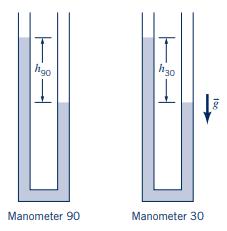
Find the percentage difference in the readings of the two identical U-tube manometers shown in Fig. P2.41. Manometer 90 uses \(90{ }^{\circ} \mathrm{C}\) water and manometer 30 uses \(30^{\circ} \mathrm{C}\) water. Both have the same applied pressure difference. Does this percentage change with the
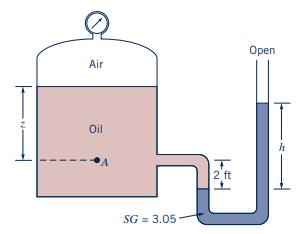
A U-tube manometer is connected to a closed tank as shown in Fig. P2.42. The air pressure in the tank is \(0.50 \mathrm{psi}\) and the liquid in the tank is oil \(\left(\gamma=54.0 \mathrm{lb} / \mathrm{ft}^{3}\right)\). The pressure at point \(A\) is \(2.00 \mathrm{psi}\). Determine:(a) the depth
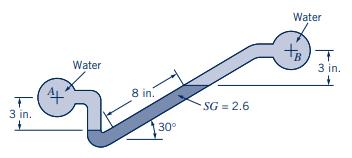
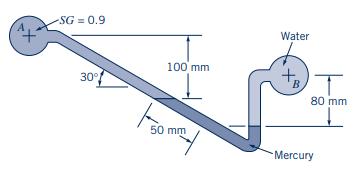
For the inclined-tube manometer of Fig. P2.43, the pressure in pipe \(A\) is 0.6 psi. The fluid in both pipes \(A\) and \(B\) is water, and the gage fluid in the manometer has a specific gravity of 2.6. What is the pressure in pipe \(B\) corresponding to the differential reading shown?Figure P2.43
A flowrate measuring device is installed in a horizontal pipe through which water is flowing. A U-tube manometer is connected to the pipe through pressure taps located 3 in. on either side of the device. The gage fluid in the manometer has a specific weight of \(112 \mathrm{lb} / \mathrm{ft}^{3}\).
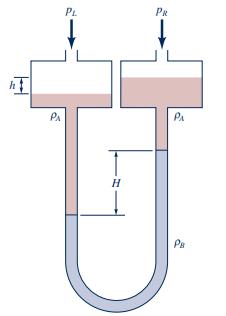
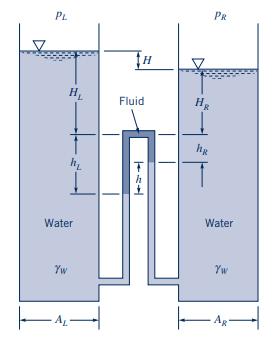
The sensitivity Sen of the micromanometer shown in Fig. P2.45 is defined as\[ S e n=\frac{H}{p_{L}-p_{R}} \]Find the sensitivity of the micromanometer in terms of the densities \(ho_{A}\) and \(ho_{B}\). How can the sensitivity be increased?Figure P2. 45 PA PL H PR PA PB
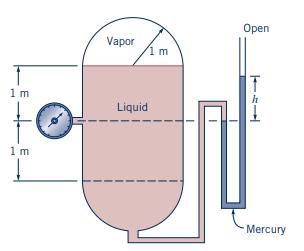
The cylindrical tank with hemispherical ends shown in Fig. P2.46 contains a volatile liquid and its vapor. The liquid density is \(800 \mathrm{~kg} / \mathrm{m}^{3}\), and its vapor density is negligible. The pressure in the vapor is \(120 \mathrm{kPa}\) (abs) and the atmospheric pressure is \(101
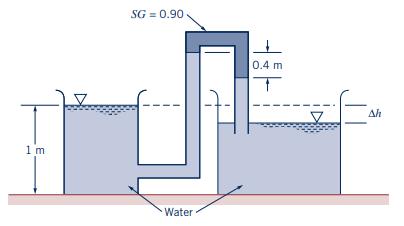
Determine the elevation difference, \(\Delta h\), between the water levels in the two open tanks shown in Fig. P2.47.Figure P2.47 1 m SG = 0.90 Water 0.4 m T
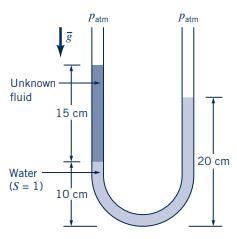
What is the specific gravity of the liquid in the left leg of the U-tube manometer shown in Fig. P2.48?Figure P2.48 100 Patm Unknown fluid 15 cm Water (S= 1) 10 cm Patm 20 cm
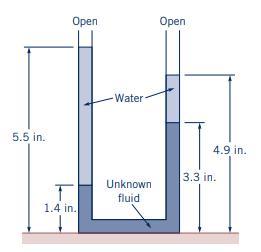
For the configuration shown in Fig. P2.49 what must be the value of the specific weight of the unknown fluid? Express your answer in \(\mathrm{lb} / \mathrm{ft}^{3}\).Figure P2.49 5.5 in. Open Water Open 4.9 in. 3.3 in. Unknown fluid 1.4 in.
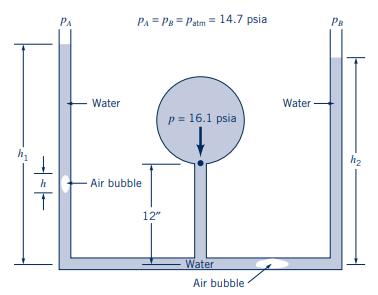
The manometer shown in Fig. P2.50 has an air bubble eiter in(a) the right horizontal line (b) the left vertical leg. Find \(h_{1}-h_{2}\) for both cases if \(p_{A}=p_{B}\).Figure P2.50 PA PA = PB = Patm = 14.7 psia PB h T 17 Water Water p = 16.1 psia Air bubble 12" Water Air bubble 12
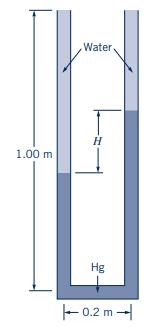
The U-tube manometer shown in Fig. P2.51 has legs that are \(1.00 \mathrm{~m}\) long. When no pressure difference is applied across the manometer, each leg has \(0.40 \mathrm{~m}\) of mercury. What is the maximum pressure difference that can be indicated by the manometer?Figure P2.51 Water. 1.00 m
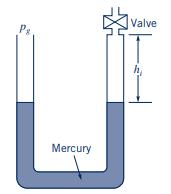
Both ends of the U-tube mercury manometer of Fig. P2.52 are initially open to the atmosphere and under standard atmospheric pressure. When the valve at the top of the right leg is open, the level of mercury below the valve is \(h_{1}\). After the valve is closed, air pressure is applied to the left
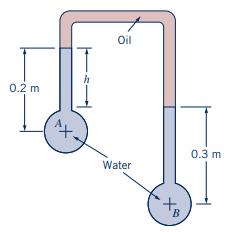
The inverted U-tube manometer of Fig. P2.53 contains oil \((S G=0.9)\) and water as shown. The pressure differential between pipes \(A\) and \(B, p_{A}-p_{B}\), is \(-5 \mathrm{kPa}\). Determine the differential reading \(h\).Figure P2.53 Oil 0.2 m A+. h Water +B 0.3 m
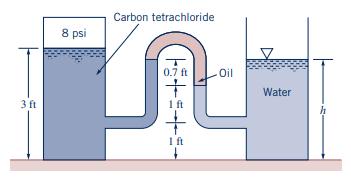
An inverted U-tube manometer containing oil \((S G=0.8)\) is located between two reservoirs as shown in Fig. P2.54. The reservoir on the left, which contains carbon tetrachloride, is closed and pressurized to \(8 \mathrm{psi}\). The reservoir on the right contains water and is open to the
The sensitivity Sen of the manometer shown in Fig. P2.55 can be defined as\[ \text { Sen }=\frac{h}{p_{R}-p_{L}} \]Three manometer fluids with the listed specific gravities \(S\) are available:Kerosene, \(S=0.82\);SAE 10 oil, \(S=0.87\); and Normal octane, \(S=0.71\).Which fluid gives the highest
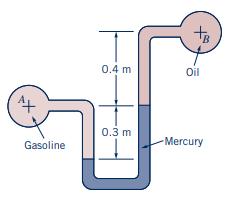
In Fig. P2.56 pipe \(A\) contains gasoline \((S G=0.7\) ), pipe \(B\) contains oil \((S G=0.9)\), and the manometer fluid is mercury. Determine the new differential reading if the pressure in pipe \(A\) is decreased \(25 \mathrm{kPa}\), and the pressure in pipe \(B\) remains constant. The initial
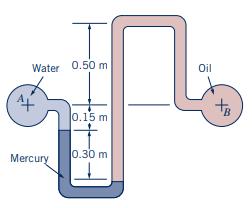
The mercury manometer of Fig. P2.57 indicates a differential reading of \(0.30 \mathrm{~m}\) when the pressure in pipe \(A\) is \(30-\mathrm{mm} \mathrm{Hg}\) vacuum. Determine the pressure in pipe \(B\).Figure P2.57 Water 0.50 m Oil 0.15 m +B 0.30 m Mercury
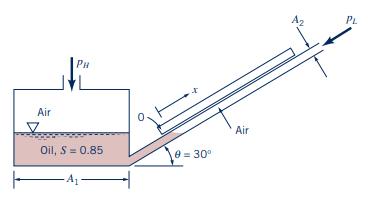
Consider the cistern manometer shown in Fig. P2.58. The scale is set up on the basis that the cistern area \(A_{1}\) is infinite. However, \(A_{1}\) is actually 50 times the internal cross-sectional area \(A_{2}\) of the inclined tube. Find the percentage error (based on the scale reading) involved
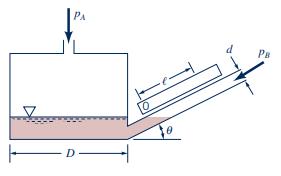
The cistern shown in Fig. P2.59 has a diameter \(D\) that is 4 times the diameter \(d\) of the inclined tube. Find the drop in the fluid level in the cistern and the pressure difference \(\left(p_{A}-p_{B}\right)\) if the liquid in the inclined tube rises \(\ell=20 \mathrm{in}\). The angle
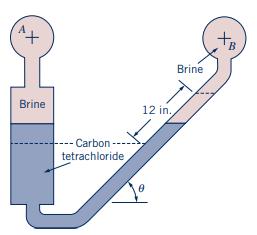
The inclined differential manometer of Fig. P2.60 contains carbon tetrachloride. Initially the pressure differential between pipes \(A\) and \(B\), which contain a brine \((S G=1.1)\), is zero as illustrated in the figure. It is desired that the manometer give a differential reading of \(12
Determine the new differential reading along the inclined leg of the mercury manometer of Fig. P2.61, if the pressure in pipe A is decreased \(10 \mathrm{kPa}\) and the pressure in pipe \(B\) remains unchanged. The fluid in \(A\) has a specific gravity of 0.9 and the fluid in \(B\) is water.Figure
A student needs to measure the air pressure inside a compressed air tank but does not have ready access to a pressure gage. Using materials already in the lab, she builds a U-tube manometer using two clear 3-ft-long plastic tubes, flexible hoses, and a tape measure. The only readily available
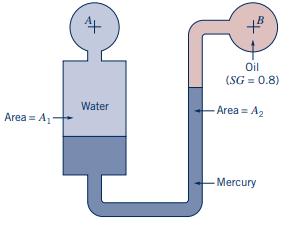
Determine the ratio of areas, \(A_{1} / A_{2}\), of the two manometer legs of Fig. P2.63 if a change in pressure in pipe \(B\) of 0.5 psi gives a corresponding change of \(1 \mathrm{in}\). in the level of the mercury in the right leg. The pressure in pipe \(A\) does not change.Figure P2.63 4 too
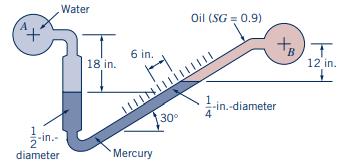
Determine the change in the elevation of the mercury in the left leg of the manometer of Fig. P2.64 as a result of an increase in pressure of 5 psi in pipe \(A\) while the pressure in pipe \(B\) remains constant.Figure P2.64 Water 18 in. 6 in. IN -in.- diameter Mercury Oil (SG = 0.9) +B F 12 in.
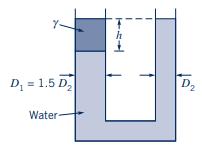
The U-shaped tube shown in Fig. 2.65 initially contains water only. A second liquid with specific weight, \(\gamma\), less than water is placed on top of the water with no mixing occurring. Can the height, \(h\), of the second liquid be adjusted so that the left and right levels are at the same
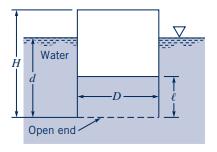
An inverted hollow cylinder is pushed into the water as is shown in Fig. P2.66. Determine the distance, \(\ell\), that the water rises in the cylinder as a function of the depth, \(d\), of the lower edge of the cylinder. Plot the results for \(0 \leq d \leq H\), when \(H\) is equal to \(1
Obtain a photograph/image of a situation in which the hydrostatic force on a plane surface is important. Print this photo and write a brief paragraph that describes the situation involved.
Showing 900 - 1000
of 2369
First
3
4
5
6
7
8
9
10
11
12
13
14
15
16
17
Last
Step by Step Answers

 Get 50% OFF
Claim Now
Get 50% OFF
Claim Now