New Semester
Started
Get
50% OFF
Study Help!
--h --m --s
Claim Now
Question Answers
Textbooks
Find textbooks, questions and answers
Oops, something went wrong!
Change your search query and then try again
S
Books
FREE
Study Help
Expert Questions
Accounting
General Management
Mathematics
Finance
Organizational Behaviour
Law
Physics
Operating System
Management Leadership
Sociology
Programming
Marketing
Database
Computer Network
Economics
Textbooks Solutions
Accounting
Managerial Accounting
Management Leadership
Cost Accounting
Statistics
Business Law
Corporate Finance
Finance
Economics
Auditing
Tutors
Online Tutors
Find a Tutor
Hire a Tutor
Become a Tutor
AI Tutor
AI Study Planner
NEW
Sell Books
Search
Search
Sign In
Register
study help
engineering
engineering fluid mechanics
Munson Young And Okiishi's Fundamentals Of Fluid Mechanics 8th Edition Philip M. Gerhart, Andrew L. Gerhart, John I. Hochstein - Solutions
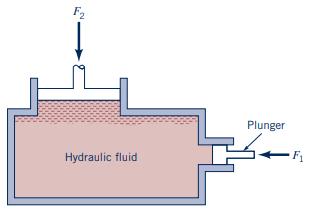
The basic elements of a hydraulic press are shown in Fig. P2.68. The plunger has an area of \(1 \mathrm{in.}^{2}\), and a force, \(F_{1}\), can be applied to the plunger through a lever mechanism having a mechanical advantage of 8 to 1 . If the large piston has an area of \(150 \mathrm{in.}^{2}\),
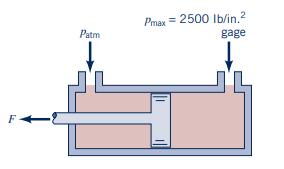
The hydraulic cylinder shown in Fig. P2.69, with a 4-in.diameter piston, is advertised as being capable of providing a force of \(F=20\) tons. If the piston has a design pressure (the maximum pressure at which the cylinder should safely operate) of \(2500 \mathrm{lb} / \mathrm{in}^{2}\), gage, can
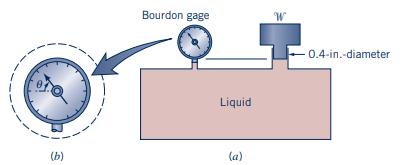
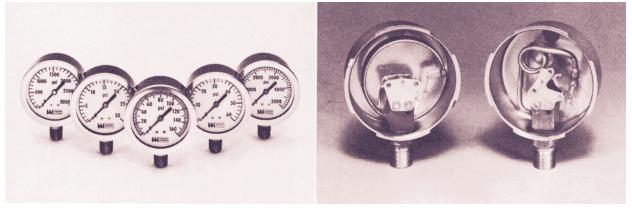
A Bourdon gage (see Fig. 2.13) is often used to measure pressure. One way to calibrate this type of gage is to use the arrangement shown in Fig. P2.70a. The container is filled with a liquid and a weight, \(\mathscr{W}\), placed on one side with the gage on the other side. The weight acting on the
A bottle jack allows an average person to lift one corner of a 4000-lb automobile completely off the ground by exerting less than \(20 \mathrm{lb}\) of force. Explain how a 20-lb force can be converted into hundreds or thousands of pounds of force, and why this does not violate our general
Suction is often used in manufacturing processes to lift objects to be moved to a new location. A 4 -ft by 8 -ft sheet of \(\frac{1}{2}\)-in. plywood weighs approximately \(36 \mathrm{lb}\). If the machine's end effector has a diameter of 5 in., determine the suction pressure required to lift the
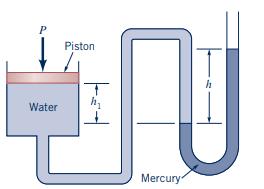
A piston having a cross-sectional area of \(0.07 \mathrm{~m}^{2}\) is located in a cylinder containing water as shown in Fig. P2.73. An open U-tube manometer is connected to the cylinder as shown. For \(h_{1}=\) \(60 \mathrm{~mm}\) and \(h=100 \mathrm{~mm}\), what is the value of the applied force,
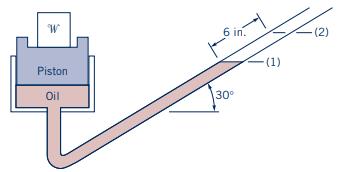
A 6-in.-diameter piston is located within a cylinder that is connected to a \(\frac{1}{2}\)-in.-diameter inclined-tube manometer as shown in Fig. P2.74. The fluid in the cylinder and the manometer is oil (specific weight \(=59 \mathrm{lb} / \mathrm{ft}^{3}\) ). When a weight, \({ }^{\mathscr{W}}\),
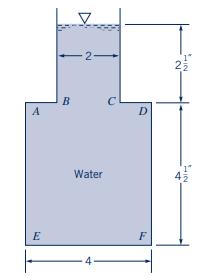
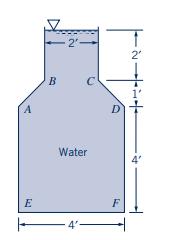
The container shown in Fig. P2.75 has square cross sections. Find the vertical force on the horizontal surface, \(A B C D\).Figure P2.75 2- B C A D E Water 23 HIN F IN
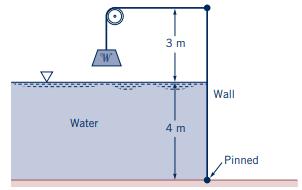
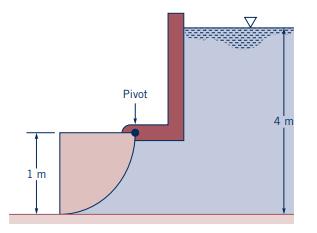
Find the weight \(\mathscr{W}\) needed to hold the wall shown in Fig. P2.76 upright. The wall is \(10 \mathrm{~m}\) wide.Figure P2.76 Water W 3 m Wall 4 m Pinned
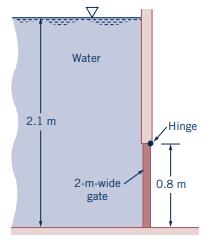
Determine the magnitude and direction of the force that must be applied to the bottom of the gate shown in Fig. P2.77 to keep the gate closed.Figure P2.77 2.1 m Water Hinge 2-m-wide gate 0.8 m
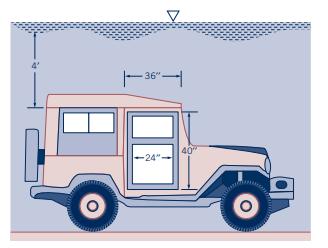
An automobile has just dropped into a river. The car door is approximately a rectangle, measures \(36 \mathrm{in}\). wide and \(40 \mathrm{in}\). high, and hinges on a vertical side. The water level inside the car is up to the midheight of the door, and the air inside the car is at atmospheric
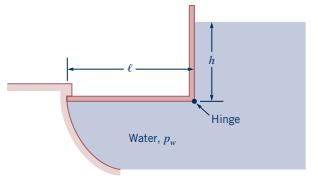
Consider the gate shown in Fig. P2.79. The gate is massless and has a width \(b\) (perpendicular to the paper). The hyprostatic pressure on the vertical side creates a counterclockwise moment about the hinge, and the hydrostatic pressure on the horizontal side (or bottom) creates a clockwise moment
Will the gate in Problem 44 ever open?Problem 44A flowrate measuring device is installed in a horizontal pipe through which water is flowing. A U-tube manometer is connected to the pipe through pressure taps located 3 in. on either side of the device. The gage fluid in the manometer has a specific
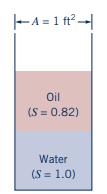
A tank contains 6 in. of oil \((S=0.82)\) above 6 in. of water \((S=1.00)\). Find the force on the bottom of the tank. See Fig. P2.81.Figure P2. 81 |-A=1 ft Oil (S=0.82) Water (S= 1.0)
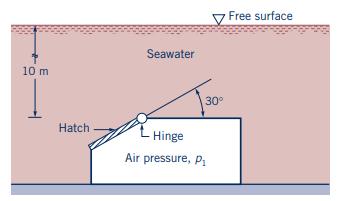
A structure is attached to the ocean floor as shown in Fig. P2.82. A 2-m-diameter hatch is located in an inclined wall and hinged on one edge. Determine the minimum air pressure, \(p_{1}\), within the container that will open the hatch. Neglect the weight of the hatch and friction in the
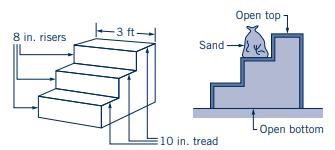
Concrete is poured into the forms as shown in Fig. P2.83 to produce a set of steps. Determine the weight of the sandbag needed to keep the bottomless forms from lifting off the ground. The weight of the forms is \(85 \mathrm{lb}\), and the specific weight of the concrete is \(150 \mathrm{lb} /
A long, vertical wall separates seawater from fresh water. If the seawater stands at a depth of \(7 \mathrm{~m}\), what depth of freshwater is required to give a zero resultant force on the wall? When the resultant force is zero, will the moment due to the fluid forces be zero? Explain.
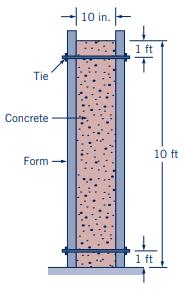
Forms used to make a concrete basement wall are shown in Fig. P2.85. Each 4-ft-long form is held together by four ties-two at the top and two at the bottom as indicated. Determine the tension in the upper and lower ties. Assume concrete acts as a fluid with a weight of \(150 \mathrm{lb} /
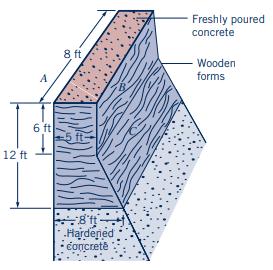
While building a high, tapered concrete wall, builders used the wooden forms shown in Fig. P2.86. If concrete has a specific gravity of about 2.5, find the total force on each of the three side sections ( \(A, B\), and \(C\) ) of the wooden forms (neglect any restraining force of the two ends of
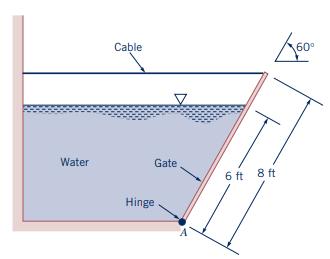
A homogeneous, 4-ft-wide, 8-ft-long rectangular gate weighing \(800 \mathrm{lb}\) is held in place by a horizontal flexible cable as shown in Fig. P2.87. Water acts against the gate, which is hinged at point \(A\). Friction in the hinge is negligible. Determine the tension in the cable.Figure P2.87
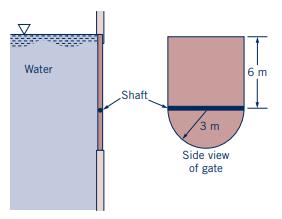
A gate having the shape shown in Fig. P2.88 is located in the vertical side of an open tank containing water. The gate is mounted on a horizontal shaft.(a) When the water level is at the top of the gate, determine the magnitude of the fluid force on the rectangular portion of the gate above the
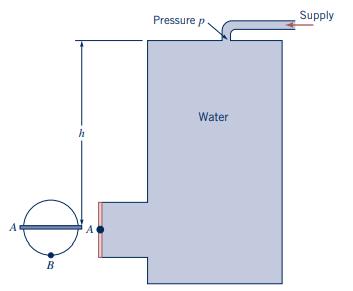
A pump supplies water under pressure to a large tank as shown in Fig. P2.89. The circular-plate valve fitted in the short discharge pipe on the tank pivots about its diameter \(A-A\) and is held shut against the water pressure by a latch at \(B\). Show that the force on the latch is independent of
Sometimes it is difficult to open an exterior door of a building because the air distribution system maintains a pressure difference between the inside and outside of the building. Estimate how big this pressure difference can be if it is "not too difficult" for an average person to open the door.
Find the center of pressure of an elliptical area of minor axis \(2 a\) and major axis \(2 b\) where axis \(2 a\) is vertical and axis \(2 b\) is horizontal. The center of the ellipse is a vertical distance \(h\) below the surface of the water \((h>a)\). The fluid density is constant. Will the
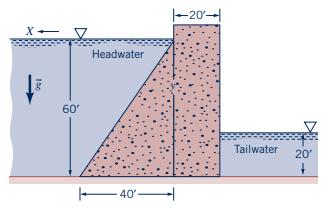
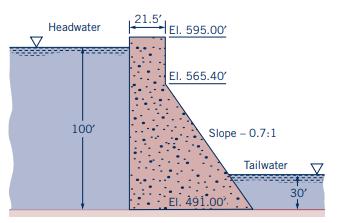
The dam shown in Fig. P2.92 is \(200 \mathrm{ft}\) long and is made of concrete with a specific gravity of 2.2. Find the magnitude and \(y\) coordinate of the line of action of the net horizontal force.Figure P2.92 X Headwater 100 60 40 -20- Tailwater 20' +
Repeat Problem 2.92 but find the magnitude and \(x\) coordinate of the line of action of the vertical force on the dam resulting from the water.Problem 2.92The dam shown in Fig. P2.92 is \(200 \mathrm{ft}\) long and is made of concrete with a specific gravity of 2.2. Find the magnitude and \(y\)
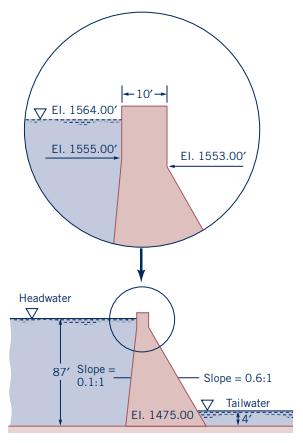
Figure P2.94 is a representation of the Keswick gravity dam in California. Find the magnitudes and locations of the hydrostatic forces acting on the headwater vertical wall of the dam and on the tailwater inclined wall of the dam. Note that the slope given is the ratio of the run to the rise.
The Keswick dam in Problem 2.94 is made of concrete and has a specific weight of \(150 \mathrm{lb} / \mathrm{ft}^{3}\). The hydrostatic forces and the weight of the dam produce a total vertical force of the dam on the foundation. Find the magnitude and location of this total vertical force.
The Keswick dam in Problem 2.94 is made of concrete and has a specific weight of \(150 \mathrm{lb} / \mathrm{ft}^{3}\). The coefficient of friction \(\mu\) between the base of the dam and the foundation is 0.65. Is the dam likely to slide downstream? Consider a unit length of the dam ( \(b=1
Figure P2.97 is a representation of the Altus gravity dam in Oklahoma. Find the magnitudes and locations of the horizontal and vertical hydrostatic force components acting on the headwater wall of the dam and on the tailwater wall of the dam. Note that the slope given is the ratio of the run to the
The Altus dam in Problem 2.97 is made of concrete with a density of \(150 \mathrm{lbm} / \mathrm{ft}^{3}\). The coefficient of friction \(\mu\) between the base of the dam and the foundation is 0.65. Is the dam likely to slide downstream? Consider a unit length of the dam \((b=1
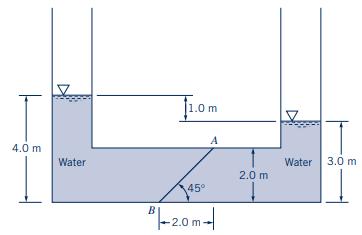
Find the magnitude and location of the net horizontal force on the gate shown in Fig. P2.99. The gate width is \(5.0 \mathrm{~m}\).Figure P2.99 4.0 m Water 11.0m A 45 B-2.0 m- 2.0 m Water 3.0 m
Find the magnitude and location of the net vertical force on the gate in Problem 2.99.Problem 2.99.Find the magnitude and location of the net horizontal force on the gate shown in Fig. P2.99. The gate width is \(5.0 \mathrm{~m}\).Figure P2.99 4.0 m Water 11.0m A 45 B-2.0 m- 2.0 m Water 3.0 m
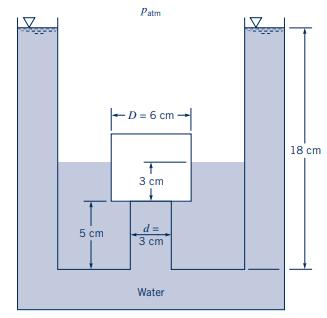
Find the total vertical force on the cylinder shown in Fig. P2.101.Figure P2. 101 Patm |D=6cm- 18 cm 3 cm 5 cm d= 3 cm Water
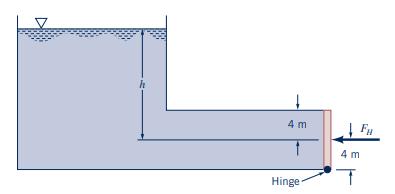
A 3-m-wide, 8-m-high rectangular gate is located at the end of a rectangular passage that is connected to a large open tank filled with water as shown in Fig. P2.102. The gate is hinged at its bottom and held closed by a horizontal force, \(F_{H}\), located at the center of the gate. The maximum
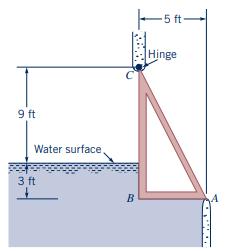
A gate having the cross section shown in Fig. P2.103 is \(4 \mathrm{ft}\) wide and is hinged at \(C\). The gate weighs \(18,000 \mathrm{lb}\), and its mass center is \(1.67 \mathrm{ft}\) to the right of the plane \(B C\). Determine the vertical reaction at \(A\) on the gate when the water level is
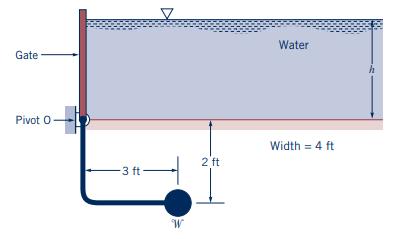
The massless, 4-ft-wide gate shown in Fig. P2.104 pivots about the frictionless hinge O. It is held in place by the \(2000 \mathrm{lb}\) counterweight, \(\mathscr{W}\). Determine the water depth, \(h\).Figure P2.104 Gate Pivot O -3 ft- W Water 2 ft Width = 4 ft h
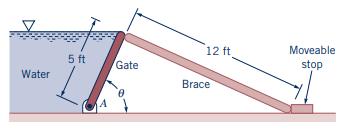
A 200-lb homogeneous gate \(10 \mathrm{ft}\) wide and \(5 \mathrm{ft}\) long is hinged at point \(A\) and held in place by a 12 -ft-long brace as shown in Fig. P2.105. As the bottom of the brace is moved to the right, the water level remains at the top of the gate. The line of action of the force
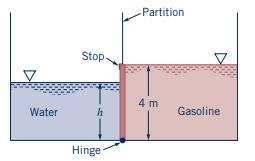
An open tank has a vertical partition and on one side contains gasoline with a density \(ho=700 \mathrm{~kg} / \mathrm{m}^{3}\) at a depth of \(4 \mathrm{~m}\), as shown in Fig. P2.106. A rectangular gate that is \(4 \mathrm{~m}\) high and \(2 \mathrm{~m}\) wide and hinged at one end is located in
A horizontal 2-m-diameter conduit is half filled with a liquid \((S G=1.6)\) and is capped at both ends with plane vertical surfaces. The air pressure in the conduit above the liquid surface is \(200 \mathrm{kPa}\). Determine the resultant force of the fluid acting on one of the end caps, and
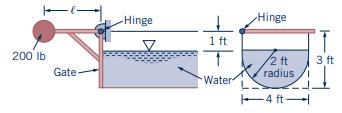
A 4 - \(\mathrm{ft}\) by 3 - \(\mathrm{ft}\) massless rectangular gate is used to close the end of the water tank shown in Fig. P2.108. A 200-lb weight attached to the arm of the gate at a distance \(\ell\) from the frictionless hinge is just sufficient to keep the gate closed when the water depth
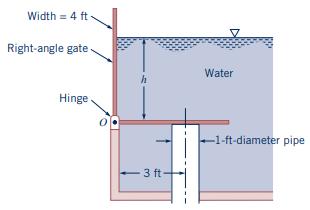
A thin 4-ft-wide, right-angle gate with negligible mass is free to pivot about a frictionless hinge at point \(O\), as shown in Fig. P2.109. The horizontal portion of the gate covers a 1 -ft-diameter Figure P2. 109 drain pipe that contains air at atmospheric pressure. Determine the minimum water
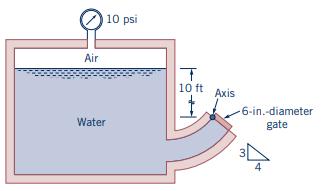
The closed vessel of Fig. P2.110 contains water with an air pressure of \(10 \mathrm{psi}\) at the water surface. One side of the vessel contains a spout that is closed by a 6 -in.-diameter circular gate that is hinged along one side as illustrated. The horizontal axis of the hinge is located \(10
The Wide World of Fluids article titled "The Three Gorges Dam,".(a) Determine the horizontal hydrostatic force on the 2309-m-long Three Gorges Dam when the average depth of the water against it is \(175 \mathrm{~m}\).(b) If all of the 6.4 billion people on Earth were to push horizontally against
Obtain a photograph/image of a situation in which the hydrostatic force on a curved surface is important. Print this photo and write a brief paragraph that describes the situation involved.
A 2-ft-diameter hemispherical plexiglass "bubble" is to be used as a special window on the side of an above-ground swimming pool. The window is to be bolted onto the vertical wall of the pool and faces outward, covering a 2 -ft-diameter opening in the wall. The center of the opening is \(4
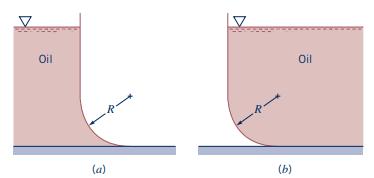
Consider the curved surface shown in Fig. P2.114 (a) and (b). The two curved surfaces are identical. How are the vertical forces on the two surfaces alike? How are they different?Figure P2. 114 (9) 3 (7) Oil Oil
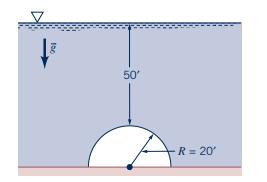
Figure P2.115 shows a cross section of a submerged tunnel used by automobiles to travel under a river. Find the magnitude and location of the resultant hydrostatic force on the circular roof of the tunnel. The tunnel is \(4 \mathrm{mi}\) long.Figure P2. 115 100 50' R = 20'
The container shown in Fig. P2.116 has circular cross sections. Find the vertical force on the inclined surface. Also find the net vertical force on the bottom, \(E F\). Is the vertical force equal to the weight of the water in the container?Figure P2. 116 B 2- Water 2' C D E 4' F
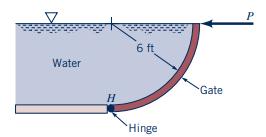
The 18-ft-long lightweight gate of Fig. P2.117 is a quarter circle and is hinged at \(H\). Determine the horizontal force, \(P\), required to hold the gate in place. Neglect friction at the hinge and the weight of the gate.Figure P2. 117 Water 6 ft H Hinge Gate P
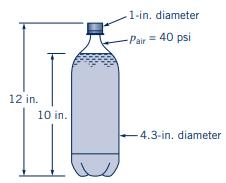
The air pressure in the top of the 2-liter pop bottle shown in Video V2.6 and Fig. P2.118 is 40 psi, and the pop depth is \(10 \mathrm{in}\). The bottom of the bottle has an irregular shape with a diameter of \(4.3 \mathrm{in}\).(a) If the bottle cap has a diameter of 1 in. what is the magnitude of
In drilling for oil in the Gulf of Mexico, some divers have to work at a depth of \(1300 \mathrm{ft}\).(a) Assume that seawater has a constant density of \(64 \mathrm{lb} / \mathrm{ft}^{3}\) and compute the pressure at this depth. The divers breathe a mixture of helium and oxygen stored in
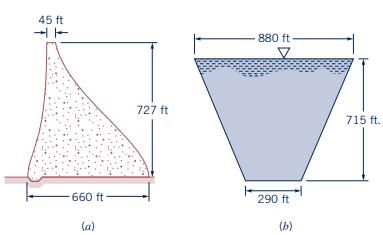
Hoover Dam (see Video 2.5) is the highest arch-gravity type of dam in the United States. A cross section of the dam is shown in Fig. P2.120(a). The walls of the canyon in which the dam is located are sloped, and just upstream of the dam the vertical plane shown in Figure P2.120(b) approximately
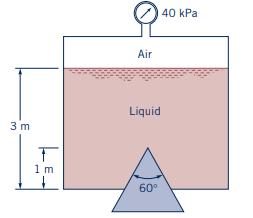
A plug in the bottom of a pressurized tank is conical in shape, as shown in Fig. P2.121. The air pressure is \(40 \mathrm{kPa}\), and the liquid in the tank has a specific weight of \(27 \mathrm{kN} / \mathrm{m}^{3}\). Determine the magnitude, direction, and line of action of the force exerted on
The homogeneous gate shown in Fig. P2.122 consists of one quarter of a circular cylinder and is used to maintain a water depth of \(4 \mathrm{~m}\). That is, when the water depth exceeds \(4 \mathrm{~m}\), the gate opens slightly and lets the water flow under it. Determine the weight of the gate
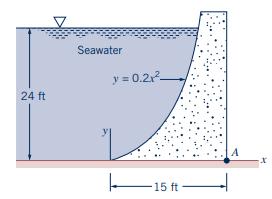
The concrete (specific weight \(=150 \mathrm{lb} / \mathrm{ft}^{3}\) ) seawall of Fig. P2.123 has a curved surface and restrains seawater at a depth of 24 ft. The trace of the surface is a parabola as illustrated. Determine the moment of the fluid force (per unit length) with respect to an axis
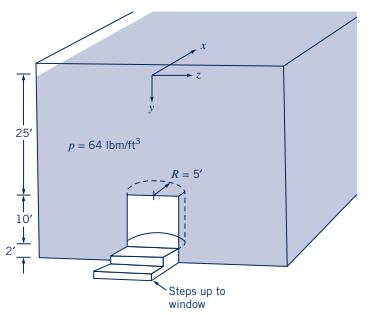
A step-in viewing window having the shape of a half-cylinder is built into the side of a large aquarium. See Fig. P2.124. Find the magnitude, direction, and location of the net horizontal forces on the viewing window.Figure P2.124 25' p = 64 lbm/ft R=5' TILT 2' 10' 1 Steps up to window
Find the magnitude, direction, and location of the net vertical force acting on the viewing window in Problem 2.124.Problem 2.124A step-in viewing window having the shape of a half-cylinder is built into the side of a large aquarium. See Fig. P2.124. Find the magnitude, direction, and location of
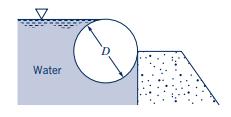
A 10-m-long log is stuck against a dam, as shown in Fig. P2.126. Find the magnitudes and locations of both the horizontal force and the vertical force of the water on the log in terms of the diameter \(D\). The center of the \(\log\) is at the same elevation as the top of the dam.Figure P2.126 Water
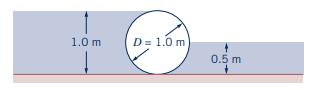
Find the net horizontal force on the 4.0-m-long log shown in Fig. P2.127.Figure P2.127 1.0 m D= 1.0 m 0.5 m
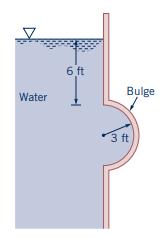
An open tank containing water has a bulge in its vertical side that is semicircular in shape as shown in Fig. P2.128. Determine the horizontal and vertical components of the force that the water exerts on the bulge. Base your analysis on a \(1-\mathrm{ft}\) length of the bulge.Figure P2. 128 Water
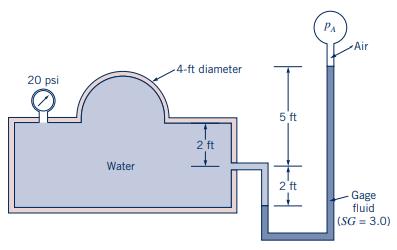
A closed tank is filled with water and has a 4 -ft-diameter hemispherical dome as shown in Fig. 2.129. A U-tube manometer is connected to the tank. Determine the vertical force of the water on the dome if the differential manometer reading is \(7 \mathrm{ft}\) and the air pressure at the upper end
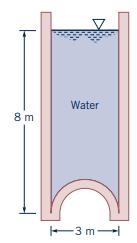
A 3-m-diameter open cylindrical tank contains water and has a hemispherical bottom as shown in Fig. P2.130. Determine the magnitude, line of action, and direction of the force of the water on the curved bottom.Figure P2.130 8 m Water 3m-
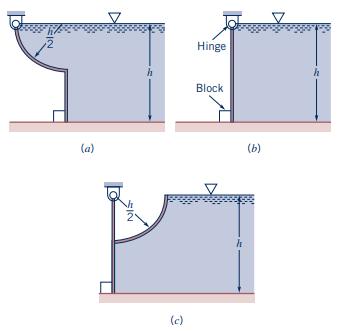
Three gates of negligible weight are used to hold back water in a channel of width \(b\) as shown in Fig. P2.131. The force of the gate against the block for gate \((b)\) is \(R\). Determine (in terms of \(R\) ) the force against the blocks for the other two gates.Figure P2.131 (a) NIS (c) h Hinge
Obtain a photograph/image of a situation in which Archimedes's principle is important. Print this photo and write a brief paragraph that describes the situation involved.
An iceberg (specific gravity 0.917) floats in the ocean (specific gravity 1.025). What percent of the volume of the iceberg is under water?
A floating 40-in.-thick piece of ice sinks 1 in. with a \(500-\mathrm{lb}\) polar bear in the center of the ice. What is the area of the ice in the plane of the water level? For seawater, \(S=1.03\).
A spherical balloon filled with helium at \(40^{\circ} \mathrm{F}\) and \(20 \mathrm{psia}\) has a 25 - \(\mathrm{ft}\) diameter. What load can it support in atmospheric air at \(40^{\circ} \mathrm{F}\) and 14.696 psia? Neglect the balloon's weight.
A river barge, whose cross section is approximately rectangular, carries a load of grain. The barge is \(28 \mathrm{ft}\) wide and \(90 \mathrm{ft}\) long. When unloaded, its draft (depth of submergence) is \(5 \mathrm{ft}\). and with the load of grain the draft is \(7 \mathrm{ft}\). Determine:(a)
A barge is \(40 \mathrm{ft}\) wide by \(120 \mathrm{ft}\) long. The weight of the barge and its cargo is denoted by \(W\). When in salt-free riverwater, it floats \(0.25 \mathrm{ft}\) deeper than when in seawater \(\left(\gamma=64 \mathrm{lb} / \mathrm{ft}^{3}\right)\). Find the weight \(W\).
When the Tucurui Dam was constructed in northern Brazil, the lake that was created covered a large forest of valuable hardwood trees. It was found that even after 15 years underwater the trees were perfectly preserved and underwater logging was started. During the logging process a tree is
Estimate the minimum water depth needed to float a canoe carrying two people and their camping gear. List all assumptions and show all calculations.
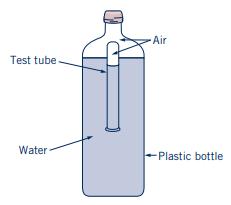
An inverted test tube partially filled with air floats in a plastic water-filled soft drink bottle as shown in Fig. P2.140. The amount of air in the tube has been adjusted so that it just floats. The bottle cap is securely fastened. A slight squeezing of the plastic bottle will cause the test tube
A child's balloon is a sphere \(1 \mathrm{ft}\). in diameter. The balloon is filled with helium \(\left(ho=0.014 \mathrm{lbm} / \mathrm{ft}^{3}\right)\). The balloon material weighs \(0.008 \mathrm{lbf} / \mathrm{ft}^{2}\) of surface area. If the child releases the balloon, how high will it rise in
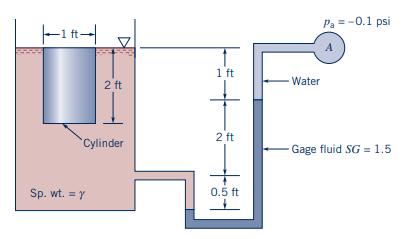
A 1-ft-diameter, 2-ft-long cylinder floats in an open tank containing a liquid having a specific weight \(\gamma\). A U-tube manometer is connected to the tank as shown in Fig. P2.142. When the pressure in pipe \(A\) is 0.1 psi below atmospheric pressure, the various fluid levels are as shown.
A not-too-honest citizen is thinking of making bogus gold bars by first making a hollow iridium ( \(S=22.5)\) ingot and plating it with a thin layer of gold \((S=19.3)\) of negligible weight and volume. The bogus bar is to have a mass of \(100 \mathrm{lbm}\). What must be the volumes of the bogus
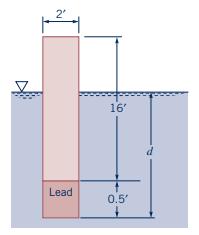
A solid cylindrical pine \((S=0.50)\) spar buoy has a cylindrical lead \((S=11.3)\) weight attached, as shown in Fig. P2.144. Determine the equilibrium position of the spar buoy in seawater (i.e., find \(d\) ). Is this spar buoy stable or unstable? For seawater, \(S=1.03\)Figure P2. 144 2' 16' Lead
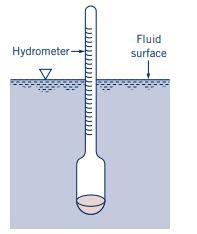
When a hydrometer (see Fig. P2.145) having a stem diameter of \(0.30 \mathrm{in}\). is placed in water, the stem protrudes \(3.15 \mathrm{in}\). above the water surface. If the water is replaced with a liquid having a specific gravity of 1.10, how much of the stem would protrude above the liquid
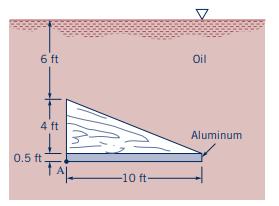
A 2-ft-thick block constructed of wood \((S G=0.6)\) is submerged in oil \((S G=0.8)\) and has a 2-ft-thick aluminum (specific weight \(=168 \mathrm{lb} / \mathrm{ft}^{3}\) ) plate attached to the bottom as indicated in Fig. P2.146. Determine completely the force required to hold the block in the
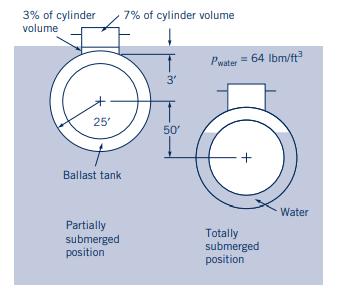
A submarine is modeled as a cylinder with a length of \(300 \mathrm{ft}\), a diameter of \(50 \mathrm{ft}\), and a conning tower as shown in Fig. P2.148. The submarine can dive a distance of \(50 \mathrm{ft}\) from the floating position in about \(30 \mathrm{sec}\). Diving is accomplished by taking
The Wide World of Fluids article titled "Concrete canoes,". How much extra water does a 147-1b concrete canoe displace compared to an ultralightweight 38-1b Kevlar canoe of the same size carrying the same load?
Obtain a photograph/image of a situation in which the pressure variation in a fluid with rigid-body motion is involved. Print this photo and write a brief paragraph that describes the situation involved.
When an automobile brakes, the fuel gage indicates a fuller tank than when the automobile is traveling at a constant speed on a level road. Is the sensor for the fuel gage located near the front or rear of the fuel tank? Assume a constant deceleration.
An open container of oil rests on the flatbed of a truck that is traveling along a horizontal road at \(55 \mathrm{mi} / \mathrm{hr}\). As the truck slows uniformly to a complete stop in \(5 \mathrm{~s}\), what will be the slope of the oil surface during the period of constant deceleration?
A 5-gal, cylindrical open container with a bottom area of 120 in. \(^{2}\) is filled with glycerin and rests on the floor of an elevator.(a) Determine the fluid pressure at the bottom of the container when the elevator has an upward acceleration of \(3 \mathrm{ft} / \mathrm{s}^{2}\).(b) What
A plastic glass has a square cross section measuring \(2 \frac{1}{2}\) in. on a side and is filled to within \(1 / 2\) in. of the top with water. The glass is placed in a level spot in a car with two opposite sides parallel to the direction of travel. How fast can the driver of the car accelerate
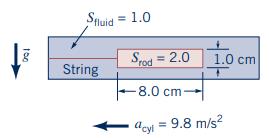
The cylinder in Fig. P2.154 accelerates to the left at the rate of \(9.80 \mathrm{~m} / \mathrm{s}^{2}\). Find the tension in the string connecting at rod of circular cross section to the cylinder. The volume between the rod and the cylinder is completely filled with water at \(10^{\circ}
A closed cylindrical tank that is \(8 \mathrm{ft}\) in diameter and \(24 \mathrm{ft}\) long is completely filled with gasoline. The tank, with its long axis horizontal, is pulled by a truck along a horizontal surface. Determine the pressure difference between the ends (along the long axis of the
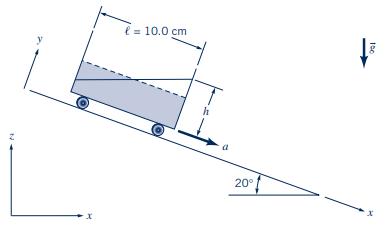
The cart shown in Fig. P2.156 measures \(10.0 \mathrm{~cm}\) long and \(6.0 \mathrm{~cm}\) high and has rectangular cross sections. It is half-filled with water and accelerates down a \(20^{\circ}\) incline plane at \(a=1.0 \mathrm{~m} / \mathrm{s}^{2}\). Find the height \(h\).Figure P2. 156 y =
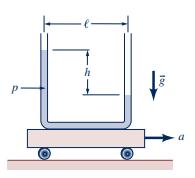
The U-tube manometer in Fig. P2.157 is used to measure the acceleration of the cart on which it sits. Develop an expression for the acceleration of the cart in terms of the liquid height \(h\), the liquid density \(ho\), the local acceleration of gravity \(g\), and the length \(\ell\).Figure P2.157
A tank has a height of \(5.0 \mathrm{~cm}\) and a square cross section measuring \(5.0 \mathrm{~cm}\) on a side. The tank is one third full of water and is rotated in a horizontal plane with the bottom of the tank \(100 \mathrm{~cm}\) from the center of rotation and two opposite sides parallel to
An open 1-m-diameter tank contains water at a depth of \(0.7 \mathrm{~m}\) when at rest. As the tank is rotated about its vertical axis the center of the fluid surface is depressed. At what angular velocity will the bottom of the tank first be exposed? No water is spilled from the tank.
A child riding in a car holds a string attached to a floating, helium-filled balloon. As the car decelerates to a stop, the balloon tilts backwards. As the car makes a right-hand turn, the balloon tilts to the right. On the other hand, the child tends to be forced forward as the car decelerates and
A closed, 0.4-m-diameter cylindrical tank is completely filled with oil \((S G=0.9)\) and rotates about its vertical longitudinal axis with an angular velocity of \(40 \mathrm{rad} / \mathrm{s}\). Determine the difference in pressure just under the vessel cover between a point on the circumference
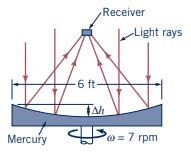
The Wide World of Fluids article titled "Rotating mercury mirror telescope,". The largest liquid mirror telescope uses a 6-ft-diameter tank of mercury rotating at \(7 \mathrm{rpm}\) to produce its parabolic-shaped mirror as shown in Fig. P2.163. Determine the difference in elevation of the mercury,
Obtain a photograph/image of a situation that can be analyzed by use of the Bernoulli equation. Print this photo and write a brief paragraph that describes the situation involved. Bernoulli equation p+pv + z = constant along streamline
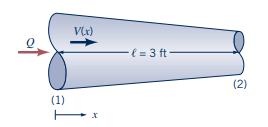
Water flows steadily through the variable area horizontal pipe shown in Fig. P3.3. The centerline velocity is given by \(\mathbf{V}=\) \(10(1+x) \hat{\mathbf{i}} \mathrm{ft} / \mathrm{s}\), where \(x\) is in feet. Viscous effects are neglected.(a) Determine the pressure gradient, \(\partial p /
Air flows steadily along a streamline from point (1) to point (2) with negligible viscous effects. The following conditions are measured: At point (1) \(z_{1}=2 \mathrm{~m}\) and \(p_{1}=0 \mathrm{kPa}\); at point (2) \(z_{2}=10 \mathrm{~m}\), \(p_{2}=20 \mathrm{~N} / \mathrm{m}^{2}\), and
What pressure gradient along the streamline, \(d p / d s\), is required to accelerate water in a horizontal pipe at a rate of \(30 \mathrm{~m} / \mathrm{s}^{2}\) ?
At a given location the airspeed is \(20 \mathrm{~m} / \mathrm{s}\) and the pressure gradient along the streamline is \(100 \mathrm{~N} / \mathrm{m}^{3}\). Estimate the airspeed at a point \(0.5 \mathrm{~m}\) farther along the streamline.
Showing 1000 - 1100
of 2369
First
4
5
6
7
8
9
10
11
12
13
14
15
16
17
18
Last
Step by Step Answers

 Get 50% OFF
Claim Now
Get 50% OFF
Claim Now