New Semester
Started
Get
50% OFF
Study Help!
--h --m --s
Claim Now
Question Answers
Textbooks
Find textbooks, questions and answers
Oops, something went wrong!
Change your search query and then try again
S
Books
FREE
Study Help
Expert Questions
Accounting
General Management
Mathematics
Finance
Organizational Behaviour
Law
Physics
Operating System
Management Leadership
Sociology
Programming
Marketing
Database
Computer Network
Economics
Textbooks Solutions
Accounting
Managerial Accounting
Management Leadership
Cost Accounting
Statistics
Business Law
Corporate Finance
Finance
Economics
Auditing
Tutors
Online Tutors
Find a Tutor
Hire a Tutor
Become a Tutor
AI Tutor
AI Study Planner
NEW
Sell Books
Search
Search
Sign In
Register
study help
engineering
engineering fluid mechanics
Engineering Fluid Mechanics 11th Edition Donald F. Elger, Barbara A. LeBret, Clayton T. Crowe, John A. Robertson - Solutions
Liquid flows with a free surface around a bend. The liquid is inviscid and incompressible, and the flow is steady and irrotational. The velocity varies with the radius across the flow as V = 1/r m/s, where r is in meters. Find the difference in depth of the liquid from the inside to the outside
A two-dimensional flow field is defined by u = x2 – y2 and v = –2xy. Is the flow rotational or irrotational?
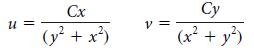
The velocity components for a two-dimensional flow arewhere C is a constant. Is the flow irrotational? Cx Cy (y + x) v = (x² + y)
The u and v velocity components of a flow field are given by u = –ωy and v = ωx. Determine the vorticity and the rate of rotation of flow field.
The vector V = 10xi – 10yj represents a two-dimensional velocity field. Is the flow irrotational?
Consider a spherical fluid particle in an inviscid fluid (no shear stresses). If pressure and gravitational forces are the only forces acting on the particle, can they cause the particle to rotate? Explain.
What is meant by rotation of a fluid particle? Use a sketch to explain.
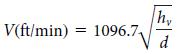
You need to measure air flow velocity. You order a commercially available Pitot-static tube, and the accompanying instructions state that the airflow velocity is given by where hv is the “velocity pressure” in inches of water and d is the density in pounds per cubic foot. The velocity
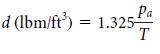
A Pitot-static tube is used to measure the airspeed of an airplane. The Pitot tube is connected to a pressure-sensing device calibrated to indicate the correct airspeed when the temperature is 17°C and the pressure is 101 kPa. The airplane flies at an altitude of 3000 m, where the pressure and
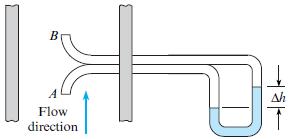
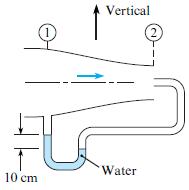
A rugged instrument used frequently for monitoring gas velocity in smokestacks consists of two open tubes oriented to the flow direction as shown and connected to a manometer. The pressure coefficient is 1.0 at A and –0.2 at B. Assume that water, at 20°C, is used in the manometer and that a 5 mm
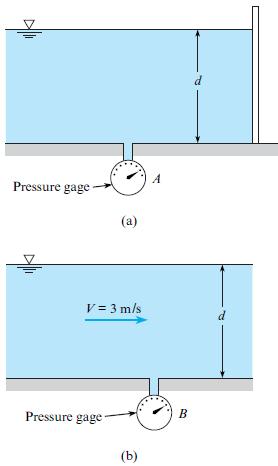
Water in a flume is shown for two conditions. If the depth d is the same for each case, will gage A read greater or less than gage B? Explain. d A Pressure gage (a) V = 3 m/s d Pressure gage B (b)
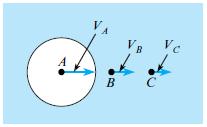
This navy surveillance sphere is being tested for the pressure field that will be induced in front of it as a function of velocity. Velocimeters in the test basin show that when VA = 14 m/s, the velocity at B is 8 m/s and at C is 1 m/s. What is pB – pC? (Velocities are measured with respect to a
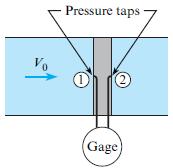
A device used to measure the velocity of fluid in a pipe consists of a cylinder, with a diameter much smaller than the pipe diameter, mounted in the pipe with pressure taps at the forward stagnation point and at the rearward side of the cylinder. Data show that the pressure coefficient at the
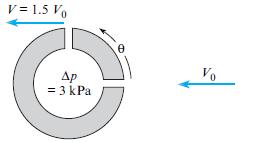
The “spherical” Pitot probe shown is used to measure the flow velocity in hot water (ρ = 965 kg/m3). Pressure taps are located at the forward stagnation point and at 90° from the forward stagnation point. The speed of fluid next to the surface of the sphere varies as 1.5 V0 sin θ, where V0
The flow-metering device shown consists of a stagnation probe at station 2 and a static pressure tap at station 1. The velocity at station 2 is 1.5 times that at station 1. Air with a density of 1.2 kg/m3 flows through the duct. A water manometer is connected between the stagnation probe and the
A Pitot-static tube is used to measure the gas velocity in a duct. A pressure transducer connected to the Pitot tube registers a pressure difference of 3.0 psi. The density of the gas in the duct is 0.19 lbm/ft3. What is the gas velocity in the duct?
A Pitot-static tube used to measure air velocity is connected to a pressure gage. If the air temperature is 200°F at standard atmospheric pressure, and if the gage reads a differential pressure of 15 psf, what is the air velocity?
A Pitot-static tube used to measure air velocity is connected to a pressure gage. If the air temperature is 10°C at standard atmospheric pressure at sea level, and if the gage reads a differential pressure of 3 kPa, what is the air velocity?
A Pitot-static tube is used to measure the velocity at the center of a 12 in. pipe. If kerosene at 68°F is flowing and the deflection on a mercury-kerosene manometer connected to the Pitot tube is 5.5 in., what is the velocity?
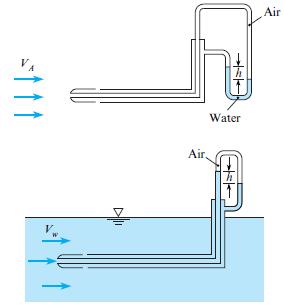
Two Pitot-static tubes are shown. The one on the top is used to measure the velocity of air, and it is connected to an air-water manometer as shown. The one on the bottom is used to measure the velocity of water, and it too is connected to an air-water manometer as shown. If the deflection h is the
To measure air velocity in a food-drying plant (T = 160°F, p = 14 psia), an air-water manometer is connected to a Pitot-static tube. When the manometer deflects 4 in., what is the velocity?
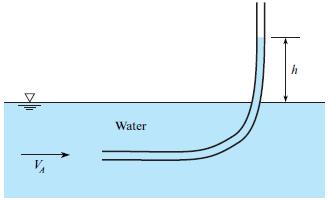
A glass tube is inserted into a flowing stream of water with one opening directed upstream and the other end vertical. If the water velocity, VA is 6.6 m/s, how high will the water rise, h? h Water V
A Pitot tube is placed in an open channel as shown. What is the velocity VA (m/s) when height h is 15 cm?
A Pitot-static tube is mounted on an airplane to measure airspeed. At an altitude of 10,000 ft , where the temperature is 23°F and the pressure is 9 psia, a pressure difference corresponding to 8 in. of water is measured. What is the airspeed?
A stagnation tube placed in a river (select all that apply)a. Can be used to determine air pressureb. Can be used to determine water velocityc. Measures kinetic pressure + static pressure
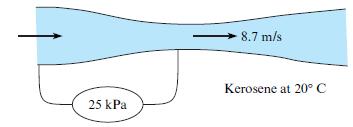
Kerosene at 20°C flows through a contraction section as shown. A pressure gage connected between the upstream pipe and throat section shows a pressure difference of 25 kPa. The gasoline velocity in the throat section is 8.7 m/s. What is the velocity (m/s) in the upstream pipe? 8.7 m/s Kerosene at
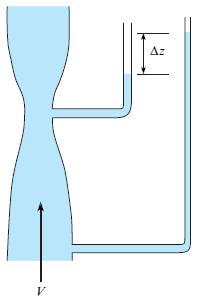
Water flows through a vertical contraction (venturi) section. Piezometers are attached to the upstream pipe and minimum area section as shown. The mean velocity in the pipe is V = 5 ft /s. The difference in elevation between the two water levels in the piezometers is Δz = 6 inches. The water
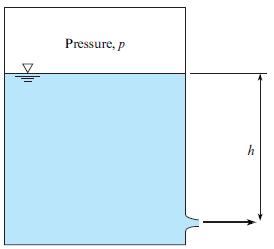
The tank shown is used to pressurize a water-fertilizer solution for delivery from a sprayer. The tank is pressurized at p = 15 kPa gage. Height h is 0.8 m. What is the velocity (m/s) of the fertilizer at the outlet? Pressure, p h
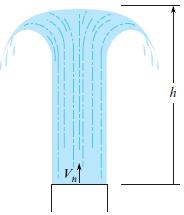
An engineer is designing a fountain, as shown, and will install a nozzle that can produce a vertical jet. How high (h) will the water in the fountain rise if Vn = 26 m/s at h = 0? V.
Describe in your own words how an aspirator works.
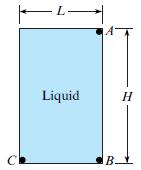
The closed tank shown, which is full of liquid, is accelerated downward at 23 g and to the right at 1g. Here L = 2.5 m, H = 3 m, and the liquid has a specific gravity of 1.3. Determine pC – pA and pB – pA. -L- Liquid H B
The closed tank shown, which is full of liquid, is accelerated downward at 1.5g and to the right at 0.9g. Here L = 3 ft , H = 4 ft , and the specific gravity of the liquid is 1.2. Determine pC – pA and pB – pA.
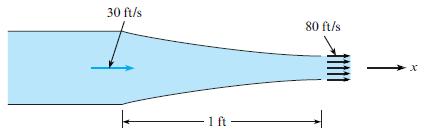
If the velocity varies linearly with distance through this water nozzle, what is the pressure gradient, dp/dx, halfway through the nozzle? Assume ρ = 62.4 lbm/ft 3. 30 ft/s 80 ft/s 1 ft-
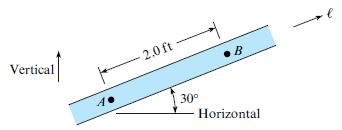
A liquid with a specific weight of 100 lbf/ft3 is in the conduit. This is a special kind of liquid that has zero viscosity. The pressures at points A and B are 170 psf and 100 psf, respectively. Which one (or more) of the following conclusions can one draw with certainty?(a) The velocity is in the
Water (ρ = 1000 kg/m3) is accelerated from rest in a horizontal pipe that is 80 m long and 30 cm in diameter. If the acceleration rate (toward the downstream end) is 5 m/s2, what is the pressure at the upstream end if the pressure at the downstream end is 90 kPa gage?
What pressure gradient is required to accelerate water (ρ = 1000 kg/m3) in a horizontal pipe at a rate of 7.7 m/s2?
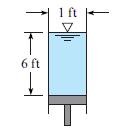
Water (ρ = 62.4 lbm/ft3) stands at a depth of 6 ft in a vertical pipe that is open at the top and closed at the bottom by a piston. What upward acceleration of the piston is necessary to create a pressure of 8 psig immediately above the piston? 1 ft
The hypothetical liquid in the tube shown in the figure has zero viscosity and a specific weight of 10 kN/m3. If pB – pA is equal to 8 kPa, one can conclude that the liquid in the tube is being accelerated (a) Upward, (b) Downward, or (c) Neither: acceleration = 0.
What pressure gradient is required to accelerate kerosene (SG = 0.81) vertically upward in a vertical pipe at a rate of 0.4 g?
What are the differences between a force due to weight and a force due to pressure? Explain.
State Newton’s second law of motion. What are the limitations on the use of Newton’s second law? Explain.
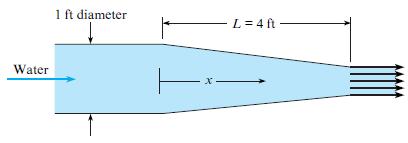
The velocity of water flow in the nozzle shown is given by the following expression:V = 2t/(1 − 0.5x/L)2, where V = velocity in feet per second, t = time in seconds, x = distance along the nozzle, and L = length of nozzle = 4 ft . When x = 0.5L and t = 3 s, what is the local acceleration along
In Prob. 4.26 the velocity varies linearly with time throughout the nozzle. The velocity at the base is 1t (ft /s) and at the tip is 4t (ft /s). What is the local acceleration midway along the nozzle when t = 2 s?Data from Prob. 4.26The nozzle in the figure is shaped such that the velocity of the
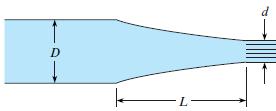
The nozzle in the figure is shaped such that the velocity of the fluid varies linearly from the base of the nozzle to its tip. Assuming quasi-one-dimensional flow, what is the convective acceleration midway between the base and the tip if the velocity is 2ft /s at the base and 5ft /s at the tip?
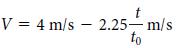
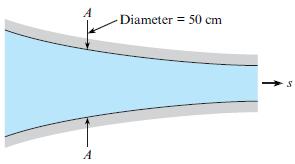
In this fl ow passage, the velocity is varying with time. The velocity varies with time at section A-A asAt time t = 0.50 s, it is known that at section A-A the velocity gradient in the s direction is +2.1 m/s per meter. Given that to is 0.6 s and assuming quasi-one-dimensional flow, answer the
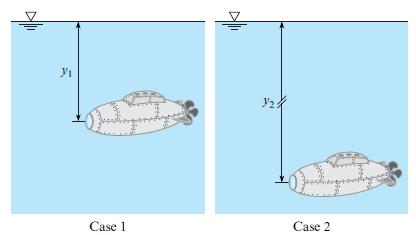
Part 1. Consider the equation for the distance between the CP and the centroid of a submerged panel (Eq. (3.33)). In that equation, ycp isa. The vertical distance from the water surface to the CP.b. The slant distance from the water surface to the CP.Part 2. Consider the figure shown. For case 1,
Using §3.2 and other resources, answer the following questions. Strive for depth, clarity, and accuracy while also combining sketches, words, and equations in ways that enhance the effectiveness of your communication.a. What does hydrostatic mean? How do engineers identify whether a fluid is
The local atmospheric pressure is 91 kPa. A gage on an oxygen tank reads a pressure of 250 kPa gage. What is the pressure in the tank in kPa abs?
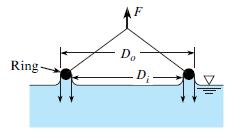
The surface tension of a liquid is being measured with a ring as shown. The ring has an outside diameter of 10 cm and an inside diameter of 9.5 cm. The mass of the ring is 10 g. The force required to pull the ring from the liquid is the weight corresponding to a mass of 16 g. What is the surface
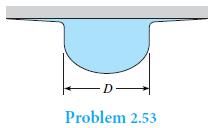
A drop of water at 20°C is forming under a solid surface. The configuration just before separating and falling as a drop is shown in the figure. Assume the forming drop has the volume of a hemisphere. What is the diameter of the hemisphere just before separating? D- - Problem 2.53
Consider a soap bubble 2 mm in diameter and a droplet of water, also 2 mm in diameter. If the value of the surface tension for the film of the soap bubble is assumed to be the same as that for water, which has the greater pressure inside it? (a) The bubble, (b) The droplet, (c)
Capillary rise can be used to describe how far water will rise above a water table because the interconnected pores in the soil act like capillary tubes. This means that deep-rooted plants in the desert need only grow to the top of the “capillary fringe” in order to get water; they do not have
By measuring the capillary rise in a tube, one can calculate the surface tension. The surface tension of water varies linearly with temperature from 0.0756 N/m at 0°C to 0.0589 N/m at 100°C. Size a tube (specify diameter and length) that uses capillary rise of water to measure temperature in the
What is the pressure within a d = 0.75 mm spherical droplet of water, relative to the atmospheric pressure outside the droplet?
Calculate the maximum capillary rise of water between two vertical glass plates spaced 1 mm apart.
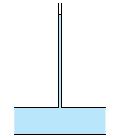
A water column in a glass tube is used to measure the pressure in a pipe. The tube is 1/2 in. in diameter. How much of the water column is due to surface-tension effects? What would be the surface-tension effects if the tube were 1/8 in. or 1/16 in. in diameter?
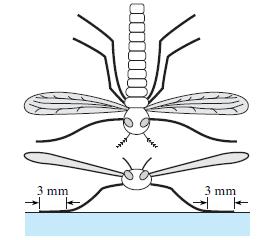
A water bug is suspended on the surface of a pond by surface tension (water does not wet the legs). Th e bug has six legs, and each leg is in contact with the water over a length of 3 mm. What is the maximum mass (in grams) of the bug if it is to avoid sinking? 3 mm 3 mm
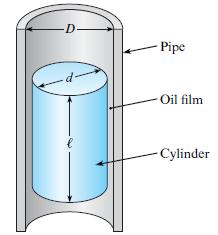
This problem involves a cylinder falling inside a pipe that is filled with oil, as depicted in the figure. The small space between the cylinder and the pipe is lubricated with an oil film that has viscosity μ. Derive a formula for the steady rate of descent of a cylinder with weight W, diameter d,
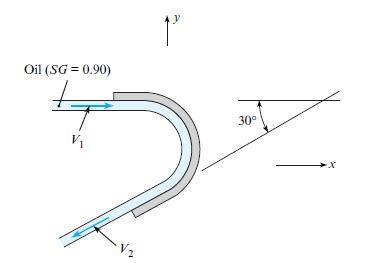
Determine the forces in the x- and y-directions needed to hold this fixed vane, which turns the oil jet (SG = 0.9) in a horizontal plane. Here V1 = 29 m/s, V2 = 33 m/s, and Q = 0.9 m3/s. y Oil (SG = 0.90) 30°
Solve Prob. 6.23 for V1 = 70 ft /s, V2 = 65 ft /s, and Q = 1.5 cfs.Data from Prob. 6.23Determine the forces in the x- and y-directions needed to hold this fixed vane, which turns the oil jet (SG = 0.9) in a horizontal plane. Here V1 = 29 m/s, V2 = 33 m/s, and Q = 0.9 m3/s. y Oil (SG = 0.90) 30°
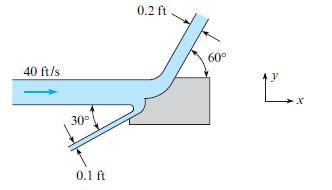
This planar water jet (60°F) is deflected by a fixed vane. What are the x- and y-components of force per unit width needed to hold the vane stationary? Neglect gravity. 0.2 ft 60° 40 ft/s 30° 0.1 ft
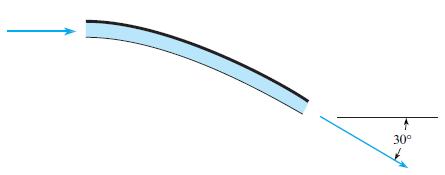
A water jet with a speed of 60 ft/s and a mass flow rate of 40 lbm/s is turned 30° by a fixed vane. Find the force of the water jet on the vane. Neglect gravity. 30°
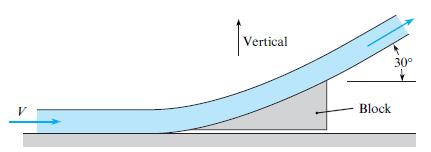
Water (ρ = 1000 kg/m3) strikes a block as shown and is deflected 30°. The flow rate of the water is 15.1 kg/s, and the inlet velocity is V = 16 m/s. The mass of the block is 1 kg. The coefficient of static friction between the block and the surface is 0.1 (friction force/normal force). If the
For the situation described in Prob. 6.27, find the maximum inlet velocity (V) such that the block will not slip.Data from Prob. 6.27,Water (ρ = 1000 kg/m3) strikes a block as shown and is deflected 30°. The flow rate of the water is 15.1 kg/s, and the inlet velocity is V = 16 m/s. The mass of
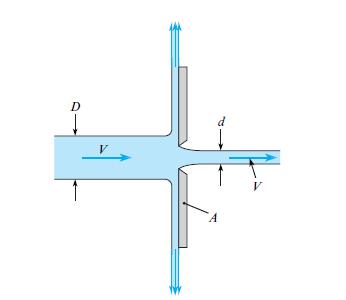
Plate A is 50 cm in diameter and has a sharp-edged orifice at its center. A water jet (at 10°C) strikes the plate concentrically with a speed of 60 m/s. What external force is needed to hold the plate in place if the jet issuing from the orifice also has a speed of 60 m/s? The diameters of the
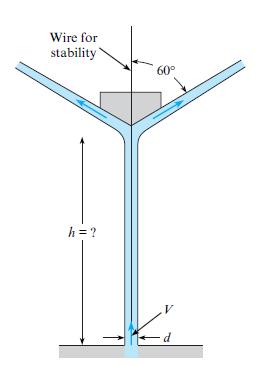
A cone that is held stable by a wire is free to move in the vertical direction and has a jet of water (at 10°C) striking it from below. The cone weighs 30 N. The initial speed of the jet as it comes from the orifice is 15 m/s, and the initial jet diameter is 2 cm. Find the height to which the cone
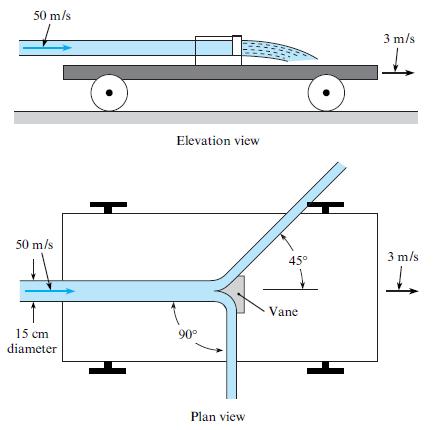
A vane on this moving cart deflects a 15-cm-diameter water (ρ = 1000 kg/m3) jet as shown. The initial speed of the water in the jet is 50 m/s, and the cart moves at a speed of 3 m/s. If the vane splits the jet so that half goes one way and half the other, what force is exerted on the vane by the
Refer to the cart of Prob. 6.32. If the cart speed is constant at 5 ft/s, and if the initial jet speed is 60 ft /s, and jet diameter = 0.15 ft, what is the rolling resistance of the cart? (ρ = 62.4 lbm/ft3.) See §6.5 for useful knowledge about moving CV’s. 50 m/s 3 m/s Elevation view 50 m/s
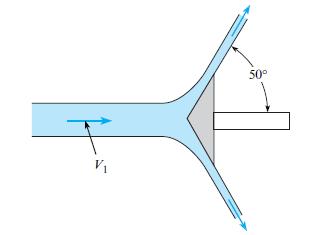
The water (ρ = 1000 kg/m3) in this jet has a speed of 60 m/s to the right and is deflected by a cone that is moving to the left with a speed of 5 m/s. Th e diameter of the jet is 10 cm. Determine the external horizontal force needed to move the cone. Assume negligible friction between the water
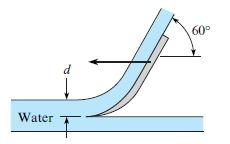
This two-dimensional water (at 50°F) jet is deflected by the two-dimensional vane, which is moving to the right with a speed of 60 ft /s. The initial jet is 0.30 ft thick (vertical dimension), and its speed is 100 ft/s. What power per foot of the jet (normal to the page) is transmitted to the
Assume that the scoop shown, which is 20 cm wide, is used as a braking device for studying deceleration effects, such as those on space vehicles. If the scoop is attached to a 1000 kg sled that is initially traveling horizontally at the rate of 100 m/s, what will be the initial deceleration of the
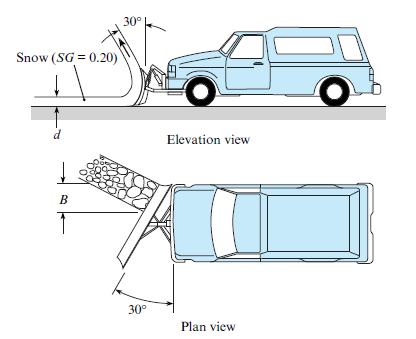
This snowplow clears a swath of snow (SG = 0.20) that is 4 in. deep (d = 4 in.) and 2 ft wide (B = 2 ft). The snow leaves the blade in the direction indicated in the sketches. Neglecting friction between the snow and the blade, estimate the power required for just the snow removal if the speed of
High-speed water jets are used for specialty cutting applications. The pressure in the chamber is approximately 60,000 psig. Using the Bernoulli equation, estimate the water speed exiting the nozzle exhausting to atmospheric pressure. Neglect compressibility effects and assume a water temperature
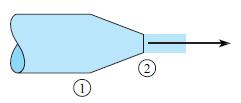
Water at 60°F flows through a nozzle that contracts from a diameter of 12 in. to 1 in. The pressure at section 1 is 2500 psfg, and atmospheric pressure prevails at the exit of the jet. Calculate the speed of the flow at the nozzle exit and the force required to hold the nozzle stationary. Neglect
Water at 15°C flows through a nozzle that contracts from a diameter of 15 cm to 2 cm. Th e exit speed is v2 = 10 m/s, and atmospheric pressure prevails at the exit of the jet. Calculate the pressure at section 1 and the force required to hold the nozzle stationary. Neglect weight. (2.
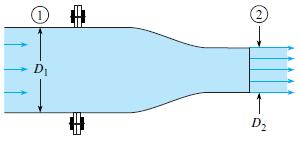
Water (at 50°F) flows through this nozzle at a rate of 25 cfs and discharges into the atmosphere. D1 = 20 in., and D2 = 9 in. Determine the force required at the flange to hold the nozzle in place. Assume irrotational flow. Neglect gravitational forces.
Solve Prob. 6.42 using the following values: Q = 0.30 m3/s, D1 = 30 cm, and D2 = 10 cm. (ρ = 1000 kg/m3.)Data from Prob. 6.42 Water (at 50°F) flows through this nozzle at a rate of 25 cfs and discharges into the atmosphere. D1 = 20 in., and D2 = 9 in. Determine the force required at the
This “double” nozzle discharges water (ρ = 62.4 lbm/ft3) into the atmosphere at a rate of 16 cfs. If the nozzle is lying in a horizontal plane, what x-component of force acting through the flange bolts is required to hold the nozzle in place? Assume irrotational flow, and assume the water
This “double” nozzle discharges water (at 10°C) into the atmosphere at a rate of 0.65 m3/s. If the nozzle is lying in a horizontal plane, what x-component of force acting through the flange bolts is required to hold the nozzle in place? Note: Assume irrotational flow, and assume the water
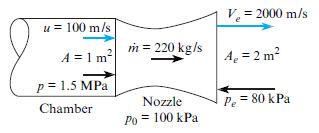
A rocket-nozzle designer is concerned about the force required to hold the nozzle section on the body of a rocket. The nozzle section is shaped as shown in the figure. The pressure and velocity at the entrance to the nozzle are 1.5 MPa and 100 m/s. The exit pressure and velocity are 80 kPa absolute
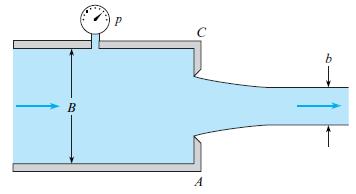
Water (ρ = 62.4 lbm/ft 3) is discharged from the two-dimensional slot shown at the rate of 8 cfs per foot of slot. Determine the pressure p at the gage and the water force per foot on the vertical end plates A and C. The slot and jet dimensions B and b are 8 in. and 4 in., respectively.
Water (at 10°C) is discharged from the two-dimensional slot shown at the rate of 0.40 m3/s per meter of slot. Determine the pressure p at the gage and the water force per meter on the vertical end plates A and C. The slot and jet dimensions B and b are 20 cm and 7 cm, respectively. b B A
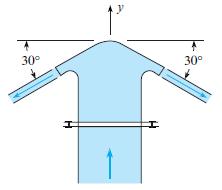
This spray head discharges water (ρ = 62.4 lbm/ft3) at a rate of 4 ft3/s. Assuming irrotational flow and an efflux speed of 58 ft/s in the free jet, determine what force acting through the bolts of the flange is needed to keep the spray head on the 6 in. pipe. Neglect gravitational forces. 30°
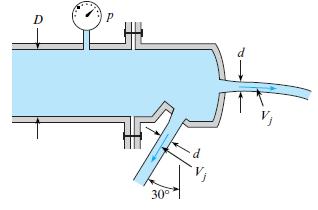
Two circular water (ρ = 62.4 lbm/ft3) jets (d = 0.5 in.) issue from this unusual nozzle. If Vj = 80.2 ft/s, what force is required at the flange to hold the nozzle in place? The pressure in the 4 in. pipe (D = 3.5 in.) is 50 psig. D 30°
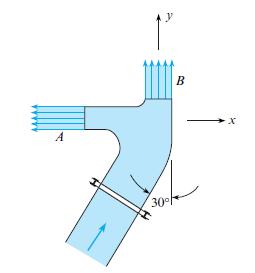
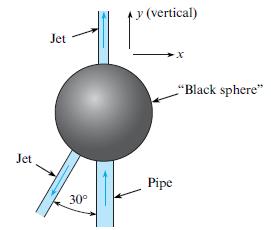
Liquid (SG = 1.2) enters the “black sphere” through a 2 in. pipe with velocity of 50 ft/s and a pressure of 60 psig. It leaves the sphere through two jets as shown. The velocity in the vertical jet is 100 ft/s, and its diameter is 1 in. Th e other jet’s diameter is also 1 in. What force
Liquid (SG = 1.5) enters the “black sphere” through a 5 cm pipe with a velocity of 10 m/s and a pressure of 400 kPa. It leaves the sphere through two jets as shown. The velocity in the vertical jet is 30 m/s, and its diameter is 25 mm. The other jet’s diameter is also 25 mm. What force
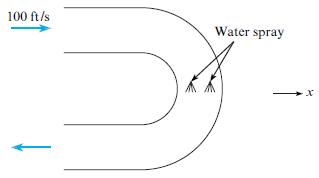
A hot gas stream enters a uniform-diameter return bend as shown. The entrance velocity is 100 ft /s, the gas density is 0.02 lbm/ft3, and the mass flow rate is 2 lbm/s. Water is sprayed into the duct to cool the gas down. The gas exits with a density of 0.05 lbm/ft 3. The mass flow of water into
Assume that the gage pressure p is the same at sections 1 and 2 in the horizontal bend shown in the figure. The fluid flowing in the bend has density ρ, discharge Q, and velocity V. The cross-sectional area of the pipe is A. Then the magnitude of the force (neglecting gravity) required at the
The pipe shown has a 180° vertical bend in it. The diameter D is 1.25 ft , and the pressure at the center of the upper pipe is 15 psig. If the flow in the bend is 40 cfs, what external force will be required to hold the bend in place against the action of the water? Th e bend weighs 200 lbf, and
The pipe shown has a 180° horizontal bend in it as shown, and D is 20 cm. The discharge of water (ρ = 1000 kg/m3) in the pipe and bend is 0.35 m3/s, and the pressure in the pipe and bend is 100 kPa gage. If the bend volume is 0.10 m3, and the bend itself weighs 400 N, what force must be applied
Water (at 50°F) flows in the 90° horizontal bend at a rate of 12 cfs and discharges into the atmosphere past the downstream flange. The pipe diameter is 1 ft . What force must be applied at the upstream flange to hold the bend in place? Assume that the volume of water downstream of the upstream
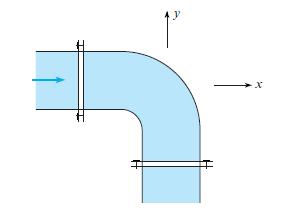
The gage pressure throughout the horizontal 90° pipe bend is 300 kPa. If the pipe diameter is 1.5 m and the water (at 10°C) flow rate is 10 m3/s, what x-component of force must be applied to the bend to hold it in place against the water action? y
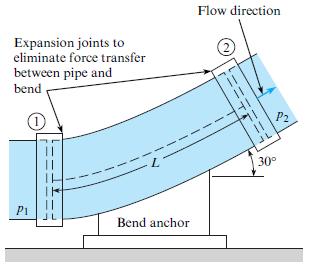
This 30° vertical bend in a pipe with a 1.5 ft diameter carries water (ρ = 62.4 lbm/ft 3) at a rate of 31.4 cfs. If the pressure p1 is 10 psi at the lower end of the bend, where the elevation is 100 ft , and p2 is 8.5 psi at the upper end, where the elevation is 103 ft , what will be the vertical
This bend discharges water (ρ = 1000 kg/m3) into the atmosphere. Determine the force components at the flange required to hold the bend in place. The bend lies in a horizontal plane. Assume viscous forces are negligible. The interior volume of the bend is 0.25 m3, D1 = 60 cm, D2 = 10 cm, and V2 =
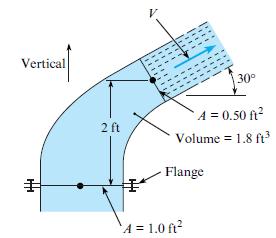
This nozzle bends the flow from vertically upward to 30° with the horizontal and discharges water (γ = 62.4 lbf/ft 3) at a speed of V = 130 ft/s. The volume within the nozzle itself is 1.8 ft3, and the weight of the nozzle is 100 lbf. For these conditions, what vertical force must be applied to
A pipe 1 ft in diameter bends through an angle of 135°. The velocity of flow of gasoline (SG = 0.8) is 15 ft/s, and the pressure is 10 psig in the bend. What external force is required to hold the bend against the action of the gasoline? Neglect the gravitational force.
A 4-in. horizontal pipe has a 180° bend in it. If the rate of flow of water (60°F) in the bend is 8 cfs and the pressure therein is 20 psig, what external force in the original direction of flow is required to hold the bend in place?
A pipe 15 cm in diameter bends through 135°. The velocity of flow of gasoline (SG = 0.8) is 8 m/s, and the pressure is 100 kPa gage throughout the bend. Neglecting gravitational force, determine the external force required to hold the bend against the action of the gasoline.
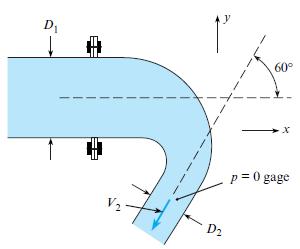
A horizontal reducing bend turns the flow of water (ρ = 1000 kg/m3) through 60°. The inlet area is 0.001 m2, and the outlet area is 0.0001 m2. The water from the outlet discharges into the atmosphere with a velocity of 55 m/s. What horizontal force (parallel to the initial flow direction) acting
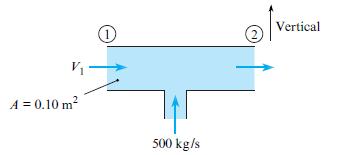
Water (at 10°C) flows in a duct as shown. The inlet water velocity is V1 = 25 m/s. The cross-sectional area of the duct is 0.1 m2. Water is injected normal to the duct wall at the rate of 500 kg/s midway between stations 1 and 2. Neglect frictional forces on the duct wall. Calculate the
Showing 1900 - 2000
of 2369
First
10
11
12
13
14
15
16
17
18
19
20
21
22
23
24
Step by Step Answers

 Get 50% OFF
Claim Now
Get 50% OFF
Claim Now