New Semester
Started
Get
50% OFF
Study Help!
--h --m --s
Claim Now
Question Answers
Textbooks
Find textbooks, questions and answers
Oops, something went wrong!
Change your search query and then try again
S
Books
FREE
Study Help
Expert Questions
Accounting
General Management
Mathematics
Finance
Organizational Behaviour
Law
Physics
Operating System
Management Leadership
Sociology
Programming
Marketing
Database
Computer Network
Economics
Textbooks Solutions
Accounting
Managerial Accounting
Management Leadership
Cost Accounting
Statistics
Business Law
Corporate Finance
Finance
Economics
Auditing
Tutors
Online Tutors
Find a Tutor
Hire a Tutor
Become a Tutor
AI Tutor
AI Study Planner
NEW
Sell Books
Search
Search
Sign In
Register
study help
engineering
engineering fluid mechanics
Engineering Fluid Mechanics 11th Edition Donald F. Elger, Barbara A. LeBret, Clayton T. Crowe, John A. Robertson - Solutions
Can normal shock waves occur in subsonic flows? Explain your answer.
A normal shock wave exists in a 500 m/s stream of nitrogen having a static temperature of −50°C and a static pressure of 70 kPa. Calculate the Mach number, pressure, and temperature downstream of the wave and the entropy increase across the wave.
Can normal shock wave exists in a Mach 3 stream of air having a static temperature and pressure of 35°F and 30 psia. Calculate the Mach number, pressure, and temperature downstream of the shock wave.
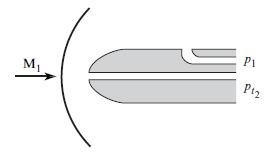
A Pitot-static tube is used to measure the Mach number on a supersonic aircraft . The tube, because of its bluntness, creates a normal shock wave as shown. The absolute total pressure downstream of the shock wave (pt2) is 150 kPa. The static pressure of the free stream ahead of the shock wave (p1)
A shock wave occurs in a methane stream in which the Mach number is 3, the static pressure is 89 kPa absolute, and the static temperature is 20°C. Determine the downstream Mach number, static pressure, static temperature, and density.
The Mach number downstream of a shock wave in helium is 0.85, and the static temperature is 110°C. Calculate the velocity upstream of the wave.
What is meant by “back pressure”?
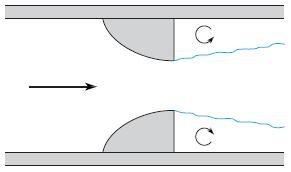
The truncated nozzle shown in the figure is used to meter the mass flow of air in a pipe. The area of the nozzle is 3 cm2. The total pressure and total temperature measured upstream of the nozzle in the pipe are 300 kPa absolute and 20°C. The pressure downstream of the nozzle (back pressure) is 90
The truncated nozzle shown in the figure is used to monitor the mass flow rate of methane. The area of the nozzle is 3 cm2, and the area of the pipe is 12 cm2. The upstream total pressure and total temperature are 150 kPa absolute and 30°C. The back pressure is 100 kPa. a. Calculate the mass
A truncated nozzle with a 10 cm2 exit area is supplied from a helium reservoir in which the absolute pressure is first 130 kPa and then 350 kPa. The temperature in the reservoir is 28°C, and the back pressure is 100 kPa. Calculate the mass flow rate of helium for the two reservoir pressures.
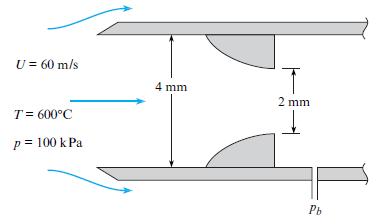
A sampling probe is used to draw gas samples from a gas stream for analysis. In sampling, it is important that the velocity entering the probe equal the velocity of the gas stream (isokinetic condition). Consider the sampling probe shown, which has a truncated nozzle inside it to control the mass
Sketch how the Mach number and velocity vary through a de Laval nozzle from the entrance to the exit. How is the velocity variation different from a venturi configuration?
When a de Laval nozzle has expansion ratio of 4, what does that mean?
A wind tunnel using air is designed to have a Mach number of 3, a static pressure of 1.5 psia, and a static temperature of −10°F in the test section. Determine the area ratio of the nozzle required and the reservoir conditions that must be maintained if air is to be used.
A de Laval nozzle is to be designed to operate supersonically and expand ideally to an absolute pressure of 25 kPa. If the stagnation pressure in the nozzle is 1 MPa, calculate the nozzle area ratio required. Determine the nozzle throat area for a mass flow of 10 kg/s and a stagnation temperature
A rocket nozzle with an area ratio of 4 is operating at a total absolute pressure of 1.3 MPa and exhausting to an atmosphere with an absolute pressure of 30 kPa. Determine whether the nozzle is overexpanded, underexpanded, or ideally expanded. Assume k = 1.4.
A de Laval nozzle with an exit area ratio of 1.688 exhausts air from a large reservoir into ambient conditions at p = 100 kPa. a. Show that the reservoir pressure must be 782.5 kPa to achieve ideally expanded exit conditions at M = 2. b. What are the static temperature and pressure at the
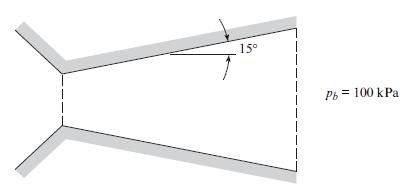
A rocket nozzle has the configuration shown. The diameter of the throat is 4 cm, and the exit diameter is 8 cm. The half-angle of the expansion cone is 15°. Gases with a specific heat ratio of 1.2 flow into the nozzle with a total pressure of 250 kPa. The back pressure is 100 kPa. First, using an
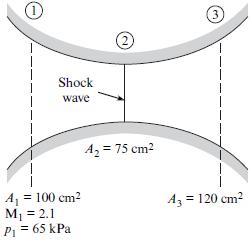
Consider airflow in the variable-area channel shown in the figure. Determine the Mach number, static pressure, and stagnation pressure at station 3. Assume isentropic flow except for normal shock waves. (3. 2) Shock wave A, = 75 cm2 A, = 100 cm2 M1 = 2.1 P1 = 65 kPa Az = 120 cm2
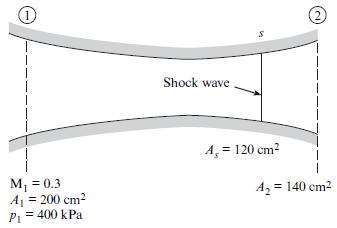
Determine the back pressure necessary for the shock wave to position itself as shown in the figure. The fluid is air. (1 2) Shock wave A, = 120 cm? M, = 0.3 A1 = 200 cm? P1 = 400 kPa Az = 140 cm2
List five different instruments or approaches that engineers use to measure fluid velocity, and five more that are used to measure pressure. For each instrument or approach, list two advantages and two disadvantages, using this text or sources on the internet.
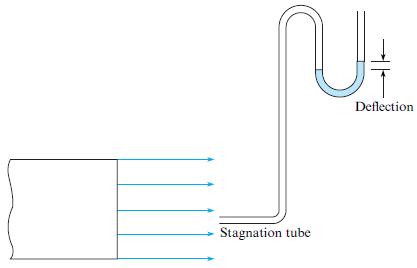
A stagnation tube 4 mm in diameter is used to measure the velocity in a stream of air as shown. What is the air velocity if the deflection on the air-water manometer is 1.6 mm? Air temperature = 10°C, and p = 1 atm.
If the velocity in an airstream (pa = 98 kPa; T = 10°C) is 24 m/s, what deflection will be produced in an air-water manometer if the stagnation tube is 2 mm in diameter? Deflection Stagnation tube
What would be the error in velocity determination if one used a Cp value of 1.00 for a circular stagnation tube instead of the true value? Assume the measurement is made with a stagnation tube 2 mm in diameter that is measuring air (T=25°C,p = 1 atm) velocity for which the stagnation
Firefighting equipment requires that the exit velocity of the firehose be 30 m/s at an elevation of 45 m above the hydrant. The nozzle at the end of the hose has a contraction ratio of 4:1 (Ae/Ahose = 1/4). The head loss in the hose is 8V 2/2g, where V is the velocity in the hose. What must the
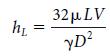
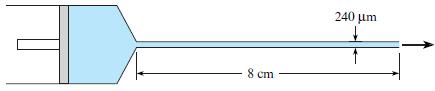
As shown, a microchannel is being designed to transfer fluid in a MEMS (micro electrical mechanical system) application. The channel is 240 micrometers in diameter and is 8 cm long. Ethyl alcohol is driven through the system at the rate of 0.1 microliters/s (μL/s) with a syringe pump, which is
A minor artery in the human arm, diameter D = 1 cm, tapers gradually over a distance of 10 cm to a diameter of d = 0.8 cm. The blood pressure (gage) at diameter D is 110 mm Hg, and at d is 85 mm Hg. What is the head loss (m) that occurs over this distance if the blood (SG = 1.06) is moving with a
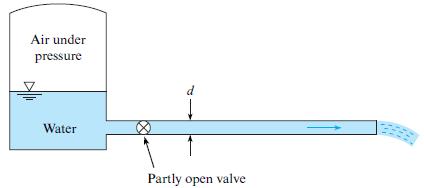
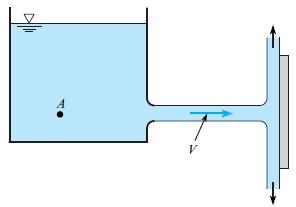
In the figure shown, suppose that the reservoir is open to the atmosphere at the top. The valve is used to control the flow rate from the reservoir. The head loss across the valve is given as hL = 4V2/2g, where V is the velocity in the pipe. The cross-sectional area of the pipe is 8 cm2. The head
A reservoir with water is pressurized as shown. The pipe diameter is 1 in. The head loss in the system is given by hL=5V2/2g. The height between the water surface and the pipe outlet is 10 ft. A discharge of 0.10 ft3/s is needed. What must the pressure in the tank be to achieve such a flow rate?
Water flows from a pressurized tank as shown. The pressure in the tank above the water surface is 100 kPa gage, and the water surface level is 8 m above the outlet. The water exit velocity is 10 m/s. The head loss in the system varies as hL=KLV2/2g, where KL is the minor-loss coefficient. Find the
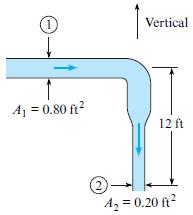
Gasoline having a specific gravity of 0.8 is flowing in the pipe shown at a rate of 5 cfs. What is the pressure at section 2 when the pressure at section 1 is 18 psig and the head loss is 9 ft between the two sections? Assume α = 1.0 at all locations. Vertical Aj = 0.80 ft? 12 ft 2) A, = 0.20 ft?
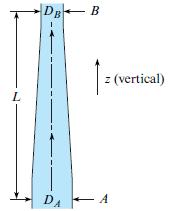
For this refinery pipe, DA = 20 cm, DB = 14 cm, and L = 1 m. If crude oil (SG = 0.90) is flowing at a rate of 0.05 m3/s, determine the difference in pressure between sections A and B. Neglect head losses. DB - B z (vertical) L. DA - A
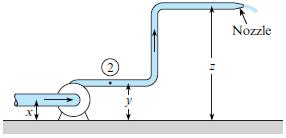
For this diagram of an industrial pressure washer system, x = 2 ft , y = 5 ft , z = 9 ft , Q = 3.4 ft 3/s, and the hose diameter is 3 in. Assuming a head loss of 4 ft is derived over the distance from point 2 to the jet, what is the pressure at point 2 if the jet from the nozzle is 1 in. in
For this system, the discharge of water is 0.2 m3/s, x = 1.0 m, y = 1.5 m, z = 6.0 m, and the pipe diameter is 60 cm. Assuming a head loss of 0.5 m, what is the pressure head at point 2 if the jet from the nozzle is 10 cm in diameter? Assume α = 1.0 at all locations.
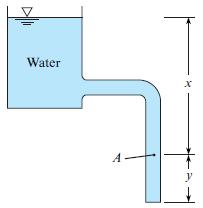
A pipe drains a tank as shown. If x = 2 m, y = 1 m, and head losses are neglected, what is the pressure at point A and what is the velocity at the exit? Assume α = 1.0 at all locations. Water A-
A pipe drains a tank as shown. If x = 11 ft , y = 7 ft , and head losses are neglected, what is the pressure at point A and what is the velocity at the exit? Assume α = 1.0 at all locations.
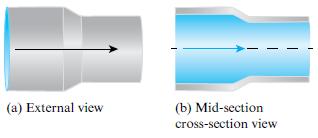
It is necessary to find the head loss for the pipe reducer shown, installed in a system with 10°C water flowing at 0.040 m3/s. The diameter reduces from 20 cm to 12 cm across this fitting (flow direction arrow shown), and the centerline pressure is measured to drop from 490 kPa to 470 kPa for the
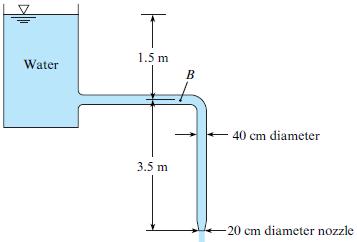
Determine the discharge in the pipe and the pressure at point B. Neglect head losses. Assume α = 1.0 at all locations. Water 1.5 m B 40 cm diameter 3.5 m -20 cm diameter nozzle
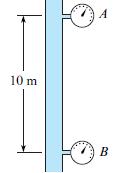
Water flows at a steady rate in this vertical pipe. The pressure at A is 10 kPa, and at B it is 98.1 kPa. The flow in the pipe is (a) Upward, (b) Downward, or (c) No flow. (Hint: See problem 7.23.) A 10 m B
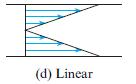
Calculate α for case (d). (d) Linear
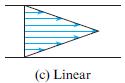
Calculate α for case (c). (c) Linear
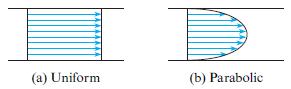
For these velocity distributions in a round pipe, indicate whether the kinetic energy correction factor α is greater than, equal to, or less than unity. (а) Uniform (b) Рarabolic
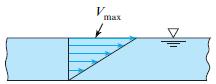
For this hypothetical velocity distribution in a wide rectangular channel, evaluate the kinetic energy correction factor α. V. max
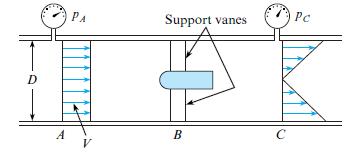
Using Section 7.3 and other resources, answer the following questions. Strive for depth, clarity, and accuracy while also combining sketches, words, and equations in ways that enhance the effectiveness of your communication.a. What is the kinetic energy correction factor? Why do engineers use this
The first law of thermodynamics for a closed system can be characterized in words asa. (Change in energy in a system) = (thermal energy in) – (work done on surroundings)b. (Change in energy in a system) = (thermal energy out) – (work done by surroundings)c. Either of the above
An engineer is considering the development of a small wind turbine (D = 1.25 m) for home applications. The design wind speed is 15 mph at T = 10°C and p = 0.9 bar. The efficiency of the turbine is η = 20%, meaning that 20% of the kinetic energy in the wind can be extracted. Estimate the power in
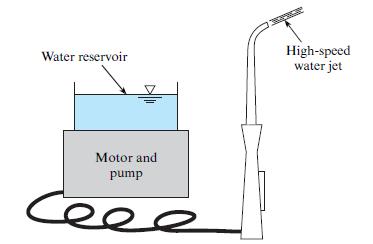
The sketch shows a common consumer product called the Water Pik. This device uses a motor to drive a piston pump that produces a jet of water (d = 1 mm, T = 10°C) with a speed of 27 m/s. Estimate the minimum electrical power in watts that is required by the device.(a) Assume that the power is used
Power (select all that are correct)a. Has same units as energyb. Has same units as energy/timec. Has same units as work/timed. Can have units of Joulee. Can have units of Wattf. Can have units of horsepowerg. Can have units of ft ∙ lbf
Energy (select all that are correct):a. Has same units as workb. Has same units as powerc. Has same units work/timed. Can have units of Joulee. Can have units of Wattf. Can have units of ft ∙ lbfg. Can have units of calories
Apply the grid method to each situation.a. Calculate the energy in joules used by a 13 hp pump that is operating for 410 hours. Also, calculate the cost of electricity for this time period. Assume that electricity costs $0.20 per kWh.b. A motor is being used to turn the shaft of a centrifugal pump.
Using Section 7.1 and other resources, answer the following questions. Strive for depth, clarity, and accuracy. Also, strive for effective use of sketches, words, and equations.a. What are the common forms of energy? Which of these forms are relevant to fluid mechanics?b. What is work? Describe
Fill in the blanks. Show your work.a. 1090 J = ________ Cal.b. _______ ft ∙ lbf = energy to lift a 13 N weight through an elevation difference of 115 m.c. 17000 Btu = ________ kWh.d. 71 ft ∙ lbf/s = ________ hp.e. [E] = [energy] = ________
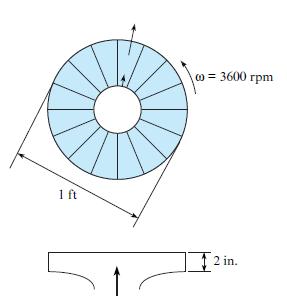
A centrifugal fan is used to pump air. The fan rotor is 1 ft in diameter, and the blade spacing is 2 in. The air enters with no angular momentum and exits radially with respect to the fan rotor. The discharge is 1500 cfm. The rotor spins at 3600 rev/min. The air is at atmospheric pressure and a
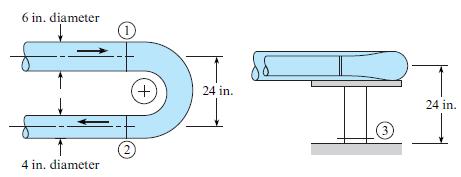
A reducing pipe bend is held in place by a pedestal as shown. There are expansion joints at sections 1 and 2, so no force is transmitted through the pipe past these sections. The pressure at section 1 is 20 psig, and the rate of flow of water (ρ = 62.4 lbm/ft 3) is 2 cfs. Find the force and moment
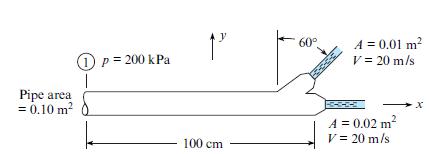
What is the reaction at section 1? Water (ρ = 1000 kg/m3) is flowing, and the axes of the two jets lie in a vertical plane. The pipe and nozzle system weighs 90 N. y A = 0.01 m? V = 20 m/s 60° O p= 200 kPa Pipe area = 0.10 m? 0 A = 0.02 m? V = 20 m/s 100 cm
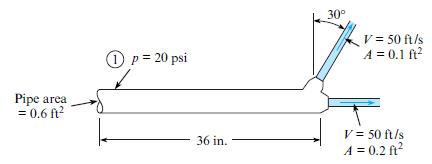
What is the force and moment reaction at section 1? Water (at 50°F) is flowing in the system. Neglect gravitational forces. 30° V = 50 ft/s A = 0.1 ft? O p = 20 psi Pipe area ='0.6 ft? V = 50 ft/s A = 0.2 ft? 36 in.
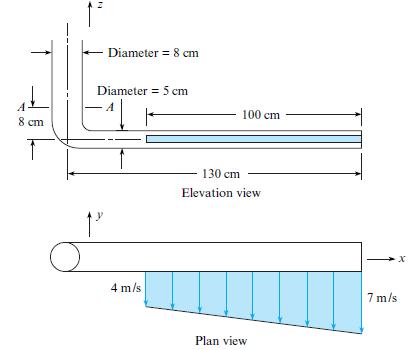
Water (ρ = 1000 kg/m3) is discharged from the slot in the pipe as shown. If the resulting two-dimensional jet is 100 cm long and 15 mm thick, and if the pressure at section A-A is 30 kPa, what is the reaction at section A-A? In this calculation, do not consider the weight of the pipe. Diameter = 8
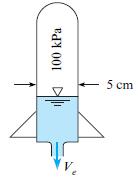
A very popular toy on the market several years ago was the water rocket. Water (at 10°C) was loaded into a plastic rocket and pressurized with a hand pump. The rocket was released and would travel a considerable distance in the air. Assume that a water rocket has a mass of 50 g and is charged with
A water jet strikes a cart as shown. After striking the cart, the water is deflected vertically with respect to the cart. The cart is initially at rest and is accelerated by the water jet. The mass in the water jet is much less than that of the cart. There is no resistance on the cart. The mass
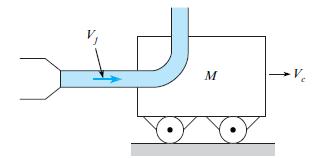
A water jet is used to accelerate a cart as shown. The discharge (Q) from the jet is 0.1 m3/s, and the velocity of the jet (Vj) is 10 m/s. When the water hits the cart, it is deflected normally as shown. The mass of the cart (M) is 10 kg. The density of water (ρ) is 1000 kg/m3. There is no
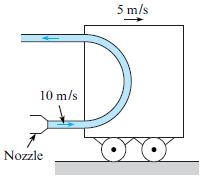
A cart is moving along a railroad track at a constant velocity of 5 m/s as shown. Water (ρ = 1000 kg/m3) issues from a nozzle at 10 m/s and is deflected through 180° by a vane on the cart. The cross-sectional area of the nozzle is 0.002 m2. Calculate the resistive force on the cart. 5 m/s 10 m/s
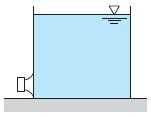
The open water tank shown is resting on a frictionless plane. The capped orifice on the side has a 4 cm diameter exit pipe that is located 3 m below the surface of the water. Ignore all friction effects, and determine the force necessary to keep the tank from moving when the cap is removed.
The surface of the earth is not a true inertial reference frame because there is a centripetal acceleration due to the earth’s rotation. The earth rotates once every 24 hours and has a diameter of 8000 miles. What is the centripetal acceleration on the surface of the earth, and how does it
Using the Internet or some other source as reference, define in your own words the meaning of “inertial reference frame.”
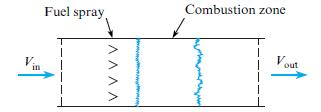
A ramjet operates by taking in air at the inlet, providing fuel for combustion, and exhausting the hot air through the exit. The mass flow at the inlet and outlet of the ramjet is 60 kg/s (the mass flow rate of fuel is negligible). The inlet velocity is 225 m/s. The density of the gases at the exit
A torpedo-like device is tested in a wind tunnel with an air density of 0.0026 slugs/ft3. The tunnel is 3 ft in diameter, the upstream pressure is 0.24 psig, and the downstream pressure is 0.10 psig. If the mean air velocity is V = 120 ft /s, what are the mass rate of flow and the maximum velocity
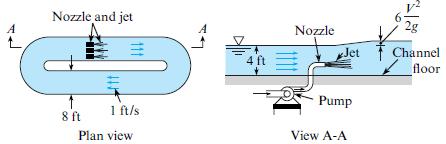
Jet-type pumps are sometimes used to circulate the flow in basins in which fish are being reared. The use of a jet-type pump eliminates the need for mechanical machinery that might be injurious to the fish. The accompanying figure shows the basic concept for this type of application. For this type
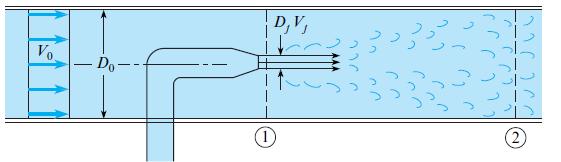
The figure illustrates the principle of the jet pump. Derive a formula for p2 – p1 as a function of Dj, Vj, D0, V0, and ρ. Assume that the fluid from the jet and the fluid initially flowing in the pipe are the same, and assume that they are completely mixed at section 2, so that the velocity is
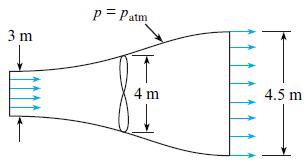
A wind turbine is operating in a 12 m/s wind that has a density of 1.2 kg/m3. Th e diameter of the turbine silhouette is 4 m. The constant-pressure (atmospheric) streamline has a diameter of 3 m upstream of the windmill and 4.5 m downstream. Assume that the velocity distributions are uniform and
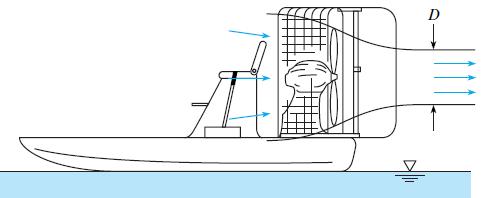
The propeller on a swamp boat produces a slipstream 3 ft in diameter with a velocity relative to the boat of 100 ft/s. If the air temperature is 80°F, what is the propulsive force when the boat is not moving and also when its forward speed is 30 ft/s? Assume that the pressure, except in the
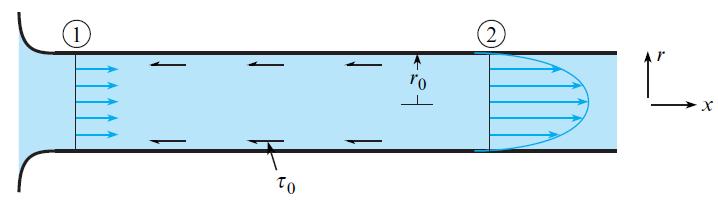
For laminar flow in a pipe, wall shear stress (τ0) causes the velocity distribution to change from uniform to parabolic as shown. At the fully developed section, the velocity profile is u = umax[1 – (r/r0)2]. Derive a formula for the force on the wall due to shear stress, Fτ, between 1 and 2 as
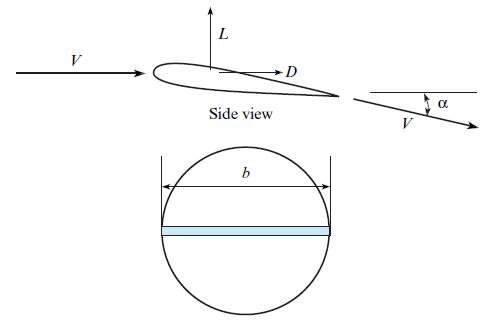
A finite span airfoil can be regarded as a vane as shown in the figure. The cross section of air affected is equal to the circle with the diameter of the wing span, b. The wing deflects the air by an angle α and produces a force normal to the free-stream velocity, the lift L, and in the
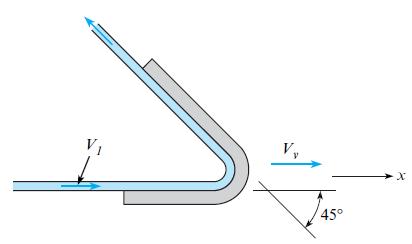
A horizontal jet of water (at 10°C) that is 6 cm in diameter and has a velocity of 20 m/s is deflected by the vane as shown. If the vane is moving at a rate of 7 m/s in the x-direction, what components of force are exerted on the vane by the water in the x-and y-directions? Assume negligible
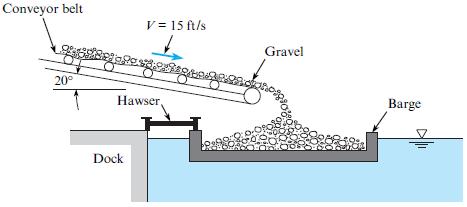
A conveyor belt discharges gravel into a barge as shown at a rate of 40 yd3/min. If the gravel weighs 120 lbf/ft 3, what is the tension in the hawser that secures the barge to the dock? Conveyor belt V = 15 ft/s Gravel 20° Hawser, Barge Dock
A jet of water (60°F) is discharging at a constant rate of 2.0 cfs from the upper tank. If the jet diameter at section 1 is 4 in., what forces will be measured by scales A and B? Assume the empty tank weighs 300 lbf, the cross-sectional area of the tank is 4 ft 2, h = 1 ft , and H = 9 ft .
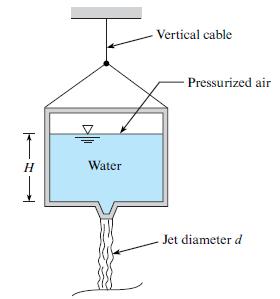
A tank of water (15°C) with a total weight of 200 N (water plus the container) is suspended by a vertical cable. Pressurized air drives a water jet (d = 12 mm) out the bottom of the tank such that the tension in the vertical cable is 10 N. If H = 425 mm, fi nd the required air pressure in units of
A group of friends regularly enjoys white-water rafting, and they bring piston water guns to shoot water from one raft to another. One summer they notice that when on placid slack water (no current), after just a few volleys at each other, they are drifting apart. They wonder whether the jet being
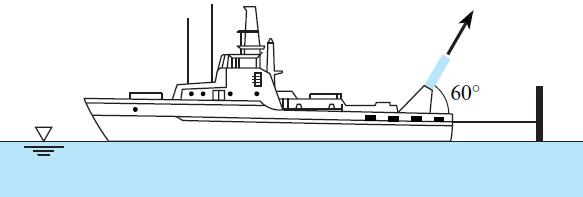
A boat is held stationary by a cable attached to a pier. A firehose directs a spray of 5°C water at a speed of V = 50 m/s. If the allowable load on the cable is 5 kN, calculate the mass flow rate of the water jet. What is the corresponding diameter of the water jet? 60
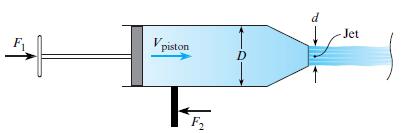
An engineer, who is designing a water toy, is making preliminary calculations. A user of the product will apply a force F1 that moves a piston (D = 80 mm) at a speed of Vpiston = 300 mm/s. Water at 20°C jets out of a converging nozzle of diameter d = 15 mm. To hold the toy stationary, the user
A horizontal water jet at 70°F issues from a circular orifice in a large tank. The jet strikes a vertical plate that is normal to the axis of the jet. A force of 600 lbf is needed to hold the plate in place against the action of the jet. If the pressure in the tank is 25 psig at point A, what is
This tank provides a water jet (70°F) to cool a vertical metal surface during manufacturing. Calculate V when a horizontal force of 180 lbf is required to hold the metal surface in place. Q = 3 cfs.
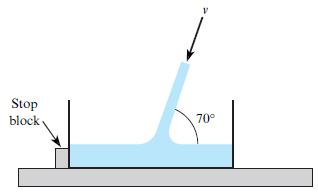
A water jet of diameter 2 inches and speed v = 60 ft/s is filling a tank. The tank has a mass of 25 lbm and contains 6 gallons of water at the instant shown. The water temperature is 70°F. Find the minimum coefficient of friction such that the force acting on the stop block is zero.
A water jet of diameter 40 mm and speed v = 20 m/s is filling a tank. The tank has a mass of 23 kg and contains 28 liters of water at the instant shown. The water temperature is 15°C. Find the force acting on the bottom of the tank and the force acting on the stop block. Neglect friction. Stop
The balloon rocket is held in place by a force F. Th e pressure inside the balloon is 12 in-H2O, the nozzle diameter is 0.4 cm, and the air density is 1.2 kg/m3. Find the exit velocity v and the force F. Neglect friction and assume the air flow is inviscid and irrotational. Nozzle
Give five examples of jets and how they occur in practice.
Which are the following are correct with respect to the derivation of the momentum equation? (Select all that apply.)a. Reynold’s transport theorem is applied to Fick’s law.b. The extensive property is momentum.c. The intensive property is mass.d. The velocity is assumed to be uniformly
Newton’s second law can be stated in this way: the force is equal to the rate of change of momentum, F = d(mv)/dt. Taking the derivative by parts yields F = m(dv/dt) + v(dm/dt). This does not correspond to F = ma. What is the source of the discrepancy?
Identify the surface and body forces acting on a buoy in the ocean. Also, sketch a free body diagram and explain how Newton’s laws of motion apply.
When the hydrofoil shown was tested, the minimum pressure on the surface of the foil was found to be 70 kPa absolute when the foil was submerged 1.80 m and towed at a speed of 8 m/s. At the same depth, at what speed will cavitation first occur? Assume irrotational flow and T = 10°C.
A sphere 1 ft in diameter is moving horizontally at a depth of 12 ft below a lake surface where the water temperature is 50°F. Relative to the sphere, the maximum water speed is Vmax = 1.5 Vo. Here, Vmax occurs near the upper and lower parts of the sphere. The term Vo is the speed of the sphere.
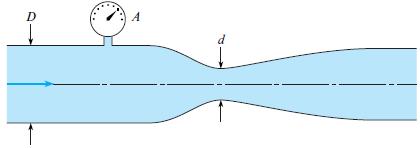
When gage A indicates a pressure of 130 kPa gage, then cavitation just starts to occur in the venturi meter. If D = 50 cm and d = 10 cm, what is the water discharge in the system for this condition of incipient cavitation? The atmospheric pressure is 100 kPa abs and the water temperature is 10°C.
Th e following questions have to do with cavitation.a. Is it more correct to say that cavitation has to do with (i) vacuum pressures, or (ii) vapor pressures?b. What does the word cavitation have to do with cavities, like the ones we get in our teeth?c. When water goes over a waterfall and you can
What is cavitation? Why does the tendency for cavitation in a liquid increase with increased temperatures?
Sometimes, when driving your car on a hot day, you may encounter a problem with the fuel pump called pump cavitation. What is happening to the gasoline? How does this affect the operation of the pump?
Water is forced out of this cylinder by the piston. If the piston is driven at a speed of 6 ft/s, what will be the speed of efflux of the water from the nozzle if d = 2 in. and D = 4 in.? Neglecting friction and assuming irrotational flow, determine the force F that will be required to drive the
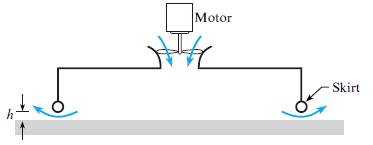
A design for a hovercraft is shown in the figure. A fan brings air at 60°F into a chamber, and the air is exhausted between the skirts and the ground. The pressure inside the chamber is responsible for the lift . The hovercraft is 15 ft long and 7 ft wide. The weight of the craft including crew,
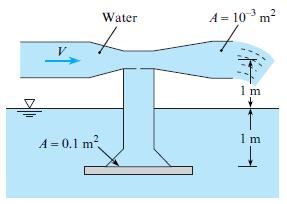
A suction device is being designed based on the venturi principle to lift objects submerged in water. The operating water temperature is 15°C. The suction cup is located 1 m below the water surface, and the venturi throat is located 1 m above the water. The atmospheric pressure is 100 kPa. The
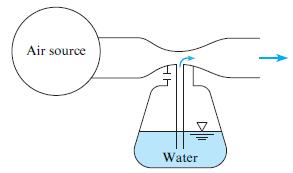
An atomizer utilizes a constriction in an air duct as shown. Design an operable atomizer making your own assumptions regarding the air source. Air source Water HH
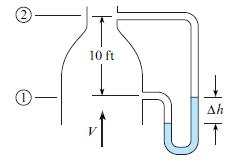
Air with a density of 0.07 lbm/ft 3 is flowing upward in the vertical duct, as shown. The velocity at the inlet (station 1) is 90 ft/s, and the area ratio between stations 1 and 2 is 0.3 (A2/A1 = 0.3). Two pressure taps, 10 ft apart, are connected to a manometer, as shown. The specific weight of
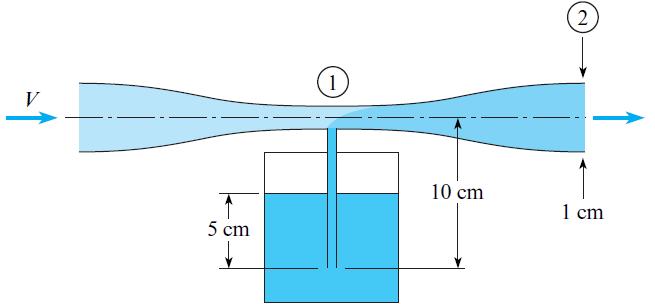
Venturi-type applicators are frequently used to spray liquid fertilizers. Water flowing through the venturi creates a sub atmospheric pressure at the throat, which in turn causes the liquid fertilizer to flow up the feed tube and mix with the water in the throat region. The venturi applicator shown
Showing 1700 - 1800
of 2369
First
10
11
12
13
14
15
16
17
18
19
20
21
22
23
24
Step by Step Answers

 Get 50% OFF
Claim Now
Get 50% OFF
Claim Now