New Semester
Started
Get
50% OFF
Study Help!
--h --m --s
Claim Now
Question Answers
Textbooks
Find textbooks, questions and answers
Oops, something went wrong!
Change your search query and then try again
S
Books
FREE
Study Help
Expert Questions
Accounting
General Management
Mathematics
Finance
Organizational Behaviour
Law
Physics
Operating System
Management Leadership
Sociology
Programming
Marketing
Database
Computer Network
Economics
Textbooks Solutions
Accounting
Managerial Accounting
Management Leadership
Cost Accounting
Statistics
Business Law
Corporate Finance
Finance
Economics
Auditing
Tutors
Online Tutors
Find a Tutor
Hire a Tutor
Become a Tutor
AI Tutor
AI Study Planner
NEW
Sell Books
Search
Search
Sign In
Register
study help
engineering
engineering fluid mechanics
Munson Young And Okiishi's Fundamentals Of Fluid Mechanics 8th Edition Philip M. Gerhart, Andrew L. Gerhart, John I. Hochstein - Solutions
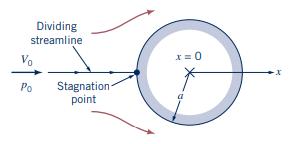
An incompressible fluid flows steadily past a circular cylinder as shown in Fig. P3.8. The fluid velocity along the dividing streamline \((-\infty \leq x \leq-a)\) is found to be \(V=V_{0}\left(1-a^{2} / x^{2}\right)\), where \(a\) is the radius of the cylinder and \(V_{0}\) is the upstream
Consider a compressible liquid that has a constant bulk modulus. Integrate "F = ma" along a streamline to obtain the equivalent of the Bernoulli equation for this flow. Assume steady, inviscid flow. Bernoulli equation p+pv + z = constant along streamline
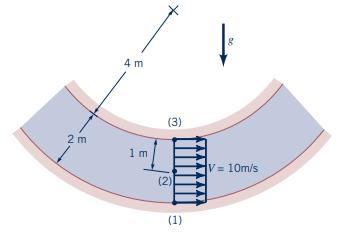
Water flows around the vertical two-dimensional bend with circular streamlines and constant velocity as shown in Fig. P3.12. If the pressure is \(40 \mathrm{kPa}\) at point (1), determine the pressures at points (2) and (3). Assume that the velocity profile is uniform as indicated.Figure P3.12 4 m
Air flows along a horizontal, curved streamline with a \(20 \mathrm{ft}\) radius with a speed of \(100 \mathrm{ft} / \mathrm{s}\). Determine the pressure gradient normal to the streamline.
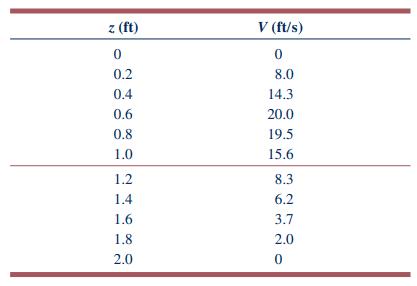
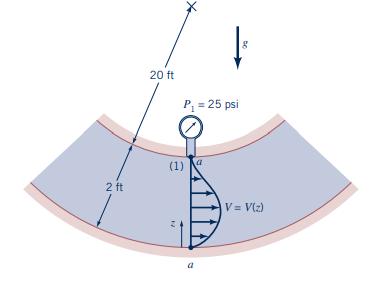
Water flows around the vertical two-dimensional bend with circular streamlines as is shown in Fig. P3.13. The pressure at point (1) is measured to be \(p_{1}=25 \mathrm{psi}\) and the velocity across section \(a-a\) is as indicated in the table. Calculate and plot the pressure across section
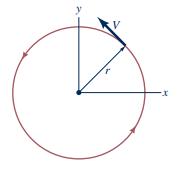
Water in a container and air in a tornado flow in horizontal circular streamlines of radius \(r\) and speed \(V\) as shown in Video V3.6 and Fig. P3.14. Determine the radial pressure gradient, \(\partial p / \partial r\), needed for the following situations:(a) The fluid is water with \(r=3
Air flows smoothly over the hood of your car and up past the windshield. However, a bug in the air does not follow the same path; it becomes splattered against the windshield. Explain why this is so.
At a given point on a horizontal streamline in flowing air, the static pressure is \(-2.0 \mathrm{psi}\) (i.e., a vacuum) and the velocity is \(150 \mathrm{ft} / \mathrm{s}\). Determine the pressure at a stagnation point on that streamline.
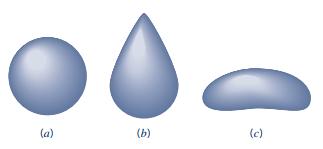
A drop of water in a zero-g environment (as in the International Space Station) will assume a spherical shape as shown in Fig. P3.18a. A raindrop in the cartoons is typically drawn as in Fig. P3.18b. The shape of an actual raindrop is more nearly like that shown in Fig. 3.18c. Discuss why these
When an airplane is flying \(200 \mathrm{mph}\) at \(5000-\mathrm{ft}\) altitude in a standard atmosphere, the air velocity at a certain point on the wing is \(273 \mathrm{mph}\) relative to the airplane.(a) What suction pressure is developed on the wing at that point?(b) What is the pressure at
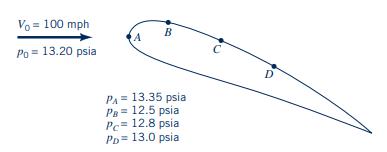
Air flows over the airfoil shown in Fig. P3.20. Sensors give the pressures shown at points \(A, B, C\), and \(D\). Find the air velocities just above points \(A, B, C\), and \(D\). The air density is 0.0020 slug \(/ \mathrm{ft}^{3}\).\(\xrightarrow[p_{0}=13.20 \text { psia }]{V_{0}=100
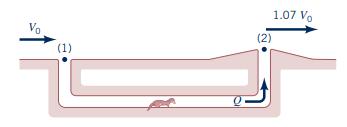
Some animals have learned to take advantage of the Bernoulli effect without having read a fluid mechanics book. For example, a typical prairie dog burrow contains two entrances-a flat front door and a mounded back door as shown in Fig. P3.21. When the wind blows with velocity \(V_{0}\) across the
Estimate the pressure on your hand when you hold it in the stream of air coming from the air hose at a filling station. List all assumptions and show calculations. Warning: Do not try this experiment; it can be dangerous!
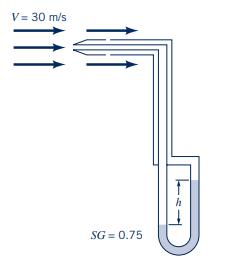
What is the minimum height for an oil \((S G=0.75)\) manometer to measure airplane speeds up to \(30 \mathrm{~m} / \mathrm{s}\) at altitudes up to \(1500 \mathrm{~m}\) ? The manometer is connected to a Pitot-static tube as shown in Fig. P3.24.Figure P3.24 V = 30 m/s SG=0.75
A Pitot-static tube is used to measure the velocity of helium in a pipe. The temperature and pressure are \(40^{\circ} \mathrm{F}\) and 25 psia. A water manometer connected to the Pitot-static tube indicates a reading of 2.3 in. Determine the helium velocity. Is it reasonable to consider the flow
A Bourdon-type pressure gage is used to measure the pressure from a Pitot tube attached to the leading edge of an airplane wing. The gage is calibrated to read in miles per hour at standard sea level conditions (rather than psi). If the airspeed meter indicates \(150 \mathrm{mph}\) when flying at
Estimate the force of a hurricane strength wind against the side of your house. List any assumptions and show all calculations.
A 40-mph wind blowing past your house speeds up as it flows up and over the roof. If elevation effects are negligible, determine(a) the pressure at the point on the roof where the speed is \(60 \mathrm{mph}\) if the pressure in the free stream blowing toward your house is 14.7 psia. Would this
The Wide World of Fluids article titled "Pressurized eyes,". Determine the air velocity needed to produce a stagnation pressure equal to \(10 \mathrm{~mm}\) of mercury.
Water flows through a hole in the bottom of a large, open tank with a speed of \(8 \mathrm{~m} / \mathrm{s}\). Determine the depth of water in the tank. Viscous effects are negligible.
Estimate the pressure needed at the pumper truck in order to shoot water from the street level onto a fire on the roof of a five-story building. List all assumptions and show all calculations.
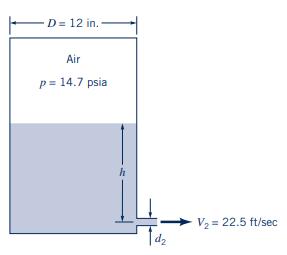
The tank shown in Fig. P3.32 contains air at atmospheric pressure above the water surface. The velocity of the water flowing from the tank is \(22.5 \mathrm{ft} / \mathrm{sec}\). Determine the water level \((h)\).Figure P3.32 D= 12 in.- Air p = 14.7 psia h d V = 22.5 ft/sec
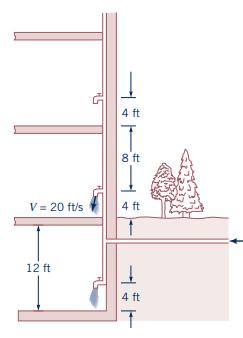
Water flows from the faucet on the first floor of the building shown in Fig. P3. 33 with a maximum velocity of \(20 \mathrm{ft} / \mathrm{s}\). For steady inviscid flow, determine the maximum water velocity from the basement faucet and from the faucet on the second floor (assume each floor is \(12
Laboratories containing dangerous materials are often kept at a pressure slightly less than ambient pressure so that contaminants can be filtered through an exhaust system rather than leaked through cracks around doors, etc. If the pressure in such a room is 0.1 in. of water below that of the
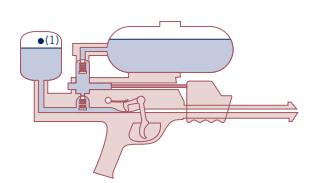
The "supersoaker" water gun shown in Fig. P3. 35 can shoot more than \(30 \mathrm{ft}\) in the horizontal direction. Estimate the minimum pressure, \(p_{1}\), needed in the chamber in order to accomplish this. List all assumptions and show all calculations.Figure P3.35
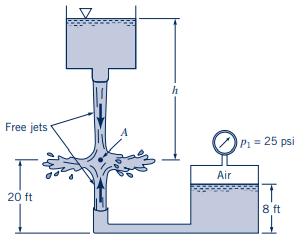
Streams of water from two tanks impinge upon each other as shown in Fig. P3.36. If viscous effects are negligible and point \(A\) is a stagnation point, determine the height \(h\).Figure P3.36 Free jets h 20 ft Air P = 25 psi T 8 ft
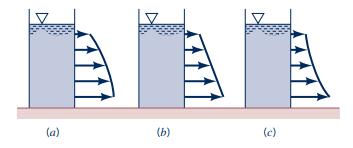
Several holes are punched into a tin can as shown in Fig. P3.37. Which of the figures represents the variation of the water velocity as it leaves the holes? Justify your choice.Figure P3.37 (2) (9) (D)
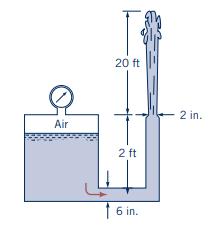
Water flows from a pressurized tank, through a 6 -in.-diameter pipe, exits from a 2-in.-diameter nozzle, and rises \(20 \mathrm{ft}\) above the nozzle as shown in Fig. P3.38. Determine the pressure in the tank if the flow is steady, frictionless, and incompressible.Figure P3.38 20 ft Air 2 ft 6 in.
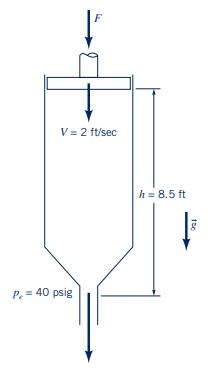
The piston shown in Fig. P3.39 is forcing \(70{ }^{\circ} \mathrm{F}\) water out the exit at \(12 \mathrm{ft} / \mathrm{sec}\). The exit pressure has been measured as \(p_{e}=40 \mathrm{psig}\). Determine the force on the piston for a piston diameter \(D_{p}=3.0 \mathrm{in}\).Figure P3.39 F V = 2
Air flows steadily through a horizontal 4-in.-diameter pipe and exits into the atmosphere through a 3-in.-diameter nozzle. The velocity at the nozzle exit is \(150 \mathrm{ft} / \mathrm{s}\). Determine the pressure in the pipe if viscous effects are negligible.
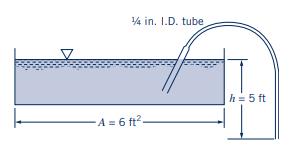
Figure P3.42 shows a tube for siphoning water from an aquarium. Determine the rate at which the water leaves the aquarium for the conditions shown. Is there an advantage to having the large-diameter section? The water flow is inviscid.Figure P3.42 4 in. I.D. tube A 6 ft- h = 5 ft
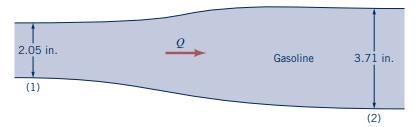
For the pipe enlargement shown in Fig. P3.43, the pressures at sections (1) and (2) are 56.3 and 58.2 psi, respectively. Determine the weight flowrate ( \(\mathrm{lb} / \mathrm{s})\) of the gasoline in the pipe.Figure P3.43 2.05 in. Gasoline (1) 3.71 in. (2)
A fire hose nozzle has a diameter of \(1 \frac{1}{8} \mathrm{in}\). According to some fire codes, the nozzle must be capable of delivering at least 250 \(\mathrm{gal} / \mathrm{min}\). If the nozzle is attached to a 3-in.-diameter hose, what pressure must be maintained just upstream of the nozzle
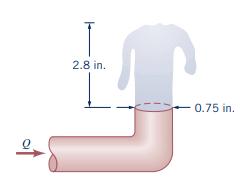
Water flowing from the 0.75-in.-diameter outlet shown in Video V8.15 and Fig. P3.45 rises 2.8 in. above the outlet. Determine the flowrate.Figure P3.45 2.8 in. C 0.75 in.
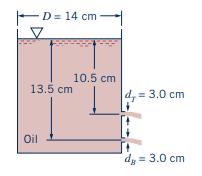
At what rate does oil \((S G=0.85)\) flow from the tank shown in Fig. P3.47?Figure P3.47 D= 14 cm 13.5 cm 10.5 cm d=3.0 cm Oil d = 3.0 cm
A fire hose has a nozzle outlet velocity of \(30 \mathrm{mph}\). What is the maximum height the water can reach?
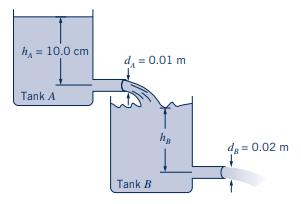
Find the water height \(h_{B}\) in tank \(B\) shown in Fig. P3.48 for steady-state conditions.Figure P3.48 h = 10.0 cm Tank A 4 = 0.01 m Tank B hs d = 0.02 m
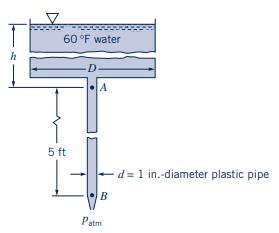
The pressure and average velocity at point \(A\) in the pipe shown in Fig. P3.49 are 16.0 psia and \(4.0 \mathrm{ft} / \mathrm{sec}\), respectively. Find the height \(h\) and the pressure and average velocity at point \(B\). Fluid fills the 1-in.-diameter discharge pipe.Figure P3.49 h 60 F water 5
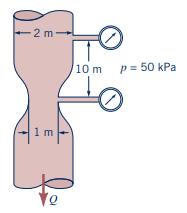
Water (assumed inviscid and incompressible) flows steadily in the vertical variable-area pipe shown in Fig. P3.50. Determine the flowrate if the pressure in each of the gages reads \(50 \mathrm{kPa}\).Figure P3.50 -2 m- 10 m p 50 kPa 1 m
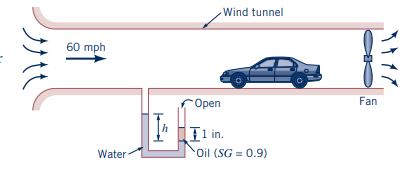
Air is drawn into a wind tunnel used for testing automobiles as shown in Fig. P3.51.(a) Determine the manometer reading, \(h\), when the velocity in the test section is \(60 \mathrm{mph}\). Note that there is a 1 -in. column of oil on the water in the manometer.(b) Determine the difference between
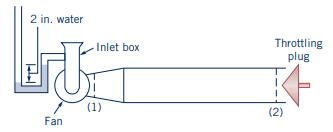
Figure P3.52 shows a duct for testing a centrifugal fan. Air is drawn from the atmosphere ( \(p_{\text {atm }}=14.7 \mathrm{psia}, T_{\mathrm{atm}}=70^{\circ} \mathrm{F}\) ). The inlet box is \(4 \mathrm{ft} \times 2 \mathrm{ft}\). At section 1, the duct is \(2.5 \mathrm{ft}\) square. At section 2,
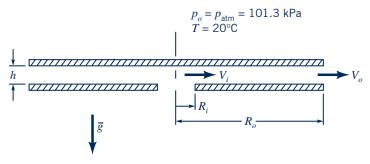
Air flows radially outward between the two parallel circular plates shown in Fig. P3.54. The pressure at the outer radius \(R_{o}=\) \(5.0 \mathrm{~cm}\) is atmospheric. Find the pressure at the inner radius \(R_{i}=\) \(0.5 \mathrm{~cm}\) if the air density is constant, the air flow is inviscid,
Repeat Problem 3.54 for air flowing radially inward.Problem 3.54Air flows radially outward between the two parallel circular plates shown in Fig. P3.54. The pressure at the outer radius \(R_{o}=\) \(5.0 \mathrm{~cm}\) is atmospheric. Find the pressure at the inner radius \(R_{i}=\) \(0.5
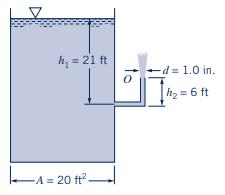
Find the water mass flow rate at the nozzle outlet \(O\) shown in Fig. P3.56, and calculate the maximum height to which the water stream will rise. The water density is 1.9 slugs \(/ \mathrm{ft}^{3}\), and the flow is inviscid.Figure P3.56 h = 21 ft -A 20 ft- to -d=1.0 in. [h = 6 ft
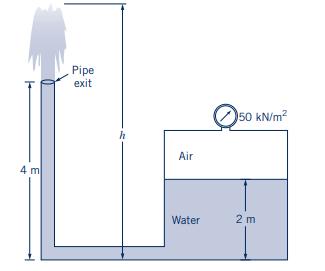
Water (assumed frictionless and incompressible) flows steadily from a large tank and exits through a vertical, constant diameter pipe as shown in Fig. P3.57. The air in the tank is pressurized to Figure P3.57 \(50 \mathrm{kN} / \mathrm{m}^{2}\). Determine(a) the height \(h\), to which the water
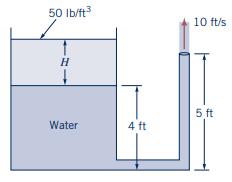
Water (assumed inviscid and incompressible) flows steadily with a speed of \(10 \mathrm{ft} / \mathrm{s}\) from the large tank shown in Fig. P3.58. Determine the depth, \(H\), of the layer of light liquid (specific weight = \(50 \mathrm{lb} / \mathrm{ft}^{3}\) ) that covers the water in the
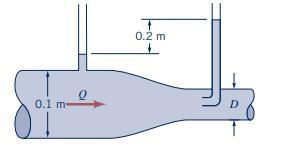
Water flows through the pipe contraction shown in Fig. P3.59. For the given \(0.2-\mathrm{m}\) difference in the manometer level, determine the flowrate as a function of the diameter of the small pipe, \(D\).Figure P3.59 0.1 m- 0.2 m D
Carbon tetrachloride flows in a pipe of variable diameter with negligible viscous effects. At point \(A\) in the pipe the pressure and velocity are \(20 \mathrm{psi}\) and \(30 \mathrm{ft} / \mathrm{s}\), respectively. At location \(B\) the pressure and velocity are \(23 \mathrm{psi}\) and \(14
A liquid stream directed vertically upward leaves a nozzle with a steady velocity \(V_{0}\) and cross-sectional area \(A_{0}\). Find the velocity \(V\) and cross-sectional area \(A\) as a function of the vertical position \(z\).
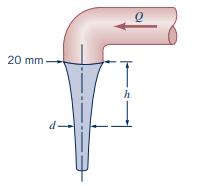
Water flows from a 20-mm-diameter pipe with a flowrate QQ as shown in Fig. P3.61. Plot the diameter of the water stream, dd, as a function of distance below the faucet, hh, for values of 0≤h≤1 m0≤h≤1 m and 0≤Q≤0.004 m3/s0≤Q≤0.004 m3/s. Discuss the validity of the
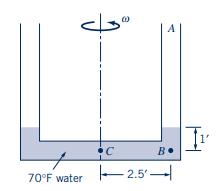
The U-tube in Fig. P2.160 rotates at \(2.0 \mathrm{rev} / \mathrm{sec}\). Find the absolute pressures at points \(C\) and \(B\) if the atmospheric pressure is 14.696 psia. Recall that \(70{ }^{\circ} \mathrm{F}\) water evaporates at an absolute pressure of 0.363 psia. Determine the absolute
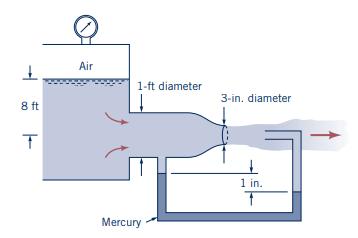
Water flows steadily from a large, closed tank as shown in Fig. P3.72. The deflection in the mercury manometer is \(1 \mathrm{in}\). and viscous effects are negligible.(a) Determine the volume flowrate.(b) Determine the air pressure in the space above the surface of the water in the tank.Figure
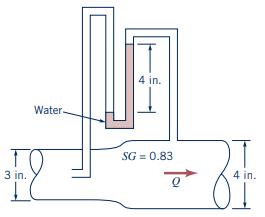
Oil of specific gravity 0.83 flows in the pipe shown in Fig. P3.74. If viscous effects are neglected, what is the flowrate?Figure P3.74 Water. 4 in. 3 in. SG= 0.83 4 in.
Carbon dioxide flows at a rate of \(1.5 \mathrm{ft}^{3} / \mathrm{s}\) from a 3-in. pipe in which the pressure and temperature are \(20 \mathrm{psi}\) (gage) and \(120^{\circ} \mathrm{F}\) into a 1.5-in. pipe. If viscous effects are neglected and incompressible conditions are assumed, determine the
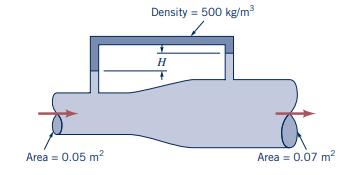
Water flows steadily through the variable area pipe shown in Fig. P3.75 with negligible viscous effects. Determine the manometer reading, \(H\), if the flowrate is \(0.4 \mathrm{~m}^{3} / \mathrm{s}\) and the density of the manometer fluid is \(500 \mathrm{~kg} / \mathrm{m}^{3}\).Figure P3.75 Area
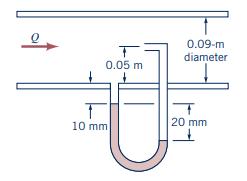
The specific gravity of the manometer fluid shown in Fig. P3.76 is 1.07. Determine the volume flowrate, \(Q\), if the flow is inviscid and incompressible and the flowing fluid is(a) water,(b) gasoline, (c) air at standard conditions.Figure P3.76 T 10 mm T 0.05 m 0.09-m diameter 20 mm
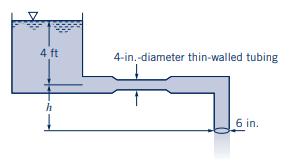
Water flows steadily with negligible viscous effects through the pipe shown in Fig. P3.77. It is known that the 4-in.-diameter section of thin-walled tubing will collapse if the pressure within it becomes less than 10 psi below atmospheric pressure. Determine the maximum value that \(h\) can have
Helium flows through a \(0.30-\mathrm{m}\)-diameter horizontal pipe with a temperature of \(20^{\circ} \mathrm{C}\) and a pressure of \(200 \mathrm{kPa}\) (abs) at a rate of \(0.30 \mathrm{~kg} / \mathrm{s}\). If the pipe reduces to \(0.25-\mathrm{m}\)-diameter, determine the pressure difference
Water is pumped from a lake through an 8-in. pipe at a rate of \(10 \mathrm{ft}^{3} / \mathrm{s}\). If viscous effects are negligible, what is the pressure in the suction pipe (the pipe between the lake and the pump) at an elevation \(6 \mathrm{ft}\) above the lake?
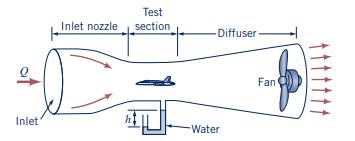
Air is drawn into a small open-circuit wing tunnel as shown in Fig. P3.80. Atmospheric pressure is \(98.7 \mathrm{kPa}\) (abs) and the temperature is \(27^{\circ} \mathrm{C}\). If viscous effects are negligible, determine the pressure at the stagnation point on the nose of the airplane. Also
Water leaves a pump at \(200 \mathrm{kPa}\) and a velocity of \(12 \mathrm{~m} / \mathrm{s}\). It then enters a diffuser to increase its pressure to \(250 \mathrm{kPa}\). What must be the ratio of the outlet area to the inlet area of the diffuser?
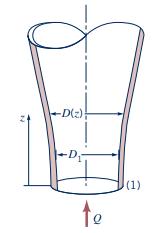
Water flows upward through a variable area pipe with a constant flowrate, \(Q\), as shown in Fig. P3.64. If viscous effects are negligible, determine the diameter, \(D(z)\), in terms of \(D_{1}\) if the pressure is to remain constant throughout the pipe. That is, \(p(z)=p_{1}\).Figure P3.64 \-D(z);
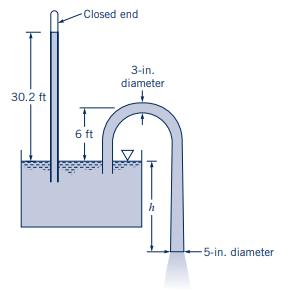
Water is siphoned from the tank shown in Fig. P3.66. The water barometer indicates a reading of \(30.2 \mathrm{ft}\). Determine the maximum value of \(h\) allowed without cavitation occurring. Note that the pressure of the vapor in the closed end of the barometer equals the vapor pressure.Figure
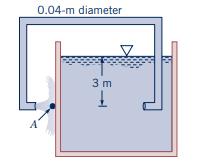
Water is siphoned from a tank as shown in Fig. P3.67. Determine the flowrate and the pressure at point \(A\), a stagnation point.Figure P3.67 0.04-m diameter A 3 m 1
The circular stream of water from a faucet is observed to taper from a diameter of \(20 \mathrm{~mm}\) to \(10 \mathrm{~mm}\) in a distance of \(50 \mathrm{~cm}\). Determine the flowrate.
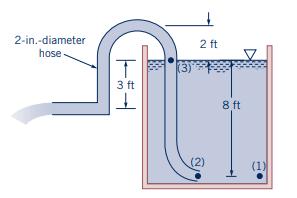
Water is siphoned from the tank shown in Fig. P3.69. Determine the flowrate from the tank and the pressure at points (1), (2), and (3) if viscous effects are negligible.Figure P3.69 2-in.-diameter hose T 3 ft 2 ft 8 ft (2)
Redo Problem 3.69 if a 1-in.-diameter nozzle is placed at the end of the tube.Problem 3.69Water is siphoned from the tank shown in Fig. P3.69. Determine the flowrate from the tank and the pressure at points (1), (2), and (3) if viscous effects are negligible.Figure P3.69 2-in.-diameter hose T 3 ft
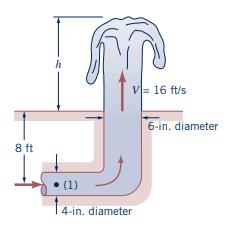
Water exits a pipe as a free jet and flows to a height \(h\) above the exit plane as shown in Fig. P3.71. The flow is steady, incompressible, and frictionless.(a) Determine the height \(h\).(b) Determine the velocity and pressure at section (1).Figure P3.71 8 ft h V= 16 ft/s (1) 14-in. diameter
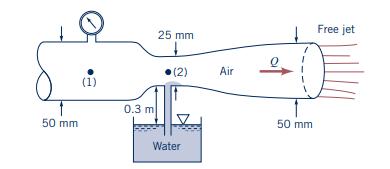
Air flows through the device shown in Fig. P3.81. If the flowrate is large enough, the pressure within the constriction will be low enough to draw the water up into the tube. Determine the flowrate, \(Q\), and the pressure needed at section (1) to draw the water into section (2). Neglect
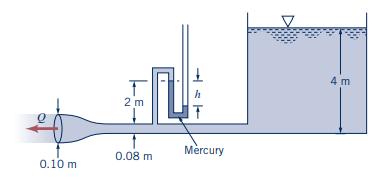
Water flows steadily from the large open tank shown in Fig. 3.82. If viscous effects are negligible, determine(a) the flowrate, \(Q\), (b) the manometer reading, \(h\).Figure P3.82 2 m h 4 m 0.08 m 0.10 m Mercury
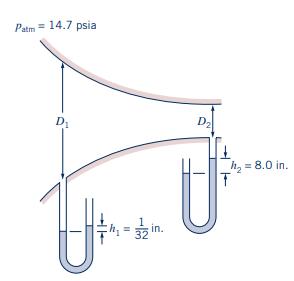
The nozzle shown in Fig. P3.84 has two water manometers to indicate the static pressures at sections 1 and 2 . The diameters \(D_{1}\) and \(D_{2}\) are 8 in. and 2 in., respectively. Air flows through the nozzle, and the air and water temperatures are \(60^{\circ} \mathrm{F}\). Find the air volume
Water from a faucet fills a \(16-\mathrm{oz}\) glass (volume \(=28.9 \mathrm{in.}^{3}\) ) in \(20 \mathrm{~s}\). If the diameter of the jet leaving the faucet is \(0.60 \mathrm{in}\)., what is the diameter of the jet when it strikes the water surface in the glass which is positioned \(14
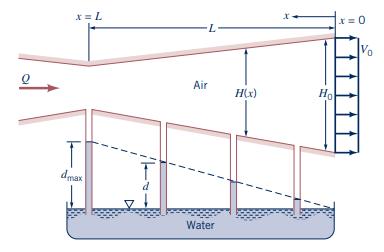
Air flows steadily through a converging-diverging rectangular channel of constant width as shown in Fig. 3.85 and Video V3.10. The height of the channel at the exit and the exit velocity are \(H_{0}\) and \(V_{0}\) respectively. The channel is to be shaped so that the distance, \(d\), that water is
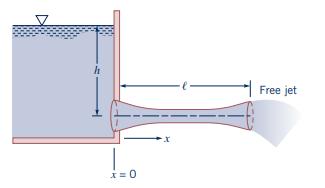
Water flows from a large tank and through a pipe of variable area as shown in Fig. 3.86. The area of the pipe is given by \(A=A_{0}[1-x(1-x / \ell) / 2 \ell]\), where \(A_{0}\) is the area at the beginning \((x=0)\) and end \((x=\ell)\) of the pipe. Plot graphs of the pressure within the pipe as a
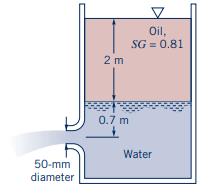
If viscous effects are neglected and the tank is large, determine the flowrate from the tank shown in Fig. P3.87.Figure P3.87 50-mm diameter 2 m 0.7 m Oil. SG=0.81 Water
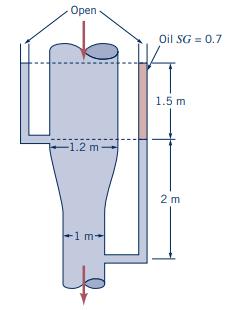
Water flows steadily downward in the pipe shown in Fig. P.3.88 with negligible losses. Determine the flowrate.Figure P3.88 Open Oil SG = 0.7 -1.2 m 1 m- 1.5 m. 2 m
The force, \(F\), of the wind blowing against a building is given by \(F=C_{D} ho V^{2} A / 2\), where \(V\) is the wind speed, \(ho\) the density of the air, \(A\) the cross-sectional area of the building, and \(C_{D}\) is a constant termed the drag coefficient. Determine the dimensions of the
The Mach number is a dimensionless ratio of the velocity of an object in a fluid to the speed of sound in the fluid. For an airplane flying at velocity \(V\) in air at absolute temperature \(T\), the Mach number Ma is\[ \mathrm{Ma}=\frac{V}{\sqrt{k R T}} \]where \(k\) is a dimensionless constant
If \(u\) is a velocity, \(x\) a length, and \(t\) a time, what are the dimensions (in the MLT system) of (a) \(\partial u / \partial t\), (b) \(\partial^{2} u / \partial x \partial t\), and (c) \(\int(\partial u / \partial t) d x\) ?
The momentum flux is given by the product \(\dot{m} V\), where \(\dot{m}\) is mass flow rate and \(V\) is velocity. If mass flow rate is given in units of mass per unit time, show that the momentum flux can be expressed in units of force.
An equation for the frictional pressure loss \(\Delta p\) (inches \(\mathrm{H}_{2} \mathrm{O}\) ) in a circular duct of inside diameter \(d\) (in.) and length \(L\) (ft) for air flowing with velocity \(V(\mathrm{ft} / \mathrm{min})\) is\[ \Delta
Show that each term in the following equation has units of \(\mathrm{lb} / \mathrm{ft}^{3}\). Consider \(u\) a velocity, \(y\) a length, \(x\) a length, \(p\) a pressure, and \(\mu\) an absolute viscosity.\[ 0=-\frac{\partial p}{\partial x}+\mu \frac{\partial^{2} u}{\partial y^{2}} \]
A formula to estimate the volume rate of flow, \(Q\), flowing over a dam of length, \(B\), is given by the equation\[ Q=3.09 B H^{3 / 2} \]where \(H\) is the depth of the water above the top of the dam (called the head). This formula gives \(Q\) in \(\mathrm{ft}^{3} / \mathrm{s}\) when \(B\) and
A commercial advertisement shows a pearl falling in a bottle of shampoo. If the diameter \(D\) of the pearl is quite small and the shampoo sufficiently viscous, the drag \(\mathscr{D}\) on the pearl is given by Stokes's law,\[ \mathscr{D}=3 \pi \mu V D \]where \(V\) is the speed of the pearl and
Cite an example of a restricted homogeneous equation contained in a technical article found in an engineering journal in your field of interest. Define all terms in the equation, explain why it is a restricted equation, and provide a complete journal citation (title, date, etc.).
The universal gas constant \(R_{0}\) is equal to \(49,700 \mathrm{ft}^{2} /\left(\mathrm{s}^{2} \cdot{ }^{\circ} \mathrm{R}\right)\), or \(8310 \mathrm{~m}^{2} /\left(\mathrm{s}^{2} \cdot \mathrm{K}\right)\). Show that these two magnitudes are equal.
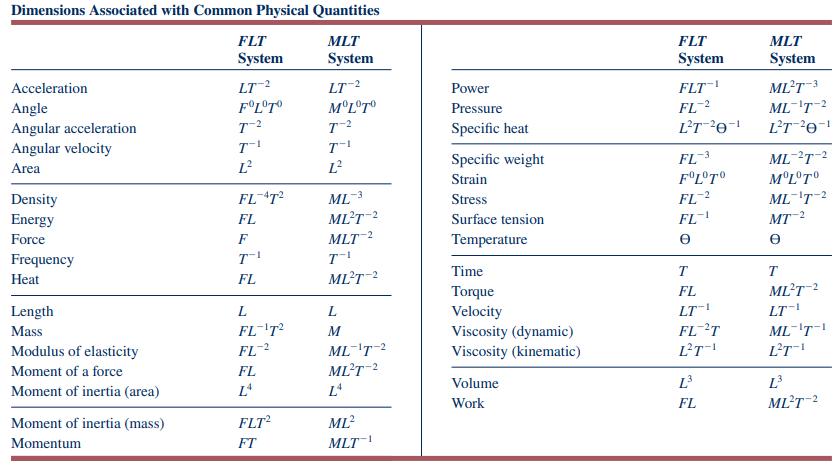
Dimensionless combinations of quantities (commonly called dimensionless parameters) play an important role in fluid mechanics. Make up five possible dimensionless parameters by using combinations of some of the quantities listed in Table 1.1.Table 1.1 Dimensions Associated with Common Physical
Obtain a photograph/image of a situation in which the density or specific weight of a fluid is important. Print this photo and write a brief paragraph that describes the situation involved.
A tank contains \(500 \mathrm{~kg}\) of a liquid whose specific gravity is 2. Determine the volume of the liquid in the tank.
A stick of butter at \(35^{\circ} \mathrm{F}\) measures 1.25 in. \(\times 1.25\) in. \(\times\) 4.65 in. and weighs 4 ounces. Find its specific weight.
The density of a certain type of jet fuel is \(775 \mathrm{~kg} / \mathrm{m}^{3}\). Determine its specific gravity and specific weight.
At \(4{ }^{\circ} \mathrm{C}\) a mixture of automobile antifreeze \((50 \%\) water and \(50 \%\) ethylene glycol by volume) has a density of \(1064 \mathrm{~kg} / \mathrm{m}^{3}\). If the water density is \(1000 \mathrm{~kg} / \mathrm{m}^{3}\), find the density of the ethylene glycol.
Estimate the number of pounds of mercury it would take to fill your bathtub. List all assumptions and show all calculations.
A mountain climber's oxygen tank contains \(1 \mathrm{lb}\) of oxygen when he begins his trip at sea level where the acceleration of gravity is \(32.174 \mathrm{ft} / \mathrm{s}^{2}\). What is the weight of the oxygen in the tank when he reaches the top of Mt. Everest where the acceleration of
With the exception of the 410 bore, the gauge of a shotgun barrel indicates the number of round lead balls, each having the bore diameter of the barrel, that together weigh \(1 \mathrm{lb}\). For example, a shotgun is called a 12-gauge shotgun if a \(\frac{1}{12}-1 \mathrm{~b}\) lead ball fits the
The presence of raindrops in the air during a heavy rainstorm increases the average density of the air-water mixture. Estimate by what percent the average air-water density is greater than that of just still air. State all assumptions and show calculations.
A regulation basketball is initially flat and is then inflated to a pressure of approximately \(24 \mathrm{lb} / \mathrm{in}^{2}\) absolute. Consider the air temperature to be constant at \(70^{\circ} \mathrm{F}\). Find the mass of air required to inflate the basketball. The basketball's inside
Nitrogen is compressed to a density of \(4 \mathrm{~kg} / \mathrm{m}^{3}\) under an absolute pressure of \(400 \mathrm{kPa}\). Determine the temperature in degrees Celsius.
Assume that the air volume in a small automobile tire is constant and equal to the volume between two concentric cylinders \(13 \mathrm{~cm}\) high with diameters of \(33 \mathrm{~cm}\) and \(52 \mathrm{~cm}\). The air in the tire is initially at \(25^{\circ} \mathrm{C}\) and \(202 \mathrm{kPa}\).
A compressed air tank contains \(5 \mathrm{~kg}\) of air at a temperature of \(80^{\circ} \mathrm{C}\). A gage on the tank reads \(300 \mathrm{kPa}\). Determine the volume of the tank.
Showing 1100 - 1200
of 2369
First
5
6
7
8
9
10
11
12
13
14
15
16
17
18
19
Last
Step by Step Answers

 Get 50% OFF
Claim Now
Get 50% OFF
Claim Now