New Semester
Started
Get
50% OFF
Study Help!
--h --m --s
Claim Now
Question Answers
Textbooks
Find textbooks, questions and answers
Oops, something went wrong!
Change your search query and then try again
S
Books
FREE
Study Help
Expert Questions
Accounting
General Management
Mathematics
Finance
Organizational Behaviour
Law
Physics
Operating System
Management Leadership
Sociology
Programming
Marketing
Database
Computer Network
Economics
Textbooks Solutions
Accounting
Managerial Accounting
Management Leadership
Cost Accounting
Statistics
Business Law
Corporate Finance
Finance
Economics
Auditing
Tutors
Online Tutors
Find a Tutor
Hire a Tutor
Become a Tutor
AI Tutor
AI Study Planner
NEW
Sell Books
Search
Search
Sign In
Register
study help
engineering
engineering fluid mechanics
Engineering Fluid Mechanics 11th Edition Donald F. Elger, Barbara A. LeBret, Clayton T. Crowe, John A. Robertson - Solutions
A large venturi meter is calibrated by means of a onetenth-scale model using the prototype liquid. What is the discharge ratio Qm/Qp for dynamic similarity? If a pressure difference of 400 kPa is measured across ports in the model for a given discharge, what pressure difference will occur between
Oil with a kinematic viscosity of 4 × 10⁻⁶ m2/s flows through a smooth pipe 15 cm in diameter at 3 m/s. What velocity should water have at 20°C in a smooth pipe 5 cm in diameter to be dynamically similar?
Water with a kinematic viscosity of 10–6 m2/s flows through a 4 cm pipe. What would the velocity of water have to be for the water flow to be dynamically similar to oil (v = 10–5 m2/s) flowing through the same pipe at a velocity of 1.0 m/s?
In a study of the power required to overcome drag, an engineer is using a π-group given byWhere P is the power lost, ρ is the fluid density, A is area, and V is the fluid velocity. In laboratory tests with a one-eighth-scale model, the power lost was measured as 5 W when the air velocity was 0.5
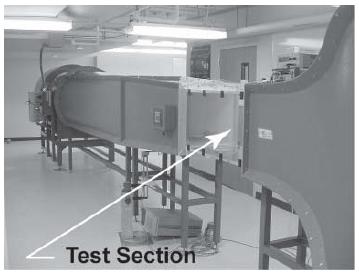
A wind tunnel operates by drawing air through a contraction, passing this air through a test section, and then exhausting the air using a large axial fan. Experimental data are recorded in the test section, which is typically a rectangular section of duct that is made of clear plastic (usually
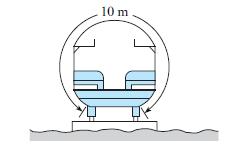
High-speed passenger trains are streamlined to reduce shear force. Th e cross section of a passenger car of one such train is shown. For a train 81 m long, estimate the shear force (a) for a speed of 81.1 km/hr and (b) for one of 204 km/hr. What power is required for just the shear force at these
A motor boat pulls a long, smooth, water-soaked log (0.5 m in diameter and 40 m long) at a speed of 3 m/s. Assuming total submergence, estimate the force required to overcome the shear force of the log. Assume a water temperature of 10°C and that the boundary layer is tripped at the front of the
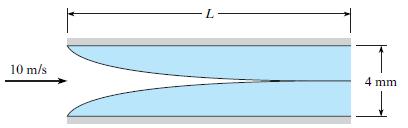
A model is being developed for the entrance region between two flat plates. As shown in the figure, it is assumed that the region is approximated by a turbulent boundary layer originating at the leading edge. The system is designed such that the plates end where the boundary layers merge. The
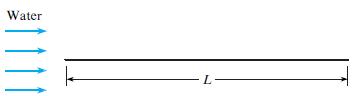
An engineer is designing a horizontal, rectangular conduit that will be part of a system that allows fish to bypass a dam. Inside the conduit, a flow of water at 40°F will be divided into two streams by a flat, rectangular metal plate. Calculate the viscous drag force on this plate, assuming
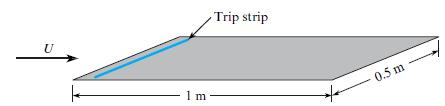
A flat plate is oriented parallel to a 45 m/s airflow at 20°C and atmospheric pressure. The plate is L = 1 m in the flow direction and 0.5 m wide. On one side of the plate, the boundary layer is tripped at the leading edge, and on the other side there is no tripping device. Find the total drag
A model airplane descends in a vertical dive through air at standard conditions (1 atmosphere and 20°C). Th e majority of the drag is due to skin friction on the wing (like that on a flat plate). The wing has a span of 1 m (tip to tip) and a chord length (leading edge to trailing edge distance) of
A turbulent boundary layer develops from the leading edge of a flat plate with water at 20°C flowing tangentially past the plate with a free-stream velocity of 7.7 m/s. Determine the drag force acting on one side of the plate, if the plate has dimensions L = 1 m, and width B = 0.5 m.
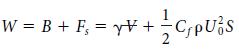
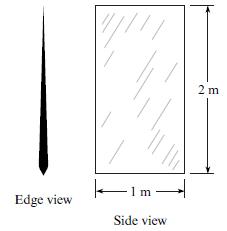
The plate shown in the figure is weighted at the bottom so it will fall stably and steadily in a liquid. The weight of the plate in air is 23.5 N, and the plate has a volume of 0.002 m3. Estimate the terminal velocity in freshwater at 20°C. The boundary layer is normal; that is, it is not tripped
A turbulent boundary layer exists in the flow of water at 20°C over a flat plate. The local shear stress measured at the surface of the plate is 0.4 N/m2. What is the velocity at a point 0.3 cm from the plate surface?
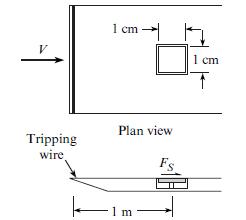
An element for sensing local shear stress is positioned in a flat plate 1 meter from the leading edge. The element simply consists of a small plate, 1 cm × 1 cm, mounted flush with the wall, and the shear force is measured on the plate. The fluid flowing by the plate is air with a free-stream
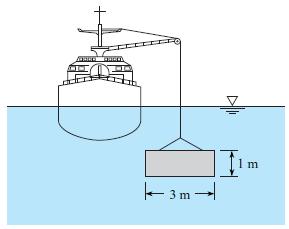
A thin plastic panel (3 mm thick) is lowered from a ship to a construction site on the ocean floor. Th e plastic panel weighs 300 N in air and is lowered at a rate of 3 m/s. Assuming that the panel remains vertically oriented, calculate the tension in the cable. 1 m 3 m
Calculate the power required to pull the sign shown if it is towed at 48 m/s and if it is assumed that the sign has the same drag force as an equivalent flat plate. Assume standard atmospheric pressure and a temperature of 10°C. 2.0 m FLUID MECHANICS FOR ALL ENGINEERS 30 m
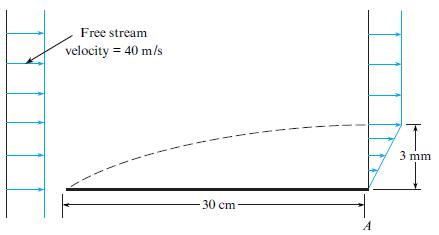
For the hypothetical boundary layer on the flat plate shown, what is the shear stress on the plate at the downstream end (point A)? Here ρ = 1.2 kg/m3 and μ = 3.0 × 10⁻⁵ N∙s/m2. Free stream velocity = 40 m/s 3 mm 30 cm A
What is the ratio of the drag force of a plate 30 m long and 5 m wide to that of a plate 10 m long and 5 m wide if both plates are towed lengthwise through water (T = 20°C) at 10 m/s?
An airplane wing of 2 m chord length (leading edge to trailing edge distance) and 11 m span flies at 200 km/hr in air at 30°C. Assume that the drag force of the wing surfaces is like that of a flat plate.a. What is the friction drag on the wing?b. What power is required to overcome this?c. How
Assume that a turbulent gas boundary layer was adjacent to a cool wall and the viscosity in the wall region was reduced. How may this affect the features of the boundary layer? Give some rationale for your answers.
A flat plate 1.5 m long and 1.0 m wide is towed in water at 20°C in the direction of its length at a speed of 15 cm/s. Determine the resistance of the plate and the boundary layer thickness at its aft end.
A thin plate 0.7 m long and 1.5 m wide is submerged and held stationary in a stream of water (T = 10°C) that has a velocity of 1.5 m/s. What is the thickness of the boundary layer on the plate for Rex = 500,000 (assume the boundary layer is still laminar), and at what distance downstream of the
A liquid (ρ = 1000 kg/m3; μ = 2 × 10⁻² N ∙ s/m2; v = 2 × 10⁻⁵ m2/s) flows tangentially past a flat plate with total length of 4 m (parallel to the flow direction), a velocity of 1 m/s, and a width of 1.5 m. What is the skin friction drag (shear force) on one side of the plate?
Oil (μ = 10–2 N∙s/m2; ρ = 900 kg/m3) flows past a plate in a tangential direction so that a boundary layer develops. If the velocity of approach is 4 m/s, then at a section 30 cm downstream of the leading edge the ratio of τδ (shear stress at the edge of the boundary layer) to τ0 (shear
A ship 600 ft long steams at a rate of 25 ft/s through still freshwater (T = 50°F). If the submerged area of the ship is 50,000 ft 2, what is the skin friction drag of this ship?
A compressor draws 0.4 m3/s of ambient air (20°C) in from the outside through a round duct that is 10 m long and 175 mm in diameter. Determine the entrance length and establish whether the flow is laminar or turbulent.
Classify each of the following features into one of two categories: laminar boundary layer (L), or turbulent boundary layer (T).a. The flow occurs in smooth layers.b. The boundary layer contains eddies that mix the flow.c. The velocity profile can be written with a power law equation.d. The
A model airplane has a wing span of 6 ft and a chord (leading edge–trailing edge distance) of 4.5 in. The model flies in air at 60°F and atmospheric pressure. The wing can be regarded as a flat plate so far as drag is concerned. (a) At what speed will a turbulent boundary layer start to
What is the ratio of the boundary layer thickness on a smooth, flat plate to the distance from the leading edge just before transition to turbulent flow?
A thin plate 6 ft long and 3 ft wide is submerged and held stationary in a stream of water (T = 60°F) that has a velocity of 17 ft/s. What is the thickness of the boundary layer on the plate for Rex = 500,000 (assume the boundary layer is still laminar), and at what distance downstream of the
Assume the wall adjacent to a liquid laminar boundary is heated and the viscosity of the fluid is lower near the wall and increases the free-stream value at the edge of the boundary layer. How would this variation in viscosity affect the boundary layer thickness and local shear stress? Give the
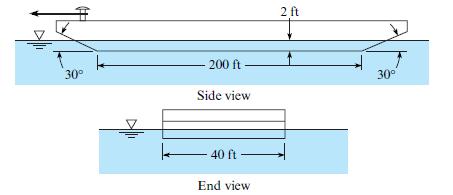
A river barge has the dimensions shown. It draws 2ft of water when empty. Estimate the skin friction drag of the barge when it is being towed at a speed of 10ft/s through still freshwater at 60°F. 2 ft 200 ft - 30° 30° Side view 40 ft End view
A supertanker has length, breadth, and draught (fully loaded) dimensions of 325 m, 48 m, and 19 m, respectively. In open seas, the tanker normally operates at a speed of 18 kt (1 kt = 0.515 m/s). For these conditions, and assuming that flat-plate boundary layer conditions are approximated, estimate
A hydroplane 3 m long skims across a very calm lake (T = 20°C) at a speed of 15 m/s. For this condition, what will be the minimum shear stress along the smooth bottom?
Estimate the power required to overcome the shear force of a water skier if he or she is towed at 30 mph and each skin is 4 ft by 6 in. Assume the water temperature is 60°F.
If the wetted area of an 80 m ship is 1500 m2, approximately how great is the skin friction drag when the ship is traveling at a speed of 15 m/s? What is the thickness of the boundary layer at the stern? Assume seawater at T = 10°C.
Kerosene (20°C) flows at a rate of 0.04 m3/s in a 25 cm diameter pipe. Would you expect the flow to be laminar or turbulent? Calculate the entrance length.
For each item ahead, which π-group (Re, We, M, or Fr) would best match the given description?a. (kinetic force)/(surface-tension force)b. (kinetic force)/(viscous force)c. (kinetic force)/(gravitational force)d. (kinetic force)/(compressive force)e. Used for modeling water flowing over a spillway
One of the shortcomings of mounting a model of an automobile in a wind tunnel and measuring drag is that the effect of the road is not included. Give some thought as to your impressions of what the effect of the road may be on automobile drag and your reasoning. Also list some variables that may
Many automobile companies advertise products with low drag for improved performance. Research the technical literature on the Internet regarding wind-tunnel testing of automobiles, and summarize your findings in a concise, informative manner on two pages or less.
The drag on a submarine moving below the free surface is to be determined by a test on a 1/19-scale model in a water tunnel. Th e velocity of the prototype in seawater (ρ = 1015 kg/m3, v = 1.4 × 10⁻⁶ m2/s) is 1 m/s. The test is done in fresh water at 20°C. Determine the speed of the water in
What is meant by geometric similitude?
The hydrodynamic drag on a sailboat is very important to the performance of the craft , especially in competitive races such as the America’s Cup. Investigate on the Internet or other sources the extent and types of simulations that have been carried out on high-performance sailboats.
One of the largest wind tunnels in the United States is the NASA Ames Research Center in Moff at Field, California. Look up information on this facility (size, test section velocity, etc.) and summarize your findings.
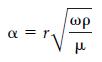
The Womersley number (α) is a π-group given by the ratio of [pulsatile transient force]/[viscous force]. Biomedical engineers have applied this to flow in blood vessels. The Womersley number is given by:where r = blood vessel radius, and ω = frequency, typically the heart rate. Just as does Re,
Using the Internet, read about the Womersley number (α) and answer the following questions.a. Is α dimensionless? How do you know? Show that all the units in fact cancel out.b. Like other independent π-groups, α is the ratio of two forces. Of what two forces is it the ratio?c. What does the
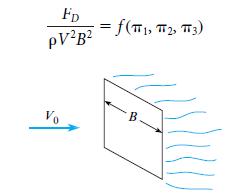
Drag tests show that the drag of a square plate placed normal to the free-stream velocity is a function of the velocity V, the density ρ, the plate dimensions B, the viscosity μ, the free-stream turbulence root mean square velocity urms, and the turbulence length scale Lx. Here urms and Lx are in
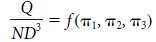
The discharge of a centrifugal pump is a function of the rotational speed of the pump, N, the diameter of the impeller, D, the head across the pump, hp, the viscosity of the fluid, μ, the density of the fluid, ρ, and the acceleration due to gravity, g. The functional relationship is Q = f (N, D,
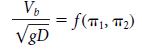
The rise velocity Vb of a bubble with diameter D in a liquid of density ρl and viscosity μ depends on the acceleration due to gravity, g, and the density difference between the bubble and the fluid, ρl – ρb. Find the π-groups in the form = f(T1, T2) gD
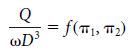
Flow situations in biofluid mechanics involve the flow through tubes that change in size with time (such as blood vessels) or are supplied by an oscillatory source (such as a pulsing gland). The volume flow rate Q in the tube will be a function of the frequency ω, the tube diameter D, the fluid
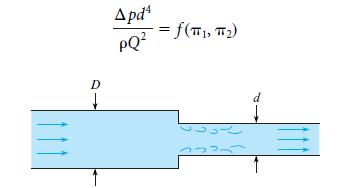
By dimensional analysis, determine the π-groups for the change in pressure that occurs when water or oil flows through a horizontal pipe with an abrupt contraction as shown. Express your answer in the functional form Apd = f(T, T12) PQ? D d
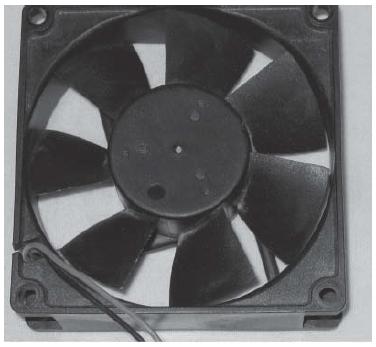
An engineer is using an experiment to characterize the power P consumed by a fan (see photo) to be used in an electronics cooling application. Power depends on four variables: P = f(ρ, D, Q, n), where ρ is the density of air, D is the diameter of the fan impeller, Q is the flow rate produced by
A general study is to be made of the height of rise of liquid in a capillary tube as a function of time after the start of a test. Other significant variables include surface tension, mass density, specific weight, viscosity, and diameter of the tube. Determine the dimensionless parameters that
The force on a satellite in the earth’s upper atmosphere depends on the mean path of the molecules λ (a length), the density ρ, the diameter of the body D, and the molecular speed c: F = f (λ, ρ, D, c). Find the nondimensionalize form of this equation.
It is known that the differential pressure developed by a centrifugal pump, Δp, is a function of the diameter D of the impeller, the speed of rotation n, the discharge Q, and the fluid density ρ. By dimensional analysis, determine the π-groups relating these variables.
Consider steady viscous flow through a small horizontal tube. For this type of flow, the pressure gradient along the tube, Δp/Δℓ should be a function of the viscosity μ, the mean velocity V, and the diameter D. By dimensional analysis, derive a functional relationship relating these variables.
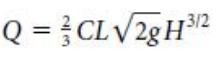
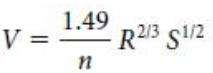
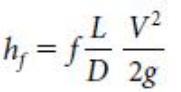
Determine which of the following equations are dimensionally homogeneous:a.where Q is discharge, C is a pure number, L is length, g is acceleration due to gravity, and H is head.b.where V is velocity, n is length to the one-sixth power, R is length, and S is slope.c.where hf is head loss, f is a
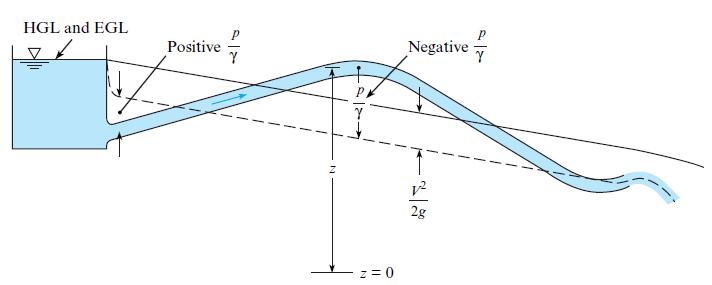
Refer to Figure 7.16. Assume that the head loss in the pipe is given by hL = 0.02(L/D)(V 2/2g), where V is the mean velocity in the pipe, D is the pipe diameter, and L is the pipe length. The elevations of the reservoir water surface, the highest point in the pipe, and the pipe outlet are 250 m,
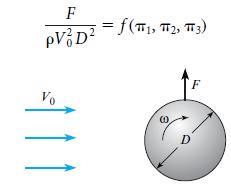
Observations show that the side thrust, F, for a rough spinning ball in a fluid is a function of the ball diameter, D, the free-stream velocity, V0, the density, ρ, the viscosity, μ, the roughness height, ks, and the angular velocity of spin, ω. Determine the dimensionless parameter(s) that
For very low velocities it is known that the drag force FD of a small sphere is a function solely of the velocity V of flow past the sphere, the diameter d of the sphere, and the viscosity μ of the fluid. Determine the π-groups involving these variables.
The maximum rise of a liquid in a small capillary tube is a function of the diameter of the tube, the surface tension, and the specific weight of the liquid. What are the significant π-groups for the problem?
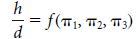
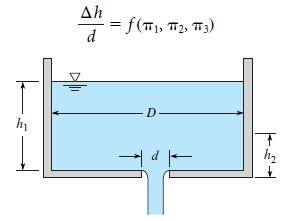
It takes a certain length of time for the liquid level in a tank of diameter D to drop from position h1 to position h2 as the tank is being drained through an orifice of diameter d at the bottom. Determine the π-groups that apply to this problem. Assume that the liquid is nonviscous. Express your
Determine the dimensions of the following variables and combinations of variables in terms of primary dimensions:a. T (torque)b. ρV2/2, where V is velocity and ρ is mass densityc. √τ/ρ, where τ is shear stressd. Q/ND3, where Q is discharge, D is diameter, and N is angular speed of a pump
Explain what is meant by dimensional homogeneity.
According to the Buckingham Π theorem, if there are six dimensional variables and three primary dimensions, how many dimensionless variables will there be?
Find the primary dimensions of density (ρ), viscosity (μ), and pressure (p).
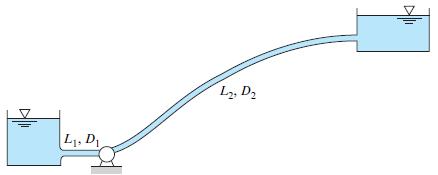
What power is required to pump water at a rate of 3 m3/s from the lower to the upper reservoir? Assume the pipe head loss is given by hL = 0.018(L/D)(V 2/2g), where L is the length of pipe, D is the pipe diameter, and V is the velocity in the pipe. Th e water temperature is 10°C, the water surface
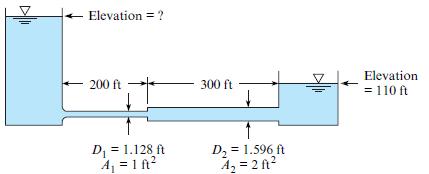
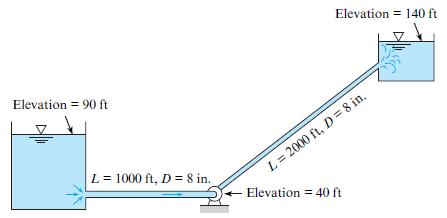
Water flows from the reservoir on the left to the reservoir on the right at a rate of 16 cfs. Th e formula for the head losses in the pipes is hL = 0.02(L/D)(V 2/2g). What elevation in the left reservoir is required to produce this flow? Also carefully sketch the HGL and the EGL for the system.
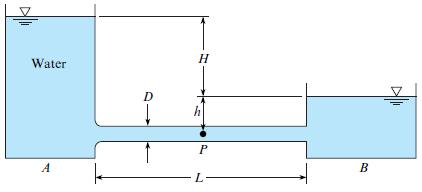
Water flows from reservoir A to reservoir B in a desert retirement community. The water temperature in the system is 100°F, the pipe diameter D is 2 ft, and the pipe length L is 160 ft. If H = 35 ft, h = 10 ft, and the pipe head loss is given by hL = 0.01(L/D)(V 2/2g), where V is the velocity in
Water flows from reservoir A to reservoir B. Th e water temperature in the system is 10°C, the pipe diameter D is 1 m, and the pipe length L is 300 m. If H = 16 m, h = 2 m, and the pipe head loss is given by hL = 0.01(L/D)(V 2/2g), where V is the velocity in the pipe, what will be the discharge in
What horsepower must be supplied to the water to pump 3.0 cfs at 68°F from the lower to the upper reservoir? Assume that the head loss in the pipes is given by hL = 0.018(L/D) (V 2/2g), where L is the length of the pipe in feet and D is the pipe diameter in feet. Sketch the HGL and the EGL.
Refer to Figure 7.14. Assume that the head loss in the pipes is given by hL = 0.02(L/D)(V 2/2g), where V is the mean velocity in the pipe, D is the pipe diameter, and L is the pipe length. The water surface elevations of the upper and lower reservoirs are 100 m and 60 m, respectively. The
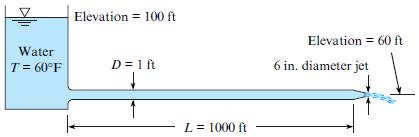
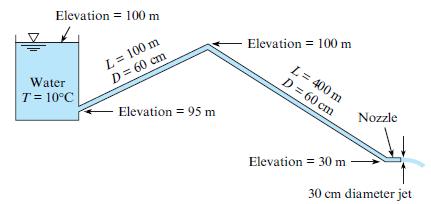
Water flows from the reservoir through a pipe and then discharges from a nozzle as shown. The head loss in the pipe itself is given as hL = 0.025(L/D)(V 2/2g), where L and D are the length and diameter of the pipe and V is the velocity in the pipe. What is the discharge of water? Also draw the HGL
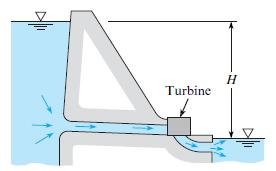
The discharge of water through this turbine is 1000 cfs. What power is generated if the turbine efficiency is 85% and the total head loss is 4 ft? H = 100 ft. Also, carefully sketch the EGL and the HGL. Turbine
Assume that the head loss in the pipe is given by hL = 0.014(L/D)(V 2/2g), where L is the length of pipe and D is the pipe diameter. Assume α = 1.0 at all locations.a. Determine the discharge of water through this system.b. Draw the HGL and the EGL for the system.c. Locate the point of maximum
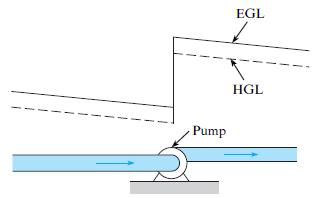
Th e pump shown is supplied with 1.5 kW from the shaft of a motor, to provide a mass flow rate of 20 kg/s. If the pump operates at 70% efficiency, what is the increase in the EGL? EGL HGL Pump
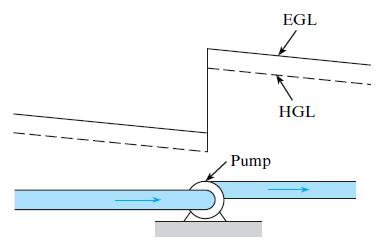
In the figure shown, the magnitude of the EGL changes from 14 m to 22 m. What is the pump head, h? EGL HGL Pump
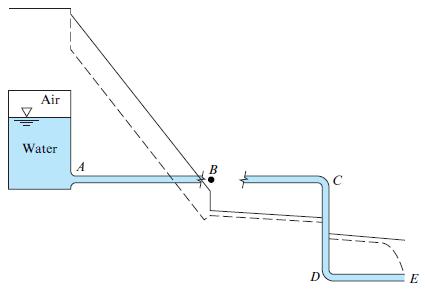
Th e HGL and the EGL for a pipeline are shown in the figure.a. Indicate which is the HGL and which is the EGL.b. Are all pipes the same size? If not, which is the smallest?c. Is there any region in the pipes where the pressure is below atmospheric pressure? If so, where?d. Where is the point of
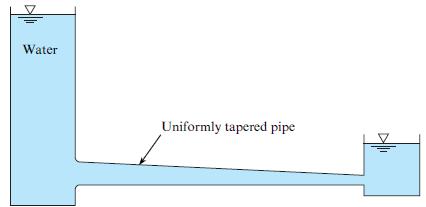
Sketch the HGL and the EGL for this conduit, which tapers uniformly from the left end to the right end. Water Uniformly tapered pipe
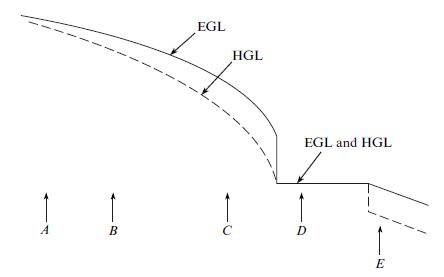
Th e HGL and the EGL are as shown for a certain flow system.a. Is flow from A to E or from E to A?b. Does it appear that a reservoir exists in the system?c. Does the pipe at E have a uniform or a variable diameter?d. Is there a pump in the system?e. Sketch the physical setup that could yield the
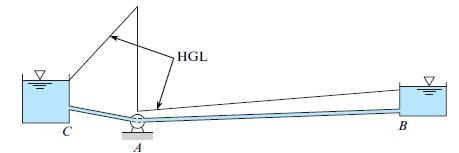
For the system shown:a. What is the flow direction?b. What kind of machine is at A?c. Do you think both pipes, AB and CA, are the same diameter?d. Sketch in the EGL for the system.e. Is there a vacuum at any point or region of the pipes? If so, identify the location. HGL B
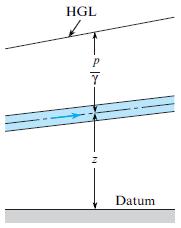
If the pipe shown has constant diameter, is this type of HGL possible? If so, under what additional conditions? If not, why not? HGL Datum
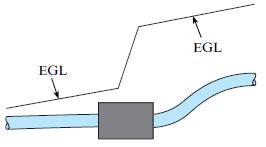
The energy grade line for steady flow in a uniform-diameter pipe is shown. Which of the following could be in the “black box”? (a) A pump, (b) A partially closed valve, (c) An abrupt expansion, or(d) A turbine? Choose all valid answer(s) and state your rationale. EGL EGL
Using Section 7.8 and other resources, answer the following questions. Strive for depth, clarity, and accuracy while also combining sketches, words, and equations in ways that enhance the effectiveness of your communication. a. What are three important reasons that engineers use the HGL and
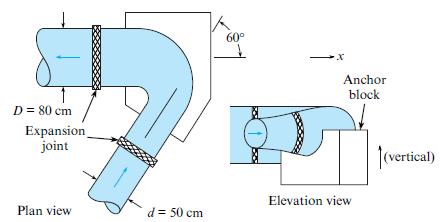
In a local water treatment plant, water flows in this bend at a rate of 7 m3/s, and the pressure at the inlet is 800 kPa. If the head loss in the bend is 13 m, what will the pressure be at the outlet of the bend? Also estimate the force of the anchor block on the bend in the x direction required to
Water flows in this bend at a rate of 5 m3/s, and the pressure at the inlet is 650 kPa. If the head loss in the bend is 10 m, what will the pressure be at the outlet of the bend? Also estimate the force of the anchor block on the bend in the x direction required to hold the bend in place. Assume α
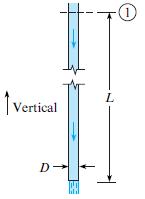
This rough aluminum pipe is 6 in. in diameter. It weighs 1.5 lb per foot of length, and the length L is 50 ft. If the discharge of water is 6 cfs and the head loss due to friction from section 1 to the end of the pipe is 10 ft, what is the longitudinal force transmitted across section 1 through the
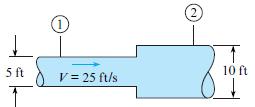
This abrupt expansion is to be used to dissipate the high energy flow of water in the 5 ft diameter penstock. Assume α = 1.0 at all locations.a. What power (in horsepower) is lost through the expansion?b. If the pressure at section 1 is 5 psig, what is the pressure at section 2?c. What force is
Water (γ = 62.4 lbf/ft 3) flows through a horizontal constant diameter pipe with a cross-sectional area of 9 in.2. The velocity in the pipe is 15 ft/s, and the water discharges to the atmosphere. The head loss between the pipe joint and the end of the pipe is 3 ft. Find the force on the joint to
A 40 cm pipe abruptly expands to a 60 cm size. Th ese pipes are horizontal, and the discharge of water from the smaller size to the larger is 1.0 m3/s. What horizontal force is required to hold the transition in place if the pressure in the 40 cm pipe is 70 kPa gage? Also, what is the head loss?
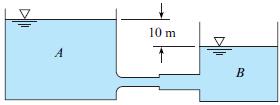
Water is draining from tank A to tank B. The elevation difference between the two tanks is 10 m. The pipe connecting the two tanks has a sudden-expansion section as shown. The cross-sectional area of the pipe from A is 8 cm2, and the area of the pipe into B is 25 cm2. Assume the head loss in the
A 6 in. pipe abruptly expands to a 12 in. size. If the discharge of water in the pipes is 5 cfs, what is the head loss due to abrupt expansion?
A 7 cm pipe carries water with a mean velocity of 2 m/s. If this pipe abruptly expands to a 15 cm pipe, what will be the head loss due to the abrupt expansion?
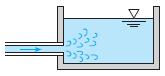
What is the head loss at the outlet of the pipe that discharges water into the reservoir at a rate of 0.8 m3/s if the diameter of the pipe is 53 cm?
What is the head loss at the outlet of the pipe that discharges water into the reservoir at a rate of 14 cfs if the diameter of the pipe is 18 in.?
How is the energy equation (7.29) in §7.3 similar to the Bernoulli equation? How is it different? Give two important similarities and three important differences. (7.29) P2 + a2 + z2 2g + h, + h P1 + Z1 + hp + ai 2g
A pumping system is to be designed to pump crude oil a distance of 1 mile in a 1 foot-diameter pipe at a rate of 3860 gpm. The pressures at the entrance and exit of the pipe are atmospheric, and the exit of the pipe is 210 feet higher than the entrance. The pressure loss in the system due to pipe
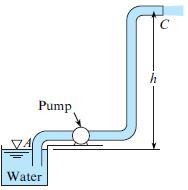
The pump shown draws water (20°C) through a 20 cm suction pipe and discharges it through a 11 cm pipe in which the velocity is 3 m/s. The 10 cm pipe discharges horizontally into air at point C. To what height h above the water surface at A can the water be raised if 28 kW is delivered to the pump?
The pump shown draws water through an 8 in. suction pipe and discharges it through a 3 in. pipe in which the velocity is 12 ft/s. The 6 in. pipe discharges horizontally into air at C. To what height h above the water surface at A can the water be raised if 14 hp is used by the pump? Th e pump
Showing 1500 - 1600
of 2369
First
9
10
11
12
13
14
15
16
17
18
19
20
21
22
23
Last
Step by Step Answers

 Get 50% OFF
Claim Now
Get 50% OFF
Claim Now