New Semester
Started
Get
50% OFF
Study Help!
--h --m --s
Claim Now
Question Answers
Textbooks
Find textbooks, questions and answers
Oops, something went wrong!
Change your search query and then try again
S
Books
FREE
Study Help
Expert Questions
Accounting
General Management
Mathematics
Finance
Organizational Behaviour
Law
Physics
Operating System
Management Leadership
Sociology
Programming
Marketing
Database
Computer Network
Economics
Textbooks Solutions
Accounting
Managerial Accounting
Management Leadership
Cost Accounting
Statistics
Business Law
Corporate Finance
Finance
Economics
Auditing
Tutors
Online Tutors
Find a Tutor
Hire a Tutor
Become a Tutor
AI Tutor
AI Study Planner
NEW
Sell Books
Search
Search
Sign In
Register
study help
engineering
introduction mechanical engineering
Mechanical Vibrations Theory And Applications 1st Edition S. GRAHAM KELLY - Solutions
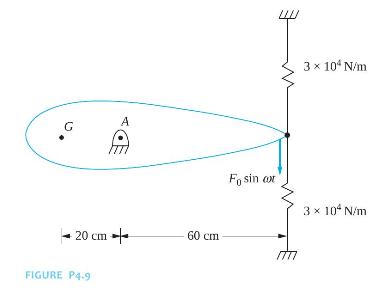
The modeling of an airfoil requires at least two degrees-of-freedom. However, its torsional stiffness is unknown, so an engineer devises a test. She prevents the airfoil from motion in the transverse direction at \(A\) but still allows it to rotate as shown in Figure P4.9. She then places two
A machine with a mass of \(50 \mathrm{~kg}\) is mounted on springs of equivalent stiffness \(6.10 \times 10^{4} \mathrm{~N} / \mathrm{m}\) and subject to a harmonic force of \(370 \sin 35 t \mathrm{~N}\) while operating. The natural frequency is close enough to the excitation frequency for beating
A machine with a mass of \(30 \mathrm{~kg}\) is mounted on springs with an equivalent stiffness of \(4.8 \times 10^{4} \mathrm{~N} / \mathrm{m}\). During operation, it is subject to a force of \(200 \sin \omega t\). Determine and plot the response of the system if the machine is at rest in
A \(5 \mathrm{~kg}\) block is mounted on a helical coil spring such that the system's natural frequency is \(50 \mathrm{rad} / \mathrm{s}\). The block is subject to a harmonic excitation of amplitude \(45 \mathrm{~N}\) at a frequency of \(50.8 \mathrm{rad} / \mathrm{s}\). What is the maximum
A 50-kg turbine is mounted on four parallel springs, each with a stiffness of \(3 \times 10^{5} \mathrm{~N} / \mathrm{m}\). When the machine operates at \(40 \mathrm{~Hz}\), its steady-state amplitude is observed as \(1.8 \mathrm{~mm}\). What is the magnitude of the excitation?
A system with an equivalent mass of \(30 \mathrm{~kg}\) has a natural frequency of \(120 \mathrm{rad} / \mathrm{s}\) and a damping ratio of 0.12 and is subject to a harmonic excitation of amplitude \(2000 \mathrm{~N}\) and frequency \(150 \mathrm{rad} / \mathrm{s}\). What are the steady-state
A \(30-\mathrm{kg}\) block is suspended from a spring with a stiffness of \(300 \mathrm{~N} / \mathrm{m}\) and attached to a dashpot of damping coefficient of \(120 \mathrm{~N} \cdot \mathrm{s} / \mathrm{m}\). The block is subject to a harmonic excitation of amplitude \(1150 \mathrm{~N}\) at a
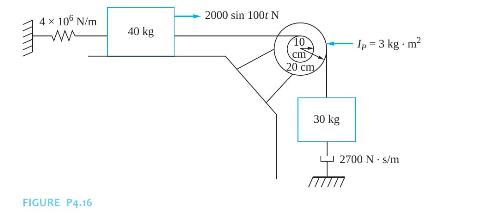
What is the amplitude of steady-state oscillation of the \(30 \mathrm{~kg}\) block of the system of Figure P4.16? 4 10 N/m 40 kg FIGURE P4.16 2000 sin 1001 N 10 cm Ip = 3 kg-m 20 cm 30 kg 2700 N s/m
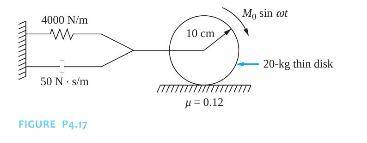
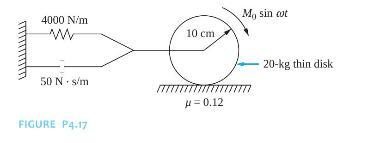
If \(\omega=16.5 \mathrm{rad} / \mathrm{s}\), what is the maximum value of \(M_{0}\) such that the disk of Figure P4.17 rolls without slip? 4000 N/m w 10 cm Mo sin cot 50 N s/m = 0.12 FIGURE P4.17 20-kg thin disk
If \(M_{0}=2 \mathrm{~N} \cdot \mathrm{m}\), for what values of \(\omega\) will the disk of Figure P4.17 roll without slip? 4000 N/m w 50 N s/m FIGURE P4.17 10 cm Mo sin cot 20-kg thin disk =0.12
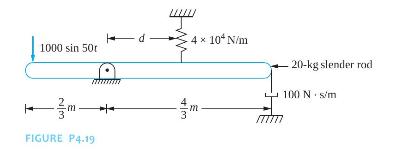
For what values of \(d\) will the steady-state amplitude of angular oscillations be less than \(1^{\circ}\) for the rod of Figure P4.19? 1000 sin 50r m+ FIGURE P4.19 d uyu 4 x 10 N/m 20-kg slender rod 100 N s/m -m
A 30-kg compressor is mounted on an isolator pad of stiffness \(6 \times 10^{5} \mathrm{~N} / \mathrm{m}\). When subject to a harmonic excitation of magnitude \(350 \mathrm{~N}\) and frequency \(100 \mathrm{rad} / \mathrm{s}\), the phase difference between the excitation and steady-state response
A thin disk with a mass of \(5 \mathrm{~kg}\) and a radius of \(10 \mathrm{~cm}\) is connected to a torsional damper of coefficient \(4.1 \mathrm{~N} \cdot \mathrm{s} \cdot \mathrm{m} / \mathrm{rad}\) and a solid circular shaft with a radius of \(10 \mathrm{~mm}\), length \(40 \mathrm{~cm}\), and
A 50-kg machine tool is mounted on an elastic foundation. An experiment is run to determine the stiffness and damping properties of the foundation. When the tool is excited with a harmonic force of magnitude \(8000 \mathrm{~N}\) at a variety of frequencies, the maximum steady-state amplitude
A machine with a mass of \(30 \mathrm{~kg}\) is placed on an elastic mounting of unknown properties. An engineer excites the machine with a harmonic force with a magnitude of \(100 \mathrm{~N}\) at a frequency of \(30 \mathrm{~Hz}\). He measures the steady-state response as having an amplitude of
A 80-kg machine tool is placed on an elastic mounting. The phase angle is measured as \(35.5^{\circ}\) when the machine is excited at \(30 \mathrm{~Hz}\). When the machine is excited at \(60 \mathrm{~Hz}\), the phase angle is \(113^{\circ}\). Determine the equivalent damping coefficient and
A \(100-\mathrm{kg}\) machine tool has a \(2-\mathrm{kg}\) rotating component. When the machine is mounted on an isolator and its operating speed is very large, the steady-state vibration amplitude is \(0.7 \mathrm{~mm}\). How far is the center of mass of the rotating component from its axis of
A \(1000 \mathrm{~kg}\) turbine with a rotating unbalance is placed on springs and viscous dampers in parallel. When the operating speed is \(20 \mathrm{~Hz}\), the observed steady-state amplitude is \(0.08 \mathrm{~mm}\). As the operating speed is increased, the steady-state amplitude increases
A \(120-\mathrm{kg}\) fan with a rotating unbalance of \(0.35 \mathrm{~kg} \cdot \mathrm{m}\) is to be placed at the midspan of a \(2.6-\mathrm{m}\) simply supported beam. The beam is made of steel \(\left(E=210 \times 10^{9} \mathrm{~N} / \mathrm{m}^{2}\right.\) ) with a uniform rectangular cross
Solve Chapter Problem 4.27 assuming the damping ratio of the beam is 0.04 .Data From Chapter Problem 4.27:A \(120-\mathrm{kg}\) fan with a rotating unbalance of \(0.35 \mathrm{~kg} \cdot \mathrm{m}\) is to be placed at the midspan of a \(2.6-\mathrm{m}\) simply supported beam. The beam is made of
A \(620-\mathrm{kg}\) fan has a rotating unbalance of \(0.25 \mathrm{~kg} \cdot \mathrm{m}\). What is the maximum stiffness of the fan's mounting such that the steady-state amplitude is \(0.5 \mathrm{~mm}\) or less at all operating speeds greater than \(100 \mathrm{~Hz}\) ? Assume a damping ratio
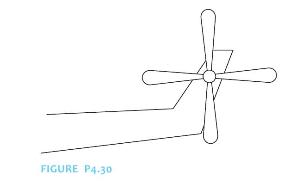
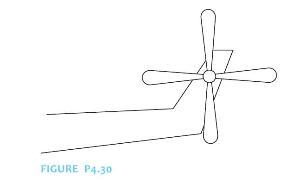
During flight a 75-g particle becomes stuck to one of the blades, \(25 \mathrm{~cm}\) from the axis of rotation. What is the steady-state amplitude of vibration caused by the resulting rotating unbalance?Refer to the following situation: The tail rotor section of the helicopter of Figure P4.30
Determine the steady–state amplitude of vibration if one of the blades in Figure P4.30 snaps off during flight.Refer to the following situation: The tail rotor section of the helicopter of Figure P4.30 consists of four blades, each of mass \(2.1 \mathrm{~kg}\), and an engine box of mass \(25
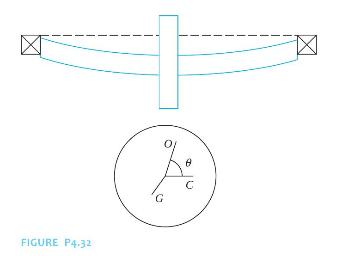
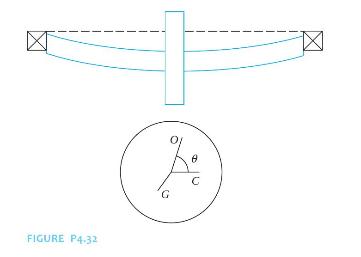
Whirling is a phenomenon that occurs in a rotating shaft when an attached rotor is unbalanced. The motion of the shaft and the eccentricity of the rotor cause an unbalanced inertia force, pulling the shaft away from its centerline, causing it to bow. Use Figure P4.32 to show that the amplitude of
A \(30-\mathrm{kg}\) rotor has an eccentricity of \(1.2 \mathrm{~cm}\). It is mounted on a shaft and bearing system whose stiffness is \(2.8 \times 10^{4} \mathrm{~N} / \mathrm{m}\) and damping ratio is 0.07 . What is the amplitude of whirling when the rotor operates at \(850 \mathrm{rpm}\) ? Refer
An engine flywheel has an eccentricity of \(0.8 \mathrm{~cm}\) and mass \(38 \mathrm{~kg}\). Assuming a damping ratio of 0.05 , what is the necessary stiffness of the bearings to limit its whirl amplitude to \(0.8 \mathrm{~mm}\) at all speeds between 1000 and \(2000 \mathrm{rpm}\) ? Refer to
It is proposed to build a \(6-\mathrm{m}\) smokestack on the top of a \(60-\mathrm{m}\) factory. The smokestack will be made of steel \(\left(ho=7850 \mathrm{~kg} / \mathrm{m}^{3}\right)\) and will have an inner radius of \(40 \mathrm{~cm}\) and an outer radius of \(45 \mathrm{~cm}\). What is the
What is the steady-state amplitude of oscillation due to vortex shedding of the smokestack of Chapter Problem. P4.35 if the wind speed is \(22 \mathrm{mph}\) ?Data From Chapter Problem 4.35:It is proposed to build a \(6-\mathrm{m}\) smokestack on the top of a \(60-\mathrm{m}\) factory. The
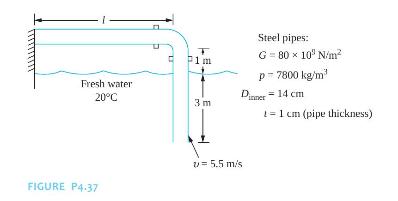
A factory is using the piping system of Figure P4.37 to discharge environmentally safe waste-water into a small river. The velocity of the river is estimated as \(5.5 \mathrm{~m} / \mathrm{s}\). Determine the allowable values of \(l\) such that the amplitude of torsional oscillations of the
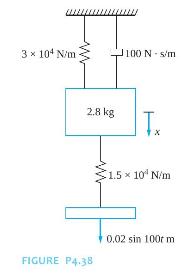
Determine the amplitude of steady-state vibration for the systems shown in Figures P4.38. Use the indicated generalized coordinate. 3 x 10⁴ N/m 100 N s/m 2.8 kg TX 1.5x10 N/m FIGURE P4.38 0.02 sin 100r m
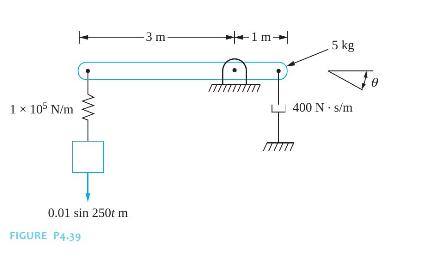
Determine the amplitude of steady-state vibration for the systems shown in Figures P4.39. Use the indicated generalized coordinate. 1 105 N/m 0.01 sin 250t m FIGURE P4.39 3 m 1 m 5 kg 400 N. s/m
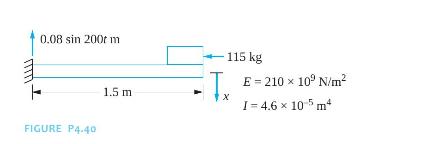
Determine the amplitude of steady-state vibration for the systems shown in Figures P4.40. Use the indicated generalized coordinate. 0.08 sin 200t m FIGURE P4.40 115 kg E-210 x 10 N/m 1.5 m X 1-4.6 10 5 m4
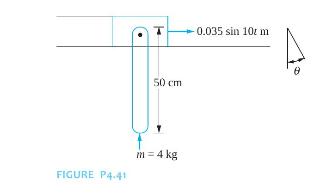
Determine the amplitude of steady-state vibration for the systems shown in Figures P4.41. Use the indicated generalized coordinate. 50 cm FIGURE P4.41 m = 4 kg -0.035 sin 10 m
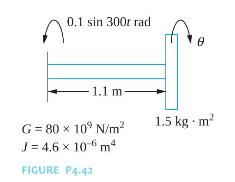
Determine the amplitude of steady-state vibration for the systems shown in Figures P4.42. Use the indicated generalized coordinate. 0.1 sin 300t rad -1.1 m- G=80 10 N/m x 106m4 J = 4.6 10 6 m4 FIGURE P4.42 1.5 kg m
A \(40 \mathrm{~kg}\) machine is attached to a base through a spring of stiffness \(2 \times 10^{4} \mathrm{~N} / \mathrm{m}\) in parallel with a dashpot of damping coefficient \(150 \mathrm{~N} \cdot \mathrm{s} / \mathrm{m}\). The base is given a time-dependent displacement \(0.15 \sin 30.1
A 5-kg rotor-balancing machine is mounted on a table through an elastic foundation of stiffness \(3.1 \times 10^{4} \mathrm{~N} / \mathrm{m}\) and damping ratio 0.04 . Transducers indicate that the table on which the machine is placed vibrates at a frequency of \(110 \mathrm{rad} / \mathrm{s}\)
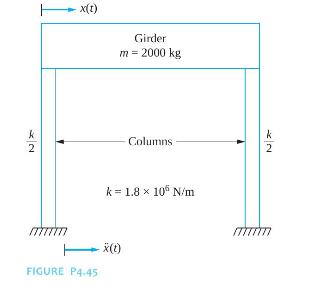
During a long earthquake the one-story frame structure of Figure P4.45 is subject to a ground acceleration of amplitude \(50 \mathrm{~mm} / \mathrm{s}^{2}\) at a frequency of \(88 \mathrm{rad} / \mathrm{s}\). Determine the acceleration amplitude of the structure. Assume the girder is rigid and the
What is the required column stiffness of a one-story structure to limit its acceleration amplitude to \(2.1 \mathrm{~m} / \mathrm{s}^{2}\) during an earthquake whose acceleration amplitude is \(150 \mathrm{~mm} / \mathrm{s}^{2}\) at a frequency of \(50 \mathrm{rad} / \mathrm{s}\) ? The mass of
In a rough sea, the heave of a ship is approximated as harmonic of amplitude \(20 \mathrm{~cm}\) at a frequency of \(1.5 \mathrm{~Hz}\). What is the acceleration amplitude of a \(20-\mathrm{kg}\) computer workstation mounted on an elastic foundation in the ship of stiffness \(700 \mathrm{~N} /
In the rough sea of Chapter Problem 4.47, what is the required stiffness of an elastic foundation of damping ratio 0.05 to limit the acceleration amplitude of a \(5-\mathrm{kg}\) radio set to \(1.5 \mathrm{~m} / \mathrm{s}^{2}\) ?Data From Chapter Problem 4.47:In a rough sea, the heave of a ship is
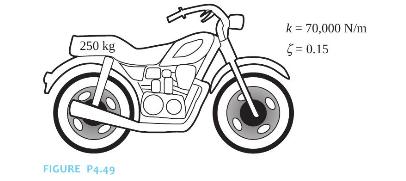
Consider the one degree-of-freedom model of a vehicle suspension system of Figure P4.49. Consider a motorcycle of mass \(250 \mathrm{~kg}\). The suspension stiffness is \(70,000 \mathrm{~N} / \mathrm{m}\) and the damping ratio is 0.15 . The motorcycle travels over a terrain that is approximately
For the motorcycle of Chapter Problem 4.49 determine(a) the "frequency response" of the motorcycle's suspension system by plotting the amplitude of acceleration versus motorcycle speed and(b) determine and plot the amplitude of displacement of the motorcycle versus its speed.Data From Chapter
What is the minimum static deflection of an undamped isolator that provides 75 percent islolation to a \(200-\mathrm{kg}\) washing machine at \(5000 \mathrm{rpm}\) ?
What is the maximum allowable stiffness of an isolator of damping ratio 0.05 that provides 81 percent isolation to a \(40-\mathrm{kg}\) printing press operating at \(850 \mathrm{rpm}\) ?
When set on a rigid foundation and operating at \(800 \mathrm{rpm}\), a 200-kg machine tool provides a harmonic force with a magnitude of \(18,000 \mathrm{~N}\) to the foundation. An engineer has determined that the maximum magnitude of a harmonic force to which the foundation should be subjected
A 150-kg engine operates at \(1500 \mathrm{rpm}\).(a) What percent isolation is achieved if the engine is mounted on four identical springs each of stiffness \(1.2 \times 10^{5} \mathrm{~N} / \mathrm{m}\) ?(b) What percent isolation is achieved if the springs are in parallel with a viscous damper
A \(150 \mathrm{~kg}\) engine operates at speeds between 1000 and \(2000 \mathrm{rpm}\). It is desired to achieve at least 85 percent isolation at all speeds. The only readily available isolator has a stiffness of \(5 \times 10^{5} \mathrm{~N} / \mathrm{m}\). How much mass must be added to the
Cork pads with a stiffness of \(6 \times 10^{5} \mathrm{~N} / \mathrm{m}\) and a damping ratio of 0.2 are used to isolate a \(40-\mathrm{kg}\) machine tool from its foundation. The machine tool operates at \(1400 \mathrm{rpm}\) and produces a harmonic force of magnitude \(80,000 \mathrm{~N}\). If
A 100-kg machine operates at \(1400 \mathrm{rpm}\) and produces a harmonic force of magnitude \(80,000 \mathrm{~N}\). The magnitude of the force transmitted to the foundation is to be reduced to \(20,000 \mathrm{~N}\) by mounting the machine on four identical undamped isolators in parallel. What is
A \(10-\mathrm{kg}\) laser flow-measuring device is used on a table in a laboratory. Because of operation of other equipment, the table is subject to vibration. Accelerometer measurements show that the dominant component of the table vibrations is at \(300 \mathrm{~Hz}\) and has an amplitude of
Rough seas cause a ship to heave with an amplitude of \(0.4 \mathrm{~m}\) at a frequency of \(20 \mathrm{rad} / \mathrm{s}\). Design an isolation system with a damping ratio of 0.13 such that a \(45 \mathrm{~kg}\) navigational computer is subject to an acceleration of only \(20 \mathrm{~m} /
A sensitive computer is being transported by rail in a boxcar. Accelerometer measurements indicate that when the train is traveling at its normal speed of \(85 \mathrm{~m} / \mathrm{s}\) the dominant component of the boxcar's vertical acceleration is \(8.5 \mathrm{~m} / \mathrm{s}^{2}\) at a
A \(200 \mathrm{~kg}\) engine operates at \(1200 \mathrm{rpm}\). Design an isolator such that the transmissibility ratio during start-up is less than 4.6 and the system achieves 80 percent isolation.
A \(150 \mathrm{~kg}\) machine tool operates at speeds between 500 and \(1500 \mathrm{rpm}\). At each speed a harmonic force of magnitude \(15,000 \mathrm{~N}\) is produced. Design an isolation system such that the maximum transmitted force during start-up is \(60,000 \mathrm{~N}\) and the maximum
A \(200 \mathrm{~kg}\) testing machine operates at \(500 \mathrm{rpm}\) and produces a harmonic force of magnitude \(40,000 \mathrm{~N}\). An isolation system for the machine consists of a damped isolator and a concrete block for mounting the machine. Design the isolation system such that all of
A 150-kg washing machine has a rotating unbalance of \(0.45 \mathrm{~kg} \cdot \mathrm{m}\). The machine is placed on isolators of equivalent stiffness \(4 \times 10^{5} \mathrm{~N} / \mathrm{m}\) and damping ratio 0.08 . Over what range of operating speeds will the transmitted force between the
A 54-kg air compressor operates at speeds between 800 and \(2000 \mathrm{rpm}\) and has a rotating unbalance of \(0.23 \mathrm{~kg} \cdot \mathrm{m}\). Design an isolator with a damping ratio of 0.15 such that the transmitted force is less than \(1000 \mathrm{~N}\) at all operating speeds.
A \(1000 \mathrm{~kg}\) turbomachine has a rotating unbalance of \(0.1 \mathrm{~kg} \cdot \mathrm{m}\). The machine operates at speeds between 500 and \(750 \mathrm{rpm}\). What is the maximum isolator stiffness of an undamped isolator that can be used to reduce the transmitted force to \(300
A motorcycle travels over a road whose contour is approximately sinusoidal, \(y(z)=0.2 \sin (0.4 z) \mathrm{m}\) where \(z\) is measured in meters. Using a SDOF model, design a suspension system with a damping ratio of 0.1 such that the acceleration felt by the rider is less than \(15 \mathrm{~m} /
A suspension system is being designed for a \(1000 \mathrm{~kg}\) vehicle. A first model of the system used in the design process is a spring of stiffness \(k\) in parallel with a viscous damper of damping coefficient \(c\). The model is being analyzed as the vehicle traverses a road with a
A \(20 \mathrm{~kg}\) block is connected to a spring of stiffness \(1 \times 10^{5} \mathrm{~N} / \mathrm{m}\) and placed on a surface which makes an angle of \(30^{\circ}\) with the horizontal. A force of \(300 \sin 80 t \mathrm{~N}\) is applied to the block. The steady-state amplitude is measured
A \(40 \mathrm{~kg}\) block is connected to a spring of stiffness \(1 \times 10^{5} \mathrm{~N} / \mathrm{m}\) and slides on a surface with a coefficient of friction 0.2 . When a harmonic force of frequency \(60 \mathrm{rad} / \mathrm{s}\) is applied to the block, the resulting amplitude of
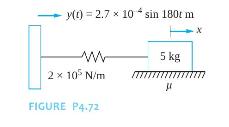
Determine the steady-state amplitude of motion of the \(5-\mathrm{kg}\) block. The coefficient of friction between the block and surface is 0.11 . (See Figure P4.72 .) y(t) 2.7 x 10 sin 180t m w 2 x 10⁵ N/m FIGURE P4.72 -x 5 kg
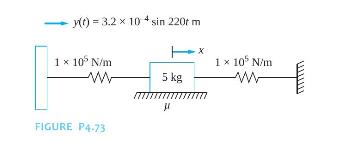
Determine the steady-state amplitude of motion of the \(5-\mathrm{kg}\) block. The coefficient of friction between the block and surface is 0.11 . (See Figure P4.73.) y(t) 3.2 x 10 sin 220 m 1 10 N/m ww 5 kg. FIGURE P4-73 X 1 105 N/m ww
Use the equivalent viscous damping approach to determine the steady-state response of a system subject to both viscous damping and Coulomb damping.
The area under the hysteresis curve for a particular helical coil spring is \(0.2 \mathrm{~N} \cdot \mathrm{m}\) when subject to a \(350 \mathrm{~N}\) load. The spring has a stiffness of \(4 \times 10^{5} \mathrm{~N} / \mathrm{m}\). If a \(44 \mathrm{~kg}\) block is hung from the spring and subject
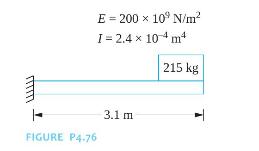
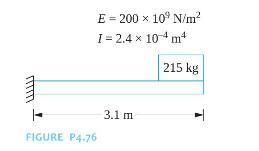
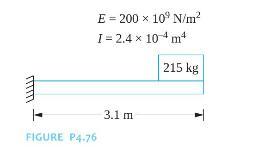
When a free-vibration test is run on the system of Figure P4.76, the ratio of amplitudes on successive cycles is 2.8 to 1 . Determine the response of the pump when it has an excitation force of magnitude \(3000 \mathrm{~N}\) at a frequency of \(2000 \mathrm{rpm}\). Assume the damping is hysteretic.
When a free-vibration test is run on the system of Figure P4.76, the ratio of amplitudes on successive cycles is 2.8 to 1 . When operating, the engine has a rotating unbalance of magnitude \(0.25 \mathrm{~kg} \cdot \mathrm{m}\). The engine operates at speeds between 500 and \(2500 \mathrm{rpm}\).
When the pump at the end of the beam of Figure P4.76 operates at \(1860 \mathrm{rpm}\), it is noted that the phase angle between the excitation and response is \(18^{\circ}\). What is the steady-state amplitude of the pump if it has a rotating unbalance of \(0.8 \mathrm{~kg} \cdot \mathrm{m}\) and
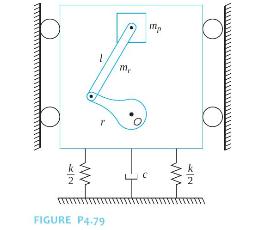
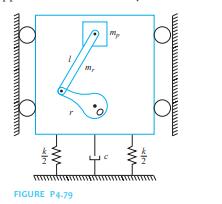
A schematic of a single-cylinder engine mounted on springs and a viscous damper is shown in Figure P4.79. The crank rotates about \(O\) with a constant speed \(\omega\). The connecting rod of mass \(m_{r}\) connects the crank and the piston of mass \(m_{p}\) such that the piston moves in a vertical
Using the results of Problem P4.79, determine the maximum steady-state response of a single-cylinder engine with \(m_{r}=1.5 \mathrm{~kg}, m_{p}=1.7 \mathrm{~kg}, r=5.0 \mathrm{~cm}, l=15.0 \mathrm{~cm}\), \(\omega=800 \mathrm{rpm}, k=1 \times 10^{5} \mathrm{~N} / \mathrm{m}, c=500 \mathrm{~N}^{p}
A 5-kg rotor-balancing machine is mounted to a table through an elastic foundation of stiffness \(10,000 \mathrm{~N} / \mathrm{m}\) and damping ratio 0.04 . Use of a transducer reveals that the table's vibration has two main components: an amplitude of \(0.8 \mathrm{~mm}\) at a frequency of \(140
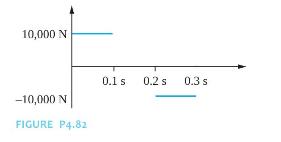
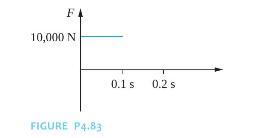
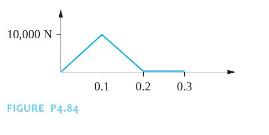
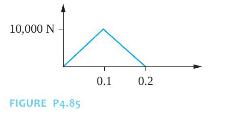
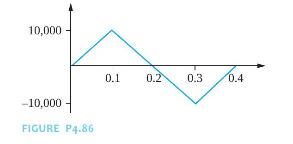
During operation a \(100-\mathrm{kg}\) press is subject to the periodic excitations shown. The press is mounted on an elastic foundation of stiffness \(1.6 \times 10^{5} \mathrm{~N} / \mathrm{m}\) and damping ratio 0.2. Determine the steady-state response of the press and approximate its maximum
During operation a \(100-\mathrm{kg}\) press is subject to the periodic excitations shown. The press is mounted on an elastic foundation of stiffness \(1.6 \times 10^{5} \mathrm{~N} / \mathrm{m}\) and damping ratio 0.2. Determine the steady-state response of the press and approximate its maximum
During operation a \(100-\mathrm{kg}\) press is subject to the periodic excitations shown. The press is mounted on an elastic foundation of stiffness \(1.6 \times 10^{5} \mathrm{~N} / \mathrm{m}\) and damping ratio 0.2. Determine the steady-state response of the press and approximate its maximum
During operation a \(100-\mathrm{kg}\) press is subject to the periodic excitations shown. The press is mounted on an elastic foundation of stiffness \(1.6 \times 10^{5} \mathrm{~N} / \mathrm{m}\) and damping ratio 0.2. Determine the steady-state response of the press and approximate its maximum
During operation a \(100-\mathrm{kg}\) press is subject to the periodic excitations shown. The press is mounted on an elastic foundation of stiffness \(1.6 \times 10^{5} \mathrm{~N} / \mathrm{m}\) and damping ratio 0.2. Determine the steady-state response of the press and approximate its maximum
Use of an accelerometer of natural frequency \(100 \mathrm{~Hz}\) and damping ratio 0.15 reveals that an engine vibrates at a frequency of \(20 \mathrm{~Hz}\) and has an acceleration amplitude of \(14.3 \mathrm{~m} / \mathrm{s}^{2}\). Determine(a) The percent error in the measurement(b) The actual
An accelerometer with a natural frequency of \(200 \mathrm{~Hz}\) and damping ratio of 0.7 is used to measure the vibrations of a system whose actual displacement is \(x(t)=1.6 \sin 45.1 t \mathrm{~mm}\). What is the accelerometer output?
An accelerometer with a natural frequency of \(200 \mathrm{~Hz}\) and damping ratio of 0.2 is used to measure the vibrations of an engine operating at \(1000 \mathrm{rpm}\). What is the percent error in the measurement?
When a machine tool is placed directly on a rigid floor, it provides an excitation of the form\[ F(t)=(4000 \sin 100 t+5100 \sin 150 t) \mathrm{N} \]to the floor. Determine the natural frequency of the system with an undamped isolator with the minimum possible static deflection such that when the
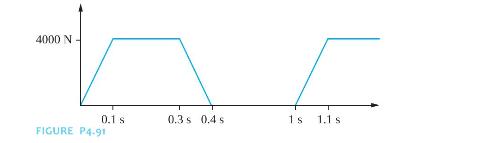
Use the force shown in Figure P4.91 as an approximation to the force provided by the punch press during its operation. Rework Example 4.17 for the excitation.Data From Example 4.17:The 500-kg punch press is to be mounted on an isolator such that the maximum of the repeating force transmitted to the
A \(550-\mathrm{kg}\) industrial sewing machine has a rotating unbalance of \(0.24 \mathrm{~kg} \cdot \mathrm{m}\). The machine operates at speeds between 2000 and \(3000 \mathrm{rpm}\). The machine is placed on an isolator pad of stiffness \(5 \times 10^{6} \mathrm{~N} / \mathrm{m}\) and damping
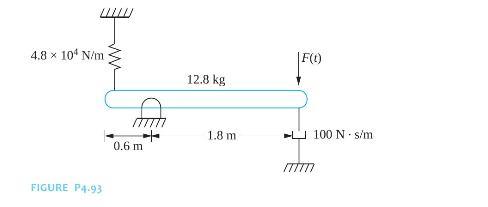
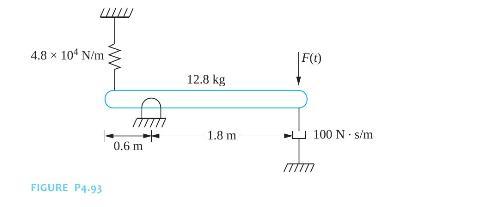
The system of Figure P4.93 is subject to the excitation\(F(t)=1000 \sin 25.4 t+800 \sin (48 t+0.35)-300 \sin (100 t+0.21) \mathrm{N}\)What is the output in \(\mathrm{mm} / \mathrm{s}^{2}\) of an accelerometer of natural frequency \(100 \mathrm{~Hz}\) and damping ratio 0.7 placed at \(A\) ? ww 4.8
What is the output, in \(\mathrm{mm}\), of a seismometer with a natural frequency of \(2.5 \mathrm{~Hz}\) and a damping ratio of 0.05 placed at point \(A\) for the system of Figure P4.93? 4.8 104 N/m ww FIGURE P4.93 0.6 m 12.8 kg F(t) 1.8 m 100 N s/m
A \(20 \mathrm{~kg}\) block is connected to a moveable support through a spring of stiffness \(1 \times 10^{5} \mathrm{~N} / \mathrm{m}\) in parallel with a viscous damper of damping coefficient \(600 \mathrm{~N} \cdot \mathrm{s} / \mathrm{m}\). The support is given a harmonic displacement of
An accelerometer has a natural frequency of \(80 \mathrm{~Hz}\) and a damping coefficient of \(8.0 \mathrm{~N} \cdot \mathrm{s} / \mathrm{m}\). When attached to a vibrating structure, it measures an amplitude of \(8.0 \mathrm{~m} / \mathrm{s}^{2}\) and a frequency of \(50 \mathrm{~Hz}\). The true
Vibrations of a \(30 \mathrm{~kg}\) machine occur at \(150 \mathrm{rad} / \mathrm{s}\) with an amplitude of \(0.003 \mathrm{~mm}\).(a) Design an energy harvester with a damping ratio of 0.2 that harvests theoretical maximum power over one cycle of vibrations from the body.(b) What is the power
An energy harvester is being designed to harvest the vibrations form a \(200 \mathrm{~kg}\) machine that has a rotating unbalance of \(0.1 \mathrm{~kg} \cdot \mathrm{m}\) which operates at \(1000 \mathrm{rpm}\). The harvester is to have a mass of \(1 \mathrm{~kg}\) and a damping ratio of 0.1 .(a)
An energy harvester is being designed for a vehicle with a simplified suspension system similar to that in the benchmark examples. The harvester, which is to be mounted on the vehicle, is to harvest energy as the vehicle vibrates while traveling. The harvester will have a mass of \(0.1
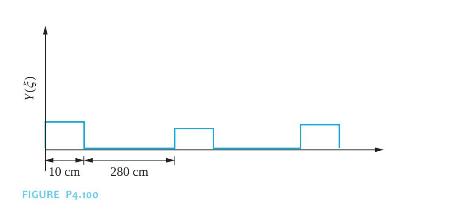
How much energy is harvested over one period by the energy harvester of Problem 4.99 if the vehicle is traveling at \(50 \mathrm{~m} / \mathrm{s}\) over a road whose contour is shown in Figure P4.100.Data From Problem 4.99:An energy harvester is being designed for a vehicle with a simplified
An energy harvester is being designed to harvest energy from a MEMS system. The harvester consists of a micro-cantilever beam vibrating in a viscous liquid such that its damping ratio is 0.2 . The micro-cantilever beam is made of silicon \(\left(E=1.9 \times 10^{11} \mathrm{~N} /
The one-dimensional displacement of a particle is\[ x(t)=0.5 e^{-0.2 t} \sin 5 t \mathrm{~m} \](a) What is the maximum displacement of the particle?(b) What is the maximum velocity of the particle?(c) What is the maximum acceleration of the particle?
The one-dimensional displacement of a particle is\[ x(t)=0.5 e^{-0.2 t} \sin (5 t+0.24) \mathrm{m} \](a) What is the maximum displacement of the particle?(b) What is the maximum velocity of the particle?(c) What is the maximum acceleration of the particle?
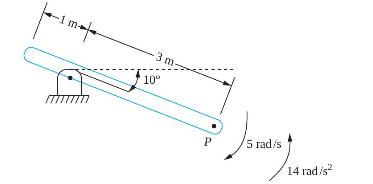
At the instant shown in Figure P1.3, the slender rod has a clockwise angular velocity of \(5 \mathrm{rad} / \mathrm{s}\) and a counterclockwise angular acceleration of \(14 \mathrm{rad} / \mathrm{s}^{2}\). At the instant shown, determine (a) the velocity of point \(P\) and (b) the acceleration of
A \(t=0\), a particle of mass \(1.2 \mathrm{~kg}\) is traveling with a speed of \(10 \mathrm{~m} / \mathrm{s} \mathrm{that} \mathrm{is}\) increasing at a rate of \(0.5 \mathrm{~m} / \mathrm{s}^{2}\). The local radius of curvature at this instant is \(50 \mathrm{~m}\). After the particle travels
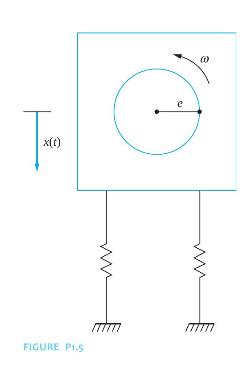
The machine of Figure P1.5 has a vertical displacement \(x(t)\). The machine has a component which rotates with a constant angular speed \(\omega\). The center of mass of the rotating component is a distance \(e\) from the axis of rotation. The center of mass of the rotating component is as shown
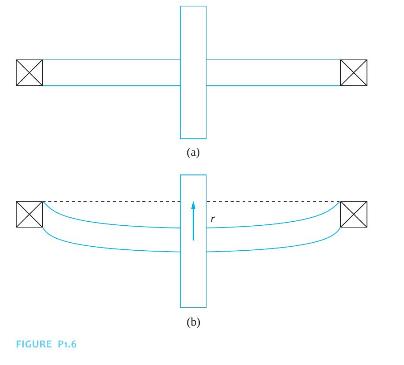
The rotor of Figure P1.6 consists of a disk mounted on a shaft. Unfortunately, the disk is unbalanced, and the center of mass is a distance \(e\) from the center of the shaft. As the disk rotates, this causes a phenomena called "whirl", where the disk bows. Let \(r\) be the instantaneous distance
A 2 ton truck is traveling down an icy, \(10^{\circ}\) hill at \(50 \mathrm{mph}\) when the driver sees a car stalled at the bottom of the hill \(250 \mathrm{ft}\) away. As soon as he sees the stalled car, the driver applies his brakes, but due to the icy conditions, a braking force of only \(2000
The contour of a bumpy road is approximated by\[ y(x)=0.03 \sin (0.125 x) \mathrm{m} \]What is the amplitude of the vertical acceleration of the wheels of an automobile as it travels over this road at a constant horizontal speed of \(40 \mathrm{~m} / \mathrm{s}\) ?
Showing 1900 - 2000
of 4547
First
13
14
15
16
17
18
19
20
21
22
23
24
25
26
27
Last
Step by Step Answers

 Get 50% OFF
Claim Now
Get 50% OFF
Claim Now