New Semester
Started
Get
50% OFF
Study Help!
--h --m --s
Claim Now
Question Answers
Textbooks
Find textbooks, questions and answers
Oops, something went wrong!
Change your search query and then try again
S
Books
FREE
Study Help
Expert Questions
Accounting
General Management
Mathematics
Finance
Organizational Behaviour
Law
Physics
Operating System
Management Leadership
Sociology
Programming
Marketing
Database
Computer Network
Economics
Textbooks Solutions
Accounting
Managerial Accounting
Management Leadership
Cost Accounting
Statistics
Business Law
Corporate Finance
Finance
Economics
Auditing
Tutors
Online Tutors
Find a Tutor
Hire a Tutor
Become a Tutor
AI Tutor
AI Study Planner
NEW
Sell Books
Search
Search
Sign In
Register
study help
engineering
introduction mechanical engineering
Principles Of Mechanical Engineering 1st Edition Sadhu Singh - Solutions
Define true and engineering stresses.
State Hooke’s law.
Define engineering and natural strains.
What is a thermal stress?
Define hardness.
Define toughness and brittleness.
Define fatigue and endurance limit.
What is a permanent set ?
What is sudden load?
Define creep. What are its stages?
What is a Wohler curve?
Define Young’s modulus of elasticity.
Define strain energy and resilience.
In an engine working on ideal Otto cycle, the temperature at the beginning and end of compression are \(45^{\circ} \mathrm{C}\) and \(370^{\circ} \mathrm{C}\) respectively. Find the compression ratio and airstandard efficiency of the engine. Assume \(\gamma=1.4\).
In an Otto cycle, air at \(15^{\circ} \mathrm{C}\) and 1 bar is compressed adiabatically until the pressure is 15 bar. Heat is added at constant volume until the pressure rises to 40 bar. Calculate (a) the air-standard efficiency, (b) the compression ratio, and (c) the mean effective pressure for
A gas engine working on Otto cycle has a cylinder of diameter \(220 \mathrm{~mm}\) and stroke \(300 \mathrm{~mm}\). The clearance volume is \(1600 \mathrm{cc}\). Find the air-standard efficiency. Assume \(c_{p}=1.004 \mathrm{~kJ} / \mathrm{kg} . \mathrm{K}\) and \(c_{v}=0.718 \mathrm{~kJ} /
A gas engine working on ideal Otto cycle has a compression ratio of 6.1. The pressure and temperature at the commencement of compression are 1 bar and \(27^{\circ} \mathrm{C}\). The heat supplied during the constant volume combustion process is \(1200 \mathrm{~kJ} / \mathrm{kg}\). Determine the
The pressure limit in a Otto cycle are 1 bar and 20 bar. The compression ratio is 5. Calculate (a) thermal efficiency, and (b) mean effective pressure. Assume \(\gamma=1.4\) for air.
An air-standard Otto cycle has a compression ratio of 6. The temperature at the start of compression process is \(25^{\circ} \mathrm{C}\) and the pressure is 1 bar. If the maximum temperature of the cycle is \(1150^{\circ} \mathrm{C}\), calculate (a) the heat supplied per \(\mathrm{kg}\) of air,
A petrol engine with compression ratio of 5 develops \(20 \mathrm{~kW}\) indicated power and consumes 8 litres of fuel per hour. The specific gravity of fuel is 0.78 and its calorific value is \(44 \mathrm{MJ} / \mathrm{kg}\). Calculate the indicated thermal efficiency and relative efficiency. Take
A diesel engine has a compression ratio of 20 and cut-off takes place at 5\% of the stroke. Find the air-standard efficiency. Assume \(\gamma=1.4\).
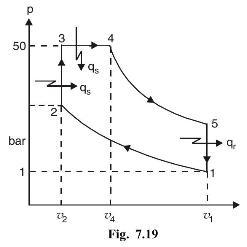
In an engine working on diesel cycle, inlet pressure and temperature are 1 bar and \(20^{\circ} \mathrm{C}\). Pressure at the end of adiabatic compression is 40 bar. The ratio of expansion after constant pressure heat addition is 5. Calculate the heat supplied, heat rejected and the efficiency of
A diesel cycle operates at a pressure of 1 bar at the beginning of compression and the volume is compressed to \(1 / 15^{\text {th }}\) of the initial volume. Heat is supplied until the volume is twice that of the clearance volume. Calculate the mean effective pressure of the cycle. Assume
The mean effective pressure of an ideal diesel cycle is 10 bar. If the initial pressure is 1 bar and the compression ratio is 14, determine the cut off ratio and the air standard efficiency. Assume \(\gamma=1.4\).
In an engine working on the diesel cycle, the air-fuel by weight is 50:1. The temperature of air at the beginning of combustion is 40C and the compression ratio is 15. What is the ideal efficiency of the engine. Calorific value of fuel is \(42 \mathrm{MJ} / \mathrm{kg}\).Assume. \[c_{v}=0.717
An air standard diesel cycle has a compression ratio of 16. The pressure at the beginning of compression stroke is 1 bar and the temperature is 20C. The maximum temperature is \(1430 C\). Determine the thermal efficiency and the mean effective pressure for this cycle. Take \(\gamma=1.4\).
A diesel engine has a compression ratio of 16. The fuel is cut-off at 0.08 stroke. The relative efficiency is \(52 \%\). Find the mass of the fuel of calorific value \(41800 \mathrm{~kJ} / \mathrm{kg}\), which would be required per \(k W\) per hour.
An engine works on dual combustion cycle, the compression ratio being 11 . The pressure at the commencement of combustion is 1 bar and the temperature is 90C. The maximum pressure in the cycle is 50 bar and the constant pressure heat addition continues for 1/20 of the stroke. Calculate the work
A six cylinder, four-stroke, spark ignition engine of bore \(10 \mathrm{~cm}\) and stroke \(12 \mathrm{~cm}\) with a compression ratio of 6 is tested at \(4800 \mathrm{rpm}\) on a dynamometer of arm \(55 \mathrm{~cm}\). During a 10 minute test, the dynamometer reads \(450 \mathrm{~N}\) and the
A six-cylinder, four-stroke, \(10 \mathrm{~cm}\) bore and \(12.5 \mathrm{~cm}\) stroke diesel engine develops \(50 \mathrm{~kW}\) at \(1000 \mathrm{rpm}\). The various efficiencies are: mechanical \(=76 \%\), volumetric \(=80 \%\) under room conditions, indicated relative \(=88 \%\), theoretical
A six-cylinder petrol engine operates on the four-stroke cycle. The bore of each cylinder is \(70 \mathrm{~mm}\) and stroke \(100 \mathrm{~mm}\). The clearance volume per cylinder is \(67 \mathrm{~cm}^{3}\). At a speed of \(3960 \mathrm{rpm}\) the full consumption is \(19.5 \mathrm{~kg} /
A four-cylinder, two-stroke cycle petrol engine develops \(40 \mathrm{~kW}\) at \(1500 \mathrm{rpm}\). The mean effective pressure in each cylinder is 7.5 bar. The mechanical efficiency is \(85 \%\) Determine the cylinder bore and piston stroke, if stroke to bore ratio is 1.5. Also determine the
A four-stroke, four-cylinder spark ignition engine has the following data :Piston diameter \(=100 \mathrm{~mm} ;\) Engine runs at a speed of \(800 \mathrm{rpm}\); Length of stroke \(=200 \mathrm{~mm}\).Find the indicated power developed in \(k W\). What should be the value of mean effective
A 4-cylinder, two-stroke cycle petrol engine develops \(30 \mathrm{~kW}\) at \(2500 \mathrm{rpm}\). The mean effective pressure on each piston is 8 bar and mechanical efficiency is \(80 \%\). Calculate the dia and stroke of each cylinder if stroke to bore ratio is 1.5. Also calculate the fuel
A six-cylinder, 4-stroke SI engine delivers \(400 \mathrm{~kW}\) at \(2200 \mathrm{rpm}\). Determine the bore and stroke from the following data :Compression ratio \(=7.6 ;\) stroke to bore ratio \(=1.25\), i.m.c.p. \(=100 \mathrm{~N} / \mathrm{cm}^{2}\), mechanical efficiency \(=0.75\), calorific
A four stroke petrol engine has a stroke volume of 5 litres. Its indicated mean effective pressure is \(0.5 \mathrm{MPa}\) and speed is \(750 \mathrm{rpm}\). Calculate the indicated power of the engine.
A four-cylinder, four stroke cycle petrol engine has \(100 \mathrm{~mm}\) bore and stroke is 1.25 times the bore. It consumes \(4 \mathrm{~kg}\) of fuel per hour having a calorific value of \(41,000 \mathrm{~kJ} / \mathrm{kg}\). The engine speed is \(800 \mathrm{rpm}\). Calculate indicated thermal
A 6 cylinder, 4 stroke I.C. engine is to develop \(89.5 \mathrm{~kW}\) at \(800 \mathrm{rpm}\). The stroke to bore ratio is 1.25:1. Assuming mechanical efficiency of \(80 \%\) and brake mean effective pressure of 5 bar, determine the diameter and stroke of the engine.
A petrol engine with bore \(150 \mathrm{~mm}\) and stroke \(200 \mathrm{~mm}\) has a clearance volume of 700 litres. If the indicated thermal efficiency is 0.30 , find the relative efficiency. Take \(\gamma=1.4\).
In a trial of a single cylinder oil engine, the following observations were made :Calculate (a) Brake power (b) BSFC (c) Brake thermal efficiency Oil consumption = = 10 kg/h
During testing of single cylinder two stroke oil engine, following data was obtained :Brake torque \(=640\) N.m, Cylinder diameter \(=21 \mathrm{~cm}\), Speed \(=350 \mathrm{rpm}\), Stroke \(=28 \mathrm{~cm}\), mean effective pressure \(=5.6 \mathrm{bar}\), oil consumption \(=8.16 \mathrm{~kg} /
The following readings were taken during the test on a single cylinder four stroke oil engine :Cylinder diameter \(=270 \mathrm{~mm}\), stroke length \(=380 \mathrm{~mm}\), mean effective pressure \(=6 \mathrm{bar}\), engine speed \(=250 \mathrm{rpm}\), net load on brake \(=1000 \mathrm{~N}\),
During a test on a single cylinder, four stroke engine having a compression ratio of 6, following data were recorded :Bore \(=10 \mathrm{~cm} ;\) Stroke \(=12.5 \mathrm{~cm} ;\) Indicated mean effective pressure \(=2.6 \mathrm{bar} ;\)Dead load on dynamometer, \(W=60 \mathrm{~N}\); Spring balance
A four cylinder, four stroke spark ignition engine has bore of \(80 \mathrm{~mm}\), stroke of \(80 \mathrm{~mm}\), and compression ratio of 8 . Calculate cubic capacity of engine and clearance volume of each cylinder.
A single cylinder, four stroke cycle oil engine is fitted with a rope brake. The diameter of the brake wheel is \(600 \mathrm{~mm}\) and rope diameter is \(26 \mathrm{~mm}\). The dead load on the brake is \(200 \mathrm{~N}\) and the spring balance reads \(30 \mathrm{~N}\). If the engine runs at
A four cylinder, two-stroke cycle petrol engine develops \(30 \mathrm{~kW}\) at \(2500 \mathrm{rpm}\). The indicated mean effective pressure of each is \(800 \mathrm{kPa}\) and \(\eta_{\text {mech }}=80 \%\). Calculate the diameter and stroke of each of the cylinder if \(\frac{L}{D}=1.5\). Also
The expansion of steam in an impulse turbine occurs in _____.
A steam turbine converts pressure/kinetic energy into _____
_____ takes into account the loss in blade velocity due to friction.
Blade or diagram efficiency is defined as the ratio of _____ to _____
Maximum blading efficiency of a single stage impulse turbine having symmetrical blades and nozzle angle is _____
In a velocity compounded steam turbine. _____ blade rings are separated by _____ blade rings.
In a reaction turbine, steam is expanded partially in the _____ and remaining expansion takes place in _____ blades.
Degree of reaction = _____/_____.
For symmetrical blading, the degree of reaction is _____.
DeLaval turbine is a/an _____.
De-Laval turbine is a:(a) simple single wheel reaction turbine(b) simple single wheel impulse turbine(c) velocity compounded impulse turbine(d) pressure compounded impulse turbine.
Curtis turbine is a:(a) reaction steam turbine(b) pressure compounded impulse steam turbine(c) velocity compounded impulse turbine(d) pressure-velocity compounded steam turbine.
Parson's turbine is :(a) impulse-reaction turbine(b) impulse turbine(c) reaction turbine(d) velocity compounded impulse turbine
Blade or diagram efficiency is:(a) \(\frac{\left(v_{w 1}+v_{w 2}\right) u}{v_{a 1}^{2}}\)(b) \(\frac{2\left(v_{w 1}+v_{w 2}\right) u}{v_{a 1}^{2}}\)(c) \(\frac{u^{2}}{v_{a 1}^{2}}\)(d) \(\frac{v_{a 1}^{2}}{u^{2}}\)
Axial thrust on rotor of steam turbine is(a) \(\dot{m}\left(v_{f 1}-v_{f 2}\right)\)(b) \(\dot{m}\left(v_{f 1}+v_{f 2}\right)\)(c) \(\dot{m}\left(v_{f 1}+v_{f 2}\right)\)(d) \(\dot{m}\left(v_{f 1}-2 v_{f 2}\right)\)
For maximum blade efficiency of single stage impulse turbine(a) \(ho\left(=\frac{u}{v_{a 1}}\right)=\frac{\cos ^{2} \alpha_{1}}{2}\)(b) \(ho=\cos \alpha_{1}\)(c) \(ho=\frac{\cos \alpha_{1}}{2}\)(d) \(ho=\cos ^{2} \alpha_{1}\)
Degree of reaction of steam turbine is(a) \(\frac{(\Delta h)_{m}}{(\Delta h)_{m}+(\Delta h)_{f}}\)(b) \(\frac{(\Delta h)_{f}}{(\Delta h)_{m}+(\Delta h)_{f}}\)(c) \(\frac{(\Delta h)_{m}}{(\Delta h)_{f}}\)(d) \(\frac{(\Delta h)_{f}}{(\Delta h)_{m}}\)
The maximum blade efficiency of impulse turbine is(a) \(\frac{\cos ^{2} \alpha_{1}}{2}(1+K C)\)(b) \(\cos ^{2} \alpha_{1}(1+K C)\)(c) \(\cos \alpha_{1}(1+K C)\)(d) \(\frac{\cos \alpha_{1}}{2}(1+K C)\)
During a refrigeration cycle, heat is rejected by the refrigerant in(a) compressor (b) condenser (c) evaporator (d) expansion valve
In a vapour compression refrigeration system, the condition of refrigerant before entering the compressor is(a) saturated liquid (b) wet vapour(c) dry saturated liquid (d) superheated vapour
The highest temperature during the cycle in vapour compression refrigeration system occurs after(a) compression (b) condensation (c) expansion (d) evaporation
In a vapour compression refrigeration system, the lowest temperature during the cycle occurs after(a) compression (b) condensation (c) expansion (d) evaporation
In a domestic refrigerator, the refrigerant commonly used is(a) Air (b) Carbon dioxide (c) Ammonia (d) Freon-12
R-12 refrigerant belongs to which group of refrigerants?(a) halo-carbon (b) azeotropes (c) inorganic (d) hydro-carbons
Which of the following is an azeotrope refrigerant?(a) R-11 (b) R-40 (c) R-114 (d) R-502
The colour of the flame of halide torch in case of leakage of freon refrigerant, will be(a) bright green (b) yellow (c) red (d) orange
The use of chlorofluoro carbon refrigerants is banned because these react with(a) water vapours and cause acid rain (b) plants and cause green house effect(c) oxygen and cause its depletion (d) ozone layer and cause its depletion
Expansion device used in a domestic refrigerator of vapour compression type is(a) automatic expansion valve (b) thermostatic expansion valve(c) hand operated valve (d) capillary tube
The bank of tube at the back of a domestic refrigerator of vapour compression type is(a) evaporator (b) condenser (c) capillary (d) electric wire
Frosting of evaporator tubes results in(a) increased heat transfer rate (b) decreased heat transfer rate(c) increased compressor pressure (d) decreased compressor pressure
The chemical formula of R-12 is(a) CCl2F (b) CClF3 (c) CCl2F2 (d) CHClF2
In a simple vapour compression cycle, the refrigerant is in the form of dry saturated vapour before entering(a) condenser (b) evaporator (c) throttle valve (d) compressor
A one ton refrigeration system means that its refrigerating effect is(a) 50 kJ/min (b) 210 kJ/min (c) 300 kJ/min (d) 350 kJ/min
Power consumption for the same refrigeration effect of a refrigerating system is(a) directly proportional to COP (b) inversely proportional to COP(c) directly proportional to √COP (d) inversely proportional to √COP
The usual expansion device used in a window air conditioner is(a) capillary tube (b) automatic expansion valve(c) float valve (d) hand expansion valve
In a window air-conditioner, air filter is placed(a) in the path of return air (b) in the path of supply air(c) after evaporator coil (d) before evaporator coil
Thermostat in a room air-conditioner controls(a) supply air temperature (b) room air temperature(c) outside air temperature (d) all of the above
The room air-conditioner controls the(a) temperature of air (b) humidity of air(c) both temperature and humidity of air (d) velocity of air
Define refrigeration and refrigeration effect.
What is the unit of refrigeration?
With a neat sketch describe vapour compression refrigeration system.
What is a refrigerant? Give its desirable properties.
What are the various types of refrigerant?
Define COP of a refrigerator and a heat pump
What are the various refrigeration systems?
Determine the COP for a simple vapour compression refrigeration system.
Describe the working of a domestic refrigerator with a neat sketch.
What are the precautions to be taken during use of domestic refrigerator?
What is air-conditioning? What is comfort air-conditioning?
Describe the working of a window type air-conditioner with a neat sketch.
An R-12 vapour compression refrigeration system is operating at a condenser temperature of 40°C and an evaporator temperature of –5°C. Calculate the actual COP of the cycle. The enthalpies of R – 12 at various points of the cycle are : h1 = 185.4 kJ/kg, h2 = 208.0 kJ/kg, h3 = h4 = 74.6 kJ/kg.
A refrigeration system of 15 tons capacity operates on simple vapour compression system cycle using R – 22. The evaporator temperature is 5°C and condenser temperature is 50°C. Calculate (a) the refrigerent mass flow rate and (b) the compressor intake volume flow rate if the compressor
A vapour absorption system has a source temperature of 110°C, the refrigeration temperature of –5°C, and ambient temperature of 35°C. Calculate its COP.
Draw the schematic diagram of simple vapour compression refrigeration system and explain the function of various components.
Showing 1300 - 1400
of 4547
First
7
8
9
10
11
12
13
14
15
16
17
18
19
20
21
Last
Step by Step Answers

 Get 50% OFF
Claim Now
Get 50% OFF
Claim Now