New Semester
Started
Get
50% OFF
Study Help!
--h --m --s
Claim Now
Question Answers
Textbooks
Find textbooks, questions and answers
Oops, something went wrong!
Change your search query and then try again
S
Books
FREE
Study Help
Expert Questions
Accounting
General Management
Mathematics
Finance
Organizational Behaviour
Law
Physics
Operating System
Management Leadership
Sociology
Programming
Marketing
Database
Computer Network
Economics
Textbooks Solutions
Accounting
Managerial Accounting
Management Leadership
Cost Accounting
Statistics
Business Law
Corporate Finance
Finance
Economics
Auditing
Tutors
Online Tutors
Find a Tutor
Hire a Tutor
Become a Tutor
AI Tutor
AI Study Planner
NEW
Sell Books
Search
Search
Sign In
Register
study help
engineering
introduction mechanical engineering
Principles Of Mechanical Engineering 1st Edition Sadhu Singh - Solutions
In a control volume, mass, momentum and energy may flow. State True (T) or False (F)
Temperature is an intensive property. State True (T) or False (F)
Kinetic energy is an extensive property. State True (T) or False (F)
Work is a path function. State True (T) or False (F)
The first law of thermodynamics is the law of conservation of energy. State True (T) or False (F)
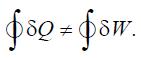
According to the first law of thermodynamics State True (T) or False (F) =
According to the first law, heat and work are mutually convertible. State True (T) or False (F)
It is impossible to construct a PMM-1. State True (T) or False (F)
For an isolated system, the energy remains constant. State True (T) or False (F)
In a steady flow process, the conditions in control volume remain unchanged with time. State True (T) or False (F)
A nozzle converts kinetic energy into pressure energy. State True (T) or False (F)
A steam turbine converts heat energy into useful work. State True (T) or False (F)
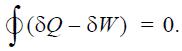
For a system undergoing a cycle, State True (T) or False (F) $(8Q-sw) = 0.
For a perfect gas, enthalpy, H = mCpdT. State True (T) or False (F)
Heat can flow automatically from cold to hot body. State True (T) or False (F)
Heat source is a low temperature reservoir. State True (T) or False (F)
A heat pump removes heat from a high temperature body. State True (T) or False (F)
It is impossible to construct a PMM2. State True (T) or False (F)
A Carnot cycle engine is not practicable. State True (T) or False (F)
A constant volume cycle is called isobaric. State True (T) or False (F)
A reversible engine is the most efficient engine working within the same temperature limits. State True (T) or False (F)
The efficiency of a reversible engine depends on the nature of the working fluid. State True (T) or False (F)
Entropy is not a property of the system. State True (T) or False (F)
Entropy is an extensive property of the system. State True (T) or False (F)
Entropy may e regarded as the degradation of energy. State True (T) or False (F)
Work done in a closed system isochoric process is zero. State True (T) or False (F)
An adiabatic process is called isentropic. State True (T) or False (F)
State True (T) or False (F) In an isentropic process, change in heat energy is zero.
State True (T) or False (F) The work done in a closed system is – ∫v.dp.
There is no change in internal energy in a free expansion process. State True (T) or False (F)
Throttling process is a reversible process. State True (T) or False (F)
There is no change in enthalpy in a throttling process. State True (T) or False (F)
The work done in a steady flow isobaric process is p (v2 – v1). State True (T) or False (F)
The work done in a non-flow isochoric process is v (p1 – p2). State True (T) or False (F)
The work done in a non-flow process is ∫p.dv. State True (T) or False (F)
In an open system, which crosses the boundary of the system?(a) heat (b) work (c) mass (d) heat and work
In an isolated system, what transfers?(a) mass (b) energy(c) both mass and energy (d) neither mass nor energy
Choose the extensive property :(a) pressure (b) volume (c) temperature (d) density
Which of the following is an intensive property?(a) volume (b) temperature (c) mass (d) energy
A system comprising of a single phase is called :(a) homogeneous (b) heterogeneous (c) isolated (d) closed
Consider the following statements : 1. In an open system, mass and energy transfer takes place.2. In a closed system, energy transfer takes place.3. The universe can be considered as an isolated system.Of these statements :(a) only 1 is correct (b) only 2 is correct(c) 1 and 2 are correct (d) 1,2
Consider the following statements :1. Milk and sugar is a homogeneous system.2. Free expansion is an irreversible process 3. Thermos flask is an isolated system.Of these statements :(a) only 1 is correct (b) 1 and 2 are correct(c) 2 and 3 are correct (d) 1,2 and 3 are correct.
Which of the following is a path function?(a) heat (b) temperature (c) pressure (d) volume.
The following are examples of some intensive and extensive properties :1. Pressure 2. Temperature 3. Volume 4. Velocity 5. Electric charge 6. Magnetisation 7. Viscosity 8. Potential energy.Which one of the following sets gives the correct combination of intensive and extensive properties?Intensive
A mixture of gases expands from 0.03 m3 to 0.06 m3 at a constant pressure of 1 MPa and absorbs 84 kJ of heat during the process. The change in internal energy of the mixture is :(a) 30 kJ (b) 54 kJ (c) 84 kJ (d) 114 kJ
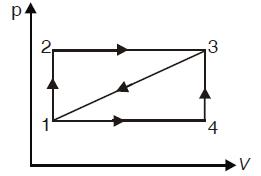
Given that for the path 1 – 2 – 3, a system absorbs 100 kJ as heat and does 60 kJ work.While along the path 1 – 4 – 3, it does 20 kJ work (see figure). The heat absorbed during the cycle 1 – 4 – 3 is :(a) – 140 kJ (b) – 80 kJ (c) – 40 kJ (d) + 60 kJ p. 2, 3 4
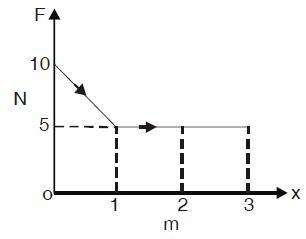
The given figure shows the variation of force in an elementary system which undergoes a process during which the plunger position changes from 0 to 3 m. If the internal energy of the system at the end of the process is 2.5 kJ higher, then the heat absorbed during the process is :(a) 15 J (b) 20 J
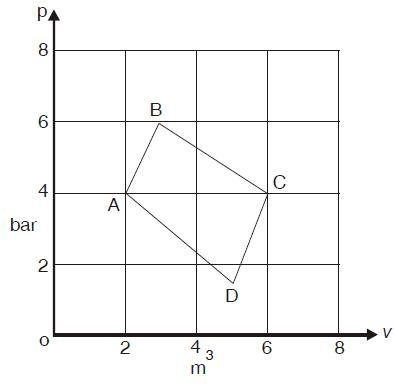
The net work done for the closed cycle shown in the given pressure – volume diagram is :(a) 600 kN.m (b) 700 kN.m (c) 900 kN.m (d) 1000 kN.m PA 8 B 6 bar 4 2 A C D 43 6 8 2 m V
The internal energy of a certain system is a function of temperature alone and is given by the formula : E = 25 + 0.25t kJ. If this system executes a process for which the work done by it per degree temperature increase is 0.75 kN.m, the heat interaction per degree temperature increase is :(a) –
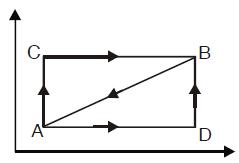
When a system is taken from state A to state B along the path A – C – B, 180 kJ of heat flows into the system and does 130 kJ of work (see figure). How much heat will flow into the system along the path A – D – B if the work done by it along the path is 40 kJ ?(a) 40 kJ (b) 60 kJ (c) 90 kJ
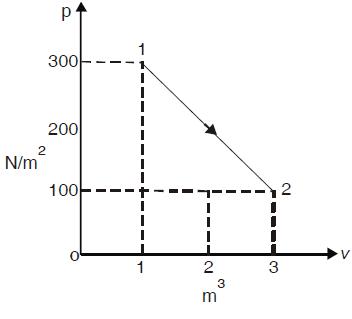
A control mass undergoes a process from state 1 to state 2 as shown in the given figure.During this process, if the heat transfers to state 2 from state 1 by another process, then the work interaction during the return process (in kN.m) would be :(a) – 400 (b) – 200 (c) 200 (d) 400 p 300- N/m 2
A tank containing air is stirred by a paddle wheel. The work input to the paddle wheel is 9000 kJ and the heat transferred to the surroundings from the tank is 3000 kJ. The external work done by the system is :(a) zero (b) 3000 kJ (c) 6000 kJ (d) 9000 kJ
The second law of thermodynamics helps to define(a) Heat (b) Work (c) Entropy (d) Internal energy
The Kelvin-Planks law states the principle of conservation of(a) Work (b) heat (c) mass (d) heat into work
Which of the following is incorrect statement(a) Heat is not completely convertible into work(b) Energy can be transferred from one form to another automatically(c) Heat cannot flow automatically from cold to hot body(d) Gas cannot expand automatically from low to high pressure
It is impossible to construct an engine which while operating in a cycle produces no other effect to extract heat from a single reservoir and do equivalent amount of work. This refers to :(a) Clausius statement (b) Kelvin-Planck’s statement(c) Carnot theorem (d) PMM-2
A Carnot cycle comprises of :(a) Two isothermal and two isentropic processes(b) Two constant volume and two isentropic processes(c) Two constant pressure and two isentropic processes(d) One constant volume , one constant pressure and two isentropic processes.
A Carnot cycle operates between temperatures of 1000 K and 500 K. Its thermal efficiency is :(a) 50% (b) 200% (c) 100% (d) 150%
A Carnot cycle operates between temperatures of 800 K and 400 K. Its efficiency will be 50% if working fluid is :(a) air (b) nitrogen (c) carbon dioxide (d) any fluid
A refrigerator and heat pump operate between the same temperature limits. If COP of the refrigerator is 3, the COP of pump will be :(a) 3 (b) 4 (c) 5 (d) 6
A heat engine is supplied with 800 kJ/s of heat at 600 K and rejects at 300 K . For the process to be reversible, heat rejected is :(a) 200 kJ/s (b) 400 kJ/s (c) 500 kJ/s (d) 600kJ/s
The more effective way to increase the thermal efficiency of a Carnot cycle is to:(a) increase the source temperature (b) decrease the sink temperature(c) increase the sink temperature (d) decrease the source temperature
Choose the correct statement(a) Entropy is an intensive property of the system(b) Entropy is conservative(c) Entropy is a measure of the level of irreversibility associated with a process(d) Entropy of the Universe is always decreasing
Consider the following statements :The definition of :1. temperature is due to Zerorth law of Thermodynamics 2. entropy is due to First law of Thermodynamics 3. internal energy is due to Second Law of Thermodynamics 4. reversibility is due to Kelvin- Planck’s statement Of these statements :(a)
One reversible heat engine operates between 1600 K and T2 , and another reversible heat engine operates between T2 and 400 K. If both the engines have the same heat input and output, then the temperature T2 must be equal to :(a) 1000 K (b) 1200 K (c) 1400 K (d) 800 K
A heat engine using lake water at 12°C as source and surrounding atmosphere at 2°C as sink executes 1080 cycles per minute. If the amount of heat drawn per cycle is 57 J, then the output of the engine will be :(a) 66 W (b) 56 W (c) 46 W (d) 36 W
In a cyclic heat engine operating between a source temperature of 600°C and a sink temperature of 20°C , the least rate of heat rejection per kW net output of the engine is :(a) 0.460 kW (b) 0.505 kW (c) 0.588 kW (d) 0.650 kW
A Carnot engine receiving heat at 400 K has an efficiency of 25% . The COP of a Carnot refrigerator working between the same temperature limits is(a) 1 (b) 2 (c) 3 (d) 4
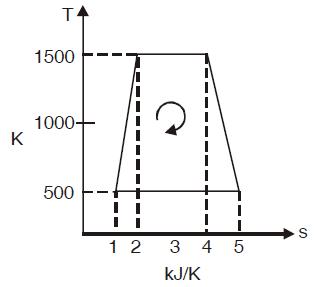
The efficiency of a reversible cyclic process undergone by a substance as shown below is :(a) 0.40 (b) 0.55 (c) 0.66 (d) 0.80 T4 1500 K 1000- 500 1 2 3 4 5 KJ/K S
A heat engine is supplied with 250 kJ/s of heat at a constant fixed temperature of 227°C.The heat is rejected at 27°C. The cycle is reversible, if the amount of rejected is :(a) 273 kJ/s (b) 200 kJ/ss (c) 180 kJ/s (d) 150 kJ/s
The work done in a steady flow process is: (a) Jp dv (b) Sv.dp (c) -Spav (d) - Svdp
The following remains constant during a throttling process:(a) internal energy (b) enthalpy (c) pressure (d) temperature
In an open system, the following can cross the boundary of the system:(a) heat and work (b) mass (c) mass, heat and work (d) heat only
In an isolated system, the following can cross the boundary of the system:(a) energy (b) mass (c) energy and mass (d) neither energy nor mass.
An isentropic process is(a) irreversible & adiabatic (b) reversible & adiabatic(c) irreversible & frictionless (d) reversible & isothermal.
In the Polytropic Process pVn = c, if n = ¥, the process is called(a) isochoric(b) isobaric(c) isothermal(d) adiabatic
During isothermal process, which does not change?(a) pressure (b) temperature(c) volume (d) both pressure & temperature
Choose the incorrect relationship(a) cp + cv = R(b) cp – cv = R(c) γ = cp/cv (d) cv = R/ (γ - 1)
Define the term thermodynamic.
Explain the thermodynamic system, surroundings and universe.
Distinguish between closed, open and isolated system with examples.
Differentiate between homogeneous and heterogeneous systems.
What do you mean by phase of a system?
What do you mean by thermodynamic equilibrium?
What do you mean by property? Distinguish between intensive and extensive properties.
Separate the following into intensive and extensive properties :Mass, weight, volume, pressure, temperature, density, velocity, surface area, internal energy, potential energy.
Explain the terms : state, phase, process and cyclic process.
What do you understand by reversible and irreversible process? Give examples.
Explain cyclic and quasi – static process.
Explain the term “Energy”. Discuss its various forms.
Define work. Show that work is a path function.
Define the term heat.
Choose the open or closed system from the following :Water pump, pressure cooker, automobile engine, air compressor, steam turbine, boiler system.
State the number of phases in the following :Pure water, water – alcohol mixture, coffee, water – oil mixture, aqua – ammonia, mild steel, at room temperature.
Explain the concept of temperature.
State zeroth law of thermodynamics.
Write the characteristic gas equation.
What is universal gas constant?
What is PMM-1.
Show that energy of an isolated system remains unchanged.
Showing 2200 - 2300
of 4547
First
16
17
18
19
20
21
22
23
24
25
26
27
28
29
30
Last
Step by Step Answers

 Get 50% OFF
Claim Now
Get 50% OFF
Claim Now