New Semester
Started
Get
50% OFF
Study Help!
--h --m --s
Claim Now
Question Answers
Textbooks
Find textbooks, questions and answers
Oops, something went wrong!
Change your search query and then try again
S
Books
FREE
Study Help
Expert Questions
Accounting
General Management
Mathematics
Finance
Organizational Behaviour
Law
Physics
Operating System
Management Leadership
Sociology
Programming
Marketing
Database
Computer Network
Economics
Textbooks Solutions
Accounting
Managerial Accounting
Management Leadership
Cost Accounting
Statistics
Business Law
Corporate Finance
Finance
Economics
Auditing
Tutors
Online Tutors
Find a Tutor
Hire a Tutor
Become a Tutor
AI Tutor
AI Study Planner
NEW
Sell Books
Search
Search
Sign In
Register
study help
engineering
introduction mechanical engineering
Principles Of Mechanical Engineering 1st Edition Sadhu Singh - Solutions
Following data relate to an oil engine working on Otto cycle :Compression ratio \(=6 ;\) B.P. \(=14.8 \mathrm{~kW}\); Suction pressure \(=1\) bar and temp. \(=27^{\circ} \mathrm{C}\); Relative efficiency \(=68 \%\); Mechanical efficiency \(=78 \%\)Find its air standard and thermal efficiencies.
A gasoline engine consumes 8 litres of fuel per hr. having specific gravity of 0.75 while it develops \(25 \mathrm{~kW}\) power. If the C.V. of fuel used is \(44200 \mathrm{~kJ} / \mathrm{kg}\), determine its indicated thermal efficiency.
A four cylinder, four stroke cycle petrol engine develops \(40 \mathrm{~kW}\) at \(2500 \mathrm{rpm}\). The mean effective pressure is \(0.8 \mathrm{MPa}\) and mechanical efficiency is \(80 \%\). Calculate diameter and stroke of each cylinder if stroke to bore ratio is 1.5. Also calculate the brake
A six cylinder, four stroke petrol engine has the following data:bore \(=8 \mathrm{~cm}\), stroke \(=10 \mathrm{~cm}\), clearance volume \(=70\) c.c., speed \(=4000 \mathrm{rpm}\), consumption \(=20 \mathrm{~kg} / \mathrm{hr}\), torque developed \(=150 \mathrm{Nm}\), C.V. of fuel used \(=43
A single cylinder, four stroke C.I. engine has the following data :bore \(=10 \mathrm{~cm} ;\) stroke \(=11 \mathrm{~cm}\), brake torque \(=28 \mathrm{Nm}\), speed \(=1600 \mathrm{rpm} ;\) i.m.e.p. \(=6.5\) bar.Find the B.P., IP., F.P. and its mechanical efficiency.
Following results refer to a test on petrol engine :I.P. \(=32 \mathrm{~kW} ;\) B.P. \(=27 \mathrm{~kW} ;\) speed \(=1200 \mathrm{rpm}\) b.s.f.c. \(=0.25 \mathrm{~kg} / \mathrm{kWh} ;\)C.V. of fuel used \(=44 \mathrm{~mJ} / \mathrm{kg}\).Calculate indicated, brake and mechanical efficiencies.
A six cylinder four stroke I.C. engine is to develop \(100 \mathrm{~kW}\) IP at \(800 \mathrm{rpm}\). The stroke to bore ratio is 1.25 . Assuming mechanical efficiency of \(80 \%\) and brake mean effective pressure of \(5 \mathrm{bar}\), find out the diameter and stroke of the engine.
A six cylinder four stroke petrol engine develops \(300 \mathrm{~kW}\) (BP) at \(2500 \mathrm{rpm}\). The stroke to bore ratio is 1.25. The mean effective pressure on each piston is 9 bar and mechanical efficiency of the engine is \(80 \%\). Indicated thermal efficiency is \(30 \%\). Calculate
During a trial on single cylinder four stroke IC engine, the following observations were taken : Mean effective pressure \(=4\) bar, speed \(=200\) RPM, Brake power \(=7.5 \mathrm{~kW}, \mathrm{~L} / \mathrm{D}\) ratio of piston \(=1.5\). If mechanical efficiency is \(70 \%\) find the dimensions of
Following data refers to a test on a petrol engine. Indicated power \(=30 \mathrm{~kW}\), Brake power \(=26\) \(\mathrm{kW}\), Engine speed \(=1800 \mathrm{RPM}\), Brake specific fuel consumption \(=0.35 \mathrm{~kg} / \mathrm{kWh}, \mathrm{C} . \mathrm{V}\). of fuel \(=\) \(44,000 \mathrm{~kJ} /
Give reasons for the following:(i) I.C. Engine cylinders are required to be cooled.(ii) Carburettor and spark plug are provided on petrol engines.The indicated power of a four stroke cycle petrol engine is \(37 \mathrm{~kW}\). The stroke is \(280 \mathrm{~mm}\) and the bore is \(190 \mathrm{~mm}\).
A 6 cylinder four stroke cycle petrol engine develops \(300 \mathrm{~kW}\) bp at 2500 r.p.m. The stroke to bore ratio is 1.25. Assuming the mechanical efficiency of \(80 \%\) and mean effective pressure of \(9 \mathrm{bar}\), determine the bore and stroke of engine.Also find the fuel consumption in
An engine is used on a job requiring \(110 \mathrm{~kW}\) BP. The mechanical efficiency of the engine is \(80 \%\) and engine consumes \(50 \mathrm{~kg} / \mathrm{hr}\) of fuel. A design improvement is made which reduces the engine friction by \(5 \mathrm{~kW}\). If indicated thermal efficiency
A four cylinder, four stroke petrol engine has the swept volume of 1750 c.c. It develops \(27 \mathrm{~kW}\) at \(1000 \mathrm{rpm}\). Mean effective pressure is \(5 \mathrm{bar}\). Find the average number of times the cylinder misfires every minute.A single cylinder, four stroke, air cooled engine
A four cylinder two stroke petrol engine with stroke to bore ratio of 1.2. develops \(32 \mathrm{~kW}\) bp at 2500 r.p.m. The mean effective pressure on each piston is 8 bar and the mechanical efficiency is 85 percent. Determine -(i) Diameter and stroke of each cylinder.(ii) Brake thermal
A four stroke petrol engine has a stroke volume of 5.7 litres. Its mean effective pressure is 600 \(\mathrm{kN} / \mathrm{m}^{2}\) and r.p.m. is 800 . Find the indicated power of the engine.
A four cylinder, four stroke petrol engine is to be design to give brake power of \(185 \mathrm{~kW}\) at 35 RPS. The stroke bore ratio is to be 1.5. Assuming mechanical efficiency of \(75 \%\) and indicated mean effective pressure of \(830 \mathrm{kPa}\). Determine the required bore and stroke.
An oil engine work on diesel cycle with temperature of \(27^{\circ} \mathrm{C}\) at the beginning of compression. If the ratio of adiabatic expansion is 8 , find the thermal efficiency of cycle. Assume \(\gamma=1.41\). A four stroke petrol engine has a stroke - volume of 5.7 litres. Its mean
Calculate the ideal efficiency of Otto cycle engine from the following data: Cylinder diameter \(=100 \mathrm{~mm}\), Length of stroke \(=150 \mathrm{~mm}\) clearance volume \(=250 \mathrm{~cm}^{3}\). Assume \(\gamma=1.4\).
In an ideal diesel cycle the temperature at the beginning and end of compression are \(57^{\circ} \mathrm{C}\) and \(603^{\circ} \mathrm{C}\) respectively. The temperature at the beginning and end of expansion are \(1950^{\circ} \mathrm{C}\) and \(870^{\circ} \mathrm{C}\) respectively. Determine
A petrol engine with a stroke length of \(200 \mathrm{~mm}\) and diameter of \(150 \mathrm{~mm}\) has a clearance volume of \(5 \times 10^{3} \mathrm{~mm}^{3}\). The indicated thermal efficiency of the engine is \(30 \%\). Find the relative efficiency of this engine. If the mean effective pressure
(i) Describe the construction and working of a spark plug. Where it is used ? Why?(ii) An engine working on Otto cycle, air has a pressure of \(1 \mathrm{bar}\) and temperature of \(27^{\circ} \mathrm{C}\) at the entry. Air is compressed adiabatically with a compression ratio of 7 . The heat is
The engine is working on ideal Otto cycle. The temperature at the beginning and at the end of compression is \(60^{\circ} \mathrm{C}\) and \(400^{\circ} \mathrm{C}\). Calculate the air standard efficiency.
The following data is available for an engine working on ideal Otto cycle Temperature at the beginning of compression \(=50^{\circ} \mathrm{C}\). Temperature at the end of compressor \(=373^{\circ} \mathrm{C}\). Calculate (1) Compression ratio (2) Air standard efficiency.
The following data is available for a four stroke petrol engine stroke volume \(=6\) Litres. Mean effective pressure \(=6\) bar. Speed of engine \(=750\) RPM. Calculate i.p. of the engine.
A six cylinder four stroke I.C. Engine is to develop \(100 \mathrm{~kW}\) i.p. at 800 RPM. The stroke to bare ratio is 1.25. Assuming Mechanical efficiency of \(80 \%\) and break mean effective pressure of 5 bar find out the diameter and stroke of the engine.
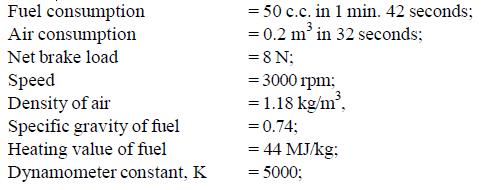
A4-stroke, 4-cylinder, single acting spark ignition petrol engine develops \(20 \mathrm{~kW}\) brake power at \(3000 \mathrm{rpm}\). The following data are given :Bore \(=65 \mathrm{~mm}\), Stroke \(=95 \mathrm{~mm}\), Clearance volume \(=65 \mathrm{~cm}^{3}\), Relative efficiency on BP basis
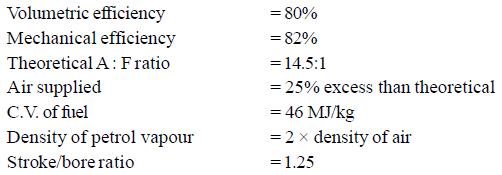
A six-cylinder, four-stroke petrol engine develops \(40 \mathrm{~kW}\) when running at \(3000 \mathrm{rpm}\). The volumetric efficiency at NTP is \(85 \%\). Indicated thermal efficiency is \(25 \%\). The A/F ratio of the mixture supplied is \(15: 1 . \mathrm{CV}\) of fuel used \(=41 \mathrm{MJ} /
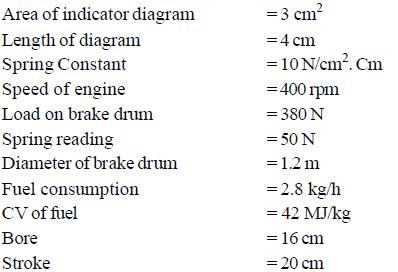
A single cylinder, four-stroke cycle oil engine works on diesel cycle. The following readings were taken when the engine was running at full load :Calculate (a) FP of engine, (b) mechanical efficiency, (c) brake thermal efficiency, and (d) BMEP. Area of indicator diagram Length of diagram Spring
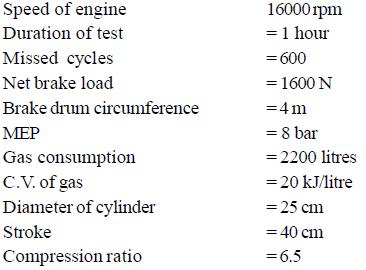
The following readings were taken during a test on a single-cylinder, four-stroke gas engine :Calculate (a) IP, (b) BP, (c) BSFC, (d) brake thermal efficiency, and (e) relative efficiency. Speed of engine Duration of test Missed cycles Net brake load Brake drum circumference MEP Gas consumption
A 6-cylinder, 4-stroke, single acting petrol engine develops \(50 \mathrm{~kW}\) brake power at \(4200 \mathrm{rpm}\) and brake thermal efficiency is \(22 \%\). The temperature and pressure at the end of suction stroke are \(60^{\circ} \mathrm{C}\) and 0.85 bar respectively. The following data are
Which of the following are boiler mountings ?(a) Economiser (b) Fusible plug (c) Super heater (d) Injector
Which out of the following boiler is capable of generating superheated steam without additional accessories ?(a) Cochran (b) Lancashire (c) Locomotive (d) Cornish
The economiser of the boiler plant is used mainly to(a) increase steam capacity (b) reduce fuel consumption(c) increase steam pressure (d) increase life of the boiler
Injector is used in small boilers(a) to inject steam to increase its capacity(b) to inject water like a feed pump(c) to inject air to the furnace(d) none of the above
Consider the following 1. Safety valve 2. Steam trap 3. Steam separator 4. Economiser Among these the boiler accessories would include(a) l, 2 and 3 (b) 2, 3 and 4 (c) l and 4 (d) l, 2, 3 and 4
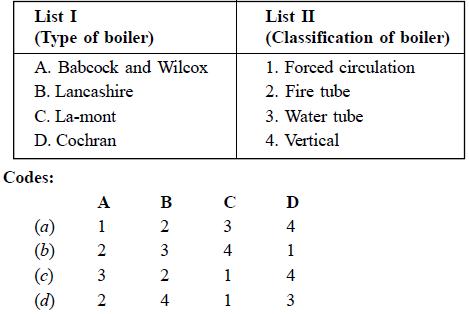
Match List I and List II and select the correct answer using the codes given below the lists List I (Type of boiler) A. Babcock and Wilcox B. Lancashire C. La-mont D. Cochran List II (Classification of boiler) 1. Forced circulation 2. Fire tube 3. Water tube 4. Vertical Codes: A (a) 1 2 (b) (c) (d)
The blow down cock is fitted in a boiler because of(a) allowing steam to flow to turbine(b) allowing exhaust gases to go to chimney(c) removing sludge from the boiler (d) blowing air in the furnace
Duplex feed pumps used in the steam boilers operate on the principle of(a) centrifugal pump (b) reciprocating pump(c) ejector pump (d) gear pump
Which boilers from the following utilizer the exhaust of the engine for increasing the draught?(a) Babcock and wilcox (b) Cochran(c) Locomotive (d) Lancashire
Once through boiler is named as such because(a) flue gas passes only in one direction (b) there is no recirculation of water(c) air is sent through the same direction (d) steam is sent out only in one direction
The gusset stays is provided in a boiler because(a) of preventing failure due to compression(b) of preventing leakage of steam(c) of preventing the bulging of flat surfaces(d) of providing support to the boiler drum
The function of the fusible plug in a boiler is(a) to prevent excessive pressure in the boiler(b) to extinguish fire in case when water level is low(c) to prevent excessive airflow(d) to prevent excessive steam flow to turbine
Glass tube water level indicator of boilers are connected in the following manner(a) Both ends are connected to water space(b) One end is connected to water space and the other end is connected to steam space(c) One end is connected to water space and the other end is connected to the
The high steam and low water safety valve is not suitable for the following type of boiler(a) Cochran (b) Lankashire (c) Locomotive (d) Cornish
The function of a steam trap in a boiler plant is(a) to prevent steam from leaking out from steam pipe(b) to prevent steam from leaking out from stop valve(c) to prevent steam from leaking out from boiler(d) to drain off water resulting from partial condensation of steam from steam pipes without
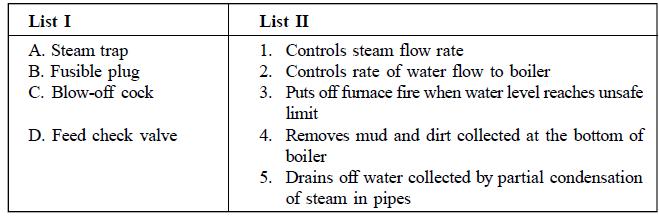
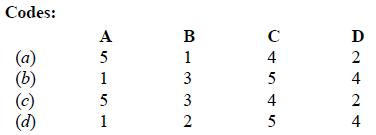
Match List I (Components) with list II (Functions) and select the correct answer using the codes given below the Lists: List I A. Steam trap B. Fusible plug C. Blow-off cock D. Feed check valve List II 1. Controls steam flow rate 2. Controls rate of water flow to boiler 3. Puts off furnace fire
The cross section of the water passage in an injector adjacent to feed check valve is(a) divergent towards boiler (b) convergent towards boiler(c) parallel passage (d) none of the above
In a Babcock and Wilcox boiler, baffles are provided in between the water tubes to(a) regulate the water flow(b) regulate the steam flow(c) allow the flue gas to have better contact with water tubes(d) have all the objectives fulfilled
The size of the steam drum in a Babcock and Wilcox boiler can be made small because(a) it contains only few water tubes(b) it contains only superheater tube(c) it does not contain any water tube(d) it contains a small number of water tubes and superheater tubes
Consider the following statements :1. Forced circulation is always used in high pressure power boilers.2. Soot blowers are used for cleaning tube surfaces at regular intervals.3. Electrostatic precipitator is used to remove fly ash from flue gases.Which of these statements are correct ?(a) l, 2 and
Once-through boilers operate at(a) subcritical pressure(b) super critical pressure(c) subcritical as well as super critical pressures(d) critical pressure only
Water after being pumped into a boiler can not come out because of(a) steam stop valve (b) feed check valve(c) safety valve (d) blow off valve
Which of the following is an accessory.(a) Safety valve (b) Feed check valve(c) Feed water pump (d) Stop valve
In Green’s Economiser the tubes are scraped(a) for the removal of scales formed due to water passage(b) for the removal of soot collected on the tubes(c) for increasing the circulation of water through tubes(d) none of the above
The correct location of an economiser is(a) between the furnace and preheater(b) between the air preheater and chimney(c) between force draught fan and furnace(d) near the superheater
The normal working pressure range for Cornish boiler as compared to that of Lancashire boiler is(a) same (b) high (c) low (d) none of this
The following mountings are fitted on the drum of a Babcock and Wilcox boiler(a) Safety valve, Pressure gauge, Feed check valve but not the Water valve(b) Safety valve, Pressure gauge, Water gauge but not the feed check valve(c) Safety valve, Feed water check valve, Blow down valve and Water
Which of the following is a fire tube boiler(a) Lancashire (b) Locomotive (c) Cochran (d) All of these
Which of the following form part(s) of the boiler mountings?1. Economiser 2. Feed check valve 3. Steam trap 4. Superheater Select the correct answer using the codes given below :Codes :(a) 2 alone (b) 1 and 3 (c) 2, 3 and 4 (d) 1, 2, 3 and 4
The fitting mounted on the boiler whose function is to put off the fire in the furnace, when level of water falls to an unsafe limit is called(a) Safety valve (b) Stop valve (c) Fusible plug (d) Blowoff cock
The fitting mounted on the boiler whose function is to prevent the steam pressure in a boiler exceeding a fixed maximum pressure is called(a) Safety valve (b) Stop valve (c) Fusible plug (d) Blowoff cock
The exact level of water in the boiler is indicated by(a) Water level indicator (b) Feed check valve(c) Blow off cock (d) Stop valve
Define equivalent evaporation and factor of evaporation.
Define boiler efficiency.
What are the purposes of carrying out boiler trial ?
Differentiate between a boiler and a steam generator.
State the primary requirements of a steam generator.
Distinguish between water tube and fire tube boilers.
Explain the difference between mountings and accessories.
What is the function of air preheater ?
What is an economiser ? What are its advantages ?
The following data is available from a boiler trial :Duration \(=1\) hour, steam generated \(=36000 \mathrm{~kg}\), steam pressure \(=12.5 \mathrm{bar}\), steam temperature \(=250^{\circ} \mathrm{C}\), temperature of water entering the economiser \(=16^{\circ} \mathrm{C}\), temperature of water
A boiler generates \(850 \mathrm{~kg}\) of steam per hour at a pressure of \(10 \mathrm{bar}\) and \(50^{\circ} \mathrm{C}\) superheat. It burns \(100 \mathrm{~kg} / \mathrm{h}\) of coal of calorific value \(30 \mathrm{MJ} / \mathrm{kg}\). The feed water temperature is \(30^{\circ} \mathrm{C}\).
A boiler supplies \(5000 \mathrm{~kg}\) of steam at 7 bar pressure and 0.98 dry. The feed water temperature is \(40^{\circ} \mathrm{C}\) when using \(650 \mathrm{~kg} / \mathrm{h}\) of coal. The calorific value of coal is \(31 \mathrm{~mJ} / \mathrm{kg}\). Calculate (a) the efficiency of boiler,
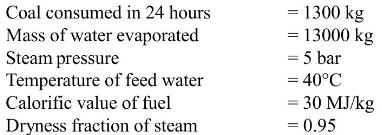
In a boiler trial, the following data is available :Calculate (a) equivalent evaporation from and at \(100^{\circ} \mathrm{C}\), and(b) boiler efficiency.Take \(c_{p w}=4.187 \mathrm{~kJ} / \mathrm{kg} . \mathrm{K}\). Coal consumed in 24 hours Mass of water evaporated Steam pressure Temperature of
Steam is generated at 12 bar and \(250^{\circ} \mathrm{C}\). The feed water temperature is \(30^{\circ} \mathrm{C}\). The calorific value of coal is \(34 \mathrm{MJ} / \mathrm{kg}\). Steam generated per \(\mathrm{kg}\) of coal burnt is \(10 \mathrm{~kg}\). Find (a) equivalent evaporation, and (b)
A boiler generates \(4000 \mathrm{~kg} / \mathrm{h}\) of steam at \(20 \mathrm{bar}, 400^{\circ} \mathrm{C}\). The feed water temperature is \(50^{\circ} \mathrm{C}\). The efficiency of the boiler is \(80 \%\). The calorific value of fuel used is \(44,500 \mathrm{~kJ} / \mathrm{kg}\). The steam
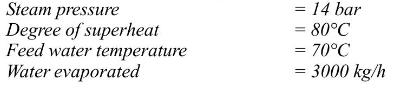
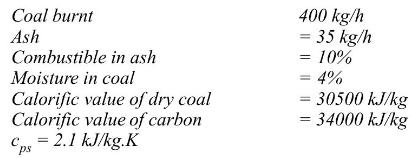
The following data was obtained during trial of a water tube boiler.Calculate (a) the efficiency of boiler plant including superheat, and (b) the efficiency of boiler and furnace combined. Steam pressure Degree of superheat Feed water temperature Water evaporated = 14 bar = 80C = = 70C = 3000 kg/h
A boiler plant supplies \(5400 \mathrm{~kg}\) of steam per hour at 7.6 bar pressure. The dryness of steam is 0.98 . The feed water temperature is \(42^{\circ} \mathrm{C}\) when using \(670 \mathrm{~kg}\) of coal/hr. The calorific valve of coal is \(31000 \mathrm{~kJ} / \mathrm{kg}\).Calculate (a)
In a boiler test, \(1300 \mathrm{~kg}\) of coal are consumed in 24 hours. The mass of water evaporated is \(13000 \mathrm{~kg}\). Steam pressure is 7 bar. The feed water temperature entering the boiler is \(40^{\circ} \mathrm{C}\). Calorific value of fuel is \(30000 \mathrm{~kJ} / \mathrm{kg}\).
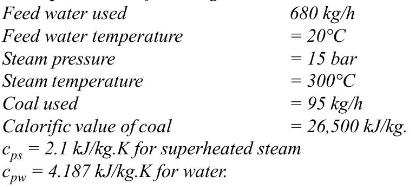
The following data was obtained in a boiler trial :Calculate : (a) Boiler efficiency (b) Equivalent evaporation from and at \(100^{\circ} \mathrm{C}\). Use the following table : Feed water used Feed water temperature Steam pressure 680 kg/h = 20C = 15 bar Steam temperature Coal used Calorific value
The superheated steam is generated from the boiler operation at 12 bar pressure. Steam generated \(/ \mathrm{kg}\) of coal burnt is \(10 \mathrm{~kg}\). Coal burnt \(=300 \mathrm{~kg} / \mathrm{h}\). If the enthalpies of superheated steam and water entering the boiler are \(2935.4 \mathrm{~kJ} /
A boiler produces \(1200 \mathrm{~kg}\) of steam \(/ \mathrm{h}\) at a pressure of \(10 \mathrm{bar}\) and temperature of \(200^{\circ} \mathrm{C}\). Coal consumed during same period is \(150 \mathrm{~kg}\). Feed water temperature is \(46^{\circ} \mathrm{C}\). C.V. of coal is \(45000 \mathrm{~kJ} /
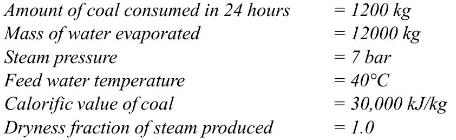
The following observations were taken during a test on a boiler trial.Calculate (a) Equivalent evaporation from and at \((F \& A) 100^{\circ} \mathrm{C}\).(b) Boiler efficiency. Amount of coal consumed in 24 hours Mass of water evaporated Steam pressure Feed water temperature Calorific value of
In a thermal power plant, the boiler produces \(50,000 \mathrm{~kg}\) of wet steam per hour with dryness fraction of 0.95. The feed water temperature is \(40^{\circ} \mathrm{C}\). Calculate the equivalent evaporation if boiler pressure is \(10 \mathrm{bar}\).
A steam generator evaporates \(18000 \mathrm{~kg} / \mathrm{h}\) of steam at 12 bar pressure and steam is \(97 \%\) dry. Feed water temperature \(=105^{\circ} \mathrm{C}\). Coal is fired at the rate of \(2050 \mathrm{~kg} / \mathrm{h}\). C.V. of coal is \(27400 \mathrm{~kJ} /
A boiler produces \(1000 \mathrm{~kg}\) of steam \(/ \mathrm{h}\) at a pressure of \(10 \mathrm{bar}\) abs. and \(0.95 \mathrm{dry}\) from water at \(40^{\circ} \mathrm{C}\). It is ascertained that \(10 \%\) of coal is unburnt at grate. If the efficiency of boiler alone is \(75 \%\), find the
A boiler produces \(2000 \mathrm{~kg}\) of dry saturated steam per hour at 10 bar. The feed water temperature \(=110^{\circ} \mathrm{C} .225 \mathrm{~kg}\) of coal having calorific value of \(30,000 \mathrm{~kJ} / \mathrm{kg}\) are fired per hour. If \(10 \%\) of coal remains unburnt, Calculate (a)
A pressure cooker contains \(2 \mathrm{~kg}\) of steam at 5 bar and \(0.9 \mathrm{dry}\). Find the quantity of heat that must be rejected so that the quality of steam becomes 0.5 dry.
5 kg of steam at \(200 \mathrm{kPa}\) occupies a volume of (a) \(2.50 \mathrm{~m}^{3}\), and (b) \(5.00 \mathrm{~m}^{3}\). Determine the temperature in each case and the quality of steam.
A vessel of volume \(0.05 \mathrm{~m}^{3}\) contains a mixture of saturated water and saturated steam at a temperature of \(300^{\circ} \mathrm{C}\). The mass of liquid present is \(10 \mathrm{~kg}\). Find the pressure, the mass, the specific volume, the enthalpy, the entropy, and the internal
The pressure of steam in a condenser is 0.15 bar and the dryness fraction is 0.87. Calculate the amount of heat that must be removed from steam in order to condense (a) \(1 \mathrm{~kg}\) of steam, and (b) \(1 \mathrm{~m}^{3}\) of steam.
5000 kg/h of steam enters a surface condenser at \(0.08 \mathrm{bar} .250\) kilolitres/ \(/ \mathrm{h}\) of cooling water is passed through the tubes and its temperature rises from \(25^{\circ} \mathrm{C}\) to \(35^{\circ} \mathrm{C}\). The condensed steam leaves the condenser with a temperature of
2 kg of steam at \(15 \mathrm{bar}, 300^{\circ} \mathrm{C}\) undergoes a constant pressure process to give wet steam of \(65 \%\) of quality. Calculate (a) the work done, (b) change in enthalpy, and (c) heat transferred assuming non-flow process.
A cylinder piston assembly contains \(2.5 \mathrm{~kg}\) of water inside it at a temperature of \(25^{\circ} \mathrm{C}\). The cylinder is well insulated and its area of cross-section is \(0.45 \mathrm{~m}\). A pressure equivalent of 6 bar is applied on water by the piston. Heat is supplied to
A house hold pressure cooker contains \(2 \mathrm{~kg}\) of dry and saturated steam at 4 bar while in operation. Calculate the quantity of heat that must be rejected so that steam becomes wet with 65 present dryness fraction. Also calculate the pressure and temperature of steam that exists in the
A sealed and evacuated drum of volume \(0.25 \mathrm{~m}^{3}\) contains saturated water at \(70^{\circ} \mathrm{C}\). It is heated till the pressure and temperature of steam becomes 14 bar and \(250^{\circ} \mathrm{C}\) respectively. Calculate (a) the mass of water contained in the drum, and (b)
A spherical vessel of \(1 \mathrm{~m}^{3}\) capacity contains steam at 10 bar and 0.95 dry. Steam is blown off until the pressure drops to 5 bar. The valve is then closed and the steam is allowed to cool until the pressure falls to 2.5 bar. Assuming that the enthalpy of steam in the vessel remains
The steam, initially at a pressure of 15 bar and a temperature of \(250^{\circ} \mathrm{C}\), expand reversibly and polytropically to \(1.5 \mathrm{bar}\). Find the final temperature, work done, and change of entropy, if the index of expansion is 1.25. (Assume 1 bar \(=1.013 \times 10^{2}
Showing 1500 - 1600
of 4547
First
9
10
11
12
13
14
15
16
17
18
19
20
21
22
23
Last
Step by Step Answers

 Get 50% OFF
Claim Now
Get 50% OFF
Claim Now