New Semester
Started
Get
50% OFF
Study Help!
--h --m --s
Claim Now
Question Answers
Textbooks
Find textbooks, questions and answers
Oops, something went wrong!
Change your search query and then try again
S
Books
FREE
Study Help
Expert Questions
Accounting
General Management
Mathematics
Finance
Organizational Behaviour
Law
Physics
Operating System
Management Leadership
Sociology
Programming
Marketing
Database
Computer Network
Economics
Textbooks Solutions
Accounting
Managerial Accounting
Management Leadership
Cost Accounting
Statistics
Business Law
Corporate Finance
Finance
Economics
Auditing
Tutors
Online Tutors
Find a Tutor
Hire a Tutor
Become a Tutor
AI Tutor
AI Study Planner
NEW
Sell Books
Search
Search
Sign In
Register
study help
engineering
introduction mechanical engineering
Principles Of Mechanical Engineering 1st Edition Sadhu Singh - Solutions
Write the steady flow energy equation.
Write the relationship between specific heats.
What is adiabatic index? Give its usual value.
What conditions are fulfilled by a steady flow process?
State the limitations of First law of thermodynamics.
State Kelvin-Planck statement for second law of thermodynamics.
State Clausius statement for the second law of thermodynamic.
What is a PMM2?
Are Kelvin-Planck and Clausius statements equivalent?
Differentiate between a heat engine and a heat sink.
What is a thermal reservoir?
Differentiate between a heat source and a heat sink.
Describe the working of a Carnot cycle.
What are the limitations of Carnot cycle?
Define thermal efficiency of a heat engine.
Differentiate between a heat pump and a refrigerator.
Define COP of a heat pump and a refrigerator.
Define the term ‘Entropy’.
Show that the entropy is a property of the system.
The entropy of the universe tends to be maximum. Comment.
What are the characteristics of entropy?
Draw the Carnot cycle on T-S diagram.
State Third law of thermodynamics.
What is the importance of third law of thermodynamics?
Determine an expansion for the heat transfer in a closed system isochoric process.
Explain the concept of a closed isobaric process and determine an expansion for its heat transfer.
Determine an expansion for the work done in a closed isothermal process.
What is an isentropic process? Determine an expansion for the work done in a non-flow isentropic process.
Determine an expansion for the heat transfer and work done in a non-flow Polytropic process.
What is a free expansion process? What are its characteristics?
What is a throttling process? State its characteristics?
What is a steady flow process? Determine the work done in such an isochoric process.
Determine an expansion for the work done in a steady flow adiabatic process.
Compare the work done in a non-flow and flow type polytropic process.
5 m3 of gas at 8 bar and 180°C is heated keeping the pressure same till the volume is doubled. Calculate(a) heat added,(b) external work done, and(c) change in internal energy during the process.
In a cyclic process, heat transfers are \(+14.7 \mathrm{~kJ},-25.2 \mathrm{~kJ},-3.56 \mathrm{~kJ}\) and \(+31.5 \mathrm{~kJ}\). What is the net work for this cyclic process?
A heat engine receives 1000 kW of heat at constant temperature of 285°C and rejects heat at 5°C . The possible heat rejected are:(a) 840 kW,(b) 442 kW and(c) 300 kW. Comment on the results.
To cool water for drinking during summer, \(1 \mathrm{~kg}\) of ice at \(-2^{\circ} \mathrm{C}\) is mixed with \(5 \mathrm{~kg}\) of water at \(27^{\circ} \mathrm{C}\) in an insulated container subjected to 1 bar atmospheric pressure. Calculate the change in temperature of water and the change in
A heat exchanger handles \(40 \mathrm{~kg} / \mathrm{min}\) of water which is heated from \(20^{\circ} \mathrm{C}\) to \(70^{\circ} \mathrm{C}\) by a hot gas entering the heat exchanger at \(150^{\circ} \mathrm{C}\) and flow rate \(80 \mathrm{~kg} / \mathrm{min}\).Determine the change in entropy.
A heat pump operates between two identical bodies of specific heat \(C\) at \(T_{1}\). The operation of the pump cools down one of the bodies to \(T_{2}\). Show that for the operation of pump the minimum work input is given by:\[W_{\min }=C\left[\frac{T_{1}^{2}}{T_{2}}+T_{2}-2 T_{1}\right]\]
A Carnot engine with an efficiency of \(40 \%\) receives \(400 \mathrm{~kJ} / \mathrm{h}\) from a high temperature source and rejects heat to a sink at \(27^{\circ} \mathrm{C}\). What is the power output of the engine and temperature of the source in \({ }^{\circ} \mathrm{C}\) ?
A reverse Carnot engine is used for the heating of a building. The building receives \(209 \mathrm{~kJ} / \mathrm{h}\) of heat at \(20^{\circ} \mathrm{C}\) from a heat pump. The outside air temperature is \(-5^{\circ} \mathrm{C}\). Calculate (a) heat taken from outside air per hour, and (b) power
A piece of red hot iron is suddenly plunged into \(10 \mathrm{~kg}\) of water at \(20^{\circ} \mathrm{C}\). The temperature of water rises to \(55^{\circ} \mathrm{C}\). Calculate the change in entropy.
Two reversible heat engines \(A\) and \(B\) are arranged in series. A rejects heat directly to \(B\). Engine \(A\) receives \(300 \mathrm{~kJ}\) at a temperature of \(500^{\circ} \mathrm{C}\) from the heat source, while engine \(B\) is in communication with a cold sink at a temperature of
A hot iron having specific heat \(0.5 \mathrm{~kJ} / \mathrm{kg} \mathrm{K}\), mass \(30 \mathrm{~kg}\) and temperature \(500^{\circ} \mathrm{C}\) is dropped into \(200 \mathrm{~kg}\) of oil of specific heat \(2.5 \mathrm{~kJ} / \mathrm{kg} \mathrm{K}\). Calculate change in entropy of iron, oil and
A heat pump is used to maintain an auditorium hall at \(25^{\circ} \mathrm{C}\) when the atmospheric temperature is \(-5^{\circ} \mathrm{C}\). The heat load is \(2400 \mathrm{~kJ} / \mathrm{min}\). Calculate the power required to run the actual heat pump if the COP of the actual heat pump is \(25
An engine manufacturer claims to have developed a heat engine with the following specifications :Power developed \(=75 \mathrm{~kW}\); Fuel burnt \(=5 \mathrm{~kg} / \mathrm{h} ;\) Heating value of fuel \(=75000 \mathrm{~kJ} / \mathrm{kg}\) Temperature limits \(=1000 \mathrm{~K}\) and \(400
A heat source \(S_{1}\) can supply \(6000 \mathrm{~kJ} / \mathrm{min}\) at \(300^{\circ} \mathrm{C}\) and another heat source \(S_{2}\) can supply \(60,000 \mathrm{~kJ} / \mathrm{min}\) at \(100^{\circ} \mathrm{C}\). Which source will you choose to supply energy to a Carnot engine to produce a
A reversible engine working in a cycle takes \(4800 \mathrm{~kJ} / \mathrm{min}\) of heat from a source at \(800 \mathrm{~K}\) and develops \(45 \mathrm{~kW}\). The engine rejects heat to two sinks at \(300 \mathrm{~K}\) and \(360 \mathrm{~K}\). Determine the heat rejected to each sink.
A reversible heat engine receives heat from two thermal reservoirs maintained at constant temperatures at \(750 \mathrm{~K}\) and \(500 \mathrm{~K}\). The engine develops \(100 \mathrm{~kW}\) and rejects \(3600 \mathrm{~kJ} / \mathrm{min}\) of heat to a heat sink at \(250 \mathrm{~K}\). Determine
A reversible heat engine operates between two reservoirs at temperatures, \(700^{\circ} \mathrm{C}\) and \(50^{\circ} \mathrm{C}\). The engine drives a reversible refrigerator which operates between reservoirs at temperature of \(50^{\circ} \mathrm{C}\) and \(-25^{\circ} \mathrm{C}\). The heat
Two Carnot engines work in series between the source and sink temperatures of \(500 \mathrm{~K}\) and \(300 \mathrm{~K}\). If both engines develop equal power determine the intermediate temperature.
A reversible heat engine working between two thermal reservoirs at \(875 \mathrm{~K}\) and \(315 \mathrm{~K}\) drives a reversible refrigerator which operates between the same \(315 \mathrm{~K}\) reservoir and a reservoir at \(260 \mathrm{~K}\). The engine is supplied \(2000 \mathrm{~kJ}\) of heat
A heat engine operating between two reservoirs at \(1000 \mathrm{~K}\) and \(300 \mathrm{~K}\) is used to drive a heat pump which extracts heat from the reservoir at \(300 \mathrm{~K}\), at a rate twice that at which engine rejects heat to it. If efficiency of the engine is \(40 \%\) of the maximum
A domestic food freezer maintains a temperature of \(-15^{\circ} \mathrm{C}\). The ambient air temperature is \(30^{\circ} \mathrm{C}\). If heat leaks into the freezer at the continuous rate of \(1.75 \mathrm{~kJ} / \mathrm{s}\), what is the least power necessary to pump this heat out continuously.
A reversible heat engine operates between two reservoirs at temperatures of \(600^{\circ} \mathrm{C}\) and \(40^{\circ} \mathrm{C}\). The engine drives a reversible refrigerator which operates between reservoirs at temperatures of \(40^{\circ} \mathrm{C}\) and \(-20^{\circ} \mathrm{C}\). The heat
2 kg of water at \(80^{\circ} \mathrm{C}\) is mixed adiabatically with \(3 \mathrm{~kg}\) of water at \(30^{\circ} \mathrm{C}\) in a constant pressure process of 1 atmosphere. Find the increase in entropy of the total mass of water due to the mixing process. The \(c_{p}\) of water \(=4.187
Water is heated at a constant pressure of \(0.7 \mathrm{mPa}\). The boiling point is \(164.97^{\circ} \mathrm{C}\). The initial temperature of the water is \(0^{\circ} \mathrm{C}\). The latent heat of evaporation is \(2066.3 \mathrm{~kJ} / \mathrm{kg}\). Find the increase in entropy of water, if
Calculate the entropy change of the universe as a result of the following processes :(a) A copper block of \(600 \mathrm{~g}\) mass and with \(c_{p}\) of \(150 \mathrm{~J} / \mathrm{kg} \mathrm{K}\) at \(100^{\circ} \mathrm{C}\) is placed in a lake at \(8^{\circ} \mathrm{C}\).(b) The same block at
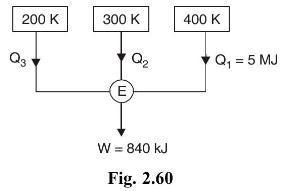
A reversible engine, as shown in Fig. 2.60 during a cycle of operation draws \(5 \mathrm{MJ}\) from the \(400 \mathrm{~K}\) reservoir and does \(840 \mathrm{~kJ}\) of work. Find the amount and direction of heat interaction with other reservoirs. 200 K 300 K 400 K Q3 E Q2 Q = 5 MJ W = 840 kJ Fig.
An adiabatic vessel contains \(2 \mathrm{~kg}\) of water at \(25^{\circ} \mathrm{C}\). By paddle-wheel work transfer, the temperature of water is increased to \(30^{\circ} \mathrm{C}\). If the specific heat of water is \(4.187 \mathrm{~kJ} / \mathrm{kg} \mathrm{K}\), find the entropy change of the
Two blocks of metal, each of mass \(10 \mathrm{~kg}\) and a specific heat of \(0.4 \mathrm{~kJ} / \mathrm{kg} \mathrm{K}\), are at a temperature of \(40^{\circ} \mathrm{C}\). A reversible refrigerator receives heat from one block and rejects heat to the other. Calculate the work required to cause a
1 kg of air at 3.5 bar and occupying \(0.35 \mathrm{~m}^{3}\) is heated at constant volume until its temperature has rises to \(316^{\circ} \mathrm{C}\). Find \((a)\) heat added, and \((b)\) gain in internal energy per \(\mathrm{kg}\) of air.Take \(c_{v}=0.718 \mathrm{~kJ} / \mathrm{kg}\). K.
1 kg of air having an initial volume of \(0.3 \mathrm{~m}^{3}\) is heated at constant pressure of \(3.2 \mathrm{bar}\) until the volume is doubled. Find \((a)\) heat added, and \((b)\) work done. Take \(c_{p}=1.005\) \(\mathrm{kJ} / \mathrm{kg} . \mathrm{K}, c_{v}=0.718 \mathrm{~kJ} /
5 m3 of gas at 8 bar and \(180^{\circ} \mathrm{C}\) is heated keeping the pressure same throughout till the volume is doubled. Find the heat added, external work done and the change in internal energy during the process. Take \(c_{p}=1.005 \mathrm{~kJ} / \mathrm{kg} . K, c_{v}=0.718 \mathrm{~kJ} /
Calculate the difference in non-flow work \(\int p d v\) and flow work \(-\int v . d p\), if \(1 \mathrm{~kg}\) of air having specific volume of \(0.4 \mathrm{~m}^{3}\) at 1.35 bar is compressed to a pressure of 10 bar according to the law \(p V^{1.3}=C\).
A gas undergoes the following reversible non-flow processes during its initial pressure of 15 bar and volume \(1 \mathrm{~m}^{3} / \mathrm{kg}\) to final pressure of 6 bar and volume \(2 \mathrm{~m}^{3} / \mathrm{kg}\).(a) Constant volume followed by constant pressure.(b) Constant pressure followed
A certain gas occupies \(0.1 \mathrm{~m}^{3}\) at 1 bar pressure. It is compressed adiabatically to a pressure of \(7 \mathrm{bar}\). Find the new volume, and change in internal energy. The density of gas at \(0^{\circ} \mathrm{C}\) and \(1 \mathrm{bar}\) is \(1.5 \mathrm{~kg} / \mathrm{m}^{3}\).
3 kg of oxygen undergoes a non-flow process during which its pressure remains constant at 7 bar from an initial volume of 1200 litres to a state where the temperature is \(520 \mathrm{~K}\). Find \((a)\) changes in internal energy, \((b)\) change in enthalpy, \((c)\) heat transferred, and \((d)\)
A constant volume chamber of \(0.3 \mathrm{~m}^{3}\) capacity contains \(2 \mathrm{~kg}\) of a gas at \(5^{\circ} \mathrm{C}\). Heat is transferred to the gas until the temperature is \(100^{\circ} \mathrm{C}\). Find the work done, heat transferred, and the change in internal energy, enthalpy and
0.5 kg of air is compressed reversibly and adiabatically from \(80 \mathrm{kPa}, 60^{\circ} \mathrm{C}\) to \(0.4 \mathrm{MPa}\), and is then expanded at constant pressure to the original volume. Calculate the heat transfer and work transfer for the whole path. Take \(R=0.287 \mathrm{~kJ} /
A mass of air is initially at \(260^{\circ} \mathrm{C}\) and \(700 \mathrm{kPa}\), and occupies \(0.028 \mathrm{~m}^{3}\). The air is expanded at constant pressure to \(0.084 \mathrm{~m}^{3}\). A Polytropic process, \(p V^{1.5}=C\), is then carried out followed by a constant temperature process
A mass of \(8 \mathrm{~kg}\) gas expands within a flexible container according to the law, \(p V^{1.5}=\) const. The initial pressure is \(1 \mathrm{MPa}\) and initial volume is \(1 \mathrm{~m}^{3}\). The final pressure is \(5 \mathrm{kPa}\). If specific internal energy of the gas decreases by \(40
During a reversible isobaric non-flow process with \(p=1.5\) bar the properties of the system change from \(0.25 \mathrm{~m}^{3} / \mathrm{kg}, 10^{\circ} \mathrm{C}\) to \(0.45 \mathrm{~m}^{3} / \mathrm{kg}, 240^{\circ} \mathrm{C}\). The specific heat of the fluid is given by \(c_{p}=[1.6+80
A closed system passes from state 1 to state 2 while \(200 \mathrm{~kJ}\) of heat is added and \(280 \mathrm{~kJ}\) of work is done. As the system is returned to state \(1,160 \mathrm{~kJ}\) of work is done on it. Calculate the heat transfer during process 2 to 1 .
A system contains \(0.15 \mathrm{~m}^{3}\) of a gas at a pressure of 3.8 bar and \(423 \mathrm{~K}\). It is expanded adiabatically till the pressure falls to \(1 \mathrm{bar}\). The gas is then heated at a constant pressure till its enthalpy increases by \(70 \mathrm{~kJ}\). Calculate the total
0.03 m3 of air at a pressure of 1.2 bar and \(298 \mathrm{~K}\) is compressed to a volume of \(0.0045 \mathrm{~m}^{3}\) according to the law \(p V^{1.3}=\) const. Find the final temperature and work done during compression.
1 kg of a perfect gas is compressed from \(0.9 \mathrm{bar}\) and \(300 \mathrm{~K}\) according to the flow \(p V^{1.3}=\) const. until the pressure is 5.4 bar. Calculate the heat flow to or from the cylinder well. Take \(R=0.277 \mathrm{~kJ} / \mathrm{kg}\). \(K\) and \(c_{p}=1.75 \mathrm{~kJ} /
The chuck used for machining a casting on lathe is(a) three jaw chuck (b) four jaw chuck(c) collet (d) magnetic chuck
The lathe post not provided with power feed is(a) lead screw (b) carriage(c) compound rest (d) cross slide
External taper can be obtained by(a) taper attachment (b) form tool(c) compound rest (d) tail stock offset.
A cone shaped recess at the top of drilled hole can be made by(a) countersinking (b) counterboring(c) taper drilling (d) grooing.
Power feed is not provided on the following drilling machine :(a) bench drill press (b) gang drilling machine(c) radial drilling machine (d) all of the above.
Reaming operation is performed to(a) improve the finish of a hole (b) obtain correct diameter(c) enlarge the hole (d) make a hole.
Which of the machine tools can be used for boring ?1. Lathe 2. Drilling machine 3. Vertical milling machine 4. Horizontal milling machine.(a) 1,2,3, (b) 1,3,4(c) 2 and 4 (d) 1, 2, 3, 4
The main purpose of boring operation as compared to drilling is to :(a) drill a hole (b) finish drilled hole(b) correct the hole (d) enlarge the existing hole.
Climb milling is chosen while machining because(a) the chip thickness increases gradually(b) it enables the cutter to dig in and start the cut(c) the specific power consumption is reduced(d) better surface finish can be obtained.
In a milling operation two side milling cutters are mounted with a desired distance between them so that both sides of a work piece can be milled simultaneously. This set up is called(a) gang milling (b) straddle milling(c) string milling (d) side milling.
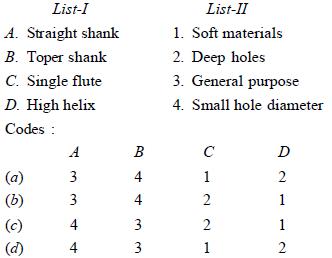
Match List-I (Type of drill) with List II (Application) and select the correct answer using the codes given below the lists : List-I A. Straight shank B. Toper shank C. Single flute D. High helix Codes: List-II 1. Soft materials 2. Deep holes 3. General purpose 4. Small hole diameter A B C D (a) 3
Consider the following statements :In Up milling process, 1. the cutter starts the cut from the machined surface and proceeds upwards.2. the cutter starts the cut from the top surface and proceeds downwards.3. the job is fed in a direction opposite to that of cutter rotation.4. the job is fed in
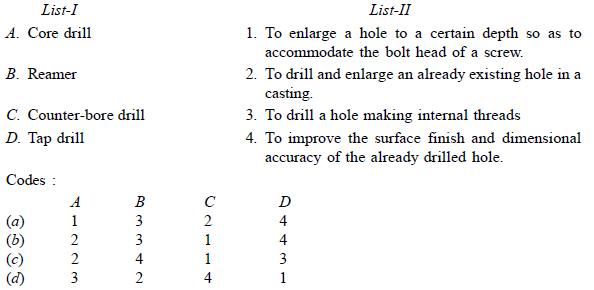
Match List-I (drill bits) with List -II (Applications) and select the correct answer using the codes given below the Lists: List-I A. Core drill B. Reamer C. Counter-bore drill D. Tap drill Codes: List-II 1. To enlarge a hole to a certain depth so as to accommodate the bolt head of a screw. 2. To
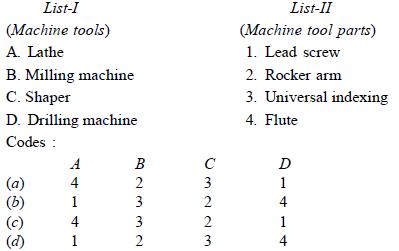
Match List-I (Machine tools) with List-II (Machine tool parts) and select the correct answer using the codes given below the lists : List-I (Machine tools) A. Lathe B. Milling machine C. Shaper D. Drilling machine Codes: (a) A B 4 2 (b) 1 (c) 4 (d) 1 3331 03223 List-II (Machine tool parts) 1. Lead
In milling machine, the cutting tool is held in position by(a) chuck (b) spindle (c) arbor (d) tool holder.
Consider the following statements associated with the lathe accessories :1. Steady rest is used for supporting a long job in between head stock and tail stock.2. Mandrel is used for turning small cylindrical jobs.3. Collects are used for turning disc-shaped job.Of these statements :(a) 1 and 2 are
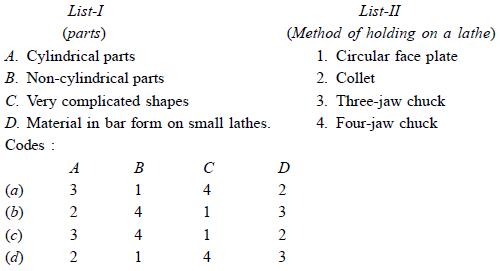
Match List-I (parts) with dist-II (Method of holding on a lathe) and select the correct answer using the codes given below the lists : List-I (parts) A. Cylindrical parts B. Non-cylindrical parts C. Very complicated shapes D. Material in bar form on small lathes. List-II (Method of holding on a
Define a machine tool.
What are the function performed by a machine tool?
How machine tools are classified according to the following criteria :(a) Field of application.(b) Accuracy(c) Weight(d) Processing operations.
What are the characteristics of general purpose machine tools ?
List the characteristics of special purpose machine tools.
Showing 2300 - 2400
of 4547
First
17
18
19
20
21
22
23
24
25
26
27
28
29
30
31
Last
Step by Step Answers

 Get 50% OFF
Claim Now
Get 50% OFF
Claim Now