New Semester
Started
Get
50% OFF
Study Help!
--h --m --s
Claim Now
Question Answers
Textbooks
Find textbooks, questions and answers
Oops, something went wrong!
Change your search query and then try again
S
Books
FREE
Study Help
Expert Questions
Accounting
General Management
Mathematics
Finance
Organizational Behaviour
Law
Physics
Operating System
Management Leadership
Sociology
Programming
Marketing
Database
Computer Network
Economics
Textbooks Solutions
Accounting
Managerial Accounting
Management Leadership
Cost Accounting
Statistics
Business Law
Corporate Finance
Finance
Economics
Auditing
Tutors
Online Tutors
Find a Tutor
Hire a Tutor
Become a Tutor
AI Tutor
AI Study Planner
NEW
Sell Books
Search
Search
Sign In
Register
study help
engineering
introduction mechanical engineering
Mechanical Vibrations Theory And Applications 1st Edition S. GRAHAM KELLY - Solutions
Steam enters a turbine at \(10 \mathrm{bar}, 300^{\circ} \mathrm{C}\) with a velocity of \(50 \mathrm{~m} / \mathrm{s}\). The steam leaves the turbine at 1.5 bar with a velocity of \(200 \mathrm{~m} / \mathrm{s}\). Determine the work done per \(\mathrm{kg}\) of steam. Assume the process to be
Superheating of steam is done at constant(a) volume(b) pressure(c) temperature(d) enthalpy
Distinguish between gas and vapour.
A vessel of \(1.35 \mathrm{~m}^{3}\) capacity is filled with steam at 13 bar absolute and \(95 \%\) dry. The vessel and its contents cool until the pressure is 2 bar absolute. Calculate the mass of the contents in the vessel and the dryness fraction of steam after cooling. Neglect the volume of
With the increase of pressure the enthalpy of evaporation of water(a) decreases(b) increases(c) remains same(d) changes randomly
Differentiate between wet, dry saturated and superheated steam.
Steam at a pressure of 5 bar and temperature \(200^{\circ} \mathrm{C}\) is expanded adiabatically to a pressure of 0.7 bar absolute. Determine the final condition of steam. For superheated steam, \(c_{p s}=2.2 \mathrm{~kJ} / \mathrm{kg}\). K.
Only throttling calorimeter is used for measuring(a) very low dryness fraction upto 0.7(b) very high dryness fraction upto 0.98(c) dryness fraction of only low pressure steam(d) dryness fraction of only high pressure steam
Explain the term internal energy of steam.
Steam at a pressure of 20 bar absolute and dryness fraction 0.8 is throttled to a pressure of 0.5 bar. Determine the final condition of steam.
Constant pressure lines in the superheated region of the Mollier diagram have(a) a positive sloped(b) a negative slope(c) zero slope(d) both positive and negative slope
Why steam is superheated ?
2 kg of wet steam at \(10 \mathrm{bar}\) and \(90 \%\) dry is expanded according to the law \(p v=\) const. to a pressure of 1 bar. Determine the final condition of steam and the change in internal energy.
Specific volume of wet steam with dryness fraction \(x\) is(a) \(x v_{f}\)(b) \(x v_{g}\)(c) \(x^{2} v_{g}\)(d) \(x^{3} v_{g}\)
Describe the process of formation of steam on T-Q diagram.
While conducting the dryness fraction test with a throttling calorimeter, it was found that the entering steam was at a pressure of 12 bar and a sample after being reduced to \(1 \mathrm{bar}\) in the calorimeter was at a temperature of \(120^{\circ} \mathrm{C}\). Estimate the dryness fraction of
Enthalpy of superheated steam is given by(a) \(h_{g}+c_{p s} \ln \frac{\mathrm{T}_{\text {sup }}}{\mathrm{T}_{s}}\)(b) \(h_{f}+h_{f g}\)(c) \(s_{g}+x s_{f g}\)(d) \(x s_{f}\)
Explain the volume changes during formation of steam with the help of T-V diagram.
In a test with a separating and throttling calorimeter, the following observations were made : Water separated \(=2.04 \mathrm{~kg}\)Steam discharged from throttling calorimeter \(=20.6 \mathrm{~kg}\) at \(150^{\circ} \mathrm{C}\)Initial pressure of steam \(=12\) bar abs.Final pressure of steam
Entropy of wet steam is given by(a) \(s_{f}+x s_{f g}\)(b) \(x s_{g}\)(c) \(s_{g}+s_{f g}\)(d) \(x s_{f}\)
What do you understand by the term priming ?
Determine the change in internal energy when one \(\mathrm{kg}\) of steam expands from \(10 \mathrm{bar} 300^{\circ} \mathrm{C}\) to 0.5 bar and 0.9 dry. Take \(c_{p s}=2.1 \mathrm{~kJ} / \mathrm{kg}\). K.
Entropy of \(1 \mathrm{~kg}\) of water at \(T K\) is given by(a) \(c_{p w} \ln \frac{\mathrm{T}}{273}\)(b) \(c_{p w} \log \frac{\mathrm{T}}{273}\)(c) \(c_{p w} \ln \frac{\mathrm{T}}{273}\)(d) \(c_{p w} \log \frac{\mathrm{T}}{273}\)
State limitations of throttling calorimeter.
One \(\mathrm{kg}\) of steam at 10 bar exists at \(200^{\circ} \mathrm{C}\) Calculate the enthalpy, specific volume, density internal energy and entropy. Take \(c_{p s}=2.1 \mathrm{~kJ} / \mathrm{kg}, \mathrm{K}\).
A vessel contains one \(\mathrm{kg}\) of steam which contains \(\frac{1}{3} \mathrm{rd}\) liquid and \(\frac{2}{3} \mathrm{rd}\) vapour by volume. The temperature of steam is \(151.86^{\circ} \mathrm{C}\) Calculate the quality, specific volume and specific enthalpy of the mixture.
A cylinder fitted with a piston contains \(0.5 \mathrm{~kg}\) of steam at 4 bar. The initial volume of steam is \(0.1 \mathrm{~m}^{3}\). Heat is transferred to steam at constant pressure until the temperature becomes \(300^{\circ} \mathrm{C}\). Determine the heat transferred and work done during
Steam at 10 bar and 0.9 dry initially occupies \(0.35 \mathrm{~m}^{3}\). It is expanded according to the law \(p v^{1.25}=\) const until the pressure falls to 2 bar. Determine(a) the mass of steam used in the process, \((b)\) the work, done, \((c)\) the change in internal energy, and \((d)\) the
One \(\mathrm{kg}\) of steam at 8.5 bar and 0.95 dry expands adiabatically to a pressure of \(1.5 \mathrm{bar}\). The law of expansion is \(p v^{1.2}=\) const. Determine(a) the final dryness fraction of steam, and \((b)\) the change in internal energy during the expansion.
A throttling calorimeter is used to measure the dryness fraction of steam in the steam mass where the steam is flowing at a pressure of 6 bar. The steam after passing through the calorimeter comes out at \(100 \mathrm{kPa}\) pressure and \(120^{\circ} \mathrm{C}\) temperature. Calculate the dryness
A separating and throttling calorimeter was used to determine the dryness fraction of steam flowing through a steam main at \(900 \mathrm{kPa}\). The pressure and temperature after throttling was \(105 \mathrm{kPa}\) and \(115^{\circ} \mathrm{C}\) respectively. The mass of steam condensed after
(a) Explain the terms : melting point, boiling point and critical point.(b) State the difference between(i) Superheated steam and wet steam.(ii) Sensible heat of water and latent heat of evaporation.(c) Define dryness fraction. Explain with a neat sketch the working of throttling calorimeter.
(a) Explain with a neat sketch working of a separating and throttling calorimeter.(b) Explain the following terms : dryness fraction, priming, superheated steam.
Calculate the quantity of the required to generate \(1 \mathrm{~kg}\) of steam at a pressure of 8 bar from water at \(30^{\circ} \mathrm{C}\)(a) when dryness fraction is 0.9 ,(b) when steam is just dry, and(c) when it is superheated at constant pressure to \(300^{\circ} \mathrm{C}\) Assume \(c_{p
Which of the following are boiler accessories ?(a) Safety valve(b) Stop valve(c) Economiser(d) Blow-off cock
What is a steam generator ?
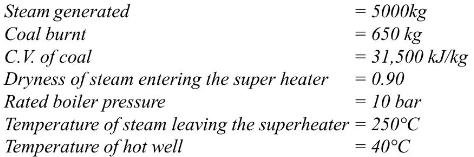
The following readings are taken during trial on a boiler for one hour :Calculate(a) equivalent evaporation per \(\mathrm{kg}\) of fuel without and with superheater,(b) thermal efficiency of the boiler without and with superheater, and(c) amount of heat supplied by the super heater per hour. Steam
How do you classify steam generators ?
Describe the construction features of a Cochran boiler. Discuss its working briefly.
5400 m3/h of wet steam 0.92 dry and at 10 bar is to be supplied by a boiler for a processing plant. Calculate(a) the mass of steam supplied per hour, and(b) the quantity of coal of calorific value 15 MJ to be burnt in boiler if over all efficiency of boiler is 30\%.
The main objective of a boiler tail is(a) to determine the thermal efficiency of the boiler when working at a definite pressure(b) to draw up heat balance sheet for the boiler(c) both(a) and (b)(d) none of the above
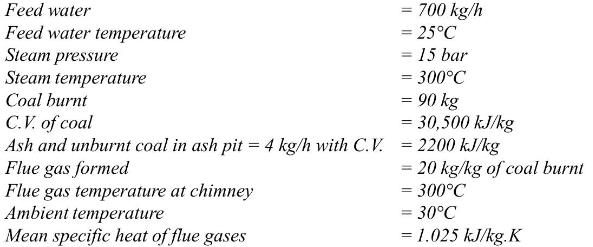
The following data refer to a boiler trial:Calculate(a) boiler efficiency,(b) equivalent evaporation, and(c) percentage heat unaccounted Feed water Feed water temperature Steam pressure Steam temperature Coal burnt C.V. of coal = 700 kg/h = 25C = = 15 bar = 300C = 90 kg = 30,500 kJ/kg Ash and
What are the merits of water tube boilers ?
Where a water tube boiler is exclusively used ? Discuss the construction and working of Babcock and Wilcox boiler.
Find the internal energy of \(1 \mathrm{~kg}\) of super heated steam at a pressure of 10 bar and \(300^{\circ} \mathrm{C}\). If this steam is expanded to 1.5 bar and 0.9 dryness, find the change in internal energy.
Economiser is generally placed between(a) last superheater/preheater and air preheater(b) air preheater and chimney(c) electrostatic precipitators(d) induced draft fan and forced draft fan
What are the demerits of fire tube boilers ?
At tempering is(a) reduction of steam pressure(b) reduction of steam temperature(c) discharge of flue gases at certain height(d) conditioning of disposable fluids for minimum pollution
The air preheater of a boiler plant is located(a) between forced draught fan and furnace(b) between furnace and economiser(c) between economiser and chimney(d) near superheater
Enumerate the factors affecting boiler selection.
In a boiler test \(1200 \mathrm{~kg}\) of coal is burnt in 24 hours. The mass of water evaporated is \(12,500 \mathrm{~kg}\). Steam pressure is \(7.6 \mathrm{bar}\). The feed water temperature was \(37^{\circ} \mathrm{C}\). Calorific value of coal is \(32 \mathrm{MJ} / \mathrm{kg}\). The steam is
With the help of a neat sketch discuss the working principle of Velox high pressure boiler.
What are the advantages of high pressure boilers ?
1 kg of steam 0.85 dry at a pressure of 1 bar is compressed in a cylinder to a pressure of 2 bar according to p \(v^{1.25}=\) const. Determine the final condition of steam and the heat transfer through the cylinder walls.
The following type of safety valve is most suitable for locomotive boiler(a) Dead weight safety valve(b) Spring loaded safety valve(c) Lever loaded safety valve(d) None of the above
A boiler produces \(10 \mathrm{~kg}\) of steam \(/ \mathrm{kg}\) of coal burnt at \(50^{\circ} \mathrm{C}\). The steam pressure is 10 bar. Find the equivalent evaporation from and at \(100^{\circ} \mathrm{C}\) if the dryness fraction of steam is 0.98 .
In a boiler trial, \(1360 \mathrm{~kg}\) of coal were consumed in 24 hours. The mass of water evaporated was \(13600 \mathrm{~kg}\) and steam pressure was \(7.5 \mathrm{bar}\). The feed water temperature was \(35^{\circ} \mathrm{C}\) Calorific value of \(1 \mathrm{~kg}\) of coal is \(30,000
Steam at a pressure of 10 bar and 0.9 dry expands to 1 bar hyperbolically. Find(a) work done and heat absorbed,(b) internal energy and change in enthalpy.Take specific heat of steam at constant pressure \(=2 \mathrm{~kJ} / \mathrm{kg} . K\).
The manhole provided in a fire tube boiler is used for(a) Inspecting the drum when the boiler is in operation(b) Inspecting the drum when the boiler is shutdown(c) Inspecting the drum and clean the inside portions of the boiler when the boiler is shutdown(d) none of the above
List the advantages of forced circulation boilers.
A boiler produces \(900 \mathrm{~kg}\) of wet steam per hour at a pressure of 7 bar. The dryness fraction of steam is 0.96 . Feed water temperature is \(20^{\circ} \mathrm{C}\). If boiler efficiency is \(75 \%\), calculate the amount of coal burnt per hour. Calorific value of coal is \(32,500
A boiler generates \(8.5 \mathrm{Kg}\) of steam per \(\mathrm{kg}\) of coal burned at a pressure of \(13.5 \mathrm{bar}\) from feed water having absolute temperature of \(350 \mathrm{~K}\). The boiler efficiency is \(70 \%\) and factor of evaporation 1.17. Taking specific heat of steam at constant
Steam initially dry saturated, expands isentropically from pressure of 15 bar to 0.15 bar. Find the index of isentropic expansion.
Consider the following statements:Blow down is necessary on boilers, because 1. the boiler water level is lowered rapidly in case it accidentally rises too high.2. the precipitated sediment of sludge is removed while the boiler is in service.3. the concentration of suspended solids in the boiler is
What is a boiler mounting ? List the various boiler mountings ?
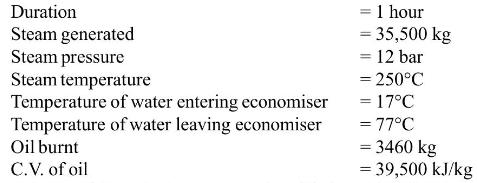
The data obtained during a boiler trial is given below:Calculate(a) equivalent evaporation,(b) thermal efficiency of plant, and(c) percentage of heat energy of fuel energy utilised by the economiser. Duration Steam generated Steam pressure Steam temperature Temperature of water entering economiser
A boiler produces \(15000 \mathrm{~kg} / \mathrm{h}\) of steam at 7 bar, \(300^{\circ} \mathrm{C}\). The feed water temperature is \(70^{\circ} \mathrm{C}\). The calorific value of fuel \(=30,000 \mathrm{~kJ} / \mathrm{kg}\). The grate is to be designed to burn \(450 \mathrm{~kg}\) of coal/ \(m^{2}
A device whose function is to heat feed water by utilizing the heat in the exhaust flue gases before leaving through the chimney is called(a) Superheater(b) Economiser(c) Air preheater(d) Feed pump
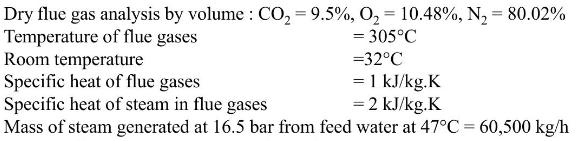
The following data relate to a boiler trial :Ultimate mass analysis of dry coal : \(\mathrm{C}=84 \%, \mathrm{O}_{2}=4 \%\), ash \(=8 \%\) Coal burnt per hour Moisture content in coal H.C.V. of coal = 6750 kg = 2% = 35490 kJ/kg Ultimate mass analysis of dry coal: C=84%, O = 4%, ash = 8%
A boiler generates \(8 \mathrm{~kg} / \mathrm{kg}\) of coal burnt at a pressure of 10 bar. The feed water temperature is \(70^{\circ} \mathrm{C}, \eta_{\text {boiler }}=75 \%\) and factor of evaporation \(=1.15\). Take \(c_{p s}=2.1 \mathrm{kj} / \mathrm{kg} \cdot \mathrm{K}\). Calculate(a) degree
3 kg of steam at a pressure of 30 bar exists in the following conditions :(a) wet steam with a dryness fraction of 0.85.(b) superheated steam with temperature of \(300^{\circ} \mathrm{C}\). Assume \(c_{p}=2302 \mathrm{~kJ} / \mathrm{kg} . \mathrm{K}\)Calculate the (i) enthalpy, (ii) volume, (iii)
A device which is used for pumping water in to the boiler is called(a) Economiser(b) Feed pump(c) Injector(d) Air preheater
Name the various accessories used on a boiler.
The mass of a pendulum bob of a cuckoo clock is \(30 \mathrm{~g}\). How far from the pin support should the bob be placed such that its period is \(1.0 \mathrm{~s}\) ?
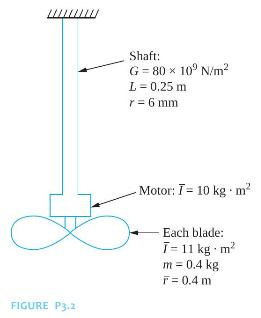
A ceiling fan assembly of five blades is driven by a motor. The assembly is attached to the ceiling by a thin shaft fixed at the ceiling. What is the natural frequency of torsional oscillations of the fan of Figure P3.2. FIGURE P3.2 Shaft: G = 80 10 N/m L = 0.25 m r = 6 mm Motor: = 10 kg. m Each
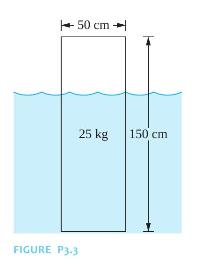
The cylindrical container of Figure P3.3 has a mass of \(25 \mathrm{~kg}\) and floats stably on the surface of an unknown fluid. When disturbed, the period of free oscillations is measured as \(0.2 \mathrm{~s}\). What is the specific gravity of the liquid? 50 cm FIGURE P3-3 25 kg 150 cm
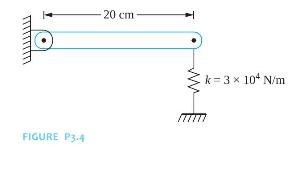
When the \(5.1 \mathrm{~kg}\) connecting rod of Figure P3.4 is placed in the position shown, the spring deflects \(0.5 \mathrm{~mm}\). When the end of the rod is displaced and released, the resulting period of oscillation is observed as \(0.15 \mathrm{~s}\). Determine the location of the center of
When a \(2000 \mathrm{lb}\) vehicle is empty, the static deflection of its suspension system is measured as \(0.8 \mathrm{in}\). What is the natural frequency of the vehicle when it is carrying \(700 \mathrm{lb}\) of passengers and cargo?
A \(400 \mathrm{~kg}\) machine is placed at the midspan of a \(3.2-\mathrm{m}\) simply supported steel \(\left(E=200 \times 10^{9} \mathrm{~N} / \mathrm{m}^{2}\right)\) beam. The machine is observed to vibrate with a natural frequency of \(9.3 \mathrm{~Hz}\). What is the moment of inertia of the
A one degree-of-freedom model of a 9 -m steel flagpole ( \(ho=7400 \mathrm{~kg} / \mathrm{m}^{3}\), \(\left.E=200 \times 10^{9} \mathrm{~N} / \mathrm{m}^{2}, G=80 \times 10^{9} \mathrm{~N} / \mathrm{m}^{2}\right)\) is that of a beam fixed at one end and free at one end. The flagpole has an inner
A \(250 \mathrm{~kg}\) compressor is to be placed at the end of a \(2.5-\mathrm{m}\) fixed-free steel \(\left(E=200 \times 10^{9} \mathrm{~N} / \mathrm{m}^{2}\right)\) beam. Specify the allowable moment of inertia of the beam's cross section about its neutral axis such that the natural frequency of
A \(50 \mathrm{~kg}\) pump is to be placed at the midspan of a \(2.8-\mathrm{m}\) simply supported steel \(\left(E=200 \times 10^{9} \mathrm{~N} / \mathrm{m}^{2}\right)\) beam. The beam is of rectangular cross section of width \(25 \mathrm{~cm}\). What are the allowable values of the
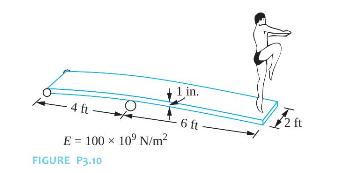
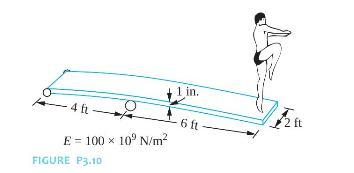
A diving board is modeled as a simply supported beam with an overhang. What is the natural frequency of a 140-1b diver at the end of the diving board of Figure P3.10 4 ft- E-100x10 N/m FIGURE P3.10 1 in. 2 ft -6 ft-
A diver is able to slightly adjust the location of the intermediate support on the diving board in Figure P3.10. What is the range of natural frequencies a \(140 \mathrm{lb}\) diver can attain if the distance between the supports can be adjusted between 4 and \(6.5 \mathrm{ft}\) ? -4 f = E 100 x 10
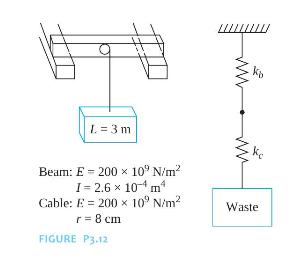
A \(60 \mathrm{~kg}\) drum of waste material is being hoisted by an overhead crane and winch system as illustrated in Figure P3.12. The system is modeled as a simply supported beam to which the cable is attached. The drum of waste material is attached to the end of the cable. When the length of the
A 200-kg package is being hoisted by a \(120-\mathrm{mm}\)-diameter steel cable \(\left(E=200 \times 10^{9} \mathrm{~N} / \mathrm{m}^{2}\right)\) at a constant velocity \(v\). What is the largest value of \(v\) such that the cable's elastic strength of \(560 \times 10^{6} \mathrm{~N} /
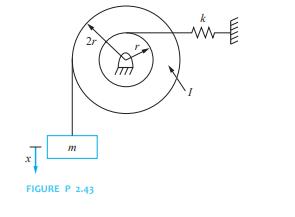
Determine the natural frequency of the system of Figure P2.43. m 2r FIGURE P 2.43
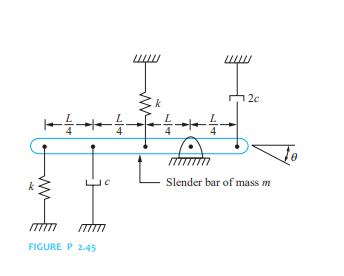
Determine the natural frequency and damping ratio of the system of Figure P2.45. FIGUREP 2.45 12c k Slender bar of mass m
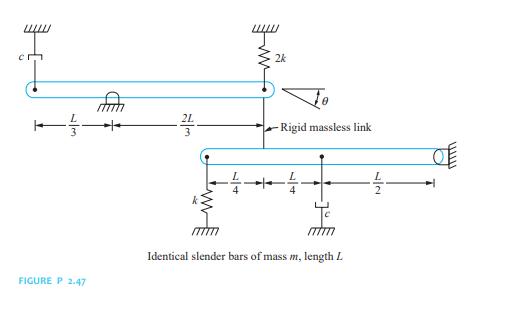
Determine the natural frequency and damping ratio for the system of Figure P2.47. mmm 13 m 2k -Rigid massless link 14 C 17 FIGURE P 2.47 Identical slender bars of mass m, length L
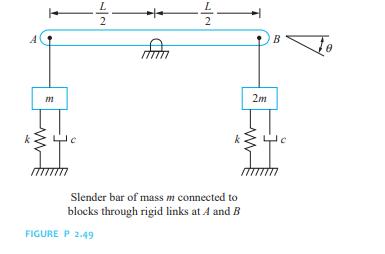
Determine the natural frequency and damping ratio for the system of Figure P2.49. m hmm 12 B 2m ww Slender bar of mass m connected to blocks through rigid links at A and B FIGURE P 2.49
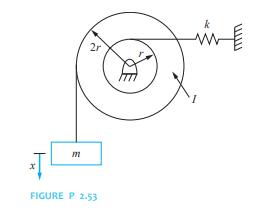
Determine the natural frequency and damping ratio for the system of Figure P2.53. m 2r FIGURE P 2.53 E
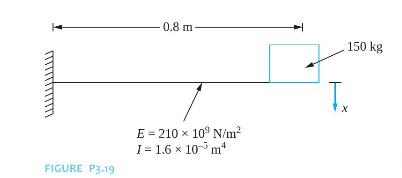
The inertia of the elastic elements is negligible. What is the natural frequency of the system assuming a SDOF model is used? See Figures P3.19. 0.8 m FIGURE P3.19 E = 210 x 10 N/m I = 1.6 10m x 150 kg
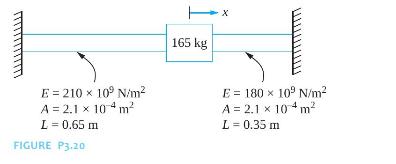
The inertia of the elastic elements is negligible. What is the natural frequency of the system assuming a SDOF model is used? See Figures P3.20. x E 210 x 10 N/m A = 2.1 104 m L = 0.65 m FIGURE P3.20 165 kg E 180 x 109 N/m A = 2.1 104 m L= 0.35 m
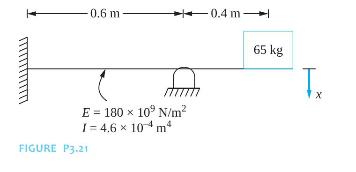
The inertia of the elastic elements is negligible. What is the natural frequency of the system assuming a SDOF model is used? See Figures P3.21. 0.6 m 0.4 m FIGURE P3.21 Imm E 180 x 109 N/m 1= 4.6 104m4 65 kg TX
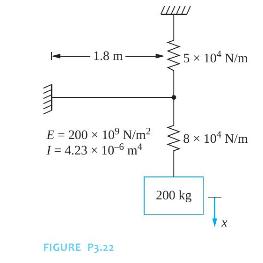
The inertia of the elastic elements is negligible. What is the natural frequency of the system assuming a SDOF model is used? See Figures P3.22. uu 1.8 m- 5 x 10⁴ N/m E 200 x 109 N/m 8 x 10 N/m I 4.23 x 10⁻⁶ m4 FIGURE P3.22 200 kg X
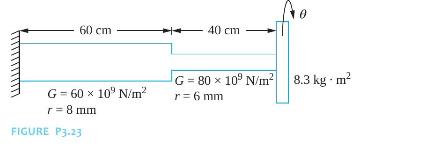
The inertia of the elastic elements is negligible. What is the natural frequency of the system assuming a SDOF model is used? See Figures P3.23. 60 cm G-60 109 N/m r = 8 mm FIGURE P3.23 40 cm G 80 x 109 N/m 8.3 kg-m r = 6 mm
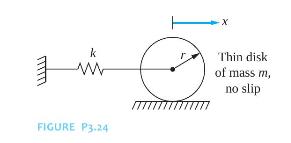
The center of the disk of Figure P3.24 is displaced a distance \(\delta\) from its equilibrium position and released. Determine \(x(t)\) if the disk rolls without slip. k www Thin disk of mass m, no slip FIGURE P3.24
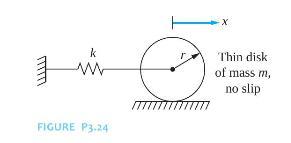
The coefficient of friction between the disk and the surface in Figure P3.24 is \(\mu\). What is the largest initial velocity of the mass center that can be imparted such that the disk rolls without slip for its entire motion? X k ww FIGURE P3-24 Thin disk of mass m, no slip
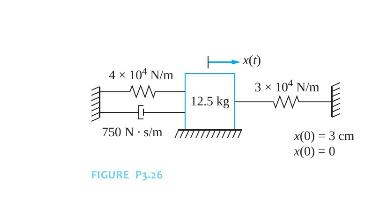
For the systems shown in Figures P3.26.(a) Determine the damping ratio(b) State whether the system is underdamped, critically damped, or overdamped(c) Determine \(x(t)\) or \(\theta(t)\) for the given initial conditions 4 10+ N/m www 750 N - s/m FIGURE P3.26 12.5 kg x(t) 3 x 10 N/m E x(0) -3 cm
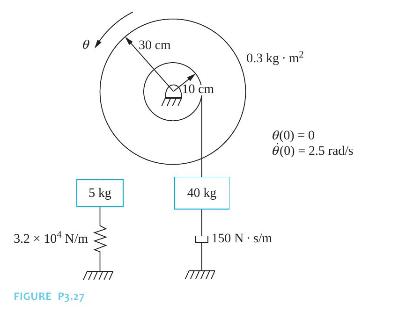
For the systems shown in Figures P3.27.(a) Determine the damping ratio (b) State whether the system is underdamped, critically damped, or overdamped (c) Determine \(x(t)\) or \(\theta(t)\) for the given initial conditions 30 cm 3.2 10 N/m FIGURE P3.27 10 cm 0.3 kg m 0(0)=0 (0) = 2.5 rad/s 40 kg 5
Showing 1700 - 1800
of 4547
First
11
12
13
14
15
16
17
18
19
20
21
22
23
24
25
Last
Step by Step Answers

 Get 50% OFF
Claim Now
Get 50% OFF
Claim Now