New Semester
Started
Get
50% OFF
Study Help!
--h --m --s
Claim Now
Question Answers
Textbooks
Find textbooks, questions and answers
Oops, something went wrong!
Change your search query and then try again
S
Books
FREE
Study Help
Expert Questions
Accounting
General Management
Mathematics
Finance
Organizational Behaviour
Law
Physics
Operating System
Management Leadership
Sociology
Programming
Marketing
Database
Computer Network
Economics
Textbooks Solutions
Accounting
Managerial Accounting
Management Leadership
Cost Accounting
Statistics
Business Law
Corporate Finance
Finance
Economics
Auditing
Tutors
Online Tutors
Find a Tutor
Hire a Tutor
Become a Tutor
AI Tutor
AI Study Planner
NEW
Sell Books
Search
Search
Sign In
Register
study help
engineering
introduction mechanical engineering
Basic Mechanical Engineering 2nd Edition PRAVIN KUMAR - Solutions
Find the moment of inertia of a disc:(a) About a line perpendicular to the plane of the disc and passing through the centroid.(b) About a line parallel to the plane of the disc and passing through the centroid.(c) About a line perpendicular to the plane of the disc and passing through the
Moment of inertia of a triangle of base \(b\) height \(h\) about its base can be given as:(a) \(I_{A B}=\frac{b^{3} h}{12}\)(b) \(I_{A B}=\frac{b h^{3}}{12}\)(c) \(I_{A B}=\frac{b h^{3}}{36}\)(d) None of these
Find the expression for mass moment of inertia of a sphere.
Moment of inertia of a triangle of base \(b\) height \(h\) about its center parallel to its base can be given as:(a) \(I_{G}=\frac{b^{3} h}{12}\)(b) \(I_{G}=\frac{b h^{3}}{12}\)(c) \(I_{G}=\frac{b h^{3}}{36}\)(d) None of these
Find the mass moment of inertia of a hollow cylinder about its axis passing through the centroid.
Moment of inertia of a circular disc about its diametral axis can be given as:(a) \(\frac{\pi r^{4}}{64}\)(b) \(\frac{\pi d^{4}}{32}\)(c) \(\frac{\pi r^{4}}{32}\)(d) \(\frac{\pi d^{4}}{64}\)
Differentiate area moment of inertia from the mass moment of inertia.
Polar moment of inertia of a circular disc about its diametral axis can be given as:(a) \(\frac{\pi r^{4}}{64}\)(b) \(\frac{\pi d^{4}}{32}\)(c) \(\frac{\pi r^{4}}{32}\)(d) \(\frac{\pi d^{4}}{64}\)
Mass moment of inertia of a sphere of radius \(R\) can be given as:(a) \(\frac{2}{5} M R^{2}\)(b) \(\frac{2}{5} M D^{2}\)(c) \(\frac{3}{5} M R^{2}\)(d) \(\frac{3}{5} M D^{2}\)
Mass moment of inertia of a circular cone of radius \(\mathrm{R}\) and height \(\mathrm{h}\) about its axis of rotation can be given as:(a) \(\frac{3}{10} M R^{2}\)(b) \(\frac{7}{10} M R^{2}\)(c) \(\frac{3}{10} \mathrm{Mh}^{2}\)(d) \(\frac{7}{10} \mathrm{Mh}^{2}\)
Mass moment of inertia of a hemisphere of radius \(\mathrm{R}\) about an axis passing through its center in its diametral plane can be given as:(a) \(\frac{1}{10} M R^{2}\)(b) \(\frac{2}{5} M D^{2}\)(c) \(\frac{2}{5} M R^{2}\)(d) \(\frac{3}{5} \mathrm{MD}^{2}\)
Mass moment of inertia of a hemisphere of radius \(\mathrm{R}\) about axis perpendicular to its diametral plane can be given as:(a) \(\frac{2}{5} M R^{2}\)(b) \(\frac{2}{5} M D^{2}\)(c) \(\frac{1}{5} M R^{2}\)(d) \(\frac{3}{5} M D^{2}\)
Hook's law holds good up to:(a) Yield point(b) Proportional limit(c) Plastic limit(d) Ultimate point
Define stress and strain.
What is the greatest length of a metal wire that can be hung vertically under its own weight? If the allowable stress in the metal of wire is \(3 \mathrm{MPa}\) and density of metal is \(12 \times 103 \mathrm{~kg} / \mathrm{m}^{3}\).
Strain is the ratio of:(a) Change in volume to original volume(b) Change in length to original length(c) Change in cross-section area to original cross-section area(d) All of the above
What do you mean by normal stress and shear stress?
A steel punch can apply maximum compressive load \(1000 \mathrm{kN}\). Find the minimum diameter of the hole, which can be punched through a \(10 \mathrm{~mm}\) thick steel plate. Assume ultimate shearing strength of steel plate is \(350 \mathrm{~N} / \mathrm{mm}^{2}\).
Define longitudinal and lateral strains.
Deformation per unit length is known as:(a) Linear strain(b) Lateral strain(c) Volumetric strain(d) None of these
A circular rod is tapered from one end to other end; the diameter at one end is \(2 \mathrm{~cm}\) and the diameter at the other end is \(1 \mathrm{~cm}\). Its length is \(20 \mathrm{~cm}\) long. On applying an axial load of \(6 \mathrm{kN}\), it was found to extend by \(0.068 \mathrm{~mm}\). Find
Modulus of rigidity is defined as the ratio of:(a) Longitudinal stress and longitudinal strain(b) Lateral stress and lateral strain(c) Shear stress and shear strain(d) Any one of the above
Define linear, superficial and volumetric strain.
(a) A uniform bar of length \(L\), cross-sectional area \(A\), and unit mass \(ho\) is suspended vertically from one end. Show that its total elongation is \(\mathrm{d}\) \(=ho g \mathrm{~L}^{2} / 2 \mathrm{E}\).(b) In the part (a), if the cross-sectional area, \(\mathrm{A}\) \(=300
Tensile strength of a material is obtained by dividing the maximum load during the test by the:(a) Area at the time of fracture(b) Original cross-section area(c) Average of(a) and (b)(d) Minimum area after fracture
Define: Young modulus, elastic limit, proportional limit, yield point, ultimate point, breaking point, modulus of rigidity, bulk modulus, and Poisson’s ratio.
A steel rod of \(25 \mathrm{~mm}\) diameter is placed concentrically in a copper tube of an internal diameter \(38.5 \mathrm{~mm}\) and external diameter of \(41.5 \mathrm{~mm}\). Nuts and washers are fitted on the rod so that the ends of the tube is enclosed by the washers. The nuts are initially
For steel, the ultimate shear strength in shear in comparison to tension is nearly:(a) Same(b) Half(c) One-third(d) Two-third
In tensile test of steel, the breaking stress as compared to ultimate stress is:(a) Less(b) More(c) Same(d) None of these
Differential engineering strain and true strain.
The value of modulus of elasticity for mild steel is of the order of:(a) \(2.1 \times 105 \mathrm{~kg} / \mathrm{cm}^{2}\)(b) \(2.1 \times 106 \mathrm{~kg} / \mathrm{cm}^{2}\)(c) \(2.1 \times 107 \mathrm{~kg} / \mathrm{cm}^{2}\)(d) \(2.1 \times 108 \mathrm{~kg} / \mathrm{cm}^{2}\)
Establish relationship between E and K.
The value of Poisson ratio for steel lies between:(a) \(0.01-0.1\)(b) \(0.23-0.27\)(c) \(0.25-0.33\)(d) \(0.4-0.6\)
Establish relationship between E and G.
The property by which a material returns to its original shape after removal of external load is known as:(a) Elasticity(b) Plasticity(c) Ductility(d) Malleability
Establish relationship between E, K and G.
Differentiate compound bar and composite bar.
The properties of a material which allows it to be drawn into a smaller section is called:(a) Elasticity(b) Plasticity(c) Ductility(d) Malleability
Write note on gradual loading, suddenly applied loading, and impact loading.
Poisson ratio is defined as:(a) Longitudinal stress/longitudinal strain(b) Longitudinal stress/lateral stress(c) Lateral strain/longitudinal strain(d) Lateral stress/lateral strain
The property of material by which it can be rolled into a sheet is known as:(a) Elasticity(b) Plasticity(c) Ductility(d) Malleability
In tensile test of mild steel, necking starts from:(a) Proportional limit(b) Plastic limit(c) Ultimate point(d) Rupture point
The strain energy stored in a body, when it is strained up to elastic limit is known as:(a) Resilience(b) Proof resilience(c) Modulus of resilience(d) Toughness
The maximum strain energy stored in a body is known as:(a) Resilience(b) Proof resilience(c) Modulus of resilience(d) Toughness
Proof resilience per unit volume is known as:(a) Resilience(b) Proof resilience(c) Modulus of resilience(d) Toughness
The deformation of a bar under its own weight compared to the deformation of the same body subjected to a direct load equal to weight of the body is:(a) Same(b) Half(c) Double(d) One-fourth
The tensile stress in a conical rod, having diameter \(\mathrm{D}\) at bottom, \(\mathrm{d}\) at top, length \(\mathrm{l}\) and subjected to tensile force \(\mathrm{F}\), at distance \(\mathrm{x}\) from small end will be:(a) \(\frac{4 F}{\pi D^{2}}\)(b) \(\frac{4 F}{\pi d^{2}}\)(c) \(\frac{4 F
The load required to produce a unit deflection in the spring is called:(a) Modulus of rigidity(b) Flexural rigidity(c) Spring stiffness(d) Torsional rigidity
What are the applications of springs?
A close coiled helical spring has to absorb \(60 \mathrm{Nm}\) of energy when compressed \(5 \mathrm{~cm}\). The coil diameter is six times the wire diameter. If there are 18 coils, estimate the diameters of coil and wire and the maximum shear stress. \(G=85,000 \mathrm{~N} / \mathrm{mm}^{2}\).
The most important properties of the spring material is:(a) High elastic limit(b) High deflection(c) Resistance to fatigue and shock(d) All the above
Explain the classification of springs?
A close-coil helical spring is to have a stiffness of \(800 \mathrm{~N} / \mathrm{m}\) in compression, with a maximum load of \(40 \mathrm{~N}\) and a maximum shearing stress of 120 \(\mathrm{N} / \mathrm{mm}^{2}\). The solid length of the spring is \(48 \mathrm{~mm}\). Find the wire diameter, mean
The purpose of the spring used in brakes and clutch is:(a) To measure the forces(b) To apply the forces(c) To absorb the shocks(d) To absorb the strain energy
Discuss the different types of spring materials.
A composite spring has two close coiled helical springs connected in series; each spring has twelve coils at a mean diameter of \(24 \mathrm{~mm}\). Find the wire diameter in one if the other is \(3 \mathrm{~mm}\) and the stiffness of the composite spring is \(640 \mathrm{~N} / \mathrm{m}\).
A spring used to absorb shocks and vibrations is:(a) Open coiled helical spring(b) Close coil helical spring(c) Leaf spring(d) Spiral spring
Derive an expression for shear stress and deflection in a helical spring subjected to an axial force.
The laminated springs are given initial curvature to:(a) Have a uniform strength(b) Make it more economical(c) Make plates flat, when subjected to design load(d) None of these
Derive an expression for the equivalent spring constant when two similar springs are connected:(a) in parallel,(b) in series.
If a close-coiled helical spring is subjected to load W and the deflection \(\delta\), then stiffness of the spring is given by:(a) \(\mathrm{W} / \delta\)(b) W \(\delta\)(c) \(\delta / \mathrm{W}\)(d) \(\mathrm{W} 2 \delta 2\)
What do you mean by cam and cam followers? Give some example of their industrial applications?
When a close-coiled helical spring is subjected to an axial load, it is said to be under:(a) Shear(b) Bending(c) Torsion(d) Crushing
Discuss the classification of the cam and followers.
When a close-coiled helical spring is cut into two equal parts. The stiffness of the resulting springs will be:(a) Same(b) Double(c) Half(d) One-fourth
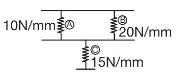
Three springs are arranged as shown in Figure 13.21, the spring constant will be:FIGURE 13.21:(a) \(10 \mathrm{~N} / \mathrm{mm}\)(b) \(20 \mathrm{~N} / \mathrm{mm}\)(c) \(30 \mathrm{~N} / \mathrm{mm}\)(d) \(40 \mathrm{~N} / \mathrm{mm}\) 10N/mm $20N/mm 15N/mm
What are the different types of bushes? Discuss its applications in engineering.
What is the difference between sliding contact bearings and rolling contact bearings?
A spring of spring constant \(\mathrm{K}\) is cut into \(\mathrm{n}\) equal lengths. The spring constant of each new part will be:(a) \(\mathrm{K} / \mathrm{n}\)(b) \(\mathrm{n} / \mathrm{K}\)(c) n.K(d) \(\mathrm{Kn}\)
A close-coiled helical spring of stiffness \(30 \mathrm{~N} / \mathrm{mm}\) is arranged with another spring of stiffness \(60 \mathrm{~N} / \mathrm{mm}\). The stiffness of composite unit is:(a) \(10 \mathrm{~N} / \mathrm{mm}\)(b) \(20 \mathrm{~N} / \mathrm{mm}\)(c) \(30 \mathrm{~N} /
Discuss the use of roller bearings.
Explain the different types of ball bearings used in the industry.
Two close-coiled helical spring of stiffness \(K_{1}\) and \(\mathrm{K}_{2}\) are connected in parallel. The combination is equivalent to a single spring of stiffness:(a) \(\sqrt{K_{1} K_{2}}\)(b) \(\frac{K_{1} K_{2}}{2}\)(c) \(K_{1}+K_{2}\)(d) \(\frac{K_{1} K_{2}}{K_{1}+K_{2}}\)
What are the different types of engineering materials used for manufacturing of bearings?
Two close-coiled helical spring of stiffness \(K_{1}\) and \(\mathrm{K}_{2}\) are connected in series. The combination is equivalent to a single spring of stiffness:(a) \(\sqrt{K_{1} K_{2}}\)(b) \(\frac{K_{1} K_{2}}{2}\)(c) \(K_{1}+K_{2}\)(d) \(\frac{K_{1} K_{2}}{K_{1}+K_{2}}\)
What are the properties required for the bearing materials?
Which motion of follower is best for high speed cams?(a) SHM follower motion(b) Uniform acceleration and retardation of follower motion(c) Cycloidal motion follower(d) All of the above
Explain the thrust loading and radial loading in the bearing.
Which of the following statements is false for SHM follower motion?(a) SHM can be used only for moderate speed purpose(b) The acceleration is zero at the beginning and the end of each stroke(c) The jerk is maximum at the mid of each stroke(d) Velocity of follower is maximum at the mid of each stroke
Which of the following conditions can be used to minimize undercutting in cam and follower mechanism?(a) By using larger roller diameter(b) By using internal cams(c) By decreasing the size of the cam(d) All of the above
What is meant by jump phenomenon in cam and follower system?(a) Follower looses contact with cam surface when cam rotates beyond particular speed due to inertia forces(b) Follower looses contact with cam surface when follower rotates beyond particular speed due to gravitational force(c) Follower
Which of the following are functions of bearings?(a) Ensure free rotation of shaft with minimum friction(b) Holding shaft in a correct position(c) Transmit the force of the shaft to the frame(d) All of the listed
A bearing supports the load acting along the axis of the shaft.(a) Thrust(b) Radial(c) Longitudinal(d) Transversal
Load acting on bearing in its plane of rotation is called as(a) Axial load(b) Radial load(c) Thrust load(d) None of the above
The materials which exhibit the same elastic properties in all directions are known as:(a) Homogeneous(b) Isotropic(c) Isentropic(d) Inelastic
In an impulse turbine, steam expands:(a) Fully in nozzle(b) Fully in blades(c) Partly in nozzle and partly in blades(d) None of the above
In impulse turbines, pressure on the two sides of the moving blades:(a) Increases(b) Decreases(c) Remains same(d) None of the above
In impulse turbine, when steam flows over the moving blades:(a) Velocity decreases(b) Velocity increases(c) Pressure decreases(d) None of the above
In a reaction steam turbine, steam expands:(a) In nozzle only(b) In moving blades only(c) Partly in nozzle partly in blades(d) None of the above
De-Lavel Turbine is a:(a) Simple impulse turbine(b) Simple reaction turbine(c) Pressure compounded turbine(d) Velocity compounded turbine
Parson's Turbine is a:(a) Simple impulse turbine(b) Simple reaction turbine(c) Pressure compounded turbine(d) Velocity compounded turbine
Curtis turbine is:(a) Simple impulse turbine(b) Simple reaction turbine(c) Pressure compounded turbine(d) Velocity compounded turbine
Rateu turbine is:(a) Simple impulse turbine(b) Simple reaction turbine(c) Pressure compounded turbine(d) Velocity compounded turbine
The turbine having identical fixed and moving blades is:(a) De-Lavel turbine(b) Parson's reaction turbine(c) Rateau turbine(d) Zoelly turbine
In reaction turbine, stage is represented by:(a) Each row of blades(b) Number of casting(c) Number of steam exits(d) None of the above
Blade efficiency is the ratio of:(a) Work done of blades and energy supplied to the blades(b) Work done on blade and energy supplied to each stage(c) Energy supplied per stage and work done on the blades(d) Energy supplied to blades and work done on blades.
Maximum efficiency of Parson's reaction turbine is equal to:(a) \(\frac{\cos ^{2} \alpha}{1+2 \cos ^{2} \alpha}\)(b) \(\frac{2 \cos ^{2} \alpha}{1+\cos ^{2} \alpha}\)(c) \(\frac{1+2 \cos ^{2} \alpha}{\cos ^{2} \alpha}\)(d) \(\frac{1+\cos ^{2} \alpha}{2 \cos ^{2} \alpha}\)
For maximum efficiency of a Parson's reaction turbine, the speed ratio is equal to:(a) \(\frac{\cos \alpha}{2}\)(b) \(\cos \alpha\)(c) \(\cos ^{2} \alpha\)(d) \(\frac{\cos ^{2} \alpha}{2}\)
For maximum blade efficiency of a single stage impulse turbine, the blade speed is equal to:(a) \(\frac{\cos \alpha}{2}\)(b) \(\cos \alpha\)(c) \(\cos ^{2} \alpha\)(d) \(\frac{\cos ^{2} \alpha}{2}\)
The compounding of turbine:(a) Increases efficiency(b) Decreases rotor speed(c) Decreases exit loss(d) All of the above
Showing 3500 - 3600
of 4547
First
29
30
31
32
33
34
35
36
37
38
39
40
41
42
43
Last
Step by Step Answers

 Get 50% OFF
Claim Now
Get 50% OFF
Claim Now