New Semester
Started
Get
50% OFF
Study Help!
--h --m --s
Claim Now
Question Answers
Textbooks
Find textbooks, questions and answers
Oops, something went wrong!
Change your search query and then try again
S
Books
FREE
Study Help
Expert Questions
Accounting
General Management
Mathematics
Finance
Organizational Behaviour
Law
Physics
Operating System
Management Leadership
Sociology
Programming
Marketing
Database
Computer Network
Economics
Textbooks Solutions
Accounting
Managerial Accounting
Management Leadership
Cost Accounting
Statistics
Business Law
Corporate Finance
Finance
Economics
Auditing
Tutors
Online Tutors
Find a Tutor
Hire a Tutor
Become a Tutor
AI Tutor
AI Study Planner
NEW
Sell Books
Search
Search
Sign In
Register
study help
engineering
mechanics of materials
Engineering Mechanics Dynamics 14th Global Edition Hibbeler - Solutions
12–125. The car starts from rest at s = 0 and increases its speed at at = 4 m>s2. Determine the time when the magnitude of acceleration becomes 20 m>s2. At what position s does this occur? p=40 m. Probs. 12-124/125
12–124. The car has an initial speed v0 = 20 m>s. If it increases its speed along the circular track at s = 0, at = (0.8s) m>s2, where s is in meters, determine the time needed for the car to travel s = 25 m.
12–123. The satellite S travels around the earth in a circular path with a constant speed of 20 Mm>h. If the acceleration is 2.5 m>s2, determine the altitude h. Assume the earth’s diameter to be 12 713 km. Prob. 12-123
12–122. The car travels along the circular path such that its speed is increased by at = (0.5et) m>s2, where t is in seconds.Determine the magnitudes of its velocity and acceleration after the car has traveled s = 18 m starting from rest.Neglect the size of the car. s = 18 m P = 30 m Prob.
12–121. If the car passes point A with a speed of 20 m>s and begins to increase its speed at a constant rate of at = 0.5 m>s2, determine the magnitude of the car’s acceleration when s = 101.68 m and x = 0. y = 16-625x2 B Probs. 12-120/121
*12–120. The car passes point A with a speed of 25 m>s after which its speed is defined by v = (25 - 0.15s) m>s.Determine the magnitude of the car’s acceleration when it reaches point B, where s = 51.5 m and x = 50 m.
12–119. The motorcycle is traveling at 1 m>s when it is at A. If the speed is then increased at v. = 0.1 m>s2, determine its speed and acceleration at the instant t = 5 s. y y = 0.5x A Prob. 12-119
12–118. Car B turns such that its speed is increased by(at)B = (0.5et) m>s2, where t is in seconds. If the car starts from rest when u = 0, determine the magnitudes of its velocity and acceleration when the arm AB rotates u = 30. Neglect the size of the car. A B 5 m Prob. 12-118
12–117. At a given instant, a car travels along a circular curved road with a speed of 20 m>s while decreasing its speed at the rate of 3 m>s2. If the magnitude of the car’s acceleration is 5 m>s2, determine the radius of curvature of the road.
*12–116. When the car reaches point A, it has a speed of 25 m>s. If the brakes are applied, its speed is reduced by at = (0.001s - 1) m>s2. Determine the magnitude of acceleration of the car just before it reaches point C. P -250 m B. -200 m- 30 Probs. 12-115/116 A.
12–115. When the car reaches point A it has a speed of 25 m>s. If the brakes are applied, its speed is reduced by at = 1 -14 t1>22 m>s2. Determine the magnitude of acceleration of the car just before it reaches point C. p = 250 m B. 30 Probs. 12-115/116 -200 m- A
12–114. The car travels along the curve having a radius of 300 m. If its speed is uniformly increased from 15 m>s to 27 m>s in 3 s, determine the magnitude of its acceleration at the instant its speed is 20 m>s. 20 m/s 300 m Prob. 12-114
12–113. The position of a particle is defined by r ={4(t - sin t)i + (2t2 - 3)j} m, where t is in seconds and the argument for the sine is in radians. Determine the speed of the particle and its normal and tangential components of acceleration when t = 1 s.
*12–112. A particle moves along the curve y = sin x with a constant speed v = 2 m>s. Determine the normal and tangential components of its velocity and acceleration at any instant.
12–111. Determine the maximum constant speed a race car can have if the acceleration of the car cannot exceed 7.5 m>s2 while rounding a track having a radius of curvature of 200 m.
12–110. The motion of a particle is defined by the equations x = (2t + t2) m and y = (t2) m, where t is in seconds. Determine the normal and tangential components of the particle’s velocity and acceleration when t = 2 s.
12–109. Small packages traveling on the conveyor belt fall off into a l-m-long loading car. If the conveyor is running at a constant speed of vC = 2 m>s, determine the smallest and largest distance R at which the end A of the car may be placed from the conveyor so that the packages enter the
*12–108. A boy throws a ball at O in the air with a speed v0 at an angle u1. If he then throws another ball with the same speed v0 at an angle u2 6 u1, determine the time between the throws so that the balls collide in midair at B. 18 B Prob. 12-108
12–107. The snowmobile is traveling at 10 m>s when it leaves the embankment at A. Determine the time of flight from A to B and the range R of the trajectory. 40 3 R- B Prob. 12-107
12–106. The balloon A is ascending at the rate vA = 12 km>h and is being carried horizontally by the wind at vw = 20 km>h. If a ballast bag is dropped from the balloon at the instant h = 50 m, determine the time needed for it to strike the ground. Assume that the bag was released from the
12–105. The drinking fountain is designed such that the nozzle is located from the edge of the basin as shown.Determine the maximum and minimum speed at which water can be ejected from the nozzle so that it does not splash over the sides of the basin at B and C. 50 mm] A 40 B 100 mm -250 mm-
*12–104. If the dart is thrown with a speed of 10 m>s, determine the longest possible time when it strikes the target. Also, what is the corresponding angle uA at which it should be thrown, and what is the velocity of the dart when it strikes the target? To 4 m- Probs. 12-103/104 B
12–103. If the dart is thrown with a speed of 10 m>s, determine the shortest possible time before it strikes the target. Also, what is the corresponding angle uA at which it should be thrown, and what is the velocity of the dart when it strikes the target?
12–102. The man at A wishes to throw two darts at the target at B so that they arrive at the same time. If each dart is thrown with a speed of 10 m>s, determine the angles uC and uD at which they should be thrown and the time between each throw. Note that the first dart must be thrown at uC (7
12–101. The velocity of the water jet discharging from the orifice can be obtained from v = 22 gh, where h = 2 m is the depth of the orifice from the free water surface.Determine the time for a particle of water leaving the orifice to reach point B and the horizontal distance x where it hits the
*12–100. The missile at A takes off from rest and rises vertically to B, where its fuel runs out in 8 s. If the acceleration varies with time as shown, determine the missile’s height hB and speed vB. If by internal controls the missile is then suddenly pointed 45° as shown, and allowed to
12–99. The projectile is launched with a velocity v0.Determine the range R, the maximum height h attained, and the time of flight. Express the results in terms of the angle u and v0. The acceleration due to gravity is g. R. Prob. 12-99 x
12–98. It is observed that the skier leaves the ramp A at an angle uA = 25 with the horizontal. If he strikes the ground at B, determine his initial speed vA and the speed at which he strikes the ground. 4 m 5 100 m Probs. 12-97/98 B
12–97. It is observed that the skier leaves the ramp A at an angle uA = 25 with the horizontal. If he strikes the ground at B, determine his initial speed vA and the time of flight tAB.
*12–96. The golf ball is hit at A with a speed of vA = 40 m>s and directed at an angle of 30° with the horizontal as shown.Determine the distance d where the ball strikes the slope at B. VA -40 m/s 130 B Prob. 12-96
12–95. Measurements of a shot recorded on a videotape during a basketball game are shown. The ball passed through the hoop even though it barely cleared the hands of the player B who attempted to block it. Neglecting the size of the ball, determine the magnitude vA of its initial velocity and the
12–94. The boy at A attempts to throw a ball over the roof of a barn such that it is launched at an angle uA = 40°.Determine the minimum speed vA at which he must throw the ball so that it reaches its maximum height at C. Also, find the distance d where the boy must stand so that he can make the
12–93. The boy at A attempts to throw a ball over the roof of a barn with an initial speed of vA = 15 m>s. Determine the angle uA at which the ball must be thrown so that it reaches its maximum height at C. Also, find the distance d where the boy should stand to make the throw.
*12–92. Show that the girl at A can throw the ball to the boy at B by launching it at equal angles measured up or down from a 45° inclination. If vA = 10 m>s, determine the range R if this value is 15°, i.e., u1 = 45° − 15° = 30°and u2 = 45° + 15° = 60°. Assume the ball is caught at
12–91. The girl at A can throw a ball at vA = 10 m>s.Calculate the maximum possible range R = Rmax and the associated angle u at which it should be thrown. Assume the ball is caught at B at the same elevation from which it is thrown.
12–90. A projectile is given a velocity v0. Determine the angle f at which it should be launched so that d is a maximum.The acceleration due to gravity is g. Probs. 12-89/90 x
12–89. A projectile is given a velocity v0 at an angle f above the horizontal. Determine the distance d to where it strikes the sloped ground. The acceleration due to gravity is g.
*12–88. Determine the minimum initial velocity v0 and the corresponding angle u0 at which the ball must be kicked in order for it to just cross over the 3-m high fence. 6 m Prob. 12-88 3 m
12–87. A projectile is fired from the platform at B. The shooter fires his gun from point A at an angle of 30°.Determine the muzzle speed of the bullet if it hits the projectile at C. B XXXX 30 1.8 m -20 m- Prob. 12-87 10 m
12–86. Neglecting the size of the ball, determine the magnitude vA of the basketball’s initial velocity and its velocity when it passes through the basket. A 30 T 2 m 10 m- Prob. 12-86 B 3 m
12–85. It is observed that the time for the ball to strike the ground at B is 2.5 s. Determine the speed vA and angle uA at which the ball was thrown. [1.2 m 50 m Prob. 12-85 B
12–84. Pegs A and B are restricted to move in the elliptical slots due to the motion of the slotted link. If the link moves with a constant speed of 10 m>s, determine the magnitude of the velocity and acceleration of peg A when x = 1m. B +y=1 Prob. 12-84 D x v = 10 m/s
12–83. The flight path of the helicopter as it takes off from A is defined by the parametric equations x = (2t2) m and y = (0.04t3) m, where t is the time in seconds. Determine the distance the helicopter is from point A and the magnitudes of its velocity and acceleration when t = 10 s. A Prob.
12–82. The roller coaster car travels down the helical path at constant speed such that the parametric equations that define its position are x = c sin kt, y = c cos kt, z = h − bt, wherec, h, and b are constants. Determine the magnitudes of its velocity and acceleration. Prob. 12-82
12–81. A particle travels along the curve from A to B in 1 s. If it takes 3 s for it to go from A to C, determine its average velocity when it goes from B to C. 45 30 30 m B A Prob. 12-81 x
12–80. The motorcycle travels with constant speed v0 along the path that, for a short distance, takes the form of a sine curve. Determine the x and y components of its velocity at any instant on the curve. y - y = c sin(x) x Prob. 12-80
12–79. The particle travels along the path defined by the parabola y = 0.5x2. If the component of velocity along the x axis is vx = (5t) m>s, where t is in seconds, determine the particle’s distance from the origin O and the magnitude of its acceleration when t = 1 s. When t = 0, x = 0, y =
12–78. A rocket is fired from rest at x = 0 and travels along a parabolic trajectory described by y2 = [120(103)x] m.If the x component of acceleration iswhere t is in seconds, determine the magnitude of the rocket’s velocity and acceleration when t = 10 s. ax () m/s,
12–77. The position of a crate sliding down a ramp is given by x = (0.25t3) m, y = (1.5t2) m, z = (6 − 0.75t5>2) m, where t is in seconds. Determine the magnitude of the crate’s velocity and acceleration when t = 2 s.
*12–76. A particle travels along the curve from A to B in 5 s.It takes 8 s for it to go from B to C and then 10 s to go from C to A. Determine its average speed when it goes around the closed path. B 20 m x A -30 m- C Prob. 12-76
12–75. A particle travels along the curve from A to B in 2 s.It takes 4 s for it to go from B to C and then 3 s to go from C to D. Determine its average speed when it goes from A to D. A B 10 m D 5 m 15 m. C Prob. 12-75 =
12–74. A particle is traveling with a velocity of v = 532te-0.2t i + 4e-0.8t2j6 m>s, where t is in seconds.Determine the magnitude of the particle’s displacement from t = 0 to t = 3 s. Use Simpson’s rule with n = 100 to evaluate the integrals. What is the magnitude of the particle’s
12–73. When a rocket reaches an altitude of 40 m it begins to travel along the parabolic path (y - 40)2 = 160x, where the coordinates are measured in meters. If the component of velocity in the vertical direction is constant at vy = 180 m/s, determine the magnitudes of the rocket’s velocity and
*12–72. If the velocity of a particle is defined as v(t) = {0.8t2i + 12t1>2j + 5k} m>s, determine the magnitude and coordinate direction anglesa, b, g of the particle’s acceleration when t = 2 s.
12–71. The velocity of a particle is v = 53i + (6 - 2t)j6 m>s, where t is in seconds. If r = 0 when t = 0, determine the displacement of the particle during the time interval t = 1 s to t = 3 s.
12–70. The position of a particle is defined by r = {5(cos 2t)i + 4(sin 2t)j} m, where t is in seconds and the arguments for the sine and cosine are given in radians.Determine the magnitudes of the velocity and acceleration of the particle when t = 1 s. Also, prove that the path of the particle
12–69. The velocity of a particle is given by v = 516t 2i +4t 3j + (5t + 2)k6 m>s, where t is in seconds. If the particle is at the origin when t = 0, determine the magnitude of the particle’s acceleration when t = 2 s. Also, what is the x, y, z coordinate position of the particle at this
*12–68. The a–s graph for a train traveling along a straight track is given for the first 400 m of its motion. Plot the v–s graph. v = 0 at s = 0. a (m/s) 2. 200 Prob. 12-68 400 (w) s-
12–67. The boat travels along a straight line with the speed described by the graph. Construct the s–t and a–s graphs.Also, determine the time required for the boat to travel a distance s = 400 m if s = 0 when t = 0. v (m/s) 80- 20- = 4s v0.2s- -s (m) 100 400 Prob. 12-67
12–66. The a–t graph for a car is shown. Construct the v–t and s–t graphs if the car starts from rest at t = 0. At what time t does the car stop? a (m/s) 5. -2 10 Prob. 12-66 45 -t(s)
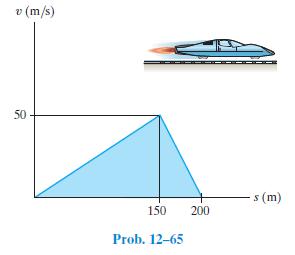
12–65. The v–s graph for a test vehicle is shown. Determine its acceleration when s = 100 m and when s = 175 m. v (m/s) 50 50 s (m) 200 150 Prob. 12-65
*12–64. From experimental data, the motion of a jet plane while traveling along a runway is defined by the v–t graph.Construct the s–t and a–t graphs for the motion. When t = 0, s = 0. v (m/s) 60 20 20 5 20 Prob. 12-64 t(s) 30
12–63. If the position of a particle is defined as s =(5t - 3t2) m, where t is in seconds, construct the s–t, v–t, and a–t graphs for 0 … t … 2.5 s.
12–62. The motion of a train is described by the a–s graph shown. Draw the v–s graph if v = 0 at s = 0. a (m/s) 3 300 Prob. 12-62 s (m) 600
12–61. A two-stage rocket is fired vertically from rest with the acceleration shown. After 15 s the first stage A burns out and the second stage B ignites. Plot the v–t and s–t graphs which describe the motion of the second stage for 0 … t … 40 s. a (m/s) B 20 15 255 A 15 Prob. 12-61 t(s)
*12–60. The speed of a train during the first minute has been recorded as follows:Plot the v–t graph, approximating the curve as straight-line segments between the given points. Determine the total distance traveled. t(s) v (m/s) 0 20 40 60 0 16 21 24
12–59. A particle travels along a curve defined by the equation s = (t3 - 3t2 + 2t) m, where t is in seconds. Draw the s – t, v – t, and a – t graphs for the particle for 0 … t … 3 s.
12–58. Two cars start from rest side by side and travel along a straight road. Car A accelerates at 4 m>s2 for 10 s and then maintains a constant speed. Car B accelerates at 5 m>s 2 until reaching a constant speed of 25 m>s and then maintains this speed. Construct the a–t, v–t, and s–t
12–57. A motorcycle starts from rest at s = 0 and travels along a straight road with the speed shown by the v–t graph.Determine the motorcycle’s acceleration and position when t = 8 s and t = 12 s. v (m/s) v = 1.25t v=5 5 v=-1+15 4 10 Probs. 12-56/57 t(s) 15
*12–56. A motorcycle starts from rest at s = 0 and travels along a straight road with the speed shown by the v–t graph.Determine the total distance the motorcycle travels until it stops when t = 15 s. Also plot the a–t and s–t graphs.
12–55. The v–t graph for the motion of a car as it moves along a straight road is shown. Draw the s–t and a–t graphs.Also determine the average speed and the distance traveled for the 15-s time interval. When t = 0, s = 0. v (m/s) 15 v=0.612 5 Prob. 12-55 t(s) 15
12–54. The a–s graph for a jeep traveling along a straight road is given for the first 300 m of its motion. Construct the v–s graph. At s = 0, v = 0. a (m/s) 2 200 Prob. 12-54 300 (m)
12–53. The v–s graph for an airplane traveling on a straight runway is shown. Determine the acceleration of the plane at s = 100 m and s = 150 m. Draw the a–s graph. v (m/s) 50 v=0.1s+30 40 -0.4s 100 200 Prob. 12-53 (w) s-
*12–52. A car starts from rest and travels along a straight road with a velocity described by the graph. Determine the total distance traveled until the car stops. Construct the s–t and a–t graphs. v(m/s) 30- v=1- v -0.5t +45 t(s) 30 60 90 Prob. 12-52
12–51. The race car starts from rest and travels along a straight road until it reaches a speed of 26 m>s in 8 s as shown on the v–t graph. The flat part of the graph is caused by shifting gears. Draw the a–t graph and determine the maximum acceleration of the car. v (m/s) 26 v=41-6 14
12–50. The jet car is originally traveling at a velocity of 10 m>s when it is subjected to the acceleration shown.Determine the car’s maximum velocity and the time t when it stops. When t = 0, s = 0. a (m/s) 6 -4 15 t(s) Prob. 12-50
12–49. The v–s graph for a go-cart traveling on a straight road is shown. Determine the acceleration of the go-cart at s = 50 m and s = 150 m. Draw the a–s graph. v (m/s) 8 100 Prob. 12-49 200 (w) s-
*12–48. The v–t graph for a train has been experimentally determined. From the data, construct the s–t and a–t graphs for the motion for 0 … t … 180 s. When t = 0, s = 0. v (m/s) 10 6 -t(s) 120 180 60 Prob. 12-48
12–47. The a–t graph of the bullet train is shown. If the train starts from rest, determine the elapsed time t before it again comes to rest.What is the total distance traveled during this time interval? Construct the v–t and s–t graphs. a (m/s) 3. a 0.1t 30 75 {s)1 < 5+1()- Prob. 12-47
12–46. A two-stage rocket is fired vertically from rest at s = 0 with the acceleration as shown. After 30 s the first stage, A, burns out and the second stage, B, ignites. Plot the v–t and s–t graphs which describe the motion of the second stage for 0 … t … 60 s. a (m/s) 24 24 B A 12 60
12–45. The motion of a jet plane just after landing on a runway is described by the a–t graph. Determine the time twhen the jet plane stops. Construct the v–t and s–t graphs for the motion. Here s = 0, and v = 150 m>s when t = 0. a (m/s) -10 -20 10 20 t(s) Prob. 12-45
*12–44. The v–t graph for a particle moving through an electric field from one plate to another has the shape shown in the figure, where t = 0.2 s and vmax = 10 m>s. Draw the s–t and a–t graphs for the particle. When t = t>2 the particle is at s = 0.5 m. Vmax 1/2 Probs. 12-43/44 -Smax
12–43. The v–t graph for a particle moving through an electric field from one plate to another has the shape shown in the figure. The acceleration and deceleration that occur are constant and both have a magnitude of 4 m>s2. If the plates are spaced 200 mm apart, determine the maximum velocity
12–42. The snowmobile moves along a straight course according to the v–t graph. Construct the s–t and a–t graphs for the same 50-s time interval.When t = 2, s = 0. v (m/s) 12 30 Prob. 12-42 -1 (s) 50
12–41. The velocity of a car is plotted as shown. Determine the total distance the car moves until it stops (t = 80 s).Construct the a–t graph. v (m/s) 10 40 Prob. 12-41 -1 (s) 80
*12–40. The s–t graph for a train has been experimentally determined. From the data, construct the v–t and a–t graphs for the motion; 0 … t … 40 s. For 0 … t … 30 s, the curve is s = (0.4t2) m, and then it becomes straight for t Ú 30 s. s (m) 600 360 -t(s) 40 30 Prob. 12-40
12–39. If the position of a particle is defined by s = [3 sin(p>4)t + 8] m, where t is in seconds, construct the s9t, v9t, and a9t graphs for 0 … t … 10 s.
12–38. Two rockets start from rest at the same elevation.Rocket A accelerates vertically at 20 m>s2 for 12 s and then maintains a constant speed. Rocket B accelerates at 15 m>s2 until reaching a constant speed of 150 m>s. Construct the a–t, v–t, and s–t graphs for each rocket until t = 20
12–37. A particle starts from s = 0 and travels along a straight line with a velocity v = (t2 - 4t + 3) m>s, where t is in seconds. Construct the v–t and a–t graphs for the time interval 0 … t … 4 s.
*12–36. If the position of a particle is defined by s = [2 sin (p>5)t + 4] m, where t is in seconds, construct the s9t, v9t, and a9t graphs for 0 … t … 10 s.
12–35. A train starts from station A and for the first kilometer, it travels with a uniform acceleration. Then, for the next two kilometers, it travels with a uniform speed. Finally, the train decelerates uniformly for another kilometer before coming to rest at station B. If the time for the
12–34. Accounting for the variation of gravitational acceleration a with respect to altitude y (see Prob. 12–40), derive an equation that relates the velocity of a freely falling particle to its altitude. Assume that the particle is released from rest at an altitude y0 from the earth’s
12–33. As a body is projected to a high altitude above the earth’s surface, the variation of the acceleration of gravity with respect to altitude y must be taken into account.Neglecting air resistance, this acceleration is determined from the formula a = -g0[R2>(R + y)2], where g0 is the
*12–32. Ball A is thrown vertically upwards with a velocity of v0. Ball B is thrown upwards from the same point with the same velocity t seconds later. Determine the elapsed time t < 2v0>g from the instant ball A is thrown to when the balls pass each other, and find the velocity of each ball at
12–31. The velocity of a particle traveling along a straight line is v = v0 - ks, where k is constant. If s = 0 when t = 0, determine the position and acceleration of the particle as a function of time.
12–30. A boy throws a ball straight up from the top of a 12-m high tower. If the ball falls past him 0.75 s later, determine the velocity at which it was thrown, the velocity of the ball when it strikes the ground, and the time of flight.
12–29. A ball A is thrown vertically upward from the top of a 30-m-high building with an initial velocity of 5 m>s. At the same instant another ball B is thrown upward from the ground with an initial velocity of 20 m>s. Determine the height from the ground and the time at which they pass.
*12–28. A sphere is fired downwards into a medium with an initial speed of 27 m>s. If it experiences a deceleration of a = (-6t) m>s2, where t is in seconds, determine the distance traveled before it stops.
12–27. When a particle falls through the air, its initial acceleration a = g diminishes until it is zero, and thereafter it falls at a constant or terminal velocity vf . If this variation of the acceleration can be expressed as a = (g>v2f) (v2f - v2), determine the time needed for the velocity to
12–26. The acceleration of a particle traveling along a straight line is a = 14 s1>2 m>s2, where s is in meters. If v = 0, s = 1 m when t = 0, determine the particle’s velocity at s = 2 m.
Showing 400 - 500
of 1529
1
2
3
4
5
6
7
8
9
10
11
12
13
14
15
Last
Step by Step Answers

 Get 50% OFF
Claim Now
Get 50% OFF
Claim Now