New Semester
Started
Get
50% OFF
Study Help!
--h --m --s
Claim Now
Question Answers
Textbooks
Find textbooks, questions and answers
Oops, something went wrong!
Change your search query and then try again
S
Books
FREE
Study Help
Expert Questions
Accounting
General Management
Mathematics
Finance
Organizational Behaviour
Law
Physics
Operating System
Management Leadership
Sociology
Programming
Marketing
Database
Computer Network
Economics
Textbooks Solutions
Accounting
Managerial Accounting
Management Leadership
Cost Accounting
Statistics
Business Law
Corporate Finance
Finance
Economics
Auditing
Tutors
Online Tutors
Find a Tutor
Hire a Tutor
Become a Tutor
AI Tutor
AI Study Planner
NEW
Sell Books
Search
Search
Sign In
Register
study help
engineering
mechanics of materials
Mechanics Of Materials 11th Edition Russell C. Hibbeler - Solutions
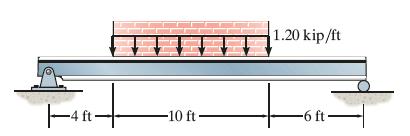
The brick wall exerts a uniform distributed load of \(1.20 \mathrm{kip} / \mathrm{ft}\) on the beam. If the allowable bending stress is \(\sigma_{\text {allow }}=22 \mathrm{ksi}\) and the allowable shear stress is \(\tau_{\text {allow }}=12 \mathrm{ksi}\), select the lightest wide-flange section
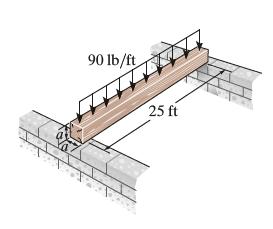
The joists of a floor in a warehouse are to be selected using square timber beams made of oak. If each beam is to be designed to carry \(90 \mathrm{lb} / \mathrm{ft}\) over a simply supported span of \(25 \mathrm{ft}\), determine the dimension \(a\) of its square cross section to the nearest
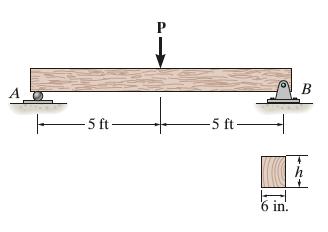
The timber beam has a width of 6 in. Determine its height \(h\) so that it simultaneously reaches an allowable bending stress of \(\sigma_{\text {allow }}=1.50 \mathrm{ksi}\) and an allowable shear stress of \(\tau_{\text {allow }}=50\) psi. What is the maximum load \(P\) that the beam can then
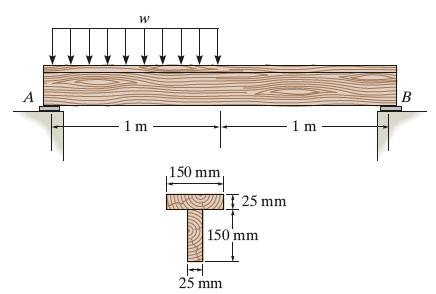
If the bearing pads at \(A\) and \(B\) support only vertical forces, determine the greatest magnitude of the uniform distributed loading \(w\) that can be applied to the beam. \(\sigma_{\text {allow }}=15 \mathrm{MPa}\), \(\tau_{\text {allow }}=1.5 \mathrm{MPa}\). W A 1 m 150 mm, 25 mm 150 mm H 25
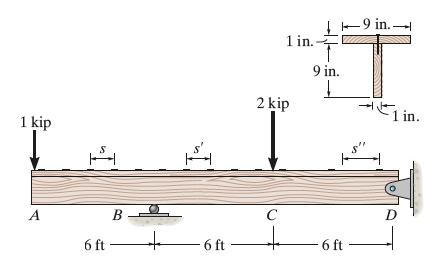
The beam is constructed from two boards. If each nail can support a shear force of \(200 \mathrm{lb}\), determine the maximum spacing of the nails, \(s, s^{\prime}\), and \(s^{\prime \prime}\), to the nearest \(\frac{1}{8}\) in. for regions \(A B, B C\), and \(C D\), respectively. 1 kip A B 6 ft +
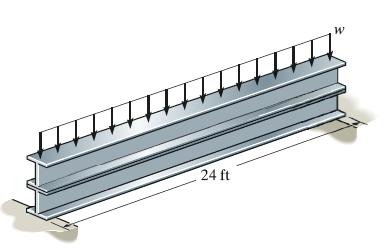
The simply supported beam is composed of two W12 \(\times 22\) sections built up as shown. Determine the maximum uniform loading \(w\) the beam will support if the allowable bending stress is \(\sigma_{\text {allow }}=22 \mathrm{ksi}\) and the allowable shear stress is \(\tau_{\text {allow }}=14
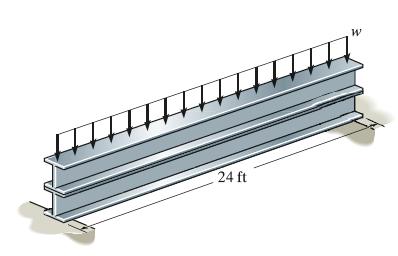
The simply supported beam is composed of two W12 \(\times 22\) sections built up as shown. Determine if the beam will safely support a loading of \(w=2 \mathrm{kip} / \mathrm{ft}\). The allowable bending stress is \(\sigma_{\text {allow }}=22 \mathrm{ksi}\) and the allowable shear stress is
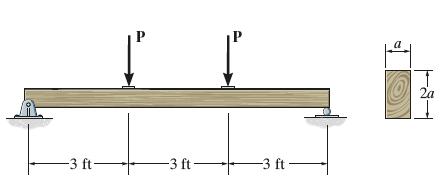
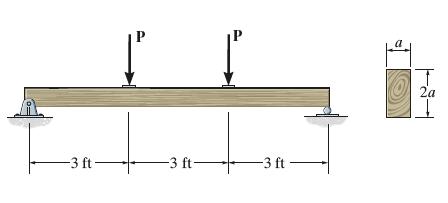
If \(P=800 \mathrm{lb}\), determine the minimum dimension \(a\) of the beam's cross section to the nearest \(\frac{1}{8}\) in. to safely support the load. The wood species has an allowable normal stress of \(\sigma_{\text {allow }}=1.5 \mathrm{ksi}\) and an allowable shear stress of \(\tau_{\text
If \(a=3 \mathrm{in}\). and the wood has an allowable normal stress of \(\sigma_{\text {allow }}=1.5 \mathrm{ksi}\), and an allowable shear stress of \(\tau_{\text {allow }}=150 \mathrm{psi}\), determine the maximum allowable value of \(\mathrm{P}\) that can act on the beam. -3 ft - -3 ft- -3 ft I
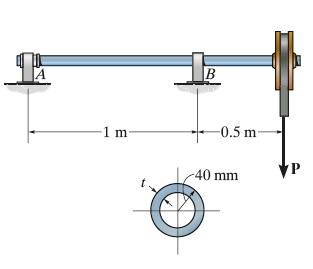
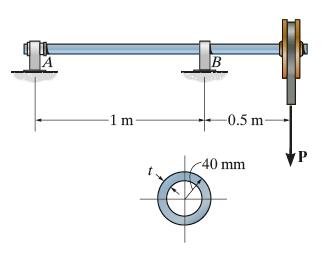
The shaft is supported by a smooth thrust bearing at \(A\) and a smooth journal bearing at \(B\). If \(P=5 \mathrm{kN}\) and the shaft is made from steel having an allowable normal stress of \(\sigma_{\text {allow }}=150\) \(\mathrm{MPa}\) and an allowable shear stress of \(\tau_{\text {allow }}=85
The shaft is supported by a smooth thrust bearing at A and a smooth journal bearing at B. If the shaft is made from steel having an allowable normal stress of \(\sigma_{\text {allow }}=150 \mathrm{MPa}\) and allowable shear stress of \(\tau_{\text {allow }}=85 \mathrm{MPa}\), determine the maximum
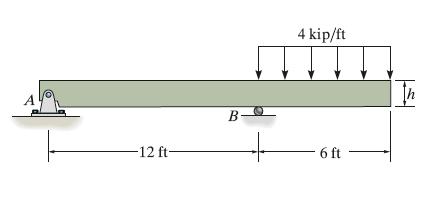
Determine the minimum depth \(h\) of the beam to the nearest \(\frac{1}{8}\) in. that will safely support the loading shown.The allowable bending stress is \(\sigma_{\text {allow }}=2.1 \mathrm{ksi}\) and the allowable shear stress is \(\tau_{\text {allow }}=10 \mathrm{ksi}\). The beam has a
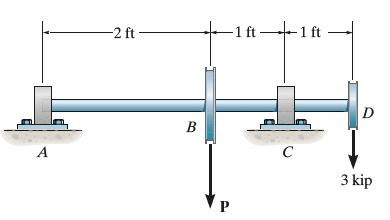
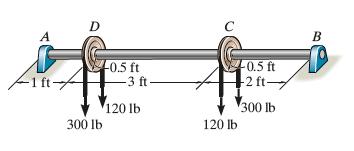
Draw the shear and moment diagrams for the shaft, and determine its required diameter to the nearest \(\frac{1}{8}\) in. if \(\sigma_{\text {allow }}=30 \mathrm{ksi}\) and \(\tau_{\text {allow }}=15 \mathrm{ksi}\). The journal bearings at \(A\) and \(C\) exert only vertical reactions on the shaft.
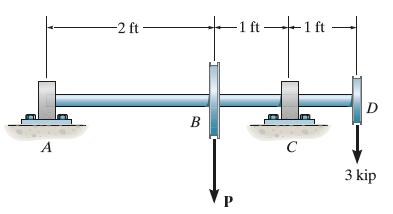
Draw the shear and moment diagrams for the shaft, and determine its required diameter to the nearest \(\frac{1}{4}\) in. if \(\sigma_{\text {allow }}=30 \mathrm{ksi}\) and \(\tau_{\text {allow }}=15 \mathrm{ksi}\). The journal bearings at \(A\) and \(C\) exert only vertical reactions on the shaft.
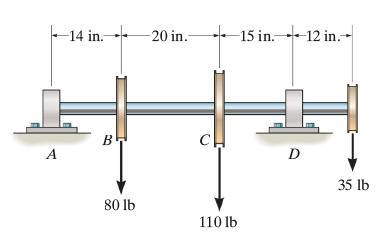
Draw the shear and moment diagrams for the shaft, and determine its required diameter to the nearest \(\frac{1}{4} \mathrm{in}\). if \(\sigma_{\text {allow }}=7 \mathrm{ksi}\) and \(\tau_{\text {allow }}=3 \mathrm{ksi}\). The bearings at \(A\) and \(D\) exert only vertical reactions on the
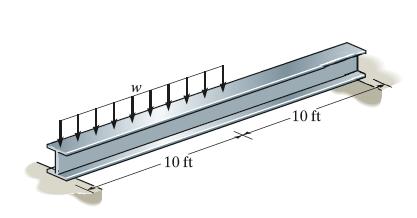
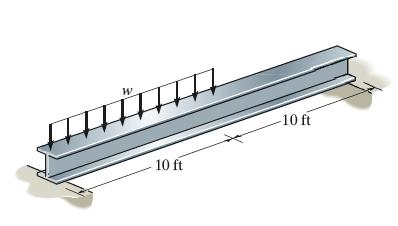
Determine the maximum uniform loading \(w\) the \(\mathrm{W} 12 \times 14\) beam will support if the allowable bending stress is \(\sigma_{\text {allow }}=22 \mathrm{ksi}\) and the allowable shear stress is \(\tau_{\text {allow }}=12 \mathrm{ksi}\). 10 ft 10 ft
Determine if the \(\mathrm{W} 14 \times 22\) beam will safely support a loading of \(w=1.5 \mathrm{kip} / \mathrm{ft}\). The allowable bending stress is \(\sigma_{\text {allow }}=22 \mathrm{ksi}\) and the allowable shear stress is \(\tau_{\text {allow }}=12 \mathrm{ksi}\). 10 ft -10 ft
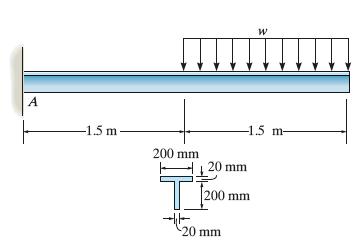
Determine the maximum uniform distributed load \(w\) that can be safely supported on the T-beam if the allowable bending stress is \(\sigma_{\text {allow }}=150 \mathrm{MPa}\) and the allowable shear stress is \(\tau_{\text {allow }}=70 \mathrm{MPa}\). A -1.5 m- 200 mm w 20 mm T1200 mm 20 mm -1.5 m
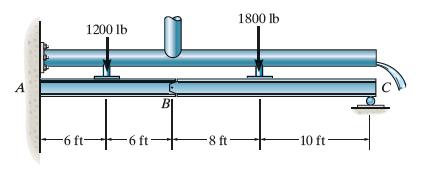
The compound beam is made from two sections, which are pinned together at \(B\). Use Appendix B and select the lightest-weight wide-flange beam that would be safe for each section if the allowable bending stress is \(\sigma_{\text {allow }}=24 \mathrm{ksi}\) and the allowable shear stress is
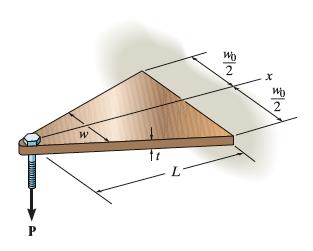
The beam is made from a plate that has a constant thickness \(t\). Determine the width \(w\) as a function of \(x\) so that it has a maximum bending stress \(\sigma_{\max }\) throughout its length when it supports the force \(\mathbf{P}\) at its end. P W L 2 x wb 2
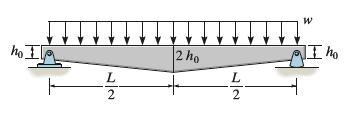
The tapered beam supports a uniform distributed load \(w\). If it is made from a plate and has a constant width \(b\), determine the absolute maximum bending stress in the beam. ho I 2 ho L L 2 2 W I ho
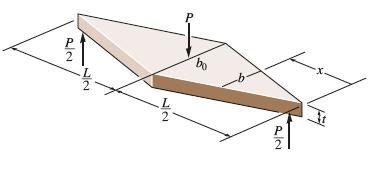
The beam is made from a plate having a constant thickness \(t\) and a width that varies as shown. If it supports a concentrated force \(\mathbf{P}\) at its center, determine the absolute maximum bending stress in the beam and specify its location \(x\), \(0 bo 22 2 22 22
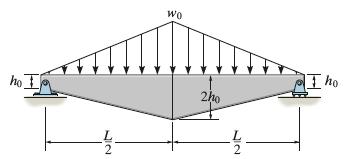
The beam has a constant thickness \(b\). If it supports the distributed loading shown, determine the maximum bending stress \(\sigma_{\max }\) in the beam. ho 22 -- Wo 2ho I ho 22
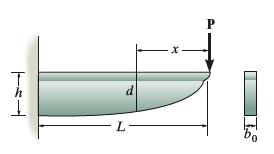
Determine the variation in the depth \(d\) of the cantilever beam that supports the concentrated force \(\mathbf{P}\) so that it has the same maximum bending stress \(\sigma_{\max }\) throughout its length. The beam has a constant width \(b_{0}\). TIL L x I
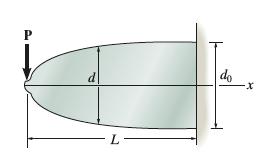
Determine the variation in the depth \(d\) of a cantilever beam that supports a concentrated force \(\mathbf{P}\) so that it has the same maximum bending stress \(\sigma_{\max }\) throughout its length. The beam has a constant width \(b_{0}\). P d do -x 7.
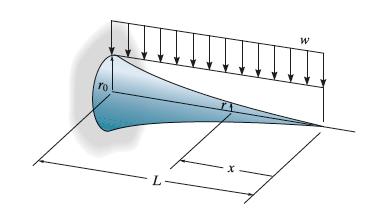
Determine the variation of the radius \(r\) of the cantilevered beam that supports the uniform distributed load so that it has a constant maximum bending stress \(\sigma_{\max }\) throughout its length. ro L- W
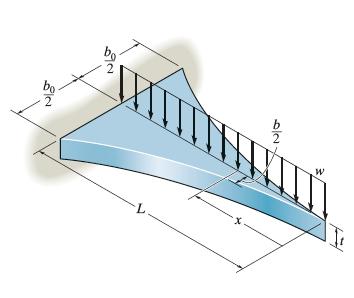
Determine the variation in the width \(b\) as a function of \(x\) for the cantilevered beam that supports a uniform distributed load along its centerline so that it has the same maximum bending stress \(\sigma_{\max }\) throughout its length. The beam has a constant depth \(t\). 192 82 02
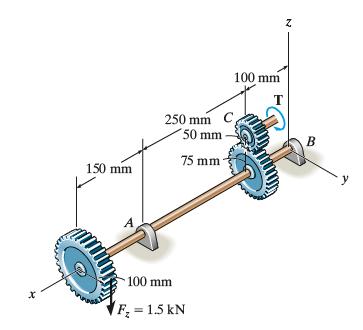
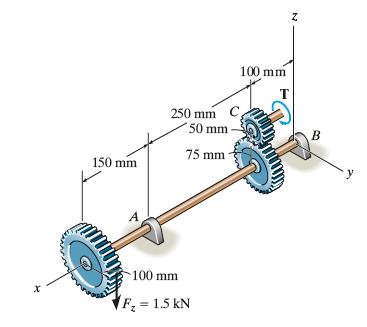
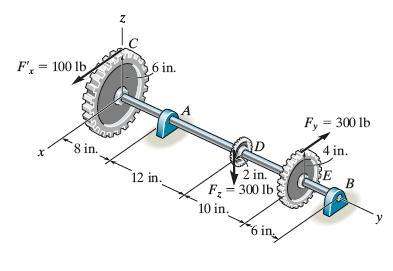
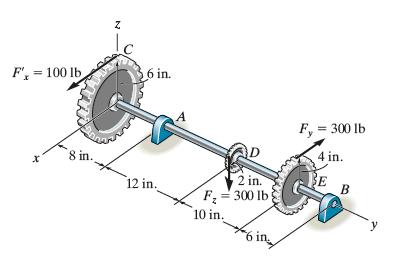
The end gear connected to the shaft is subjected to the loading shown. If the bearings at \(A\) and \(B\) exert only \(y\) and \(z\) components of force on the shaft, determine the equilibrium torque \(T\) at gear \(C\) and then determine the smallest diameter of the shaft to the nearest millimeter
The end gear connected to the shaft is subjected to the loading shown. If the bearings at \(A\) and \(B\) exert only \(y\) and \(z\) components of force on the shaft, determine the equilibrium torque \(T\) at gear \(C\) and then determine the smallest diameter of the shaft to the nearest millimeter
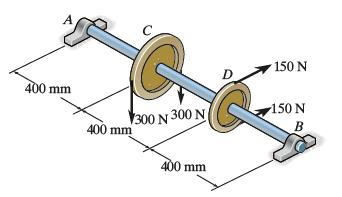
The 50 -mm-diameter shaft is supported by journal bearings at \(A\) and \(B\). If the pulleys \(C\) and \(D\) are subjected to the loadings shown, determine the absolute maximum bending stress in the shaft. 150 N 400 mm 300 N 300 N 150 N B 400 mm 400 mm
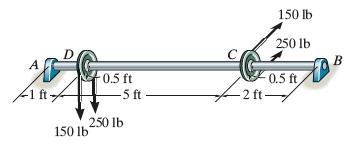
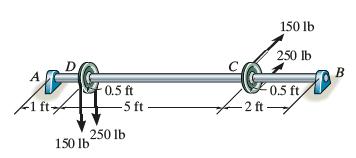
The pulleys fixed to the shaft are loaded as shown. If the journal bearings at \(A\) and \(B\) exert only horizontal and vertical forces on the shaft, determine the required diameter of the shaft to the nearest \(\frac{1}{8}\) in. using the maximum shear stress theory of failure, \(\tau_{\text
The pulleys fixed to the shaft are loaded as shown. If the journal bearings at \(A\) and \(B\) exert only horizontal and vertical forces on the shaft, determine the required diameter of the shaft to the nearest \(\frac{1}{8}\) in. Use the maximum distortion energy theory of failure, \(\sigma_{\text
The two pulleys fixed to the shaft are loaded as shown. If the journal bearings at \(A\) and \(B\) exert only vertical forces on the shaft, determine the required diameter of the shaft to the nearest \(\frac{1}{8}\) in. using the maximum distortion energy theory. \(\sigma_{\text {allow }}=67
The shaft is supported by journal bearings at \(A\) and \(B\) that exert force components only in the \(x\) and \(z\) directions on the shaft. If the allowable normal stress for the shaft is \(\sigma_{\text {allow }}=15 \mathrm{ksi}\), determine to the nearest \(\frac{1}{8}\) in. the smallest
The shaft is supported by bearings at \(A\) and \(B\) that exert force components only in the \(x\) and \(z\) directions on the shaft. If the allowable normal stress for the shaft is \(\sigma_{\text {allow }}=15 \mathrm{ksi}\), determine to the nearest \(\frac{1}{8}\) in. the smallest diameter of
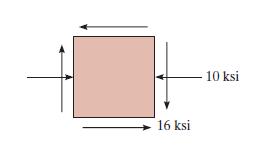
Determine the equivalent state of stress on an element if it is oriented \(50^{\circ}\) counterclockwise from the element shown. Use the stress transformation equations. 16 ksi 10 ksi
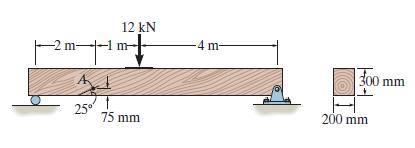
The wood beam is subjected to a load of \(12 \mathrm{kN}\). Determine the principal stresses at point \(A\) and specify the orientation of the element. -2 m- 201 12 kN m 25 75 mm 4 m- 300 mm 200 mm mm
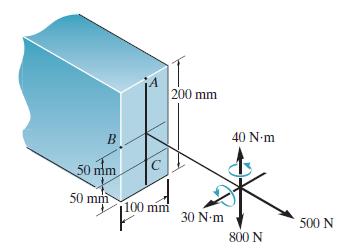
The internal loadings at a section of the beam consist of an axial force of \(500 \mathrm{~N}\), a shear force of \(800 \mathrm{~N}\), and two moment components of \(30 \mathrm{~N} \cdot \mathrm{m}\) and of \(40 \mathrm{~N} \cdot \mathrm{m}\). Determine the principal stresses at point \(A\). Also
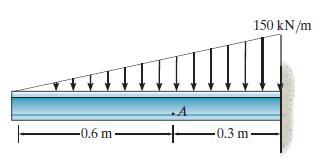
Determine the principal stresses at point \(A\), which is located at the bottom of the web. Show the results on an element located at this point. -0.6 m- + 0.3 m 150 kN/m
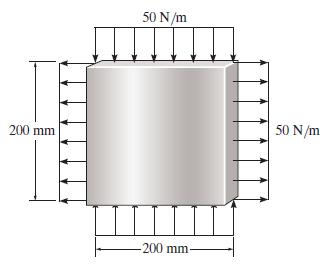
The square steel plate has a thickness of \(10 \mathrm{~mm}\) and is subjected to the edge loading shown. Determine the maximum in-plane shear stress and the average normal stress developed in the steel. 200 mm 50 N/m -200 mm- 50 N/m
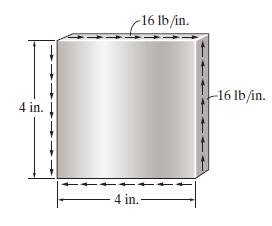
The square steel plate has a thickness of \(0.5 \mathrm{in}\). and is subjected to the edge loading shown. Determine the principal stresses developed in the steel. 4 in. 4 in. -16 lb/in. -16 lb/in.
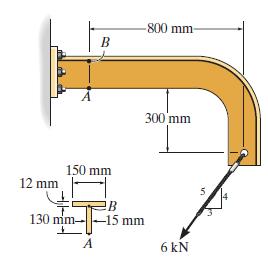
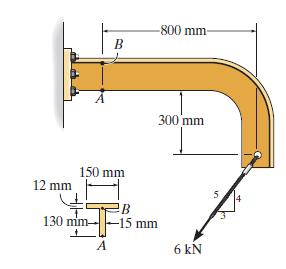
Determine the principal stresses acting at point \(A\) of the supporting frame. Show the results on a properly oriented element located at this point. B 150 mm -800 mm- 300 mm 12 mm B 130 mm- -15 mm A 6 kN
Determine the principal stresses acting at point \(B\), which is located just on the web, below the horizontal segment on the cross section. Show the results on a properly oriented element located at this point. Although it is not very accurate, use the shear formula to calculate the shear stress.
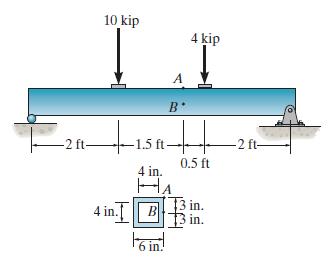
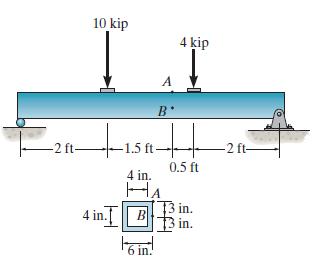
Determine the maximum in-plane shear stress in the box beam at point \(A\). Show the results on an element located at this point. 10 kip 4 kip A B* -2 ft- -1.5 ft- || -2 ft- 4 in. HA 4 in. B +6 in! 0.5 ft 3 in.
Determine the principal stresses in the box beam at point \(B\).Show the results on an element located at this point. 10 kip 4 kip A B* -2 ft- -1.5 ft -2 ft- ft- 0.5 ft 4 in. HA in. 4 in. B 6 in. 3 in.
Determine the principal stresses and also the maximum in-plane shear stress that are developed at point \(A\). For each case, show the results on an element located at this point. The rod has a diameter of \(40 \mathrm{~mm}\). 150 mm B 150 mm A 100 mm- 450 N 450 N
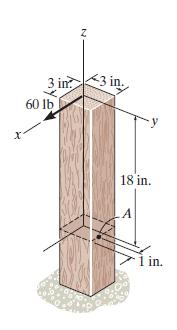
The post has a square cross-sectional area. If it is fixed at its base and a horizontal force is applied at its end as shown, determine(a) the maximum in-plane shear stress developed at \(A\) and(b) the principal stresses at \(A\). Z 3 in 3 in 60 lb 18 in. A 1 in.
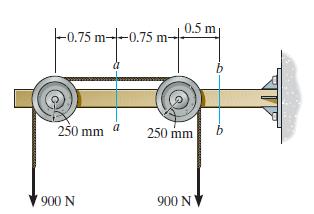
Determine the principal stresses at point \(A\) on the cross section of the hanger at section \(a-a\). Specify the orientation of this state of stress and indicate the result on an element at the point. -0.75 m-0.75 m- -0.75m--0.75 0.5 m a 250 mm 250 mm 900 N 900 N
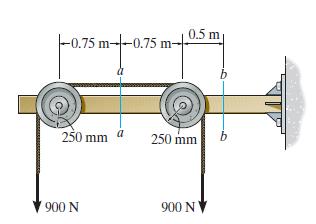
Determine the principal stresses at point \(A\) on the cross section of the hanger at section \(b-b\). Specify the orientation of the state of stress and indicate the results on an element at the point. -0.75 m--0.75 m- 0.5 m 250 mm 250 mm b 900 N 900 N
The stair tread of the escalator is supported on two of its sides by the moving pin at \(A\) and the roller at \(B\). If a man having a weight of \(300 \mathrm{lb}\) stands in the center of the tread, determine the principal stresses developed on the cross section at point \(C\). The stairs move at
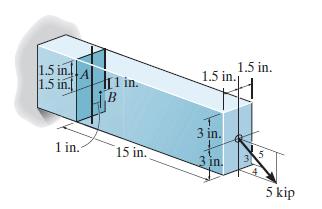
The cantilevered rectangular bar is subjected to the force of 5 kip. Determine the principal stresses at point \(A\). 1.5 in. 1.5 in.. 1.5 in. A 1 in. 1.5 in. B 3 in. 1 in. 15 in. 3 in. 5 kip
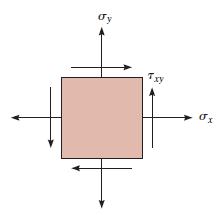
Consider the general case of plane stress as shown. Write a computer program that will show a plot of the three Mohr's circles for the element, and will also determine the maximum in-plane shear stress and the absolute maximum shear stress. dy Txy
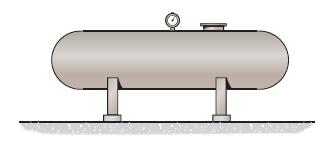
The propane gas tank has an inner diameter of \(1500 \mathrm{~mm}\) and wall thickness of \(15 \mathrm{~mm}\). If the pressure in the tank is \(2 \mathrm{MPa}\), determine the absolute maximum shear stress in the wall of the tank.
Consider the general case of plane strain where \(\epsilon_{x}, \epsilon_{y}\), and \(\gamma_{x y}\) are known. Write a computer program that can be used to determine the normal and shear strain, \(\epsilon_{x^{\prime}}\) and \(\gamma_{x^{\prime} y^{\prime}}\), on the plane of an element oriented
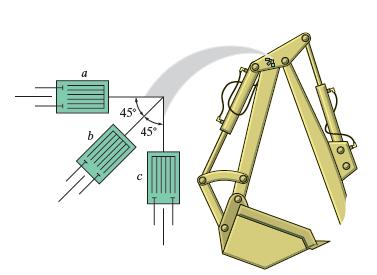
The \(45^{\circ}\) strain rosette is mounted on the link of the backhoe. The following readings are obtained from each gauge: \(\epsilon_{a}=650\left(10^{-6}\right), \epsilon_{b}=-300\left(10^{-6}\right), \epsilon_{c}=480\left(10^{-6}\right)\). Determine(a) the principal strains and(b) the maximum
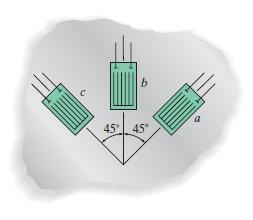
The \(45^{\circ}\) strain rosette is mounted on a steel shaft. The following readings are obtained from each gauge: gage: \(\epsilon_{a}=300\left(10^{-6}\right), \epsilon_{b}=-250\left(10^{-6}\right), \epsilon_{c}=-450\left(10^{-6}\right)\). Determine(a) the in-plane principal strains and(b) the
Consider the general orientation of three strain gages at a point as shown. Write a computer program that can be used to determine the principal in-plane strains and the maximum in-plane shear strain at the point. Show an application of the program using the values \(\theta_{a}=40^{\circ},
For the case of plane stress, show that Hooke's law can be written as\[\sigma_{x}=\frac{E}{\left(1-u^{2}\right)}\left(\epsilon_{x}+u \epsilon_{y}\right), \quad \sigma_{y}=\frac{E}{\left(1-u^{2}\right)}\left(\epsilon_{y}+u \epsilon_{x}\right)\]
A bar of copper alloy is loaded in a tension machine and it is determined that \(\epsilon_{x}=940\left(10^{-6}\right)\) and \(\sigma_{x}=14 \mathrm{ksi}, \sigma_{y}=0\), \(\sigma_{z}=0\). Determine the modulus of elasticity, \(E_{\mathrm{cu}}\), and the dilatation, \(e_{\mathrm{cu}}\), of the
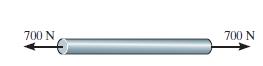
The rod is made of aluminum 2014-T6. If it is subjected to the tensile load of \(700 \mathrm{~N}\) and has a diameter of \(20 \mathrm{~mm}\), determine the absolute maximum shear strain in the rod at a point on its surface. 700 N 700 N
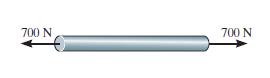
The rod is made of aluminum 2014-T6. If it is subjected to the tensile load of \(700 \mathrm{~N}\) and has a diameter of \(20 \mathrm{~mm}\), determine the principal strains at a point on the surface of the rod. 700 N 700 N
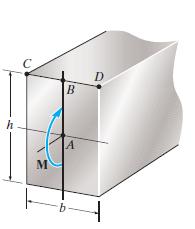
The cross section of the rectangular beam is subjected to the bending moment M. Determine an expression for the increase in length of lines \(A B\) and \(C D\). The material has a modulus of elasticity \(E\) and Poisson's ratio is \(u\). h B D M A t b-
The principal strains at a point on an aluminum plate are \(\epsilon_{1}=780\left(10^{-6}\right)\) and \(\epsilon_{2}=400\left(10^{-6}\right)\). Determine the associated principal stresses at the point in the same plane. \(E_{\mathrm{al}}=10\left(10^{3}\right) \mathrm{ksi}, u_{\mathrm{al}}=0.33\).
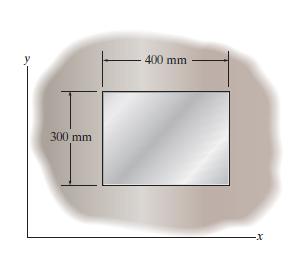
The 6061-T6 aluminum alloy plate fits snugly into the rigid constraint. Determine the normal stresses \(\sigma_{x}\) and \(\sigma_{y}\) developed in the plate if the temperature is increased by \(\Delta T=50^{\circ} \mathrm{C}\). Hint: Add the thermal strain \(\alpha \Delta T\) to the equations for
The principal strains in a plane are \(\epsilon_{1}=630\left(10^{-6}\right)\) and \(\epsilon_{2}=350\left(10^{-6}\right)\). Determine the associated principal stresses at the point in the same plane. \(E_{\mathrm{al}}=10\left(10^{3}\right) \mathrm{ksi}\) and \(u_{\mathrm{al}}=0.33\).
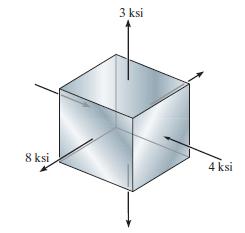
The principal stresses at a point are shown in the figure. If the material is aluminum for which \(E_{\mathrm{al}}=10\left(10^{3}\right) \mathrm{ksi}\) and \(u_{\mathrm{al}}=0.33\), determine the principal strains. 3 ksi 8 ksi 4 ksi
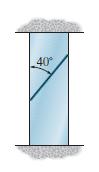
The block is fitted between the fixed supports. If the glued joint can resist a maximum shear stress of \(\tau_{\text {allow }}=2 \mathrm{ksi}\), determine the temperature rise that will cause the joint to fail. Take \(E=10\left(10^{3}\right) \mathrm{ksi}, u=0.2\). Add the thermal strain \(\alpha
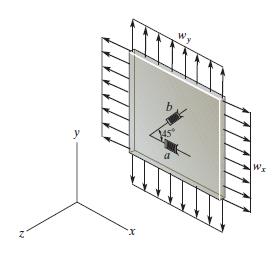
Two strain gages \(a\) and \(b\) are attached to the surface of the plate made from a material having a modulus of elasticity of \(E=70 \mathrm{GPa}\) and Poisson's ratio \(u=0.35\). If the gages give a reading of \(\epsilon_{a}=450\left(10^{-6}\right)\) and
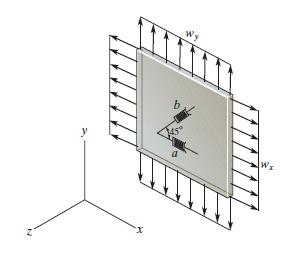
Two strain gages \(a\) and \(b\) are attached to the surface of the plate which is subjected to the uniform distributed load \(w_{x}=700 \mathrm{kN} / \mathrm{m}\) and \(w_{y}=-175 \mathrm{kN} / \mathrm{m}\). If the gages give a reading of \(\epsilon_{a}=450\left(10^{-6}\right)\) and
The principal strains in a plane, measured experimentally at a point on the 2014-T6 aluminum fuselage of a jet aircraft, are \(\epsilon_{1}=450\left(10^{-6}\right)\) and \(\epsilon_{2}=-600\left(10^{-6}\right)\). Determine the associated principal stresses at the point in the same plane.
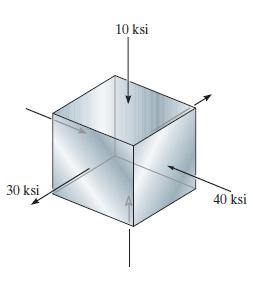
The principal stresses at a point are shown in the figure. If the material is structural A992 steel, determine the principal strains. 10 ksi 30 ksi 40 ksi
The principal plane stresses and associated strains in a plane at a point are \(\sigma_{1}=30 \mathrm{ksi}, \sigma_{2}=-10 \mathrm{ksi}, \epsilon_{1}=1.14\left(10^{-3}\right)\), \(\epsilon_{2}=-0.655\left(10^{-3}\right)\). Determine the modulus of elasticity and Poisson's ratio.
A rod has a radius of \(20 \mathrm{~mm}\). If it is subjected to an axial load of \(20 \mathrm{kN}\) such that the axial strain in the rod is \(\epsilon_{x}=218\left(10^{-6}\right)\), determine the modulus of elasticity \(E\) and the change in its diameter. Take \(v=0.35\).
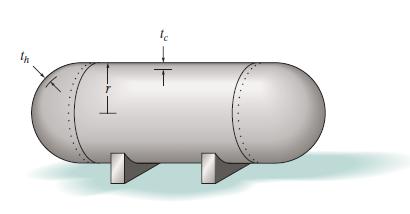
The cylindrical pressure vessel is fabricated using hemispherical end caps in order to reduce the bending stress that would occur if flat ends were used.The bending stresses at the seam where the caps are attached can be eliminated by proper choice of the thickness \(t_{h}\) and \(t_{c}\) of the
A thin-walled cylindrical pressure vessel has an inner radius \(r\), thickness \(t\), and length \(L\). If it is subjected to an internal pressure \(p\), show that the increase in its inner radius is \(d r=r \epsilon_{1}=p r^{2}\left(1-\frac{1}{2} u\right) / E t\) and the increase in its length is
The rubber block is confined in the U-shape smooth rigid block. If the rubber has a modulus of elasticity \(E\) and Poisson's ratio \(v\), determine the effective modulus of elasticity of the rubber under the confined condition.
Derive an expression for an equivalent torque \(T_{e}\) that, if applied alone to a solid bar with a circular cross section, would cause the same maximum shear stress as the combination of an applied moment \(M\) and torque \(T\). Assume that the principal stresses have opposite algebraic signs.
A bar with a square cross section is made of a material having a yield stress of \(\sigma_{Y}=120 \mathrm{ksi}\). If the bar is subjected to a bending moment of \(75 \mathrm{kip} \cdot\) in., determine the required size of the bar according to the maximum distortion energy theory. Use a factor of
Cast iron when tested in tension and compression has an ultimate strength of \(\left(\sigma_{\mathrm{ult}}\right)_{t}=280 \mathrm{MPa}\) and \(\left(\sigma_{\mathrm{ult}}\right)_{c}=420 \mathrm{MPa}\), respectively. Also, when subjected to pure torsion it can sustain an ultimate shear stress of
Derive an expression for an equivalent bending moment \(M_{e}\) that, if applied alone to a solid cylinder, would cause the same maximum shear stress as the combination of an applied moment \(M\) and torque \(T\). Assume that the principal stresses are of opposite algebraic signs.
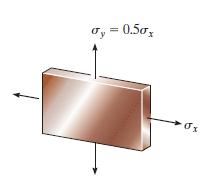
The plate is made of hard copper, which yields at \(\sigma_{Y}=105 \mathrm{ksi}\). Using the maximum shear stress theory, determine the tensile stress \(\sigma_{Y}\) that can be applied to the plate if a tensile stress \(\sigma_{y}=0.5 \sigma_{Y}\) is also applied. y=0.50 = 0.50% 0x
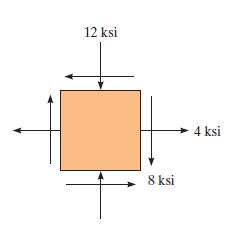
The element is subjected to the state of stress shown. If \(\sigma_{Y}=36 \mathrm{ksi}\), determine the factor of safety for the loading based on the maximum shear stress theory. 12 ksi 8 ksi 4 ksi
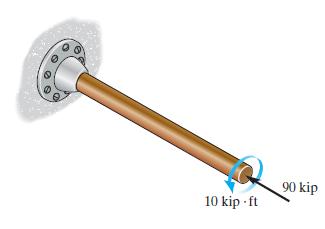
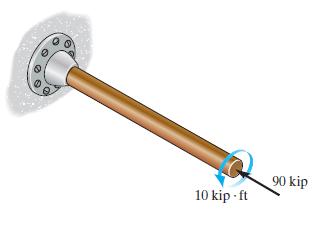
If the 3-in.-diameter short rod is made from brittle material having an ultimate strength of \(\sigma_{\text {ult }}=60 \mathrm{ksi}\), for both tension and compression, determine if the shaft fails according to the maximum normal stress theory. Use a factor of safety of 2 against rupture. 10
If the 3-in.-diameter shaft is made from cast iron having tensile and compressive ultimate strengths of \(\left(\sigma_{\mathrm{ult}}\right)_{t}=40 \mathrm{ksi}\), and \(\left(\sigma_{\mathrm{ult}}\right)_{c}=80 \mathrm{ksi}\), respectively, determine if the shaft fails according to Mohr's failure
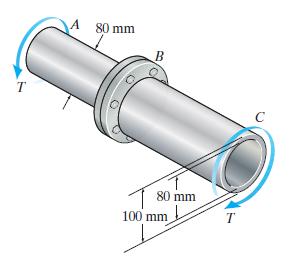
The shaft consists of a solid segment \(A B\) and a hollow segment \(B C\), which are rigidly joined by the coupling at \(B\). If the shaft is made from A-36 steel, determine the maximum torque \(T\) that can be applied according to the maximumshear-stress theory. Use a factor of safety of 1.5
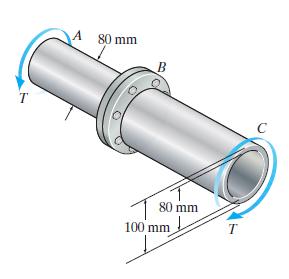
The shaft consists of a solid segment \(A B\) and a hollow segment \(B C\), which are rigidly joined by the coupling at \(B\). If the shaft is made from A-36 steel, determine the maximum torque \(T\) that can be applied according to the maximumdistortion-energy theory. Use a factor of safety of 1.5
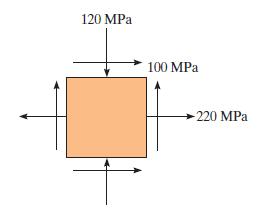
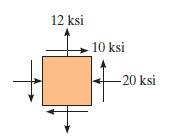
If \(\sigma_{Y}=50 \mathrm{ksi}\), determine the factor of safety for this state of stress against yielding, based on(a) the maximum shear stress theory and(b) the maximum distortion energy theory. 12 ksi 10 ksi -20 ksi
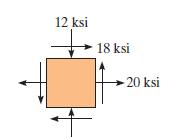
The state of plane stress at a critical point in a steel machine bracket is shown. If the yield stress for steel is \(\sigma_{Y}=36 \mathrm{ksi}\), determine if yielding occurs using the maximum distortion energy theory. 12 ksi 18 ksi -20 ksi
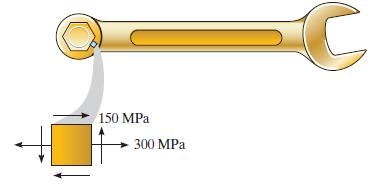
The state of stress acting at a point on a wrench is shown. Determine the smallest yield stress for steel that might be selected for the part, based on the maximum distortion energy theory. 150 MPa 300 MPa C
The state of stress acting at a point on a wrench is shown. Determine the smallest yield stress for steel that might be selected for the part, based on the maximum shear stress theory. 150 MPa 300 MPa C
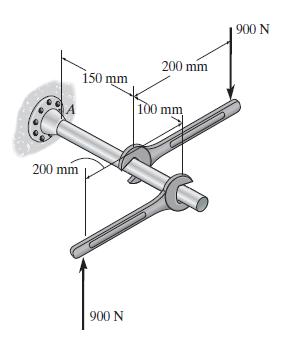
If the A-36 steel pipe has outer and inner diameters of \(30 \mathrm{~mm}\) and \(20 \mathrm{~mm}\), respectively, determine the factor of safety against yielding of the material at point \(A\) according to the maximum shear stress theory. 200 mm 150 mm 900 N 200 mm 100 mm 900 N
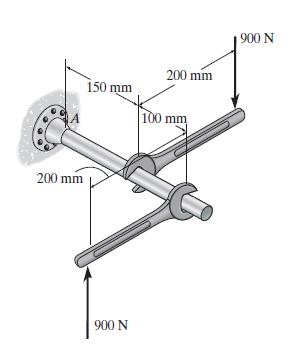
If the A-36 steel pipe has an outer and inner diameter of \(30 \mathrm{~mm}\) and \(20 \mathrm{~mm}\), respectively, determine the factor of safety against yielding of the material at point \(A\) according to the maximum distortion energy theory. 200 mm 150 mm 200 mm 100 mm 900 N 900 N
The principal stresses acting at a point on a thin-walled cylindrical pressure vessel are \(\sigma_{1}=p r / t, \sigma_{2}=p r / 2 t\), and \(\sigma_{3}=0\). If the yield stress is \(\sigma_{Y}\), determine the maximum value of \(p\) based on(a) the maximum shear stress theory and(b) the maximum
The gas tank is made from A-36 steel and has an inner diameter of \(1.50 \mathrm{~m}\). If the tank is designed to withstand a pressure of \(5 \mathrm{MPa}\), determine the minimum required wall thickness to the nearest millimeter using(a) the maximum shear stress theory and(b) maximum distortion
The element is subjected to the state of stress shown. If the material is machine steel having a yield stress of \(\sigma_{Y}=750 \mathrm{MPa}\), determine the factor of safety with respect to yielding using the maximum distortion energy theory.
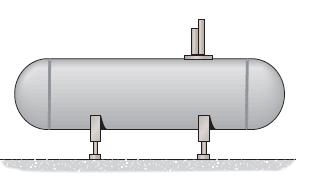
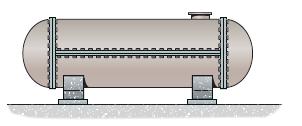
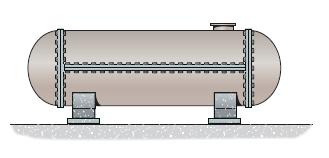
The gas storage tank is fabricated by bolting together two half cylindrical thin shells and two hemispherical shells as shown. If the tank is designed to withstand a pressure of \(3 \mathrm{MPa}\), determine the required minimum thickness of the cylindrical and hemispherical shells and the minimum
The gas storage tank is fabricated by bolting together two half cylindrical thin shells and two hemispherical shells as shown. If the tank is designed to withstand a pressure of \(3 \mathrm{MPa}\), determine the required minimum thickness of the cylindrical and hemispherical shells and the minimum
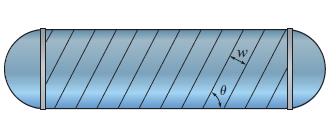
The cylindrical tank is fabricated by welding a strip of thin plate helically, making an angle \(\theta\) with the longitudinal axis of the tank. If the strip has a width \(w\) and thickness \(t\), and the gas within the tank of diameter \(d\) is subjected to a pressure \(p\), show that the normal
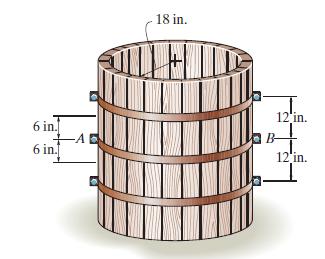
The staves or vertical members of the wooden tank are held together using semicircular hoops having a thickness of 0.5 in. and a width of 2 in. Determine the normal stress in hoop \(A B\) if the tank is subjected to an internal pressure of 2 psi and this loading is transmitted directly to the
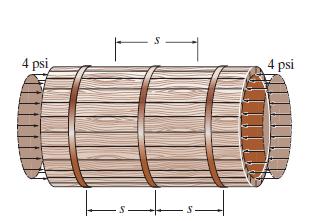
A wood pipe having an inner diameter of \(3 \mathrm{ft}\) is bound together using steel hoops each having a cross-sectional area of \(0.2 \mathrm{in}^{2}\). If the allowable stress for the hoops is \(\sigma_{\text {allow }}=12 \mathrm{ksi}\), determine their maximum spacing \(s\) along the section
Showing 900 - 1000
of 1529
First
2
3
4
5
6
7
8
9
10
11
12
13
14
15
16
Step by Step Answers

 Get 50% OFF
Claim Now
Get 50% OFF
Claim Now