New Semester
Started
Get
50% OFF
Study Help!
--h --m --s
Claim Now
Question Answers
Textbooks
Find textbooks, questions and answers
Oops, something went wrong!
Change your search query and then try again
S
Books
FREE
Study Help
Expert Questions
Accounting
General Management
Mathematics
Finance
Organizational Behaviour
Law
Physics
Operating System
Management Leadership
Sociology
Programming
Marketing
Database
Computer Network
Economics
Textbooks Solutions
Accounting
Managerial Accounting
Management Leadership
Cost Accounting
Statistics
Business Law
Corporate Finance
Finance
Economics
Auditing
Tutors
Online Tutors
Find a Tutor
Hire a Tutor
Become a Tutor
AI Tutor
AI Study Planner
NEW
Sell Books
Search
Search
Sign In
Register
study help
engineering
mechanics of materials
Mechanics Of Materials 11th Edition Russell C. Hibbeler - Solutions
A column of intermediate length buckles when the compressive stress is \(40 \mathrm{ksi}\). If the slenderness ratio is 60 , determine the tangent modulus.
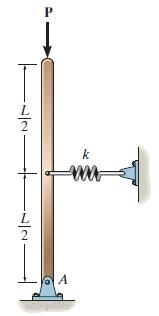
Determine the critical buckling load for the column. The column material can be assumed rigid. T P k ww
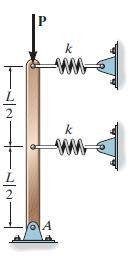
Determine the critical buckling load for the column. The column material can be assumed rigid. P 22. 2 k www A
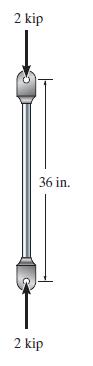
The aircraft link is made from an A992 steel rod. Determine the smallest diameter of the rod, to the nearest \(\frac{1}{16}\) in., that will support the load of 2 kip without buckling. The ends are pin connected. 2 kip 36 in. 2 kip
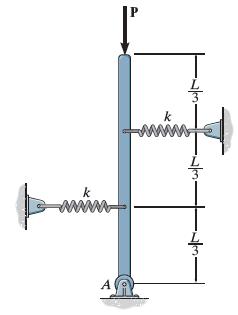
Determine the critical buckling load for the column. The column material can be assumed rigid. Each spring has a stiffness \(k\). www A
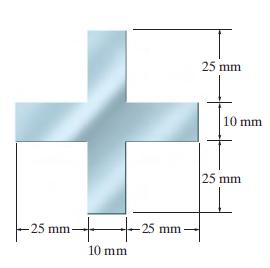
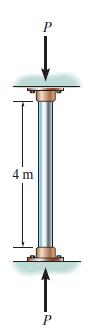
An A-36 steel column has a length of \(4 \mathrm{~m}\) and is pinned at both ends. If the cross-sectional area has the dimensions shown, determine the critical load. -25 mm 25 mm- 10 mm 25 mm 10 mm 25 mm
Solve Prob. 13-5 if the column is fixed at its bottom and pinned at its top.Data from Prob. 13-5An A-36 steel column has a length of \(4 \mathrm{~m}\) and is pinned at both ends. If the cross-sectional area has the dimensions shown, determine the critical load. -25 mm 25 mm- 10 mm 25 mm 10 mm 25 mm
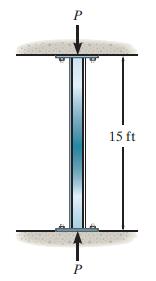
The \(\mathrm{W} 10 \times 45\) is made of \(\mathrm{A}-36\) steel and is used as a column that has a length of \(15 \mathrm{ft}\). If its ends are assumed pin supported, and it is subjected to an axial load of \(100 \mathrm{kip}\), determine the factor of safety with respect to buckling. P P 15 ft
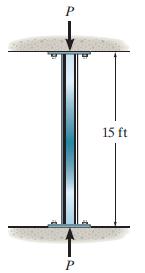
The \(\mathrm{W} 10 \times 45\) is made of A- 36 steel and is used as a column that has a length of \(15 \mathrm{ft}\). If the ends of the column are fixed supported, can the column support the critical load without yielding? P 15 ft
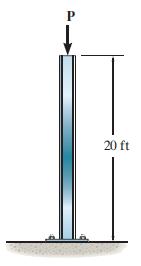
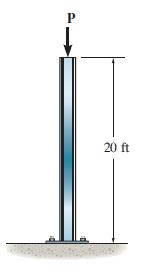
The W14 \(\times 38\) column is made of A-36 steel and is fixed supported at its base. If it is subjected to an axial load of \(P=15\) kip, determine the factor of safety with respect to buckling. P 20 ft
The W14 \(\times 38\) column is made of A-36 steel. Determine the critical load if its bottom end is fixed supported and its top is free to move in plane about the strong axis and is pinned about the weak axis, i.e., out of plane. P 20 ft
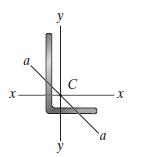
The 2014-T6 aluminum angle has a cross-sectional area of \(A=2.67\) in \(^{2}\) and a radius of gyration about the \(x\) axis of \(r_{x}=1.25\) in. and about the \(y\) axis of \(r_{y}=1.06\) in. The smallest radius of gyration occurs about the \(a-a\) axis and is \(r_{a}=0.727\) in. If the angle is
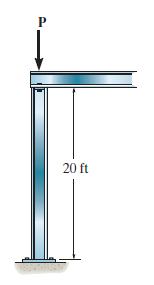
The W18 \(\times 40\) is used as a structural A992 steel column that can be assumed pinned at top and fixed at the base. Determine the largest axial force \(P\) that can be applied without causing it to buckle. P 20 ft
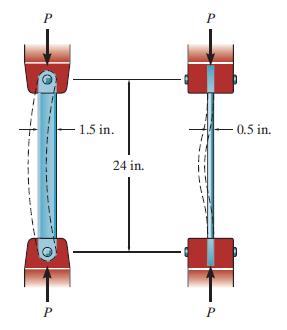
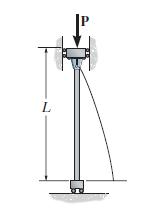
An L-2 steel link in a forging machine is pin connected to the forks at its ends as shown. Determine the maximum load \(P\) it can carry without buckling. Use a factor of safety with respect to buckling of F.S. \(=1.75\). Note from the figure on the left that the ends are pinned for buckling,
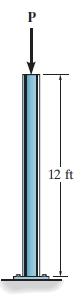
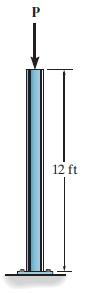
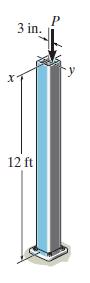
The W12 \(\times 87\) structural A-36 steel column has a length of \(12 \mathrm{ft}\). If its bottom end is fixed supported while its top is free, and it is subjected to an axial load of \(P=380\) kip, determine the factor of safety with respect to buckling. P 12 ft
The W12 \(\times 87\) structural A-36 steel column has a length of \(12 \mathrm{ft}\). If its bottom end is fixed supported while its top is free, determine the largest axial load it can support. Use a factor of safety with respect to buckling of 1.75. P 12 ft
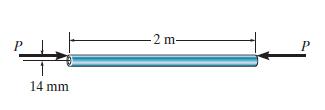
An A36 steel hollow circular tube has an outer diameter of \(200 \mathrm{~mm}\) and inner diameter of \(180 \mathrm{~mm}\). If it is pinned at both ends, determine the largest axial load that can be applied to the tube without causing it to buckle. The tube is \(10 \mathrm{~m}\) long.
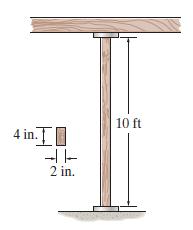
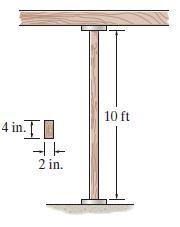
The 10 -ft wooden rectangular column has the dimensions shown. Determine the critical load if the ends are assumed to be pin connected. \(E_{\mathrm{w}}=1.6\left(10^{3}\right) \mathrm{ksi}, \sigma_{Y}=5 \mathrm{ksi}\). 4 in. I 2 in. 10 ft
The 10 -ft wooden column has the dimensions shown. Determine the critical load if the bottom is fixed and the top is pinned. Take \(E_{\mathrm{w}}=1.6\left(10^{3}\right) \mathrm{ksi}, \sigma_{Y}=5 \mathrm{ksi}\). 4 in. in. 17 2 in. 10 ft
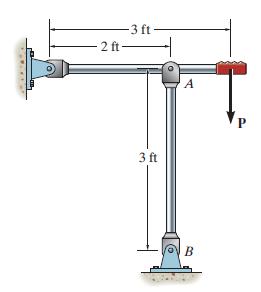
Determine the maximum force \(P\) that can be applied to the handle so that the A992 steel control \(\operatorname{rod} A B\) does not buckle. The rod has a diameter of \(1.25 \mathrm{in}\). It is pin connected at its ends. 2 ft- -3 ft A 3 ft P B
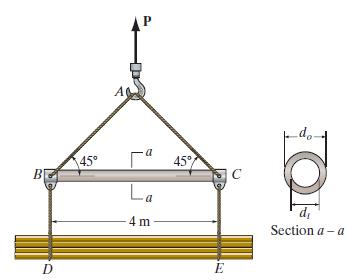
The strongback \(B C\) is made of an A992 steel hollow circular section with an outer diameter of \(d_{o}=60 \mathrm{~mm}\) and inner diameter of \(d_{i}=40 \mathrm{~mm}\). Determine the maximum allowable lifting force \(P\) without causing the strongback to buckle. F.S. \(=2\) against buckling is
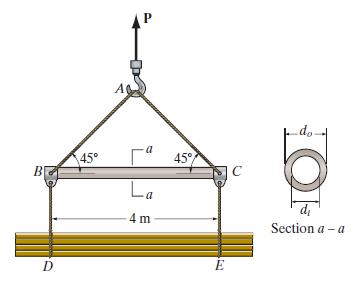
The strongback is made of an A992 steel hollow circular section with the outer diameter of \(d_{o}=60 \mathrm{~mm}\). If it is designed to withstand the lifting force of \(P=60 \mathrm{kN}\), determine the minimum required wall thickness of the strongback so that it will not buckle. Use F.S. \(=2\)
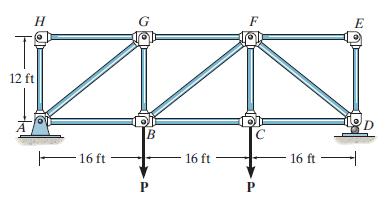
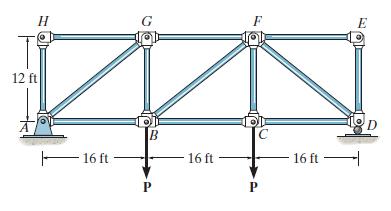
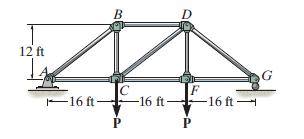
The members of the truss are assumed to be pin connected. If member \(G F\) is an \(\mathrm{A}-36\) steel rod having a diameter of 2 in., determine the greatest magnitude of load \(\mathbf{P}\) that can be supported by the truss without causing this member to buckle. 12 ft A H 16 ft P B 16 ft P C
The members of the truss are assumed to be pin connected. If member \(A G\) is an \(\mathrm{A}-36\) steel rod having a diameter of 2 in., determine the greatest magnitude of load \(\mathbf{P}\) that can be supported by the truss without causing this member to buckle. 12 ft H F E 16 ft B D C 16 ft
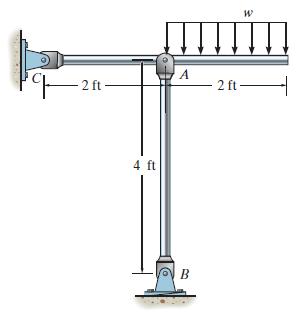
Determine the maximum distributed load that can be applied to the bar so that the \(\mathrm{A}-36\) steel strut \(A B\) does not buckle. The strut has a diameter of 2 in. It is pin connected at its ends. W A -2 ft- 2 ft- 4 ft B
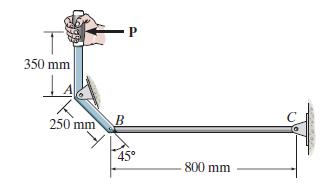
Determine the maximum force \(P\) that can be applied to the handle so that the A-36 steel control rod \(B C\) does not buckle. The rod has a diameter of \(25 \mathrm{~mm}\). 350 mm A 250 mm B 45 800 mm
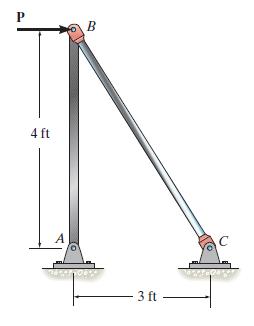
The 2014-T6 aluminum rod \(B C\) has a diameter of 2 in. If it is pin connected at its ends, determine the maximum allowable load \(P\) that can be applied to the frame. Use a factor of safety with respect to buckling of 2 . P B 4 ft A 3 ft
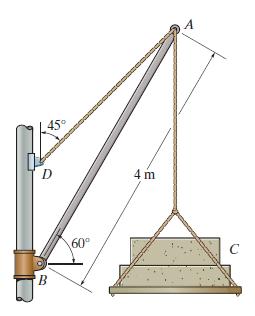
If load \(C\) has a mass of \(500 \mathrm{~kg}\), determine the required minimum diameter of the solid L2-steel \(\operatorname{rod} A B\) to the nearest \(\mathrm{mm}\) so that it will not buckle. Use F.S. \(=2\) against buckling. 45 D 4 m B 60 C
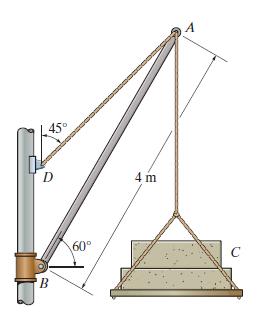
If the diameter of the solid L2-steel \(\operatorname{rod} A B\) is \(50 \mathrm{~mm}\), determine the maximum mass \(C\) that the rod can support without buckling. Use F.S. \(=2\) against buckling. 45 D 4 m B 60 C
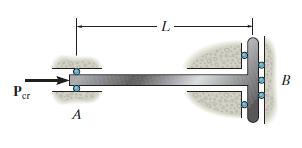
The column is supported at \(B\) by a support that does not permit rotation but allows vertical displacement. Determine the critical load \(P_{\mathrm{cr}} . E I\) is constant. Per A L B
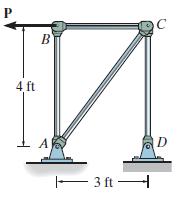
The members of the truss are assumed to be pin connected. If member \(A C\) is an \(\mathrm{A}-36\) steel rod of 2 in. diameter, determine the maximum load \(P\) that can be supported by the truss without causing the member to buckle. P B C 4 ft A 3 ft 1 +
The steel bar \(A B\) has a rectangular cross section. If it is pin connected at its ends, determine the maximum allowable intensity \(w\) of the distributed load that can be applied to \(B C\) without causing \(A B\) to buckle. Use a factor of safety with respect to buckling of 1.5. Take
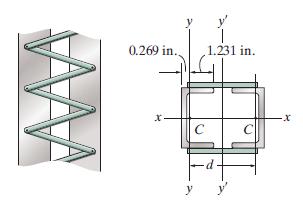
The two steel channels are to be laced together to form a 30 -ft-long bridge column assumed to be pin connected at its ends. Each channel has a cross-sectional area of \(A=3.10 \mathrm{in}^{2}\) and moments of inertia \(I_{x}=55.4 \mathrm{in}^{4}, I_{y}=0.382 \mathrm{in}^{4}\). The centroid \(C\)
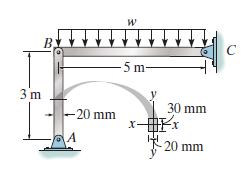
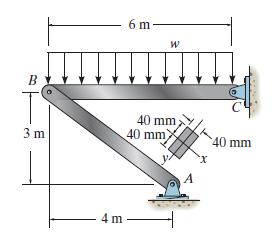
The steel bar AB of the frame is assumed to be pin connected at its ends for y-y axis buckling. If w = 3 kN/m, determine the factor of safety with respect to y-y axis buckling. Take Est =200 GPa, σy = 360 MPa. B 3 m 4 m 6 m W 40 mm 40 mm 40 mm
A 6061-T6 aluminum alloy solid circular rod of length \(4 \mathrm{~m}\) is pinned at both of its ends. If it is subjected to an axial load of \(15 \mathrm{kN}\) and F.S. \(=2\) against buckling, determine the minimum required diameter of the rod to the nearest \(\mathrm{mm}\).
A 6061-T6 aluminum alloy solid circular rod of length \(4 \mathrm{~m}\) is pinned at one end while fixed at the other end. If it is subjected to an axial load of \(15 \mathrm{kN}\) and F.S. \(=2\) against buckling, determine the minimum required diameter of the rod to the nearest \(\mathrm{mm}\).
The members of the truss are assumed to be pin connected. If member \(B D\) is an \(\mathrm{A} 992\) steel rod having a radius of 2 in., determine the maximum load \(P\) that can be supported by the truss without causing the member to buckle. 12 ft 16 ft- B -16 ft -16 ft-
Solve Prob. 13-36 for member \(A B\), which has a radius of 2 in.Data from Prob. 13-36The members of the truss are assumed to be pin connected. If member \(B D\) is an \(\mathrm{A} 992\) steel rod having a radius of 2 in., determine the maximum load \(P\) that can be supported by the truss without
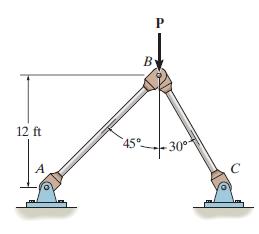
The linkage is made using two A992 steel rods, each having a circular cross section. Determine the diameter of each rod to the nearest 1/8 in. that will support a load of P = 6 kip. Assume that the rods are pin connected at their ends. Use a factor of safety with respect to buckling of 1.8. B P 12
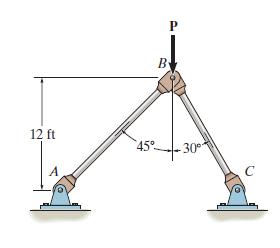
The linkage is made using two A992 steel rods, each having a circular cross section. If each rod has a diameter of \(\frac{3}{4}\) in., determine the largest load it can support without causing any rod to buckle. Assume that the rods are pin connected at their ends. By P 12 ft A 45 30 C
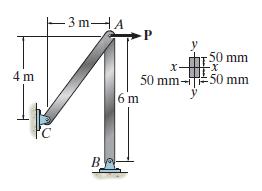
The steel bar AB of the frame is assumed to be pin connected at its ends for \(y-y\) axis buckling. If \(P=18 \mathrm{kN}\), determine the factor of safety with respect to buckling. Take \(E_{\mathrm{st}}=200 \mathrm{GPa}\), \(\sigma_{Y}=360 \mathrm{MPa}\). 3m-A P 4 m PC B 6 m x- 50 mm -x 50 mm-50
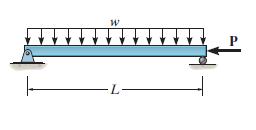
The ideal column has a weight \(w\) (force/length) and is subjected to the axial load \(\mathbf{P}\). Determine the maximum moment in the column at midspan. \(E I\) is constant. Establish the differential equation for deection, Eq. 13-1, with the origin at the midspan. The general solution is
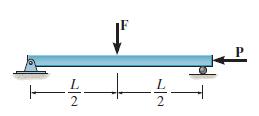
The ideal column is subjected to the force \(\mathbf{F}\) at its midpoint and the axial load \(\mathbf{P}\). Determine the maximum moment in the column at midspan. \(E I\) is constant. Hint: Establish the differential equation for deflection, Eq. 13-1. The general solution is \(v=C_{1} \sin k
The column with constant \(E I\) has the end constraints shown.Determine the critical load for the column. L
Consider an ideal column as in Fig. 13-10c, having both ends fixed. Show that the critical load on the column is \(P_{\text {cr }}=4 \pi^{2} E I / L^{2}\). Due to the vertical deflection of the top of the column, a constant moment \(\mathbf{M}^{\prime}\) will be developed at the supports. Show that
Consider an ideal column as in Fig. 13-10d, having one end fixed and the other pinned. Show that the critical load on the column is \(P_{\text {cr }}=20.19 E I / L^{2}\). Hint: Due to the vertical deflection at the top of the column, a constant moment \(\mathbf{M}^{\prime}\) will be developed at
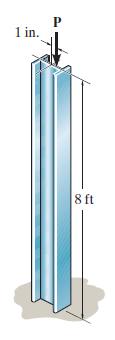
Determine the \(\operatorname{load} P\) required to cause the A-36 steel W8 \(\times 15\) column to fail either by buckling or by yielding.The column is fixed at its base and free at its top. 1 in. P 8 ft
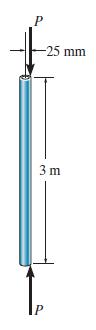
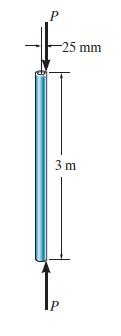
The tube is made of C86100 bronze and has an outer diameter of \(60 \mathrm{~mm}\) and a wall thickness of \(10 \mathrm{~mm}\). Determine the eccentric load \(P\) that it can support without failure. The tube is fixed at one end and pinned at the other. P -25 mm 3 m P
Solve Prob. 13-47 if instead the tube is free at one end and fixed at the other.Data from Prob. 13-47The tube is made of C86100 bronze and has an outer diameter of \(60 \mathrm{~mm}\) and a wall thickness of \(10 \mathrm{~mm}\). Determine the eccentric load \(P\) that it can support without
The aluminum column is fixed at the bottom and free at the top. Determine the maximum force \(P\) that can be applied at \(A\) without causing it to buckle or yield. Use a factor of safety of 3 with respect to buckling and yielding. Take \(E_{\mathrm{al}}=70\) \(\mathrm{GPa}, \sigma_{Y}=95
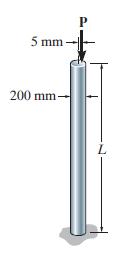
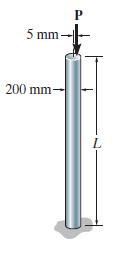
A column of intermediate length buckles when the compressive stress is \(40 \mathrm{ksi}\). If the slenderness ratio is 60 , determine the tangent modulus. 5 mm- 200 mm- L
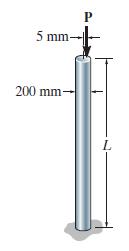
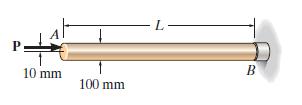
The aluminum rod is fixed at its base and free at its top. If the eccentric load \(P=200 \mathrm{kN}\) is applied, determine the greatest allowable length \(L\) of the rod so that it does not buckle or yield. Take \(E_{\text {al }}=72 \mathrm{GPa}, \sigma_{Y}=410 \mathrm{MPa}\). 5 mm- P 200 mm- L
The aluminum rod is fixed at its base and free at its top. If the length of the rod is \(L=2 \mathrm{~m}\), determine the greatest allowable load \(P\) that can be applied so that the rod does not buckle or yield. Also, determine the largest sidesway deection of the rod due to the loading.
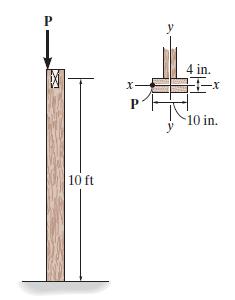
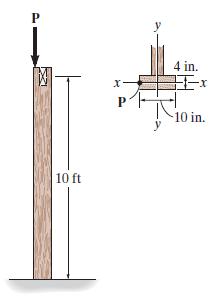
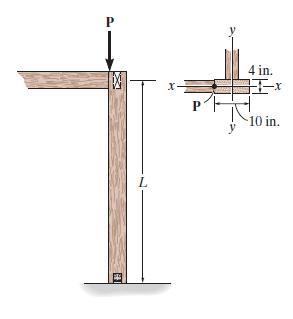
Assume that the wood column is pin connected at its base and top. Determine the maximum eccentric load \(P\) that can be applied without causing the column to buckle or yield. \(E_{\mathrm{w}}=1.8\left(10^{3}\right) \mathrm{ksi}, \sigma_{Y}=8 \mathrm{ksi}\). P 10 ft x- P 4 in. 10 in.
Assume that the wood column is pinned top and bottom for movement about the \(x-x\) axis, and fixed at the bottom and free at the top for movement about the \(y-y\) axis. Determine the maximum eccentric load \(P\) that can be applied without causing the column to buckle or yield. Take
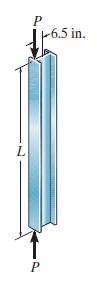
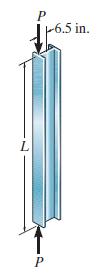
A W14 \(\times 30\) structural A992 steel column is pin connected at is ends and has a length \(L=12 \mathrm{ft}\). Determine the maximum eccentric load \(P\) that can be applied so the column does not buckle or yield. L P -6.5 in. P
A W16 \(\times 45\) structural A992 steel column is fixed at the base and free at the top and has a length \(L=8 \mathrm{ft}\). Determine the maximum eccentric load \(P\) that can be applied so the column does not buckle or yield. L P -6.5 in. P
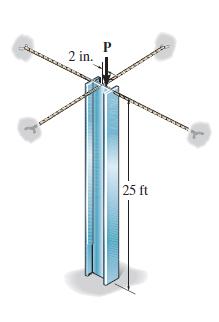
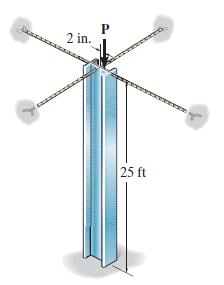
Determine the \(\operatorname{load} P\) required to cause the steel \(\mathrm{W} 12 \times 50\) structural A-36 steel column to fail either by buckling or by yielding. The column is fixed at its bottom and the cables at its top act as a pin to hold it. 2 in. 25 ft
Solve Prob. 13-57 if the column is an A-36 steel W12 \(\times 16\) section.Data from Prob. 13-57Determine the \(\operatorname{load} P\) required to cause the steel \(\mathrm{W} 12 \times 50\) structural A-36 steel column to fail either by buckling or by yielding. The column is fixed at its bottom
The tube is made of copper and has an outer diameter of \(35 \mathrm{~mm}\) and a wall thickness of \(7 \mathrm{~mm}\). Determine the eccentric load \(\mathrm{P}\) that it can support without failure.The tube is pin supported at its ends. \(E_{\mathrm{cu}}=120 \mathrm{GPa}, \sigma_{Y}=750
The wood column is pinned at its base and top. If \(L=5 \mathrm{ft}\), determine the maximum eccentric load \(P\) that can be applied without causing the column to buckle or yield. \(E_{\mathrm{w}}=1.8\left(10^{3}\right) \mathrm{ksi}, \sigma_{Y}=8 \mathrm{ksi}\). P 4 in. x- P 10 in. L #
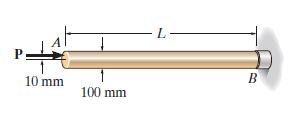
The brass rod is fixed at one end and free at the other end. If the eccentric load \(P=200 \mathrm{kN}\) is applied, determine the greatest allowable length \(L\) of the rod so that it does not buckle or yield. Take \(E_{\mathrm{br}}=101 \mathrm{GPa}, \sigma_{Y}=69 \mathrm{MPa}\). 10 mm 100 mm L- B
The brass rod is fixed at one end and free at the other end. If the length of the rod is \(L=2 \mathrm{~m}\), determine the greatest allowable load \(P\) that can be applied so that the rod does not buckle or yield. Also, determine the largest sidesway deflection of the rod due to the loading.
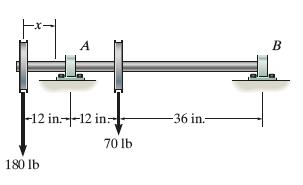
Determine the equation of the elastic curve. Use discontinuity functions. \(E I\) is constant. A -12 in-12 in 70 lb -36 in.- 180 lb B
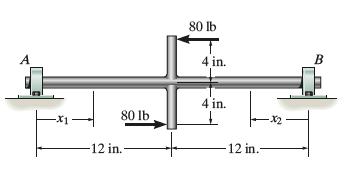
Draw the bending-moment diagram for the shaft and then, from this diagram, sketch the deflection or elastic curve for the shaft's centerline. Determine the equations of the elastic curve using the coordinates \(x_{1}\) and \(x_{2}\). Use the method of integration. \(E I\) is constant. A -12 in. 80
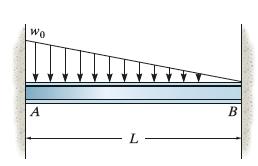
Determine the moment reactions at the supports \(A\) and \(B\). Use the method of integration. \(E I\) is constant. Wo 111 A L B
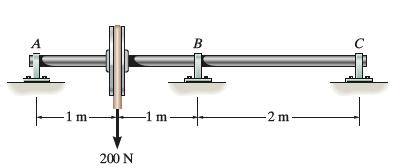
Determine the reactions, then draw the shear and moment diagrams. Use the moment-area theorems. \(E I\) is constant. A m -1 m 200 N B 2 m. C
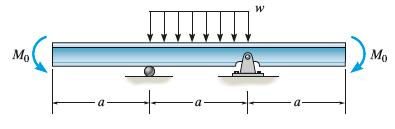
Using the method of superposition, determine the magnitude of \(\mathbf{M}_{0}\) in terms of the distributed load \(w\) and dimension \(a\) so that the deflection at the center of the beam is zero. \(E I\) is constant. Mo W Mo
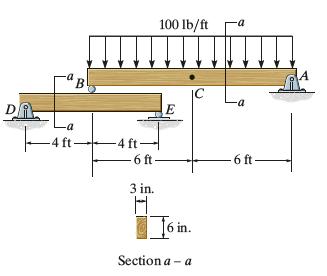
Using the method of superposition, determine the displacement at \(C\) of beam \(A B\). The beams are made of wood having a modulus of elasticity of \(E=1.5\left(10^{3}\right) \mathrm{ksi}\). DA -a B 100 lb/ft -4 ft. E -6 ft -6 ft. 3 in. H 16 in. Section a- a A
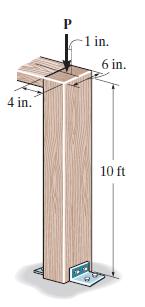
The column has a thickness of 4 in. and a width of 6 in. Using the NFPA equations of Sec. 13.6 and Eq. 13-30, determine the maximum allowable eccentric force \(P\) that can be applied.Assume that the column is pinned at both its top and bottom. 4 in. 1 in. 6 in. 10 ft
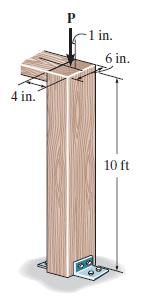
The column has a thickness of 4 in. and a width of 6 in. Using the NFPA equations of Sec. 13.6 and Eq. 13-30, determine the maximum allowable eccentric force \(P\) that can be applied. Assume that the column is pinned at the top and xed at the bottom. 4 in. P -1 in. 6 in. 10 ft
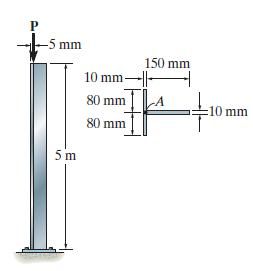
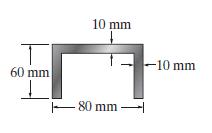
A steel column has a length of \(5 \mathrm{~m}\) and is free at one end and fixed at the other end. If the cross-sectional area has the dimensions shown, determine the critical load.\(E_{\mathrm{st}}=200 \mathrm{GPa}, \sigma_{Y}=360 \mathrm{MPa}\). 60 mm 10 mm 80 mm- -10 mm
The square structural A992 steel tubing has outer dimensions of 8 in. by 8 in. Its cross-sectional area is \(14.40 \mathrm{in}^{2}\) and its moments of inertia are \(I_{x}=I_{y}=131 \mathrm{in}^{4}\). Determine the maximum force \(P\) it can support. The column can be assumed xed at its base and
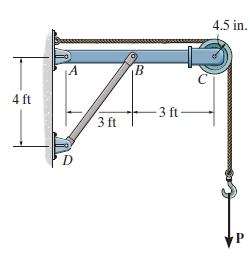
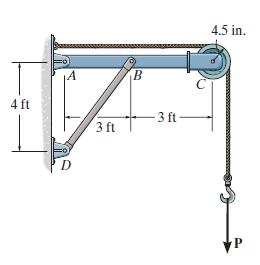
If the A-36 steel solid circular rod \(B D\) has a diameter of 2 in., determine the allowable maximum force \(P\) that can be supported by the frame without causing the rod to buckle. Use F.S. \(=2\) against buckling. B 4 ft D 3 ft 3 ft 4.5 in. P
If \(P=15\) kip, determine the required minimum diameter of the A992 steel solid circular rod \(B D\) to the nearest \(\frac{1}{16} \mathrm{in}\). Use F.S. \(=2\) against buckling. A B 4 ft D 3 ft 3 ft- 4.5 in. P
The steel pipe is fixed supported at its ends. If it is \(4 \mathrm{~m}\) long and has an outer diameter of \(50 \mathrm{~mm}\), determine its required thickness so that it can support an axial force of \(P=100 \mathrm{kN}\) without buckling. \(E_{\mathrm{st}}=200 \mathrm{GPa}, \sigma_{Y}=250
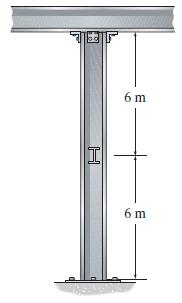
The W200 \(\times 46\) wide-flange A992-steel column can be considered pinned at its top and fixed at its base. Also, the column is braced at its mid-height against weak axis buckling. Determine the maximum axial force the column can support without causing it to buckle. I 6 m 6 m
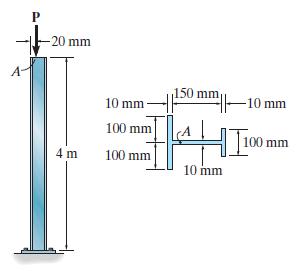
The wide-flange A992 steel column has the cross section shown. If it is fixed at the bottom and free at the top, determine the maximum force \(P\) that can be applied at \(A\) without causing it to buckle or yield. Use a factor of safety of 3 with respect to buckling and yielding. P -20 mm 4 m 150
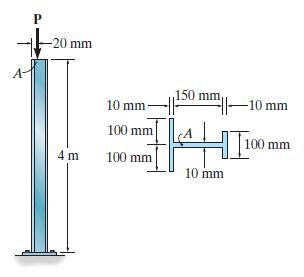
The wide-flange A992 steel column has the cross section shown. If it is fixed at the bottom and free at the top, determine if the column will buckle or yield when the force \(P=10 \mathrm{kN}\) is applied at \(A\). Use a factor of safety of 3 with respect to buckling and yielding. P -20 mm 150 mm
An L2 steel strap having a thickness of 0.125 in. and a width of \(2 \mathrm{in}\). is bent into a circular arc of radius \(600 \mathrm{in}\). Determine the maximum bending stress in the strap.
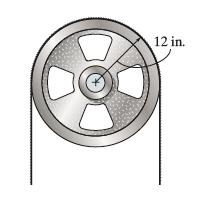
The L2 steel blade of the band saw wraps around the pulley having a radius of \(12 \mathrm{in}\). Determine the maximum normal stress in the blade. The blade has a width of 0.75 in. and a thickness of 0.0625 in. 12 in.
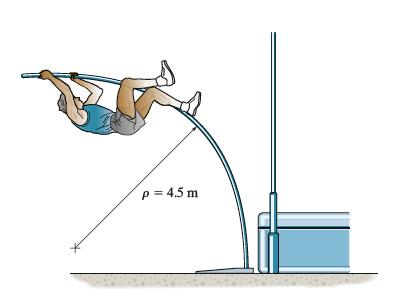
A picture is taken of a man performing a pole vault, and the minimum radius of curvature of the pole is estimated by measurement to be \(4.5 \mathrm{~m}\). If the pole is \(40 \mathrm{~mm}\) in diameter and it is made of a glass-reinforced plastic for which \(E_{\mathrm{g}}=131 \mathrm{GPa}\),
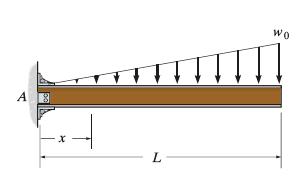
Determine the equation of the elastic curve and the maximum deflection of the cantilever beam. A x L Wo
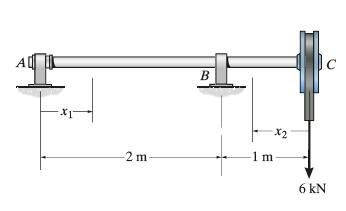
Determine the displacement of end \(\mathrm{C}\) of the 100 -mm-diameter solid circular shaft. The shaft is made of steel having a modulus of elasticity of \(E=200 \mathrm{GPa}\). B C -2 m- 1 m- x2 6 kN
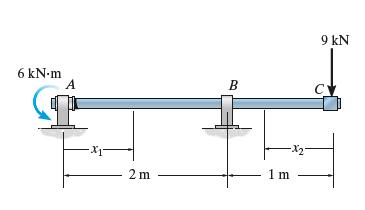
Determine the maximum deflection of the 150 -mm-diameter solid circular shaft. The shaft is made of steel having \(E=200 \mathrm{GPa}\). 6 kNm A B -x1- 1 m 2 m 9 kN C
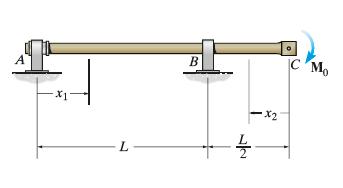
Determine the equation of the elastic curve in terms of the \(x_{1}\) and \(x_{2}\) coordinates. What is the deflection of end \(C\) of the shaft? \(E I\) is constant. Ix- L B 2x. Mo
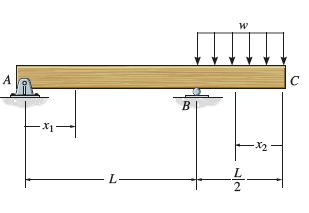
Determine the equation of the elastic curve in terms of the \(x_{1}\) and \(x_{2}\) coordinates and the deflection of end \(C\) of the overhang beam. \(E I\) is constant. x1 L- W B C X2
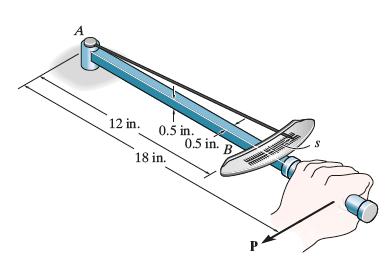
A torque wrench is used to tighten the nut on a bolt. If the dial indicates that a torque of \(60 \mathrm{lb} \cdot \mathrm{ft}\) is applied when the bolt is fully tightened, determine the force \(P\) acting at the handle and the distance \(s\) the needle moves along the scale. Assume only the
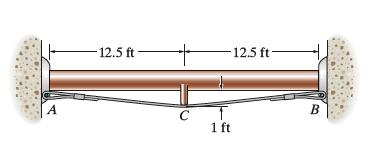
The pipe can be assumed roller supported at its ends and by a rigid saddle \(\mathrm{C}\) at its center. The saddle rests on a cable that is connected to the supports. Determine the force that should be developed in the cable if the saddle keeps the pipe from sagging or deecting at its center. The
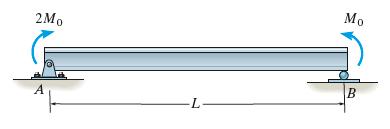
Determine the equation of the elastic curve and determine the maximum deflection. \(E I\) is constant. 2Mo A Mo B -L-
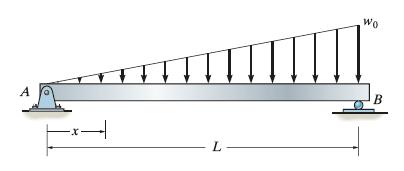
Determine the maximum slope of the beam. \(E I\) is constant. A . We L B
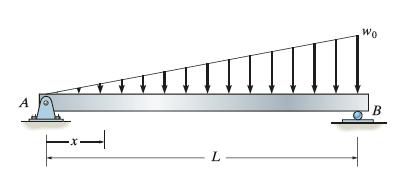
Determine the maximum deflection of the beam. \(E I\) is constant. A L Wo B
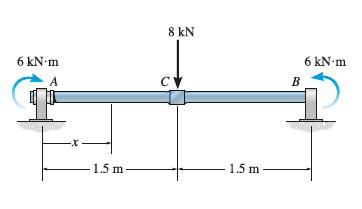
Determine the maximum deflection of the solid circular shaft. The shaft is made of steel having \(E=200 \mathrm{GPa}\). It has a diameter of \(100 \mathrm{~mm}\). 6 kNm 8 kN -x 1.5 m 1.5 m B 6 kNm
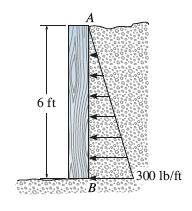
Wooden posts used for a retaining wall have a diameter of 3 in. If the soil pressure along a post varies uniformly from zero at the top \(A\) to a maximum of \(300 \mathrm{lb} / \mathrm{ft}\) at the bottom \(B\), determine the slope and displacement at the top of the post. Take
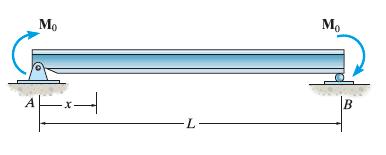
Determine the displacement at the center of the beam and the slope at \(B\). \(E I\) is constant. Mo A |x- -L Mo B
The fence board weaves between the three smooth fixed posts. If the posts remain along the same line, determine the maximum bending stress in the board. The board has a width of \(6 \mathrm{in}\). and a thickness of \(0.5 \mathrm{in}\). Assume the displacement of each end of the board relative to
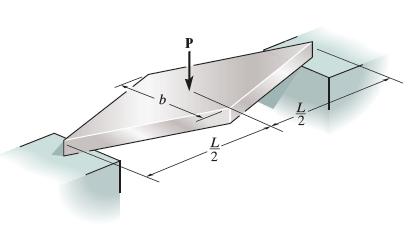
The tapered beam has a rectangular cross section. Determine the deflection of its center in terms of the load \(P\), length \(L\), modulus of elasticity \(E\), and the moment of inertia \(I_{c}\) of its center. 2 22
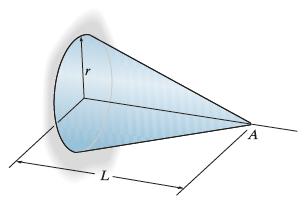
The beam is made of a material having a specific weight of \(\gamma\). Determine the displacement and slope at its end \(A\) due to its weight. The modulus of elasticity for the material is \(E\). L
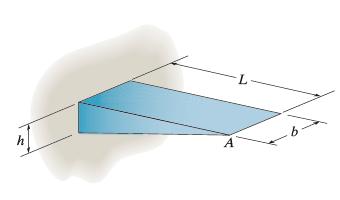
The beam is made of a material having a specific weight \(\gamma\). Determine the displacement and slope at its end \(A\) due to its weight. The modulus of elasticity for the material is \(E\). h L A b
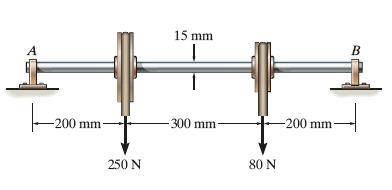
The shaft is made of steel and has a diameter of \(15 \mathrm{~mm}\). Determine its maximum deflection. The bearings at \(A\) and \(B\) exert only vertical reactions on the shaft. \(E_{\mathrm{st}}=200 \mathrm{GPa}\). 15 mm B A -200 mm- 250 N 300 mm- 80 N -200 mm-
Showing 700 - 800
of 1529
1
2
3
4
5
6
7
8
9
10
11
12
13
14
15
Last
Step by Step Answers

 Get 50% OFF
Claim Now
Get 50% OFF
Claim Now