New Semester
Started
Get
50% OFF
Study Help!
--h --m --s
Claim Now
Question Answers
Textbooks
Find textbooks, questions and answers
Oops, something went wrong!
Change your search query and then try again
S
Books
FREE
Study Help
Expert Questions
Accounting
General Management
Mathematics
Finance
Organizational Behaviour
Law
Physics
Operating System
Management Leadership
Sociology
Programming
Marketing
Database
Computer Network
Economics
Textbooks Solutions
Accounting
Managerial Accounting
Management Leadership
Cost Accounting
Statistics
Business Law
Corporate Finance
Finance
Economics
Auditing
Tutors
Online Tutors
Find a Tutor
Hire a Tutor
Become a Tutor
AI Tutor
AI Study Planner
NEW
Sell Books
Search
Search
Sign In
Register
study help
engineering
mechanics of materials
Mechanics Of Materials 11th Edition Russell C. Hibbeler - Solutions
12–25. A particle is moving along a straight line such that its acceleration is defined as a = (-2v) m>s2, where v is in meters per second. If v = 20 m>s when s = 0 and t = 0, determine the particle’s position, velocity, and acceleration as functions of time.
*12–24. A sandbag is dropped from a balloon which is ascending vertically at a constant speed of 6 m>s. If the bag is released with the same upward velocity of 6 m>s when t = 0 and hits the ground when t = 8 s, determine the speed of the bag as it hits the ground and the altitude of the balloon
12–23. If the effects of atmospheric resistance are accounted for, a freely falling body has an acceleration defined by the equation a = 9.81[1 - v 2(10 -4)] m>s2, where v is in m>s and the positive direction is downward. If the body is released from rest at a very high altitude, determine (a)
12–22. The acceleration of a particle along a straight line is defined by a = (2t - 9) m>s2, where t is in seconds. At t = 0, s = 1 m and v = 10 m>s. When t = 9 s, determine(a) the particle’s position, (b) the total distance traveled, and (c) the velocity.
12–21. When a train is traveling along a straight track at 2 m>s, it begins to accelerate at a = (60v-4) m>s2, where v is in m>s. Determine its velocity v and the position 3 s after the acceleration. Prob. 12-21
*12–20. The acceleration of a rocket traveling upward is given by a = (6 + 0.02s) m>s2, where s is in meters. Determine the time needed for the rocket to reach an altitude of s = 100 m. Initially, v = 0 and s = 0 when t = 0. Prob. 12-20
12–19. The acceleration of a rocket traveling upward is given by a = (6 + 0.02s) m>s2, where s is in meters. Determine the rocket’s velocity when s = 2 km and the time needed to reach this attitude. Initially, v = 0 and s = 0 when t = 0. Prob. 12-19
12–18. A particle is moving along a straight line with an initial velocity of 6 m>s when it is subjected to a deceleration of a = (-1.5v1>2) m>s2, where v is in m>s. Determine how far it travels before it stops. How much time does this take?
12–17. A particle is moving with a velocity of v0 when s = 0 and t = 0. If it is subjected to a deceleration of a = -kv3, where k is a constant, determine its velocity and position as functions of time.
*12–16. Determine the time required for a car to travel 1 km along a road if the car starts from rest, reaches a maximum speed at some intermediate point, and then stops at the end of the road. The car can accelerate at 1.5 m>s2 and decelerate at 2 m>s2.
12–15. A particle is moving along a straight line such that its velocity is defined as v = (-4s2) m>s, where s is in meters. If s = 2 m when t = 0, determine the velocity and acceleration as functions of time.
12–14. A train starts from rest at station A and accelerates at 0.5 m>s2 for 60 s. Afterwards it travels with a constant velocity for 15 min. It then decelerates at 1 m>s2 until it is brought to rest at station B. Determine the distance between the stations.
12–13. The acceleration of a particle as it moves along a straight line is given by a = (2t - 1) m>s2, where t is in seconds. If s = 1 m and v = 2 m>s when t = 0, determine the particle’s velocity and position when t = 6 s. Also, determine the total distance the particle travels during this
*12–12. A particle moves along a straight line with an acceleration of a = 5>(3s1>3 + s5>2) m>s2, where s is in meters. Determine the particle’s velocity when s = 2 m, if it starts from rest when s = 1 m. Use a numerical method to evaluate the integral.
12–11. Traveling with an initial speed of 70 km>h, a car accelerates at 6000 km>h2 along a straight road. How long will it take to reach a speed of 120 km>h? Also, through what distance does the car travel during this time?
12–10. A particle travels along a straight-line path such that in 4 s it moves from an initial position sA = -8 m to a position sB = +3 m. Then in another 5 s it moves from sB to sC = -6 m. Determine the particle’s average velocity and average speed during the 9-s time interval.
12–9. When two cars A and B are next to one another, they are traveling in the same direction with speeds vA and vB, respectively. If B maintains its constant speed, while A begins to decelerate at aA, determine the distance d between the cars at the instant A stops. A -d- Prob. 12-9 B
*12–8. A particle travels along a straight line with a velocity v = (12 - 3t2) m>s, where t is in seconds. When t = 1 s, the particle is located 10 m to the left of the origin.Determine the acceleration when t = 4 s, the displacement from t = 0 to t = 10 s, and the distance the particle travels
12–7. A bus starts from rest with a constant acceleration of 1 m>s2. Determine the time required for it to attain a speed of 25 m>s and the distance traveled.
12–6. A stone A is dropped from rest down a well, and in 1 s another stone B is dropped from rest. Determine the distance between the stones another second later.
12–5. A particle moves along a straight line such that its position is defined by s = (t2 - 6t + 5) m. Determine the average velocity, the average speed, and the acceleration of the particle when t = 6 s.
*12–4. A particle is moving along a straight line such that its position is defined by s = (10t2 + 20) mm, where t is in seconds. Determine (a) the displacement of the particle during the time interval from t = 1 s to t = 5 s, (b) the average velocity of the particle during this time interval,
12–3. The velocity of a particle traveling in a straight line is given by v = (6t - 3t2) m>s, where t is in seconds. If s = 0 when t = 0, determine the particle’s deceleration and position when t = 3 s. How far has the particle traveled during the 3-s time interval, and what is its average
12–2. The acceleration of a particle as it moves along a straight line is given by a = (4t3 - 1) m>s2, where t is in seconds. If s = 2 m and v = 5 m>s when t = 0, determine the particle’s velocity and position when t = 5 s. Also, determine the total distance the particle travels during this
12–1. Starting from rest, a particle moving in a straight line has an acceleration of a = (2t - 6) m>s2, where t is in seconds. What is the particle’s velocity when t = 6 s, and what is its position when t = 11 s?
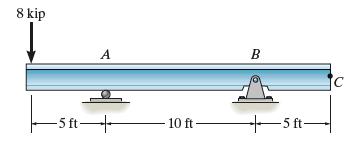
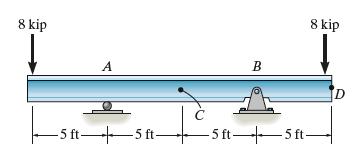
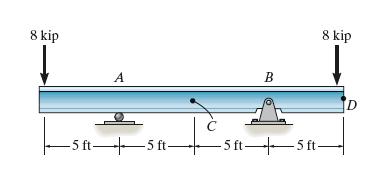
Determine the displacement of point \(C\). The beam is made from A992 steel and has a moment of inertia of \(I=53.8 \mathrm{in}^{4}\). 8 kip A B -5 ft- -10 ft 5 ft-
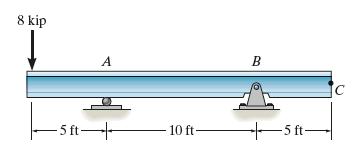
Determine the slope at \(B\). The beam is made from A992 steel and has a moment of inertia of \(I=53.8 \mathrm{in}^{4}\). 8 kip A B -5 ft- 10 ft- -5 ft-
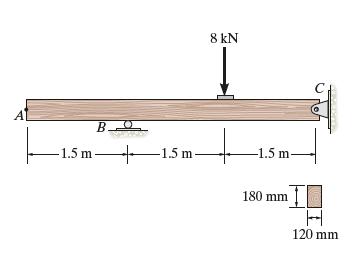
The beam is made of Douglas fir. Determine the slope at \(C\). 8 kN BO -1.5m 1.5m- -1.5 m- 180 mm H 120 mm
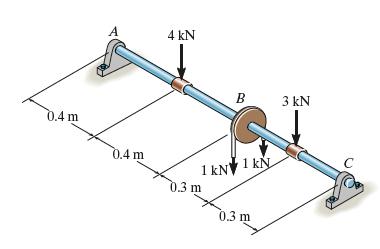
Determine the displacement at pulley \(B\). The A992 steel shaft has a diameter of \(30 \mathrm{~mm}\). 4 kN B 3 kN 0.4 m 0.4 m 0.3 m 1 kN 1 kN 0.3 m C
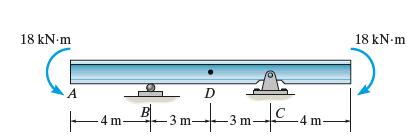
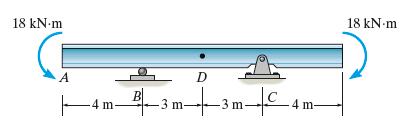
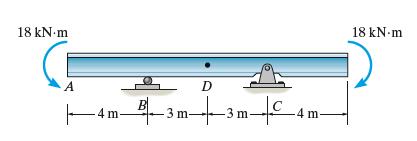
Determine the displacement at point \(D\). The A992 steel beam has a moment of inertia of \(I=125\left(10^{6}\right) \mathrm{mm}^{4}\). 18 kNm A 4m- D B3m 3m 41 4 m- 18 kNm
Determine the slope at \(A\). The A992 steel beam has a moment of inertia of \(I=125\left(10^{6}\right) \mathrm{mm}^{4}\). 18 kNm A -4 m- D B3m 3m 4m m- 18 kNm
Determine the slope at \(B\). The A992 structural steel beam has a moment of inertia of \(I=125\left(10^{6}\right) \mathrm{mm}^{4}\). 18 kNm A 4m- D 1-3m-3m-Ca 4 m. 18 kNm
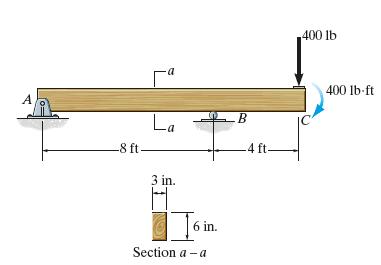
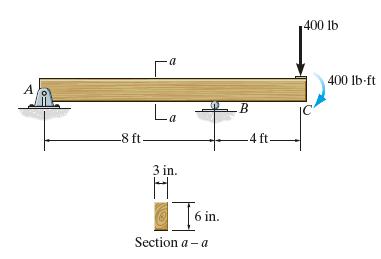
Determine the displacement of end \(C\) of the overhang Douglas fir beam. A a 400 lb -8 ft. La 3 in. H 6 6 in. Section a-a B -4 ft 400 lb-ft
Determine the slope at \(A\) of the overhang white spruce beam. A a 400 lb -8 ft La 3 in. H 16 in. Section a-a B -4 ft. 400 lb-ft
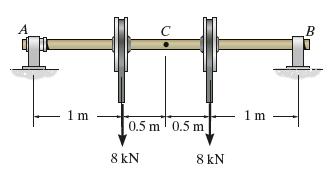
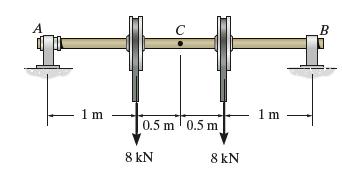
Determine the slope at \(A\) of the 2014-T6 aluminum shaft having a diameter of \(100 \mathrm{~mm}\). A T 1 m C B 0.5 m 0.5 m 8 kN 8 kN 1 m
Determine the displacement at point \(C\) of the 2014-T6 aluminum shaft having a diameter of \(100 \mathrm{~mm}\). A 1 m 1 m 0.5 m 0.5 m 8 kN 8 kN B
Determine the displacement at point \(C\) of the W14 \(\times 26\) beam made from A992 steel. 8 kip A -5 ft 5 ft. B C -5 ft 5 ft- 8 kip D
Determine the slope at \(A\) of the W14 \(\times 26\) beam made from A992 steel. 8 kip A -5 ft 5 ft- B 8 kip C -5 ft 5 ft- D
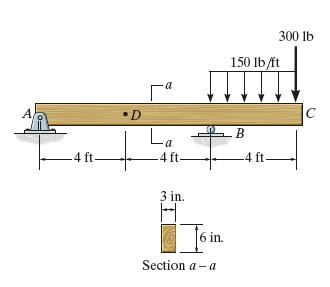
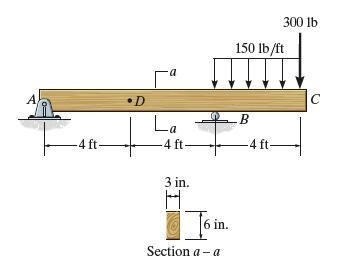
Determine the slope at \(C\) of the overhang white spruce beam. A .D a La -4 ft. -4 ft 150 lb/ft 300 lb B -4 ft. C 3 in. H in. Section a-a
Determine the displacement at point \(D\) of the overhang white spruce beam. A -4 ft. 150 lb/ft 300 lb D La -4 ft -B 3 in. H 16 in. Section a-a -4 ft- C
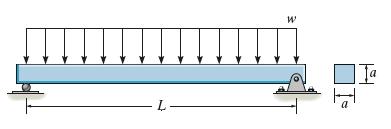
Determine the maximum deflection of the beam caused only by bending, and caused by both bending and shear. Take \(E=3 G\). I W 7
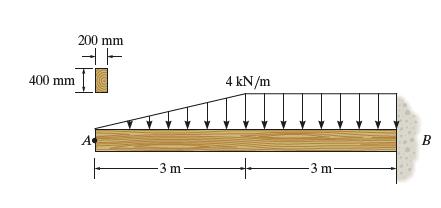
The beam is made of oak, for which \(E_{0}=11 \mathrm{GPa}\). Determine the slope and displacement at point \(A\). 200 mm 400 mm I A 4 kN/m -3 m- + -3 m- B
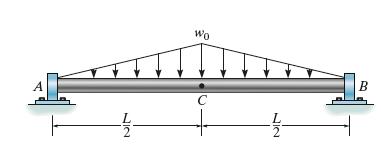
Determine the slope of the shaft at the bearing support \(A\). \(E I\) is constant. 22 Wo C B
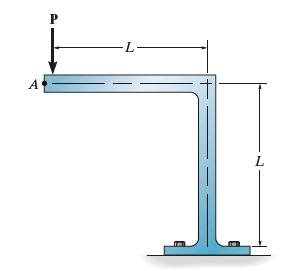
Determine the vertical displacement of point \(A\) on the angle bracket due to the concentrated force \(\mathbf{P}\). The bracket is fixed connected to its support. EI is constant. Consider only the effect of bending. A P L L
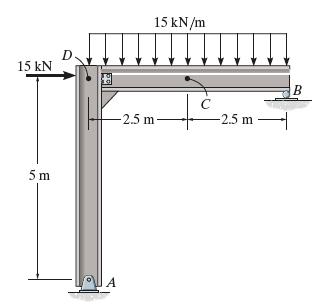
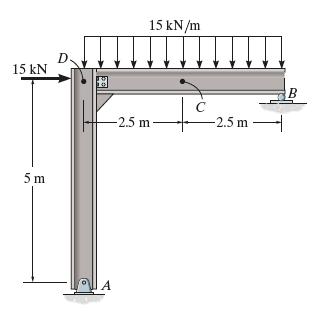
Determine the vertical displacement of point \(C\). The frame is made using A-36 steel W250 \(\times 45\) members. Consider only the effect of bending. 15 kN D 15 kN/m 5 m A B C -2.5 m- -2.5 m-
Determine the horizontal displacement of end \(B\). The frame is made using A-36 steel W \(250 \times 45\) members. Consider only the effect of bending. 15 kN 5 m A 15 kN/m B C -2.5 m- -2.5 m
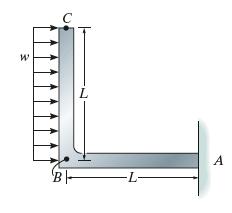
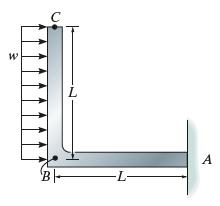
The L-shaped frame is made from two segments, each of length \(L\) and flexural stiffness \(E I\). Determine the horizontal displacement of point \(C\). W C L A B- -L-
The L-shaped frame is made from two segments, each of length \(L\) and flexural stiffness \(E I\). Determine the vertical displacement of point \(B\). W C L A B -L-
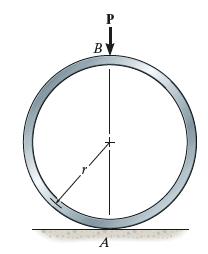
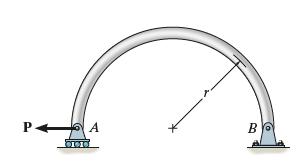
Determine the vertical displacement of the ring at point \(B\). \(E I\) is constant. B P A
Determine the horizontal displacement of the roller at \(A\) due to the loading. \(E I\) is constant. PA B
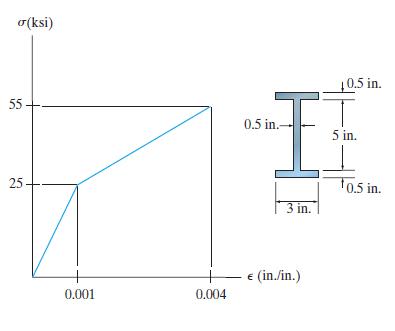
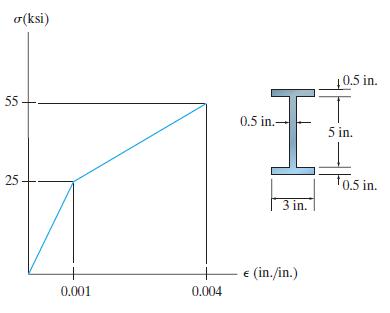
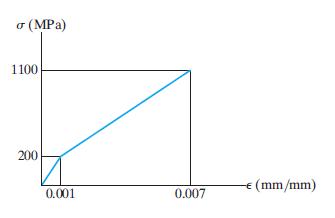
The 6-ft-long column has the cross section shown and is made of material which has a stress-strain diagram that can be approximated by the two line segments. If the column is pinned at both ends, determine the critical load \(P_{\mathrm{cr}}\) for the column. (ksi) 55 0.5 in. 25 40.5 in. 5 in. 10.5
The 6-ft-long column has the cross section shown and is made of material which has a stress-strain diagram that can be approximated by the two line segments. If the column is fixed at both ends, determine the critical load \(P_{\text {cr }}\) for the column. (ksi) 55 0.5 in.- 25 25 0.001 0.004 3
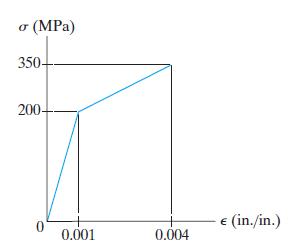
The stress-strain diagram for the material of a column can be approximated as shown. Plot \(P / A\) versus \(K L / r\) for the column. (MPa) 350- 200- (in./in.) 0 0.001 0.004
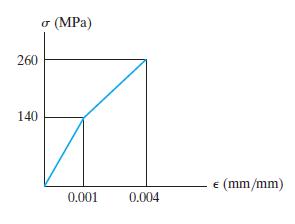
Construct the buckling curve, \(P / A\) versus \(L / r\), for a column that has a bilinear stress-strain curve in compression as shown. The column is pinned at its ends. 260 (MPa) 140 E (mm/mm) 0.001 0.004
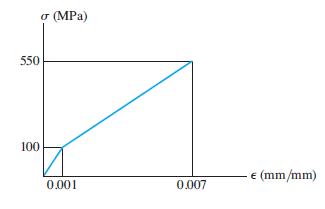
The stress-strain diagram of a material can be approximated by the two line segments. If a bar having a diameter of \(80 \mathrm{~mm}\) and a length of \(1.5 \mathrm{~m}\) is made from this material, determine the critical load provided the ends are pinned. Assume that the load acts through the
The stress-strain diagram for a material can be approximated by the two line segments. If a bar having a diameter of \(80 \mathrm{~mm}\) and a length of \(1.5 \mathrm{~m}\) is made from this material, determine the critical load provided the ends are pinned. Assume that the load acts through the
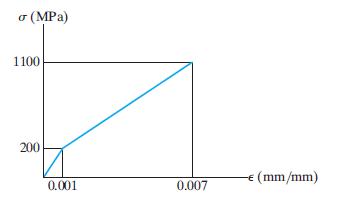
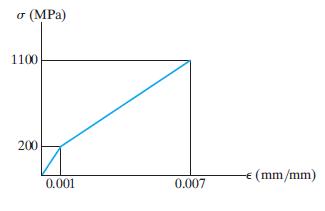
The stress-strain diagram for a material can be approximated by the two line segments. If a bar having a diameter of 80 \(\mathrm{mm}\) and length of \(1.5 \mathrm{~m}\) is made from this material, determine the critical load provided the ends are fixed. Assume that the load acts through the axis
The stress-strain diagram for a material can be approximated by the two line segments. If a bar having a diameter of \(80 \mathrm{~mm}\) and length of \(1.5 \mathrm{~m}\) is made from this material, determine the critical load provided one end is pinned and the other is fixed. Assume that the load
Determine the largest length of a structural A-36 steel rod if it is fixed supported and subjected to an axial load of \(100 \mathrm{kN}\). The rod has a diameter of \(50 \mathrm{~mm}\). Use the AISC equations.
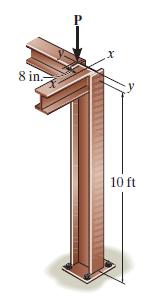
Use the AISC equations, select from Appendix B the lightest-weight wide-flange A992 steel column that is \(14 \mathrm{ft}\) long and supports an axial load of 40 kip. The ends are pinned. Take \(\sigma_{Y}=50 \mathrm{ksi}\)
Using the AISC equations, select from Appendix B the lightest-weight structural A-36 steel column that is \(24 \mathrm{ft}\) long and supports an axial load of 100 kip. The ends are fixed.
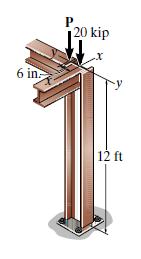
Using the AISC equations, select from Appendix B the lightest-weight wide-flange A992 steel column that is \(12 \mathrm{ft}\) long and supports an axial load of 20 kip. The ends are pinned.
Determine the longest length of a W10 \(\times 12\) structural A992 steel section if it is fixed supported and is subjected to an axial load of \(28 \mathrm{kip}\). Use the AISC equations.
Using the AISC equations, select from Appendix B the lightest-weight wide-flange A992 steel column that is \(30 \mathrm{ft}\) long and supports an axial load of \(200 \mathrm{kip}\). The ends are fixed.
A W8 \(\times 24\) A-36 steel column is \(30 \mathrm{ft}\) long and is pinned at both ends and braced against its weak axis at mid height. Determine the allowable axial force \(P\) that can be safely supported by the column. Use the AISC column design formulas.
Check if a W10 \(\times 39\) column can safely support an axial force of \(P=250 \mathrm{kip}\). The column is \(20 \mathrm{ft}\) long and is pinned at both ends and braced against its weak axis at mid height. It is made of steel having \(E=29\left(10^{3}\right) \mathrm{ksi}\) and \(\sigma_{Y}=50
A 5 -ft-long rod is used in a machine to transmit an axial compressive load of 3 kip. Determine its smallest diameter if it is pin connected at its ends and is made of a 2014-T6 aluminum alloy.
Using the AISC equations, determine the longest length of a W8 \(\times 31\) column. The column is made of A992 steel and it supports an axial load of 10 kip. The ends are pinned.
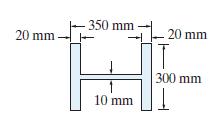
Using the AISC equations, check if a column having the cross section shown can support an axial force of \(1500 \mathrm{kN}\). The column has a length of \(4 \mathrm{~m}\), is made from A992 steel, and its ends are pinned. 20 mm + 350 mm 10 mm T 20 mm 300 mm
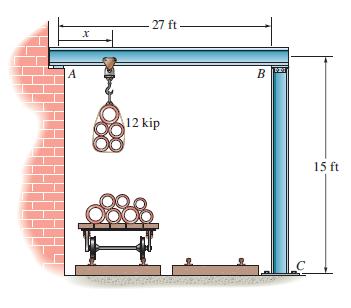
If the maximum anticipated hoist load is 12 kip, determine if the W8 \(\times 31\) wide-flange A-36 steel column is adequate for supporting the load. The hoist travels along the bottom flange of the beam, \(1 \mathrm{ft} \leq x \leq 25 \mathrm{ft}\), and has negligible size. Assume the beam is
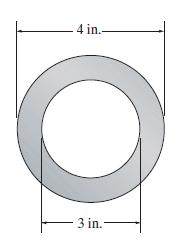
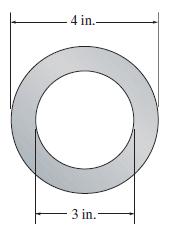
The 2014-T6 aluminum hollow section has the cross section shown. If the column is \(10 \mathrm{ft}\) long and is fixed at both ends, determine the allowable axial force \(P\) that can be safely supported by the column. 4 in. 3 in.
The 2014-T6 aluminum hollow section has the cross section shown. If the column is fixed at its base and pinned at its top, and is subjected to the axial force \(P=100\) kip, determine the maximum length of the column for it to safely support the load. 4 in.- 3 in.
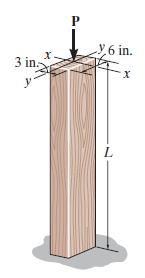
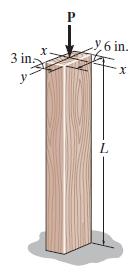
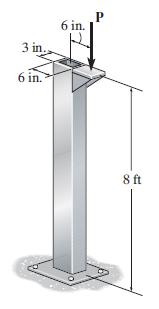
The column is made of wood. It is fixed at its bottom and free at its top. Use the NFPA formulas to determine its greatest allowable length if it supports an axial force of \(P=6\) kip. 3 in. y x. P y.6 in. x L
The column is made of wood. It is fixed at its bottom and free at its top. Use the NFPA formulas to determine the largest allowable axial force \(P\) that it can support if it has a length \(L=6 \mathrm{ft}\). 3 in. y x. 26 y.6 in. x L
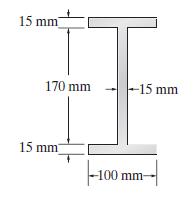
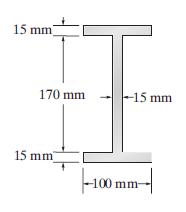
The 2014-T6 aluminum column is \(3 \mathrm{~m}\) long and has the cross section shown. If the column is pinned at both ends and braced against the weak axis at its mid height, determine the allowable axial force \(P\) that can be safely supported by the column. 15 mm] 170 mm -15 mm 15 mm -100 mm-
The 2014-T6 aluminum column has the cross section shown. If the column is pinned at both ends and subjected to an axial force \(P=100 \mathrm{kN}\), determine the maximum length of the column. 15 mm] 170 mm -15 mm 15 mm -100 mm- -10
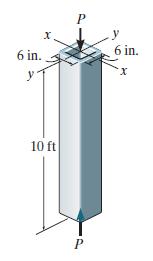
The tube is 0.25 in. thick, is made of a 2014-T6 aluminum alloy and is fixed at its bottom and pinned at its top. Determine the largest axial force that it can support. 6 in. y. x P 6 in. x 10 ft P
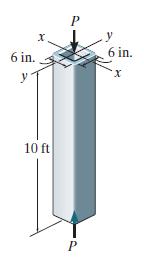
The tube is 0.25 in. thick, is made of a 2014-T6 aluminum alloy, and is fixed connected at its ends. Determine the largest axial force that it can support. 6 in. y 6 in. x 10 ft P
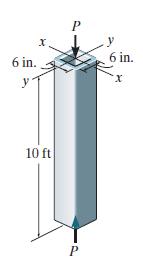
The tube is 0.25 in. thick, is made of a 2014-T6 aluminum alloy and is pin connected at its ends. Determine the largest axial force it can support. 6 in. y 10 ft P 6 in. x P
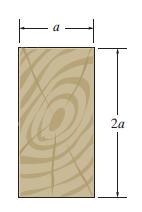
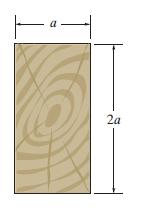
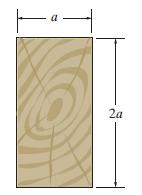
A rectangular wooden column has the cross section shown. If the column is \(6 \mathrm{ft}\) long and subjected to an axial force of \(P=15\) kip, determine the required minimum dimension \(a\) of its cross-sectional area to the nearest \(\frac{1}{16}\) in. so that the column can safely support the
A rectangular wooden column has the cross section shown. If \(a=3\) in. and the column is \(12 \mathrm{ft}\) long, determine the allowable axial force \(P\) that can be safely supported by the column if it is pinned at its top and fixed at its base. -a- 2a
A rectangular wooden column has the cross section shown. If \(a=3\) in. and the column is subjected to an axial force of \(P=15\) kip, determine the maximum length the column can have to safely support the load. The column is pinned at its top and fixed at its base. -- 2a D-
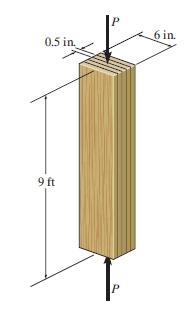
The wooden column is formed by gluing together the 6 in. \(X\) 0.5 in. boards. If the column is pinned at both ends and is subjected to an axial force of \(P=20 \mathrm{kip}\), determine the required number of boards needed to form the column in order to safely support the loading. 0.5 in. 9 ft P 6
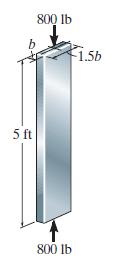
The bar is made from a 2014-T6 aluminum alloy. Determine its thickness \(b\) if its width is \(1.5 b\). Assume that it is fixed connected at its ends. b 800 lb 5 ft 800 lb 1.5b
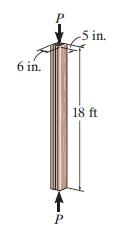
The timber column has a length of \(18 \mathrm{ft}\) and is pin connected at its ends. Use the NFPA formulas to determine the largest axial force \(P\) that it can support. 6 in. 5 -5 in. P 18 ft
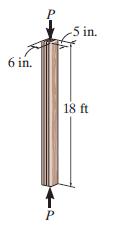
The timber column has a length of \(18 \mathrm{ft}\) and is fixed connected at its ends. Use the NFPA formulas to determine the largest axial force \(P\) that it can support. 6 in. P -5 in. P 18 ft
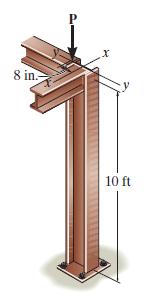
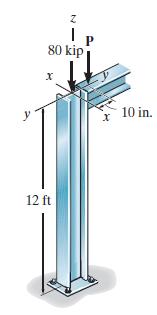
The W8 \(\times 15\) wide-flange A-36 steel column is assumed to be pinned at its top and bottom. Determine the largest eccentric load \(P\) that can be applied using Eq. 13-30 and the AISC equations of Sec. 13.6. 8 in.- 10 ft
Solve Prob. 13-107 if the column is fixed at its bottom and pinned at its top.Data from Prob. 13-107The W8 \(\times 15\) wide-flange A-36 steel column is assumed to be pinned at its top and bottom. Determine the largest eccentric load \(P\) that can be applied using Eq. 13-30 and the AISC equations
The W10×19 structural A992 steel column is assumed to be pinned at its top and bottom. Determine the largest eccentric load \(P\) that can be applied using Eq. \(13-30\) and the AISC equations of Sec. 13.6. 6 in P 20 kip 12 ft
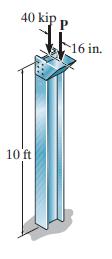
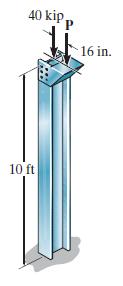
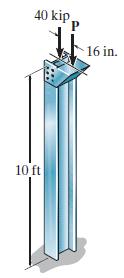
The W12 \(\times 50\) wide-flange A-36 steel column is fixed at its bottom and free at its top. Determine the greatest eccentric load \(P\) that can be applied using Eq. 13-30 and the AISC equations of Sec. 13.6. 40 kip 16 in. 10 ft
The W14 \(\times 43\) structural A-36 steel column is fixed at its bottom and free at its top. Determine the greatest eccentric load \(P\) that can be applied using Eq. \(13-30\) and the AISC equations of Sec. 13.6. 40 kip 16 in. 10 ft
The W10 \(\times 45\) structural A-36 steel column is fixed at its bottom and free at its top. If it is subjected to a load of \(P=2\) kip, determine if it is safe based on the AISC equations of Sec. 13.6 and Eq. 13-30. 40 kip 16 in. 10 ft
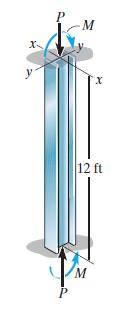
The W14 \(\times 22\) structural A-36 steel column is fixed at its top and bottom. If a horizontal load (not shown) causes it to support end moments of \(M=10 \mathrm{kip} \cdot \mathrm{ft}\), determine the maximum allowable axial force \(P\) that can be applied. Bending is about the \(x-x\) axis.
The W14 \(\times 22\) column is fixed at its top and bottom. If a horizontal load (not shown) causes it to support end moments of \(M=15 \mathrm{kip} \cdot \mathrm{ft}\), determine the maximum allowable axial force \(P\) that can be applied. Bending is about the \(x-x\) axis. Use the interaction
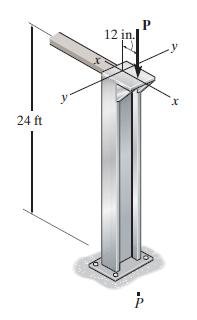
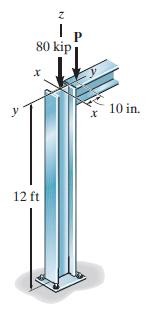
The W14 \(\times 53\) structural A-36 steel column supports an axial load of 80 kip in addition to an eccentric load \(P\). Determine the maximum allowable value of \(P\) based on the AISC equations of Sec. 13.6 and Eq. 13-30. Assume the column is fixed at its base, and at its top it is free to
The W12 \(\times 45\) structural A-36 steel column supports an axial load of 80 kip in addition to an eccentric load of \(P=60\) kip. Determine if the column fails based on the AISC equations of Sec. 13.6 and Eq. 13-30. Assume that the column is fixed at its base, and at its top it is free to sway
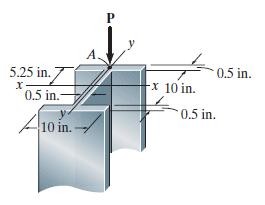
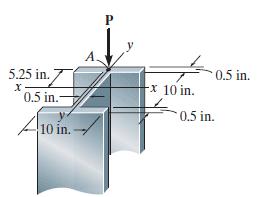
A 20 -ft-long column is made from a 2014-T6 aluminum alloy. If it is pinned at its top and bottom, and a compressive force \(\mathbf{P}\) is applied at point \(A\), determine the maximum allowable magnitude of \(\mathbf{P}\) using the equations of Sec. 13.6 and Eq. 13-30. 5.25 in. 0.5 in.- x 10 in.
A 20-ft-long column is made of aluminum alloy 2014-T6. If it is pinned at its top and bottom, and a compressive force \(\mathbf{P}\) is applied at point \(A\), determine the maximum allowable magnitude of \(\mathbf{P}\) using the equations of Sec. 13.6 and the interaction formula with
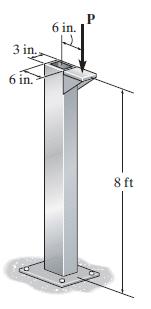
The 2014-T6 aluminum hollow column is fixed at its base and free at its top. Determine the maximum eccentric force \(P\) that can be safely supported by the column. Use the allowable stress method. The thickness of the wall for the section is \(t=0.5\) in. 3 in. 6 in. P 6 in. 8 ft
The 2014-T6 aluminum hollow column is fixed at its base and free at its top. Determine the maximum eccentric force \(P\) that can be safely supported by the column. Use the interaction formula. The allowable bending stress is \(\left(\sigma_{b}\right)_{\text {allow }}\) \(=30 \mathrm{ksi}\). The
Showing 500 - 600
of 1529
1
2
3
4
5
6
7
8
9
10
11
12
13
14
15
Last
Step by Step Answers

 Get 50% OFF
Claim Now
Get 50% OFF
Claim Now