New Semester
Started
Get
50% OFF
Study Help!
--h --m --s
Claim Now
Question Answers
Textbooks
Find textbooks, questions and answers
Oops, something went wrong!
Change your search query and then try again
S
Books
FREE
Study Help
Expert Questions
Accounting
General Management
Mathematics
Finance
Organizational Behaviour
Law
Physics
Operating System
Management Leadership
Sociology
Programming
Marketing
Database
Computer Network
Economics
Textbooks Solutions
Accounting
Managerial Accounting
Management Leadership
Cost Accounting
Statistics
Business Law
Corporate Finance
Finance
Economics
Auditing
Tutors
Online Tutors
Find a Tutor
Hire a Tutor
Become a Tutor
AI Tutor
AI Study Planner
NEW
Sell Books
Search
Search
Sign In
Register
study help
engineering
the science and engineering of materials
The Science And Engineering Of Materials 7th Edition Donald R. Askeland, Wendelin J. Wright - Solutions
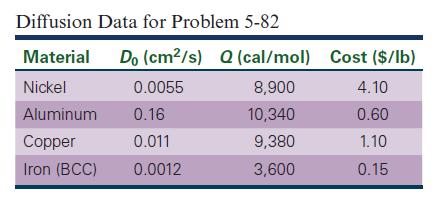
Design a spherical tank, with a wall thickness of 2 cm that will ensure that no more than 50 kg of hydrogen will be lost per year. The tank, which will operate at 500°C, can be made from nickel, aluminum, copper, or iron. The diffusion coefficient of hydrogen and the cost per pound for each
A steel gear initially containing 0.10% C is to be carburized so that the carbon content at a depth of 0.05 in. is 0.50% C. We can generate a carburizing gas at the surface that contains anywhere from 0.95% C to 1.15% C. Design an appropriate carburizing heat treatment.
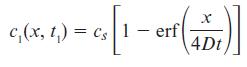
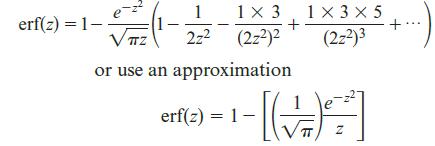
Assume that the surface concentration of phosphorus being diffused in silicon is 1021 atoms/cm3. We need to design a process, known as the pre-deposition step, such that the concentration of P (c1 for step 1) at a depth of 0.25 micrometer is 1013 atoms/cm3. Assume that this is conducted at a
When a valve casting containing copper and nickel solidifies under nonequilibrium conditions, we find that the composition of the alloy varies substantially over a distance of 0.005 cm. Usually we are able to eliminate this concentration difference by heating the alloy for 8 h at 1200°C; however,
Carburization Heat Treatment. Write a computer program for calculating carburization heat treatments. The program should ask the user to provide an input for the carbon concentration at the surface (cs), and the concentration of carbon in the bulk (c0). The program should also ask the user to
Calculation of Diffusion Coefficients. Write a computer program that will ask the user to provide the data for the activation energy Q and the value of D0. The program should then ask the user to input a valid range of temperatures. The program, when executed, provides the values of D as a function
Comparison of Reaction Rates. Write a computer program that will ask the user to input the activation energy for a chemical reaction. The program should then ask the user to provide two temperatures for which the reaction rates need to be compared. Using the value of the gas constant and activation
1. Describe the problems associated with metal impurities in silicon devices. 2. What are the processes involved in the removal of metal impurities from silicon devices by gettering?
Calculate the number of vacancies per m3 for gold at 900°C. The energy for vacancy formation is 0.86 eV/atom.
Au and Ag form a substitutional solid solution. This means that the crystal structure of a Au-Ag alloy consists of Ag atoms substituting for Au atoms in the regular atomic positions of the FCC structure. For a Au-50 at% Ag alloy, what is the wt% Ag in the alloy?
ZnS has the zinc blende structure. If the density is 3.02 g/cm3 and the lattice parameter is 0.59583 nm, determine the number of Schottky defects (a) Per unit cell; and(b) Per cubic centimeter.
Write down the defect chemistry equation for introduction of SrTiO3 in BaTiO3 using the Kröger-Vink notation.
Do amorphous and crystalline materials plastically deform by the same mechanisms? Explain.
What is the Burger’s vector orientation relationship with the dislocation axis for both edge and screw dislocations?
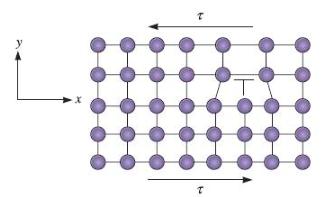
Draw a Burgers circuit around the dislocation shown in Figure 4-18. Clearly indicate the Burgers vector that you find. What type of dislocation is this? In what direction will the dislocation move due to the applied shear stress t? Reference your answers to the coordinate axes shown.
What is a slip system and what role does it play in plastic deformation?
Calculate the length of the Burgers vector in the following materials:(a) BCC niobium;(b) FCC silver; and(c) Diamond cubic silicon.
Can ceramic and polymeric materials contain dislocations?
Why is it that ceramic materials are brittle?
What is meant by the terms plastic and elastic deformation?
Why is the theoretical strength of metals much higher than that observed experimentally?
The distance from earth to the moon is 240,000 miles. If this were the total length of dislocation in a cubic centimeter of material, what would be the dislocation density? Compare your answer to typical dislocation densities for metals.
Why would metals behave as brittle materials without dislocations?
Why is it that dislocations play an important role in controlling the mechanical properties of metallic materials, however, they do not play a role in determining the mechanical properties of glasses?
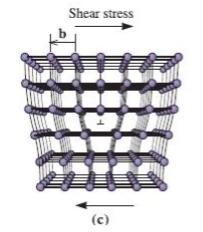
Suppose you would like to introduce an interstitial or large substitutional atom into the crystal near a dislocation. Would the atom fit more easily above or below the dislocation line shown in Figure 4-7(c)? Explain. Shear stress (c) Figure 4-7(c) (Repeated For Problem 4-39.)
Using Schmid’s Law, the resolved shear stress operating on a slip direction/plane is given by τr = σ cos λ cos Φ. If either of these angles equal 90°, what happens to the dislocations involved?
Why is it that single crystal and polycrystalline copper are both ductile; however, only single crystal, but not polycrystalline, zinc can exhibit considerable ductility?
Explain why hexagonal close-packed metals tend to have a limited ability to be strain hardened.
Why is it that cross slip in BCC and FCC metals is easier than in HCP metals? How does this influence the ductility of BCC, FCC, and HCP metals?
Arrange the following metals in the expected order of increasing ductility: Cu, Ti, and Fe. Explain.
What are the imperfections in the atomic arrangements that have a significant effect on the material behavior? Give an example of each.
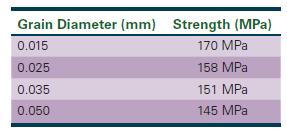
A copper-zinc alloy has the properties shown in the table below.Determine(a) The constants in the Hall-Petch equation; and(b) The grain size required to obtain a strength of 200 MPa. Grain Diameter (mm) Strength (MPa) 0.015 170 MPa 0.025 158 MPa 0.035 151 MPa 0.050 145 MPa
The strength of titanium is found to be 65,000 psi when the grain size is 6.7 x 10⁻⁴ in. and 82,000 psi when the grain size is 3.15 x 10⁻⁵ in. Determine(a) The constants in the Hall-Petch equation; and(b) The strength of the titanium when the grain size is reduced to 8.00 x 10⁻⁶ in.
If there were 50 grains per in2 in a photograph of a metal taken at 100 x magnification, calculate the ASTM grain size number (n).
If the area of a photograph measured 7.812 in2 and 23 grains were documented at 250 x magnification, what would the ASTM grain size number (n) be?
You have the choice to either purchase a copper alloy that has an ASTM grain size of 5 or ASTM grain size of 8. You are unable to decide if there is much of a difference between these two. Determine how many grains/in2 would appear on a photograph taken at 1003 for a metal given these two ASTM
The mill test report (MTR) on a structural steel you are considering using on an elevated pedestrian bridge over a busy roadway shows an ASTM grain size of 1.5. Would you accept this steel for this particular project? Explain.
For an ASTM grain size number of 8, calculate the number of grains per square inch(a) At a magnification of 100 and(b) With no magnification.
Determine the ASTM grain size number if 20 grains/square inch are observed at a magnification of 400.
Determine the ASTM grain size number if 25 grains/square inch are observed at a magnification of 50.
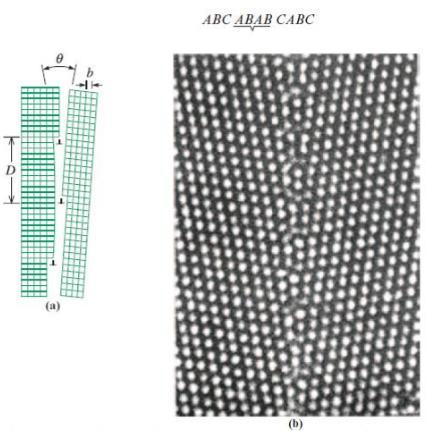
The angle θ of a tilt boundary is given by sin (θ/2) = b/(2D) [See Figure 4-15(a).] Verify the correctness of this equation. D - ABC ABAB CABC (b)
Calculate the angle u of a small angle grain boundary in FCC aluminum when the dislocations are 5000 Å apart. TDI ht @ ABC ABAB CABC (b) Figure 4-15 (a) The small angle grain boundary is produced by an array of dislocations, causing an angular mismatch between the lattices on either side of the
For BCC iron, calculate the average distance between dislocations in a small angle grain boundary tilted 0.50°. [See Figure 4-15(a).] TDI ht @ ABC ABAB CABC (b) Figure 4-15 (a) The small angle grain boundary is produced by an array of dislocations, causing an angular mismatch between the lattices
Every time we alloy a metal, it gets stronger. Is this true or false? Explain your answer fully.
How do the strengthening mechanisms strain hardening, alloying and grain size strengthening increase materials strength? What do they all have in common? Can more than one mechanism be used in a given alloy? Explain.
What makes plain carbon steel harder than pure iron?
Why is jewelry made from gold or silver alloyed with copper?
Why do we prefer to use semiconductor crystals that contain as small a number of dislocations as possible?
In structural applications (e.g., steel for bridges and buildings or aluminum alloys for aircraft), why do we use alloys rather than pure metals?
Assuming that we could obtain a 1 wt% solid solution of each of the following elements in aluminum, which of the elements would be expected to produce the greatest strengthening effect: Mg, Mn, Cu, and Zn? Why?
Do dislocations control the strength of a silicate glass? Explain.
What is meant by the term strain hardening?
To which mechanism of strengthening is the Hall-Petch equation related?
Pure copper is strengthened by the addition of a small concentration of Be. To which mechanism of strengthening is this related?
The density of pure aluminum calculated from crystallographic data is expected to be 2.69955 g/cm3.(a) Design an aluminum alloy that has a density of 2.6450 g/cm3.(b) Design an aluminum alloy that has a density of 2.7450 g/cm3.
You would like a metal plate with good weldability. During the welding process, the metal next to the weld is heated almost to the melting temperature and, depending on the welding parameters, may remain hot for some period of time. Design an alloy that will minimize the loss of strength in this
We need a material that is optically transparent but electrically conductive. Such materials are used for touch screen displays. What kind of materials can be used for this application?
Temperature dependence of vacancy concentrations. Write a computer program that will provide a user with the equilibrium concentration of vacancies in a metallic element as a function of temperature. The user should specify a meaningful and valid range of temperatures (e.g., 100 to 1200 K for
Hall-Petch equation. Write a computer program that will ask the user to enter two sets of values of σy and grain size (d) for a metallic material. The program should then utilize the data to calculate the Hall- Petch equation. The program then should prompt the user to input another value of grain
ASTM grain size number calculator. Write a computer program that will ask the user to input the magnification of a micrograph of the sample for which the ASTM number is being calculated. The program should then ask the user for the number of grains counted and the area (in square inches) from which
What is the driving force for diffusion?
Compare the carbon dioxide permeabilities of low-density polyethylene (LDPE), polypropylene, and polyethylene terephthalate (PET) films at room temperature.
Give three examples of materials processes that rely on diffusion in solids and explain how diffusion plays a critical role for one of those processes.
In the carburization treatment of steels, what are the diffusing species?
Why do we use PET plastic to make carbonated beverage bottles?
Why is it that aluminum metal oxidizes more readily than iron but aluminum is considered to be a metal that usually does not “rust”?
What is a thermal barrier coating? Where are such coatings used?
What is a nitriding heat treatment?
A certain mechanical component is heat treated using carburization. A commonly encountered engineering problem is that we need to machine a certain part of the component and this part of the surface should not be hardened. Explain how we can achieve this objective.
Write down the Arrhenius equation and explain the different terms.
Compare the diffusion coefficients for hydrogen and nitrogen in FCC iron at1000°C and explain the reason for the difference in their values.
Determine the diffusion coefficient D for the diffusion of hydrogen into FCC iron at 800°C.
Without referring to the actual data, can you predict whether the activation energy for diffusion of carbon in FCC iron will be higher or lower than that in BCC iron? Explain.
What is the difference between diffusivity and the diffusion coefficient?
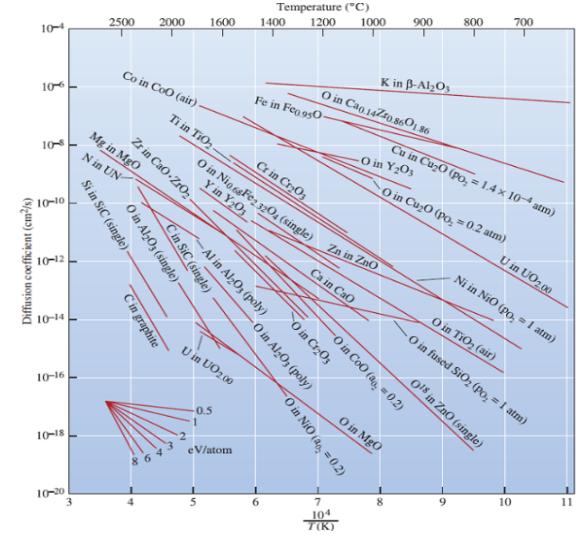
Activation energy is sometimes express edas (eV/atom), (e.g., as shown in Figure 5-15, which illustrates the diffusion coefficients of ions in different oxides). Convert eV/ atom to J/mole. (cm²/s) Diffusion coefficient ( 10-6 10-8 10-10 10-12 10-14 10-16 10-18 10-20 T T 3 Si in SiC (single)
The diffusion coefficient for Cr3+ in Cr2O3 is 6 x 10-15 cm2/s at 727°C and 1 x 10⁻⁹ cm2/s at 1400°C. Calculate (a) The activation energy; and(b) The constant D0.
The diffusion coefficient for O2- in Cr2O3 is 4 x 10-15 cm2/s at 1150°C and 6 x 10-11 cm2/s at 1715°C. Calculate(a) The activation energy; and(b) The constant D0.
In order to produce a certain semiconductor, a process called doping is performed in which phosphorus is diffused into germanium. If D0 = 2.0 cm2/s and the activation energy is 57,500 cal/mol, determine the diffusivity of P in Ge at 800°C.
How is self-diffusion of atoms in metals verified experimentally?
The Arrhenius equation was originally developed for comparing rates of chemical reactions. Compare the rates of a chemical reaction at 20 and 100°C by calculating the ratio of the chemical reaction rates. Assume that the activation energy for liquids in which the chemical reaction is conducted is
Why is it that the activation energy for diffusion via the interstitial mechanism is less than those for other mechanisms?
When a Cu-Zn alloy solidifies, one portion of the structure contains 25 at% zinc and another portion 0.025 mm away contains 20 at% zinc. The lattice parameter for the FCC alloy is about 3.63 x 10⁻⁸ cm.Determine the concentration gradient in(a) at% Zn per cm;(b) wt% Zn per cm; and(c) Zn atoms/
How would the internal pressure of hydrogen in a storage tank affect the rate of diffusion? Explain.
A 0.2-mm-thick wafer of silicon is treated so that a uniform concentration gradient of antimony is produced. One surface contains 1 Sb atom per 108 Si atoms and the other surface contains 500 Sb atoms per 108 Si atoms. The lattice parameter for Si is 5.4307 Å (Appendix A). Calculate the
Calculate the diffusion coefficients for the diffusion of hydrogen through BCC iron and FCC aluminum at room temperature (25°C). For the diffusion of H into Al, D0 = 0.11 cm2/s and Q = 9780 cal/mol. Based on your calculations, which material would be better suited as the material for a
Write down Fick’s first law of diffusion. Clearly explain what each term means.
A 4-cm-diameter, 0.5-mm-thick spherical container made of BCC iron holds nitrogen at 700°C. The concentration at the inner surface is 0.05 at% and at the outer surface is 0.002 at%. Calculate the number of grams of nitrogen that are lost from the container per hour.
Write down the equation that describes the dependence of D on temperature.
Why is it that inorganic glasses form upon relatively slow cooling of melts, while rapid solidification is necessary to form metallic glasses?
In solids, the process of diffusion of atoms and ions takes time. Explain how this is used to our advantage while forming metallic glasses.
In ionic materials, is diffusion expected to occur at a faster rate for cations or anions? Explain.
Pure zinc is to be diffused into copper by dipping copper into molten zinc at 450°C. Calculate how long it would take to obtain 10 wt% zinc at a depth of 0.5 mm beneath the copper surface. Is this commercially feasible? What practical problems might arise if we raise the temperature to 1000°C?
Use the diffusion data in the table below for atoms in iron to answer the questions that follow. Assume metastable equilibrium conditions and trace amounts of C in Fe. The gas constant in SI units is 8.314 J/(mol . K).(a) Plot the diffusion coefficient as a function f inverse temperature (1/T)
The plot below has three lines representing grain boundary, surface, and volume self diffusion in a metal. Match the lines labeled A, B, and C with the type of diffusion. Justify your answer by calculating the activation energy for diffusion for each case.
What are barrier polymers?
What factors, other than permeability, are important in selecting a polymer for making plastic bottles?
Amorphous PET is more permeable to CO2 than PET that contains microcrystallites. Explain why.
Determine the carburizing time necessary to achieve a carbon concentration of 0.30 wt% at a position 4-mm into a steel alloy that initially contains 0.10 wt% carbon. The surface concentration is to be maintained at 0.90 wt% carbon, and the treatment is to be conducted at 1100°C. Use the diffusion
Nitriding is a process in which nitrogen is allowed to diffuse into the surface of steel for the purpose of increasing the surface hardness of a component. It has been determined that a satisfactory nitrogen case depth is produced in BCC iron after 1 hour at 700°C. How much time is required to
Indicate the directions (a) [111], (b) [025], and (c) [414] within a unit cell.
Showing 1800 - 1900
of 2309
First
10
11
12
13
14
15
16
17
18
19
20
21
22
23
24
Step by Step Answers

 Get 50% OFF
Claim Now
Get 50% OFF
Claim Now