New Semester
Started
Get
50% OFF
Study Help!
--h --m --s
Claim Now
Question Answers
Textbooks
Find textbooks, questions and answers
Oops, something went wrong!
Change your search query and then try again
S
Books
FREE
Study Help
Expert Questions
Accounting
General Management
Mathematics
Finance
Organizational Behaviour
Law
Physics
Operating System
Management Leadership
Sociology
Programming
Marketing
Database
Computer Network
Economics
Textbooks Solutions
Accounting
Managerial Accounting
Management Leadership
Cost Accounting
Statistics
Business Law
Corporate Finance
Finance
Economics
Auditing
Tutors
Online Tutors
Find a Tutor
Hire a Tutor
Become a Tutor
AI Tutor
AI Study Planner
NEW
Sell Books
Search
Search
Sign In
Register
study help
mathematics
precalculus
Precalculus Concepts Through Functions A Unit Circle Approach To Trigonometry 5th Edition Michael Sullivan - Solutions
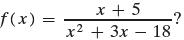
What is the domain of f(x) = x + 5 x² + 3x - 18
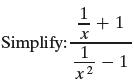
Answers are given at the end of these exercises. X Simplify: 1 x2 +1 - 1
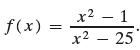
Find the domain of the function f(x) = x² - 1 x² - 25 2
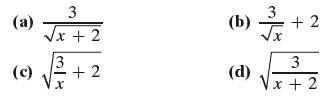
If f (x) = √x + 2 and g(x) = 3/x, then (f º g)(x) equals (a) (c) 3 √x + 2 3 √2/2 X +2 (b)+ (d) 3 √x + 2
Problems 79–88 are based on previously learned material. The purpose of these problems is to keep the material fresh in your mind so that you are better prepared for later sections, a final exam, or subsequent courses such as calculus.If f (x) = √3x − 1 and g(x) = √3x + 1, find (f · g)(x)
Problems 79–88 are based on previously learned material. The purpose of these problems is to keep the material fresh in your mind so that you are better prepared for later sections, a final exam, or subsequent courses such as calculus.If f (x) = 4x + 3, find
Problems 79–88 are based on previously learned material. The purpose of these problems is to keep the material fresh in your mind so that you are better prepared for later sections, a final exam, or subsequent courses such as calculus.Determine whether the graph of (x2 + y2 − 2x)2 = 9(x2 + y2 )
Problems 79–88 are based on previously learned material. The purpose of these problems is to keep the material fresh in your mind so that you are better prepared for later sections, a final exam, or subsequent courses such as calculus.Approximate the turning points of f (x) = x3 − 2x2 + 4.
Problems 79–88 are based on previously learned material. The purpose of these problems is to keep the material fresh in your mind so that you are better prepared for later sections, a final exam, or subsequent courses such as calculus.Solve: 5x2 − 3 = 2x2 + 11x + 1
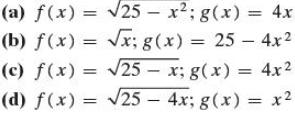
If H = f º g and H(x) = 25 − 4x2, which of the following cannot be the component functions f and g? (a) f(x) = √√25 - x²; g(x) = 4x (b) f(x)=√x; g(x) = 25 - 4x² (c) f(x) = √25 - x; g(x) = 4x² (d) f(x) = √25 - 4x; g(x) = x²
Problems 79–88 are based on previously learned material. The purpose of these problems is to keep the material fresh in your mind so that you are better prepared for later sections, a final exam, or subsequent courses such as calculus.What are the quotient and remainder when 8x2 − 4x + 5 is
Suppose f is a one-to-one function with a domain of {x|x ≠ 3} and a range ofWhich of the following is the domain of f −1? {} y =
Find f (3) if f (x) = −4x2 + 5x.
Find f (3x) if f (x) = 4 − 2x2.
Where is the function f (x) = x2 increasing? Where is it decreasing?
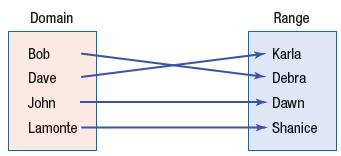
In Problems 13 – 20, determine whether the function is one-to-one. Domain Bob Dave John Lamonte Range Karla Debra Dawn Shanice
Given two functions f and g, the_______ ________ , denoted f º g, is defined by ( f º g )(x) = ______.
If x1 and x2 are any two different inputs of a function f , then f is one-to-one if ________.
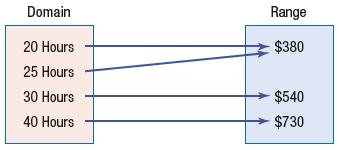
In Problems 13 – 20, determine whether the function is one-to-one. Domain 20 Hours 25 Hours 30 Hours - 40 Hours Range $380 $540 $730
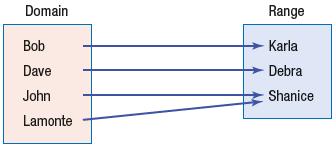
In Problems 13 – 20, determine whether the function is one-to-one. Domain Bob Dave John Lamonte Range Karla Debra Shanice
True or False If f (x) = x2 and g(x) = √x + 9, then (f º g)(4) = 5.
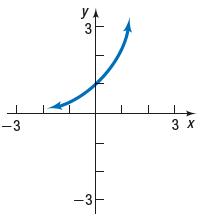
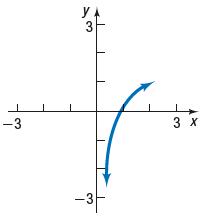
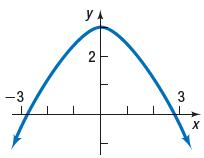
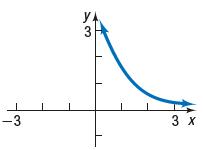
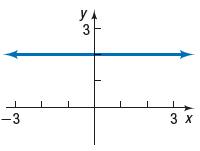
In Problems 21 – 26, the graph of a function f is given. Use the horizontal-line test to determine whether f is one-to-one. -3 3 -3 3 x
If f is a one-to-one function and f (3) = 8, then f −1 (8) = _____.
In Problems 21 – 26, the graph of a function f is given. Use the horizontal-line test to determine whether f is one-to-one. -3 YA 3 -3 3 x
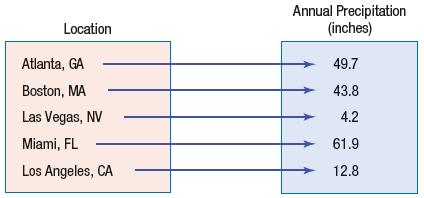
In Problems 27–34, find the inverse of each one-to-one function. State the domain and the range of each inverse function. Location Atlanta, GA Boston, MA Las Vegas, NV Miami, FL Los Angeles, CA Annual Precipitation (inches) 49.7 43.8 4.2 61.9 12.8
In Problems 21 – 26, the graph of a function f is given. Use the horizontal-line test to determine whether f is one-to-one. -3 YA 2 3 X
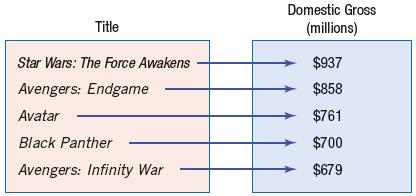
In Problems 27–34, find the inverse of each one-to-one function. State the domain and the range of each inverse function. Title Star Wars: The Force Awakens Avengers: Endgame Avatar Black Panther Avengers: Infinity War Domestic Gross (millions) $937 $858 $761 $700 $679
True or False If f and g are inverse functions, then the domain of f is the same as the range of g .
In Problems 21 – 26, the graph of a function f is given. Use the horizontal-line test to determine whether f is one-to-one. -3 У 3 3 x
In Problems 21 – 26, the graph of a function f is given. Use the horizontal-line test to determine whether f is one-to-one. I -3 y 4 3 3 x
If (−2, 3) is a point on the graph of a one-to-one function f , which of the following points is on the graph of f −1 ?(a) ( 3, −2)(b) ( 2, −3)(c) ( −3, 2)(d) ( −2, −3)
In Problems 13–22, for the given functions f and g, find:(a) (f º g)(4)(b) (g º f)(2)(c) (f º f)(1)(d) (g º g)(0)f (x) = 2x; g(x) = 3x2 + 1
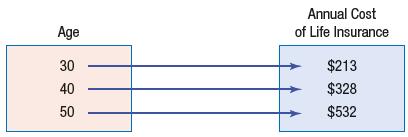
In Problems 27–34, find the inverse of each one-to-one function. State the domain and the range of each inverse function. Age 30 40 50 Annual Cost of Life Insurance $213 $328 $532
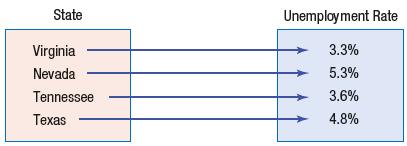
In Problems 27–34, find the inverse of each one-to-one function. State the domain and the range of each inverse function. State Virginia Nevada Tennessee Texas Unemployment Rate 3.3% 5.3% 3.6% 4.8%
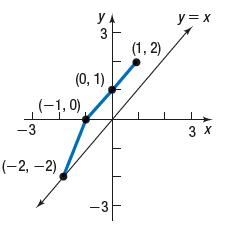
In Problems 35–40, the graph of a one-to-one function f is given. Draw the graph of the inverse function f −1. -3 (-1,0) (-2,-2) y YA 3 (0, 1) -3 (1,2) y=x 3 x
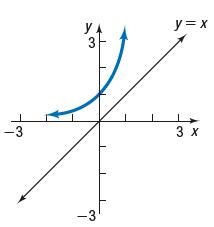
In Problems 35–40, the graph of a one-to-one function f is given. Draw the graph of the inverse function f −1. -3 У 3 -3 y=x 3 x
In Problems 41–50, verify that the functions f and g are inverses of each other by showing that f (g(x)) = x and g(f (x)) = x. Give any values of x that need to be excluded from the domain of f and the domain of g. f(x) = 2x + 6; g(x) = || •x 3 HIN 2 -
In Problems 41–50, verify that the functions f and g are inverses of each other by showing that f (g(x)) = x and g(f (x)) = x. Give any values of x that need to be excluded from the domain of f and the domain of g. f(x) = 3x + 4; g(x) = = 1/(x-4)
In Problems 41–50, verify that the functions f and g are inverses of each other by showing that f (g(x)) = x and g(f (x)) = x. Give any values of x that need to be excluded from the domain of f and the domain of g. f(x)= = 2x + 3. x + 4 g(x) = 4x 3 2-x
In Problems 41–50, verify that the functions f and g are inverses of each other by showing that f (g(x)) = x and g(f (x)) = x. Give any values of x that need to be excluded from the domain of f and the domain of g. f(x) = 32x; g(x): =-1/(x-3) =
In Problems 41–50, verify that the functions f and g are inverses of each other by showing that f (g(x)) = x and g(f (x)) = x. Give any values of x that need to be excluded from the domain of f and the domain of g. f(x) = 4x8; g(x) 4 +2
In Problems 51–62, the function f is one-to-one.(a) Find its inverse function f −1 and check your answer.(b) Find the domain and the range of f and f −1.(c) Graph f, f −1, and y = x on the same coordinate axes. f(x) = 4 X
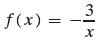
In Problems 51–62, the function f is one-to-one.(a) Find its inverse function f −1 and check your answer.(b) Find the domain and the range of f and f −1.(c) Graph f, f −1, and y = x on the same coordinate axes. f(x) = 3 X
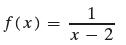
In Problems 51–62, the function f is one-to-one.(a) Find its inverse function f −1 and check your answer.(b) Find the domain and the range of f and f −1.(c) Graph f, f −1, and y = x on the same coordinate axes. f(x) = 1 x-2
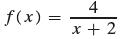
In Problems 51–62, the function f is one-to-one.(a) Find its inverse function f −1 and check your answer.(b) Find the domain and the range of f and f −1.(c) Graph f, f −1, and y = x on the same coordinate axes. f(x) = 4 x + 2
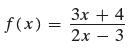
In Problems 63–80, the function f is one-to-one.(a) Find its inverse function f −1 and check your answer.(b) Find the domain and the range of f and f −1. f(x) = 3x + 4 2x - 3
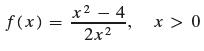
In Problems 63–80, the function f is one-to-one.(a) Find its inverse function f −1 and check your answer.(b) Find the domain and the range of f and f −1. f(x) = - x2 2-4 2x2 x > 0
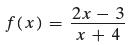
In Problems 63–80, the function f is one-to-one.(a) Find its inverse function f −1 and check your answer.(b) Find the domain and the range of f and f −1. f(x)= 2x - 3 x + 4
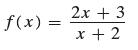
In Problems 63–80, the function f is one-to-one.(a) Find its inverse function f −1 and check your answer.(b) Find the domain and the range of f and f −1. f(x) = 2x + 3 x + 2
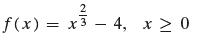
In Problems 63–80, the function f is one-to-one.(a) Find its inverse function f −1 and check your answer.(b) Find the domain and the range of f and f −1. f(x) = x³ - 4, x3 - 4, x > 0
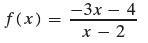
In Problems 63–80, the function f is one-to-one.(a) Find its inverse function f −1 and check your answer.(b) Find the domain and the range of f and f −1. f(x) = T -3x - 4 x 2
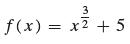
In Problems 63–80, the function f is one-to-one.(a) Find its inverse function f −1 and check your answer.(b) Find the domain and the range of f and f −1. 3 f(x) = x2 + 5 +5 ان
In Problems 41–50, verify that the functions f and g are inverses of each other by showing that f (g(x)) = x and g(f (x)) = x. Give any values of x that need to be excluded from the domain of f and the domain of g.f (x) = x; g(x) = x
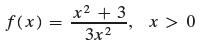
In Problems 63–80, the function f is one-to-one.(a) Find its inverse function f −1 and check your answer.(b) Find the domain and the range of f and f −1. f(x) = x2 + 3 3x2 x > 0
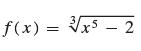
In Problems 63–80, the function f is one-to-one.(a) Find its inverse function f −1 and check your answer.(b) Find the domain and the range of f and f −1. f(x) = x5 3x5 – 2 -
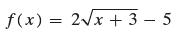
In Problems 63–80, the function f is one-to-one.(a) Find its inverse function f −1 and check your answer.(b) Find the domain and the range of f and f −1. f(x) = 2√x + 3-5
In Problems 51–62, the function f is one-to-one.(a) Find its inverse function f −1 and check your answer.(b) Find the domain and the range of f and f −1.(c) Graph f, f −1, and y = x on the same coordinate axes.f (x) = x2 + 4, x ≥ 0
Suppose f (x) = 2x3 − 3x2 − 8x + 12 and g(x) = x + 5. Find the zeros of (f º g)(x).
If f (x) = x2 + 5x + c, g(x) = ax + b, and (f º g)(x) = 4x2 + 22x + 31, find a, b, and c.
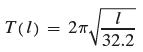
In applications, the symbols used for the independent and dependent variables are often based on common usage. So, rather than using y = f (x) to represent a function, an applied problem might use C = C(q) to represent the cost C of manufacturing q units of a good. Because of this, the inverse
Problems 79–88. The purpose of these problems is to keep the material fresh in your mind so that you are better prepared for later sections, a final exam, or subsequent courses such as calculus.Find the distance between the points (−3, 8) and (2, −7).
Problems 79–88. The purpose of these problems is to keep the material fresh in your mind so that you are better prepared for later sections, a final exam, or subsequent courses such as calculus.Solve: −x3 (9 − x2)−1/2 + 2x(9 − x2)1/2 = 0
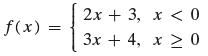
For(a) Find the domain and range of f.(b) Find f −1.(c) Find the domain and range of f −1. f(x) = 2x + 3, x < 0 3x + 4, x 20
The function f (x) = |x| is not one-to-one. Find a suitable restriction on the domain of f so that the new function that results is one-to-one. Then find the inverse of the new function.
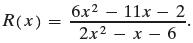
Problems 115 – 124. The purpose of these problems is to keep the material fresh in your mind so that you are better prepared for later sections, a final exam, or subsequent courses such as calculus.Find the domain ofFind any horizontal, vertical, or oblique asymptotes. R(x) = 6x2 11x 2 2x²x6
The function f (x) = x4 is not one-to-one. Find a suitable restriction on the domain of f so that the new function that results is one-to-one. Then find the inverse of the new function.
In applications, the symbols used for the independent and dependent variables are often based on common usage. So, rather than using y = f (x) to represent a function, an applied problem might use C = C(q) to represent the cost C of manufacturing q units of a good. Because of this, the inverse
In applications, the symbols used for the independent and dependent variables are often based on common usage. So, rather than using y = f (x) to represent a function, an applied problem might use C = C(q) to represent the cost C of manufacturing q units of a good. Because of this, the inverse
In applications, the symbols used for the independent and dependent variables are often based on common usage. So, rather than using y = f (x) to represent a function, an applied problem might use C = C(q) to represent the cost C of manufacturing q units of a good. Because of this, the inverse
In applications, the symbols used for the independent and dependent variables are often based on common usage. So, rather than using y = f (x) to represent a function, an applied problem might use C = C(q) to represent the cost C of manufacturing q units of a good. Because of this, the inverse
In applications, the symbols used for the independent and dependent variables are often based on common usage. So, rather than using y = f (x) to represent a function, an applied problem might use C = C(q) to represent the cost C of manufacturing q units of a good. Because of this, the inverse
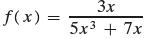
Problems 115 – 124. The purpose of these problems is to keep the material fresh in your mind so that you are better prepared for later sections, a final exam, or subsequent courses such as calculus.Is the function even, odd, or neither? f(x) = 3x 5x3 + 7x
In applications, the symbols used for the independent and dependent variables are often based on common usage. So, rather than using y = f (x) to represent a function, an applied problem might use C = C(q) to represent the cost C of manufacturing q units of a good. Because of this, the inverse
In applications, the symbols used for the independent and dependent variables are often based on common usage. So, rather than using y = f (x) to represent a function, an applied problem might use C = C(q) to represent the cost C of manufacturing q units of a good. Because of this, the inverse
If h(x) = (f º g)(x), find h−1 in terms of f −1 and g−1.
Is every odd function one-to-one? Explain.
Problems 115 – 124. The purpose of these problems is to keep the material fresh in your mind so that you are better prepared for later sections, a final exam, or subsequent courses such as calculus.If f (x) = 3x2 − 7x, find f (x + h) − f (x).
Problems 115 – 124. The purpose of these problems is to keep the material fresh in your mind so that you are better prepared for later sections, a final exam, or subsequent courses such as calculus.Find the zeros of the quadratic function f (x) = 3x2 + 5x + 1.What are the x -intercepts, if any,
Problems 115 – 124. The purpose of these problems is to keep the material fresh in your mind so that you are better prepared for later sections, a final exam, or subsequent courses such as calculus.Use the techniques of shifting, compressing or stretching, and reflections to graph f (x) =
Problems 115 – 124. The purpose of these problems is to keep the material fresh in your mind so that you are better prepared for later sections, a final exam, or subsequent courses such as calculus.Find an equation of a circle with center (−3, 5) and radius 7.
Problems 115 – 124. The purpose of these problems is to keep the material fresh in your mind so that you are better prepared for later sections, a final exam, or subsequent courses such as calculus.Find an equation of the line that contains the point (−4, 1) and is perpendicular to the line 3 x
Problems 115 – 124. The purpose of these problems is to keep the material fresh in your mind so that you are better prepared for later sections, a final exam, or subsequent courses such as calculus.Solve for D : 2 x + 2yD = xD + y
Problems 115 – 124. The purpose of these problems is to keep the material fresh in your mind so that you are better prepared for later sections, a final exam, or subsequent courses such as calculus.Find the average rate of change of f (x) = −3x2 + 2x +1 from 2 to 4.
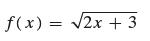
Problems 115 – 124. The purpose of these problems is to keep the material fresh in your mind so that you are better prepared for later sections, a final exam, or subsequent courses such as calculus.Find the difference quotient of f : f(x) = √2x + 3
Problems 79–88.The purpose of these problems is to keep the material fresh in your mind so that you are better prepared for later sections, a final exam, or subsequent courses such as calculus.For the quadratic function f (x) = −1/3 x2 + 2x + 5, find the vertex and the axis of symmetry, and
Problems 79–88. The purpose of these problems is to keep the material fresh in your mind so that you are better prepared for later sections, a final exam, or subsequent courses such as calculus.Solve: x2 − 6x − 7 ≤ 0
In Problems 47–52, find functions f and g so that f º g = H. H(x): √x² + 1
In Problems 47–52, find functions f and g so that f º g = H. H(x)=√1x²
Ifand find the domain of (f º g º h)(x). f(x) = 1 x+4 g(x) x x-2
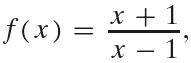
If find (f ° f)(x). f(x) = x + 1 x-1
Given three functions f, g, and h, define (f º g º h)(x) = f [g(h(x))]. Find (f º g º h)(2) if f(x) = 6x - 7, g(x) = X and h(x) = = √x √x + 7.
In Problems 47–52, find functions f and g so that f º g = H.H(x) = (1 + x2 )3
Problems 79–88. The purpose of these problems is to keep the material fresh in your mind so that you are better prepared for later sections, a final exam, or subsequent courses such as calculus.Given f (x) = 3x + 8 and g(x) = x − 5, find State the domain of each. (f + g)(x), (f- g)(x), (f
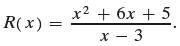
Problems 79–88. The purpose of these problems is to keep the material fresh in your mind so that you are better prepared for later sections, a final exam, or subsequent courses such as calculus.Find the domain ofFind any horizontal, vertical, or oblique asymptotes. R(x) = x² + 6x + 5 x - 3
In Problems 47–52, find functions f and g so that f º g = H.H(x) = |2x + 1|
In Problems 47–52, find functions f and g so that f º g = H.H(x) = |2x2 + 3|
If f (x) = 2x3 − 3x2 + 4x −1 and g(x) = 2, find (f º g)(x) and (g º f)(x).
The volume V of a right circular cone is V = 1/3πr2 h. If the height is twice the radius, express the volume V as a function of r.
Traders often buy foreign currency in the hope of making money when the currency’s value changes. For example, on March 10, 2022, one U.S. dollar could purchase 0.9101 euro, and one euro could purchase 128.4337 yen. Let f (x) represent the number of euros you can buy with x dollars, and let g(x)
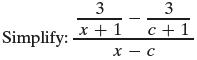
Problems 79–88. The purpose of these problems is to keep the material fresh in your mind so that you are better prepared for later sections, a final exam, or subsequent courses such as calculus. Simplify: 3 x + 1 3 c+1 X-C
Showing 4300 - 4400
of 29454
First
37
38
39
40
41
42
43
44
45
46
47
48
49
50
51
Last
Step by Step Answers

 Get 50% OFF
Claim Now
Get 50% OFF
Claim Now