New Semester
Started
Get
50% OFF
Study Help!
--h --m --s
Claim Now
Question Answers
Textbooks
Find textbooks, questions and answers
Oops, something went wrong!
Change your search query and then try again
S
Books
FREE
Study Help
Expert Questions
Accounting
General Management
Mathematics
Finance
Organizational Behaviour
Law
Physics
Operating System
Management Leadership
Sociology
Programming
Marketing
Database
Computer Network
Economics
Textbooks Solutions
Accounting
Managerial Accounting
Management Leadership
Cost Accounting
Statistics
Business Law
Corporate Finance
Finance
Economics
Auditing
Tutors
Online Tutors
Find a Tutor
Hire a Tutor
Become a Tutor
AI Tutor
AI Study Planner
NEW
Sell Books
Search
Search
Sign In
Register
study help
mathematics
precalculus
Precalculus Concepts Through Functions A Unit Circle Approach To Trigonometry 5th Edition Michael Sullivan - Solutions
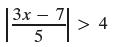
In Problems 45–78, solve each inequality. Express your answer using set notation or interval notation. Graph the solution set. 3.x - 57/>4
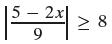
In Problems 45–78, solve each inequality. Express your answer using set notation or interval notation. Graph the solution set. 52x1 9 8
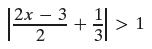
In Problems 45–78, solve each inequality. Express your answer using set notation or interval notation. Graph the solution set. - 3 |²x2= ³ + 1/ 1³ - }| > 1
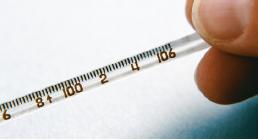
“Normal” human body temperature is 98.6°F. If a temperature x that differs from normal by at least 1.5° is considered unhealthy, write the condition for an unhealthy temperature x as an inequality involving an absolute value, and solve for x. แ 004.8
In Problems 87–92, find a and b.If |x2|7, then a < 1 x - 10 < b.
In Problems 87–92, find a and b.If Ix+13, then a < x + 5 ≤ b.
According to data from the Hill Aerospace Museum (Hill Air Force Base, Utah), the speed of sound varies depending on altitude, barometric pressure, and temperature. For example, at 20,000 feet, 13.75 inches of mercury, and −12.3°F, the speed of sound is about 707 miles per hour, but the speed
In Problems 87–92, find a and b.If |x − 1| < 3, then a < x + 4 < b.
In Problems 87–92, find a and b.If |x + 2| < 5, then a < x − 2 < b.
In Problems 87–92, find a and b.If |x + 4|≤ 2, then a ≤ 2x − 3 ≤ b.
In Problems 87–92, find a and b.If |x − 3| ≤ 1, then a ≤ 3x + 1 ≤ b.
Prove the triangle inequality |a + b| ≤ |a| + |b|. Expand |a + b|2 = (a + b)2, and use the fact that a ≤ |a|.]
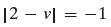
In Problems 17–44, find the real solutions, if any, of each equation. 12 |2v| = -1
Problems 28 – 37 are based on previously learned material. The purpose of these problems is to keep the material fresh in your mind so that you are better prepared for later sections, a final exam, or subsequent courses such as calculus.Solve: 3 |2x − 1| + 5 > 26
Problems 31 – 34 , find all complex zeros of each function.G (y) = y4 − 81
The equation |x| = −2 has no solution. Explain why.
The inequality |x| > −0.5 has all real numbers as solutions. Explain why.
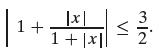
Solve | 1+₁ |x| 1 + |x|| VI
If |2x − 5| = x + 13 and |4 − 3y| = 2, what is the largest possible value of y/x?
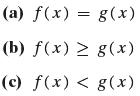
If f (x) = |−3x + 2| and g(x) = x + 10,solve: (a) f(x) = g(x) (b) f(x) ≥ g(x) (c) f(x) < g(x)
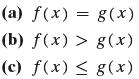
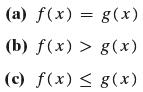
If f (x) = |4x − 3| and g(x) = x + 2,solve: (a) f(x) = g(x) (b) f(x) > g(x) (c) f(x) ≤ g(x)
Solve |x + |3x − 2|| = 2.
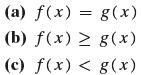
If f (x) = −2 |2x − 3| and g(x) = −12,solve: (a) f(x) = g(x) (b) f(x) > g(x) (c) f(x) < g(x)
Solve |3x − |2x + 1|| = 4.
If f (x) = −3 |5x − 2| and g(x) = −9,solve: (a) f(x) = g(x) (b) f(x) > g(x) (c) f(x) ≤ g(x)
Prove that |a − b| ≥ |a| − |b|. Apply the triangle inequality from Problem 93 toData from problem 93Prove the triangle inequality |a + b| ≤ |a| + |b|. Expand |a + b|2 = (a + b)2, and use the fact that a ≤ |a|. ] lal = |(a - b) + bl.]
The inequality |x| > 0 has as its solution set {x| x ≠ 0}. Explain why.
Problems 106–109 are based on previously learned material. The purpose of these problems is to keep the material fresh in your mind so that you are better prepared for later sections, a final exam, or subsequent courses such as calculus.Multiply (5 − i)(3 + 2i). Write the answer in the form a +
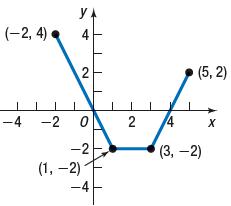
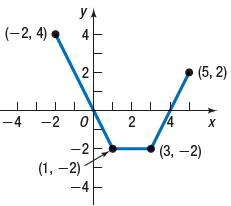
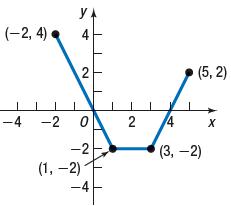
Problems 106–109 are based on previously learned material. The purpose of these problems is to keep the material fresh in your mind so that you are better prepared for later sections, a final exam, or subsequent courses such as calculus.Use the graph of the function to the right to find:(a) The
Problems 106–109 are based on previously learned material. The purpose of these problems is to keep the material fresh in your mind so that you are better prepared for later sections, a final exam, or subsequent courses such as calculus.Solve the inequality 2(x + 4) + x < 4(x + 2). Express the
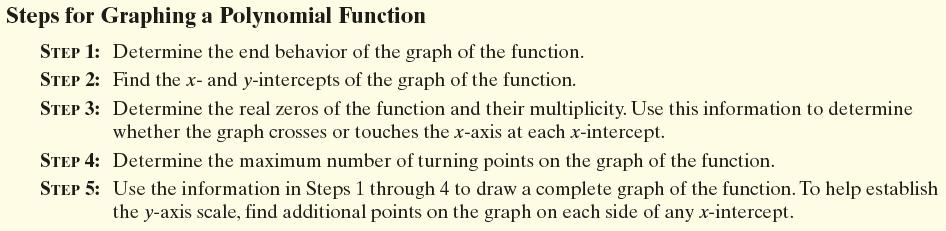
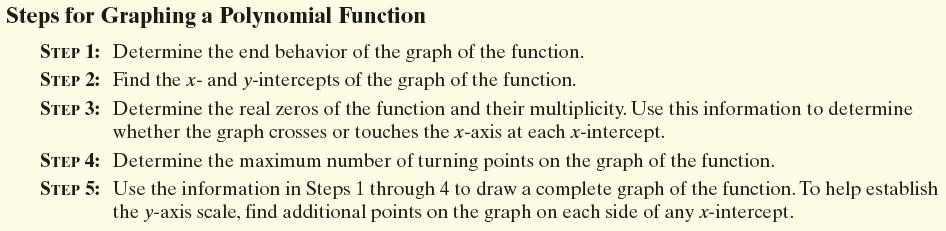
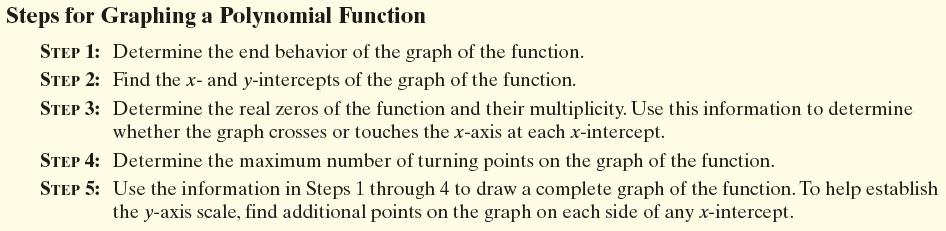
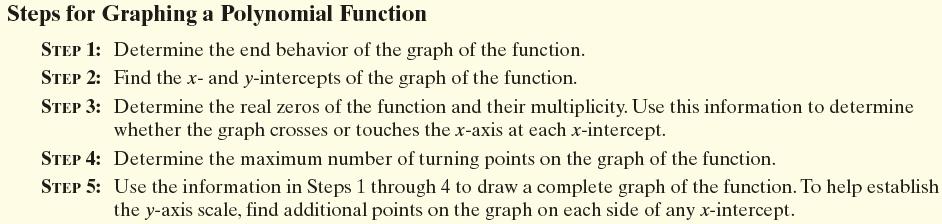
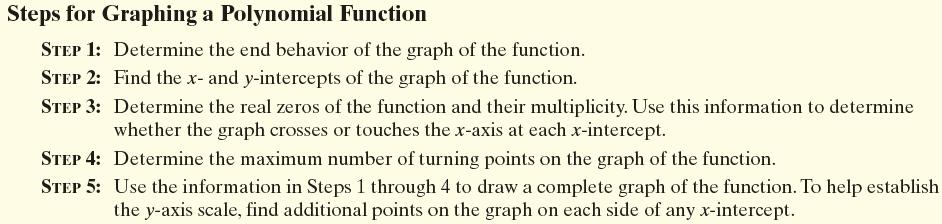
In Problems 5–22, graph each polynomial function by following Steps 1 through 5. f (x) = x2 (x − 3) Steps for Graphing a Polynomial Function STEP 1: Determine the end behavior of the graph of the function. STEP 2: Find the x- and y-intercepts of the graph of the function. STEP 3: Determine
Use a graphing utility to find the quadratic function of best fit for the data below. X Y 2 3.08 2.5 3.42 3 3.65 3.5 3.82 4 3.6
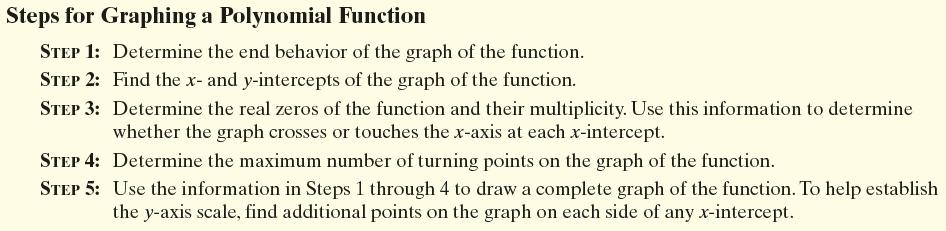
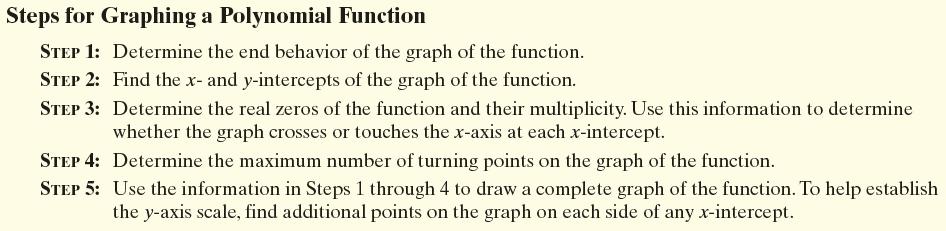
In Problems 5–22, graph each polynomial function by following Steps 1 through 5. f (x) = (x + 4)2 (1 − x) Steps for Graphing a Polynomial Function STEP 1: Determine the end behavior of the graph of the function. STEP 2: Find the x- and y-intercepts of the graph of the function. STEP 3:
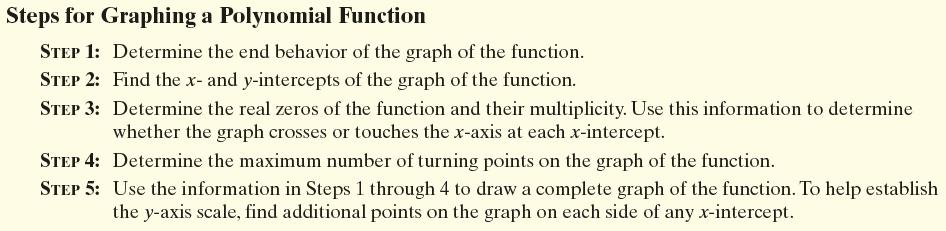
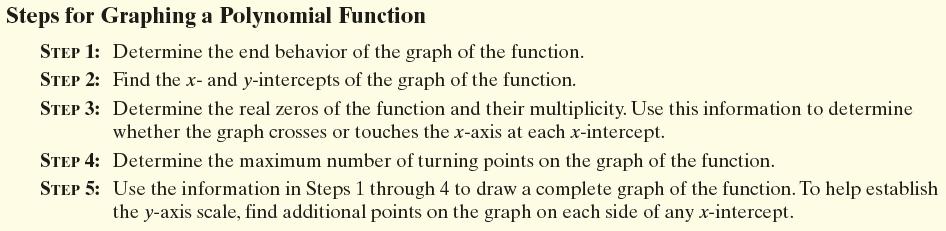
In Problems 5–22, graph each polynomial function by following Steps 1 through 5. f (x) = (x − 1)( x + 3)2 Steps for Graphing a Polynomial Function STEP 1: Determine the end behavior of the graph of the function. STEP 2: Find the x- and y-intercepts of the graph of the function. STEP 3:
Determine the leading term of 3 + 2x − 7x3.
Open the “Multiplicity” interactive figure, which is available in the Video & Resource Library of MyLab Math (under Interactive Figures) or at bit.ly/3raFUGB.(a) Use the slider to set a to 1, b to 2, and c to 1. What are the zeros of f?(b) (i) Leave a set to 1, b to 2, and c to 1. Note the
Open the “Multiplicity” interactive figure, which is available in the Video & Resource Library of MyLab Math (under Interactive Figures) or at bit.ly/3raFUGB.(a) Set the value of c to 1. Set the value of a to 1 and b to 1. What is the degree of the polynomial? How many turning points does
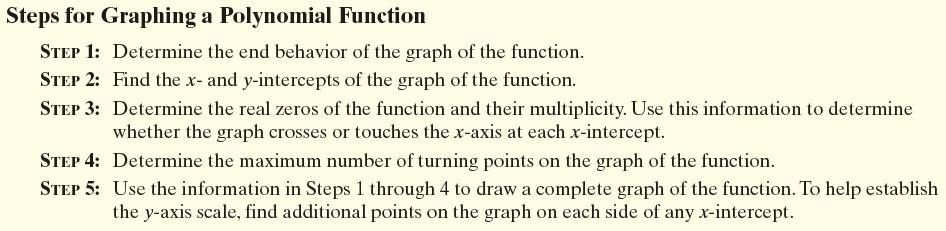
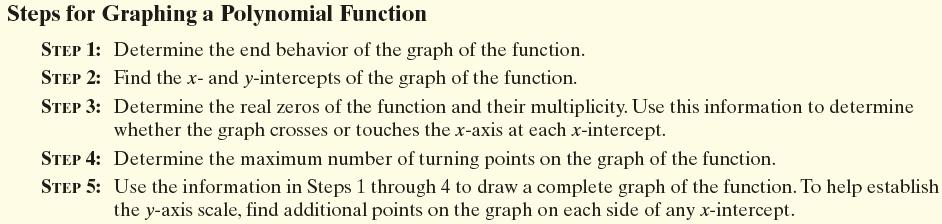
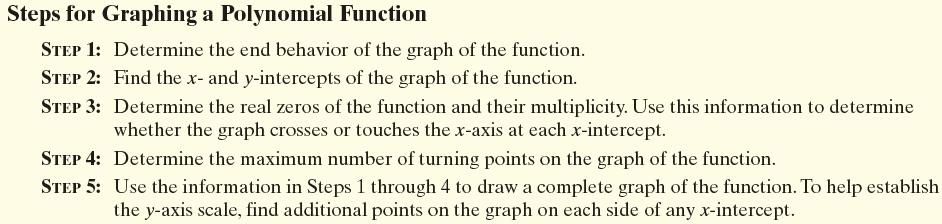
In Problems 5–22, graph each polynomial function by following Steps 1 through 5. f (x) = −2(x + 2)( x − 2)3 Steps for Graphing a Polynomial Function STEP 1: Determine the end behavior of the graph of the function. STEP 2: Find the x- and y-intercepts of the graph of the function. STEP 3:
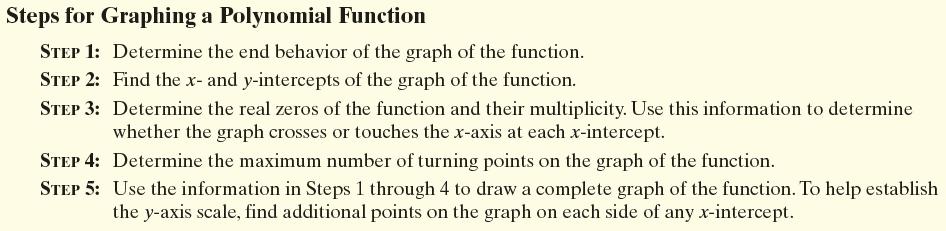
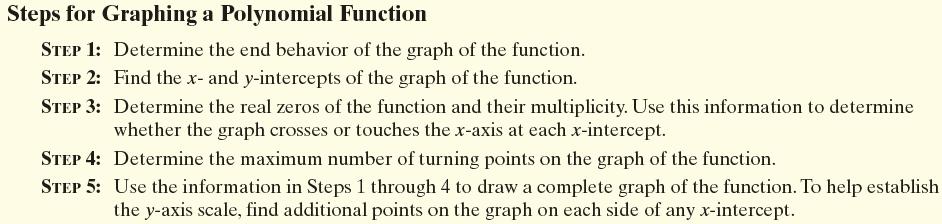
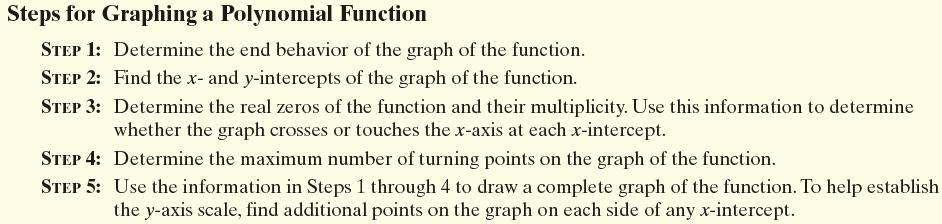
In Problems 5–22, graph each polynomial function by following Steps 1 through 5. Steps for Graphing a Polynomial Function STEP 1: Determine the end behavior of the graph of the function. STEP 2: Find the x- and y-intercepts of the graph of the function. STEP 3: Determine the real zeros of the
In Problems 5–22, graph each polynomial function by following Steps 1 through 5.f (x) = (x + 1)2 (x − 2)2 Steps for Graphing a Polynomial Function STEP 1: Determine the end behavior of the graph of the function. STEP 2: Find the x- and y-intercepts of the graph of the function. STEP 3:
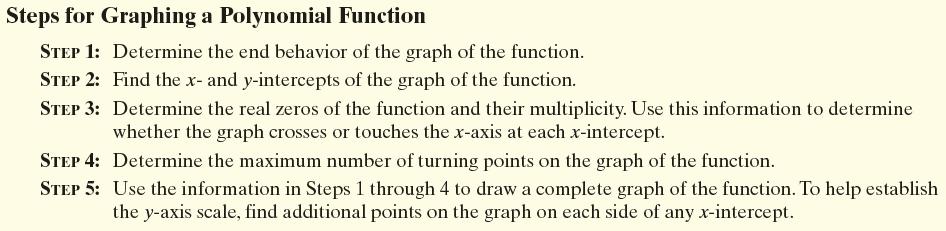
In Problems 5–22, graph each polynomial function by following Steps 1 through 5.f (x) = (x + 1)(x − 2)(x + 4) Steps for Graphing a Polynomial Function STEP 1: Determine the end behavior of the graph of the function. STEP 2: Find the x- and y-intercepts of the graph of the function. STEP 3:
In Problems 17–28, determine which functions are polynomial functions. For those that are, state the degree. For those that are not, state why not. Write each polynomial in standard form. Then identify the leading term and the constant term. h(x) = √x(√x-1)
In Problems 5–22, graph each polynomial function by following Steps 1 through 5.f (x) = −2(x − 1)2 (x2 − 16) Steps for Graphing a Polynomial Function STEP 1: Determine the end behavior of the graph of the function. STEP 2: Find the x- and y-intercepts of the graph of the function. STEP 3:
If r is a real zero of even multiplicity of a polynomial function f , then the graph of f_____ the x -axis at r. (a) Crosses(b) Touches(c) Avoids
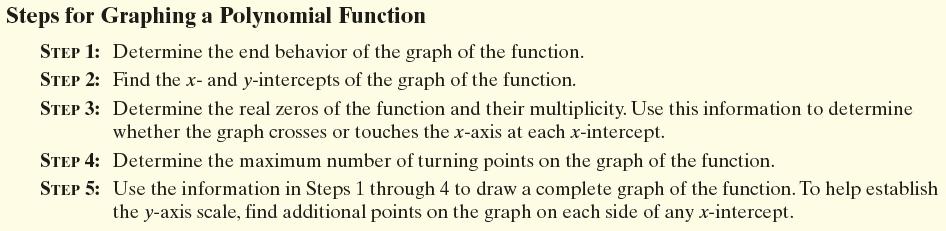
In Problems 31–42, graph each polynomial function f by following Steps 1 through 5.f (x) = x3 + x2 − 12x Steps for Graphing a Polynomial Function STEP 1: Determine the end behavior of the graph of the function. STEP 2: Find the x- and y-intercepts of the graph of the function. STEP 3: Determine
In Problems 5–22, graph each polynomial function by following Steps 1 through 5.f (x) = (x − 2)2 ( x + 2)( x + 4) Steps for Graphing a Polynomial Function STEP 1: Determine the end behavior of the graph of the function. STEP 2: Find the x- and y-intercepts of the graph of the function. STEP 3:
In Problems 5–22, graph each polynomial function by following Steps 1 through 5.f (x) = x2 ( x2 + 1)( x + 4) Steps for Graphing a Polynomial Function STEP 1: Determine the end behavior of the graph of the function. STEP 2: Find the x- and y-intercepts of the graph of the function. STEP 3:
If r is a real solution of the equation f (x) = 0, list three equivalent statements regarding f and r.
In Problems 5–22, graph each polynomial function by following Steps 1 through 5.f (x) = x2 ( x − 2)( x2 + 3) Steps for Graphing a Polynomial Function STEP 1: Determine the end behavior of the graph of the function. STEP 2: Find the x- and y-intercepts of the graph of the function. STEP 3:
The graph of the function f (x) = 3x4 − x3 + 5x2 − 2x − 7 resembles the graph of______ for large values of |x|.
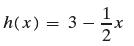
In Problems 17–28, determine which functions are polynomial functions. For those that are, state the degree. For those that are not, state why not. Write each polynomial in standard form. Then identify the leading term and the constant term. h(x) = 3 _ 2 X
The______ of a real zero is the number of times its corresponding factor occurs.(a) Degree(b) Multiplicity(c) Turning point(d) Limit
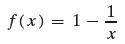
In Problems 17–28, determine which functions are polynomial functions. For those that are, state the degree. For those that are not, state why not. Write each polynomial in standard form. Then identify the leading term and the constant term. f(x) = 1- 1
In Problems 31–42, graph each polynomial function f by following Steps 1 through 5.f (x) = x3 + 0.2x2 − 1.5876x − 0.31752 Steps for Graphing a Polynomial Function STEP 1: Determine the end behavior of the graph of the function. STEP 2: Find the x- and y-intercepts of the graph of the
The graph of y = 5x6 − 3x4 + 2x − 9 has at most how many turning points?(a) − 9(b) 14(c) 6(d) 5
In Problems 17–28, determine which functions are polynomial functions. For those that are, state the degree. For those that are not, state why not. Write each polynomial in standard form. Then identify the leading term and the constant term.f (x) = 4x + x3
In Problems 31–42, graph each polynomial function f by following Steps 1 through 5.f (x) = x3 + 2.56x2 − 3.31x + 0.89 Steps for Graphing a Polynomial Function STEP 1: Determine the end behavior of the graph of the function. STEP 2: Find the x- and y-intercepts of the graph of the function. STEP
In Problems 17–28, determine which functions are polynomial functions. For those that are, state the degree. For those that are not, state why not. Write each polynomial in standard form. Then identify the leading term and the constant term.f (x) = 5x2 + 4x4
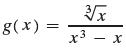
Problems 50–59 are based on previously learned material. The purpose of these problems is to keep the material fresh in your mind so that you are better prepared for later sections, a final exam, or subsequent courses such as calculus.Determine if the function is even, odd, or neither. g(x)
In Problems 31–42, graph each polynomial function f by following Steps 1 through 5.f (x) = x3 + 2x2 − 8x Steps for Graphing a Polynomial Function STEP 1: Determine the end behavior of the graph of the function. STEP 2: Find the x- and y-intercepts of the graph of the function. STEP 3: Determine
In Problems 31–42, graph each polynomial function f by following Steps 1 through 5.f (x) = 2x4 + 12x3 − 8x2 − 48x Steps for Graphing a Polynomial Function STEP 1: Determine the end behavior of the graph of the function. STEP 2: Find the x- and y-intercepts of the graph of the function. STEP
In Problems 17–28, determine which functions are polynomial functions. For those that are, state the degree. For those that are not, state why not. Write each polynomial in standard form. Then identify the leading term and the constant term.f (x) = x(x − 1)
In Problems 31–42, graph each polynomial function f by following Steps 1 through 5.f (x) = 4x3 + 10x2 − 4x − 10 Steps for Graphing a Polynomial Function STEP 1: Determine the end behavior of the graph of the function. STEP 2: Find the x- and y-intercepts of the graph of the function. STEP 3:
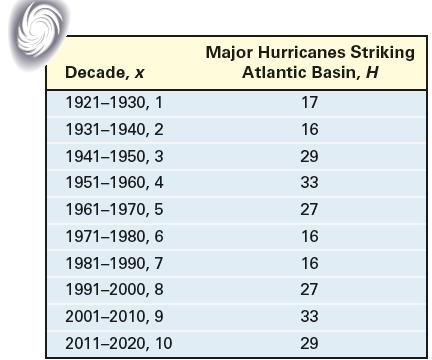
In 2012, Hurricane Sandy struck the East Coast of the United States, killing 147 people and causing an estimated $75 billion in damage. With a gale diameter of about 1000 miles, it was the largest ever to form over the Atlantic Basin. The accompanying data represent the number of major hurricane
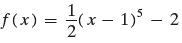
In Problems 29–42, use transformations of the graph of y = x4 or y = x5 to graph each function. f(x)=(x-1)³-2
In Problems 29–42, use transformations of the graph of y = x4 or y = x5 to graph each function.f (x) = (x + 1)4
Suppose f (x) = −ax2 (x − b)(x + c)2, where 0 < a < b < c.(a) Graph f.(b) In what interval(s) is there a local maximum value?(c) Which numbers yield a local minimum value?(d) Where is f (x) < 0?(e) Where is f (−x − 4) < 0?(f) Is f increasing, decreasing, or neither on (−
In Problems 29–42, use transformations of the graph of y = x4 or y = x5 to graph each function.f (x) = (x − 2)5
In Problems 29–42, use transformations of the graph of y = x4 or y = x5 to graph each function.f (x) = x5 − 3
In Problems 29–42, use transformations of the graph of y = x4 or y = x5 to graph each function.f (x) = x4 + 2
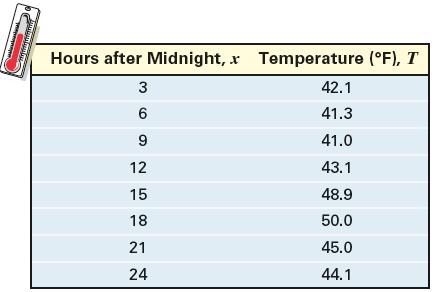
The following data represent the temperature T (°Fahrenheit) in Kansas City, Missouri, x hours after midnight on March 18, 2018.(a) Draw a scatter plot of the data. Comment on the type of relation that may exist between the two variables.(b) Find the average rate of change in temperature from 9 am
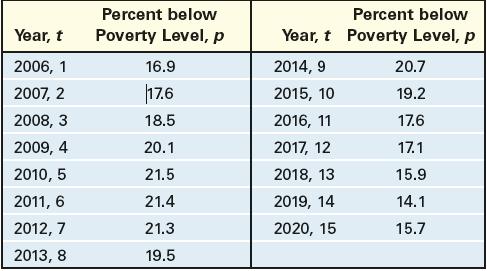
The data on the shown below represent the percentage of families with children in the United States whose income is below the poverty level.(a) With a graphing utility, draw a scatter plot of the data. Comment on the type of relation that appears to exist between the two variables.(b) Decide on a
In Problems 29–42, use transformations of the graph of y = x4 or y = x5 to graph each function.f (x) = −x4
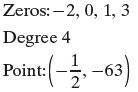
In Problems 51–60, find a polynomial function with the given real zeros whose graph contains the given point. Zeros:-2, 0, 1, 3 Degree 4 Point: int:(-1,-63) 2
In Problems 29–42, use transformations of the graph of y = x4 or y = x5 to graph each function.f (x) = (x + 2)4 − 3
Determine the power function that resembles the end behavior of g(x) = - - - −4x² (4 − 5x)² (2x − 3) ( ½ x + 1)³ 3
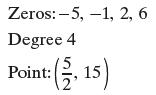
In Problems 51–60, find a polynomial function with the given real zeros whose graph contains the given point. Zeros: -5, 1, 2, 6 Degree 4 Point: (2, 15)
In Problems 29–42, use transformations of the graph of y = x4 or y = x5 to graph each function.f (x) = 4 − (x − 2)5
In Problems 43–50, find a polynomial function whose real zeros and degree are given.Zeros: −5, 0, 6; degree 3
Problems 50–59 are based on previously learned material. The purpose of these problems is to keep the material fresh in your mind so that you are better prepared for later sections, a final exam, or subsequent courses such as calculus.Given f(x) = 2x³7x + 1, find 7x + 1, find ƒ(-1).
Assume that the probability of winning a point on serve or return is treated as constant throughout the match. Further suppose that x is the probability that the better player in a match wins a set.(a) The probability P3 that the better player wins a best-of-three match is P3 (x) = x [1 + 2(1 −
Problems 50–59 are based on previously learned material. The purpose of these problems is to keep the material fresh in your mind so that you are better prepared for later sections, a final exam, or subsequent courses such as calculus.Solve 2 |3x − 1| + 4 > 10.
Problems 50–59 are based on previously learned material. The purpose of these problems is to keep the material fresh in your mind so that you are better prepared for later sections, a final exam, or subsequent courses such as calculus.Determine the function that is graphed if the graph of f (x) =
Problems 50–59 are based on previously learned material. The purpose of these problems is to keep the material fresh in your mind so that you are better prepared for later sections, a final exam, or subsequent courses such as calculus.Find the vertex of the graph of f (x) = −2x2 + 7x − 3.
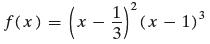
In Problems 61–72, for each polynomial function:(a) List each real zero and its multiplicity.(b) Determine whether the graph crosses or touches the x-axis at each x-intercept.(c) Determine the maximum number of turning points on the graph.(d) Determine the end behavior; that is, find the power
Problems 50–59 are based on previously learned material. The purpose of these problems is to keep the material fresh in your mind so that you are better prepared for later sections, a final exam, or subsequent courses such as calculus.The strain on a solid object varies directly with the external
Problems 50–59 are based on previously learned material. The purpose of these problems is to keep the material fresh in your mind so that you are better prepared for later sections, a final exam, or subsequent courses such as calculus.Find the domain of f (x) = −9 √x − 4 + 1.
Problems 50–59 are based on previously learned material. The purpose of these problems is to keep the material fresh in your mind so that you are better prepared for later sections, a final exam, or subsequent courses such as calculus.Find the average rate of change of f (x) = x2 + 4x − 3from
Problems 50–59 are based on previously learned material. The purpose of these problems is to keep the material fresh in your mind so that you are better prepared for later sections, a final exam, or subsequent courses such as calculus.Find the center and radius of the circle x2 + 4x + y2 − 2y =
Problems 50–59 are based on previously learned material. The purpose of these problems is to keep the material fresh in your mind so that you are better prepared for later sections, a final exam, or subsequent courses such as calculus.How long will it take $5000 to grow to $7500 at a simple
In Problems 61–72, for each polynomial function:(a) List each real zero and its multiplicity.(b) Determine whether the graph crosses or touches the x-axis at each x-intercept.(c) Determine the maximum number of turning points on the graph.(d) Determine the end behavior; that is, find the power
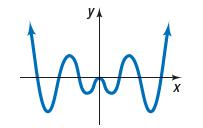
The illustration shows the graph of a polynomial function.(a) Is the degree of the polynomial even or odd?(b) Is the leading coefficient positive or negative?(c) Is the function even, odd, or neither?(d) Why is x2 necessarily a factor of the polynomial?(e) What is the minimum degree of the
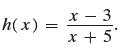
Problems 99–107 are based on previously learned material. The purpose of these problems is to keep the material fresh in your mind so that you are better prepared for later sections, a final exam, or subsequent courses such as calculus.Find the domain of the function h(x) = x - 3 x + 5°
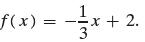
Problems 99–107 are based on previously learned material. The purpose of these problems is to keep the material fresh in your mind so that you are better prepared for later sections, a final exam, or subsequent courses such as calculus.Find the difference quotient of 1 f(x) : = -√x+2. 3
In Problems 61–72, for each polynomial function:(a) List each real zero and its multiplicity.(b) Determine whether the graph crosses or touches the x-axis at each x-intercept.(c) Determine the maximum number of turning points on the graph.(d) Determine the end behavior; that is, find the power
G(x) = (x + 3)2 (x − 2)(a) Identify the x-intercepts of the graph of G.(b) What are the x-intercepts of the graph of y = G(x + 3)?
Consider the function f (x) = 2x3 − 3x2 + 4.(a) Determine the maximum number of turning points on the graph of f .(b) Graph f using a graphing utility with window settings [−5, 5, 1, −10, 10, 1]. Verify that the graph has the maximum number of turning points found in part (a).(c) Determine
Consider the function f (x) = −x4 + 2x2 + 3.(a) Determine the maximum number of turning points on the graph of f.(b) Graph f using a graphing utility with window settings [−5, 5, 1, −10, 10, 1]. Verify that the graph has the maximum number of turning points found in part (a).(c) Determine the
Find the real zeros of f (x) = 3(x2 − 1)(x2 + 4x + 3)2 and their multiplicity.
Problems 99–107 are based on previously learned material. The purpose of these problems is to keep the material fresh in your mind so that you are better prepared for later sections, a final exam, or subsequent courses such as calculus.Find an equation of the line that contains the point (2,
Showing 4800 - 4900
of 29454
First
42
43
44
45
46
47
48
49
50
51
52
53
54
55
56
Last
Step by Step Answers

 Get 50% OFF
Claim Now
Get 50% OFF
Claim Now