New Semester
Started
Get
50% OFF
Study Help!
--h --m --s
Claim Now
Question Answers
Textbooks
Find textbooks, questions and answers
Oops, something went wrong!
Change your search query and then try again
S
Books
FREE
Study Help
Expert Questions
Accounting
General Management
Mathematics
Finance
Organizational Behaviour
Law
Physics
Operating System
Management Leadership
Sociology
Programming
Marketing
Database
Computer Network
Economics
Textbooks Solutions
Accounting
Managerial Accounting
Management Leadership
Cost Accounting
Statistics
Business Law
Corporate Finance
Finance
Economics
Auditing
Tutors
Online Tutors
Find a Tutor
Hire a Tutor
Become a Tutor
AI Tutor
AI Study Planner
NEW
Sell Books
Search
Search
Sign In
Register
study help
mathematics
precalculus
Precalculus Concepts Through Functions A Unit Circle Approach To Trigonometry 5th Edition Michael Sullivan - Solutions
In Problems 25–32, use the given zero to find the remaining zeros of each polynomial function.g(x) = x3 + 3x2 + 25x + 75; zero: −5i
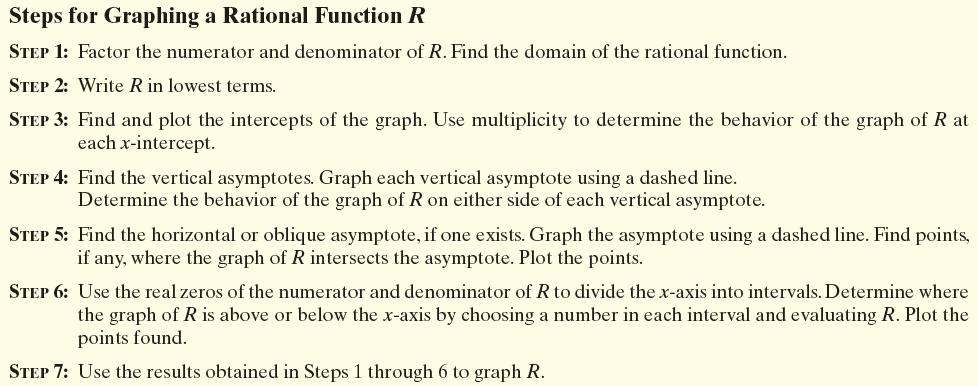
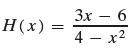
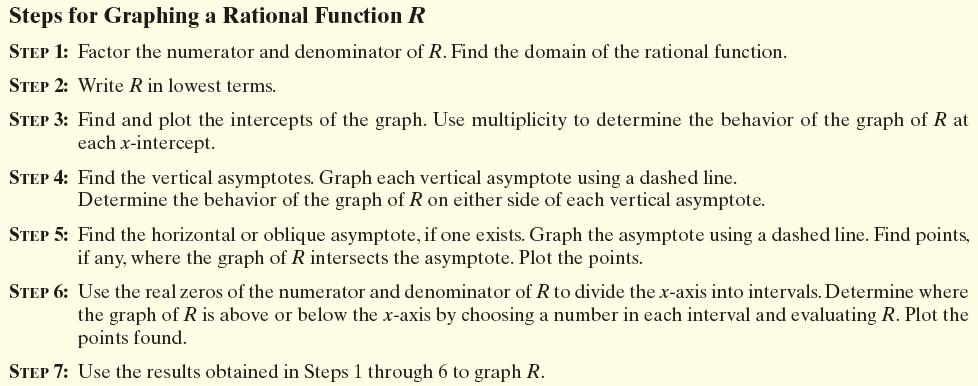
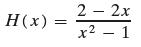
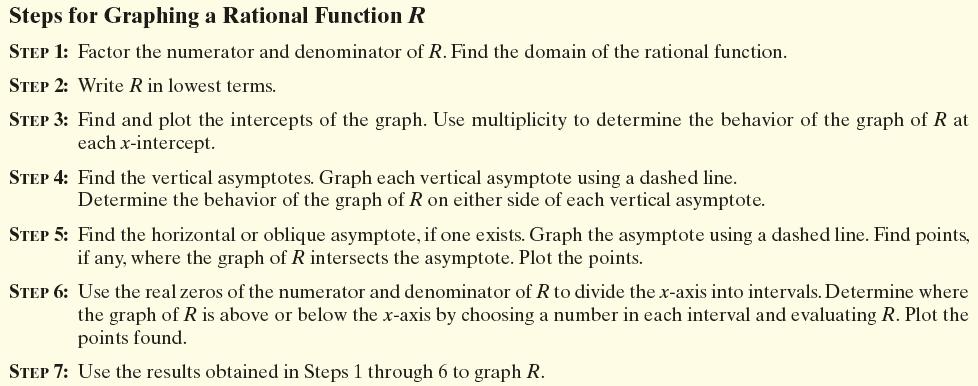
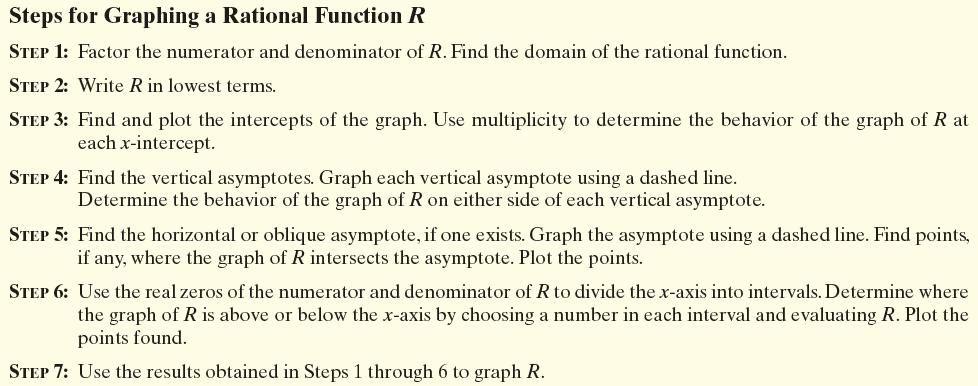
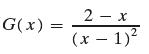
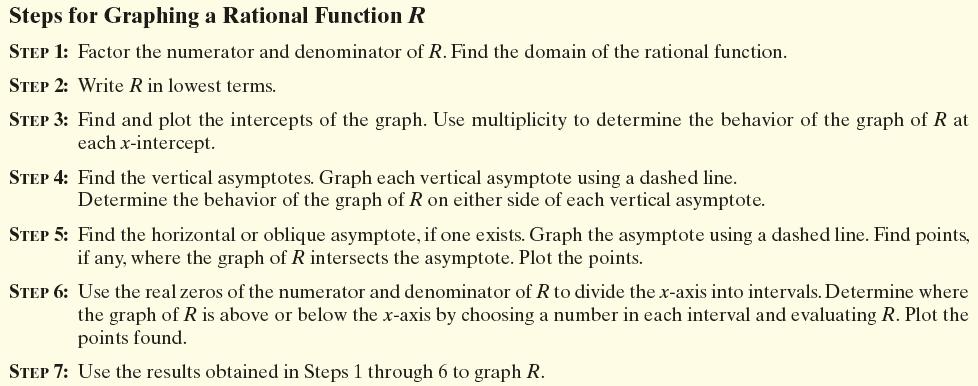
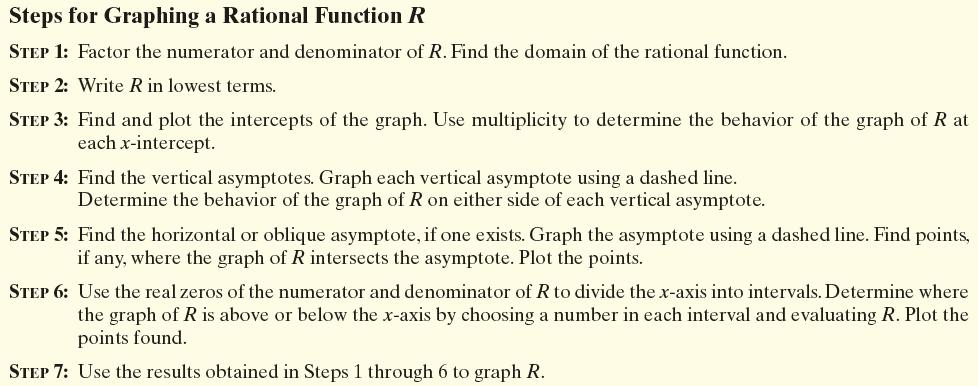
In Problems 7 – 50, follow Steps 1 through 7 shown below to graph each function. Steps for Graphing a Rational Function R STEP 1: Factor the numerator and denominator of R. Find the domain of the rational function. STEP 2: Write R in lowest terms. STEP 3: Find and plot the intercepts of the
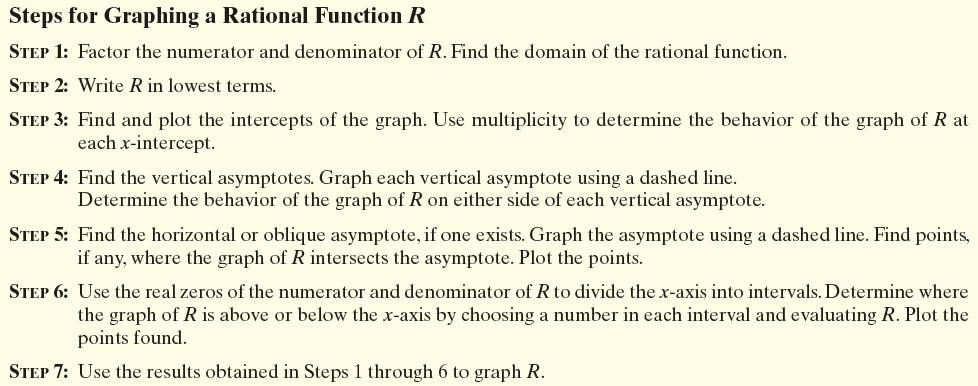
In Problems 7 – 50, follow Steps 1 through 7 shown below to graph each function. Steps for Graphing a Rational Function R STEP 1: Factor the numerator and denominator of R. Find the domain of the rational function. STEP 2: Write R in lowest terms. STEP 3: Find and plot the intercepts of the
In Problems 21–32, determine the maximum number of real zeros that each polynomial function may have. Then use Descartes’ Rule of Signs to determine how many positive and how many negative real zeros each polynomial function may have. Do not attempt to find the zeros.f (x) = x4 + 5x3 − 2
In Problems 7 – 50, follow Steps 1 through 7 shown below to graph each function. Steps for Graphing a Rational Function R STEP 1: Factor the numerator and denominator of R. Find the domain of the rational function. STEP 2: Write R in lowest terms. STEP 3: Find and plot the intercepts of the
In Problems 25–32, use the given zero to find the remaining zeros of each polynomial function.h(x) = 3x4 + 5x3 + 25x2 + 45x − 18; zero: 3i
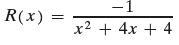
In Problems 33–44,(a) Graph the rational function using transformations,(b) Use the final graph to find the domain and range,(c) Use the final graph to list any vertical, horizontal, or oblique asymptotes. R(x) = -1 x² + 4x + 4
In Problems 7 – 50, follow Steps 1 through 7 shown below to graph each function. Steps for Graphing a Rational Function R STEP 1: Factor the numerator and denominator of R. Find the domain of the rational function. STEP 2: Write R in lowest terms. STEP 3: Find and plot the intercepts of the
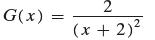
In Problems 33–44,(a) Graph the rational function using transformations,(b) Use the final graph to find the domain and range,(c) Use the final graph to list any vertical, horizontal, or oblique asymptotes. G(x) = 2 (x + 2)²
In Problems 21–32, determine the maximum number of real zeros that each polynomial function may have. Then use Descartes’ Rule of Signs to determine how many positive and how many negative real zeros each polynomial function may have. Do not attempt to find the zeros.f (x) = x6 − 1
In Problems 7 – 50, follow Steps 1 through 7 shown below to graph each function. Steps for Graphing a Rational Function R STEP 1: Factor the numerator and denominator of R. Find the domain of the rational function. STEP 2: Write R in lowest terms. STEP 3: Find and plot the intercepts of the
In Problems 33–44, list the potential rational zeros of each polynomial function. Do not attempt to find the zeros.f (x) = x5 − 2x2 + 8x − 5
In Problems 33–44, list the potential rational zeros of each polynomial function. Do not attempt to find the zeros.f (x) = −4x3 + x2 + x + 6
In Problems 33–44, list the potential rational zeros of each polynomial function. Do not attempt to find the zeros.f (x) = 2x5 − x3 + 2x2 + 12
In Problems 33–44, list the potential rational zeros of each polynomial function. Do not attempt to find the zeros.f (x) = 3x5 − x2 + 2x + 18
A can in the shape of a right circular cylinder is required to have a volume of 500 cubic centimeters. The top and bottom are made of material that costs 6¢ per square centimeter, while the sides are made of material that costs 4¢ per square centimeter.(a) Express the total cost C of the material
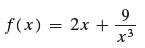
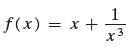
In Problems 7 – 50, follow Steps 1 through 7 shown below to graph each function. Steps for Graphing a Rational Function R STEP 1: Factor the numerator and denominator of R. Find the domain of the rational function. STEP 2: Write R in lowest terms. STEP 3: Find and plot the intercepts of the
In Problems 7 – 50, follow Steps 1 through 7 shown below to graph each function. Steps for Graphing a Rational Function R STEP 1: Factor the numerator and denominator of R. Find the domain of the rational function. STEP 2: Write R in lowest terms. STEP 3: Find and plot the intercepts of the
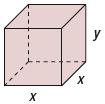
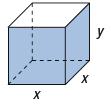
United Parcel Service (UPS) has contracted you to design a closed box with a square base that has a volume of 10,000 cubic inches. See the illustration.(a) Express the surface area S of the box as a function of x.(b) Using a graphing utility, graph the function found in part (a).(c) What is the
Suppose two employees at a fast-food restaurant can serve customers at the rate of 6 customers per minute. Further suppose that customers are arriving at the restaurant at the rate of x customers per minute. The average time T, in minutes, spent waiting in line and having your order taken and
At a fundraiser, each person in attendance is given a ball marked with a different number from 1 through x. All the balls are then placed in an urn, and a ball is chosen at random from the urn. The probability that a particular ball is selected is 1/x. So the probability that a particular ball is
Cougar Packaging has contracted you to design an open box with a square base that has a volume of 5000 cubic inches. See the illustration.(a) Express the surface area S of the box as a function of x.(b) Using a graphing utility, graph the function found in part (a).(c) What is the minimum amount of
To win a game in tennis, a player must win four points. If both players have won three points, the play continues until a player is ahead by two points to win the game. The modelrepresents the probability P of a player winning a game in which the player is serving the game and x is the probability
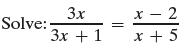
Problems 76–85 are based on previously learned material. The purpose of these problems is to keep the material fresh in your mind so that you are better prepared for later sections, a final exam, or subsequent courses such as calculus. Solve: 3x 3x + 1 || x - 2 2 x +5
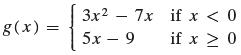
Problems 76–85 are based on previously learned material. The purpose of these problems is to keep the material fresh in your mind so that you are better prepared for later sections, a final exam, or subsequent courses such as calculus.Find g(3) where g(x) = 3x²7x if x < 0 if x > 0 6 - xç
Problems 76–85 are based on previously learned material. The purpose of these problems is to keep the material fresh in your mind so that you are better prepared for later sections, a final exam, or subsequent courses such as calculus.Subtract: (4x3 − 7x + 1) − (5x2 − 9x + 3)
Problems 76–85 are based on previously learned material. The purpose of these problems is to keep the material fresh in your mind so that you are better prepared for later sections, a final exam, or subsequent courses such as calculus.Find the absolute maximum of f (x) = −2/3 x2 + 6x − 5.
Problems 76–85 are based on previously learned material. The purpose of these problems is to keep the material fresh in your mind so that you are better prepared for later sections, a final exam, or subsequent courses such as calculus.Find the vertex of the graph of f (x) = 3x2 − 12x + 7.
Problems 76–85 are based on previously learned material. The purpose of these problems is to keep the material fresh in your mind so that you are better prepared for later sections, a final exam, or subsequent courses such as calculus.Find the function whose graph is the same as the graph of y =
Problems 76–85 are based on previously learned material. The purpose of these problems is to keep the material fresh in your mind so that you are better prepared for later sections, a final exam, or subsequent courses such as calculus.Given f (x) = x2 + 3x − 2, find f (x − 2).
Problems 76–85 are based on previously learned material. The purpose of these problems is to keep the material fresh in your mind so that you are better prepared for later sections, a final exam, or subsequent courses such as calculus.Determine whether the lines y = 3x − 2 and 2x + 6y = 7 are
Problems 76–85 are based on previously learned material. The purpose of these problems is to keep the material fresh in your mind so that you are better prepared for later sections, a final exam, or subsequent courses such as calculus. Solve: x - √x + 7 = 5
Problems 76–85 are based on previously learned material. The purpose of these problems is to keep the material fresh in your mind so that you are better prepared for later sections, a final exam, or subsequent courses such as calculus. Solve: 2 -x² √4x² +√4 − x² = 0
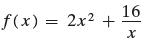
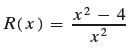
In Problems 33–44,(a) Graph the rational function using transformations,(b) Use the final graph to find the domain and range,(c) Use the final graph to list any vertical, horizontal, or oblique asymptotes. R(x) = x² - 4 X
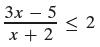
In Problems 19–54, solve each inequality algebraically. 3x - 5 x + 2 ≤2
In Problems 33–44, list the potential rational zeros of each polynomial function. Do not attempt to find the zeros.f (x) = 6x4 + 2x3 − x2 + 20
In Problems 19–54, solve each inequality algebraically. x + 1 x - 3 2
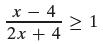
In Problems 19–54, solve each inequality algebraically. x - 4 2x + 4 IV 1
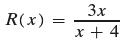
In Problems 45–56, find the vertical, horizontal, and oblique asymptotes, if any, of each rational function. R(x) = 3x x +4
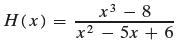
In Problems 45–56, find the vertical, horizontal, and oblique asymptotes, if any, of each rational function. H (x) = x2 x38 − 5x +6
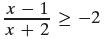
In Problems 19–54, solve each inequality algebraically. x-1 x + 2 ≥ -2
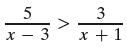
In Problems 19–54, solve each inequality algebraically. 5 x - 3 V 3 x + 1
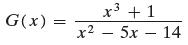
In Problems 45–56, find the vertical, horizontal, and oblique asymptotes, if any, of each rational function. G(x) x³ + 1 x2 – 5x – 14
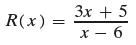
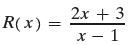
In Problems 45–56, find the vertical, horizontal, and oblique asymptotes, if any, of each rational function. R(x) = 3x + 5 x-6
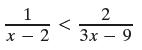
In Problems 19–54, solve each inequality algebraically. 1 x-2 V 2 3x - 9
Suppose f (x) = 2x3 − 14x2 + bx − 3 with f (2) = 0 and g( x) = x3 + cx2 − 8x + 30, with the zero x = 3 − i, where b and c are real numbers. Find ( f · g )(1).†
In Problems 33–44, list the potential rational zeros of each polynomial function. Do not attempt to find the zeros. f(x) = -6x3x + x + 10
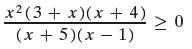
In Problems 19–54, solve each inequality algebraically. x² (3+x)(x + 4) (x + 5)(x - 1) ≥ 0
Let f be the polynomial function of degree 4 with real coefficients, leading coefficient 1, and zeros x = 3 + i, 2, −2. Let g be the polynomial function of degree 4 with intercept (0, −4) and zeros x = i, 2i.Find ( f + g )(1).†
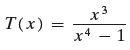
In Problems 45–56, find the vertical, horizontal, and oblique asymptotes, if any, of each rational function. T(x) x3 x4 - 1
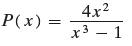
In Problems 45–56, find the vertical, horizontal, and oblique asymptotes, if any, of each rational function. P(x) = 4x² 3-1 x 3
The complex zeros of f (x) = x4 + 1 For the function f (x) = x4 + 1:(a) Factor f into the product of two irreducible quadratics.(b) Find the zeros of f by finding the zeros of each irreducible quadratic.
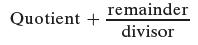
The standard form of the rational functionTo write a rational function in standard form requires polynomial division.(a) Write the rational function in standard form by writing R in the form (b) Graph R using transformations.(c) Find the vertical asymptote and the horizontal asymptote of R.
Problems 51 – 60 are based on previously learned material. The purpose of these problems is to keep the material fresh in your mind so that you are better prepared for later sections, a final exam, or subsequent courses such as calculus.If and state its domain. f(x) = x + X 1 and g(x) = 3x - 2,
Problems 51 – 60 are based on previously learned material. The purpose of these problems is to keep the material fresh in your mind so that you are better prepared for later sections, a final exam, or subsequent courses such as calculus.Draw a scatter plot for the given data. X у -1 1 -4
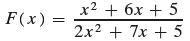
In Problems 45–56, find the vertical, horizontal, and oblique asymptotes, if any, of each rational function. F(x)= x² + 6x + 5 2x² + 7x + 5
In Problems 45–56, use the Rational Zeros Theorem to find all the real zeros of each polynomial function. Use the zeros to factor f over the real numbers.f (x) = x3 + 8x2 + 11x − 20
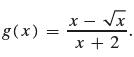
Problems 51 – 60 are based on previously learned material. The purpose of these problems is to keep the material fresh in your mind so that you are better prepared for later sections, a final exam, or subsequent courses such as calculus.Find the domain of g(x) = x - √x x + 2
Problems 51 – 60 are based on previously learned material. The purpose of these problems is to keep the material fresh in your mind so that you are better prepared for later sections, a final exam, or subsequent courses such as calculus.Rationalize the numerator: √x - 3 x + 7
For the polynomial function f (x) = x2 + 2ix − 10:(a) Verify that 3 − i is a zero of f.(b) Verify that 3 + i is not a zero of f.(c) Explain why these results do not contradict the Conjugate Pairs Theorem.
Problems 67–76 are based on previously learned material. The purpose of these problems is to keep the material fresh in your mind so that you are better prepared for later sections, a final exam, or subsequent courses such as calculus. Solve: (3x7) + 1 = X 4 - 2
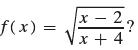
What is the domain of the function f(x) = x 2 x + 4
Problems 51 – 60 are based on previously learned material. The purpose of these problems is to keep the material fresh in your mind so that you are better prepared for later sections, a final exam, or subsequent courses such as calculus.Given f (x) = √3 − x, find x so that f (x) = 5.
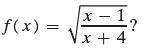
What is the domain of the function f(x) = - 1? x-1 x + 4
Problems 51 – 60 are based on previously learned material. The purpose of these problems is to keep the material fresh in your mind so that you are better prepared for later sections, a final exam, or subsequent courses such as calculus.Multiply: (2x − 5) (3x2 + x − 4 )
Problems 51 – 60 are based on previously learned material. The purpose of these problems is to keep the material fresh in your mind so that you are better prepared for later sections, a final exam, or subsequent courses such as calculus.Find the area and circumference of a circle with a diameter
Problems 51 – 60 are based on previously learned material. The purpose of these problems is to keep the material fresh in your mind so that you are better prepared for later sections, a final exam, or subsequent courses such as calculus.Solve x = √y + 3 − 5 for y.
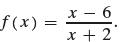
Problems 67–76 are based on previously learned material. The purpose of these problems is to keep the material fresh in your mind so that you are better prepared for later sections, a final exam, or subsequent courses such as calculus.Find the intercepts of the graph of f(x) = 9-x x + 2
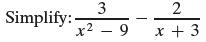
Problems 67–76 are based on previously learned material. The purpose of these problems is to keep the material fresh in your mind so that you are better prepared for later sections, a final exam, or subsequent courses such as calculus. Simplify: 3 x² - 9 2 x + 3
Problems 51 – 60 are based on previously learned material. The purpose of these problems is to keep the material fresh in your mind so that you are better prepared for later sections, a final exam, or subsequent courses such as calculus.Find the intercepts of the graph of the equation 3x + y2 =
Problems 51 – 60 are based on previously learned material. The purpose of these problems is to keep the material fresh in your mind so that you are better prepared for later sections, a final exam, or subsequent courses such as calculus.Find the difference quotient of f (x) = x3 + 8.
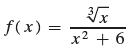
Problems 67–76 are based on previously learned material. The purpose of these problems is to keep the material fresh in your mind so that you are better prepared for later sections, a final exam, or subsequent courses such as calculus.Determine whether the function is even, odd, or neither. f(x)
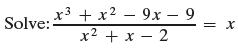
Problems 67–76 are based on previously learned material. The purpose of these problems is to keep the material fresh in your mind so that you are better prepared for later sections, a final exam, or subsequent courses such as calculus. x³ + x² Solve:* 9x - 9 x² + x - 2 X
What is the domain of the function f (x) = √x3 − 3x2 ?
Problems 67–76 are based on previously learned material. The purpose of these problems is to keep the material fresh in your mind so that you are better prepared for later sections, a final exam, or subsequent courses such as calculus.Find the equation of a vertical line passing through the point
Problems 67–76 are based on previously learned material. The purpose of these problems is to keep the material fresh in your mind so that you are better prepared for later sections, a final exam, or subsequent courses such as calculus.Is the graph of the equation 2x3 − xy2 = 4 symmetric with
Problems 67–76 are based on previously learned material. The purpose of these problems is to keep the material fresh in your mind so that you are better prepared for later sections, a final exam, or subsequent courses such as calculus.What are the points of intersection of the graphs of the
Problems 67–76 are based on previously learned material. The purpose of these problems is to keep the material fresh in your mind so that you are better prepared for later sections, a final exam, or subsequent courses such as calculus.Use a graphing utility to find the local maximum of f (x) = x3
Problems 67–76 are based on previously learned material. The purpose of these problems is to keep the material fresh in your mind so that you are better prepared for later sections, a final exam, or subsequent courses such as calculus.Where is f (x) = 5x2 − 13x − 6 < 0?
Suppose that f (x) = 4x3 − 11x2 − 26x + 24. Find the real zeros of f (x − 2).
In Problems 45–56, use the Rational Zeros Theorem to find all the real zeros of each polynomial function. Use the zeros to factor f over the real numbers.f (x) = x4 + x3 − 3x2 − x + 2
In Problems 45–56, use the Rational Zeros Theorem to find all the real zeros of each polynomial function. Use the zeros to factor f over the real numbers.f (x) = x4 − x3 − 6x2 + 4x + 8
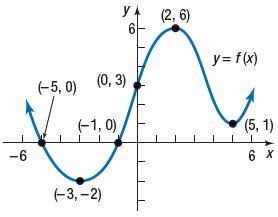
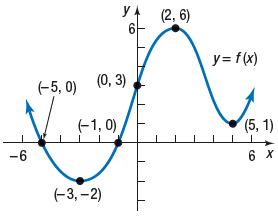
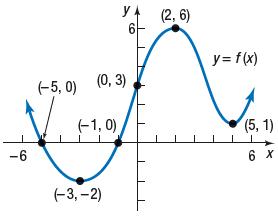
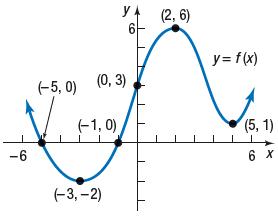
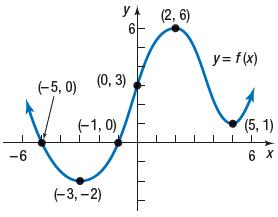
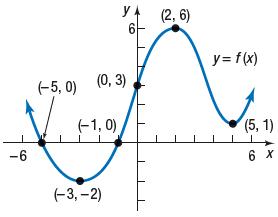
Problems 126 – 135 are based on previously learned material. The purpose of these problems is to keep the material fresh in your mind so that you are better prepared for later sections, a final exam, or subsequent courses such as calculus.For Problems 130 – 135 , use the graph given below.On
In Problems 57–68, solve each equation in the real number system.2x3 − 3x2 − 3x − 5 = 0
Problems 126 – 135 are based on previously learned material. The purpose of these problems is to keep the material fresh in your mind so that you are better prepared for later sections, a final exam, or subsequent courses such as calculus.For Problems 130 – 135, use the graph given below.On
In Problems 69–78, find bounds on the real zeros of each polynomial function.f (x) = −x4 + 3x3 − 4x2 − 2x + 9
For Problems 130 – 135, use the graph given below.What are the turning points? -6 (-5,0) (0,3) (-1,0) y YA 6 (-3,-2) (2,6) y = f(x) (5, 1) 6 X
Problems 126 – 135 are based on previously learned material. The purpose of these problems is to keep the material fresh in your mind so that you are better prepared for later sections, a final exam, or subsequent courses such as calculus.For Problems 130 – 135, use the graph given below.What
For Problems 130 – 135, use the graph given below.What are the intercepts of the graph of f ? -6 (-5,0) (0,3) (-1,0) y YA 6 (-3,-2) (2,6) y = f(x) (5, 1) 6 X
For Problems 130 – 135, use the graph given below.What are the absolute extrema, if any? -6 (-5,0) (0,3) (-1,0) y YA 6 (-3,-2) (2,6) y = f(x) (5, 1) 6 X
In Problems 69–78, find bounds on the real zeros of each polynomial function.f (x) = −4x5 + 5x3 + 9x2 + 3x − 12
In Problems 79–84, use the Intermediate Value Theorem to show that each polynomial function has a real zero in the given interval.f (x) = x5 − x4 + 7x3 − 7x2 − 18x + 18; [1.4, 1.5]
Suppose that f (x) = 3x3 + 16x2 + 3x − 10. Find the real zeros of f (x + 3).
Find k so that x − 2 is a factor of f (x) = x3 − kx2 + kx + 2.
Suppose f is a polynomial function. If f (−2) = 7 and f (6) = −1, then the Intermediate Value Theorem guarantees which of the following? Justify your answer.(a) f (0) = 0(b) f (c) = 3 for at least one number c between − 2 and 6.(c) f (c) = 0 for at least one number between − 1 and 7.(d) −
Use the Intermediate Value Theorem to show that the functions y = x3 and y = 1 − x2 intersect somewhere between x = 0 and x = 1.
Problems 126 – 135 are based on previously learned material. The purpose of these problems is to keep the material fresh in your mind so that you are better prepared for later sections, a final exam, or subsequent courses such as calculus.Write f (x) = −3x2 + 30x − 4 in the form f (x) = a(x
Problems 126 – 135 are based on previously learned material. The purpose of these problems is to keep the material fresh in your mind so that you are better prepared for later sections, a final exam, or subsequent courses such as calculus.Express the inequality 3 ≤ x < 8 using interval
Problems 126 – 135 are based on previously learned material. The purpose of these problems is to keep the material fresh in your mind so that you are better prepared for later sections, a final exam, or subsequent courses such as calculus.Solve 2x − 5y = 3 for y.
Problems 126 – 135 are based on previously learned material. The purpose of these problems is to keep the material fresh in your mind so that you are better prepared for later sections, a final exam, or subsequent courses such as calculus.Solve 1/3 x2 − 2x + 9 = 0.
Showing 4500 - 4600
of 29454
First
39
40
41
42
43
44
45
46
47
48
49
50
51
52
53
Last
Step by Step Answers

 Get 50% OFF
Claim Now
Get 50% OFF
Claim Now