New Semester
Started
Get
50% OFF
Study Help!
--h --m --s
Claim Now
Question Answers
Textbooks
Find textbooks, questions and answers
Oops, something went wrong!
Change your search query and then try again
S
Books
FREE
Study Help
Expert Questions
Accounting
General Management
Mathematics
Finance
Organizational Behaviour
Law
Physics
Operating System
Management Leadership
Sociology
Programming
Marketing
Database
Computer Network
Economics
Textbooks Solutions
Accounting
Managerial Accounting
Management Leadership
Cost Accounting
Statistics
Business Law
Corporate Finance
Finance
Economics
Auditing
Tutors
Online Tutors
Find a Tutor
Hire a Tutor
Become a Tutor
AI Tutor
AI Study Planner
NEW
Sell Books
Search
Search
Sign In
Register
study help
mathematics
precalculus
Thomas Calculus Early Transcendentals 13th Edition Joel R Hass, Christopher E Heil, Maurice D Weir - Solutions
Replace the Cartesian equations with equivalent polar equations.(x - 5)2 + y2 = 25
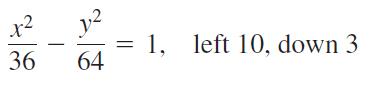
Give equations for conic sections and tell how many units up or down and to the right or left each curve is to be shifted. Find an equation for the new conic section, and find the new foci, vertices, centers, and asymptotes, as appropriate. If the curve is a parabola, find the new directrix as
Graph the lines and conic section.r = 3 sec (θ - π/3)
Find the center, foci, vertices, asymptotes, and radius, as appropriate, of the conic section.x2 - y2 - 2x + 4y = 4
Give equations for conic sections and tell how many units up or down and to the right or left each curve is to be shifted. Find an equation for the new conic section, and find the new foci, vertices, centers, and asymptotes, as appropriate. If the curve is a parabola, find the new directrix as
Replace the Cartesian equations with equivalent polar equations.(x - 3)2 + (y + 1)2 = 4
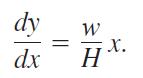
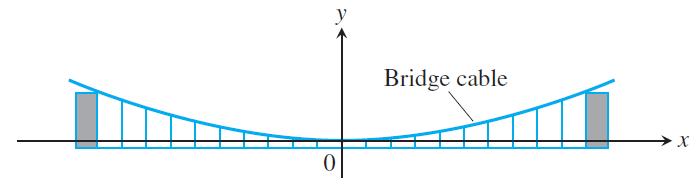
The suspension bridge cable shown in the accompanying figure supports a uniform load of w pounds per horizontal foot. It can be shown that if H is the horizontal tension of the cable at the origin, then the curve of the cable satisfies the equationShow that the cable hangs in a parabola by solving
Graph the lines and conic section.r = 4 sec (θ + π/6)
Find the center, foci, vertices, asymptotes, and radius, as appropriate, of the conic section.x2 - y2 + 4x - 6y = 6
Replace the Cartesian equations with equivalent polar equations.(x + 2)2 + (y - 5)2 = 16
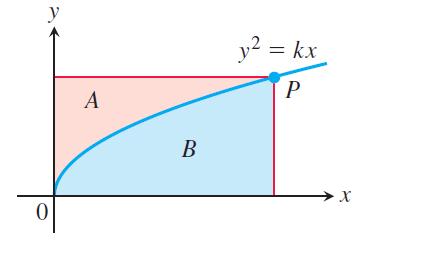
If lines are drawn parallel to the coordinate axes through a point P on the parabola y2 = kx, k > 0, the parabola partitions the rectangular region bounded by these lines and the coordinate axes into two smaller regions, A and B.a. If the two smaller regions are revolved about the y-axis, show
Graph the lines and conic section.r = 4 sin θ
Find the center, foci, vertices, asymptotes, and radius, as appropriate, of the conic section.2x2 - y2 + 6y = 3
Find all polar coordinates of the origin.
Show that the vertical distance between the line y = (b/a)x and the upper half of the right-hand branch y = (b/a)√x2 - a2 of the hyperbola (x2/a2) - (y2/b2) = 1 approaches 0 by showing thatSimilar results hold for the remaining portions of the hyperbola and the lines y = ±(b/a)x. lim b (2x -
Graph the lines and conic section.r = -2 cos θ
Find the center, foci, vertices, asymptotes, and radius, as appropriate, of the conic section.y2 - 4x2 + 16x = 24
a. Show that every vertical line in the xy-plane has a polar equation of the form r = a sec θ.b. Find the analogous polar equation for horizontal lines in the xy-plane.
Graph the lines and conic section.r = 8/(4 + cos θ)
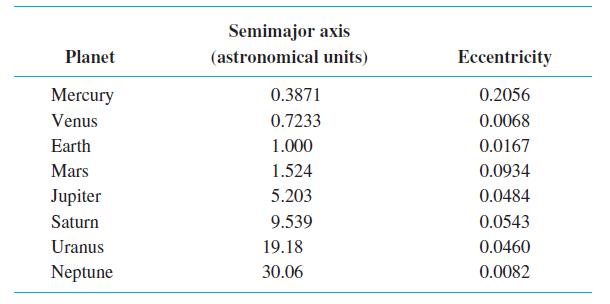
Use the data in the table below and Equation (6) to find polar equations for the orbits of the planets. Planet Mercury Venus Earth Mars Jupiter Saturn Uranus Neptune Semimajor axis (astronomical
Complete the squares to identify the conic sections. Find their foci, vertices, centers, and asymptotes (as appropriate). If the curve is a parabola, find its directrix as well.x2 - 4x - 4y2 = 0
Graph the lines and conic section.r = 8/(4 + sin θ)
Complete the squares to identify the conic sections Find their foci, vertices, centers, and asymptotes (as appropriate). If the curve is a parabola, find its directrix as well.4x2 - y2 + 4y = 8
Graph the lines and conic section.r = 1/(1 - sin θ)
Show that the number 4p is the width of the parabola x2 = 4py (p > 0) at the focus by showing that the line y = p cuts the parabola at points that are 4p units apart.
Complete the squares to identify the conic sections Find their foci, vertices, centers, and asymptotes (as appropriate). If the curve is a parabola, find its directrix as well.y2 - 2y + 16x = -49
Graph the lines and conic section.r = 1/(1 + cos θ)
Complete the squares to identify the conic sections Find their foci, vertices, centers, and asymptotes (as appropriate). If the curve is a parabola, find its directrix as well.x2 - 2x + 8y = -17
Graph the lines and conic section.r = 1/(1 + 2 sin θ)
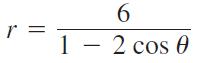
Sketch the conic sections whose polar coordinate equations are given. Give polar coordinates for the vertices and, in the case of ellipses, for the centers as well. r 6 1 - 2 cos 0
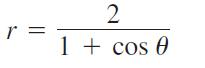
Sketch the conic sections whose polar coordinate equations are given. Give polar coordinates for the vertices and, in the case of ellipses, for the centers as well. r || 2 1 + cos 0 Ꮎ
Find the dimensions of the rectangle of largest area that can be inscribed in the ellipse x2 + 4y2 = 4 with its sides parallel to the coordinate axes. What is the area of the rectangle?
Complete the squares to identify the conic sections Find their foci, vertices, centers, and asymptotes (as appropriate). If the curve is a parabola, find its directrix as well.9x2 + 16y2 + 54x - 64y = -1
Graph the lines and conic section.r = 1/(1 + 2 cos θ)
The “triangular” region in the first quadrant bounded by the x-axis, the line x = 4, and the hyperbola 9x2 - 4y2 = 36 is revolved about the x-axis to generate a solid. Find the volume of the solid.
Complete the squares to identify the conic sections Find their foci, vertices, centers, and asymptotes (as appropriate). If the curve is a parabola, find its directrix as well.25x2 + 9y2 - 100x + 54y = 44
Find the volume of the solid generated by revolving the region enclosed by the ellipse 9x2 + 4y2 = 36 about the (a) x-axis, (b) y-axis.
Complete the squares to identify the conic sections Find their foci, vertices, centers, and asymptotes (as appropriate). If the curve is a parabola, find its directrix as well.x2 + y2 - 2x - 2y = 0
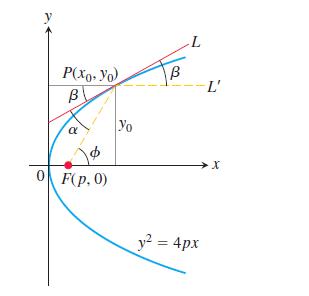
The accompanying figure shows a typical point P(x0, y0) on the parabola y2 = 4px. The line L is tangent to the parabola at P. The parabola’s focus lies at F( p, 0). The ray L′ extending from P to the right is parallel to the x-axis. We show that light from F to P will be reflected out along
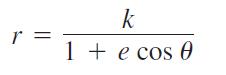
Show that the equations x = r cos θ, y = r sin θ transform the polar equationinto the Cartesian equation r k 1 + e cos 0
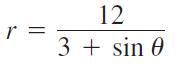
Sketch the conic sections whose polar coordinate equations are given. Give polar coordinates for the vertices and, in the case of ellipses, for the centers as well. r || 12 3+ sin 0
Show that the tangents to the curve y2 = 4px from any point on the line x = -p are perpendicular.
Complete the squares to identify the conic sections Find their foci, vertices, centers, and asymptotes (as appropriate). If the curve is a parabola, find its directrix as well.x2 + y2 + 4x + 2y = 1
Find equations for the tangents to the circle (x - 2)2 + ( y - 1)2 = 5 at the points where the circle crosses the coordinate axes.
The region bounded on the left by the y-axis, on the right by the hyperbola x2 - y2 = 1, and above and below by the lines y = ±3 is revolved about the y-axis to generate a solid. Find the volume of the solid.
Find the centroid of the region that is bounded below by the x-axis and above by the ellipse (x2/9) + (y2/16) = 1.
The curve y = √x2 + 1, 0 ≤ x ≤ √2, which is part of the upper branch of the hyperbola y2 - x2 = 1, is revolved about the x-axis to generate a surface. Find the area of the surface.
Find the centers and radii of the sphere. (x - √2)² + (y-√2)² + (z + √2)² = 2
Give the eccentricities of conic sections with one focus at the origin of the polar coordinate plane, along with the directrix for that focus. Find a polar equation for each conic section.e = 2, r cos θ = 2
Give the eccentricities of conic sections with one focus at the origin of the polar coordinate plane, along with the directrix for that focus. Find a polar equation for each conic section.e = 1, r cos θ = -4
Give the eccentricities of conic sections with one focus at the origin of the polar coordinate plane, along with the directrix for that focus. Find a polar equation for each conic section.e = 1/2, r sin θ = 2
Give the eccentricities of conic sections with one focus at the origin of the polar coordinate plane, along with the directrix for that focus. Find a polar equation for each conic section.e = 1/3, r sin θ = -6
Find the volume of the solid generated by revolving the region enclosed by the ellipse 9x2 + 4y2 = 36 about (a) The x-axis, (b) The y-axis.
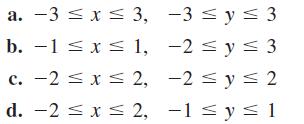
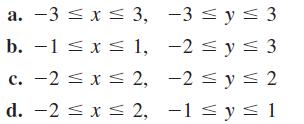
Plot the surfaces over the indicated domains. If you can, rotate the surface into different viewing positions.z = 1 - y2, -2 ≤ x ≤ 2, -2 ≤ y ≤ 2 a. -3 ≤ x ≤ 3, b. -1 ≤ x ≤ 1, c. -2 ≤ x ≤ 2, d. 2 ≤ x ≤ 2, -3 ≤ y ≤ 3 -2 ≤ y ≤ 3 -2≤ y ≤ 2 -1 ≤ y ≤ 1
The “triangular” region in the first quadrant bounded by the x-axis, the line x = 4, and the hyperbola 9x2 - 4y2 = 36 is revolved about the x-axis to generate a solid. Find the volume of the solid.
Plot the surfaces over the indicated domains. If you can, rotate the surface into different viewing positions.z = x2 + y2, -3 ≤ x ≤ 3, -3 ≤ y ≤ 3 a. -3 ≤ x ≤ 3, b. -1 ≤ x ≤ 1, c. -2 ≤ x ≤ 2, d. 2 ≤ x ≤ 2, -3 ≤ y ≤ 3 -2 ≤ y ≤ 3 -2≤ y ≤ 2 -1 ≤ y ≤ 1
Sketch the surfaces.y2 + z2 - x2 = 1
Write inequalities to describe the set.The closed region bounded by the spheres of radius 1 and radius 2 centered at the origin.
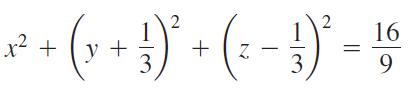
Find the centers and radii of the sphere. 2 16 ₁² + ( x + ²)² + ( ² − 1 ) ² = ¹6 3 3 9
What speed and direction should the jetliner in Example 8 have in order for the resultant vector to be 500 mph due east? In Example 8 EXAMPLE 8 A jet airliner, flying due east at 500 mph in still air, encounters a 70-mph tailwind blowing in the direction 60 north of east. The airplane holds its
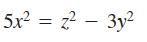
Use a CAS to plot the surface. Identify the type of quadric surface from your graph. 5x² = = 2² - 3y²
Sketch the surfaces.x2 + y2 = z
Find a 2 * 2 determinant formula for the area of the triangle in the xy-plane with vertices at (0, 0), (a1, a2), and (b1, b2). Explain your work.
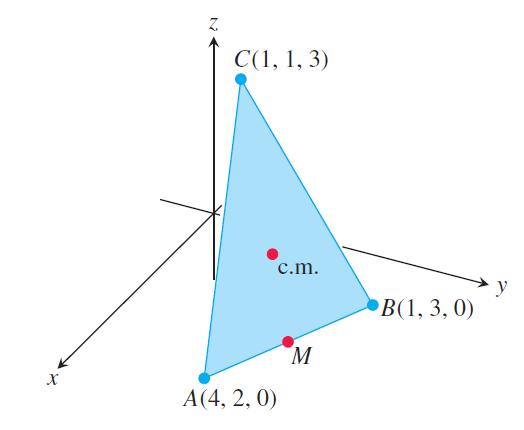
Suppose that A, B, and C are the corner points of the thin triangular plate of constant density shown here.a. Find the vector from C to the midpoint M of side AB.b. Find the vector from C to the point that lies two-thirds of the way from C to M on the median CM.c. Find the coordinates of the point
A bird flies from its nest 5 km in the direction 60° north of east, where it stops to rest on a tree. It then flies 10 km in the direction due southeast and lands atop a telephone pole. Place an xy-coordinate system so that the origin is the bird’s nest, the x-axis points east, and the y-axis
Use a calculator to find the acute angles between the planes to the nearest hundredth of a radian.x + y + z = 1, z = 0 (the xy-plane)
Suppose that A, B, and C are vertices of a triangle and that a, b, and c are, respectively, the midpoints of the opposite sides. Show that Aa + Bb + Cc = 0.
Find a concise 3 * 3 determinant formula that gives the area of a triangle in the xy-plane having vertices (a1, a2), (b1, b2), and (c1, c2).
Use similar triangles to find the coordinates of the point Q that divides the segment from P1(x1, y1, z1) to P2(x2, y2, z2) into two lengths whose ratio is p/q = r.
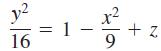
Use a CAS to plot the surface. Identify the type of quadric surface from your graph. 以 16 1 我 9 + z
Use a calculator to find the acute angles between the planes to the nearest hundredth of a radian.2x + 2y - z = 3, x + 2y + z = 2
In r(t) is the position of a particle in the xy-plane at time t. Find an equation in x and y whose graph is the path of the particle. Then find the particle’s velocity and acceleration vectors at the given value of t. 2 1 j, t = I ? / + 1¹ + ¹ = r(1)
Find the point in which the line meets the plane.x = 1 + 2t, y = 1 + 5t, z = 3t; x + y + z = 2
Find the centers and radii of the spheres.x2 + y2 + z2 + 4x - 4z = 0
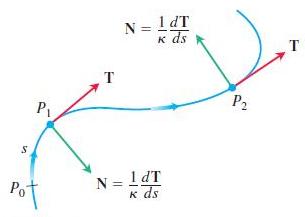
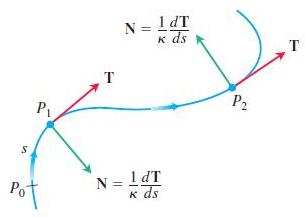
a. Show that n(t) = -g′(t)i + ƒ′(t)j and -n(t) = g′(t)i - ƒ′(t)j are both normal to the curve r(t) = ƒ(t)i + g(t)j at the point (ƒ(t), g(t)).To obtain N for a particular plane curve, we can choose the one of n or -n from part (a) that points toward the concave side of the curve, and
In r(t) is the position of a particle in the xy-plane at time t. Find an equation in x and y whose graph is the path of the particle. Then find the particle’s velocity and acceleration vectors at the given value of t. 2 r(t) = e'i + e²¹j, t = ln 3
Find the point in which the line meets the plane.x = -1 + 3t, y = -2, z = 5t; 2x - 3z = 7
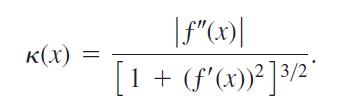
a. The graph y = ƒ(x) in the xy-plane automatically has the parametrization x = x, y = ƒ(x), and the vector formula r(x) = xi + ƒ(x)j. Use this formula to show that if ƒ is a twice-differentiable function of x, thenb. Use the formula for k in part (a) to find the curvature of y = ln (cos x),
Find the centers and radii of the spheres.x2 + y2 + z2 - 6y + 8z = 0
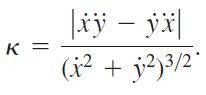
a. Show that the curvature of a smooth curve r(t) = ƒ(t)i + g(t)j defined by twice-differentiable functions x = ƒ(t) and y = g(t) is given by the formulaThe dots in the formula denote differentiation with respect to t, one derivative for each dot. Apply the formula to find the curvatures of the
Find T, N, and κ for the plane curves.r(t) = ti + (ln cos t)j, -π/2 < t < π/2
In r(t) is the position of a particle in the xy-plane at time t. Find an equation in x and y whose graph is the path of the particle. Then find the particle’s velocity and acceleration vectors at the given value of t.r(t) = (t + 1)i + (t2 - 1)j, t = 1
Give the position vectors of particles moving along various curves in the xy-plane. In each case, find the particle’s velocity and acceleration vectors at the stated times and sketch them as vectors on the curve.x2 + y2 = 16 (4 COS 1)i r(t) = 4 cos (4 sin ½).j j; t = π and 3π/2 ㅠ
Find T, N, and κ for the plane curves.r(t) = (ln sec t)i + tj, -π/2 < t < π/2
Find T, N, and κ for the plane curves.r(t) = (2t + 3)i + (5 - t2)j
Find T, N, and κ for the plane curves.r(t) = (cos t + t sin t)i + (sin t - t cos t)j, t > 0
In r(t) is the position of a particle in the xy-plane at time t. Find an equation in x and y whose graph is the path of the particle. Then find the particle’s velocity and acceleration vectors at the given value of t.r(t) = (cos 2t)i + (3 sin 2t)j, t = 0
Give the position vectors of particles moving along various curves in the xy-plane. In each case, find the particle’s velocity and acceleration vectors at the stated times and sketch them as vectors on the curve.x2 + y2 = 1r(t) = (sin t)i + (cos t)j; t = π/4 and π/2
Give the position vectors of particles moving along various curves in the xy-plane. In each case, find the particle’s velocity and acceleration vectors at the stated times and sketch them as vectors on the curve.x = t - sin t, y = 1 - cos tr(t) = (t - sin t)i + (1 - cos t)j; t = π and 3π/2
a. Use the method of Exercise 7 to find N for the curve r(t) = t i + (1/3)t3 j when t 0.b. Calculate N for t ≠ 0 directly from T using Equation (4) for the curve in part (a). Does N exist at t = 0? Graph the curve and explain what is happening to N as t passes from negative to positive
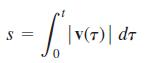
Find the arc length parameter along the curve from the point where t = 0 by evaluating the integralfrom Equation (3). Then find the length of the indicated portion of the curve. = f'live 0 S |V(T) dr
In r(t) is the position of a particle in space at time t. Find the particle’s velocity and acceleration vectors. Then find the particle’s speed and direction of motion at the given value of t. Write the particle’s velocity at that time as the product of its speed and direction. r(t) = (t +
Find the point on the curveat a distance 26π units along the curve from the point (0, 5, 0) in the direction of increasing arc length. r(t) = (5 sin t)i + (5 cost)j + 12tk
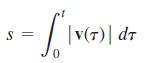
Find the arc length parameter along the curve from the point where t = 0 by evaluating the integralfrom Equation (3). Then find the length of the indicated portion of the curve. = f'live 0 S |V(T) dr
In r(t) is the position of a particle in space at time t. Find the particle’s velocity and acceleration vectors. Then find the particle’s speed and direction of motion at the given value of t. Write the particle’s velocity at that time as the product of its speed and direction. r(t) = (2 cos
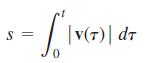
Find the arc length parameter along the curve from the point where t = 0 by evaluating the integralfrom Equation (3). Then find the length of the indicated portion of the curve. = f'live 0 S |V(T) dr
In r(t) is the position of a particle in space at time t. Find the particle’s velocity and acceleration vectors. Then find the particle’s speed and direction of motion at the given value of t. Write the particle’s velocity at that time as the product of its speed and direction. r(t) = (1 +
In r(t) is the position of a particle in space at time t. Find the particle’s velocity and acceleration vectors. Then find the particle’s speed and direction of motion at the given value of t. Write the particle’s velocity at that time as the product of its speed and direction. r(t) = 4 (sec
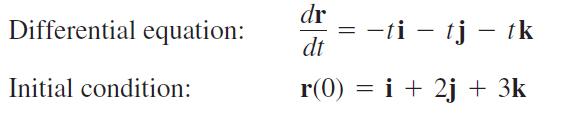
Solve the initial value problems for r as a vector function of t. Differential equation: Initial condition: dr dt r(0) = -ti - tj - tk = i + 2j + 3k
Give the position vectors of particles moving along various curves in the xy-plane. In each case, find the particle’s velocity and acceleration vectors at the stated times and sketch them as vectors on the curve.y = x2 + 1r(t) = ti + (t2 + 1)j; t = -1, 0, and 1
Showing 8300 - 8400
of 29454
First
77
78
79
80
81
82
83
84
85
86
87
88
89
90
91
Last
Step by Step Answers

 Get 50% OFF
Claim Now
Get 50% OFF
Claim Now