New Semester
Started
Get
50% OFF
Study Help!
--h --m --s
Claim Now
Question Answers
Textbooks
Find textbooks, questions and answers
Oops, something went wrong!
Change your search query and then try again
S
Books
FREE
Study Help
Expert Questions
Accounting
General Management
Mathematics
Finance
Organizational Behaviour
Law
Physics
Operating System
Management Leadership
Sociology
Programming
Marketing
Database
Computer Network
Economics
Textbooks Solutions
Accounting
Managerial Accounting
Management Leadership
Cost Accounting
Statistics
Business Law
Corporate Finance
Finance
Economics
Auditing
Tutors
Online Tutors
Find a Tutor
Hire a Tutor
Become a Tutor
AI Tutor
AI Study Planner
NEW
Sell Books
Search
Search
Sign In
Register
study help
mathematics
precalculus
Thomas Calculus Early Transcendentals 13th Edition Joel R Hass, Christopher E Heil, Maurice D Weir - Solutions
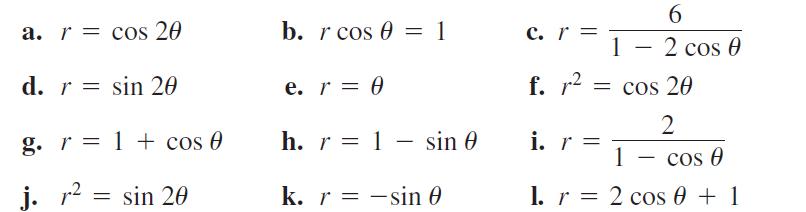
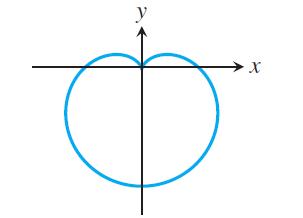
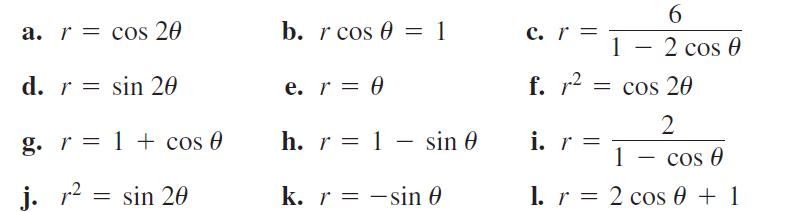
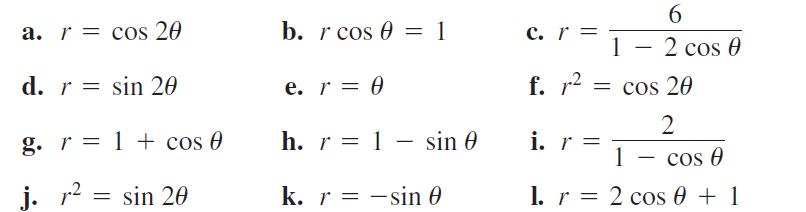
Match each graph with the appropriate equation (a)–(l). There are more equations than graphs, so some equations will not be matched.Cardioid a. r= cos 20 d. r = sin 20 g. r= 1 + cos 0 j. r² = = sin 20 b. r cos 0 = 1 e. r = 0 h. r 1 sin = k. r = -sin 0 - 0 c. r 6 1 - 2 cos 0 f. ² = cos 20 i. r
If you have a parametric equation grapher, graph the equations over the given interval.x = 4 cos t, y = 2 sin t, overa. 0 ≤ t ≤ 2πb. 0 ≤ t ≤ πc. -π/2 ≤ t ≤ π/2.
Replace the polar equations with equivalent Cartesian equations. Then describe or identify the graph.r = csc θ er cos θ
To illustrate the fact that the numbers we get for length do not depend on the way we parametrize our curves (except for the mild restrictions preventing doubling back mentioned earlier), calculate the length of the semicircle y = √1 - x2 with these two different parametrizations:a. x = cos 2t, y
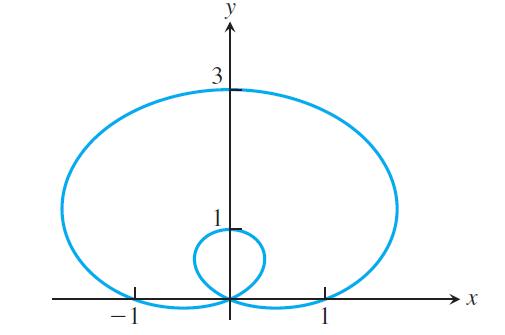
The curve with parametric equations x = (1 + 2 sin θ) cos θ, y = (1 + 2 sin θ) sin θ is called a limaçon and is shown in the accompanying figure. Find the points (x, y) and the slopes of the tangent lines at these points fora. θ = 0. b. θ = π/2. c. θ = 4π/3. y 3 1 X
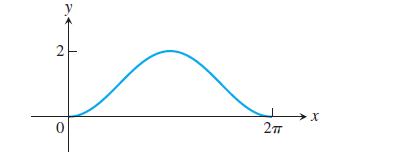
The curve with parametric equations x = t, y = 1 - cos t, 0 ≤ t ≤ 2π is called a sinusoid and is shown in the accompanying figure. Find the point (x, y) where the slope of the tangent line isa. Largest.b. Smallest. y 2 0 2TT X
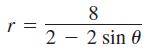
Include the directrix that corresponds to the focus at the origin. Label the vertices with appropriate polar coordinates. Label the centers of the ellipses as well. r 8 2 - 2 sin 0
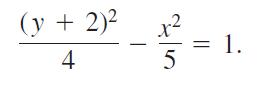
The hyperbola (y2/4) - (x2/5) = 1 is shifted 2 units down to generate the hyperbolaa. Find the center, foci, vertices, and asymptotes of the new hyperbola.b. Plot the new center, foci, vertices, and asymptotes, and sketch in the hyperbola. (y + 2)² 4 5 1.
If you have a parametric equation grapher, graph the equations over the given interval.x = sec t (enter as 1 / cos (t)), y = tan t (enter as sin (t) / cos (t)), overa. -1.5 ≤ t ≤ 1.5b. -0.5 ≤ t ≤ 0.5c. -0.1 ≤ t ≤ 0.1.
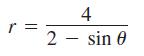
Include the directrix that corresponds to the focus at the origin. Label the vertices with appropriate polar coordinates. Label the centers of the ellipses as well. || 4 2 sin 0
Replace the polar equations with equivalent Cartesian equations. Then describe or identify the graph.r sin θ = ln r + ln cos θ
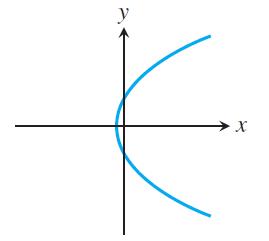
Match each graph with the appropriate equation (a)–(l). There are more equations than graphs, so some equations will not be matched.Parabola a. r= cos 20 d. r = sin 20 g. r= 1 + cos 0 j. r² = = sin 20 b. r cos 0 = 1 e. r = 0 h. r 1 sin = k. r = -sin 0 - 0 c. r 6 1 - 2 cos 0 f. ² = cos 20 i. r
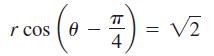
Sketch the lines and find Cartesian equations for them. r cos e 7T 4 = √2
Replace the polar equations with equivalent Cartesian equations. Then describe or identify the graph.r2 + 2r2 cos θ sin θ = 1
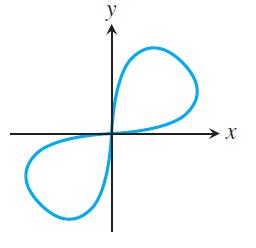
Match each graph with the appropriate equation (a)–(l). There are more equations than graphs, so some equations will not be matched.Lemniscate a. r= cos 20 d. r = sin 20 g. r= 1 + cos 0 j. r² = = sin 20 b. r cos 0 = 1 e. r = 0 h. r 1 sin = k. r = -sin 0 - 0 c. r 6 1 - 2 cos 0 f. ² = cos 20 i. r
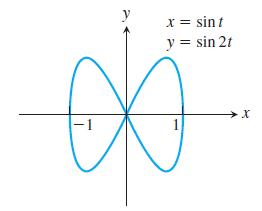
The curves are called Bowditch curves or Lissajous figures. In each case, find the point in the interior of the first quadrant where the tangent to the curve is horizontal, and find the equations of the two tangents at the origin. y फै x = sin t y = sin 2t 1 X
Replace the polar equations with equivalent Cartesian equations. Then describe or identify the graph.cos2 θ = sin2 θ
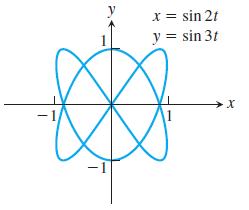
The curves are called Bowditch curves or Lissajous figures. In each case, find the point in the interior of the first quadrant where the tangent to the curve is horizontal, and find the equations of the two tangents at the origin. -1 y x = sin2t y = sin 3t 1 大
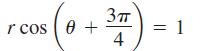
Sketch the lines and find Cartesian equations for them. r cos 0 + Зп 4 = 1
Give equations for parabolas and tell how many units up or down and to the right or left each parabola is to be shifted. Find an equation for the new parabola, and find the new vertex, focus, and directrix.y2 = 4x, left 2, down 3
Replace the polar equations with equivalent Cartesian equations. Then describe or identify the graph.r2 = -4r cos θ
Give equations for parabolas and tell how many units up or down and to the right or left each parabola is to be shifted. Find an equation for the new parabola, and find the new vertex, focus, and directrix.y2 = -12x, right 4, up 3
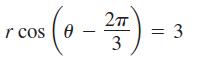
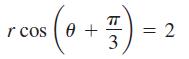
Sketch the lines and find Cartesian equations for them. r cos e 0 2πT 3 = 3 ||
Replace the polar equations with equivalent Cartesian equations. Then describe or identify the graph.r2 = -6r sin θ
Sketch the lines and find Cartesian equations for them. cos 0 + ||
Give equations for parabolas and tell how many units up or down and to the right or left each parabola is to be shifted. Find an equation for the new parabola, and find the new vertex, focus, and directrix.x2 = 8y, right 1, down 7
Replace the polar equations with equivalent Cartesian equations. Then describe or identify the graph.r = 8 sin θ
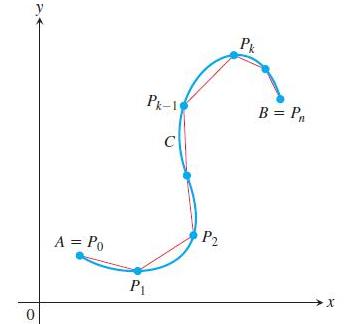
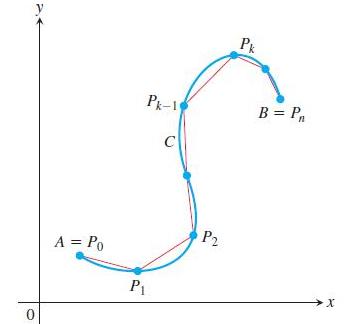
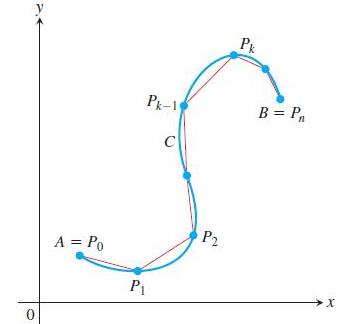
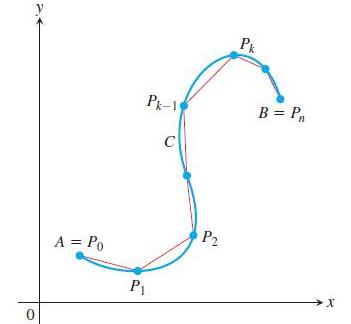
Use a CAS to perform the following steps for the given curve over the closed interval.a. Plot the curve together with the polygonal path approximations for n = 2, 4, 8 partition points over the interval. (See Figure 11.15.)b. Find the corresponding approximation to the length of the curve by
Find the areas of the regions in the polar coordinate plane described.Enclosed by the limaçon r = 2 - cos θ
Find a polar equation in the form r cos (θ - θ0) = r0 for each of the lines. √2x + √2y = 6
a. Find the length of one arch of the cycloid x = a(t - sin t), y = a(1 - cos t).b. Find the area of the surface generated by revolving one arch of the cycloid in part (a) about the x-axis for a = 1.
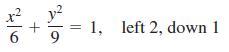
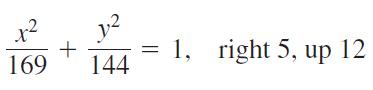
Give equations for ellipses and tell how many units up or down and to the right or left each ellipse is to be shifted. Find an equation for the new ellipse, and find the new foci, vertices, and center. 6 + 9 || 1, left 2, down 1
Replace the polar equations with equivalent Cartesian equations. Then describe or identify the graph.r = 3 cos θ
Find the volume swept out by revolving the region bounded by the x-axis and one arch of the cycloid x = t - sin t, y = 1 - cos t about the x-axis.
Give equations for parabolas and tell how many units up or down and to the right or left each parabola is to be shifted. Find an equation for the new parabola, and find the new vertex, focus, and directrix.x2 = 6y, left 3, down 2
Find the areas of the regions in the polar coordinate plane described.Enclosed by one leaf of the three-leaved rose r = sin 3θ.
Use a CAS to perform the following steps for the given curve over the closed interval.a. Plot the curve together with the polygonal path approximations for n = 2, 4, 8 partition points over the interval. (See Figure 11.15.)b. Find the corresponding approximation to the length of the curve by
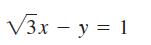
Find a polar equation in the form r cos (θ - θ0) = r0 for each of the lines. √3x - y = 1
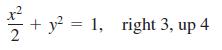
Give equations for ellipses and tell how many units up or down and to the right or left each ellipse is to be shifted. Find an equation for the new ellipse, and find the new foci, vertices, and center. 2/2+ -y²= 1, right 3, up 4
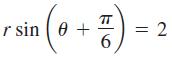
Replace the polar equations with equivalent Cartesian equations. Then describe or identify the graph. rsin(6+ 归 6 = 2
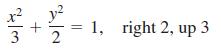
Give equations for ellipses and tell how many units up or down and to the right or left each ellipse is to be shifted. Find an equation for the new ellipse, and find the new foci, vertices, and center. 3 + 2 = 1, right 2, up 3
Replace the polar equations with equivalent Cartesian equations. Then describe or identify the graph.r = 2 cos θ + 2 sin θ
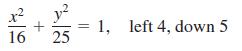
Give equations for ellipses and tell how many units up or down and to the right or left each ellipse is to be shifted. Find an equation for the new ellipse, and find the new foci, vertices, and center. 16 25 1, left 4, down S
Find the areas of the regions in the polar coordinate plane described.Inside the “figure eight” r = 1 + cos 2θ and outside the circle r = 1
Use a CAS to perform the following steps for the given curve over the closed interval.a. Plot the curve together with the polygonal path approximations for n = 2, 4, 8 partition points over the interval. (See Figure 11.15.)b. Find the corresponding approximation to the length of the curve by
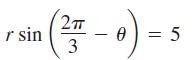
Replace the polar equations with equivalent Cartesian equations. Then describe or identify the graph. r sin 2π 3 - 0 = 5
Replace the polar equations with equivalent Cartesian equations. Then describe or identify the graph.r = 2 cos θ - sin θ
Find the areas of the regions in the polar coordinate plane described.Inside the cardioid r = 2(1 + sin θ) and outside the circle r = 2 sin θ
Find a polar equation in the form r cos (θ - θ0) = r0 for each of the lines.y = -5
Use a CAS to perform the following steps for the given curve over the closed interval.a. Plot the curve together with the polygonal path approximations for n = 2, 4, 8 partition points over the interval. (See Figure 11.15.)b. Find the corresponding approximation to the length of the curve by
Find the lengths of the curves given by the polar coordinate equation.r = -1 + cos θ
Find a polar equation in the form r cos (θ - θ0) = r0 for each of the lines.x = -4
Find the lengths of the curves given by the polar coordinate equation.r = 2 sin θ + 2 cos θ, 0 ≤ θ ≤ π/2
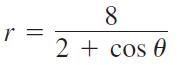
Sketch the conic sections whose polar coordinate equations are given. Give polar coordinates for the vertices and, in the case of ellipses, for the centers as well. r || 8 2 + cos 0
Find the lengths of the curves given by the polar coordinate equation. r = V1 + cos 20, -π/2 ≤ 0 ≤ π/2 -
Give equations for hyperbolas and tell how many units up or down and to the right or left each hyperbola is to be shifted. Find an equation for the new hyperbola, and find the new center, foci, vertices, and asymptotes. x2 16 9 = 1, left 2, down 1
Give equations for hyperbolas and tell how many units up or down and to the right or left each hyperbola is to be shifted. Find an equation for the new hyperbola, and find the new center, foci, vertices, and asymptotes. 12 3 - x² = 1, right 1, up 3 |
Find the lengths of the curves given by the polar coordinate equation.r = 8 sin3 (θ/3), 0 ≤ θ ≤ π/4
Sketch the circles. Give polar coordinates for their centers and identify their radii.r = 6 sin θ
Replace the Cartesian equations with equivalent polar equations.y = 1
Sketch the circles. Give polar coordinates for their centers and identify their radii.r = -2 cos θ
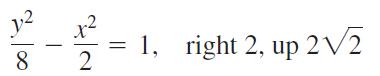
Give equations for hyperbolas and tell how many units up or down and to the right or left each hyperbola is to be shifted. Find an equation for the new hyperbola, and find the new center, foci, vertices, and asymptotes.y2 - x2 = 1, left 1, down 1
Replace the Cartesian equations with equivalent polar equations.x = y
Sketch the parabolas. Include the focus and directrix in each sketch.x2 = -4y
Sketch the circles. Give polar coordinates for their centers and identify their radii.r = -8 sin θ
Replace the Cartesian equations with equivalent polar equations.x - y = 3
Sketch the parabolas. Include the focus and directrix in each sketch.x2 = 2y
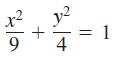
Replace the Cartesian equations with equivalent polar equations. + y 4 = 1
Find polar equations for the circles. Sketch each circle in the coordinate plane and label it with both its Cartesian and polar equations.(x - 6)2 + y2 = 36
Replace the Cartesian equations with equivalent polar equations.x2 + y2 = 4
Find the center, foci, vertices, asymptotes, and radius, as appropriate, of the conic section.x2 + 4x + y2 = 12
Sketch the parabolas. Include the focus and directrix in each sketch.y2 = 3x
Find polar equations for the circles. Sketch each circle in the coordinate plane and label it with both its Cartesian and polar equations.(x + 2)2 + y2 = 4
Find the center, foci, vertices, asymptotes, and radius, as appropriate, of the conic section.2x2 + 2y2 - 28x + 12y + 114 = 0
Replace the Cartesian equations with equivalent polar equations.x2 - y2 = 1
Sketch the parabolas. Include the focus and directrix in each sketch.y2 = -(8/3)x
Find polar equations for the circles. Sketch each circle in the coordinate plane and label it with both its Cartesian and polar equations.x2 + (y - 5)2 = 25
Find the center, foci, vertices, asymptotes, and radius, as appropriate, of the conic section.x2 + 2x + 4y - 3 = 0
Find the eccentricities of the ellipses and hyperbolas. Sketch each conic section. Include the foci, vertices, and asymptotes (as appropriate) in your sketch.16x2 + 7y2 = 112
Find polar equations for the circles. Sketch each circle in the coordinate plane and label it with both its Cartesian and polar equations.x2 + (y + 7)2 = 49
Find the center, foci, vertices, asymptotes, and radius, as appropriate, of the conic section.y2 - 4y - 8x - 12 = 0
Replace the Cartesian equations with equivalent polar equations.xy = 2
Find the eccentricities of the ellipses and hyperbolas. Sketch each conic section. Include the foci, vertices, and asymptotes (as appropriate) in your sketch.x2 + 2y2 = 4
Find polar equations for the circles. Sketch each circle in the coordinate plane and label it with both its Cartesian and polar equations.x2 + 2x + y2 = 0
Find the center, foci, vertices, asymptotes, and radius, as appropriate, of the conic section.x2 + 5y2 + 4x = 1
Replace the Cartesian equations with equivalent polar equations.y2 = 4x
Find the eccentricities of the ellipses and hyperbolas. Sketch each conic section. Include the foci, vertices, and asymptotes (as appropriate) in your sketch.3x2 - y2 = 3
Find polar equations for the circles. Sketch each circle in the coordinate plane and label it with both its Cartesian and polar equations.x2 - 16x + y2 = 0
Find the center, foci, vertices, asymptotes, and radius, as appropriate, of the conic section.9x2 + 6y2 + 36y = 0
Replace the Cartesian equations with equivalent polar equations.x2 + xy + y2 = 1
Find the eccentricities of the ellipses and hyperbolas. Sketch each conic section. Include the foci, vertices, and asymptotes (as appropriate) in your sketch.5y2 - 4x2 = 20
Find polar equations for the circles. Sketch each circle in the coordinate plane and label it with both its Cartesian and polar equations.x2 + y2 + y = 0
Find polar equations for the circles. Sketch each circle in the coordinate plane and label it with both its Cartesian and polar equations. 2+² 4 3- = 0
Give equations for conic sections and tell how many units up or down and to the right or left each curve is to be shifted. Find an equation for the new conic section, and find the new foci, vertices, centers, and asymptotes, as appropriate. If the curve is a parabola, find the new directrix as
Find the center, foci, vertices, asymptotes, and radius, as appropriate, of the conic section.x2 + 2y2 - 2x - 4y = -1
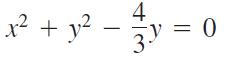
Replace the Cartesian equations with equivalent polar equations.x2 + (y - 2)2 = 4
Give equations for conic sections and tell how many units up or down and to the right or left each curve is to be shifted. Find an equation for the new conic section, and find the new foci, vertices, centers, and asymptotes, as appropriate. If the curve is a parabola, find the new directrix as
Give equations for conic sections and tell how many units up or down and to the right or left each curve is to be shifted. Find an equation for the new conic section, and find the new foci, vertices, centers, and asymptotes, as appropriate. If the curve is a parabola, find the new directrix as
Give equations for conic sections and tell how many units up or down and to the right or left each curve is to be shifted. Find an equation for the new conic section, and find the new foci, vertices, centers, and asymptotes, as appropriate. If the curve is a parabola, find the new directrix as
Find the center, foci, vertices, asymptotes, and radius, as appropriate, of the conic section.4x2 + y2 + 8x - 2y = -1
Showing 8200 - 8300
of 29454
First
76
77
78
79
80
81
82
83
84
85
86
87
88
89
90
Last
Step by Step Answers

 Get 50% OFF
Claim Now
Get 50% OFF
Claim Now