New Semester
Started
Get
50% OFF
Study Help!
--h --m --s
Claim Now
Question Answers
Textbooks
Find textbooks, questions and answers
Oops, something went wrong!
Change your search query and then try again
S
Books
FREE
Study Help
Expert Questions
Accounting
General Management
Mathematics
Finance
Organizational Behaviour
Law
Physics
Operating System
Management Leadership
Sociology
Programming
Marketing
Database
Computer Network
Economics
Textbooks Solutions
Accounting
Managerial Accounting
Management Leadership
Cost Accounting
Statistics
Business Law
Corporate Finance
Finance
Economics
Auditing
Tutors
Online Tutors
Find a Tutor
Hire a Tutor
Become a Tutor
AI Tutor
AI Study Planner
NEW
Sell Books
Search
Search
Sign In
Register
study help
physics
conceptual physical science
Conceptual Physical Science 6th Edition Paul G. Hewitt, John A. Suchocki, Leslie A. Hewitt - Solutions
In what year was the efficient electrolysis of aluminum discovered?
What metal coats a galvanized nail?
What are some differences between corrosion and combustion?
What is iron forced to accept during cathodic protection?
What happens to the polarity of oxygen atoms as they transform from molecular oxygen, O2, into water molecules, H2O?
The pH of a solution can be approximated with a pH indicator, which is any chemical whose color changes with pH. Many pH indicators are found in plants; the pigment of red cabbage is a good example. This pigment is red at low pH values (acidic), light purple at slightly acidic pH values, blue at
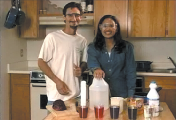
Make a concentrated solution of red cabbage extract by boiling a cup of shredded red cabbage in a cup of water for about 5 minutes. Pour this extract into a large transparent container, such as a vase or a 2-L plastic bottle with the top cut off. Add a tablespoon of white vinegar to acidify the
Add about an inch of water to a large test tube followed by a couple drops of phenolphthalein pH indicator, which you will likely need to obtain from your classroom. Add a small pinch of washing soda, which contains sodium carbonate, Na2CO3. Upon mixing, the washing soda turns the solution basic,
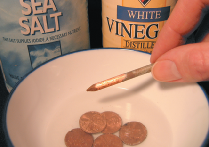
Copper metal reacts slowly with the oxygen in air to form reddish copper(I) oxide, Cu2O, which is a compound that coats the surface of older pennies, making them look tarnished. When such a penny is placed in a solution of salt in vinegar, the copper(I) oxide acts as a base and reacts with the
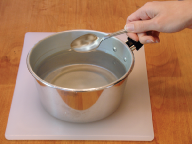
Silver tarnishes because it reacts with the small amounts of smelly hydrogen sulfide, H2S, we put into the air as we digest our food. In this reaction, the silver loses electrons to the sulfur. You can reverse this reaction by allowing the silver to get its electrons back from aluminum. Flatten
A battery is made by connecting a metal that tends to lose electrons with another metal that tends to gain electrons. Two metals that make for a good battery are copper and zinc, both of which are found in any post-1982 penny. Zinc has a low melting point, which makes it easy to remove from the
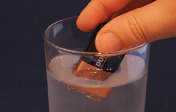
You can see the electrolysis of water by immersing the top of a disposable 9-V battery in salt water. The bubbles that form contain hydrogen gas produced as the water decomposes. Why does this activity work better with salt water than with tap water? Sharpen both ends of two pencils. Hold a
Show that the hydroxide ion concentration in an aqueous solution is 1 × 10⁻⁴ M when the hydronium ion concentration is 1 × 10⁻¹⁰ M. Recall that 10a × 10b = 10(a+b).
When the hydronium ion concentration of a solution is 1 × 10⁻¹⁰ M, what is the pH of the solution? Is the solution acidic or basic? When the hydronium ion concentration of a solution is 1 × 10⁻⁴ M, what is the pH of the solution? Is the solution acidic or basic?
Show that an aqueous solution having a pH of 5 has a hydroxide ion concentration of 1 × 10⁻⁹ M.
When the pH of a solution is 1, the concentration of hydronium ions is 10-1 M = 0.1 M. Assume that the volume of this solution is 500 mL. What is the pH after 500 mL of water is added? You will need a calculator with a logarithm function to answer this question.
Show that the pH of a solution is -0.301 when its hydronium ion concentration equals 2 moles/L. Is the solution acidic or basic?
Each year about 1.6 × 10⁷ (16 million) metric tons (mt) of aluminum are produced. How many grams is this? (Recall that 1 mt is 1000 kg.)
Use the following balanced chemical equation to show that the production of 1.6 × 10⁷ metric tons of aluminum, Al, through electrolysis each year produces about 2.0 × 10⁷ metric tons of carbon dioxide, CO2. Interestingly, the total mass of our atmosphere is only about 5 × 10¹⁵ metric tons.4
Rank the solutions in order of increasing concentration of hydronium ions, H3O+: (a) hydrogen chloride, HCl (concentration = 2 M); (b) acetic acid, CH3COOH (concentration = 2 M); (c) ammonia, NH3 (concentration = 2 M).
The three chemicals listed below are all very weak acids because they all have a difficult time losing a hydrogen ion, H+. Upon losing this hydrogen ion, the central atom of each of these molecules takes on a negative charge. Holding onto this negative charge isn’t easy, especially when there are
If gravity is not a force, then what is it?
No galaxy that has been found so far is less than 25% helium. If not from the stars, where did this helium come from?
If not from the Big Bang, then where do elements heavier than helium come from?
Compare and contrast the unsaturated zone with the saturated zone.
If a hole is dug in the unsaturated zone, does it fill with water? Why or why not?
Distinguish between porosity and hydraulic conductivity.
As water is precipitated onto the land, where does it go? Where does most of the water on land end up?
Where does most of Earth’s precipitation occur?
During an earthquake, what type of land surface is safer: rigid bedrock or sandy soil? Explain your thinking.
Cite one line of evidence that suggests that subduction once occurred off the coast of California.
Relate the formation of metamorphic rocks to plate tectonics. Would you expect to find metamorphic rocks at all three types of plate boundaries? Why or why not?
Are the present-day continents a permanent feature on our planet? Discuss why or why not.
Are the present-day ocean basins a permanent feature on our planet? Discuss why or why not.
In an earthquake, does the release of energy usually happen all at once? Defend your answer.
If you found folded beds of sedimentary rock in the field, what detail would you need to know in order to tell whether the fold was an anticline or a syncline?
Strike-slip faults show horizontal motion. Where in the United States do we find strike-slip faulting?
Normal faults are created by tensional forces. Where in the United States do we find evidence of normal faults?
Reverse faults are created by compressional forces. Where in the United States do we find evidence of reverse faults?
What is the direct source of energy responsible for earthquakes in southern California?
In 1960, a large tsunami struck the Hawaiian Islands without warning, devastating the coastal town of Hilo, Hawaii. Since that time, a tsunami warning station has been established for the coastal areas of the Pacific. Why do you think these stations are located around the Pacific Rim?
How much more does the ground shake during a magnitude-6.6 earthquake than it does during a magnitude-5.6 earthquake?
Why are most earthquakes generated near plate boundaries?
How do faults and folds support the idea that lithospheric plates move?
The Mercalli scale measures earthquake intensity. The Richter and seismic moment scales measure earthquake magnitude. Which scale is the more precise measurement? Why?
What type of fault is associated with the 1964 earthquake in Alaska?
Where does most of an earthquake’s damage generally occur?
Subduction is the process of one lithospheric plate descending beneath another. Why does the oceanic portion of the lithosphere undergo subduction whereas the continental portion does not?
Lithospheric rock is continuously created and destroyed. Where do the creation and destruction take place? Do the rates of the two processes balance each other?
How did the Himalaya Mountains originate? How did the Andes Mountains originate?
What type of lava erupts at divergent boundaries? What type erupts at convergent boundaries?
How old is the Atlantic Ocean thought to be? For how many years has lava been extruding at the Mid-Atlantic Ridge?
Magma is generated at divergent and convergent plate boundaries. What type of magma is dominant at each boundary? Why are they different?
Why does granite form frequently at oceanic–continental convergent boundaries but infrequently at oceanic– oceanic convergent boundaries?
What kind of plate boundary separates the North American Plate from the Pacific Plate?
Why do mountains tend to form in long, narrow ranges?
At what type of plate boundary were the Appalachian Mountains produced?
What is the driving force for mountain building in the Andes?
What kinds of plate boundaries are associated with centers of seafloor spreading?
Why are the most ancient rocks found on the continents, not on the ocean floor?
Where is Earth’s longest mountain range located?
How are the theories of seafloor spreading and continental drift supported by paleomagnetic data?
What is meant by magnetic pole reversals? What useful information do they give us about Earth’s history?
Upon crystallization, certain minerals (the most important being magnetite) align themselves in the direction of the surrounding magnetic field, providing a magnetic fossil imprint. How does the seafloor’s magnetic record support the theory of continental drift?
How is Earth’s crust like a conveyor belt?
Describe how the different paths of polar wandering helped establish that continents move over geologic time.
How did glacial striations support Wegener’s hypothesis of continental rift?
Where and what is the most likely source of the energy that generates Earth’s magnetic field?
Speculate on why the lower part of the lithosphere is rigid and the asthenosphere is plastic, even though they are both part of the mantle.
How do erosion and wearing away of a mountain affect the depth to which the crust extends into the lithosphere?
Which extends farther into the mantle: the continental crust or the oceanic crust? Why?
Why is Earth’s crust thicker beneath a mountain range?
Does the fact that the mantle is beneath the crust necessarily mean that the mantle is denser than the crust? Explain.
If Earth’s mantle is composed of rock, how can we say that the crust floats on the mantle?
Even though the inner and outer cores are both composed of predominantly iron and nickel, the inner core is solid and the outer core is liquid. Why?
What is the evidence that Earth’s inner core is solid?
What does the P-wave shadow tell us about Earth’s composition?
How do seismic waves indicate layering of materials in Earth’s interior?
How can seismic waves indicate whether regions inside Earth are solid or liquid?
Compare the relative speeds of primary and secondary seismic waves. Which type of material can each travel through?
Earthquakes at plate boundaries vary in their size and destructiveness. Rank the types of plate boundaries according to increasing earthquake destructiveness:(a) Divergent boundaries,(b) Transform boundaries,(c) Convergent boundaries.
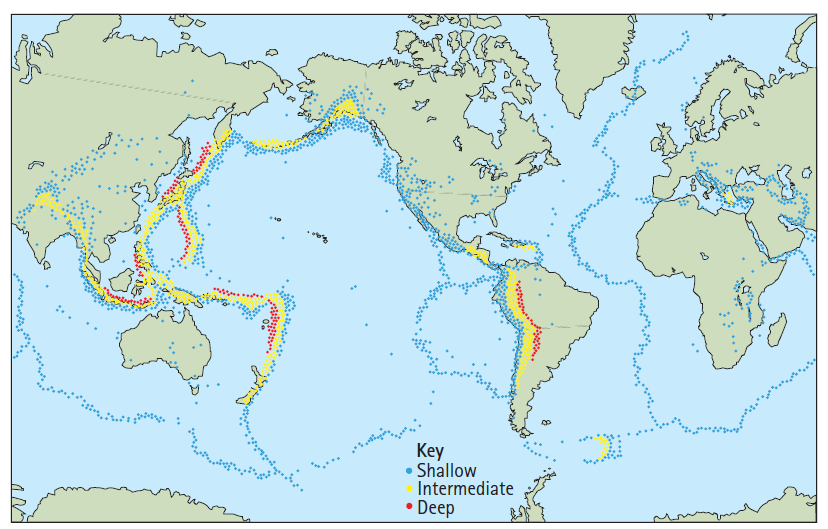
Consult Figure 21.37 and rank these countries in terms of earthquake frequency (from greatest to least):(a) Greenland,(b) United States (lower 48 states),(c) Indonesia,(d) Australia. Key • Shallow Intermediate • Deep ళి
Earth’s crust and its core differ greatly in density. After a quick review of Sections 20.1 and 21.2, rank the following elements in order of increasing density:(a) Iron,(b) Silicon,(c) Nickel,(d) Aluminum.
Going from slowest to fastest, rank the following seismic waves:(a) Rayleigh waves,(b) P-waves,(c) S-waves.
List the parts of Earth’s crust in order of generally increasing density:(a) Oceanic crust,(b) Continental crust,(c) Asthenosphere,(d) Lithosphere.
The San Andreas Fault separates the northwest-moving Pacific Plate, on which Los Angeles sits, from the North American Plate, on which San Francisco sits. If the plates slide past each other at a rate of 3.5 cm/yr, how long will it take the two cities to form one large city? (The present distance
If the rate of movement along a fault is known, the amount of offset over a period of time can be calculated. The basic relationship isRate = distance/timeMovement along the San Andreas Fault is about 3.5 cm/yr. If a fence were built across the fault in 2005, how far apart would the two sections of
The Richter magnitude scale is logarithmic, meaning that each increase of 1 point on the scale corresponds to an increase by a factor of 10 in the amplitude of the seismic waves recorded on a seismograph. An earthquake that measures magnitude 8 on the scale has how many times more ground-shaking
If the mid-Atlantic ocean is spreading at 2.5 cm per year, how many years has it taken for it to reach its present width of about 5000 km?
The weight of the ocean floor bearing down on the lithosphere is increased by the weight of ocean water. Relative to the weight of the 10-km-thick basaltic ocean crust (density 3 g/cm3), how much weight does a 3-km-deep ocean (density 1 g/cm3) contribute? Express your answer as a percentage of the
As the ground shakes, so do buildings on top of the land. It is often said that earthquakes don’t kill people, but falling buildings do. Older, unreinforced brick buildings and woodframe buildings can collapse during an earthquake. Reinforcing these older buildings helps to strengthen their
Look for a very old window, and note the lens effect in the bottom part of the glass. Glass has both solid and liquid properties; in fact, it is often thought of as a very viscous liquid. Over many years, its downward flow due to gravity is evidenced by the increased thickness near the bottom of
A slinky offers a great way to illustrate how seismic waves travel through Earth’s interior. Place the Slinky on the floor. With two people firmly holding the ends of the Slinky, stretch it out to about 5 ft in length (do not overstretch). On one end, pull the Slinky backward and then push
What is the source of a tsunami’s huge amount of energy?
Where are most of the world’s volcanoes formed?
What happens to rock when stress exceeds a rock’s elastic limit?
Which kind of fault forms primarily from tension in Earth’s crust? Primarily from compression?
What is the difference between reverse faults and normal faults?
Distinguish between anticlines and synclines.
Are folded rocks primarily the result of compressional or tensional forces?
Showing 2100 - 2200
of 3486
First
15
16
17
18
19
20
21
22
23
24
25
26
27
28
29
Last
Step by Step Answers

 Get 50% OFF
Claim Now
Get 50% OFF
Claim Now