New Semester
Started
Get
50% OFF
Study Help!
--h --m --s
Claim Now
Question Answers
Textbooks
Find textbooks, questions and answers
Oops, something went wrong!
Change your search query and then try again
S
Books
FREE
Study Help
Expert Questions
Accounting
General Management
Mathematics
Finance
Organizational Behaviour
Law
Physics
Operating System
Management Leadership
Sociology
Programming
Marketing
Database
Computer Network
Economics
Textbooks Solutions
Accounting
Managerial Accounting
Management Leadership
Cost Accounting
Statistics
Business Law
Corporate Finance
Finance
Economics
Auditing
Tutors
Online Tutors
Find a Tutor
Hire a Tutor
Become a Tutor
AI Tutor
AI Study Planner
NEW
Sell Books
Search
Search
Sign In
Register
study help
physics
conceptual physical science
Conceptual Physical Science 6th Edition Paul G. Hewitt, John A. Suchocki, Leslie A. Hewitt - Solutions
Why can wastewater treatment requirements in Hawaii be less stringent than those in most locations on the U.S. mainland?
What are two ways in which people disinfect water in areas where municipal treatment facilities are not available?
What naturally occurring element has been contaminating the water supply of Bangladesh?
Why is treated water sprayed into the air before it is piped to users?
Why are soap molecules so attracted to calcium and magnesium ions?
What is the difference between a soap and a detergent?
What component of hard water makes it hard?
Why does the solubility of a gas solute in a liquid solvent decrease with increasing temperature?
Which portion of a soap molecule is nonpolar?
Is concentration typically given with the volume of solvent or the volume of solution?
What happens to the volume of a sugar solution as more sugar is dissolved in it?
Distinguish between a solute and a solvent.
How can a solution be separated from a suspension?
How is a solution different from a suspension?
Why isn’t it practical to have a macroscopic sample that is 100% pure?
How can the components of a mixture be separated from one another?
How does distillation separate the components of a mixture?
What defines a material as being a mixture?
What are some of the obstacles that people face when trying to recycle materials? How might these obstacles be overcome in your community? Should the government require that certain materials be recycled? If so, how should this requirement be enforced?
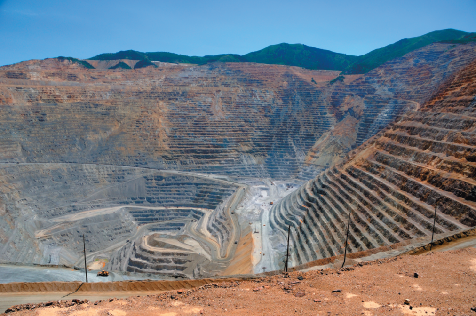
What should be done with mining pits after all the ore has been removed? Consider the open-pit copper mine of Figure 15.14.
If you’ve been studying hard, by now you have great insight into why oil and water don’t mix. You understand that the oxygen atom has eight electrons: two in the first shell, and six in the valence shell. Two of these six valence electrons bond to two hydrogen atoms, which leaves the four
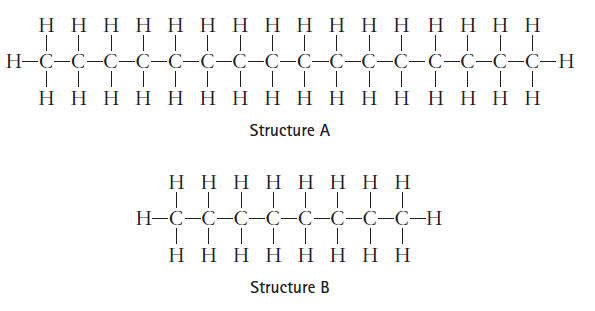
Of the two structures shown below, one is a typical gasoline molecule and the other is a typical motor oil molecule. Which is which? Base your reasoning not on memorization, but rather on what you know about electrical attractions between molecules and the various physical properties of gasoline
Why is calcium fluoride, CaF2, a high-melting-point crystalline solid, whereas stannic chloride, SnCl4, is a volatile liquid?
A thin stream of water is pulled to a rubber balloon with a static electric charge. Might a small ice cube also be pulled to a statically charged balloon?
Chlorine, Cl2, is a gas at room temperature, but bromine, Br2, is a liquid. Why?
Why are ion–dipole attractions stronger than dipole–dipole attractions?
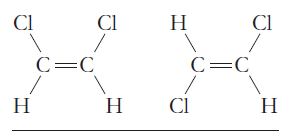
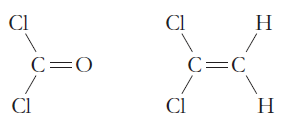
In the figure on the next page, the molecule from each pair that should have a higher boiling point. (Atomic numbers: Cl = 17; O = 8; C = 6; H =1).a.b. CI Cl Н Cl C=C C=C Н Н CI Н CI CI Н C=0 C=C Cl CI Н
True or False: The more shells in an atom, the lower its electronegativity. Please explain.
True or False: The greater the nuclear charge of an atom, the greater its electronegativity. Please explain.
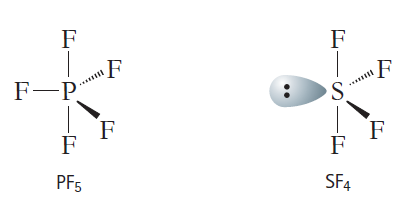
Examine the three-dimensional geometries of PF5 and SF4 shown below. Which do you think is the more polar compound? F-P SF4 PF5
Write the electron-dot structure for the covalent compound acetylene, C2H2.
What drives an atom to form a covalent bond: its nuclear charge or the need to have a filled outer shell? Please explain.
How are metallic bonds similar to ionic bonds? How are they different?
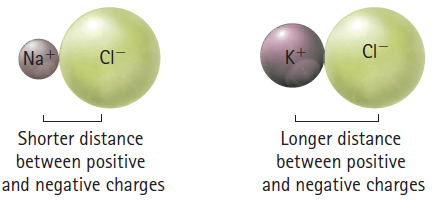
Which should be more difficult to pull apart: a sodium ion from a chloride ion or a potassium ion from a chloride ion? Please explain. CI- Nat CI- K+ Longer distance between positive and negative charges Shorter distance between positive and negative charges
Sulfuric acid, H2SO4, loses two protons to form what polyatomic ion? What molecule loses a proton to form the hydroxide ion, OH-?
Why does an atom with many valence electrons tend to gain electrons rather than lose any?
Why does an atom with many valence electrons tend to gain electrons rather than lose any?
Why is it so easy for a magnesium atom to lose two electrons?
Why does an atom with few valence electrons tend to lose these electrons rather than gain more?
The valence electron of a sodium atom does not sense the full 11+ of the sodium nucleus. Why not?
What happens when hydrogen’s electron gets close to the valence shell of a fluorine atom?
Explain how a convection cycle is generated.
What happens to the water vapor in saturated air as the air cools?
The year 2010 witnessed several extreme weather events: the Moscow heat wave; disastrous flooding in Pakistan, Vietnam, and the South Pacific; drought in the Amazon; and several devastating winter storms throughout the Northern Hemisphere. Are these severe weather events related to global warming?
Our global climate is changing. There are many contributing factors to this change. One factor that is often ignored is soot: black and brown particles emitted by the burning of fossil fuels—diesel, coal, gasoline, and jet fuel—and the burning of solid biofuels—wood, manure, and dung (used
In old-growth redwood forests, some trees have survived for well over a thousand years. As a consequence, they provide a record of climate change. By studying tree rings, scientists have discovered that redwoods have played a significant role in removing CO2 from the atmosphere. They have also
Clouds can act like a blanket around Earth—they can trap terrestrial radiation to warm Earth’s surface, and they can block incoming solar radiation to cool Earth’s surface. Which cloud type is a better warmer and which is a better cooler: high, thin cirrus clouds or low, thick stratus clouds?
Antarctica is covered by glaciers and large ice sheets. Is the snowfall in Antarctica therefore heavy or light? Why?
What is an occluded front, and how is it indicated on a weather map?
What is an isobar, and what does it mean when isobars are spaced close together on a weather map? What does it mean when they are spaced far apart?
The accuracy of weather forecasts depends on great quantities of data and thousands of calculations. If the number of data points were decreased, would accuracy also decrease?
Cite at least four types of information needed to predict the weather.
On a broadcast news report, you hear that a highpressure system is moving into your area. What kind of weather can you expect from this general forecast?
In what part of the United States do tornadoes occur with the highest frequency?
What is the source of the enormous amount of energy released by a hurricane?
Why are hurricanes more likely to occur on the East Coast of the United States than on the West Coast?
Tornadoes form in the regions of a strong updraft, and yet they descend from the base of a cloud. Explain.
Sinking air warms, and yet the downdrafts in a thunderstorm are cold. Why?
What accounts for the large spaces of blue sky between cumulus clouds?
Would you expect a glass of water to evaporate more quickly on a windy, warm, dry summer day or on a calm, cold, dry winter day? Defend your answer.
In the spring months, what happens when cold, dry continental polar air (cP) clashes with hot, humid maritime tropical air (mT)?
What is the name of the cold, dry air mass that affects the northern United States in the winter?
How does a rain-shadow desert form?
Which air mass is more stable: a cold, dry air mass or a warm, moist air mass?
In simplest terms, what is an occluded front?
Explain why freezing rain is more commonly associated with warm fronts than with cold fronts.
How do fronts cause clouds and precipitation?
What is the difference between rainfall that accompanies the passage of a warm front and rainfall that accompanies the passage of a cold front?
What events need to happen before precipitation occurs?
What kind of weather does a continental tropical air mass bring?
How can altostratus clouds change into altocumulus clouds?
What cloud form is associated with thunderstorms?
What cloud form is associated with a stable air mass?
Why don’t cumulus clouds form over cool water?
The sky is overcast, and it is raining. What type of cloud is above you: nimbostratus or stratocumulus?
Why must an air mass rise in order to produce precipitation?
Which produce(s) precipitation: a rising moist air mass, a descending moist air mass, or both?
Give three ways in which heat can be added to an air parcel.
What happens to the pressure and temperature of an air parcel aloft as it descends in the atmosphere?
Two air parcels with the same temperature (25°C) rise from sea level to an elevation of 4 km. Air parcel 1 has a relative humidity of 50%; and air parcel 2 has a relative humidity of 10%. At the 4-km elevation, what is the temperature for each air parcel?
The density of air is generally given as mass per unit volume—for example, kilograms per cubic meter (kg/m3). Compare the following two dry air parcels at the same elevation: Air parcel 1 has a temperature of 32°F; and air parcel 2 has a temperature of 77°F. Which air mass is more dense?
Which air parcel will have the greater temperature change as it rises in the atmosphere: a dry air parcel or a saturated air parcel?
When does an adiabatic process happen in the atmosphere?
Can the temperature of an air mass change if heat is added or subtracted? Explain.
When compared to calm and clear nights, why are surface temperatures higher on a night with considerablecloud cover?
Why does warm, moist air blowing over cold water result in fog?
What happens to relative humidity when temperature increases? What happens to relative humidity when air temperature decreases?
What is dew point?
In which atmospheric layer does all our weather occur?
When the condensation rate is greater than the evaporation rate, what happens to the air?
What is the relationship between capacity and humidity?
Distinguish between dew and frost.
Why are saturation and condensation more likely to occur on a cold day than on a warm day?
Why does a July day in the Gulf of Mexico generally feel appreciably hotter than a July day in Arizona, even when temperatures are the same?
Several things need to happen for a cloud to fully develop. List, from first to last, the following steps in the development of a cloud: (a) air rises to the lifting condensation level, (b) air rises and the condensation rate exceeds the evaporation rate, (c) air rises to a level where the
The cooling rate of a rising air parcel depends on the type of air mass. List, from the greatest to the least temperature change, the following lapse rates for each kilometer of rising air: (a) environmental lapse rate, (b) moist adiabatic lapse rate, (c) dry adiabatic lapse rate.
List, from beginning to end, the stages in the formation of a hurricane: (a) the central low-pressure area intensifies, (b) sufficient warm air and high humidity exist, (c) inward-flowing air spirals, (d) rising warm air creates a central low-pressure area, (e) the rotation and speed of the wind
List, from beginning to end, the stages in the weather as a cold front goes by: (a) warm air is forced upward where it cools, (b) air cools and sinks, pressure rises, and rain stops, (c) cumulonimbus or nimbostratus clouds form, (d) thunderstorms with heavy showers and gusty winds occur.
Evaporation and condensation are always happening. List, from first to last, the following events that lead to the formation of water droplets: (a) the relative humidity approaches 100%, (b) the temperature cools and air molecules move more slowly, (c) the net rate of evaporation decreases, (d) the
Several things need to happen before precipitation forms. List, from first to last, the following steps in the collision–coalescence process: (a) cloud droplets form, (b) water vapor condenses on small particles, (c) cloud droplets are floated upward, (d) cloud droplets are bombarded by updraft
Showing 2600 - 2700
of 3486
First
20
21
22
23
24
25
26
27
28
29
30
31
32
33
34
Last
Step by Step Answers

 Get 50% OFF
Claim Now
Get 50% OFF
Claim Now