New Semester
Started
Get
50% OFF
Study Help!
--h --m --s
Claim Now
Question Answers
Textbooks
Find textbooks, questions and answers
Oops, something went wrong!
Change your search query and then try again
S
Books
FREE
Study Help
Expert Questions
Accounting
General Management
Mathematics
Finance
Organizational Behaviour
Law
Physics
Operating System
Management Leadership
Sociology
Programming
Marketing
Database
Computer Network
Economics
Textbooks Solutions
Accounting
Managerial Accounting
Management Leadership
Cost Accounting
Statistics
Business Law
Corporate Finance
Finance
Economics
Auditing
Tutors
Online Tutors
Find a Tutor
Hire a Tutor
Become a Tutor
AI Tutor
AI Study Planner
NEW
Sell Books
Search
Search
Sign In
Register
study help
physics
conceptual physical science
Conceptual Physical Science 6th Edition Paul G. Hewitt, John A. Suchocki, Leslie A. Hewitt - Solutions
On a mountain top (elevation 2 km), an air parcel has a temperature of 5°C and the relative humidity is 80%. As the air parcel moves downslope to an elevation near sea level, what happens to the air temperature and the relative humidity?
At sea level, an air parcel at 20°C has a relative humidity of 50%. As the unsaturated air parcel rises 1 km up a mountain, the air cools to a temperature of 10°C and becomes completely saturated. The air parcel continues to climb to the top of the mountain—an elevation of 2 km. What were the
What are the air’s temperature and the dew point temperature when the specific humidity is 10.0 g/kg and the relative humidity is 50%?
If the relative humidity of an air mass is 70% and the air temperature is 20°C, what is the capacity? What is the humidity? What is the dew point temperature?
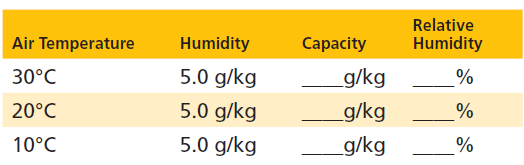
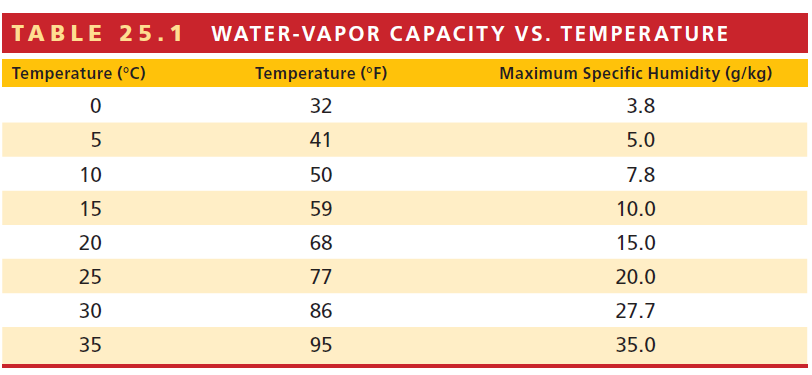
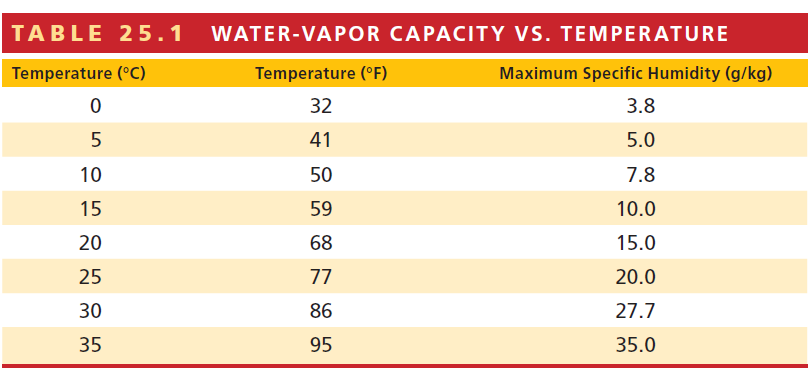
In this problem, humidity is held constant but temperature varies. Use Table 25.1 to find water-vapor capacity, and then use the formula for relative humidity to complete the following chart. What happens to relative humidity when temperature decreases? What happens when temperature increases?
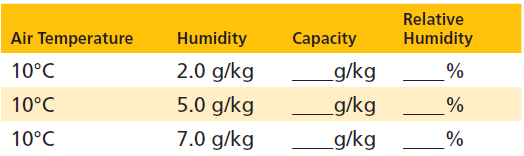
In this problem, temperature is held constant but humidity varies. Use Table 25.1 to find water-vapor capacity, and then use the formula for relative humidity to complete the following chart. What happens to relative humidity when water vapor is added? What happens when water vapor is
At 50°F the maximum amount of water vapor in air is 7.8 g/kg. If the relative humidity is 40%, what is the specific humidity of this air?
Briefly describe how thunder and lightning develop.
How do downdrafts form in thunderstorms?
Under what conditions does orographic precipitation occur?
What are the three main atmospheric lifting mechanisms?
Differentiate between a cold front and a warm front.
Does a rain shadow occur on the windward or the leeward side of a mountain range? Explain.
Explain how convectional lifting plays a role in the formation of cumulus clouds.
Which type of cloud can become a thunderhead?
Are clouds that have vertical development characteristic of stable air, stationary air, unstable air, or dry air?
Which of the following cloud forms is least likely to produce rain or snow: cirrostratus, nimbostratus, altocumulus, or stratocumulus?
Name the cloud group to which each of the following cloud types belongs:(a) Altocumulus,(b) Cirrostratus,(c) Nimbostratus,(d) Cumulus clouds.
Name the cloud form associated with(a) The hazy shade of winter,(b) A mackerel sky,(c) Floating cotton,(d) Snowfall.
How do clouds form?
What happens to the air pressure and temperature of an air parcel as it flows up the side of a mountain?
What is a temperature inversion? Give one location where these inversions often occur.
Name at least two ways in which thermal energy in air can be decreased.
Name at least two ways in which thermal energy in air can be increased.
When a parcel of air rises, does it become warmer, become cooler, or remain the same temperature?
Explain why warm air rises and cools as it expands.
Distinguish between condensation and precipitation.
When water vapor condenses to liquid water, is heat absorbed or released?
Does condensation occur more readily at high temperatures or low temperatures? Explain.
What factors are responsible for condensation?
What does saturation point have to do with dew point?
As air temperature decreases, does relative humidity increase, decrease, or stay the same?
Why does relative humidity increase at night?
What is the chemical formula for the compound titanium dioxide?
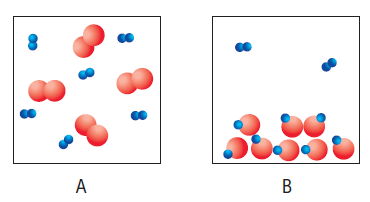
Each sphere in the diagrams below represents an atom. Joined spheres represent molecules. Which box contains a liquid phase? Why can’t you assume that box B represents a lower temperature? B
How might speculations about potential dangers of nanotechnology threaten public support for it? Consider Michael Crichton’s 2002 science-fiction novel Prey, in which self-replicating nanobots run amok, turning everything they contact into a gray goo.
Why isn’t water classified as an element?
Classify each change as physical or chemical. Even if you are incorrect in your assessment, you should be able to defend why you chose as you did.(a) Grass grows.(b) An infant gains 10 lb.(c) A rock is crushed to powder.(d) A tire is inflated with air.
State whether each of the following is a physical or chemical property of matter.(a) Carbon dioxide escapes when a soda can is opened.(b) A bronze statue turns green.(c) A silver spoon tarnishes.
State whether each of the following is a physical or chemical property of matter.(a) Graphite conducts electricity.(b) Bismuth, Bi, loses its iridescence upon melting.(c) A copper penny is smushed into an embossed souvenir.
Each night you measure your height just before going to bed. When you arise each morning, you measure your height again and consistently find that you are 1 inch taller than you were the night before, but only as tall as you were 24 hours ago! Is what happens to your body in this instance best
Oxygen, O2, has a boiling point of 90 K (-183°C), and nitrogen, N2, has a boiling point of 77 K (-196°C). Which is a liquid and which is a gas at 80 K (-193°C)?
In the winter Vermonters make a tasty treat called “sugar on snow” in which they pour boiled-down maple syrup onto a scoop of clean fresh snow. As the syrup hits the snow, it forms a delicious taffy. Identify the physical changes involved in the making of sugar on snow. Identify any chemical
With no one looking, you add 5 mL of a cinnamon solution to a blue balloon, which you tie shut. You also add 5 mL of fresh water to a red balloon, which you also tie shut. You heat the two balloons in a microwave until each inflates to about the size of a grapefruit. Your brother then comes along,
Alcohol wiped across a tabletop rapidly disappears. What happens to the temperature of the tabletop? Why?
A cotton ball is dipped in alcohol and wiped across a tabletop. Explain what happens to the alcohol molecules deposited on the tabletop. Is this a physical or chemical change?
You combine 50 mL of water with 50 mL of purified alcohol and get a total of 98 mL of the mixture. Please explain how this occurs.
Is chemistry the study of submicroscopic, microscopic, or macroscopic matter, or of all three? Defend your answer.
Of physics, chemistry, and biology, which science is the most complex? Please explain.
What is the best way to really prove to yourself that you understand an idea?
If someone is able to explain an idea to you using small familiar words, what does this say about how well that person understands the idea?
While visiting a foreign country, a foreign-speaking citizen tries to give you verbal directions to a local museum. After multiple attempts, he is unsuccessful. An onlooker sees your frustration and concludes that you are not smart enough to understand simple directions. Another onlooker
Rank the compounds in order of increasing number of atoms: (a) C12H22O12,(b) DNA,(c) Pb(C2H3O2)2.
Rank the physical and chemical changes in order of the amount of energy released: (a) the condensation of rain in a thunderstorm, (b) the burning of a gallon of gasoline in a car engine, (c) the explosion of a firecracker.
Rank the following in order of increasing volume: (a) bacterium, (b) virus, (c) water molecule.
What effects might a cure for aging have on the problem of overpopulation? How would society be able to support so many people living well into their 100s? What trends do you foresee in company retirement plans? Might there be a greater emphasis on “privatized retirement accounts”? Why?
In the past 20 years, the average life expectancy in most nations has risen by a couple of years. So has the “healthy life expectancy,” which is a measure of how long people remain in good health. Are the two necessarily related? How so?
“A calculator is useful but certainly not exciting.” Why would someone from 100 years ago vehemently disagree with this statement? We often marvel at a new technology, but how long does this marveling last? How soon before a new technology becomes assumed? Think of other examples. Is technology
The famous 20th-century physicist Richard Feynman (1918–1988) noted: “The laws of science do not limit our ability to manipulate single atoms and molecules.” What does?
The British diplomat, physicist, and environmentalist John Ashton, in speaking to a group of scientists, stated (paraphrased): “There has to be much better communication between the world of science and the world of politics. Consider the different meanings of the word uncertainty. To scientists,
Your friend smells cinnamon coming from an inflated rubber balloon containing cinnamon extract. You tell him that the cinnamon molecules are passing through the micropores of the balloon. He accepts the idea that the balloon contains micropores but insists that he is simply smelling
Medicines, such as pain relievers and antidepressants, are found in the drinking water supplies of many municipalities. How did these medicines get there? Does it matter that they are there? Should something be done about it? If so, what?
How is chemistry similar to nanotechnology? How is it different?
People often behave differently when they are in a group than when they are by themselves. Explain how this is similar to the behavior of atoms. Is this good news or bad news for the development of nanotechnology?
How does a scanning probe microscope differ from an optical microscope?
What is the common name for oxygen oxide?
What is the common name for dioxygen oxide?
What is the chemical name for a compound with the formula Ba3N2?
What is the chemical formula for the compound dihydrogen sulfide?
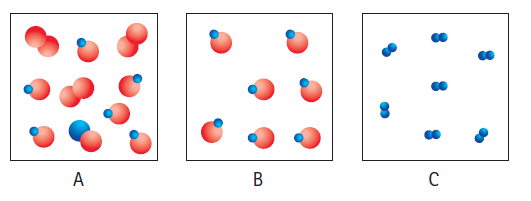
Which of the following boxes contains only an element? Which contains only a compound? How many different types of molecules are shown altogether in the three boxes? A В
If you eat metallic sodium or inhale chlorine gas, you stand a strong chance of dying. Let these two elements react with each other, however, and you can safely sprinkle the compound on your popcorn for better taste. What is going on?
Oxygen, O2, is certainly good for you. Does it follow that if small amounts of oxygen are good for you, then large amounts of oxygen would be especially good for you?
Oxygen atoms are used to make water molecules. Does this mean that oxygen, O2, and water, H2O, have similar properties? Why do we drown when we breathe in water, despite all the oxygen atoms present in this material?
Octane is a component of gasoline. It reacts with oxygen, O2, to form carbon dioxide and water. Is octane an element or a compound? How can you tell?
Is aging primarily an example of a physical or chemical change?
Classify each change as physical or chemical. Even if you are incorrect in your assessment, you should be able to defend why you chose as you did.(a) Grape juice turns to wine.(b) Wood burns to ashes.(c) Water begins to boil.(d) A broken leg mends itself.
Use Exercise 53 as an analogy to describe what occurs in Exercise 54. Does it make sense to think that the alcohol is made of very tiny particles (molecules) rather than being an infinitely continuous material?Exercise 53A skillet is lined with a thin layer of cooking oil followed by a layer of
A cotton ball dipped in alcohol is wiped across a tabletop. Would the resulting smell of the alcohol be more or less noticeable if the tabletop were much warmer? Explain.
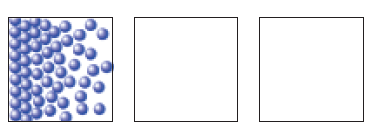
The leftmost diagram below shows two phases of a single substance. In the middle box, draw what these particles would look like if heat were taken away. In the box on the right, show what they would look like if heat were added. If each particle represents a water molecule, what is the temperature
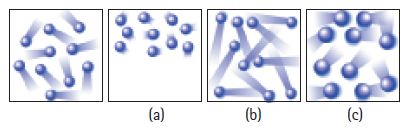
The leftmost diagram below shows the moving particles of a gas within a rigid container. Which of the three boxes on the right—(a), (b), or (c)—best represents this material upon the addition of heat? (c) (a) (b)
You combine 50 mL of small BBs with 50 mL of large BBs and get a total of 90 mL of BBs of mixed sizes. Please explain how this occurs.
Rank the following in order of increasing force of attraction between submicroscopic particles: (a) sugar, (b) water, (c) air.
When you pour a solution of hydrogen peroxide, H2O2, over a cut, an enzyme in your blood decomposes it to produce oxygen gas, O2, as evidenced by the bubbling that takes place. It is this oxygen at high concentrations at the site of the injury that kills off microorganisms. A similar enzyme is
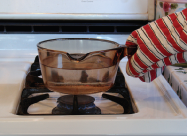
This activity is for those with access to a gas stove. Place a large pot of cool water on top of the stove, and set the burner on high. What product from the combustion of the natural gas do you see condensing on the outside of the pot? Where did it come from? Would more or less of this product
Air molecules stuck inside an inflated balloon collide continuously with the inner surface of the balloon. Each collision provides a little push outward on the balloon. All the many collisions working together keep the balloon inflated. To get a “feel” for what’s happening here, add about a
Add a pinch of red Kool-Aid crystals to a still glass of hot water. Add the same amount of crystals to a second still glass of cold water. With no stirring, which would you expect to become uniform in color first: the hot water or the cold water? Why?
Who is the ultimate expert at nanotechnology?
What are the two main approaches to building nanoscale materials and devices?
How soon will nanotechnology give rise to commercial products?
Why are common names often used for chemical compounds instead of systematic names?
What is the IUPAC systematic name for the compound KF?
Which element within a compound is given first in the compound’s name?
Are the physical and chemical properties of a compound necessarily similar to those of the elements of which it is composed?
What does the chemical formula of a substance tell us about that substance?
How many atoms are there in one molecule of H3PO4? How many atoms of each element are there in one molecule of H3PO4?
What is the difference between an element and a compound?
How many atoms are in a sulfur molecule that has the elemental formula S8?
What are some of the clues that help us to determine whether an observed change is physical or chemical?
Why is the rusting of iron considered to be a chemical change?
Why is it sometimes difficult to decide whether an observed change is physical or chemical?
Showing 2700 - 2800
of 3486
First
21
22
23
24
25
26
27
28
29
30
31
32
33
34
35
Step by Step Answers

 Get 50% OFF
Claim Now
Get 50% OFF
Claim Now