New Semester
Started
Get
50% OFF
Study Help!
--h --m --s
Claim Now
Question Answers
Textbooks
Find textbooks, questions and answers
Oops, something went wrong!
Change your search query and then try again
S
Books
FREE
Study Help
Expert Questions
Accounting
General Management
Mathematics
Finance
Organizational Behaviour
Law
Physics
Operating System
Management Leadership
Sociology
Programming
Marketing
Database
Computer Network
Economics
Textbooks Solutions
Accounting
Managerial Accounting
Management Leadership
Cost Accounting
Statistics
Business Law
Corporate Finance
Finance
Economics
Auditing
Tutors
Online Tutors
Find a Tutor
Hire a Tutor
Become a Tutor
AI Tutor
AI Study Planner
NEW
Sell Books
Search
Search
Sign In
Register
study help
physics
conceptual physical science
Conceptual Physical Science 6th Edition Paul G. Hewitt, John A. Suchocki, Leslie A. Hewitt - Solutions
Does it necessarily take a minimum of 25,000 years to travel a distance of 25,000 light-years?
What was Einstein’s cosmological constant?
Mercury and Venus are never seen at night straight up toward the top of the sky. Why not?
If Venus were somehow transported into the habitable zone, would conditions once again become favorable for life?
Why is there so little wind on the surface of Venus?
What is the cause of winds on Mars (and also on nearly every other planet)?
The greenhouse effect is very pronounced on Venus but doesn’t exist on Mercury. Why?
Explain how energy is transported outward through the convection zone.
Explain how energy is transported from the Sun’s core through the radiation zone.
Explain why the radiation zone is more dense than the convection zone.
Does the Sun have south and north magnetic poles?
Where does the Sun get its energy?
A TV screen is normally light gray when not illuminated. How is the darkness of sunspots similar to the black parts of an image on a TV screen?
Which tends to be larger: a star or a nebula? Which tends to be denser? Which tends to be easier to see in the night sky? Which tends to be longer lived?
If Earth didn’t spin on its axis but still revolved around the Sun, would the Sun set on the eastern horizon, on the western horizon, or not at all?
If Earth didn’t spin on its axis but still revolved around the Sun, how long would a day be on Earth?
When a contracting ball of hot gas spins into a disk shape, it cools. Why?
What happens to the shape of a nebula as it contracts and spins faster?
According to the nebular theory, what happens to a nebula as it contracts under the force of gravity?
Rank in order of increasing average distance from the Sun:(a) Kuiper belt objects,(b) Asteroids,(c) Oort cloud objects.
Rank in order of decreasing number of people who have seen a:(a) Solar eclipse,(b) Lunar eclipse,(c) New Moon.
Rank in order of increasing pressure at the center of each planet:(a) Jupiter,(b) Saturn,(c) Earth.
Rank in order of increasing average density:(a) Jupiter,(b) Saturn,(c) Earth
Rank these planets in order of increasing number of moons:(a) Mars,(b) Venus,(c) Earth.
Rank these planets in order from longest to shortest year: (a) Mercury,(b) Venus,(c) Earth.
If the Sun were the size of a beach ball, Earth would be the size of a green pea 110 m away. Show that the nearest star, Alpha Centauri (4.4 light-years away), would be about 30,000 km distant. (Find the distance to Alpha Centauri in units of AU.)
What would be the consequence of a comet’s tail sweeping across Earth?
Where is the Sun located when you view a full Moon?
What is the Kuiper belt?
What is the Oort cloud, and what is it noted for?
What is a falling star?
What is the age of the Sun?
Why are the days on Mercury very hot and the nights very cold?
What two planets are evening or morning “stars”?
Why is Earth called “the blue planet”?
What gas makes up most of the Martian atmosphere?
What evidence tells us that Mars was at one time wetter than it presently is?
What surface feature do Jupiter and the Sun have in common?
Which move faster: Saturn’s inner rings or the outer rings?
How tilted is Uranus’s axis?
Why is Neptune bluer than Uranus?
Why doesn’t the Moon have an atmosphere?
Where are the Sun and the Moon located at the time of a new Moon?
Why don’t eclipses occur monthly, or nearly monthly?
How does the Moon’s rate of rotation about its own axis compare with its rate of revolution around Earth?
Between the orbits of what two planets is the asteroid belt located?
What is the difference between a meteor and a meteorite?
What causes comet tails to point away from the Sun?
The nearest star to our Sun is Alpha Centauri, which is about 4.4 light-years away. Assume that it too has an Oort cloud about 1.6 light-years in diameter. Show that there is enough space between us and it to fit about 1.75 solar systems
The light-year is a standard unit of distance used by astronomers. It is the distance light travels in one Earth year. In units of light-years, what is the approximate diameter of our solar system, including the outer reaches of the Oort cloud? (Assume that 1 light-year equals 63,000 AU.)
How many days does sunlight take to travel the 50,000 AU from the Sun to the outer reaches of the Oort cloud?
Knowing that the speed of light is 300,000 km/s, show that it takes about 8 min for sunlight to reach Earth.
The planets of our solar system orbit in roughly the same plane, which is the plane of our solar system. We can identify the plane of our solar system in the night sky by noting the positions of the planets, which, from our point of view on Earth, appear in a roughly straight line relative to one
How does the rotation of the Sun differ from the rotation of a solid body?
What dwarf planet was downgraded from planetary status in 2006?
How many known planets are in our solar system?
How are the outer planets different from the inner planets aside from their location?
What are sunspots?
What is the solar wind?
Why are clouds that form over water more efficient in producing precipitation than clouds that form over land?
How would air circulate in the Northern and Southern Hemispheres if there were no land and Earth did not rotate?
If a north wind blows across the sea surface, in what direction does the surface current flow in the Northern Hemisphere? In the Southern Hemisphere?
At the surface, does an Ekman spiral look like a whirlpool or a gyre?
Why do wind-generated waves change direction when they reach shallow water?
During a heavy storm, which will have a more protected shore: a gently sloping beach or a steep and narrow beach?
How does the density of seawater vary with changes in temperature? How does density change with salinity?
Water denser than surrounding water sinks. With respect to the densities of deeper water, how far does it sink?
Explain why most of the bottom water of the oceans forms in the North Atlantic and near Antarctica.
What effect does the formation of sea ice in polar regions have on the density of seawater? Explain.
What happens to the water level in a glass of water when a floating ice cube in the glass melts? Similarly, what happens to the water level in the Great Lakes when floating chunks of ice melt?
What is the relationship between global atmospheric circulation and ocean currents? Relate oceanic gyres to patterns of subtropical high pressure.
What is the characteristic climate of the doldrums, and why does it occur?
Which receive more solar energy over the course of a year: tropical regions or temperate regions? How does this affect ocean salinity?
How does the Coriolis force influence the movement of surface waters?
What are the jet streams, and how do they form?
Relate the jet stream to upper-air circulation. How does this circulation pattern affect airline schedules from New York to San Francisco and the return trip to New York?
Why do the temperate zones have unpredictable weather?
What role does the Sun play in the circulation of ocean currents?
What causes air movement? What is the primary force that causes all winds?
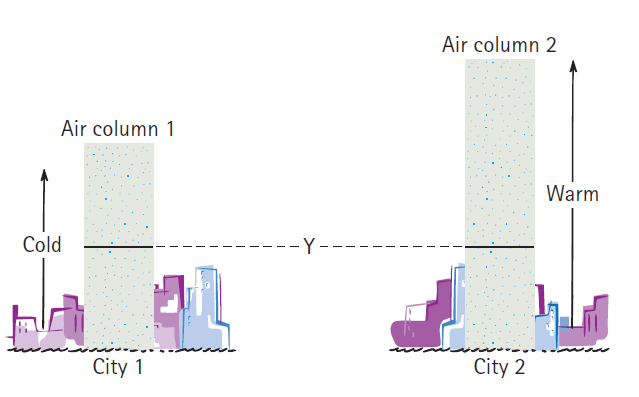
Wind always moves from high pressure to lower pressure. In Figure 24.25b, why does the surface wind move from city 1 to city 2? Air column 2 Air column 1 Warm Cold -Y-- City 1 City 2
Which air is less dense—cool air or warm air? Explain.
Why does warm air rise and cool air sink?
Temperature and pressure are directly proportional to each other. This means that as the temperature decreases, the pressure also decreases; and as the temperature increases, the pressure increases. If warm air rises, does this mean the air moves to a region of higher pressure? Explain.
What is the mass in kilograms of the air in an “empty” nonpressurized scuba tank that has an internal volume of 0.0100 m3?
What happens to the amount of the Sun’s mass as it “burns”?
According to the nebular theory, did the planets start forming before or after the Sun ignited?
Search the sky for passing jets and look for the condensation trail—contrail—that the jet leaves behind. Because jet exhaust is mainly carbon dioxide and water vapor, when the water vapor mixes with the cold environment of the upper troposphere, it can condense into small water droplets to form
What happens when water vapor in a can suddenly condenses? Put a small amount of water in an aluminum softdrink can, and then heat the can on a stove until steam comes out of the opening. With a pair of tongs, invert the can into a pan of cool water. Air is driven from the can so that only
Why does a nebula spin faster as it contracts?
If Earth were not spinning, in what direction would the surface winds blow where you live? In what direction do surface winds blow on Earth at 15° S latitude, and why?
If there were no water on Earth’s surface, would weather occur? Defend your answer.
As the world’s population increases, the amount of carbon dioxide emissions from fossil fuel combustion also increases. Yet the amount of carbon dioxide emitted is greater than the amount found in the atmosphere. Where is the likely repository of excess atmospheric carbon dioxide?
In tropical regions, solar energy exceeds terrestrial radiation. What effect does this have on the salinity of oceans in tropical regions?
How do scientists determine greenhouse gas levels and temperature levels for the geologic past?
How do equatorial regions and polar regions on Earth compare in terms of the number of hours of sunlight in a year? Why are polar regions so much colder?
If the composition of the atmosphere were changed so more terrestrial radiation could escape, what effect would this have on Earth’s average temperature? How about if the atmosphere let less terrestrial radiation escape?
How is global warming affected by the relative transparencies of the atmosphere to long-wavelength and short wave length electromagnetic radiation?
How do the wavelengths of radiant energy vary with the temperature of the radiating source? How does this affect solar and terrestrial radiation?
Pretend you have a magic beanstalk. As you climb it upward to about 10 kilometers, what happens to air pressure and air temperature?
Why is it important that mountain climbers wear sunglasses and apply sunblock even when the temperature is below freezing?
Showing 1500 - 1600
of 3486
First
9
10
11
12
13
14
15
16
17
18
19
20
21
22
23
Last
Step by Step Answers

 Get 50% OFF
Claim Now
Get 50% OFF
Claim Now