New Semester
Started
Get
50% OFF
Study Help!
--h --m --s
Claim Now
Question Answers
Textbooks
Find textbooks, questions and answers
Oops, something went wrong!
Change your search query and then try again
S
Books
FREE
Study Help
Expert Questions
Accounting
General Management
Mathematics
Finance
Organizational Behaviour
Law
Physics
Operating System
Management Leadership
Sociology
Programming
Marketing
Database
Computer Network
Economics
Textbooks Solutions
Accounting
Managerial Accounting
Management Leadership
Cost Accounting
Statistics
Business Law
Corporate Finance
Finance
Economics
Auditing
Tutors
Online Tutors
Find a Tutor
Hire a Tutor
Become a Tutor
AI Tutor
AI Study Planner
NEW
Sell Books
Search
Search
Sign In
Register
study help
physics
fundamentals thermal fluid
Fundamentals of Thermal-Fluid Sciences 5th edition Yunus A. Cengel, Robert H. Turner, John M. Cimbala - Solutions
Oxy-fuel combustion power plants use pulverized coal particles as fuel to burn in a pure oxygen environment to generate electricity. Before entering the furnace, pulverized spherical coal particles with an average diameter of 300 mm, are being transported at 2 m/s through a 3-m long heated tube
Consider a sphere of diameter 5 cm, a cube of side length 5 cm, and a rectangular prism of dimension 4 cm × 5 cm × 6 cm, all initially at 0°C and all made of silver (k = 429 W/m·K, r = 10,500 kg/m3, cp = 0.235 kJ/kg·K). Now all three of these geometries are exposed to ambient air at 33°C on
What is an infinitely long cylinder? When is it proper to treat an actual cylinder as being infinitely long, and when is it not? For example, is it proper to use this model when finding the temperatures near the bottom or top surfaces of a cylinder? Explain.
What is the physical significance of the Fourier number? Will the Fourier number for a specified heat transfer problem double when the time is doubled?
Why are the transient temperature charts prepared using nondimensionalized quantities such as the Biot and Fourier numbers instead of the actual variables such as thermal conductivity and time?
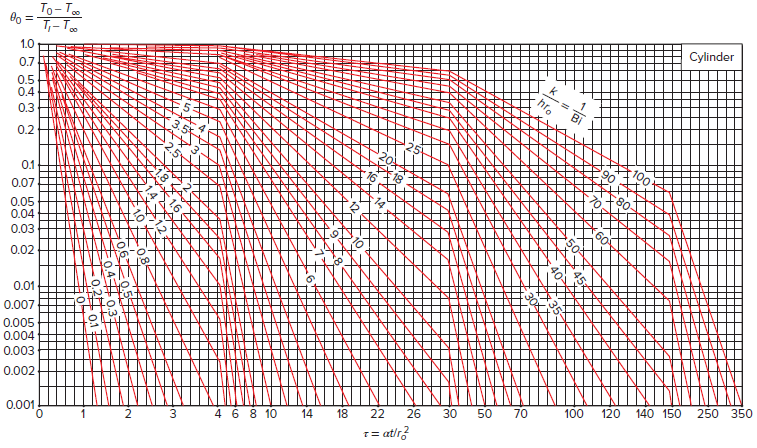
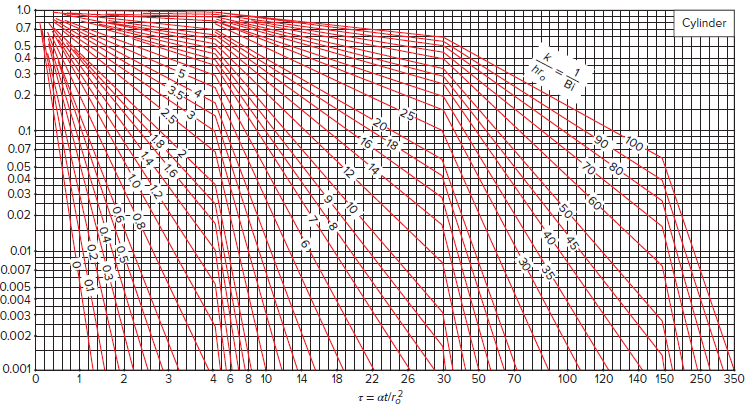
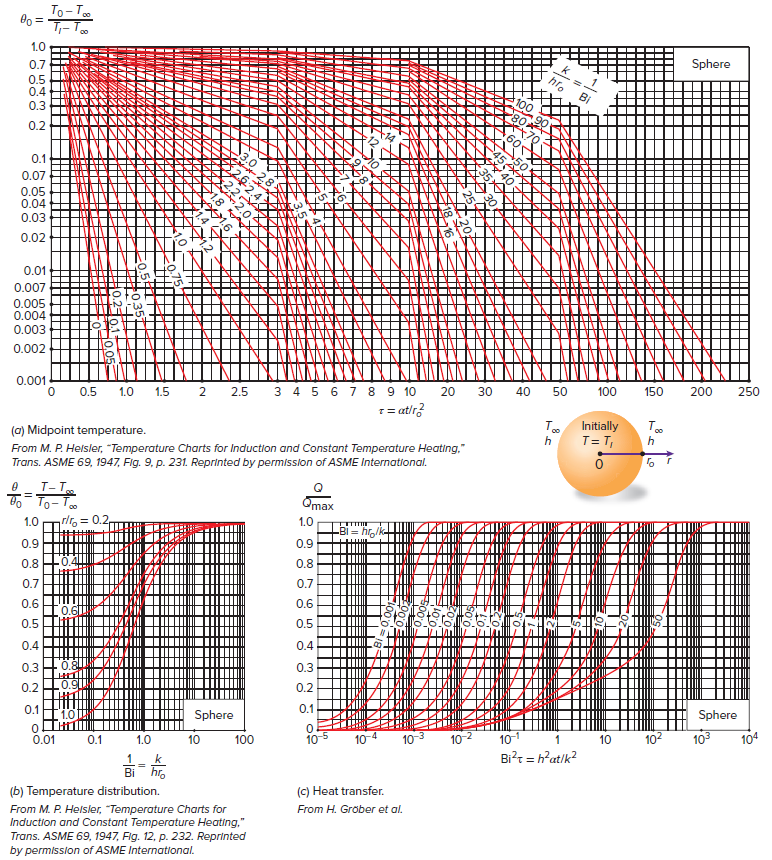
Can the transient temperature charts in Fig. 18€“14 for a plane wall exposed to convection on both sides be used for a plane wall with one side exposed to convection while the other side is insulated? Explain.Fig. 18€“14 To-T 8o = T-To Cylinder 1.0 0.7 0.5 0.4 0.3 Bi 0.2 100 0.1
The Biot number during a heat transfer process between a sphere and its surroundings is determined to be 0.02. Would you use lumped system analysis or the transient temperature charts when determining the midpoint temperature of the sphere? Why?
A body at an initial temperature of Ti is brought into a medium at a constant temperature of T∞. How can you determine the maximum possible amount of heat transfer between the body and the surrounding medium?
In a meat processing plant, 2-cm-thick steaks (k = 0.45 W/m·K and α = 0.91 × 10⁻⁷ m2/s) that are initially at 25°C are to be cooled by passing them through a refrigeration room at -11°C. The heat transfer coefficient on both sides of the steaks is 9 W/m2·K. If both surfaces of the steaks are
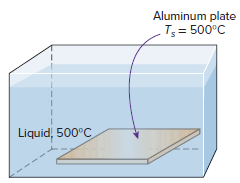
A 10-cm thick aluminum plate (Ï = 2702 kg/m3, cp= 903 J/kg·K, k = 237 W/m·K, and α = 97.1 × 10€“6m2/s) is being heated in liquid with temperature of 500°C. The aluminum plate has a uniform initial temperature of 25°C. If the
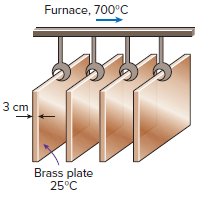
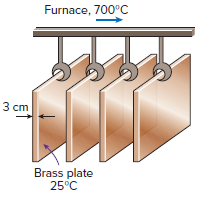
In a production facility, 3-cm-thick large brass plates (k = 110 W/m·K, Ï = 8530 kg/m3, cp= 380 J/kg·K, and α = 33.9 × 10⁻⁶m2/s) that are initially at a uniform temperature of 25°C are heated by passing them through an oven maintained at
Reconsider Prob. 18€“43. Using an appropriate software, investigate the effects of the temperature of the oven and the heating time on the final surface temperature of the plates. Let the oven temperature vary from 500°C to 900°C and the time from 2 min to 30 min. Plot the surface
Layers of 23-cm-thick meat slabs (k = 0.47 W/m·K and α = 0.13 × 10⁻⁶ m2/s) initially at a uniform temperature of 7°C are to be frozen by refrigerated air at 230°C flowing at a velocity of 1.4 m/s. The average heat transfer coefficient between the meat and the air is 20 W/m2·K. Assuming the
In an annealing process, a 50-mm-thick stainless steel plate (Ï = 8238 kg/m3, cp= 468 J/kg·K, k = 13.4 W/m·K, and α = 3.48 × 10€“6m2/s) was reheated in a furnace from an initial uniform temperature of 230°C. The ambient temperature
Layers of 6-in-thick meat slabs (k = 0.26 Btu/h·ft·°F and α = 1.4 × 10⁻⁶ ft2/s) initially at a uniform temperature of 50°F are cooled by refrigerated air at 23°F to a temperature of 36°F at their center in 12 h. Estimate the average heat transfer coefficient during this cooling process.
A long cylindrical wood log (k = 0.17 W/m·K and α = 1.28 × 10⁻⁷ m2/s) is 10 cm in diameter and is initially at a uniform temperature of 15°C. It is exposed to hot gases at 550°C in a fireplace with a heat transfer coefficient of 13.6 W/m2·K on the surface. If the ignition temperature of the
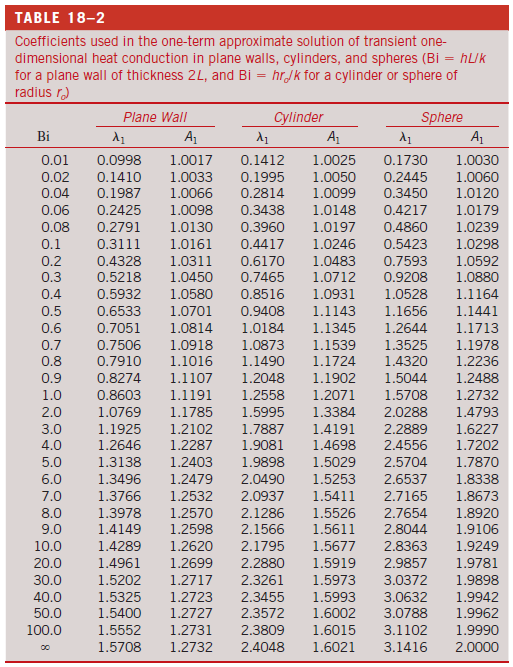
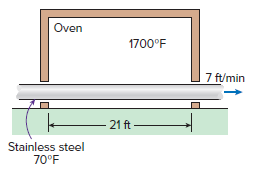
Long cylindrical AISI stainless steel rods (k = 7.74 Btu/h·ft·°F and α = 0.135 ft2/h) of 4-in-diameter are heat treated by drawing them at a velocity of 7 ft/min through a 21-ft-long oven maintained at 1700°F. The heat transfer coefficient in the oven is 20
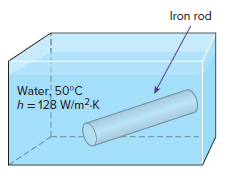
A long iron rod (Ï = 7870 kg/m3, cp= 447 J/kg·K, k = 80.2 W/m·K, and α = 23.1 × 10€“6m2/s) with diameter of 25 mm is initially heated to a uniform temperature of 700°C. The iron rod is then quenched in a large water bath that is
A 30-cm-diameter, 4-m-high cylindrical column of a house made of concrete (k = 0.79 W/m·K, α = 5.94 × 10⁻⁷ m2/s, ρ = 1600 kg/m3, and cp = 0.84 kJ/kg·K) cooled to 14°C during a cold night is heated again during the day by being exposed to ambient air at an average temperature of 28°C with an
A long 35-cm-diameter cylindrical shaft made of stainless steel 304 (k = 14.9 W/m·K, ρ = 7900 kg/m3, cp = 477 J/kg·K, and α = 3.95 × 10⁻⁶ m2/s) comes out of an oven at a uniform temperature of 400°C. The shaft is then allowed to cool slowly in a chamber at 150°C with an average convection
Reconsider Prob. 18–52. Using an appropriate software, investigate the effect of the cooling time on the final center temperature of the shaft and the amount of heat transfer. Let the time vary from 5 min to 60 min. Plot the center temperature and the heat transfer as a function of time, and
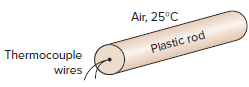
A 2-cm-diameter plastic rod has a thermocouple inserted to measure temperature at the center of the rod. The plastic rod (Ï = 1190 kg/m3, cp= 1465 J/kg·K, and k = 0.19 W/m·K) was initially heated to a uniform temperature of 70°C, and allowed to be cooled in ambient air
A long Pyroceram rod (Ï = 2600 kg/m3, cp= 808 J/kg·K, k = 3.98 W/m·K, and α = 1.89 × 10€“6m2/s) with diameter of 10 mm has an initial uniform temperature of 1000°C. The Pyroceram rod is allowed to cool in ambient temperature of
Steel rods, 2 m in length and 60 mm in diameter, are being drawn through an oven that maintains a temperature of 800°C and convection heat transfer coefficient of 128 W/m2·K. The steel rods (Ï = 7832 kg/m3, cp= 434 J/kg·K, k = 63.9 W/m·K, and α =
For heat transfer purposes, an egg can be considered to be a 5.5-cm-diameter sphere having the properties of water. An egg that is initially at 8°C is dropped into the boiling water at 100°C. The heat transfer coefficient at the surface of the egg is estimated to be 800 W/m2·K. If the egg is
Citrus fruits are very susceptible to cold weather, and extended ex posure to subfreezing temperatures can destroy them. Consider an 8-cm- diameter orange that is initially at 158C. A cold front moves in one night, and the ambient temperature suddenly drops to 268C, with a heat transfer coefficient
A person puts a few apples into the freezer at - 15°C to cool them quickly for guests who are about to arrive. Initially, the apples are at a uniform temperature of 20°C, and the heat transfer coefficient on the surfaces is 8 W/m2·K. Treating the apples as 9-cm-diameter spheres and taking their
Reconsider Prob. 18–61. Using an appropriate software, investigate the effect of the initial temperature of the apples on the final center and surface temperatures and the amount of heat transfer. Let the initial temperature vary from 2°C to 30°C. Plot the center temperature, the surface
A 9-cm-diameter potato (ρ = 1100 kg/m3, cp = 3900 J/kg·K, k = 0.6 W/m·K, and α = 1.4 × 10⁻⁷ m2/s) that is initially at a uniform temperature of 25°C is baked in an oven at 170°C until a temperature sensor inserted to the center of the potato indicates a reading of 70°C. The potato is then
In Betty Crocker’s Cookbook, it is stated that it takes 2 h 45 min to roast a 3.2-kg rib initially at 4.5°C “rare” in an oven maintained at 163°C. It is recommended that a meat thermometer be used to monitor the cooking, and the rib is considered rare done when the thermometer inserted into
Repeat Prob. 18–64 for a roast rib that is to be “welldone” instead of “rare.” A rib is considered to be well-done when its center temperature reaches 77°C, and the roasting in this case takes about 4 h 15 min.Repeat Prob.In Betty Crocker’s Cookbook, it is stated that it takes 2 h 45
Oranges of 2.5-in-diameter (k = 0.26 Btu/h·ft·°F and α = 1.4 3 10-6 ft2/s) initially at a uniform temperature of 78°F are to be cooled by refrigerated air at 25°F flowing at a velocity of 1 ft/s. The average heat transfer coefficient between the oranges and the air is experimentally
Under what conditions can a plane wall be treated as a semi-infinite medium?
What is a semi-infinite medium? Give examples of solid bodies that can be treated as semi-infinite mediums for heat transfer purposes.
Consider a hot semi-infinite solid at an initial temperature of Ti that is exposed to convection to a cooler medium at a constant temperature of T∞, with a heat transfer coefficient of h. Explain how you can determine the total amount of heat transfer from the solid up to a specified time to.
The walls of a furnace are made of 1.2-ft-thick concrete (k = 0.64 Btu/h·ft·°F and α = 0.023 ft2/h). Initially, the furnace and the surrounding air are in thermal equilibrium at 70°F. The furnace is then fired, and the inner surfaces of the furnace are subjected to hot gases at 1800°F with a
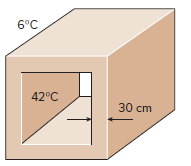
Consider a curing kiln whose walls are made of 30-cm-thick concrete with a thermal diffusivity of α = 0.23 × 10⁻⁵m2/s. Initially, the kiln and its walls are in equilibrium with the surroundings at 6°C. Then all the doors are closed and the kiln is heated by steam so
In areas where the air temperature remains below 0°C for prolonged periods of time, the freezing of water in underground pipes is a major concern. Fortunately, the soil remains relatively warm during those periods, and it takes weeks for the subfreezing temperatures to reach the water mains in the
A highway made of asphalt is initially at a uniform temperature of 55°C. Suddenly the highway surface temperature is reduced to 25°C by rain. Determine the temperature at the depth of 3 cm from the highway surface and the heat flux transferred from the highway after 60 min. Assume the highway
A thick aluminum block initially at 20°C is subjected to constant heat flux of 4000 W/m2 by an electric resistance heater whose top surface is insulated. Determine how much the surface temperature of the block will rise after 30 min.
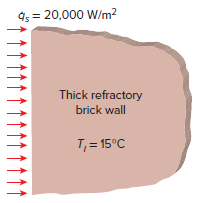
Refractory bricks are used as linings for furnaces, and they generally have low thermal conductivity to minimize heat loss through the furnace walls. Consider a thick furnace wall lining with refractory bricks (k = 1.0 W/m·K and α = 5.08 × 10⁻⁷m2/s), where
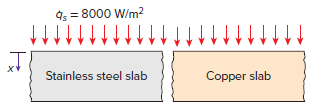
Thick slabs of stainless steel (k = 14.9 W/m·K and α = 3.95 × 10⁻⁶m2/s) and copper (k = 401 W/m·K and α = 117 × 10-6m2/s) are subjected to uniform heat flux of 8 kW/m2at the surface. The two slabs have a uniform initial temperature
A thick wood slab (k = 0.17 W/m·K and α = 1.28 × 10⁻⁷ m2/s) that is initially at a uniform temperature of 25°C is exposed to hot gases at 550°C for a period of 5 min. The heat transfer coefficient between the gases and the wood slab is 35 W/m2·K. If the ignition temperature of the wood is
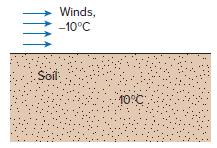
The soil temperature in the upper layers of the earth varies with the variations in the atmospheric conditions. Before a cold front moves in, the earth at a location is initially at a uniform temperature of 10°C. Then the area is subjected to a temperature of 210°C and high winds that
We often cut a watermelon in half and put it into the freezer to cool it quickly. But usually we forget to check on it and end up having a watermelon with a frozen layer on the top. To avoid this potential problem a person wants to set the timer such that it will go off when the temperature of the
What is the product solution method? How is it used to determine the transient temperature distribution in a two-dimensional system?
A short cylinder initially at a uniform temperature Ti is subjected to convection from all of its surfaces to a medium at temperature T∞. Explain how you can determine the temperature of the midpoint of the cylinder at a specified time t.
Consider a short cylinder whose top and bottom surfaces are insulated. The cylinder is initially at a uniform temperature Ti and is subjected to convection from its side surface to a medium at temperature T∞ with a heat transfer coefficient of h. Is the heat transfer in this short cylinder one-
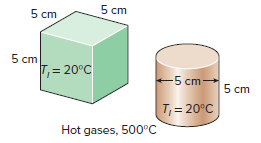
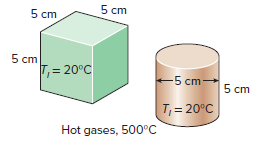
Consider a cubic block whose sides are 5 cm long and a cylindrical block whose height and diameter are also 5 cm. Both blocks are initially at 20°C and are made of granite (k = 2.5 W/m·K and α = 1.15 × 10⁻⁶m2/s). Now both blocks are exposed to hot gases at
Repeat Prob. 18€“87 with the heat transfer coefficient at the top and the bottom surfaces of each block being doubled to 80 W/m2·K.Repeat Prob.Consider a cubic block whose sides are 5 cm long and a cylindrical block whose height and diameter are also 5 cm. Both blocks are initially
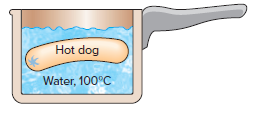
A hot dog can be considered to be a cylinder 5 in long and 0.8 in in diameter whose properties are ρ = 61.2 lbm/ft3, cp = 0.93 Btu/lbm·8F, k = 0.44 Btu/h·ft·8F, and α = 0.0077 ft2/h. A hot dog initially at 408F is dropped into boiling water at 2128F. If the heat transfer coefficient at the
A 2-cm-high cylindrical ice block (k = 2.22 W/m·K and α = 0.124 × 10⁻⁷ m2/s) is placed on a table on its base of diameter 2 cm in a room at 24°C. The heat transfer coefficient on the exposed surfaces of the ice block is 13 W/m2·K, and heat transfer from the base of the ice block to the table
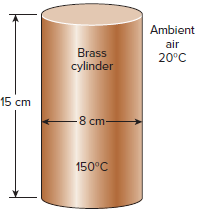
A short brass cylinder (Ï = 8530 kg/m3, cp= 0.389 kJ/kg·K, k = 110 W/m·K, and α = 3.39 × 10⁻⁵m2/s) of diameter 8 cm and height 15 cm is initially at a uniform temperature of 150°C. The cylinder is now placed in atmospheric air at 20°C,
A semi-infinite aluminum cylinder (k = 237 W/m·K, α = 9.71 × 10⁻⁵ m2/s) of diameter D = 15 cm is initially at a uniform temperature of Ti = 115°C. The cylinder is now placed in water at 10°C, where heat transfer takes place by convection with a heat transfer coefficient of h = 140 W/m2·K.
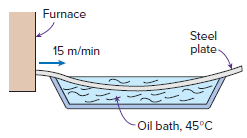
A long roll of 2-m-wide and 0.5-cm-thick 1-Mn manganese steel plate coming off a furnace at 820°C is to be quenched in an oil bath (cp= 2.0 kJ/kg·K) at 45°C. The metal sheet is moving at a steady velocity of 15 m/min, and the oil bath is 9 m long. Taking the convection heat transfer
Large steel plates 1.0-cm in thickness are quenched from 600°C to 100°C by submerging them in an oil reservoir held at 30°C. The average heat transfer coefficient for both faces of steel plates is 400 W/m2·K. Average steel properties are k = 45 W/m·K, ρ = 7800 kg/m3, and cp = 470 J/kg·K.
Aluminum wires, 3 mm in diameter, are produced by extrusion. The wires leave the extruder at an average temperature of 350°C and at a linear rate of 10 m/min. Before leaving the extrusion room, the wires are cooled to an average temperature of 50°C by transferring heat to the surrounding air at
During a picnic on a hot summer day, the only available drinks were those at the ambient temperature of 90°F. In an effort to cool a 12-fluid-oz drink in a can, which is 5 in high and has a diameter of 2.5 in, a person grabs the can and starts shaking it in the iced water of the chest at 32°F.
Two metal rods are being heated in an oven with uniform ambient temperature of 1000°C and convection heat transfer coefficient of 25 W/m2·K. Rod A is made of aluminum (ρ = 2702 kg/m3, cp = 903 J/kg·K, and k = 237 W/m·K) and rod B is made of stainless steel (ρ = 8238 kg/m3, cp = 468 J/kg·K,
Stainless steel ball bearings (ρ = 8085 kg/m3, k = 15.1 W/m·°C, cp = 0.480 kJ/kg·°C, and α = 3.91 × 10⁻⁶ m2/s) having a diameter of 1.2 cm are to be quenched in water. The balls leave the oven at a uniform temperature of 900°C and are exposed to air at 30°C for a while before they are
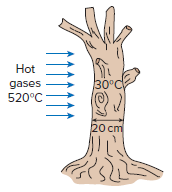
During a fire, the trunks of some dry oak trees (k = 0.17 W/m·K and α = 1.28 × 10⁻⁷m2/s) that are initially at a uniform temperature of 30°C are exposed to hot gases at 520°C for a period of 5 h, with a heat transfer coefficient of 65 W/m2·K on the
In Betty Crocker’s Cookbook, it is stated that it takes 5 h to roast a 14-lbm stuffed turkey initially at 40°F in an oven maintained at 325°F. It is recommended that a meat thermometer be used to monitor the cooking, and the turkey isconsidered done when the thermometer inserted deep into the
Spherical glass beads coming out of a kiln are allowed to cool in a room temperature of 30°C. A glass bead with a diameter of 10 mm and an initial temperature of 400°C is allowed to cool for 3 min. If the convection heat transfer coefficient is 28 W/m2·K, determine the temperature at
The water main in the cities must be placed at sufficient depth below the earth’s surface to avoid freezing during extended periods of subfreezing temperatures. Determine the minimum depth at which the water main must be placed at a location where the soil is initially at 15°C and the earth’s
A 40-cm-thick brick wall (k = 0.72 W/m·K, and α = 1.6 × 10⁻⁶ m2/s) is heated to an average temperature of 18°C by the heating system and the solar radiation incident on it during the day. During the night, the outer surface of the wall is exposed to cold air at 23°C with an average heat
A large heated steel block (ρ = 7832 kg/m3, cp = 434 J/kg·K, k = 63.9 W/m·K, and α = 18.8 × 10⁻⁶ m2/s) is allowed to cool in a room at 25°C. The steel block has an initial temperature of 450°C and the convection heat transfer coefficient is 25 W/m2·K. Assuming that the steel block can be
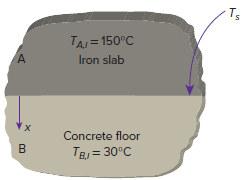
A large iron slab (Ï = 7870 kg/m3, cp= 447 J/ kg·K, and k = 80.2 W/m·K) was initially heated to a uniform temperature of 150°C and then placed on concrete floor (Ï = 1600 kg/m3, cp= 840 J/kg·K, and k = 0.79 W/m·K). The concrete floor was
A hot dog can be considered to be a 12-cm-long cylinder whose diameter is 2 cm and whose properties are Ï = 980 kg/m3, cp= 3.9 kJ/kg·K, k = 0.76 W/m·K, and α = 2 × 10⁻⁷m2/s. A hot dog initially at 5°C is dropped into boiling water at
Reconsider Prob. 15–35. Using an appropriate software, investigate the effect of car speed on the required power to overcome(a) Rolling resistance,(b) The aerodynamic drag,(c) Their combined effect. Let the car speed vary from 0 to 150 km/h in increments of 15 km/h. Tabulate and plot the results.
During steady motion of a vehicle on a level road, the power delivered to the wheels is used to overcome aerodynamic drag and rolling resistance (the product of the rolling resistance coefficient and the weight of the vehicle), assuming the friction at the bearings of the wheels is negligible.
A 5-ft-diameter spherical tank completely submerged in freshwater is being towed by a ship at 12 ft/s. Assuming turbulent flow, determine the required towing power.
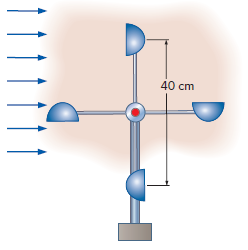
Reconsider Prob. 15€“32. Using an appropriate software, investigate the effect of wind speed on the torque applied on the pivot. Let the wind speed vary from 0 to 50 m/s in increments of 5 m/s. Tabulate and plot the results.In Prob. 40 cm
A wind turbine with two or four hollow hemispherical cups connected to a pivot is commonly used to measure wind speed. Consider a wind turbine with four 8-cm-diameter cups with a center-to-center distance of 40 cm, as shown in Fig. P15€“32. The pivot is stuck as a result of some
A 70-kg bicyclist is riding her 15-kg bicycle downhill on a road with a slope of 8° without pedaling or braking. The bicyclist has a frontal area of 0.45 m2 and a drag coefficient of 1.1 in the upright position, and a frontal area of 0.4 m2 and a drag coefficient of 0.9 in the racing position.
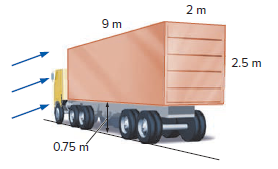
During major windstorms, high vehicles such as RVs and semis may be thrown off the road and boxcars off their tracks, especially when they are empty and in open areas. Consider a 5000-kg semi that is 9 m long, 2.5 m high, and 2 m wide. The distance between the bottom of the truck and the road is
Wind loading is a primary consideration in the design of the supporting mechanisms of billboards, as evidenced by many billboards being knocked down during high winds. Determine the wind force acting on an 12-ft-high, 20-ft-wide billboard due to 55-mi/h winds in the normal direction when the
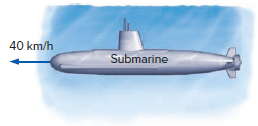
A submarine can be treated as an ellipsoid with a diameter of 5 m and a length of 25 m. Determine the power required for this submarine to cruise horizontally and steadily at 40 km/h in seawater whose density is 1025 kg/m3. Also determine the power required to tow this submarine in air whose
At highway speeds, about half of the power generated by the car’s engine is used to overcome aerodynamic drag, and thus the fuel consumption is nearly proportional to the drag force on a level road. Determine the percentage increase in fuel consumption of a car per unit time when a person who
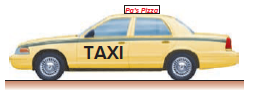
Advertisement signs are commonly carried by taxicabs for additional income, but they also increase the fuel cost. Consider a sign that consists of a 0.30-m-high, 0.9-m-wide, and 0.9-m-long rectangular block mounted on top of a taxicab such that the sign has a frontal area of 0.3 m by 0.9 m from all
Bill gets a job delivering pizzas. The pizza company makes him mount a sign on the roof of his car. The frontal area of the sign is A = 0.612 ft2, and he estimates the drag coefficient to be CD = 0.94 at nearly all air speeds. Estimate how much additional money it costs Bill per year in fuel to
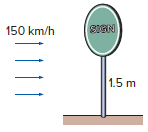
A circular sign has a diameter of 50 cm and is subjected to normal winds up to 150 km/h at 10°C and 100 kPa. Determine the drag force acting on the sign. Also determine the bending moment at the bottom of its pole whose height from the ground to the bottom of the sign is 1.5 m. Disregard the
Reconsider Prob. 15–22E. Using an appropriate software, investigate the effect of frontal area on the annual fuel consumption of the car. Let the frontal area vary from 10 to 30 ft2 in increments of 2 ft2. Tabulate and plot the results.In Prob.To reduce the drag coefficient and thus to improve
To reduce the drag coefficient and thus to improve the fuel efficiency, the frontal area of a car is to be reduced. Determine the amount of fuel and money saved per year as a result of reducing the frontal area from 18 to 15 ft2. Assume the car is driven 12,000 mi a year at an average speed of 55
A car is moving at a constant velocity of 110 km/h. Determine the upstream velocity to be used in fluid flow analysis if(a) The air is calm,(b) Wind is blowing against the direction of motion of the car at 30 km/h,(c) Wind is blowing in the same direction of motion of the car at 30 km/h.
During a high Reynolds number experiment, the total drag force acting on a spherical body of diameter D = 12 cm subjected to airflow at 1 atm and 5°C is measured to be 5.2 N. The pressure drag acting on the body is calculated by integrating the pressure distribution (measured by the use of
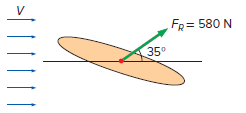
The resultant of the pressure and wall shear forces acting on a body is measured to be 580 N, making 35° with the direction of flow. Determine the drag and the lift forces acting on the body. FR = 580 N 35°
The drag coefficient of a car at the design conditions of 1 atm, 25°C, and 90 km/h is to be determined experimentally in a large wind tunnel in a full-scale test. The height and width of the car are 1.25 m and 1.65 m, respectively. If the horizontal force acting on the car is measured to be 220 N,
In general, how does the drag coefficient vary with the Reynolds number at(a) Low and moderate Reynolds numbers(b) At high Reynolds numbers (Re > 104)?
What is drafting? How does it affect the drag coefficient of the drafted body?
What is flow separation? What causes it? What is the effect of flow separation on the drag coefficient?
What is the effect of streamlining on (a) friction drag (b) Pressure drag? Does the total drag acting on a body necessarily decrease as a result of streamlining? Explain.
What is the effect of surface roughness on the friction drag coefficient in laminar and turbulent flows?
What is the difference between skin friction drag and pressure drag? Which is usually more significant for slender bodies such as airfoils?
What is terminal velocity? How is it determined?
During flow over a given body, the drag force, the upstream velocity, and the fluid density are measured. Explain how you would determine the drag coefficient. What area would you use in the calculations?
What is lift? What causes it? Does wall shear contribute to the lift?
What is the difference between the upstream velocity and the free-stream velocity? For what types of flow are these two velocities equal to each other?
What is the difference between streamlined and bluff bodies? Is a tennis ball a streamlined or bluff body?
Name some applications in which a large drag is desired.
What is drag? What causes it? Why do we usually try to minimize it?
Showing 900 - 1000
of 1421
1
2
3
4
5
6
7
8
9
10
11
12
13
14
15
Step by Step Answers

 Get 50% OFF
Claim Now
Get 50% OFF
Claim Now