New Semester
Started
Get
50% OFF
Study Help!
--h --m --s
Claim Now
Question Answers
Textbooks
Find textbooks, questions and answers
Oops, something went wrong!
Change your search query and then try again
S
Books
FREE
Study Help
Expert Questions
Accounting
General Management
Mathematics
Finance
Organizational Behaviour
Law
Physics
Operating System
Management Leadership
Sociology
Programming
Marketing
Database
Computer Network
Economics
Textbooks Solutions
Accounting
Managerial Accounting
Management Leadership
Cost Accounting
Statistics
Business Law
Corporate Finance
Finance
Economics
Auditing
Tutors
Online Tutors
Find a Tutor
Hire a Tutor
Become a Tutor
AI Tutor
AI Study Planner
NEW
Sell Books
Search
Search
Sign In
Register
study help
physics
fundamentals thermal fluid
Fundamentals of Thermal-Fluid Sciences 5th edition Yunus A. Cengel, Robert H. Turner, John M. Cimbala - Solutions
What is the physical mechanism that causes the friction factor to be higher in turbulent flow?
Consider laminar flow of air in a circular pipe with perfectly smooth surfaces. Do you think the friction factor for this flow is zero? Explain.
How is head loss related to pressure loss? For a given fluid, explain how you would convert head loss to pressure loss.
Consider fully developed laminar flow in a circular pipe. If the viscosity of the fluid is reduced by half by heating while the flow rate is held constant, how does the head loss change?
What is turbulent viscosity? What causes it?
Explain why the friction factor is independent of the Reynolds number at very large Reynolds numbers.
Consider fully developed laminar flow in a circular pipe. If the diameter of the pipe is reduced by half while the flow rate and the pipe length are held constant, the head loss will (a) Double, (b) Triple, (c) Quadruple, (d) Increase by a factor of 8, (e) Increase by a factor of 16.
Discuss whether fully developed pipe flow is one-, two-, or three-dimensional.
How is the friction factor for flow in a pipe related to the pressure loss? How is the pressure loss related to the pumping power requirement for a given mass flow rate?
In the fully developed region of flow in a circular pipe, does the velocity profile change in the flow direction?
How does the wall shear stress τw vary along the flow direction in the fully developed region in(a) Laminar flow(b) Turbulent flow?
Someone claims that in fully developed turbulent flow in a pipe, the shear stress is a maximum at the pipe wall. Do you agree with this claim? Explain.
Someone claims that the shear stress at the center of a circular pipe during fully developed laminar flow is zero. Do you agree with this claim? Explain.
Someone claims that the average velocity in a circular pipe in fully developed laminar flow can be determined by simply measuring the velocity at R/2 (midway between the wall surface and the centerline). Do you agree? Explain.
Someone claims that the volume flow rate in a circular pipe with laminar flow can be determined by measuring the velocity at the centerline in the fully developed region, multiplying it by the cross-sectional area, and dividing the result by 2. Do you agree? Explain.
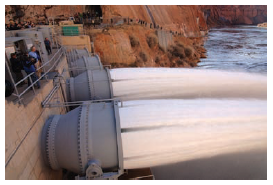
Shown here is a cool picture of water being released at 300,000 gallons per second in the spring of 2008. This was part of a revitalization effort for the ecosystem of the Grand Canyon and the Colorado River. Estimate the Reynolds number of the pipe flow. Is it laminar or turbulent?
How does surface roughness affect the pressure drop in a pipe if the flow is turbulent? What would your response be if the flow were laminar?
Which fluid at room temperature requires a larger pump to flow at a specified velocity in a given pipe: water or engine oil? Why?
Show that the Reynolds number for flow in a circular pipe of diameter D can be expressed as Re = 4ṁ/(πDμ).
Consider a person walking first in air and then in water at the same speed. For which motion will the Reynolds number be higher?
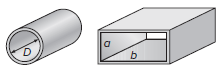
What is the physical significance of the Reynolds number? How is it defined for(a) Flow in a circular pipe of inner diameter D(b) Flow in a rectangular duct of cross section a × b?
Why are liquids usually transported in circular pipes?
How is the hydrodynamic entry length defined for flow in a pipe? Is the entry length longer in laminar or turbulent flow?
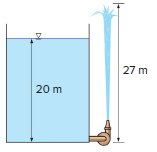
The water level in a tank is 20 m above the ground. A hose is connected to the bottom of the tank, and the nozzle at the end of the hose is pointed straight up. The tank is at sea level, and the water surface is open to the atmosphere. In the line leading from the tank to the nozzle is a pump,
A person is filling a knee-high bucket with water using a garden hose and holding it such that water discharges from the hose at the level of his waist. Someone suggests that the bucket will fill faster if the hose is lowered such that water discharges from the hose at the knee level. Do you agree
Define static, dynamic, and hydrostatic pressure. Under what conditions is their sum constant for a flow stream?
What is streamwise acceleration? How does it differ from normal acceleration? Can a fluid particle accelerate in steady flow?
Define pressure head, velocity head, and elevation head for a fluid stream and express them for a fluid stream whose pressure is P, velocity is V, and elevation is z.
Explain how and why a siphon works. Someone proposes siphoning cold water over a 7-m-high wall. Is this feasible? Explain.
How is the location of the hydraulic grade line determined for open-channel flow? How is it determined at the outlet of a pipe discharging to the atmosphere?
In a certain application, a siphon must go over a high wall. Can water or oil with a specific gravity of 0.8 go over a higher wall? Why?
What is the hydraulic grade line? How does it differ from the energy grade line? Under what conditions do both lines coincide with the free surface of a liquid?
A siphon pumps water from a large reservoir to a lower tank that is initially empty. The tank also has a rounded orifice 20 ft below the reservoir surface where the water leaves the tank. Both the siphon and the orifice diameters are 2 in. Ignoring frictional losses, determine to what height the
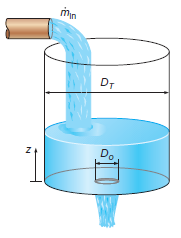
Water enters a tank of diameter DTsteadily at a mass flow rate of min. An orifice at the bottom with diameter Doallows water to escape. The orifice has a rounded entrance, so the frictional losses are negligible. If the tank is initially empty, (a) Determine the maximum height that the water will
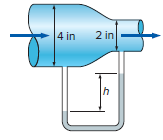
Water flows through a horizontal pipe at a rate of 2.4 gal/s. The pipe consists of two sections of diameters 4 in and 2 in with a smooth reducing section. The pressure difference between the two pipe sections is measured by a mercury manometer. Neglecting frictional effects, determine the
An airplane is flying at an altitude of 12,000 m. Determine the gage pressure at the stagnation point on the nose of the plane if the speed of the plane is 300 km/h. How would you solve this problem if the speed were 1050 km/h? Explain.
While traveling on a dirt road, the bottom of a car hits a sharp rock and a small hole develops at the bottom of its gas tank. If the height of the gasoline in the tank is 30 cm, determine the initial velocity of the gasoline at the hole. Discuss how the velocity will change with time and how the
The water in an 8-m-diameter, 3-m-high above-ground swimming pool is to be emptied by unplugging a 3-cm-diameter, 25-m-long horizontal pipe attached to the bottom of the pool. Determine the maximum discharge rate of water through the pipe. Also, explain why the actual flow rate will be less.
Reconsider Prob. 12–26. Determine how long it will take to empty the swimming pool completely.In ProblemThe water in an 8-m-diameter, 3-m-high above-ground swimming pool is to be emptied by unplugging a 3-cm-diameter, 25-m-long horizontal pipe attached to the bottom of the pool. Determine the
Reconsider Prob. 12–27. Using an appropriate software, investigate the effect of the discharge pipe diameter on the time required to empty the pool completely. Let the diameter vary from 1 to 10 cm in increments of 1 cm. Tabulate and plot the results.
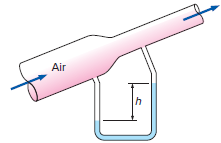
Air at 105 kPa and 37?C flows upward through a 6-cm-diameter inclined duct at a rate of 65 L/s. The duct diameter is then reduced to 4 cm through a reducer. The pressure change across the reducer is measured by a water manometer. The elevation difference between the two points on the pipe where the
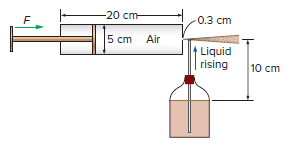
A handheld bicycle pump can be used as an atomizer to generate a fine mist of paint or pesticide by forcing air at a high velocity through a small hole and placing a short tube between the liquid reservoir and the high-speed air jet. The pressure across a subsonic jet exposed to the atmosphere is
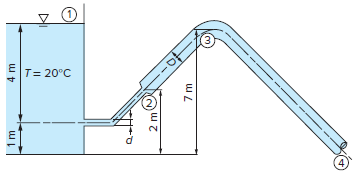
Water at 20°C is siphoned from a reservoir as shown in Fig. P12€“31. For d = 10 cm and D = 16 cm, determine(a) The minimum flow rate that can be achieved without cavitation occurring in the piping system(b) The maximum elevation of the highest point of the piping system to avoid
The water pressure in the mains of a city at a particular location is 270 kPa gage. Determine if this main can serve water to neighborhoods that are 25 m above this location.
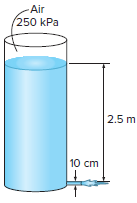
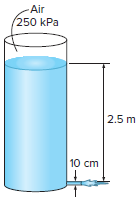
A pressurized tank of water has a 10-cm-diameter orifice at the bottom, where water discharges to the atmosphere. The water level is 2.5 m above the outlet. The tank air pressure above the water level is 250 kPa (absolute) while the atmospheric pressure is 100 kPa. Neglecting frictional effects,
Reconsider Prob. 12??33. Using an appropriate software, investigate the effect of water height in the tank on the discharge velocity. Let the water height vary from 0 to 5 m in increments of 0.5 m. Tabulate and plot the results. -Air 250 kPa 2.5 m 10 cm
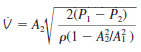
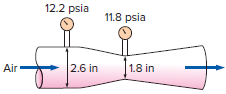
Air is flowing through a venturi meter whose diameter is 2.6 in at the entrance part (location 1) and 1.8 in at the throat (location 2). The gage pressure is measured to be 12.2 psia at the entrance and 11.8 psia at the throat. Neglecting frictional effects, show that the volume flow rate can be
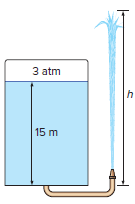
The water level in a tank is 15 m above the ground. A hose is connected to the bottom of the tank, and the nozzle at the end of the hose is pointed straight up. The tank cover is airtight, and the air pressure above the water surface is 3 atm gage. The system is at sea level. Determine the maximum
What is useful pump head? How is it related to the power input to the pump?
Consider the steady adiabatic flow of an incompressible fluid. Can the temperature of the fluid decrease during flow? Explain.
What is irreversible head loss? How is it related to the mechanical energy loss?
Consider the steady adiabatic flow of an incompressible fluid. If the temperature of the fluid remains constant during flow, is it accurate to say that the frictional effects are negligible?
What is the kinetic energy correction factor? Is it significant?
The water level in a tank is 20 m above the ground. A hose is connected to the bottom of the tank, and the nozzle at the end of the hose is pointed straight up. The water stream from the nozzle is observed to rise 25 m above the ground. Explain what may cause the water from the hose to rise above
A 3-m-high tank filled with water has a discharge valve near the bottom and another near the top.(a) If these two valves are opened, will there be any difference between the discharge velocities of the two water streams?(b) If a hose whose discharge end is left open on the ground is first connected
In a hydroelectric power plant, water flows from an elevation of 400 ft to a turbine, where electric power is generated. For an overall turbine–generator efficiency of 85 percent, determine the minimum flow rate required to generate 100 kW of electricity.
Reconsider Prob. 12–45E. Determine the flow rate of water if the irreversible head loss of the piping system between the free surfaces of the inlet and the outlet is 36 ft.In ProblemIn a hydroelectric power plant, water flows from an elevation of 400 ft to a turbine, where electric power is
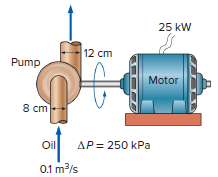
An oil pump is drawing 25 kW of electric power while pumping oil with r = 860 kg/m3at a rate of 0.1 m3/s. The inlet and outlet diameters of the pipe are 8 cm and 12 cm, respectively. If the pressure rise of oil in the pump is measured to be 250 kPa and the motor efficiency is 90 percent, determine
Water is being pumped from a large lake to a reservoir 25 m above at a rate of 25 L/s by a 10-kW (shaft) pump. If the irreversible head loss of the piping system is 5 m, determine the mechanical efficiency of the pump.
Reconsider Prob. 12–48. Using an appropriate software, investigate the effect of irreversible head loss on the mechanical efficiency of the pump. Let the head loss vary from 0 to 15 m in increments of 1 m. Plot the results and discuss them.In ProblemWater is being pumped from a large lake to a
A 15-hp (shaft) pump is used to raise water to a 45-m higher elevation. If the mechanical efficiency of the pump is 82 percent, determine the maximum volume flow rate of water.
Water flows at a rate of 0.035 m3/s in a horizontal pipe whose diameter is reduced from 15 cm to 8 cm by a reducer. If the pressure at the centerline is measured to be 480 kPa and 445 kPa before and after the reducer, respectively, determine the irreversible head loss in the reducer. Take the
A hydraulic turbine has 50 m of head available at a flow rate of 1.30 m3/s, and its overall turbine–generator efficiency is 78 percent. Determine the electric power output of this turbine.
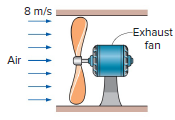
A fan is to be selected to ventilate a bathroom whose dimensions are 2 m × 3 m × 3 m. The air velocity is not to exceed 8 m/s to minimize vibration and noise. The combined efficiency of the fan??motor unit to be used can be taken to be 50 percent. If the fan is to replace the entire volume of air
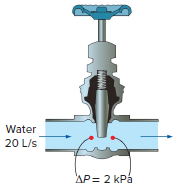
Water flows at a rate of 20 L/s through a horizontal pipe whose diameter is constant at 3 cm. The pressure drop across a valve in the pipe is measured to be 2 kPa, as shown in Fig P12??55. Determine the irreversible head loss of the valve, and the useful pumping power needed to overcome the
The water level in a tank is 34 ft above the ground. A hose is connected to the bottom of the tank at the ground level and the nozzle at the end of the hose is pointed straight up. The tank cover is airtight, but the pressure over the water surface is unknown. Determine the minimum tank air
A large tank is initially filled with water 5 m above the center of a sharp-edged 10-cm-diameter orifice. The tank water surface is open to the atmosphere, and the orifice drains to the atmosphere. If the total irreversible head loss in the system is 0.3 m, determine the initial discharge velocity
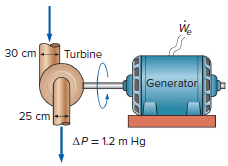
Water enters a hydraulic turbine through a 30-cmdiameter pipe at a rate of 0.6 m3/s and exits through a 25-cmdiameter pipe. The pressure drop in the turbine is measured by a mercury manometer to be 1.2 m. For a combined turbine??generator efficiency of 83 percent, determine the net electric power
The velocity profile for turbulent flow in a circular pipe is approximated as u(r) = umax(1 - r/R)1/n, where n = 9. Determine the kinetic energy correction factor for this flow.
A 5-cm-diameter horizontal jet of water with a velocity of 40 m/s relative to the ground strikes a flat plate that is moving in the same direction as the jet at a velocity of 10 m/s. The water splatters in all directions in the plane of the plate. How much force does the water stream exert on the
Water in a partially filled large tank is to be supplied to the roof top, which is 8 m above the water level in the tank, through a 2.5-cm-internal-diameter pipe by maintaining a constant air pressure of 300 kPa (gage) in the tank. If the head loss in the piping is 2 m of water, determine the
Express Newton’s first, second, and third laws.
What are the three major assumptions used in the derivation of the Bernoulli equation?
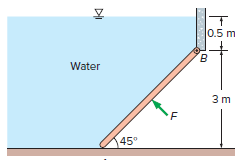
The 280-kg, 6-m-wide rectangular gate shown in Fig. P11??52 is hinged at B and leans against the floor at A making an angle of 45? with the horizontal. The gate is to be opened from its lower edge by applying a normal force at its center. Determine the minimum force F required to open the water
The density of a floating body can be determined by tying weights to the body until both the body and the weights are completely submerged, and then weighing them separately in air. Consider a wood log that weighs 1540 N in air. If it takes 34 kg of lead (ρ = 11,300 kg/m3) to completely sink the
The average density of icebergs is about 917 kg/m3.(a) Determine the percentage of the total volume of an iceberg submerged in seawater of density 1042 kg/m3.(b) Although icebergs are mostly submerged, they are observed to turn over. Explain how this can happen.
The volume and the average density of an irregularly shaped body are to be determined by using a spring scale. The body weighs 7200 N in air and 4790 N in water. Determine the volume and the density of the body. State your assumptions.
A crane is used to lower weights into a lake for an underwater construction project. Determine the tension in the rope of the crane due to a 3-ft-diameter spherical steel block (density = 494 lbm/ft3) when it is(a) Suspended in the air(b) Completely immersed in water.
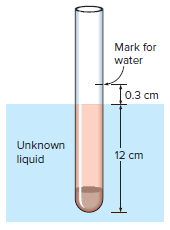
The density of a liquid is to be determined by an old 1-cm-diameter cylindrical hydrometer whose division marks are completely wiped out. The hydrometer is first dropped in water, and the water level is marked. The hydrometer is then dropped into the other liquid, and it is observed that the mark
Discuss the stability of (a) A submerged, (b) A floating body whose center of gravity is above the center of buoyancy.
Consider a 3-kg copper cube and a 3-kg copper ball submerged in a liquid. Will the buoyant forces acting on these two bodies be the same or different? Explain.
Consider two 5-cm-diameter spherical balls—one made of aluminum, the other of iron—submerged in water. Will the buoyant forces acting on these two balls be the same or different? Explain.
Consider two identical spherical balls submerged in water at different depths. Will the buoyant forces acting on these two balls be the same or different? Explain.
What is buoyant force? What causes it? What is the magnitude of the buoyant force acting on a submerged body whose volume is V? What are the direction and the line of action of the buoyant force?
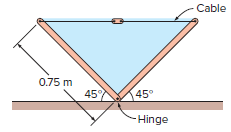
The two sides of a V-shaped water trough are hinged to each other at the bottom where they meet, as shown in Fig. P11??25, making an angle of 45? with the ground from both sides. Each side is 0.75 m wide, and the two parts are held together by a cable and turnbuckle placed every 6 m along the
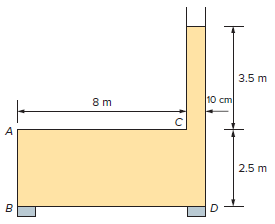
The following 2.5 m × 8.1 m × 6 m tank shown is filled by oil of SG = 0.88. Determine (a) The magnitude and the location of the line of action of the resultant force acting on surface AB (b) The pressure force acting on surface BD. Will the force acting on surface BD equal the weight of the oil
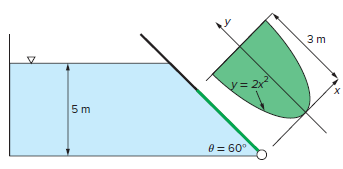
From Prob. 11-22, knowing that the density of the suspension depends on liquid depth and changes linearly from 800 kg/m3 to 900 kg/m3 in the vertical direction, determine the resultant force acting on the gate ABC, and its line of action. 3 m y= 2x 5 m 0 = 60°
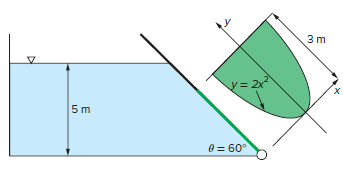
An open settling tank shown in the figure contains a liquid suspension. Determine the resultant force acting on the gate and its line of action if the liquid density is 850 kg/m3. 3 m y= 2x 5 m 0 = 60°
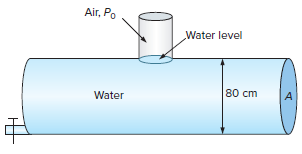
A cylindrical tank is fully filled with water (Fig. P11??21). In order to increase the flow from the tank, an additional pressure is applied to the water surface by a compressor. For P0= 0, P0= 3 bar, and P0= 10 bar, calculate the hydrostatic force on the surface A exerted by water. Air, Po Water
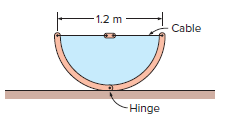
A water trough of semicircular cross section of radius 0.6 m consists of two symmetric parts hinged to each other at the bottom, as shown in Fig. P11??20. The two parts are held together by a cable and turnbuckle placed every 3 m along the length of the trough. Calculate the tension in each cable
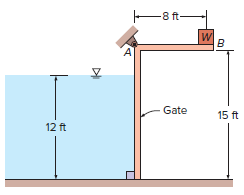
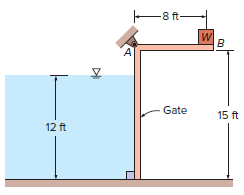
Repeat Prob. 11??18E for a water height of 8 ft. In Problem The flow of water from a reservoir is controlled by a 5-ft-wide L-shaped gate hinged at point A, as shown in Fig. P11??18E. If it is desired that the gate open when the water height is 12 ft, determine the mass of the required weight W.
The flow of water from a reservoir is controlled by a 5-ft-wide L-shaped gate hinged at point A, as shown in Fig. P11??18E. If it is desired that the gate open when the water height is 12 ft, determine the mass of the required weight W. -8 ft- W B Gate 15 ft 12 ft
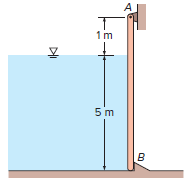
Reconsider Prob. 11??16. Using an appropriate software, investigate the effect of water depth on the force exerted on the plate by the ridge. Let the water depth vary from 0 to 5 m in increments of 0.5 m. Tabulate and plot your results. In Problem A 6-m-high, 5-m-wide rectangular plate blocks the
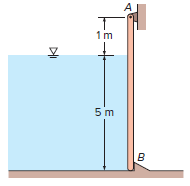
A 6-m-high, 5-m-wide rectangular plate blocks the end of a 5-m-deep freshwater channel, as shown in Fig. P11??16. The plate is hinged about a horizontal axis along its upper edge through a point A and is restrained from opening by a fixed ridge at point B. Determine the force exerted on the plate
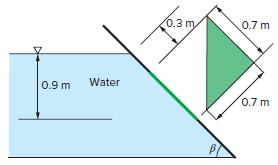
Determine the resultant force acting on the 0.7-m-high and 0.7-m-wide triangular gate shown in Fig. P11??15 and its line of action. 0.3 m. 0.7 m 0.9 m Water 0.7 m
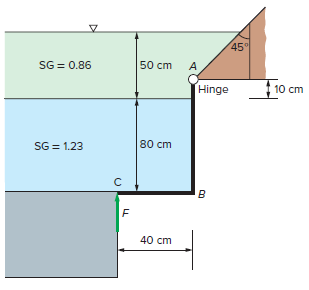
For a gate width of 2 m into the paper (Fig. P11??14), determine the force required to hold the gate ABC at its location. 45 SG = 0.86 50 cm A Hinge 10 cm SG = 1.23 80 cm B 40 cm LL
The water side of the wall of a 70-m-long dam is a quarter circle with a radius of 7 m. Determine the hydro static force on the dam and its line of action when the dam is filled to the rim.
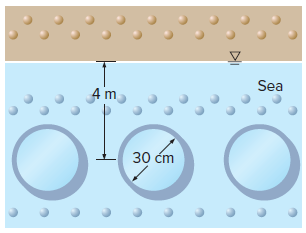
A room in the lower level of a cruise ship has a 30-cm-diameter circular window. If the midpoint of the window is 4 m below the water surface, determine the hydrostatic force acting on the window, and the pressure center. Take the specific gravity of seawater to be 1.025. Sea 4 m 30 ćm
Consider a 200-ft-high, 1200-ft-wide dam filled to capacity. Determine(a) The hydrostatic force on the dam and(b) The force per unit area of the dam near the top and near the bottom.
Consider a 8-m-long, 8-m-wide, and 2-m-high above ground swimming pool that is filled with water to the rim. (a) Determine the hydrostatic force on each wall and the distance of the line of action of this force from the ground. (b) If the height of the walls of the pool is doubled and the
Showing 1100 - 1200
of 1421
1
2
3
4
5
6
7
8
9
10
11
12
13
14
15
Step by Step Answers

 Get 50% OFF
Claim Now
Get 50% OFF
Claim Now