New Semester
Started
Get
50% OFF
Study Help!
--h --m --s
Claim Now
Question Answers
Textbooks
Find textbooks, questions and answers
Oops, something went wrong!
Change your search query and then try again
S
Books
FREE
Study Help
Expert Questions
Accounting
General Management
Mathematics
Finance
Organizational Behaviour
Law
Physics
Operating System
Management Leadership
Sociology
Programming
Marketing
Database
Computer Network
Economics
Textbooks Solutions
Accounting
Managerial Accounting
Management Leadership
Cost Accounting
Statistics
Business Law
Corporate Finance
Finance
Economics
Auditing
Tutors
Online Tutors
Find a Tutor
Hire a Tutor
Become a Tutor
AI Tutor
AI Study Planner
NEW
Sell Books
Search
Search
Sign In
Register
study help
physics
fundamentals thermal fluid
Fundamentals of Thermal-Fluid Sciences 5th edition Yunus A. Cengel, Robert H. Turner, John M. Cimbala - Solutions
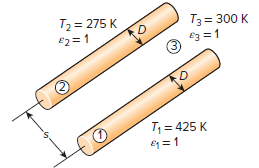
Two long parallel 20-cm-diameter cylinders are located 30 cm apart from each other. Both cylinders are black, and are maintained at temperatures 425 K and 275 K. The surroundings can be treated as a blackbody at 300 K. For a 1-mlong section of the cylinders, determine the rates of radiation heat
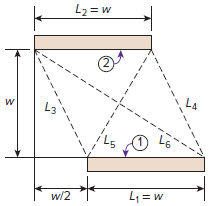
Two infinitely long parallel plates of width w are located at w distance apart, as shown in Fig. P21€“95. The two plates behave as black surfaces, where surface 1 has a temperature of 500°C and surface 2 has a temperature of 50°C. Determine the radiation heat flux between the two
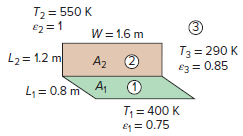
Consider two rectangular surfaces perpendicular to each other with a common edge which is 1.6 m long. The horizontal surface is 0.8 m wide and the vertical surface is 1.2 m high. The horizontal surface has an emissivity of 0.75 and is maintained at 400 K. The vertical surface is black and is
A furnace is shaped like a long equilateral-triangular duct where the width of each side is 2 m. Heat is supplied from the base surface, whose emissivity is ε1 = 0.8, at a rate of 800 W/m2 while the side surfaces, whose emissivities are 0.5, are maintained at 500 K. Neglecting the end effects,
Reconsider Prob. 21–97. Using an appropriate software, investigate the effects of the rate of the heat transfer at the base surface and the temperature of the side surfaces on the temperature of the base surface. Let the rate of heat transfer vary from 500 W/m2 to 1000 W/m2 and the temperature
Consider a long semicylindrical duct of diameter 1.0 m. Heat is supplied from the base surface, which is black, at a rate of 1200 W/m2, while the side surface with an emissivity of 0.4 is maintained at 650 K. Neglecting the end effects, determine the temperature of the base surface.
Consider a 20-cm-diameter hemispherical enclosure. The dome is maintained at 600 K and heat is supplied from the dome at a rate of 50 W while the base surface with an emissivity of 0.55 is maintained at 400 K. Determine the emissivity of the dome.
Two very large parallel plates are maintained at uniform temperatures of T1 = 600 K and T2 = 400 K and have emissivities ε1 = 0.5 and ε2 = 0.9, respectively. Determine the net rate of radiation heat transfer between the two surfaces per unit area of the plates.
Reconsider Prob. 21–101. Using an appropriate software, investigate the effects of the temperature and the emissivity of the hot plate on the net rate of radiation heat transfer between the plates. Let the temperature vary from 500 K to 1000 K and the emissivity from 0.1 to 0.9. Plot the net rate
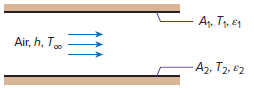
Air is flowing between two infinitely large parallel plates. The upper plate is at 500 K and has an emissivity of 0.7, while the lower plate is a black surface with temperature at 330 K. If the air temperature is 290 K, determine the convection heat transfer coefficient associated with the air. A1,
Liquid nitrogen is stored in a spherical tank of 1m diameter, where tank surface is maintained uniformly at 80K. The spherical tank is encosed by a 1.6m diameter concentric sphere with a uniform surface temperature of 273K. Both spherical surface has an emissivity of 0.01, and the gap between the
Two very long concentric cylinders of diameters D1 = 0.35 m and D2 = 0.5 m are maintained at uniform temperatures of T1 = 950 K and T2 = 500 K and have emissivities ε1 = 1 and ε2 = 0.55, respectively. Determine the net rate of radiation heat transfer between the two cylinders per unit length of
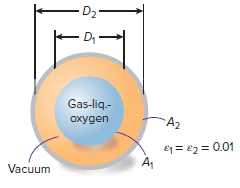
Two-phase gas-liquid oxygen is stored in a spherical tank of 1-m diameter, where it is maintained at its normal boiling point. The spherical tank is enclosed by a 1.6-m diameter concentric spherical surface at 273 K. Both spherical surfaces have an emissivity of 0.01, and the gap between the inner
Two concentric spheres of diameters D1 = 0.3 m and D2 = 0.4 m are maintained at uniform temperatures T1 = 700 K and T2 = 500 K and have emissivities ε1 = 0.5 and ε2 = 0.7, respectively. Determine the net rate of radiation heat transfer between the two spheres. Also, determine the convection heat
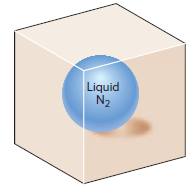
A spherical tank of diameter D = 2 m that is filled with liquid nitrogen at 100 K is kept in an evacuated cubic enclosure whose sides are 3 m long. The emissivities of the spherical tank and the enclosure are ε1= 0.1 and ε2= 0.8, respectively. If the temperature of the
Repeat Prob. 21€“108 by replacing the cubic enclosure by a spherical enclosure whose diameter is 3 m.Repeat Prob. 21€“108A spherical tank of diameter D = 2 m that is filled with liquid nitrogen at 100 K is kept in an evacuated cubic enclosure whose sides are 3 m long. The
Reconsider Prob. 21€“108. Using an appropriate software, investigate the effects of the side length and the emissivity of the cubic enclosure, and the emissivity of the spherical tank on the net rate of radiation heat transfer. Let the side length vary from 2.5 m to 5 m and both
A 9-ft-high room with a base area of 12 ft × 12 ft is to be heated by electric resistance heaters placed on the ceiling, which is maintained at a uniform temperature of 90°F at all times. The floor of the room is at 65°F and has an emissivity of 0.8. The side surfaces are well insulated.
Consider a 4-m × 4-m × 4-m cubical furnace whose floor and ceiling are black and whose side surfaces are reradiating. The floor and the ceiling of the furnace are maintained at temperatures of 550 K and 1100 K, respectively. Determine the net rate of radiation heat transfer between the floor and
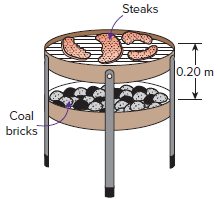
Consider a circular grill whose diameter is 0.3 m. The bottom of the grill is covered with hot coal bricks at 950 K, while the wire mesh on top of the grill is covered with steaks initially at 5°C. The distance between the coal bricks and the steaks is 0.20 m. Treating both the steaks and the
Consider a 10-ft × 10-ft × 10-ft cubical furnace whose top and side surfaces closely approximate black surfaces and whose base surface has an emissivity ε = 0.7. The base, top, and side surfaces of the furnace are maintained at uniform temperatures of 800 R, 1600 R, and 2400 R, respectively.
Reconsider Prob. 21–114E. Using an appropriate software, investigate the effect of base surface emissivity on the net rates of radiation heat transfer between the base and the side surfaces, between the base and top surfaces, and to the base surface. Let the emissivity vary from 0.1 to 0.9. Plot
A 1-m-diameter spherical cavity is maintained at a uniform temperature of 600 K. Now a 5-mm-diameter hole is drilled. Determine the maximum rate of radiation energy streaming through the hole. What would your answer be if the diameter of the cavity were 3 m?
Daylight and incandescent light may be approximated as a blackbody at the effective surface temperatures of 5800 K and 2800 K, respectively. Determine the wavelength at maximum emission of radiation for each of the lighting sources.
Two parallel concentric disks, 20 cm and 40 cm in diameter, are separated by a distance of 10 cm. The smaller disk (ε = 0.80) is at a temperature of 300°C. The larger disk (ε = 0.60) is at a temperature of 800°C.(a) Calculate the radiation view factors.(b) Determine the rate of radiation heat
The human skin is “selective” when it comes to the absorption of the solar radiation that strikes it perpendicularly. The skin absorbs only 50 percent of the incident radiation with wavelengths between λ1 = 0.517 mm and λ2 = 1.552 mm. The radiation with wavelengths shorter than λ1 and longer
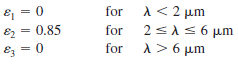
The spectral emissivity of an opaque surface at 1500 K is approximated asDetermine the total emissivity and the emissive flux of thesurface. for λ6 μη =0 ε
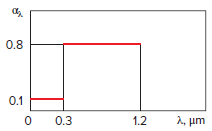
The spectral absorptivity of an opaque surface is as shown on the graph. Determine the absorptivity of the surface for radiation emitted by a source at(a) 1000 K(b) 3000 K. 0.8 0.1 2, um 0.3 1.2
The surface in Prob. 21€“120 receives solar radiation at a rate of 470 W/m2. Determine the solar absorptivity of the surface and the rate of absorption of solar radiation.In ProbThe spectral absorptivity of an opaque surface is as shown on the graph. Determine the absorptivity of the
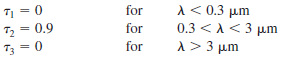
The spectral transmissivity of a glass cover used in a solar collector is given asSolar radiation is incident at a rate of 950 W/m2, and the absorber plate, which can be considered to be black, is maintained at 340 K by the cooling water. Determine(a) The solar flux incident on the absorber
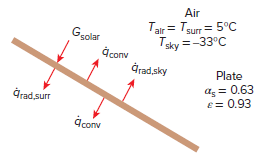
Solar radiation is incident on the front surface of a thin plate with direct and diffuse components of 300 and 250 W/m2, respectively. The direct radiation makes a 30° angle with the normal of the surface. The plate surfaces have a solar absorptivity of 0.63 and an emissivity of 0.93. The air
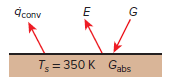
A horizontal opaque flat plate is well insulated on the edges and the lower surface. The top surface has an area of 5 m2, and it experiences uniform irradiation at a rate of 5000 W. The plate absorbs 4000 W of the irradiation, and the surface is losing heat at a rate of 500 W by convection. If the
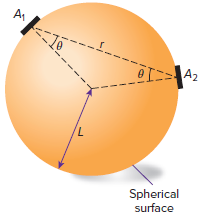
Consider two diffuse surfaces A1and A2oriented on a spherical surface as shown in the figure. Determine(a) The expression for the view factor F12 in terms of A2 and L,(b) The value of the view factor F12 when A2 = 0.02 m2 and L = 1 m. 10 A2 7, Spherical surface
Consider an enclosure consisting of eight surfaces. How many view factors does this geometry involve? How many of these view factors can be determined by the application of the reciprocity and the summation rules?
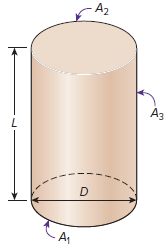
Consider a cylindrical enclosure with A1, A2, and A3representing the internal base, top, and side surfaces, respectively. Using the length to diameter ratio, K = L/D, determine(a) The expression for the view factor from the side surface to itself F33 in terms of K(b) The value of the view factor
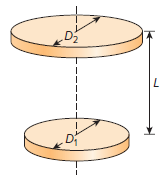
Two parallel back disks are positioned coaxially with a distance of 0.25 m apart. The lower disk is 0.2 m in diameter and the upper disk is 0.4 m in diameter. If the lower disk is heated electrically at 20 W to maintain a uniform temperature of 500 K, determine the temperature of the upper disk. L
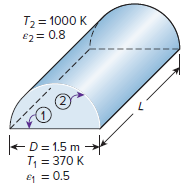
A dryer is shaped like a long semicylindrical duct of diameter 1.5 m. The base of the dryer is occupied with water soaked materials to be dried, and maintained at a temperature of 370 K and emissivity of 0.5. The dome of the dryer is maintained at 1000 K with emissivity of 0.8. Determine the drying
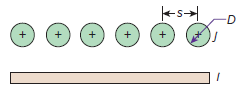
A large number of long tubes, each of diameter D, are placed parallel to each other and at a center-to-center distance of s. Since all of the tubes are geometrically similar and at the same temperature, these could be treated collectively as one surface (Aj) for radiation heat transfer
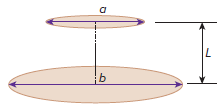
Consider the two parallel coaxial disks of diameters a and b, shown in Fig. P21€“132. For this geometry, the view factor from the smaller disk to the larger disk can be calculated fromwhere, A = a/2L, B = b/2L, and C = 1 + [(1 + A2)/B2]. The diameter, emissivity, and temperature are 20
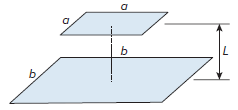
Two square plates, with the sides a and b (and b > a), are coaxial and parallel to each other, as shown in Fig. P21€“133, and they are separated by a center-to-center distance of L. The radiation view factor from the smaller to the larger plate, Fab, is given bywhere, A = a/L and B =
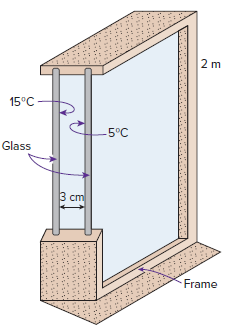
A vertical 2-m-high and 5-m-wide double-pane window consists of two sheets of glass separated by a 3-cm-thick air gap. In order to reduce heat transfer through the window, the air space between the two glasses is partially evacuated to 0.3 atm pressure. The emissivities of the glass surfaces are
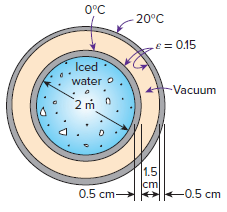
A 2-m-internal-diameter double-walled spherical tank is used to store iced water at 0°C. Each wall is 0.5 cm thick, and the 1.5-cm-thick air space between the two walls of the tank is evacuated in order to minimize heat transfer. The surfaces surrounding the evacuated space are polished so that
Two concentric spheres of diameters D1 = 15 cm and D2 = 25 cm are separated by air at 1 atm pressure. The surface temperatures of the two spheres enclosing the air are T1 = 350 K and T2 = 275 K, respectively, and their emissivities are 0.75. Determine the rate of heat transfer from the inner sphere
Consider a cubical furnace with a side length of 3 m. The top surface is maintained at 700 K. The base surface has an emissivity of 0.90 and is maintained at 950 K. The side surface is black and is maintained at 450 K. Heat is supplied from the base surface at a rate of 340 kW. Determine the
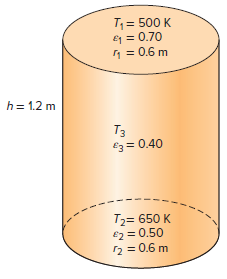
A furnace is of cylindrical shape with a diameter of 1.2 m and a length of 1.2 m. The top surface has an emissivity of 0.70 and is maintained at 500 K. The bottom surface has an emissivity of 0.50 and is maintained at 650 K. The side surface has an emissivity of 0.40. Heat is supplied from the base
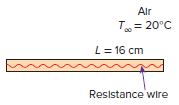
Consider a thin 16-cm-long and 20-cm-wide horizontal plate suspended in air at 20°C. The plate is equipped with electric resistance heating elements with a rating of 20 W. Now the heater is turned on and the plate temperature rises. Determine the temperature of the plate when steady operating
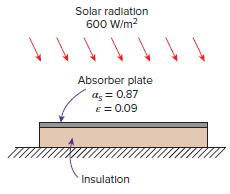
Repeat Prob. 20€“34 for an aluminum plate painted flat black (solar absorptivity 0.98 and emissivity 0.98) and also for a plate painted white (solar absorptivity 0.26 and emissivity 0.90). Evaluate air properties at a film temperature of 45°C and 1 atm pressure. Is this a good
A circular grill of diameter 0.25 m has an emissivity of 0.8. If the surface temperature is maintained at 150°C, determine the required electrical power when the room air and surroundings are at 30°C.
A can of engine oil with a length of 150 mm and a diameter of 100 mm is placed vertically in the trunk of a car. In a hot summer day, the temperature in the trunk is 43°C. If the surface temperature of the can is 17°C, determine heat transfer rate from the can surface. Neglect the heat transfer
Flue gases from an incinerator are released to atmosphere using a stack that is 0.6 m in diameter and 10.0 m high. The outer surface of the stack is at 40°C and the surrounding air is at 10°C. Determine the rate of heat transfer from the stack assuming(a) There is no wind(b) The stack is exposed
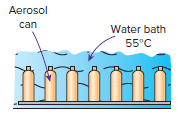
In a plant that manufactures canned aerosol paints, the cans are temperature-tested in water baths at 55°C before they are shipped to ensure that they withstand temperatures up to 55°C during transportation and shelving. The cans, moving on a conveyor, enter the open hot water bath, which
Reconsider Prob. 20€“39. In order to reduce the heating cost of the hot water, it is proposed to insulate the side and bottom surfaces of the container with 5-cm-thick fiberglass insulation (k = 0.035 W/m·K) and to wrap the insulation with aluminum foil (ε = 0.1) in
Consider a cylinder with a length of 15 cm and a diameter of 10 cm. The cylinder has a surface temperature of 43°C, while the room air temperature is 17°C. Determine whether placing the cylinder horizontally or vertically would achieve higher heat transfer rate.
An aluminum soda can of 150 mm in length and 60 mm in diameter is placed horizontally inside a refrigerator compartment that maintains a temperature of 4°C. If the surface temperature of the can is 36°C, estimate heat transfer rate from the can. Neglect the heat transfer from the ends of the can.
Thermal energy generated by the electrical resistance of a 5-mm-diameter and 4-m-long bare cable is dissipated to the surrounding air at 20°C. The voltage drop and the electric current across the cable in steady operation are measured to be 60 V and 1.5 A, respectively. Disregarding radiation,
A 10-m-long section of a 6-cm-diameter horizontal hot-water pipe passes through a large room whose temperature is 27°C. If the temperature and the emissivity of the outer surface of the pipe are 73°C and 0.8, respectively, determine the rate of heat loss from the pipe by(a) Natural convection(b)
A 3-mm-diameter and 12-m-long electric wire is tightly wrapped with a 1.5-mm-thick plastic cover whose thermal conductivity and emissivity are k = 0.20 W/m·K and ε = 0.9. Electrical measurements indicate that a current of 10 A passes through the wire and there is a voltage drop of 7 V along the
Hot water is being transported in a horizontal pipe (k = 0.15 W/m∙K, Di = 2.5 cm, Do = 4.5 cm), where the pipe inner surface temperature is at 100°C. A length of 2 m of the pipe outer surface is exposed to cool air at 12°C. Assuming that the properties of air can be evaluated at 40°C and 1 atm
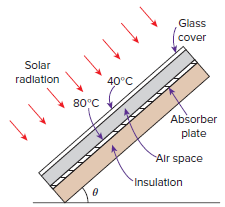
Flat-plate solar collectors are often tilted up toward the sun in order to intercept a greater amount of direct solar radiation. The tilt angle from the horizontal also affects the rate of heat loss from the collector. Consider a 1.5-m-high and 3-m-wide solar collector that is tilted at an angle
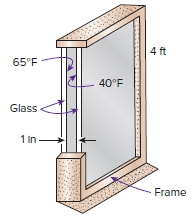
A vertical 4-ft-high and 6-ft-wide double-pane window consists of two sheets of glass separated by a 1-in air gap at atmospheric pressure. If the glass surface temperatures across the air gap are measured to be 65°F and 40°F, determine the rate of heat transfer through the window by(a)
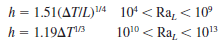
Consider a vertical plate with length L, placed in quiescent air. If the film temperature is 20°C and the average Nusselt number in natural convection is of the form Nu = CRanL, show that the average heat transfer coefficient can be expressed as
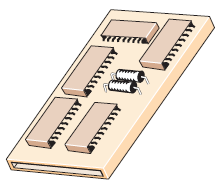
Repeat Prob. 20–28 assuming the circuit board to be positioned horizontally with (a) chips facing up and (b) chips facing down.Repeat Prob. 20–28A 50-cm × 50-cm circuit board that contains 121 square chips on one side is to be cooled by combined naturalconvection and radiation by mounting it
Consider a 15-cm × 20-cm printed circuit board (PCB) that has electronic components on one side. The board is placed in a room at 20°C. The heat loss from the back surface of the board is negligible. If the circuit board is dissipating 8 W of power in steady operation, determine
Reconsider Prob. 20€“30. Using an appropriate software, investigate the effects of the room temperature and the emissivity of the board on the temperature of the hot surface of the board for different orientations of the board. Let the room temperature vary from 5°C to 35°C and
A 50-cm × 50-cm circuit board that contains 121 square chips on one side is to be cooled by combined naturalconvection and radiation by mounting it on a vertical surface in a room at 25°C. Each chip dissipates 0.18 W of power, and the emissivity of the chip surfaces is 0.7. Assuming the heat
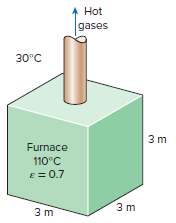
The side surfaces of a 3-m-high cubic industrial furnace burning natural gas are not insulated, and the temperature at the outer surface of this section is measured to be 110°C. The temperature of the furnace room, including its surfaces, is 30°C, and the emissivity of the outer surface of
Reconsider Prob. 20–25E. Using an appropriate software, plot the rate of natural convection heat transfer for different orientations of the plate as a function of the plate temperature as the temperature varies from 80°F to 180°F and discuss the results.Reconsider Prob. 20–25E.Consider a 2-ft
Consider a 2-ft × 2-ft thin square plate in a room at 75°F. One side of the plate is maintained at a temperature of 130°F, while the other side is insulated. Determine the rate of heat transfer from the plate by natural convection if the plate is (a) Vertical,(b) Horizontal with hot surface
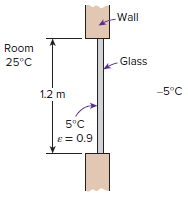
Consider a 1.2-m-high and 2-m-wide glass window with a thickness of 6 mm, thermal conductivity k = 0.78 W/m·K, and emissivity ε = 0.9. The room and the walls that face the window are maintained at 25°C, and the average temperature of the inner surface of the window is
Reconsider Prob. 20€“22. Using an appropriate software, evaluate the effect of the uniform surface heat flux on the plate midpoint temperature for(a) The highly polished surface(b) The black oxidized surface. By varying the surface heat flux from 500 to 1500 W/m2, plot the plate midpoint
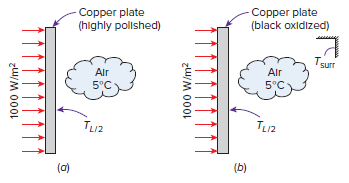
A 0.5-m-long thin vertical copper plate is subjected to a uniform heat flux of 1000 W/m2on one side, while the other side is exposed to air at 5°C. Determine the plate midpoint temperature for(a) A highly polished surface(b) A black oxidized surface. - Copper plate (highly polished) Copper
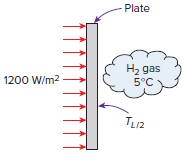
A 0.5-m-long thin vertical plate is subjected to a uniform heat flux of 1200 W/m2 on one side, while the other side is exposed to hydrogen gas at 5°C. Assuming that the properties of the hydrogen gas can be evaluated at 50°C, determine the plate midpoint temperature TL / 2. Is 50°C an
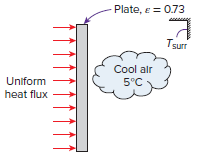
A 0.5-m-long thin vertical plate is subjected to uniform heat flux on one side, while the other side is exposed to cool air at 5°C. The plate surface has an emissivity of 0.73, and its midpoint temperature is 55°C. Determine the heat flux subjected on the plate surface. Plate, e= 0.73 Tsur
A long 2-in-diameter rod with surface temperature of 200°F is submerged in a bath of fluid. Determine the Grashof and Rayleigh numbers if the fluid is(a) Liquid water at 40°F,(b) Liquid ammonia at 40°F,(c) Engine oil at 50°F,(d) Air at 40°F (1 atm).
In which mode of heat transfer is the convection heat transfer coefficient usually higher, natural convection or forced convection? Why?
What is natural convection? How does it differ from forced convection? What force causes natural convection currents?
A 300-W cylindrical resistance heater is 0.75 m long and 0.5 cm in diameter. The resistance wire is placed horizontally in a fluid at 20°C. Determine the outer surface temperature of the resistance wire in steady operation if the fluid is(a) Air(b) Water. Ignore any heat transfer by radiation. Use
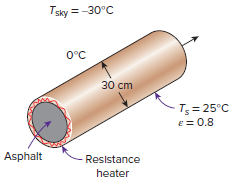
Thick fluids such as asphalt and waxes and the pipes in which they flow are often heated in order to reduce the viscosity of the fluids and thus to reduce the pumping costs. Consider the flow of such a fluid through a 100-m-long pipe of outer diameter 30 cm in calm ambient air at 0°C. The pipe
Reconsider Prob. 20€“47. To reduce the heating cost of the pipe, it is proposed to insulate it with sufficiently thick fiberglass insulation (k = 0.035 W/m·K) wrapped with aluminum foil (ε = 0.1) to cut down the heat losses by 85 percent. Assuming the pipe temperature
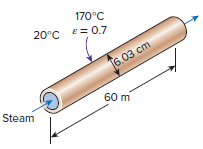
During a visit to a plastic sheeting plant, it was observed that a 60-m-long section of a 2-in nominal (6.03-cm-outer-diameter) steam pipe was extended from one end of the plant to the other with no insulation on it. The temperature measurements at several locations revealed that the average
Reconsider Prob. 20€“50. Using an appropriate software, investigate the effect of the surface temperature of the steam pipe on the rate of heat loss from the pipe and the annual cost of this heat loss. Let the surface temperature vary from 100°C to 200°C. Plot the rate of heat
Reconsider Prob. 20€“50. In order to reduce heat losses, it is proposed to insulate the steam pipe with 5-cmthick fiberglass insulation (k = 0.038 W/m·K) and to wrap it with aluminum foil (ε = 0.1) in order to minimize the radiation losses. Also, an estimate is
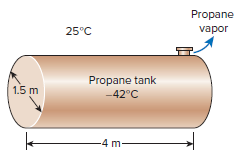
A 1.5-m-diameter, 4-m-long cylindrical propane tank is initially filled with liquid propane, whose density is 581 kg/m3. The tank is exposed to the ambient air at 25°C in calm weather. The outer surface of the tank is polished so that the radiation heat transfer is negligible. Now a crack
Hot engine oil is being transported in a horizontal pipe (k = 15 W/m∙K, Di = 5 cm) with a wall thickness of 5 mm. The pipe is covered with a 5-mm-thick layer of insulation (k = 0.15 W/m∙K). A length of 2 m of the outer surface is exposed to cool air at 10°C. If the pipe inner surface
Reconsider Prob. 20–55. Using an appropriate software, evaluate the effect of the insulation layer thickness on the outer surface temperature. By varying the insulation layer thickness from 5 to 15 mm, plot the outer surface temperature as a function of the thickness of the insulation
A hot fluid (kfluid = 0.72 W/m∙K) is flowing as a laminar fully-developed flow inside a pipe with an inner diameter of 35 mm and a wall thickness of 5 mm. The pipe is 10 m long and the outer surface is exposed to air at 10°C. The average temperature difference between the hot fluid and the pipe
A hot liquid (cp = 1000 J/kg∙K) flows at a flow rate of 0.05 kg/s inside a copper pipe with an inner diameter of 45 mm and a wall thickness of 5 mm. At the pipe exit, the liquid temperature decreases by 10°C from its temperature at the inlet. The outer surface of the 5-m-long copper pipe is
An average person generates heat at a rate of 240 Btu/h while resting in a room at 70°F. Assuming onequarter of this heat is lost from the head and taking the emissivity of the skin to be 0.9, determine the average surface temperature of the head when it is not covered. The head can be
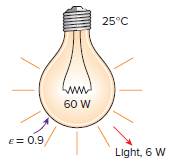
An incandescent lightbulb is an inexpensive but highly inefficient device that converts electrical energy into light. It converts about 10 percent of the electrical energy it consumes into light while converting the remaining 90 percent into heat. The glass bulb of the lamp heats up very quickly as
The water in a 40-L tank is to be heated from 15°C to 45°C by a 6-cm-diameter spherical heater whose surface temperature is maintained at 85°C. Determine how long the heater should be kept on.
A 2-m-diameter thin-walled stainless steel spherical tank is filled with chemicals undergoing a reaction. The reaction releases heat through the tank, where the tank outer surface temperature is 50°C and is exposed to air at 20°C. The stainless steel surface of the tank has an emissivity of 0.35.
A hot liquid is filled in a spherical tank with an inner diameter of 3 m and a wall thickness of 3 cm. The tank wall is made of a material with a thermal conductivity of 0.15 W/m∙K. The hot liquid in the tank causes the inner surface temperature to be 100°C, while the tank outer surface is
The upper and lower compartments of a well-insulated container are separated by two parallel sheets of glass with an air space between them. One of the compartments is to be filled with a hot fluid and the other with a cold fluid. If it is desired that heat transfer between the two compartments be
Someone claims that the air space in a double-pane window enhances the heat transfer from a house because of the natural convection currents that occur in the air space and recommends that the double-pane window be replaced by a single sheet of glass whose thickness is equal to the sum of the
Consider a double-pane window consisting of two glass sheets separated by a 1-cm-wide air space. Someone suggests inserting a thin vinyl sheet in the middle of the two glasses to form two 0.5-cm-wide compartments in the window in order to reduce natural convection heat transfer through the window.
What does the effective conductivity of an enclosure represent? How is the ratio of the effective conductivity to thermal conductivity related to the Nusselt number?
Show that the thermal resistance of a rectangular enclosure can be expressed as R = Lc /(Ak Nu), where k is the thermal conductivity of the fluid in the enclosure.
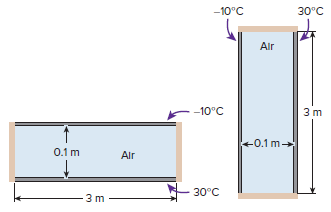
Consider a 3-m-high rectangular enclosure consisting of two surfaces separated by a 0.1-m air gap at 1 atm. If the surface temperatures across the air gap are 30°C and €“10°C, determine the ratio of the heat transfer rate for the horizontal orientation (with hotter surface at the
A vertical 1.5-m-high and 3.0-m-wide enclosure consists of two surfaces separated by a 0.4-m air gap at atmospheric pressure. If the surface temperatures across the air gap are measured to be 280 K and 336 K and the surface emissivities to be 0.15 and 0.90, determine the fraction of heat
A vertical 1.5-m-high, 2.8-m-wide double-pane window consists of two layers of glass separated by a 2.0-cm air gap at atmospheric pressure. The room temperature is 26°C while the inner glass temperature is 18°C. Disregarding radiation heat transfer, determine the temperature of the outer glass
Showing 300 - 400
of 1421
1
2
3
4
5
6
7
8
9
10
11
12
13
14
15
Step by Step Answers

 Get 50% OFF
Claim Now
Get 50% OFF
Claim Now



![[(B + A)? + 4]0.5 –- [(B – A)² + F. ab 2A](https://dsd5zvtm8ll6.cloudfront.net/si.question.images/images/question_images/1544/0/2/7/4135c07fd15d31341544009959678.jpg)