New Semester
Started
Get
50% OFF
Study Help!
--h --m --s
Claim Now
Question Answers
Textbooks
Find textbooks, questions and answers
Oops, something went wrong!
Change your search query and then try again
S
Books
FREE
Study Help
Expert Questions
Accounting
General Management
Mathematics
Finance
Organizational Behaviour
Law
Physics
Operating System
Management Leadership
Sociology
Programming
Marketing
Database
Computer Network
Economics
Textbooks Solutions
Accounting
Managerial Accounting
Management Leadership
Cost Accounting
Statistics
Business Law
Corporate Finance
Finance
Economics
Auditing
Tutors
Online Tutors
Find a Tutor
Hire a Tutor
Become a Tutor
AI Tutor
AI Study Planner
NEW
Sell Books
Search
Search
Sign In
Register
study help
physics
fundamentals thermal fluid
Fundamentals of Thermal-Fluid Sciences 5th edition Yunus A. Cengel, Robert H. Turner, John M. Cimbala - Solutions
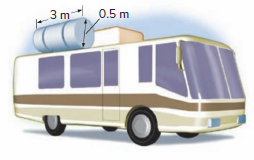
It is proposed to meet the water needs of a recreational vehicle (RV) by installing a 3-m-long, 0.5-m-diameter cylindrical tank on top of the vehicle. Determine the additional power requirement of the RV at a speed of 80 km/h when the tank is installed such that its circular surfaces face(a) The
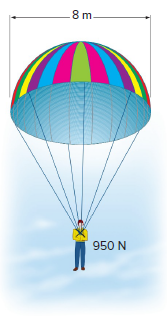
A paratrooper and his 8-m-diameter parachute weigh 950 N. Taking the average air density to be 1.2 kg/m3, determine the terminal velocity of the paratrooper. 950 N
A commercial airplane has a total mass of 150,000 lbm and a wing planform area of 1800 ft2. The plane has a cruising speed of 550 mi/h and a cruising altitude of 38,000 ft where the air density is 0.0208 lbm/ft3. The plane has double-slotted flaps for use during takeoff and landing, but it cruises
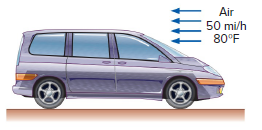
The passenger compartment of a minivan traveling at 50 mi/h in ambient air at 1 atm and 80°F is modeled as a 4.5-ft-high, 6-ft-wide, and 11-ft-long rectangular box. The airflow over the exterior surfaces is assumed to be turbulent because of the intense vibrations involved. Determine the
The cylindrical chimney of a factory has an external diameter of 1.1 m and is 20 m high. Determine the bending moment at the base of the chimney when winds at 110 km/h are blowing across it. Take the atmospheric conditions to be 20°C and 1 atm.
Reconsider Prob. 15€“89. Using an appropriate software, investigate the effect of boat speed on the drag force acting on the bottom surface of the boat, and the power needed to overcome it. Let the boat speed vary from 0 to 100 km/h in increments of 10 km/h. Tabulate and plot the results.
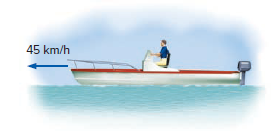
A plastic boat whose bottom surface can be approximated as a 1.5-m-wide, 2-m-long flat surface is to move through water at 15°C at speeds up to 45 km/h. Determine the friction drag exerted on the boat by the water and the power needed to overcome it. 45 km/h
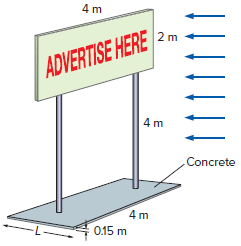
A 2-m-high, 4-m-wide rectangular advertisement panel is attached to a 4-m-wide, 0.15-m-high rectangular concrete block (density 5 2300 kg/m3) by two 5-cm-diameter, 4-m-high (exposed part) poles, as shown in Fig. P15€“88. If the sign is to withstand 150 km/h winds from any direction,
A 1.2-m-external-diameter spherical tank is located outdoors at 1 atm and 25°C and is subjected to winds at 48 km/h. Determine the drag force exerted on it by the wind.
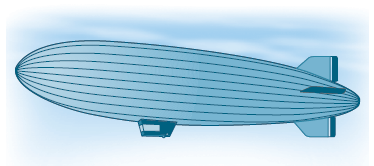
Consider a blimp that can be approximated as a 3-m diameter, 8-m long ellipsoid and is connected to the ground. On a windless day, the rope tension due to the net buoyancy effect is measured to be 120 N. Determine the rope tension when there are 50 km/h winds blowing along the blimp (parallel to
An airplane has a mass of 50,000 kg, a wing area of 300 m2, a maximum lift coefficient of 3.2, and a cruising drag coefficient of 0.03 at an altitude of 12,000 m. Determine(a) The takeoff speed at sea level, assuming it is 20 percent over the stall speed,(b) The thrust that the engines must deliver
A small airplane has a total mass of 1800 kg and a wing area of 42 m2. Determine the lift and drag coefficients of this airplane while cruising at an altitude of 4000 m at a constant speed of 280 km/h and generating 190 kW of power.
Consider a light plane that has a total weight of 11,000 N and a wing area of 39 m2and whose wings resemble the NACA 23012 airfoil with no flaps. Using data from Fig. 11€“45, determine the takeoff speed at an angle of attack of 5° at sea level. Also determine the stall speed. 2 m
The NACA 64(l)–412 airfoil has a lift-to-drag ratio of 50 at 0° angle of attack, as shown in Fig. 15–43. At what angle of attack does this ratio increase to 80?
Reconsider Prob. 15–80. Using an appropriate software, investigate the effect of passenger count on the takeoff speed of the aircraft. Let the number of passengers vary from 0 to 500 in increments of 50. Tabulate and plot the results.Reconsider Prob.A jumbo jet airplane has a mass of about
A jumbo jet airplane has a mass of about 400,000 kg when fully loaded with over 400 passengers and takes off at a speed of 250 km/h. Determine the takeoff speed when the airplane has 100 empty seats. Assume each passenger with luggage is 140 kg and the wing and flap settings are maintained the same.
An airplane is consuming fuel at a rate of 7 gal/min when cruising at a constant altitude of 10,000 ft at constant speed. Assuming the drag coefficient and the engine efficiency to remain the same, determine the rate of fuel consumption at an altitude of 30,000 ft at the same speed.
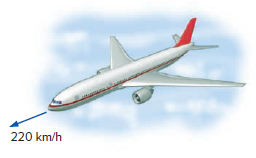
Consider an airplane whose takeoff speed is 220 km/h and that takes 15 s to take off at sea level. For an airport at an elevation of 1600 m (such as Denver), determine(a) The takeoff speed,(b) The takeoff time,(c) The additional runway length required for this airplane. Assume constant acceleration
Consider an aircraft that takes off at 260 km/h when it is fully loaded. If the weight of the aircraft is increased by 10 percent as a result of overloading, determine the speed at which the overloaded aircraft will take off.
A small aircraft has a wing area of 35 m2, a lift coefficient of 0.45 at takeoff settings, and a total mass of 4000 kg. Determine(a) The takeoff speed of this aircraft at sea level at standard atmospheric conditions,(b) The wing loading,(c) The required power to maintain a constant cruising speed
How do flaps affect the lift and the drag of wings?
Explain why endplates or winglets are added to some airplane wings.
What is induced drag on wings? Can induced drag be minimized by using long and narrow wings or short and wide wings?
What is the effect of wing tip vortices (the air circulation from the lower part of the wings to the upper part) on the drag and the lift?
Why are flaps used at the leading and trailing edges of the wings of large aircraft during takeoff and landing? Can an aircraft take off or land without them?
Both the lift and the drag of an airfoil increase with an increase in the angle of attack. In general, which increases at a higher rate, the lift or the drag?
Air is flowing past a symmetrical airfoil at zero angle of attack. Is the(a) Lift(b) Drag acting on the airfoil zero or nonzero?
Air is flowing past a nonsymmetrical airfoil at zero angle of attack. Is the(a) Lift(b) Drag acting on the airfoil zero or nonzero?
What is stall? What causes an airfoil to stall? Why are commercial aircraft not allowed to fly at conditions near stall?
Why is the contribution of viscous effects to lift usually negligible for airfoils?
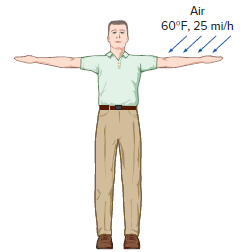
A person extends his uncovered arms into the windy air outside at 1 atm and 60°F and 25 mi/h in order to feel nature closely. Treating the arm as a 2-ft-long and 4-indiameter cylinder, determine the combined drag force on both arms. Air 60°F, 25 mi/h ////
A 6-mm-diameter electrical transmission line is exposed to windy air. Determine the drag force exerted on a 160-m-long section of the wire during a windy day when the air is at 1 atm and 15°C and the wind is blowing across the transmission line at 65 km/h.
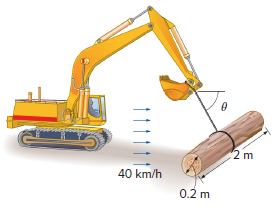
A 2-m-long, 0.2-m-diameter cylindrical pine log (density = 513 kg/m3) is suspended by a crane in the horizontal position. The log is subjected to normal winds of 40 km/h at 5°C and 88 kPa. Disregarding the weight of the cable and its drag, determine the angle u the cable will make with the
Dust particles of diameter 0.06 mm and density 1.6 g/cm3 are unsettled during high winds and rise to a height of 200 m by the time things calm down. Estimate how long it takes for the dust particles to fall back to the ground in still air at 1 atm and 30°C, and their velocity. Disregard the
A 1.2-in-outer-diameter pipe is to span across a river at a 140-ft-wide section while being completely immersed in water. The average flow velocity of the water is 10 ft/s, and its temperature is 70°F. Determine the drag force exerted on the pipe by the river.
Consider 0.8-cm-diameter hail that is falling freely in atmospheric air at 1 atm and 5°C. Determine the terminal velocity of the hail. Take the density of hail to be 910 kg/m3.
A long 5-cm-diameter steam pipe passes through some area open to the wind. Determine the drag force acting on the pipe per unit of its length when the air is at 1 atm and 10°C and the wind is blowing across the pipe at a speed of 50 km/h.
A 0.1-mm-diameter dust particle whose density is 2.1 g/cm3 is observed to be suspended in the air at 1 atm and 25°C at a fixed point. Estimate the updraft velocity of air motion at that location. Assume Stokes law to be applicable. Is this a valid assumption?
In flow over cylinders, why does the drag coefficient suddenly drop when the boundary layer becomes turbulent? Isn’t turbulence supposed to increase the drag coefficient instead of decreasing it?
In flow over bluff bodies such as a cylinder, how does the pressure drag differ from the friction drag?
Why is flow separation in flow over cylinders delayed when the boundary layer is turbulent?
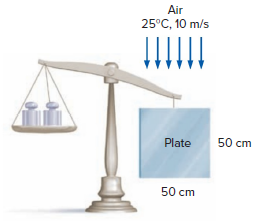
The weight of a thin flat plate 50 cm × 50 cm in size is balanced by a counterweight that has a mass of 2 kg, as shown in Fig. P15€“54. Now a fan is turned on, and air at 1 atm and 25°C flows downward over both surfaces of the plate (front and back in the sketch) with a
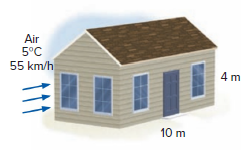
During a winter day, wind at 55 km/h, 5°C, and 1 atm is blowing parallel to a 4-m-high and 10-m-long wall of a house. Approximating the wall surfaces as smooth, determine the friction drag acting on the wall. What would your answer be if the wind velocity has doubled? How realistic is it to
Repeat Prob. 15–51 for water.Repeat Prob.Air at 25°C and 1 atm is flowing over a long flat plate with a velocity of 8 m/s. Determine the distance from the leading edge of the plate where the flow becomes turbulent, and the thickness of the boundary layer at that location.
Air at 25°C and 1 atm is flowing over a long flat plate with a velocity of 8 m/s. Determine the distance from the leading edge of the plate where the flow becomes turbulent, and the thickness of the boundary layer at that location.
Reconsider Prob. 15€“49E. Using an appropriate software, investigate the effect of truck speed on the total drag force acting on the top and side surfaces, and the power required to overcome it. Let the truck speed vary from 0 to 100 mi/h in increments of 10 mi/h. Tabulate and plot the
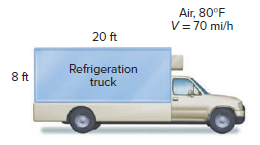
Consider a refrigeration truck traveling at 70 mi/h at a location where the air is at 1 atm and 80°F. The refrigerated compartment of the truck can be considered to be a 9-ft-wide, 8-ft-high, and 20-ft-long rectangular box. Assuming the airflow over the entire outer surface to be turbulent and
Light oil at 75°F flows over a 22-ft-long flat plate with a free-stream velocity of 6 ft/s. Determine the total drag force per unit width of the plate.
Water at 43.3°C flows over a large plate at a velocity of 30.0 cm/s. The plate is 1.0 m long (in the flow direction), and its surface is maintained at a uniform temperature of 10.0°C. Calculate the steady rate of heat transfer per unit width of the plate.
Hot carbon dioxide exhaust gas at 1 atm is being cooled by flat plates. The gas at 220°C flows in parallel over the upper and lower surfaces of a 1.5-m-long flat plate at a velocity of 3 m/s. If the flat plate surface temperature is maintained at 80°C, determine(a) The local convection heat
Hot engine oil at 150°C is flowing in parallel over a flat plate at a velocity of 2 m/s. Surface temperature of the 0.5-mlong flat plate is constant at 50°C. Determine(a) The local convection heat transfer coefficient at 0.2 m from the leading edge and the average convection heat transfer
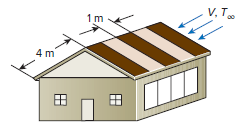
Parallel plates form a solar collector that covers a roof, as shown in the figure. The plates are maintained at 15°C, while ambient air at 10°C flows over the roof with V = 2 m/s. Determine the rate of convective heat loss from(a) The first plate(b) The third plate. V, T 1 m 4 m
Hydrogen gas at 1 atm is flowing in parallel over the upper and lower surfaces of a 3-m-long flat plate at a velocity of 2.5 m/s. The gas temperature is 120°C and the surface temperature of the plate is maintained at 30°C. Using an appropriate software, investigate the local convection heat
Carbon dioxide and hydrogen as ideal gases at 1 atm and −20°C flow in parallel over a flat plate. The flow velocity of each gas is 1 m/s and the surface temperature of the 3-m-long plate is maintained at 20°C. Using an appropriate software, evaluate the local Reynolds number, the local Nusselt
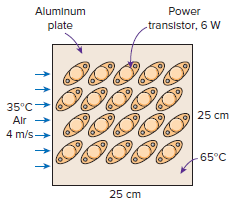
An array of power transistors, dissipating 6 W of power each, are to be cooled by mounting them on a 25-cm × 25-cm-square aluminum plate and blowing air at 35°C over the plate with a fan at a velocity of 4 m/s. The average temperature of the plate is not to exceed 65°C.
Repeat Prob. 19€“22 for a location at an elevation of 1610 m where the atmospheric pressure is 83.4 kPa.Repeat Prob.An array of power transistors, dissipating 6 W of power each, are to be cooled by mounting them on a 25-cm × 25-cm-square aluminum plate and blowing air at
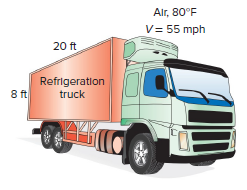
Consider a refrigeration truck traveling at 55 mph at a location where the air temperature is 80°F. The refrigerated compartment of the truck can be considered to be a 9-ft-wide, 8-ft-high, and 20-ft-long rectangular box. The refrigeration system of the truck can provide 3 tons of refrigeration
Consider a hot automotive engine, which can be approximated as a 0.5-m-high, 0.40-m-wide, and 0.8-m-long rectangular block. The bottom surface of the block is at a temperature of 100°C and has an emissivity of 0.95. The ambient air is at 20°C, and the road surface is at 25°C. Determine the rate
Air at 1 atm is flowing in parallel over a 3-mlong flat plate with a velocity of 7 m/s. The air has a free stream temperature of 120°C and the surface temperature of the plate is maintained at 20°C. Determine the distance x from the leading edge of the plate where the critical Reynolds number
The local atmospheric pressure in Denver, Colorado (elevation 1610 m), is 83.4 kPa. Air at this pressure and at 30°C flows with a velocity of 6 m/s over a 2.5-m × 8-m flat plate whose temperature is 120°C. Determine the rate of heat transfer from the plate if the air flows parallel to the(a)
Warm air is blown over the inner surface of an automobile windshield to defrost ice accumulated on the outer surface of the windshield. Consider an automobile windshield (kw = 0.8 Btu/h·ft·R) with an overall height of 20 in and thickness of 0.2 in. The outside air (1 atm) ambient temperature is
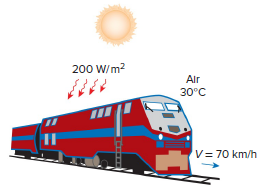
The top surface of the passenger car of a train moving at a velocity of 70 km/h is 2.8 m wide and 8 m long. The top surface is absorbing solar radiation at a rate of 200 W/m2, and the temperature of the ambient air is 30°C. Assuming the roof of the car to be perfectly insulated and the
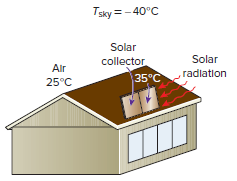
Solar radiation is incident on the glass cover of a solar collector at a rate of 700 W/m2. The glass transmits 88 percent of the incident radiation and has an emissivity of 0.90. The entire hot water needs of a family in summer can be met by two collectors 1.2 m high and 1 m wide. The two
Liquid mercury at 250°C is flowing with a velocity of 0.3 m/s in parallel over a 0.1-m-long flat plate where there is an unheated starting length of 5 cm. The heated section of the flat plate is maintained at a constant temperature of 50°C. Determine(a) The local convection heat transfer
A 15 mm × 15 mm silicon chip is mounted such that the edges are flush in a substrate. The chip dissipates 1.4 W of power uniformly, while air at 20°C (1 atm) with a velocity of 25 m/s is used to cool the upper surface of the chip. If the substrate provides an unheated starting length of 15 mm,
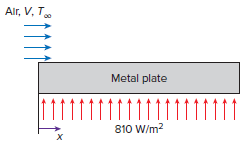
The upper surface of a metal plate is being cooled with parallel air flow while its lower surface is subjected to a uniform heat flux of 810 W/m2. The air has a free stream velocity and temperature of 2.5 m/s and 15°C, respectively. Determine the surface temperature of the plate at x = 1.5 m
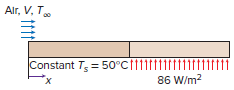
Air is flowing in parallel over the upper surface of a flat plate with a length of 4 m. The first half of the plate length, from the leading edge, has a constant surface temperature of 50°C. The second half of the plate length is subjected to a uniform heat flux of 86 W/m2. The air has a free
A 15-cm × 15-cm circuit board dissipating 20 W of power uniformly is cooled by air, which approaches the circuit board at 20°C with a velocity of 6 m/s. Disregarding any heat transfer from the back surface of the board, determine the surface temperature of the electronic components(a) At the
A long 8-cm-diameter steam pipe whose external surface temperature is 90°C passes through some open area that is not protected against the winds. Determine the rate of heat loss from the pipe per unit of its length when the air is at 1 atm pressure and 7°C and the wind is blowing across the pipe
A heated long cylindrical rod is placed in a cross flow of air at 20°C (1 atm) with velocity of 10 m/s. The rod has a diameter of 5 mm and its surface has an emissivity of 0.95. If the surrounding temperature is 20°C and the heat flux dissipated from the rod is 16000 W/m2, determine the surface
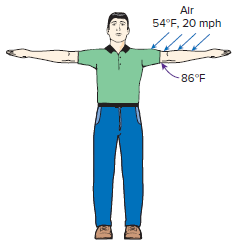
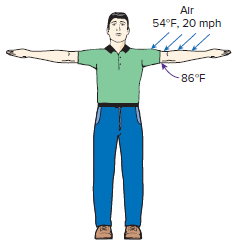
A person extends his uncovered arms into the windy air outside at 54°F and 20 mph in order to feel nature closely. Initially, the skin temperature of the arm is 86°F. Treating the arm as a 2-ft-long and 3-in-diameter cylinder, determine the rate of heat loss from the arm. Alr r 54°F, 20
Reconsider Prob. 19€“44E. Using an appropriate software, investigate the effects of air temperature and wind velocity on the rate of heat loss from the arm. Let the air temperature vary from 20°F to 80°F and the wind velocity from 10 mph to 40 mph. Plot the rate of heat loss as a
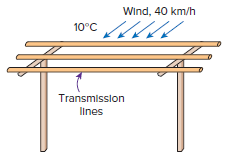
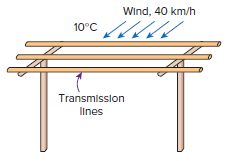
A 6-mm-diameter electrical transmission line carries an electric current of 50 A and has a resistance of 0.002 ohm/m length. Determine the surface temperature of the wire during a windy day when the air temperature is 10°C and the wind is blowing across the transmission line at 40 km/h. Wind,
Reconsider Prob. 19€“47. Using an appropriate software, investigate the effect of the wind velocity on the surface temperature of the wire. Let the wind velocity vary from 10 km/h to 80 km/h. Plot the surface temperature as a function of wind velocity and discuss the results. Wind, 40
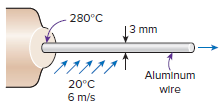
A long aluminum wire of diameter 3 mm is extruded at a temperature of 280°C. The wire is subjected to cross air flow at 20°C at a velocity of 6 m/s. Determine the rate of heat transfer from the wire to the air per meter length when it is first exposed to the air. 280°C |3 mm Aluminum 20°C
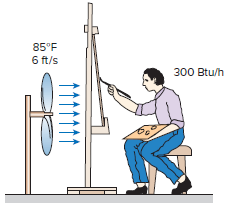
Consider a person who is trying to keep cool on a hot summer day by turning a fan on and exposing his entire body to air flow. The air temperature is 85°F and the fan is blowing air at a velocity of 6 ft/s. If the person is doing light work and generating sensible heat at a rate of 300 Btu/h,
A 0.4-W cylindrical electronic component with diameter 0.3 cm and length 1.8 cm and mounted on a circuit board is cooled by air flowing across it at a velocity of 240 m/min. If the air temperature is 35°C, determine the surface temperature of the component. For air properties evaluations assume a
Consider a 50-cm-diameter and 95-cm-long hot water tank. The tank is placed on the roof of a house. The water inside the tank is heated to 80°C by a flat-plate solar collector during the day. The tank is then exposed to windy air at 18°C with an average velocity of 40 km/h during the night.
Reconsider Prob. 19–53. Using an appropriate software, plot the temperature of the tank as a function of the cooling time as the time varies from 30 min to 5 h and discuss the results.Reconsider Prob.Consider a 50-cm-diameter and 95-cm-long hot water tank. The tank is placed on the roof of a
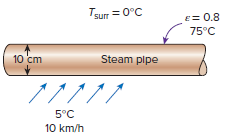
During a plant visit, it was noticed that a 12-m-long section of a 10-cm-diameter steam pipe is completely exposed to the ambient air. The temperature measurements indicate that the average temperature of the outer surface of the steam pipe is 75°C when the ambient temperature is 5°C. There
A 10-cm-diameter, 30-cm-high cylindrical bottle contains cold water at 3°C. The bottle is placed in windy air at 27°C. The water temperature is measured to be 11°C after 45 min of cooling. Disregarding radiation effects and heat transfer from the top and bottom surfaces, estimate the average
An average person generates heat at a rate of 84 W while resting. Assuming one-quarter of this heat is lost from the head and disregarding radiation, determine the average surface temperature of the head when it is not covered and is subjected to winds at 10°C and 25 km/h. The head can be
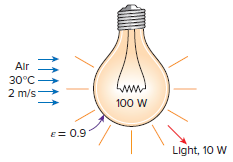
An incandescent lightbulb is an inexpensive but highly inefficient device that converts electrical energy into light. It converts about 10 percent of the electrical energy it consumes into light while converting the remaining 90 percent into heat. (A fluorescent lightbulb will give the same amount
A 1.8-m-diameter spherical tank of negligible thickness contains iced water at 0°C. Air at 25°C flows over the tank with a velocity of 7 m/s. Determine the rate of heat transfer to the tank and the rate at which ice melts. The heat of fusion of water at 0°C is 333.7 kJ/kg.
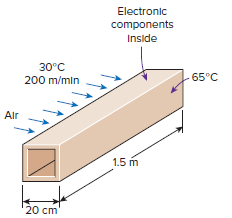
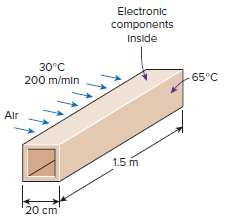
The components of an electronic system are located in a 1.5-m-long horizontal duct whose cross section is 20 cm × 20 cm. The components in the duct are not allowed to come into direct contact with cooling air, and thus are cooled by air at 30°C flowing over the duct with a velocity
Repeat Prob. 19€“61 for a location at 3000-m altitude where the atmospheric pressure is 70.12 kPa.
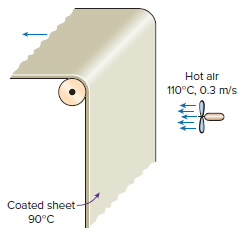
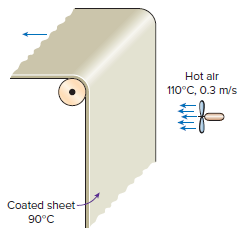
A coated sheet is being dried with hot air blowing in cross flow on the sheet surface. The surface temperature of the sheet is constant at 90°C, while the air velocity and temperature are 0.3 m/s and 110°C, respectively. The length of the sheet subjected to the blowing hot air is 1 m long.
Reconsider Prob. 19€“63. Using an appropriate software, evaluate the hot air velocity on the convection heat transfer coefficient. By varying the hot air velocity from 0.15 to 0.35 m/s, plot the convection heat transfer coefficient as a function of air velocity. Hot alr 110°C, 0.3 m/s
How is the thermal entry length defined for flow in a tube? In what region is the flow in a tube fully developed?
Consider laminar forced convection in a circular tube. Will the heat flux be higher near the inlet of the tube or near the exit? Why?
Consider turbulent forced convection in a circular tube. Will the heat flux be higher near the inlet of the tube or near the exit? Why?
What does the logarithmic mean temperature difference represent for flow in a tube whose surface temperature is constant? Why do we use the logarithmic mean temperature instead of the arithmetic mean temperature?
Consider fluid flow in a tube whose surface temperature remains constant. What is the appropriate temperature difference for use in Newton’s law of cooling with an average heat transfer coefficient?
What is the physical significance of the number of transfer units NTU = hAs /mcp? What do small and large NTU values tell about a heat transfer system?
Air enters a 25-cm-diameter 12-m-long underwater duct at 50°C and 1 atm at a mean velocity of 7 m/s, and is cooled by the water outside. If the average heat transfer coefficient is 85 W/m2∙K and the tube temperature is nearly equal to the water temperature of 10°C, determine the exit
Combustion gases passing through a 3-cminternal-diameter circular tube are used to vaporize waste water at atmospheric pressure. Hot gases enter the tube at 115 kPa and 250°C at a mean velocity of 5 m/s, and leave at 150°C. If the average heat transfer coefficient is 120 W/m2∙K and the inner
Repeat Prob. 19–72 for a heat transfer coefficient of 40 W/m2∙K.Combustion gases passing through a 3-cminternal-diameter circular tube are used to vaporize waste water at atmospheric pressure. Hot gases enter the tube at 115 kPa and 250°C at a mean velocity of 5 m/s, and leave at 150°C. If
Cooling water available at 10°C is used to condense steam at 30°C in the condenser of a power plant at a rate of 0.15 kg/s by circulating the cooling water through a bank of 5-m-long 1.2-cm-internal-diameter thin copper tubes. Water enters the tubes at a mean velocity of 4 m/s and leaves at a
Repeat Prob. 19–74 for steam condensing at a rate of 0.60 kg/s.Cooling water available at 10°C is used to condense steam at 30°C in the condenser of a power plant at a rate of 0.15 kg/s by circulating the cooling water through a bank of 5-m-long 1.2-cm-internal-diameter thin copper tubes. Water
Reconsider Prob. 19–74. Using an appropriate software, investigate the effect of the cooling water average (mean) velocity on the number of tubes needed to achieve the indicated heat transfer rate in the condenser. By varying the cooling water average velocity from 0.3 to 6 m/s, plot the number
Showing 500 - 600
of 1421
1
2
3
4
5
6
7
8
9
10
11
12
13
14
15
Step by Step Answers

 Get 50% OFF
Claim Now
Get 50% OFF
Claim Now