New Semester
Started
Get
50% OFF
Study Help!
--h --m --s
Claim Now
Question Answers
Textbooks
Find textbooks, questions and answers
Oops, something went wrong!
Change your search query and then try again
S
Books
FREE
Study Help
Expert Questions
Accounting
General Management
Mathematics
Finance
Organizational Behaviour
Law
Physics
Operating System
Management Leadership
Sociology
Programming
Marketing
Database
Computer Network
Economics
Textbooks Solutions
Accounting
Managerial Accounting
Management Leadership
Cost Accounting
Statistics
Business Law
Corporate Finance
Finance
Economics
Auditing
Tutors
Online Tutors
Find a Tutor
Hire a Tutor
Become a Tutor
AI Tutor
AI Study Planner
NEW
Sell Books
Search
Search
Sign In
Register
study help
physics
fundamentals thermal fluid
Fundamentals of Thermal-Fluid Sciences 5th edition Yunus A. Cengel, Robert H. Turner, John M. Cimbala - Solutions
Can all three modes of heat transfer occur simultaneously (in parallel) in a medium?
Can a medium involve(a) Conduction and convection,(b) Conduction and radiation,(c) Convection and radiation simultaneously? Give examples for the “yes” answers.
The deep human body temperature of a healthy person remains constant at 37°C while the temperature and the humidity of the environment change with time. Discuss the heat transfer mechanisms between the human body and the environment both in summer and winter, and explain how a person can keep
We often turn the fan on in summer to help us cool. Explain how a fan makes us feel cooler in the summer. Also explain why some people use ceiling fans also in winter.
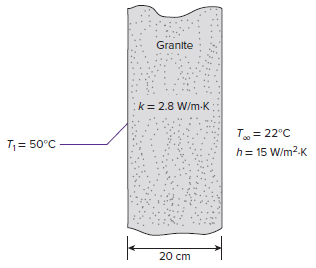
Consider a 20 cm thick granite wall with a thermal conductivity of 2.79 W/m·K. The temperature of the left surface is held constant at 50°C, whereas the right face is exposed to a flow of 22°C air with a convection heat transfer coefficient of 15 W/m2·K. Neglecting heat
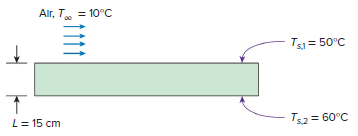
A solid plate, with a thickness of 15 cm and a thermal conductivity of 80 W/mˆ™K, is being cooled at the upper surface by air. The air temperature is 10°C, while the temperatures at the upper and lower surfaces of the plate are 50 and 60°C, respectively. Determine the convection
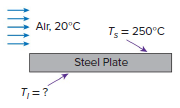
Air at 20°C with a convection heat transfer coefficient of 25 W/m2·K blows over a horizontal steel hot plate (k = 43 W/m·K). The surface area of the plate is 0.38 m2with a thickness of 2 cm. The plate surface is maintained at a constant temperature of Ts= 250°C and the plate
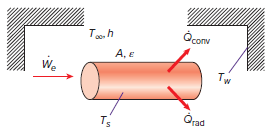
An electronic package with a surface area of 1 m2 placed in an orbiting space station is exposed to space. The electronics in this package dissipate all 1 kW of its power to the space through its exposed surface. The exposed surface has an emissivity of 1.0 and an absorptivity of 0.25. Determine
Consider steady heat transfer between two large parallel plates at constant temperatures of T1 = 290 K and T2 = 150 K that are L = 2 cm apart. Assuming the surfaces to be black (emissivity ε = 1), determine the rate of heat transfer between the plates per unit surface area assuming the gap between
Consider a person standing in a room at 18°C. Determine the total rate of heat transfer from this person if the exposed surface area and the skin temperature of the person are 1.7 m2 and 32°C, respectively, and the convection heat transfer coefficient is 5 W/m2·K. Take the emissivity of the skin
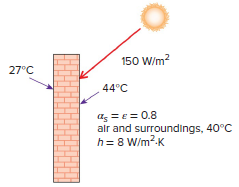
The inner and outer surfaces of a 25-cm-thick wall in summer are at 27°C and 44°C, respectively. The outer surface of the wall exchanges heat by radiation with surrounding surfaces at 40°C, and convection with ambient air also at 40°C with a convection heat transfer coefficient of 8
A 2-in-diameter spherical ball whose surface is maintained at a temperature of 170°F is suspended in the middle of a room at 70°F. If the convection heat transfer coefficient is 15 Btu/h·ft2·°F and the emissivity of the surface is 0.8, determine the total rate of heat transfer from the ball.
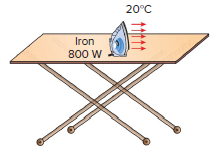
An 800-W iron is left on the iron board with its base exposed to the air at 20°C. The convection heat transfer coefficient between the base surface and the surrounding air is 35 W/m2·K. If the base has an emissivity of 0.6 and a surface area of 0.02 m2, determine the temperature of the
A 3-m-internal-diameter spherical tank made of 1-cm-thick stainless steel is used to store iced water at 0°C. The tank is located outdoors at 25°C. Assuming the entire steel tank to be at 0°C and thus the thermal resistance of the tank to be negligible, determine(a) The rate of heat transfer to
Solar radiation is incident on a = m2 solar absorber plate surface at a rate of 800 W/m2. Ninety-three percent of the solar radiation is absorbed by the absorber plate, while the remaining 7 percent is reflected away. The solar absorber plate has a surface temperature of 40°C with an emissivity of
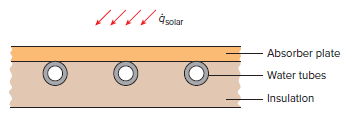
A flat-plate solar collector is used to heat water by having water flow through tubes attached at the back of the thin solar absorber plate. The absorber plate has a surface area of 2 m2with emissivity and absorptivity of 0.9. The surface temperature of the absorber is 35°C, and solar radiation
The roof of a house consists of a 22-cm-thick concrete slab (k = 2 W/m·K) that is 15 m wide and 20 m long. The emissivity of the outer surface of the roof is 0.9, and the convection heat transfer coefficient on that surface is estimated to be 15 W/m2·K. The inner surface of the roof is maintained
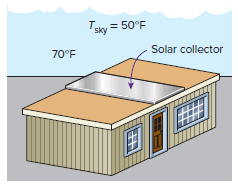
Consider a flat-plate solar collector placed horizontally on the flat roof of a house. The collector is 5 ft wide and 15 ft long, and the average temperature of the exposed surface of the collector is 100°F. The emissivity of the exposed surface of the collector is 0.9. Determine the rate of
An AISI 304 stainless steel sheet is going through an annealing process inside an electrically heated oven. The ambient air inside the oven is 600°C, while the surrounding surfaces of the oven are at a uniform temperature of 750°C. If the emissivity of the stainless steel sheet is 0.40 and the
Engine valves (cp = 440 J/kg·K and ρ = 7840 kg/m3) are to be heated from 40°C to 800°C in 5 min in the heat treatment section of a valve manufacturing facility. The valves have a cylindrical stem with a diameter of 8 mm and a length of 10 cm. The valve head and the stem may be assumed to be of
A cylindrical resistor element on a circuit board dissipates 1.2 W of power. The resistor is 2 cm long, and has a diameter of 0.4 cm. Assuming heat to be transferred uniformly from all surfaces, determine(a) The amount of heat this resistor dissipates during a 24-hour period,(b) The heat flux,(c)
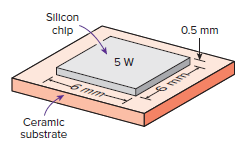
The heat generated in the circuitry on the surface of a silicon chip (k = 130 W/m·K) is conducted to the ceramic substrate to which it is attached. The chip is 6 mm × 6 mm in size and 0.5 mm thick and dissipates 5 W of power. Disregarding any heat transfer through the 0.5-mm
A 0.3-cm-thick, 12-cm-high, and 18-cm-long circuit board houses 80 closely spaced logic chips on one side, each dissipating 0.06 W. The board is impregnated with copper fillings and has an effective thermal conductivity of 16 W/m·K. All the heat generated in the chips is conducted across the
A 40-cm-long, 800-W electric resistance heating element with diameter 0.5 cm and surface temperature 120°C is immersed in 75 kg of water initially at 20°C. Determine how long it will take for this heater to raise the water temperature to 80°C. Also, determine the convection heat transfer
It is well known that wind makes the cold air feel much colder as a result of the wind chill effect that is due to the increase in the convection heat transfer coefficient with increasing air velocity. The wind chill effect is usually expressed in terms of the wind chill temperature (WCT), which is
An engine block with a surface area measured to be 0.95 m2 generates a power output of 50 kW with a net engine efficiency of 35%. The engine block operates inside a compartment at 157°C and the average convection heat transfer coefficient is 50 W/m2·K. If convection is the only heat transfer
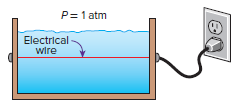
Consider an electrical wire submerged in liquid water at atmospheric conditions. The wire has a diameter of 1 mm and a length of 15 cm. The current through the wire is increased until the water reaches a temperature of 100°C. For this situation (boiling water) use an average value of the upper
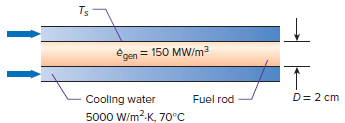
A cylindrical fuel rod of 2 cm in diameter is encased in a concentric tube and cooled by water. The fuel generates heat uniformly at a rate of 150 MW/m3. The convection heat transfer coefficient on the fuel rod is 5000 W/m2ˆ™K, and the average temperature of the cooling water,
Consider a person standing in a room maintained at 20°C at all times. The inner surfaces of the walls, floors, and ceiling of the house are observed to be at an average temperature of 12°C in winter and 23°C in summer. Determine the rates of radiation heat transfer between this person and the
Reconsider Prob. 16–84. Using an appropriate software, plot the rate of radiation heat transfer in winter as a function of the temperature of the inner surface of the room in the range of 8°C to 18°C. Discuss the results.Reconsider Prob.Consider a person standing in a room maintained at 20°C
Consider a 3-m × 3-m × 3-m cubical furnace whose top and side surfaces closely approximate black surfaces at a temperature of 1200 K. The base surface has an emissivity of ε = 0.4, and is maintained at 800 K. Determine the net rate of radiation heat transfer to the base surface from the top and
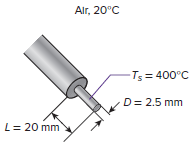
A soldering iron has a cylindrical tip of 2.5 mm in diameter and 20 mm in length. With age and usage, the tip has oxidized and has an emissivity of 0.80. Assuming that the average convection heat transfer coefficient over the soldering iron tip is 25 W/m2·K, and the surrounding air
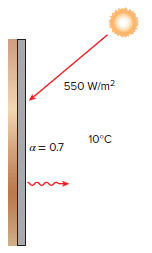
A thin metal plate is insulated on the back and exposed to solar radiation on the front surface. The exposed surface of the plate has an absorptivity of 0.7 for solar radiation. If solar radiation is incident on the plate at a rate of 550 W/m2and the surrounding air temperature is 10°C,
Consider a flat-plate solar collector placed on the roof of a house. The temperatures at the inner and outer surfaces of the glass cover are measured to be 33°C and 31°C, respectively. The glass cover has a surface area of 2.5 m2, a thickness of 0.6 cm, and a thermal conductivity of 0.7 W/m·K.
An electric heater with the total surface area of 0.25 m2and emissivity 0.75 is in a room where the air has a temperature of 20°C and the walls are at 10°C. When the heater consumes 500 W of electric power, its surface has a steady temperature of 120°C. Determine the temperature of the
Consider two surfaces pressed against each other. Now the air at the interface is evacuated. Will the thermal contact resistance at the interface increase or decrease as a result?
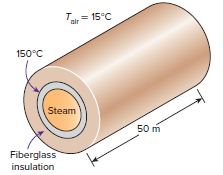
A 50-m-long section of a steam pipe whose outer diameter is 10 cm passes through an open space at 15°C. The average temperature of the outer surface of the pipe is measured to be 150°C. If the combined heat transfer coefficient on the outer surface of the pipe is 20 W/m2·K,
Consider heat conduction through a wall of thickness L and area A. Under what conditions will the temperature distributions in the wall be a straight line?
Consider heat conduction through a plane wall. Does the energy content of the wall change during steady heat conduction? How about during transient conduction? Explain.
What does the thermal resistance of a medium represent?
Can we define the convection resistance for a unit surface area as the inverse of the convection heat transfer coefficient?
Consider steady heat transfer through the wall of a room in winter. The convection heat transfer coefficient at the outer surface of the wall is three times that of the inner surface as a result of the winds. On which surface of the wall do you think the temperature will be closer to the
How is the combined heat transfer coefficient defined? What convenience does it offer in heat transfer calculations?
Why are the convection and the radiation resistances at a surface in parallel instead of being in series?
Consider steady one-dimensional heat transfer through a plane wall exposed to convection from both sides to environments at known temperatures T∞1 and T∞2 with known heat transfer coefficients h1 and h2. Once the rate of heat transfer has been evaluated, explain how you would determine the
Someone comments that a microwave oven can be viewed as a conventional oven with zero convection resistance at the surface of the food. Is this an accurate statement?
Consider two cold canned drinks, one wrapped in a blanket and the other placed on a table in the same room. Which drink will warm up faster?
Consider a surface of area A at which the convection and radiation heat transfer coefficients are hconv and hrad, respectively. Explain how you would determine (a) the single equivalent heat transfer coefficient (b) the equivalent thermal resistance. Assume the medium and the surrounding surfaces
How does the thermal resistance network associated with a single-layer plane wall differ from the one associated with a five-layer composite wall?
Consider steady one-dimensional heat transfer through a multilayer medium. If the rate of heat transfer is known, explain how you would determine the temperature drop across each layer.
Consider a window glass consisting of two 4-mmthick glass sheets pressed tightly against each other. Compare the heat transfer rate through this window with that of one consisting of a single 8-mm-thick glass sheet under identical conditions.
Consider a 3-m-high, 6-m-wide, and 0.3-m-thick brick wall whose thermal conductivity is k = 0.8 W/m·K. On a certain day, the temperatures of the inner and the outer surfaces of the wall are measured to be 14°C and 2°C, respectively. Determine the rate of heat loss through the wall on that day.
Consider a person standing in a room at 20°C with an exposed surface area of 1.7 m2. The deep body temperature of the human body is 37°C, and the thermal conductivity of the human tissue near the skin is about 0.3 W/m·K. The body is losing heat at a rate of 150 W by natural convection and
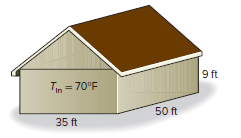
Consider an electrically heated brick house (k = 0.40 Btu/h·ft·°F) whose walls are 9 ft high and 1 ft thick. Two of the walls of the house are 50 ft long and the others are 35 ft long. The house is maintained at 70°F at all times while the temperature of the outdoors varies.
A 12-cm × 18-cm circuit board houses on its surface 100 closely spaced logic chips, each dissipating 0.06 W in an environment at 40°C. The heat transfer from the back surface of the board is negligible. If the heat transfer coefficient on the surface of the board is 10 W/m2·K, determine(a) The
A cylindrical resistor element on a circuit board dissipates 0.15 W of power in an environment at 40°C. The resistor is 1.2 cm long, and has a diameter of 0.3 cm. Assuming heat to be transferred uniformly from all surfaces, determine(a) The amount of heat this resistor dissipates during a 24-h
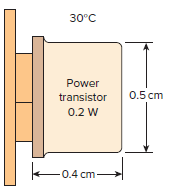
Consider a power transistor that dissipates 0.2 W of power in an environment at 30°C. The transistor is 0.4 cm long and has a diameter of 0.5 cm. Assuming heat to be transferred uniformly from all surfaces, determine(a) The amount of heat this resistor dissipates during a 24-h period, in
A 1.0 m × 1.5 m double-pane window consists of two 4-mm-thick layers of glass (k = 0.78 W/m·K) that are separated by a 5-mm air gap (kair = 0.025 W/m·K). The heat flow through the air gap is assumed to be by conduction. The inside and outside air temperatures are 20°C and 220°C, respectively,
Consider a 1.2-m-high and 2-m-wide glass window whose thickness is 6 mm and thermal conductivity is k = 0.78 W/m·K. Determine the steady rate of heat transfer through this glass window and the temperature of its inner surface for a day during which the room is maintained at 24°C while the
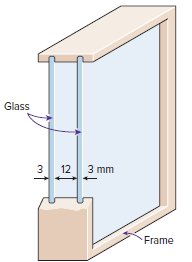
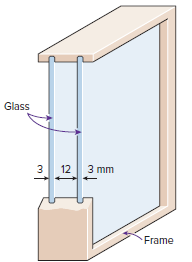
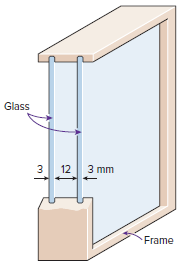
Consider a 1.2-m-high and 2-m-wide doublepane window consisting of two 3-mm-thick layers of glass (k = 0.78 W/m·K) separated by a 12-mm-wide stagnant air space (k = 0.026 W/m·K). Determine the steady rate of heat transfer through this double-pane window and the temperature of its
Repeat Prob. 17€“23, assuming the space between the two glass layers is evacuated.Data from 17-23Consider a 1.2-m-high and 2-m-wide doublepane window consisting of two 3-mm-thick layers of glass (k = 0.78 W/m · K) separated by a 12-mm-wide stagnant air space (k = 0.026
Reconsider Prob. 17€“23. Using an appropriate software, plot the rate of heat transfer through the window as a function of the width of air space in the range of 2 mm to 20 mm, assuming pure conduction through the air. Discuss the results.Data from 17-23Consider a 1.2-m-high and 2-m-wide
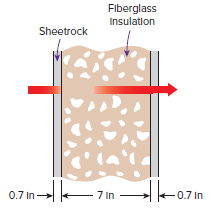
A wall is constructed of two layers of 0.7-in-thick sheetrock (k = 0.10 Btu/h·ft·°F), which is a plasterboard made of two layers of heavy paper separated by a layer of gypsum, placed 7 in apart. The space between the sheetrocks is filled with fiberglass insulation (k = 0.020
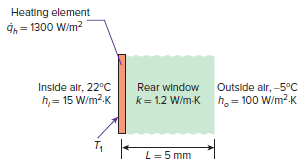
To defog the rear window of an automobile, a very thin transparent heating element is attached to the inner surface of the window. A uniform heat flux of 1300 W/m2is provided to the heating element for defogging a rear window with thickness of 5 mm. The interior temperature of the automobile is
To defrost ice accumulated on the outer surface of an automobile windshield, warm air is blown over the inner surface of the windshield. Consider an automobile windshield with thickness of 5 mm and thermal conductivity of 1.4 W/m·K. The outside ambient temperature is -10°C and the
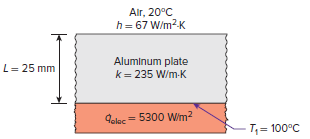
An aluminum plate of 25 mm thick (k = 235 W/m·K) is attached on a copper plate with thickness of 10 mm. The copper plate is heated electrically to dissipate a uniform heat flux of 5300 W/m2. The upper surface of the aluminum plate is exposed to convection heat transfer in a condition such
A 2-m × 1.5-m section of wall of an industrial furnace burning natural gas is not insulated, and the temperature at the outer surface of this section is measured to be 80°C. The temperature of the furnace room is 30°C, and the combined convection and radiation heat transfer coefficient at the
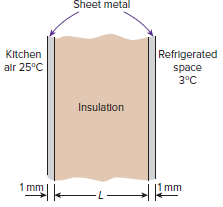
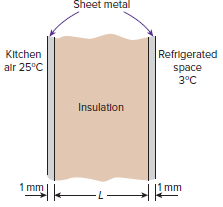
The wall of a refrigerator is constructed of fiberglass insulation (k = 0.035 W/m·K) sandwiched between two layers of 1-mm-thick sheet metal (k = 15.1 W/m·K). The refrigerated space is maintained at 3°C, and the average heat transfer coefficients at the inner and outer surfaces of
Reconsider Prob. 17€“32. Using an appropriate software, investigate the effects of the thermal conductivities of the insulation material and the sheet metal on the thickness of the insulation. Let the thermal conductivity vary from 0.02 W/m·K to 0.08 W/m·K for insulation and
Heat is to be conducted along a circuit board that has a copper layer on one side. The circuit board is 15 cm long and 15 cm wide, and the thicknesses of the copper and epoxy layers are 0.1 mm and 1.2 mm, respectively. Disregarding heat transfer from side surfaces, determine the percentages of heat
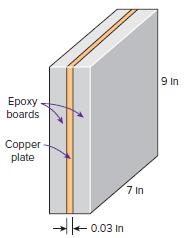
A 0.03-in-thick copper plate (k = 223 Btu/h·ft·°F) is sandwiched between two 0.15-in-thick epoxy boards (k = 0.15 Btu/h·ft·°F) that are 7 in × 9 in in size. Determine the effective thermal conductivity of the board along its 9-in-long side. What
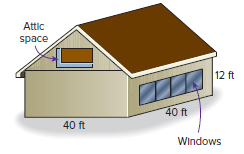
Consider a house whose walls are 12 ft high and 40 ft long. Two of the walls of the house have no windows, while each of the other two walls has four windows made of 0.25-in-thick glass (k = 0.45 Btu/h·ft·°F), 3 ft × 5 ft in size. The walls are certified to have an
What is thermal contact resistance? How is it related to thermal contact conductance?
Will the thermal contact resistance be greater for smooth or rough plain surfaces?
Explain how the thermal contact resistance can be minimized.
A wall consists of two layers of insulation pressed against each other. Do we need to be concerned about the thermal contact resistance at the interface in a heat transfer analysis or can we just ignore it?
A plate consists of two thin metal layers pressed against each other. Do we need to be concerned about the thermal contact resistance at the interface in a heat transfer analysis or can we just ignore it?
The thermal contact conductance at the interface of two 1-cm-thick copper plates is measured to be 18,000 W/m2·K. Determine the thickness of the copper plate whose thermal resistance is equal to the thermal resistance of the interface between the plates.
Two 5-cm-diameter, 15-cm-long aluminum bars (k = 176 W/m·K) with ground surfaces are pressed against each other with a pressure of 20 atm. The bars are enclosed in an insulation sleeve and, thus, heat transfer from the lateral surfaces is negligible. If the top and bottom surfaces of the two-bar
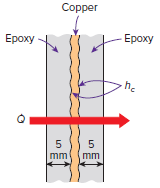
A 1-mm-thick copper plate (k = 386 W/m·K) is sandwiched between two 5-mm-thick epoxy boards (k = 0.26 W/m·K) that are 15 cm × 20 cm in size. If the thermal contact conductance on both sides of the copper plate is estimated to be 6000 W/m·K, determine the error
Two identical aluminum plates with thickness of 30 cm are pressed against each other at an average pressure of 1 atm. The interface, sandwiched between the two plates, is filled with glycerin. On the left outer surface, it is subjected to a uniform heat flux of 7800 W/m2 at a constant temperature
A two-layer wall is made of two metal plates, with surface roughness of about 25 mm, pressed together at an average pressure of 10 MPa. The first layer is a stainless steel plate with a thickness of 5 mm and a thermal conductivity of 14 W/m∙K. The second layer is an aluminum plate with a
An aluminum plate and a stainless steel plate are pressed against each other at an average pressure of 20 MPa. Both plates have a surface roughness of 2 μm. Determine the impact on the temperature drop at the interface if the surface roughness of the plates is increased by tenfold.
A thin electronic component with a surface area of 950 cm2 is cooled by having a heat sink attached on its top surface. The thermal contact conductance of the interface between the electronic component and the heat sink is 25,000 W/m2∙K. According to the manufacturer, the heat sink has combined
Consider an engine cover that is made with two layers of metal plates. The inner layer is stainless steel (k1 = 14 W/m∙K) with a thickness of 10 mm, and the outer layer is aluminum (k2 = 237 W/m∙K) with a thickness of 5 mm. Both metal plates have a surface roughness of about 23 mm. The aluminum
Inconel® refers to a class of nickel-chromium-based superalloys that are used in high-temperature applications, such as gas turbine blades. For further improvement in the performance of gas turbine engine, the outer blade surface is coated with ceramic-based thermal barrier coating (TBC). Consider
What are the two approaches used in the development of the thermal resistance network for two-dimensional problems?
The thermal resistance networks can also be used approximately for multidimensional problems. For what kind of multidimensional problems will the thermal resistance approach give adequate results?
When plotting the thermal resistance network associated with a heat transfer problem, explain when two resistances are in series and when they are in parallel.
A 10-cm-thick wall is to be constructed with 2.5-m-long wood studs (k = 0.11 W/m·K) that have a cross section of 10 cm × 10 cm. At some point the builder ran out of those studs and started using pairs of 2.5-m-long wood studs that have a cross section of 5 cm × 10 cm nailed to each other
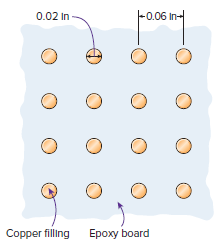
Consider a 6-in × 8-in epoxy glass laminate (k = 0.10 Btu/h·ft·°F) whose thickness is 0.05 in. In order to reduce the thermal resistance across its thickness, cylindrical copper fillings (k = 223 Btu/h·ft·°F) of 0.02 in diameter are to be planted
Clothing made of several thin layers of fabric with trapped air in between, often called ski clothing, is commonly used in cold climates because it is light, fashionable, and a very effective thermal insulator. So it is no surprise that such clothing has largely replaced thick and heavy
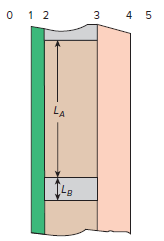
A typical section of a building wall is shown in Fig. P17€“58. This section extends in and out of the page and is repeated in the vertical direction. The wall support members are made of steel (k = 50 W/m·K). The support members are 8 cm (t23) × 0.5 cm (LB). The
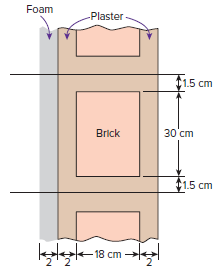
A 4-m-high and 6-m-wide wall consists of a long 18-cm × 30-cm cross section of horizontal bricks (k = 0.72 W/m·K) separated by 3-cm-thick plaster layers (k = 0.22 W/m·K). There are also 2-cm-thick plaster layers on each side of the wall, and a 2-cm-thick rigid foam (k =
A 12-m-long and 5-m-high wall is constructed of two layers of 1-cm-thick sheetrock (k = 0.17 W/m·K) spaced 16 cm by wood studs (k = 0.11 W/m·K) whose cross section is 16 cm × 5 cm. The studs are placed vertically 60 cm apart, and the space between them is filled with fiberglass insulation (k =
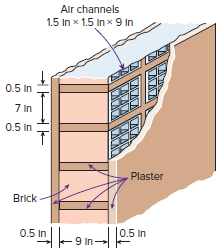
A 10-in-thick, 30-ft-long, and 10-ft-high wall is to be constructed using 9-in-long solid bricks (k = 0.40 Btu/h·ft·°F) of cross section 7 in × 7 in, or identical size bricks with nine square air holes (k = 0.015 Btu/h·ft·°F) that are 9 in long and
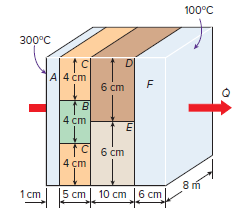
Consider a 5-m-high, 8-m-long, and 0.22-m-thick wall whose representative cross section is as given in the figure. The thermal conductivities of various materials used, in W/m·K, are kA= kF= 2, kB= 8, kC= 20, kD= 15, and kE= 35. The left and right surfaces of the wall are maintained at
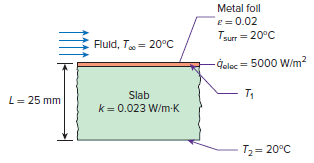
In an experiment to measure convection heat transfer coefficients, a very thin metal foil of very low emissivity (e.g., highly polished copper) is attached on the surface of a slab of material with very low thermal conductivity. The other surface of the metal foil is exposed to convection heat
What is an infinitely long cylinder? When is it proper to treat an actual cylinder as being infinitely long, and when is it not?
Can the thermal resistance concept be used for a solid cylinder or sphere in steady operation? Explain.
Showing 700 - 800
of 1421
1
2
3
4
5
6
7
8
9
10
11
12
13
14
15
Step by Step Answers

 Get 50% OFF
Claim Now
Get 50% OFF
Claim Now